
All Topics  
Denim

 
Denim

   Email Print
   Bookmark   Link


Denim


Denim is a rugged cotton
Cotton

Cotton is a soft, staple fiber that grows in a form known as a boll around the seeds of the cotton plant a shrub native to tropical and subtropical regions around the world, including the Americas, India and Africa....
 twill
Twill

Twill is a type of textile weaving with a pattern of diagonal parallel ribs.It is made by passing the weft thread over one or more Warp threads and then under two or more warp threads and so on, with a "step" or offset between rows to create the characteristic diagonal pattern....
 textile
Textile

A textile is a flexible material consisting of a network of natural or artificial fibres often referred to as thread or yarn. Yarn is produced by Spinning raw wool fibres, linen, cotton, or other material on a spinning wheel to produce long strands known as yarn....
, in which the weft
Weft

In weaving, weft or woof is the yarn which is drawn under and over parallel Warp yarns to create a textile. In North America, it is sometimes referred to as the "fill" or the "filling yarn", and in India, it is referred to as "baana"....
 passes under two (twi- "double") or more warp
Warp (weaving)

In weaving, the warp is the set of lengthwise yarns through which the weft is woven. Each individual warp thread in a fabric is called a warp end....
 fibers. This produces the familiar diagonal ribbing identifiable on the reverse of the fabric, which distinguishes denim from cotton duck
Cotton duck

Cotton duck , also simply duck, sometimes duck cloth or duck canvas, commonly called "canvas" outside of the textile industry, is a heavy, plain weave cotton Textile....
.


Discussion
Ask a question about 'Denim'
Start a new discussion about 'Denim'
Answer questions from other users
Full Discussion Forum


Recent Posts


Encyclopedia


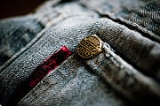
Closeup of Copper Rivet On Jeans
Denim is a rugged cotton
Cotton

Cotton is a soft, staple fiber that grows in a form known as a boll around the seeds of the cotton plant a shrub native to tropical and subtropical regions around the world, including the Americas, India and Africa....
 twill
Twill

Twill is a type of textile weaving with a pattern of diagonal parallel ribs.It is made by passing the weft thread over one or more Warp threads and then under two or more warp threads and so on, with a "step" or offset between rows to create the characteristic diagonal pattern....
 textile
Textile

A textile is a flexible material consisting of a network of natural or artificial fibres often referred to as thread or yarn. Yarn is produced by Spinning raw wool fibres, linen, cotton, or other material on a spinning wheel to produce long strands known as yarn....
, in which the weft
Weft

In weaving, weft or woof is the yarn which is drawn under and over parallel Warp yarns to create a textile. In North America, it is sometimes referred to as the "fill" or the "filling yarn", and in India, it is referred to as "baana"....
 passes under two (twi- "double") or more warp
Warp (weaving)

In weaving, the warp is the set of lengthwise yarns through which the weft is woven. Each individual warp thread in a fabric is called a warp end....
 fibers. This produces the familiar diagonal ribbing identifiable on the reverse of the fabric, which distinguishes denim from cotton duck
Cotton duck

Cotton duck , also simply duck, sometimes duck cloth or duck canvas, commonly called "canvas" outside of the textile industry, is a heavy, plain weave cotton Textile....
. Denim has been in American usage since the late eighteenth century. The word comes from the name of a sturdy fabric called serge
Serge

Serge is a type of twill textile that has diagonal lines or ridges on both sides, made with a two-up, two-down weave. The worsted variety is used in making military uniforms, suit s, great and trench coats....
, originally made in Nīmes
Nīmes

N?mes is a city in southern France. It is the capital of the Gard Departments of France. N?mes has a rich history, dating back to the Roman Empire, and it is a popular tourist destination....
, France, by the Andre family. Originally called serge de Nīmes
Nīmes

N?mes is a city in southern France. It is the capital of the Gard Departments of France. N?mes has a rich history, dating back to the Roman Empire, and it is a popular tourist destination....
, the name was soon shortened to denim. Denim was traditionally colored blue with indigo dye
Indigo dye

Indigo dye is dye with a distinctive blue color . The chemical compound that constitutes the indigo dye is called indican. The ancients extracted the natural dye from several species of plant as well as one of the two famous Hexaplex trunculus, but nearly all indigo produced today is Chemical synthesis....
 to make blue "jeans
Jeans

Jeans are pants, or trousers, made from denim. Mainly designed for work, they became popular among teenagers starting in the 1950s. Historic brands include Levi's and Wrangler Jeans....
," though "jean" then denoted a different, lighter cotton textile; the contemporary use of jean comes from the French word for Genoa
Genoa

Genoa is a city and an important seaport in northern Italy, the capital of the Province of Genoa and of the region of Liguria. The city has a population of about 610,000 and the urban area has a population of about 900,000....
, Italy
Italy

Italy , officially the Italian Republic , is a country located on the Italian Peninsula in Southern Europe and on the two largest islands in the Mediterranean Sea, Sicily and Sardinia....
 (Gźnes), where the first denim trousers were made.

A similarly woven traditional American cotton textile is the diagonal warp-striped hickory cloth that was once associated with railroadmen's overalls, in which blue or black contrasting with undyed white threads form the woven pattern. Hickory cloth was characterized as being as rugged as hickory
Hickory

Trees in the genus Carya are commonly known as Hickory. The genus includes 17?19 species of deciduous trees with pinnately compound leaf and large nut ....
 wood—not to mention the fact that it was deemed to be worn mainly by "hick
Hick

Hick may refer to:?noun 1. an unsophisticated, boorish, and provincial person; rube.?adjective 2. pertaining to or characteristic of hicks: hick ideas....
s"—although neither may be the origin of that term [from a nickname for "Richard"]. Records of a group of New Yorkers headed for the California gold fields in 1849 show that they took along four "hickory shirts" apiece. Hickory cloth would later furnish the material for some "fatigue" pantaloons and shirts in the American Civil War
American Civil War

The American Civil War , also known as the War Between the States and several Naming the American Civil War, was a civil war in the United States....
.

The word dungarees, to identify heavy cotton pants such as overalls, can be traced to a thick cotton country-made cloth, Dongari Kapar, which was sold in the quarter contiguous to the Dongari Killa, the fort of what was then known as Bombay (). The word entered English with just this meaning in 1696 (OED). Dongri Fort was rebuilt in 1769 as Fort George, Bombay, where the first cotton mill was established in 1854. Dyed in indigo, the traditional cloth was used by Portuguese sailors and cut wide so that the legs could be swiftly rolled up when necessary. Thus, dungarees have a separate history.

Dry denim


Dry or raw denim, as opposed to washed denim, is a denim fabric
Textile

A textile is a flexible material consisting of a network of natural or artificial fibres often referred to as thread or yarn. Yarn is produced by Spinning raw wool fibres, linen, cotton, or other material on a spinning wheel to produce long strands known as yarn....
 that is not washed after being dyed during its production. Over time, denim will generally fade, which is often considered desirable.

Most denim is washed after being crafted into an article of clothing in order to make it softer and to eliminate any shrinkage which could cause an item to not fit after the owner washes it. In addition to being washed, non-dry denim is sometimes artificially "distressed" to achieve a worn-in look.

Much of the appeal of dry denim lies in the fact that with time the fabric will fade in a manner similar to factory distressed denim. With dry denim, however, such fading is affected by the body of the person who wears the jeans and the activities of their daily life. This creates what many enthusiasts feel to be a more natural, unique look than pre-distressed denim.

To facilitate the natural distressing process, some wearers of dry denim will often abstain from washing their jeans for more than six months, though it is not a necessity for fading. Often, enthusiasts will just hang their unwashed denim to help get rid of the smell.

Selvage denim


Selvage denim (also called selvedge denim) is a type of denim which forms a clean natural edge that does not unravel. It is commonly presented in the unwashed or raw state. Typically, the selvage edges will be located along the out-seam of the pants, making it visible when cuffs are worn. Although selvage denim is not completely synonymous with unwashed denim, the presence of selvage typically implies that the denim used is a higher quality.

The word "selvage
Selvage

In a weaving fabric, the selvage is the uncut edge of the fabric which is on the right- and left-hand edges as it comes out of the loom. As such it is 'finished' and will not fray because the weft threads double back on themselves....
" comes from the phrase "self-edge", the natural edge of a roll of fabric. As applied to denim
Denim

Denim is a rugged cotton twill textile, in which the weft passes under two or more Warp fibers. This produces the familiar diagonal ribbing identifiable on the reverse of the fabric, which distinguishes denim from cotton duck....
, it means that which is made on old-style shuttle looms. These looms weave fabric with one continuous cross thread (the weft
Weft

In weaving, weft or woof is the yarn which is drawn under and over parallel Warp yarns to create a textile. In North America, it is sometimes referred to as the "fill" or the "filling yarn", and in India, it is referred to as "baana"....
) that is passed back and forth all the way down the length of the bolt. As the weft loops back into the edge of the denim it creates this “self-edge” or Selvage. Selvage is desirable because the edge can’t fray like lower grade denims that have separate wefts which leave an open edge that must be stitched. Shuttle looming is a more time-consuming weaving process that produces denim of a tighter weave resulting in a heavier weight fabric that lasts.

Shuttle loom
Shuttle loom

Shuttle LoomsThe major components of the loom are the warp beam, heddles, harnesses, Shuttle , reed and takeup roll. In the loom, yarn processing includes shedding, picking, battening and taking-up operations....
s weave a more narrow piece of fabric, and thus a longer piece of fabric is required to make a pair of jeans (approximately 3 yards). To maximize yield, traditional jean makers use the fabric all the way to the selvage edge. When the cuff is turned up the two selvage edges, where the denim is sewn together, can be seen. The selvage edge is usually stitched with colored thread: green, white, brown, yellow, and red (red is the most common). Fabric mills used these colors to differentiate between fabrics.

Most selvage jeans today are dyed with synthetic indigo, but natural indigo dye
Indigo dye

Indigo dye is dye with a distinctive blue color . The chemical compound that constitutes the indigo dye is called indican. The ancients extracted the natural dye from several species of plant as well as one of the two famous Hexaplex trunculus, but nearly all indigo produced today is Chemical synthesis....
 is available in smaller niche denim labels such as Evisu. Though they are supposed to have the same chemical makeup, there are more impurities in the natural indigo dye. Loop dying machines feed a rope of cotton yarn through vats of indigo dye and then back out. The dye is allowed to oxidize before the next dip. Multiple dips create a deep dark indigo blue.

In response to increased demand for jeans in the 1950's, American denim manufacturers replaced the old shuttle style looms with modern projectile looms. The new looms produced fabric faster and wider (60-inches or wider), though lighter and less durable. Synthetic dyeing techniques along with post-dye treatments were introduced to control shrink and twist.

Color Denim


Denim Fabric Dyeing is divided into two categories; Indigo Dyeing and second is Sulphur Dyeing. Indigo Dyeing is traditional blue colors or shades similar to blue colors.

Sulphur Dyeing (also called Color Denim) is done for specially black colors and other colors like Pink, Grey, Rust, Mustard, Green and Red.

Uses of denim


Jeans


Fits and types of jeans
  • Baggy
    Baggy

    Baggy was a British dance-oriented music genre popular in the early 1990s.The scene was extremely influenced by Madchester, although the scene was not geographically confined to Manchester....
  • Bootcut
  • Boyfriend
    Boyfriend (fashion)

    In fashion design, primarily in ready-to-wear lines, boyfriend is any style for women's clothing that was modified from a corresponding men's garment....
  • Carpenter
    Carpenter jeans

    Carpenter jeans are jeans with many pockets and loops which can be used to carry objects such as tools and are often loose around the leg to be able to accommodated the affixed items....
  • Cropped
  • Flare
  • Embroidered
  • High-waisted
  • Loose
    Loose

    Loose may refer to:in music*Loose , a 2006 album by Nelly Furtado**Loose Mini DVD, a 2007 DVD by Nelly Furtado**Loose the Concert, a 2007 live DVD by Nelly Furtado...
  • Relaxed
  • Skinny
    Skinny jeans

    Slim-fit pants or skinny jeans have a snug fit through the legs and end in a small leg opening. Other names for this style include carrot leg pants, cigarette pants, drainpipes, peg leg pants, pencil pants, skinny pants, slimjims, tapered pants, or ice-cream cone pants....
  • Straight-leg
  • Wide leg
    Wide leg jeans

    Wide leg jeans are a style of clothing popularized in the mid-to-late 1990s, especially by men trying to achieve an "alternative" style. For men, the style is also called hip-hop clothing and remains popular with this subculture in 2008....
  • Drain Pipe


Denim clothing

Besides trousers, denim can also be made into:
  • Overall
    Overall

    An overall is a type of garment which is usually used as protective clothing when working. Some people call an overall a "pair of overalls" by analogy with "pair of trousers"....
    s
  • Shorts
    Shorts

    Shorts are a garment worn by both men and women over their pelvic area, circling the waist, and covering the upper part of the upper legs or more, sometimes extending as far as mid-calf, but not covering the entire length of the leg, either as outer or undergarment....
  • Dress
    Dress

    A Dress is a garment consisting of a skirt with an attached bodice or with a matching bodice giving the effect of a one-piece garment.Dress may also refer to:...
    es
  • Denim skirts
  • Shirt
    Shirt

    A shirt is a cloth garment for the upper body. Originally an item of Undergarment worn exclusively by men, it has become in American English a catch-all term for almost any upper-body garment other than outerwear such as sweaters or Coat , or undergarments such as brassiere ....
    s
  • Jacket
    Jacket

    A jacket is a type of sleeved Hip - or waist-length garment for the upper body. For clothing older than the 1850s, a distinction is often maintained with a coat , but in many instances the terms are now interchangeable....
    s
  • Bag
    Bag

    A bag is a non-Stiffness or semi-rigid container, made of paper, cloth, plastic, leather, or some other flexible material.A bag is used for packaging and/or carrying items....
    s
  • Capri
    Capri pants

    Capri Pants are a style of pants usually worn in warm weather. They are designed to end mid-Calf muscle or just below the calf. Though capri pants are most popular with women, they have become popular among men in many countries, especially in Europe and Latin America....
    s
  • Cut offs
  • Daisy Dukes
    Daisy Dukes

    Daisy Dukes are extremely short, form-fitting or cut-off denim shorts, usually portrayed as being worn by young women and girls in the American South....
  • shoe
    Shoe

    A shoe is an item of footwear evolved at first to protect the human foot and later, additionally, as an item of decoration in itself. The foot contains more bones than any other single part of the human body, and has human evolution over hundreds of thousands of years in relation to vastly varied terrain and climate....
    s
  • hat
    Hat

    A hat is a headcovering. It may be worn for protection against the elements, for religious reasons, for safety, or as a fashion accessory. In the past, hats were an indicator of social status....
    s
  • sock
    Sock

    A sock is a knitted or woven type of hosiery garment for enclosing the human foot. Socks are designed to:* ease chafing between the foot and footwear...
    s


Denim Jewelry

Silver Jewelry with accents of denim.
  • Denim jewelry


Denim Remnant


Bonded Logic UltraTouch is a home insulation, to replace fiberglass, made from the remnants of fabric used in making blue jeans.

Jeans Beetle

Between 1973 and 1975 Volkswagen produced the Jeans Beetle
Volkswagen Beetle

The Volkswagen Type 1 is an economy car produced by the Germany auto maker Volkswagen from 1938 until 2003. The car was originally known as K?fer, the German language word for "beetle," from which the popular English nickname originates....
 which had all-denim trim. They also repeated this concept in some later models.

See also

  • Denim (color)
    Denim (color)

    Denim is a shade of blue that resembles the shade of blue used in Denim.Crayola created this color in 1993 as one of the new 16 colors...
  • Designer jeans
    Designer jeans

    Designer jeans are high-fashion jeans. The Nakash brothers are generally credited with starting the trend when they launched their Jordache line of jeans in 1978....
  • Jeans
    Jeans

    Jeans are pants, or trousers, made from denim. Mainly designed for work, they became popular among teenagers starting in the 1950s. Historic brands include Levi's and Wrangler Jeans....
  • Stone washing
    Stone washing

    Stone washing is a textiles manufacturing process typically utilized by the fashion industry, in order to give a newly-assembled cloth garment a worn-out appearance....


External links