

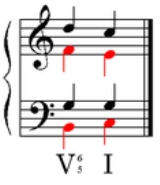
Semitone

Encyclopedia
A semitone, also called a half step or a half tone
, is the smallest musical interval commonly used in Western tonal music, and it is considered the most dissonant when sounded harmonically.
It is defined as the interval between two adjacent notes in a 12-tone scale
(e.g. from C to C). This implies that its size is exactly or approximately equal to 100 cents
, a twelfth of an octave
.
In a 12-note approximately equally divided scale, any interval can be defined in terms of an appropriate number of semitones (e.g. a whole tone or major second is 2 semitones wide, a major third
4 semitones, and a perfect fifth
7 semitones.
In music theory
, a distinction is made between a diatonic semitone, or minor second (an interval encompassing two staff positions, e.g. from C to D) and a chromatic semitone or augmented unison (an interval between two notes at the same staff position, e.g. from C to C). These are enharmonically equivalent
when twelve-tone equal temperament
is used, but are not the same thing in meantone temperament
, where the diatonic semitone is distinguished from and larger than the chromatic semitone (augmented unison.) See Interval (music)#Number for more details about this terminology.
In twelve-tone equal temperament all semitones are equal in size (100 cents). In other tuning systems, "semitone" refers to a family of intervals that may vary both in size and name. In Pythagorean tuning
, seven semitones out of twelve are diatonic, with ratio 256:243 or 90.2 cents (Pythagorean limma), and the other five are chromatic, with ratio 2187:2048 or 113.7 cents (Pythagorean apotome); they differ by the Pythagorean comma
of ratio 531441:524288 or 23.5 cents. In quarter-comma meantone
, seven of them are diatonic, and 117.1 cents wide, while the other five are chromatic, and 76.0 cents wide; they differ by the lesser diesis
of ratio 128:125 or 41.1 cents. 12-tone scales tuned in just intonation
typically define three or four kinds of semitones. For instance, Asymmetric five-limit tuning
yields chromatic semitones with ratios 25:24 (70.7 cents) and 135:128 (92.2 cents), and diatonic semitones with ratios 16:15 (111.7 cents) and 27:25 (133.2 cents). For further details, see below.
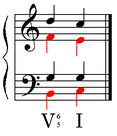 The minor second occurs in the major scale
, between the third and fourth degree, (mi (E) and fa (F) in C major), and between the seventh and eighth degree (ti (B) and do (C) in C major). It is also called the diatonic semitone because it occurs between steps in the diatonic scale
. The minor second is abbreviated m2 (or −2). Its inversion is the major seventh
(M7, or +7).
. Here, middle C
is followed by D, which is a tone 100 cents
sharper than C, and then by both tones together.
Melodically
, this interval is very frequently used, and is of particular importance in cadences
. In the perfect
and deceptive cadences it appears as a resolution of the leading-tone
to the tonic
. In the plagal cadence, it appears as the falling of the subdominant
to the mediant
. It also occurs in many forms of the imperfect cadence, wherever the tonic falls to the leading-tone.
Harmonically
, the interval usually occurs as some form of dissonance
or a nonchord tone
that is not part of the functional harmony
. It may also appear in inversions of a major seventh chord
, and in many added tone chord
s.
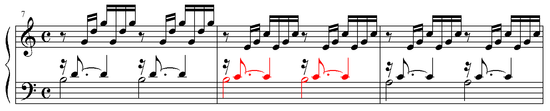
 In unusual situations, the minor second can add a great deal of character to the music. For instance, Frédéric Chopin
's Étude Op. 25, No. 5
opens with a melody accompanied by a line that plays fleeting minor seconds. These are used to humorous and whimsical effect, which contrasts with its more lyrical middle section. This eccentric dissonance has earned the piece its nickname: the "wrong note" étude. This kind of usage of the minor second appears in many other works of the Romantic
period, such as Modest Mussorgsky
's Ballet of the Unhatched Chicks
. More recently, the music to the movie Jaws exemplifies the minor second.
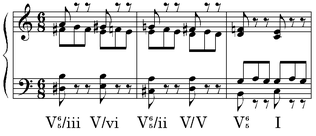 The augmented unison, the interval produced by the augmentation
, or widening by one-half step, of the perfect unison, does not occur between diatonic scale steps, but instead between a scale step and a chromatic alteration of the same step. It is also called a chromatic semitone. The augmented unison is abbreviated A1, or aug 1. Its inversion is the diminished octave
(d8, or dim 8). The augmented unison is also the inversion of the augmented octave, because the interval of the diminished unison does not exist. This is because a unison is always made larger when one note of the interval is changed with an accidental.
Melodically
, an augmented unison very frequently occurs when proceeding to a chromatic chord, such as a secondary dominant
, a diminished seventh chord
, or an augmented sixth chord
. Its use is also often the consequence of a melody proceeding in semitones, regardless of harmonic underpinning, e.g. D, D, E, F, F. (Restricting the notation to only minor seconds is impractical, as the same example would have a rapidly increasing number of accidentals, written enharmonically as D, E, F, G, A).
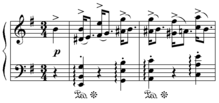
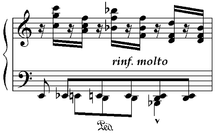 Harmonically
, augmented unisons are quite rare in tonal repertoire. In the example to the right, Liszt
had written an E against an E in the bass. Here E was preferred to a D to make the tone's function clear as part of an F dominant seventh chord, and the augmented unison is the result of superimposing this harmony upon an E pedal point
.
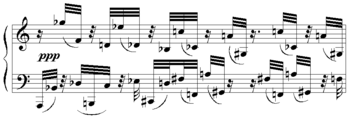
In addition to this kind of usage, harmonic augmented unisons are frequently written in modern works involving tone clusters, such as Iannis Xenakis
' Evryali for piano solo.
, and it has always had a place in the diatonic scales of Western music since. The various modal
scales of medieval music
theory were all based upon this diatonic pattern of tones and semitones.
Though it would later become an integral part of the musical cadence
, in the early polyphony of the 11th century this was not the case. Guido of Arezzo
suggested instead in his Micrologus
other alternatives: either proceeding by whole tone from a major second
to a unison, or an occursus having two notes at a major third
move by contrary motion toward a unison, each having moved a whole tone.
“As late as the 13th century the half step was experienced as a problematic interval not easily understood, as the irrational [sic] remainder between the perfect fourth and the ditone
 .” In a melodic half step, no “tendency was perceived of the lower tone toward the upper, or of the upper toward the lower. The second tone was not taken to be the ‘goal’ of the first. Instead, the half step was avoided in clausula
e because it lacked clarity as an interval.”
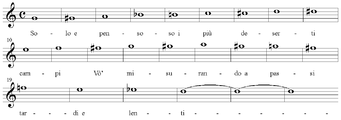 However, beginning in the 13th century cadences
begin to require motion in one voice by half step and the other a whole step in contrary motion. These cadences would become a fundamental part of the musical language, even to the point where the usual accidental accompanying the minor second in a cadence was often omitted from the written score (a practice known as musica ficta
). By the 16th century, the semitone had become a more versatile interval, sometimes even appearing as an augmented unison in very chromatic passages. Semantically, in the 16th century the repeated melodic semitone became associated with weeping, see: passus duriusculus
, lament bass
, and pianto
.
By the Baroque era
(1600 to 1750), the tonal
harmonic framework was fully formed, and the various musical functions of the semitone were rigorously understood. Later in this period the adoption of well temperament
s for instrumental tuning and the more frequent use of enharmonic
equivalences increased the ease with which a semitone could be applied. Its function remained similar through the Classical
period, and though it was used more frequently as the language of tonality became more chromatic in the Romantic
period, the musical function of the semitone did not change.
In the 20th century, however, composers such as Arnold Schoenberg
, Béla Bartók
, and Igor Stravinsky
sought alternatives or extensions of tonal harmony, and found other uses for the semitone. Often the semitone was exploited harmonically as a caustic dissonance, having no resolution. Some composers would even use large collections of harmonic semitones (tone clusters) as a source of cacophony in their music (e.g. the early piano works of Henry Cowell
). By now, enharmonic equivalence was a commonplace property of equal temperament
, and instrumental use of the semitone was not at all problematic for the performer. The composer was free to write semitones wherever he wished.
system used. Meantone temperament
s have two distinct types of semitones, but in the exceptional case of Equal temperament
, there is only one. The unevenly distributed well temperament
s contain many different semitones. Pythagorean tuning
, similar to meantone tuning, has two, but in other systems of just intonation there are many more possibilities.
systems, there are two different semitones. This results because of the break in the circle of fifths
that occurs in the tuning system: diatonic semitones derive from a chain of five fifths that does not cross the break, and chromatic semitones come from one that does.
The chromatic semitone is usually smaller than the diatonic. In the common quarter-comma meantone
, tuned as a cycle of tempered
fifths
from E to G, the chromatic and diatonic semitones are 76.0 and 117.1 cents wide respectively.
Extended meantone temperaments with more than 12 notes still retain the same two semitone sizes, but there is more flexibility for the musician about whether to use an augmented unison or minor second. 31-tone equal temperament is the most flexible of these, which makes an unbroken circle of 31 fifths, allowing the choice of semitone to be made for any pitch.
is a form of meantone tuning in which the diatonic and chromatic semitones are exactly the same, because its circle of fifths has no break. Each semitone is equal to one twelfth of an octave. This is a ratio of 21/12 (approximately 1.05946), or 100 cents, and is 11.7 cents narrower than the 16:15 ratio (its most common form in just intonation
, discussed below).
All diatonic intervals can be expressed as an equivalent number of semitones. For instance a whole tone
equals two semitones.
There are many approximations, rational
or otherwise, to the equal-tempered semitone. To cite a few:
For more examples, see Pythagorean and Just systems of tuning below.
, but the characteristic they all share is that their semitones are of an uneven size. Every semitone in a well temperament has its own interval (usually close to the equal-tempered version of 100 cents), and there is no clear distinction between a diatonic and chromatic semitone in the tuning. Well temperament was constructed so that enharmonic
equivalence could be assumed between all of these semitones, and whether they were written as a minor second or augmented unison did not effect a different sound. Instead, in these systems, each key
had a slightly different sonic color or character, beyond the limitations of conventional notation.
is a broken circle of fifths
. This creates two distinct semitones, but because Pythagorean tuning is also a form of 3-limit just intonation
, these semitones are rational. Also, unlike most meantone temperaments, the chromatic semitone is larger than the diatonic.
The Pythagorean diatonic semitone has a ratio of 256/243 , and is often called the Pythagorean limma. It is also sometimes called the Pythagorean minor semitone. It is about 90.2 cents.
It can be thought of as the difference between three octaves and five just fifths
, and functions as a diatonic semitone in a Pythagorean tuning
.
The Pythagorean chromatic semitone has a ratio of 2187/2048 . It is about 113.7 cents
. It may also be called the Pythagorean apotome or the Pythagorean major semitone. (See Pythagorean interval
.)
It can be thought of as the difference between four perfect octave
s and seven just fifths
, and functions as a chromatic semitone in a Pythagorean tuning
.
The Pythagorean limma and Pythagorean apotome are enharmonic
equivalents (chromatic semitones) and only a Pythagorean comma
apart, in contrast to diatonic and chromatic semitones in meantone temperament
and 5-limit just intonation
.
typically corresponds to a pitch ratio
of 16:15 or 1.0666... (approximately 111.7 cent
s), called the just diatonic semitone. This is a practical just semitone, since it is the difference between a perfect fourth
and major third
( ).
).
An augmented unison in just intonation is another semitone of 25:24 or 1.0416... (approximately 70.7 cents). It is the difference between a 5:4 major third and a 6:5 minor third. Composer Ben Johnston uses a sharp an accidental to indicate a note is raised 70.7 cents, or a flat to indicate a note is lowered 70.7 cents.
Two other kinds of semitones are produced by 5-limt tuning. A chromatic scale
defines 12 semitones as the 12 intervals between the 13 adjacent notes forming a full octave (e.g. from C4 to C5). The 12 semitones produced by a commonly used version of 5-limit tuning have four different sizes, and can be classified as follows:
The most frequently occurring semitones are the just ones (S3 and S1): S3 occurs six times out of 12, S1 three times, S2 twice, and S4 only once.
The smaller chromatic and diatonic semitones differ from the larger by the syntonic comma
(81:80 or 21.5 cents). The smaller and larger chromatic semitones differ from the respective diatonic semitones by the same 128:125 diesis as the above meantone semitones. Finally, while the inner semitones differ by the diaschisma
(2048:2025 or 19.6 cents), the outer differ by the greater diesis (648:625 or 62.6 cents).
Other ratios may function as a minor second. In 7-limit there is the septimal diatonic semitone of 15:14 available between the 5-limit major seventh
(15:8) and the 7-limit minor seventh (7:4). There is also a smaller septimal chromatic semitone
of 21:20 between a septimal minor seventh and a fifth (21:8) and an octave and a major third (5:2). Both are more rarely used than their 5-limit neighbours, although the former was often implemented by theorist Henry Cowell
, while Harry Partch
used the latter as part of his 43-tone scale
.
Under 11-limit tuning, there is a fairly common undecimal neutral second
(12:11) , but it lies on the boundary between the minor and major second
(150.6 cents). In just intonation there are infinitely many possibilities for intervals that fall within the range of the semitone (e.g. the Pythagorean semitones mentioned above), but most of them are impractical.
In 17-limit just intonation, the major diatonic semitone is 15:14 or 119.4 cents , and the minor diatonic semitone is 17:16 or 105.0 cents.
Though the names diatonic and chromatic are often used for these intervals, their musical function is not the same as the two meantone semitones. For instance, 15:14 would usually be written as an augmented unison, functioning as the chromatic counterpart to a diatonic 16:15. These distinctions are highly dependent on the musical context, and just intonation is not particularly well suited to chromatic usage (diatonic semitone function is more prevalent).
distinguishes between the chromatic and diatonic semitones; in this tuning, the chromatic semitone is one step of the scale , and the diatonic semitone is two . 31-tone equal temperament
also distinguishes between these two intervals, which become 2 and 3 steps of the scale, respectively. 53-ET
has an even closer match to the two semitones with 3 and 5 steps of its scale while 72-ET
uses 4 and 7 steps of its scale.
In general, because the two semitones can be viewed as the difference between major and minor thirds, and the difference between major thirds and perfect fourths, tuning systems that match these just intervals closely will also distinguish between the two types of semitones and match their just intervals closely.
Major second
In Western music theory, a major second is a musical interval spanning two semitones, and encompassing two adjacent staff positions . For example, the interval from C to D is a major second, as the note D lies two semitones above C, and the two notes are notated on adjacent staff postions...
, is the smallest musical interval commonly used in Western tonal music, and it is considered the most dissonant when sounded harmonically.
It is defined as the interval between two adjacent notes in a 12-tone scale
Chromatic scale
The chromatic scale is a musical scale with twelve pitches, each a semitone apart. On a modern piano or other equal-tempered instrument, all the half steps are the same size...
(e.g. from C to C). This implies that its size is exactly or approximately equal to 100 cents
Cent (music)
The cent is a logarithmic unit of measure used for musical intervals. Twelve-tone equal temperament divides the octave into 12 semitones of 100 cents each...
, a twelfth of an octave
Octave
In music, an octave is the interval between one musical pitch and another with half or double its frequency. The octave relationship is a natural phenomenon that has been referred to as the "basic miracle of music", the use of which is "common in most musical systems"...
.
In a 12-note approximately equally divided scale, any interval can be defined in terms of an appropriate number of semitones (e.g. a whole tone or major second is 2 semitones wide, a major third
Major third
In classical music from Western culture, a third is a musical interval encompassing three staff positions , and the major third is one of two commonly occurring thirds. It is qualified as major because it is the largest of the two: the major third spans four semitones, the minor third three...
4 semitones, and a perfect fifth
Perfect fifth
In classical music from Western culture, a fifth is a musical interval encompassing five staff positions , and the perfect fifth is a fifth spanning seven semitones, or in meantone, four diatonic semitones and three chromatic semitones...
7 semitones.
In music theory
Music theory
Music theory is the study of how music works. It examines the language and notation of music. It seeks to identify patterns and structures in composers' techniques across or within genres, styles, or historical periods...
, a distinction is made between a diatonic semitone, or minor second (an interval encompassing two staff positions, e.g. from C to D) and a chromatic semitone or augmented unison (an interval between two notes at the same staff position, e.g. from C to C). These are enharmonically equivalent
Enharmonic
In modern musical notation and tuning, an enharmonic equivalent is a note , interval , or key signature which is equivalent to some other note, interval, or key signature, but "spelled", or named, differently...
when twelve-tone equal temperament
Equal temperament
An equal temperament is a musical temperament, or a system of tuning, in which every pair of adjacent notes has an identical frequency ratio. As pitch is perceived roughly as the logarithm of frequency, this means that the perceived "distance" from every note to its nearest neighbor is the same for...
is used, but are not the same thing in meantone temperament
Meantone temperament
Meantone temperament is a musical temperament, which is a system of musical tuning. In general, a meantone is constructed the same way as Pythagorean tuning, as a stack of perfect fifths, but in meantone, each fifth is narrow compared to the ratio 27/12:1 in 12 equal temperament, the opposite of...
, where the diatonic semitone is distinguished from and larger than the chromatic semitone (augmented unison.) See Interval (music)#Number for more details about this terminology.
In twelve-tone equal temperament all semitones are equal in size (100 cents). In other tuning systems, "semitone" refers to a family of intervals that may vary both in size and name. In Pythagorean tuning
Pythagorean tuning
Pythagorean tuning is a system of musical tuning in which the frequency relationships of all intervals are based on the ratio 3:2. This interval is chosen because it is one of the most consonant...
, seven semitones out of twelve are diatonic, with ratio 256:243 or 90.2 cents (Pythagorean limma), and the other five are chromatic, with ratio 2187:2048 or 113.7 cents (Pythagorean apotome); they differ by the Pythagorean comma
Pythagorean comma
In musical tuning, the Pythagorean comma , named after the ancient mathematician and philosopher Pythagoras, is the small interval existing in Pythagorean tuning between two enharmonically equivalent notes such as C and B , or D and C...
of ratio 531441:524288 or 23.5 cents. In quarter-comma meantone
Quarter-comma meantone
Quarter-comma meantone, or 1/4-comma meantone, was the most common meantone temperament in the sixteenth and seventeenth centuries, and was sometimes used later. This method is a variant of Pythagorean tuning...
, seven of them are diatonic, and 117.1 cents wide, while the other five are chromatic, and 76.0 cents wide; they differ by the lesser diesis
Diesis
In classical music from Western culture, a diesis is either an accidental , or a comma type of musical interval, usually defined as the difference between an octave and three justly tuned major thirds , equal to 128:125 or about 41.06 cents...
of ratio 128:125 or 41.1 cents. 12-tone scales tuned in just intonation
Just intonation
In music, just intonation is any musical tuning in which the frequencies of notes are related by ratios of small whole numbers. Any interval tuned in this way is called a just interval. The two notes in any just interval are members of the same harmonic series...
typically define three or four kinds of semitones. For instance, Asymmetric five-limit tuning
Five-limit tuning
Five-limit tuning, or 5-limit tuning is a method to obtain a justly tuned musical scale. The frequencies of the notes of such a scale are obtained by multiplying the frequency of a given reference note by powers of 2, 3, or 5, or a combination of them...
yields chromatic semitones with ratios 25:24 (70.7 cents) and 135:128 (92.2 cents), and diatonic semitones with ratios 16:15 (111.7 cents) and 27:25 (133.2 cents). For further details, see below.
Minor second
Major scale
In music theory, the major scale or Ionian scale is one of the diatonic scales. It is made up of seven distinct notes, plus an eighth which duplicates the first an octave higher. In solfege these notes correspond to the syllables "Do, Re, Mi, Fa, Sol, La, Ti/Si, ", the "Do" in the parenthesis at...
, between the third and fourth degree, (mi (E) and fa (F) in C major), and between the seventh and eighth degree (ti (B) and do (C) in C major). It is also called the diatonic semitone because it occurs between steps in the diatonic scale
Diatonic scale
In music theory, a diatonic scale is a seven note, octave-repeating musical scale comprising five whole steps and two half steps for each octave, in which the two half steps are separated from each other by either two or three whole steps...
. The minor second is abbreviated m2 (or −2). Its inversion is the major seventh
Major seventh
In classical music from Western culture, a seventh is a musical interval encompassing seven staff positions , and the major seventh is one of two commonly occurring sevenths. It is qualified as major because it is the larger of the two...
(M7, or +7).
. Here, middle C
Middle C
C or Do is the first note of the fixed-Do solfège scale. Its enharmonic is B.-Middle C:Middle C is designated C4 in scientific pitch notation because of the note's position as the fourth C key on a standard 88-key piano keyboard...
is followed by D, which is a tone 100 cents
Cent (music)
The cent is a logarithmic unit of measure used for musical intervals. Twelve-tone equal temperament divides the octave into 12 semitones of 100 cents each...
sharper than C, and then by both tones together.
Melodically
Melody
A melody , also tune, voice, or line, is a linear succession of musical tones which is perceived as a single entity...
, this interval is very frequently used, and is of particular importance in cadences
Cadence (music)
In Western musical theory, a cadence is, "a melodic or harmonic configuration that creates a sense of repose or resolution [finality or pause]." A harmonic cadence is a progression of two chords that concludes a phrase, section, or piece of music...
. In the perfect
Interval (music)
In music theory, an interval is a combination of two notes, or the ratio between their frequencies. Two-note combinations are also called dyads...
and deceptive cadences it appears as a resolution of the leading-tone
Leading-tone
In music theory, a leading-note is a note or pitch which resolves or "leads" to a note one semitone higher or lower, being a lower and upper leading-tone, respectively....
to the tonic
Tonic (music)
In music, the tonic is the first scale degree of the diatonic scale and the tonal center or final resolution tone. The triad formed on the tonic note, the tonic chord, is thus the most significant chord...
. In the plagal cadence, it appears as the falling of the subdominant
Subdominant
In music, the subdominant is the technical name for the fourth tonal degree of the diatonic scale. It is so called because it is the same distance "below" the tonic as the dominant is above the tonic - in other words, the tonic is the dominant of the subdominant. It is also the note immediately...
to the mediant
Mediant
In music, the mediant is the third scale degree of the diatonic scale, being the note halfway between the tonic and the dominant. Similarly, the submediant is halfway between the tonic and subdominant...
. It also occurs in many forms of the imperfect cadence, wherever the tonic falls to the leading-tone.
Harmonically
Harmony
In music, harmony is the use of simultaneous pitches , or chords. The study of harmony involves chords and their construction and chord progressions and the principles of connection that govern them. Harmony is often said to refer to the "vertical" aspect of music, as distinguished from melodic...
, the interval usually occurs as some form of dissonance
Consonance and dissonance
In music, a consonance is a harmony, chord, or interval considered stable, as opposed to a dissonance , which is considered to be unstable...
or a nonchord tone
Nonchord tone
A nonchord tone, nonharmonic tone, or non-harmony note is a note in a piece of music which is not a part of the implied harmony that is described by the other notes sounding at the time...
that is not part of the functional harmony
Diatonic function
In tonal music theory, a diatonic function is the specific, recognized role of each of the 7 notes and their chords in relation to the diatonic key...
. It may also appear in inversions of a major seventh chord
Major seventh chord
In music, a major seventh chord is any nondominant seventh chord where the "third" note is a major third above the root.Most typically, major seventh chord refers to where the "seventh" note is a major seventh above the root . This is more precisely known as the major/major seventh chord, and it...
, and in many added tone chord
Added tone chord
An added tone chord is a non-tertian chord composed of a tertian triad and an extra "added" note. The added note is not a seventh , but typically a non-tertian note, which cannot be defined by a sequence of thirds from the root, such as the added sixth or fourth...
s.
Frédéric Chopin
Frédéric François Chopin was a Polish composer and virtuoso pianist. He is considered one of the great masters of Romantic music and has been called "the poet of the piano"....
's Étude Op. 25, No. 5
Étude Op. 25, No. 5 (Chopin)
Étude Op. 25, No. 5, in E minor, is a technical study composed by Frédéric Chopin in 1837. Marking a serious departure in the expected technique developed previously, Chopin wrote this étude with a series of quick minor seconds that produce slightly dissonant sounds...
opens with a melody accompanied by a line that plays fleeting minor seconds. These are used to humorous and whimsical effect, which contrasts with its more lyrical middle section. This eccentric dissonance has earned the piece its nickname: the "wrong note" étude. This kind of usage of the minor second appears in many other works of the Romantic
Romantic music
Romantic music or music in the Romantic Period is a musicological and artistic term referring to a particular period, theory, compositional practice, and canon in Western music history, from 1810 to 1900....
period, such as Modest Mussorgsky
Modest Mussorgsky
Modest Petrovich Mussorgsky was a Russian composer, one of the group known as 'The Five'. He was an innovator of Russian music in the romantic period...
's Ballet of the Unhatched Chicks
Pictures at an Exhibition
Pictures at an Exhibition is a suite in ten movements composed for piano by Russian composer Modest Mussorgsky in 1874.The suite is Mussorgsky's most famous piano composition, and has become a showpiece for virtuoso pianists...
. More recently, the music to the movie Jaws exemplifies the minor second.
Augmented unison
Augmentation (music)
In Western music and music theory, the word augmentation has three distinct meanings. Augmentation is a compositional device where a melody, theme or motif is presented in longer note-values than were previously used...
, or widening by one-half step, of the perfect unison, does not occur between diatonic scale steps, but instead between a scale step and a chromatic alteration of the same step. It is also called a chromatic semitone. The augmented unison is abbreviated A1, or aug 1. Its inversion is the diminished octave
Diminished octave
In classical music from Western culture, a diminished octave is an interval produced by narrowing a perfect octave by a chromatic semitone. As such, the two notes are denoted by the same letter but have different accidentals...
(d8, or dim 8). The augmented unison is also the inversion of the augmented octave, because the interval of the diminished unison does not exist. This is because a unison is always made larger when one note of the interval is changed with an accidental.
Melodically
Melody
A melody , also tune, voice, or line, is a linear succession of musical tones which is perceived as a single entity...
, an augmented unison very frequently occurs when proceeding to a chromatic chord, such as a secondary dominant
Secondary dominant
Secondary dominant is an analytical label for a specific harmonic device, prevalent in the tonal idiom of Western music beginning in the common practice period...
, a diminished seventh chord
Diminished seventh chord
A diminished seventh chord is a four note chord that comprises a diminished triad plus the interval of a diminished seventh above the root. Thus it is , or enharmonically , of any major scale; for example, C diminished-seventh would be , or enharmonically...
, or an augmented sixth chord
Augmented sixth chord
In music theory, an augmented sixth chord contains the interval of an augmented sixth above its "root" or bass tone . This chord has its origins in the Renaissance, further developed in the Baroque, and became a distinctive part of the musical style of the Classical and Romantic periods.-Resolution...
. Its use is also often the consequence of a melody proceeding in semitones, regardless of harmonic underpinning, e.g. D, D, E, F, F. (Restricting the notation to only minor seconds is impractical, as the same example would have a rapidly increasing number of accidentals, written enharmonically as D, E, F, G, A).
Harmony
In music, harmony is the use of simultaneous pitches , or chords. The study of harmony involves chords and their construction and chord progressions and the principles of connection that govern them. Harmony is often said to refer to the "vertical" aspect of music, as distinguished from melodic...
, augmented unisons are quite rare in tonal repertoire. In the example to the right, Liszt
Franz Liszt
Franz Liszt ; ), was a 19th-century Hungarian composer, pianist, conductor, and teacher.Liszt became renowned in Europe during the nineteenth century for his virtuosic skill as a pianist. He was said by his contemporaries to have been the most technically advanced pianist of his age...
had written an E against an E in the bass. Here E was preferred to a D to make the tone's function clear as part of an F dominant seventh chord, and the augmented unison is the result of superimposing this harmony upon an E pedal point
Pedal point
In tonal music, a pedal point is a sustained tone, typically in the bass, during which at least one foreign, i.e., dissonant harmony is sounded in the other parts. A pedal point sometimes functions as a "non-chord tone", placing it in the categories alongside suspensions, retardations, and passing...
.
In addition to this kind of usage, harmonic augmented unisons are frequently written in modern works involving tone clusters, such as Iannis Xenakis
Iannis Xenakis
Iannis Xenakis was a Romanian-born Greek ethnic, naturalized French composer, music theorist, and architect-engineer. He is commonly recognized as one of the most important post-war avant-garde composers...
' Evryali for piano solo.
History
The semitone appeared in the music theory of Greek antiquity as part of a diatonic tetrachordTetrachord
Traditionally, a tetrachord is a series of three intervals filling in the interval of a perfect fourth, a 4:3 frequency proportion. In modern usage a tetrachord is any four-note segment of a scale or tone row. The term tetrachord derives from ancient Greek music theory...
, and it has always had a place in the diatonic scales of Western music since. The various modal
Musical mode
In the theory of Western music since the ninth century, mode generally refers to a type of scale. This usage, still the most common in recent years, reflects a tradition dating to the middle ages, itself inspired by the theory of ancient Greek music.The word encompasses several additional...
scales of medieval music
Medieval music
Medieval music is Western music written during the Middle Ages. This era begins with the fall of the Roman Empire and ends sometime in the early fifteenth century...
theory were all based upon this diatonic pattern of tones and semitones.
Though it would later become an integral part of the musical cadence
Cadence (music)
In Western musical theory, a cadence is, "a melodic or harmonic configuration that creates a sense of repose or resolution [finality or pause]." A harmonic cadence is a progression of two chords that concludes a phrase, section, or piece of music...
, in the early polyphony of the 11th century this was not the case. Guido of Arezzo
Guido of Arezzo
Guido of Arezzo or Guido Aretinus or Guido da Arezzo or Guido Monaco or Guido d'Arezzo was a music theorist of the Medieval era...
suggested instead in his Micrologus
Micrologus
The Micrologus is a treatise on Medieval music written by Guido of Arezzo, dating to approximately 1026. It was dedicated to Tedald, Bishop of Arezzo. This treatise outlines singing and teaching practice for Gregorian chant, and has considerable discussion of the composition of polyphonic...
other alternatives: either proceeding by whole tone from a major second
Major second
In Western music theory, a major second is a musical interval spanning two semitones, and encompassing two adjacent staff positions . For example, the interval from C to D is a major second, as the note D lies two semitones above C, and the two notes are notated on adjacent staff postions...
to a unison, or an occursus having two notes at a major third
Major third
In classical music from Western culture, a third is a musical interval encompassing three staff positions , and the major third is one of two commonly occurring thirds. It is qualified as major because it is the largest of the two: the major third spans four semitones, the minor third three...
move by contrary motion toward a unison, each having moved a whole tone.
“As late as the 13th century the half step was experienced as a problematic interval not easily understood, as the irrational [sic] remainder between the perfect fourth and the ditone
Ditone
In music, a ditone is the interval 81:64, which is 407.82 cents. It is the major third in Pythagorean tuning. The ditone is evenly divisible by two major tones and is wider than a just major third by a syntonic comma...
.” In a melodic half step, no “tendency was perceived of the lower tone toward the upper, or of the upper toward the lower. The second tone was not taken to be the ‘goal’ of the first. Instead, the half step was avoided in clausulaClausula
In Roman rhetoric, a clausula was a rhythmic figure used to add finesse and finality to the end of a sentence or phrase. There was a large range of popular clausulae...
e because it lacked clarity as an interval.”
Cadence (music)
In Western musical theory, a cadence is, "a melodic or harmonic configuration that creates a sense of repose or resolution [finality or pause]." A harmonic cadence is a progression of two chords that concludes a phrase, section, or piece of music...
begin to require motion in one voice by half step and the other a whole step in contrary motion. These cadences would become a fundamental part of the musical language, even to the point where the usual accidental accompanying the minor second in a cadence was often omitted from the written score (a practice known as musica ficta
Musica ficta
Musica ficta was a term used in European music theory from the late 12th century to about 1600 to describe any pitches, whether notated or to be added by performers in accordance with their training, that lie outside the system of musica recta or musica vera as defined by the hexachord system of...
). By the 16th century, the semitone had become a more versatile interval, sometimes even appearing as an augmented unison in very chromatic passages. Semantically, in the 16th century the repeated melodic semitone became associated with weeping, see: passus duriusculus
Chromatic fourth
In music, a chromatic fourth, or passus duriusculus, is a melody or melodic fragment spanning a perfect fourth with all or almost all chromatic intervals filled in . The quintessential example is in D minor with the tonic and dominant notes as boundaries, :The chromatic fourth was first used in the...
, lament bass
Lament bass
In music, the lament bass is a ground bass, built from a descending perfect fourth from tonic to dominant, with each step harmonized. The diatonic version is the upper tetrachord from the natural minor scale, known as the Phrygian tetrachord, while the chromatic version, the chromatic fourth, has...
, and pianto
Pianto
In music, the pianto is the motif of a descending minor second, has represented laments and been associated textually with weeping, sighing ; or pain, grief, etc.; since the 16th century. For example the passus duriusculus. "It was present equally in vocal and instrumental music."...
.
By the Baroque era
Baroque music
Baroque music describes a style of Western Classical music approximately extending from 1600 to 1760. This era follows the Renaissance and was followed in turn by the Classical era...
(1600 to 1750), the tonal
Tonality
Tonality is a system of music in which specific hierarchical pitch relationships are based on a key "center", or tonic. The term tonalité originated with Alexandre-Étienne Choron and was borrowed by François-Joseph Fétis in 1840...
harmonic framework was fully formed, and the various musical functions of the semitone were rigorously understood. Later in this period the adoption of well temperament
Well temperament
Well temperament is a type of tempered tuning described in 20th-century music theory. The term is modelled on the German word wohltemperiert which appears in the title of J.S. Bach's famous composition, The Well-Tempered Clavier...
s for instrumental tuning and the more frequent use of enharmonic
Enharmonic
In modern musical notation and tuning, an enharmonic equivalent is a note , interval , or key signature which is equivalent to some other note, interval, or key signature, but "spelled", or named, differently...
equivalences increased the ease with which a semitone could be applied. Its function remained similar through the Classical
Classical music
Classical music is the art music produced in, or rooted in, the traditions of Western liturgical and secular music, encompassing a broad period from roughly the 11th century to present times...
period, and though it was used more frequently as the language of tonality became more chromatic in the Romantic
Romantic music
Romantic music or music in the Romantic Period is a musicological and artistic term referring to a particular period, theory, compositional practice, and canon in Western music history, from 1810 to 1900....
period, the musical function of the semitone did not change.
In the 20th century, however, composers such as Arnold Schoenberg
Arnold Schoenberg
Arnold Schoenberg was an Austrian composer, associated with the expressionist movement in German poetry and art, and leader of the Second Viennese School...
, Béla Bartók
Béla Bartók
Béla Viktor János Bartók was a Hungarian composer and pianist. He is considered one of the most important composers of the 20th century and is regarded, along with Liszt, as Hungary's greatest composer...
, and Igor Stravinsky
Igor Stravinsky
Igor Fyodorovich Stravinsky ; 6 April 1971) was a Russian, later naturalized French, and then naturalized American composer, pianist, and conductor....
sought alternatives or extensions of tonal harmony, and found other uses for the semitone. Often the semitone was exploited harmonically as a caustic dissonance, having no resolution. Some composers would even use large collections of harmonic semitones (tone clusters) as a source of cacophony in their music (e.g. the early piano works of Henry Cowell
Henry Cowell
Henry Cowell was an American composer, music theorist, pianist, teacher, publisher, and impresario. His contribution to the world of music was summed up by Virgil Thomson, writing in the early 1950s:...
). By now, enharmonic equivalence was a commonplace property of equal temperament
Equal temperament
An equal temperament is a musical temperament, or a system of tuning, in which every pair of adjacent notes has an identical frequency ratio. As pitch is perceived roughly as the logarithm of frequency, this means that the perceived "distance" from every note to its nearest neighbor is the same for...
, and instrumental use of the semitone was not at all problematic for the performer. The composer was free to write semitones wherever he wished.
Semitones in different tunings
The exact size of a semitone depends on the tuningMusical tuning
In music, there are two common meanings for tuning:* Tuning practice, the act of tuning an instrument or voice.* Tuning systems, the various systems of pitches used to tune an instrument, and their theoretical bases.-Tuning practice:...
system used. Meantone temperament
Meantone temperament
Meantone temperament is a musical temperament, which is a system of musical tuning. In general, a meantone is constructed the same way as Pythagorean tuning, as a stack of perfect fifths, but in meantone, each fifth is narrow compared to the ratio 27/12:1 in 12 equal temperament, the opposite of...
s have two distinct types of semitones, but in the exceptional case of Equal temperament
Equal temperament
An equal temperament is a musical temperament, or a system of tuning, in which every pair of adjacent notes has an identical frequency ratio. As pitch is perceived roughly as the logarithm of frequency, this means that the perceived "distance" from every note to its nearest neighbor is the same for...
, there is only one. The unevenly distributed well temperament
Well temperament
Well temperament is a type of tempered tuning described in 20th-century music theory. The term is modelled on the German word wohltemperiert which appears in the title of J.S. Bach's famous composition, The Well-Tempered Clavier...
s contain many different semitones. Pythagorean tuning
Pythagorean tuning
Pythagorean tuning is a system of musical tuning in which the frequency relationships of all intervals are based on the ratio 3:2. This interval is chosen because it is one of the most consonant...
, similar to meantone tuning, has two, but in other systems of just intonation there are many more possibilities.
Meantone temperament
In meantoneMeantone temperament
Meantone temperament is a musical temperament, which is a system of musical tuning. In general, a meantone is constructed the same way as Pythagorean tuning, as a stack of perfect fifths, but in meantone, each fifth is narrow compared to the ratio 27/12:1 in 12 equal temperament, the opposite of...
systems, there are two different semitones. This results because of the break in the circle of fifths
Circle of fifths
In music theory, the circle of fifths shows the relationships among the 12 tones of the chromatic scale, their corresponding key signatures, and the associated major and minor keys...
that occurs in the tuning system: diatonic semitones derive from a chain of five fifths that does not cross the break, and chromatic semitones come from one that does.
The chromatic semitone is usually smaller than the diatonic. In the common quarter-comma meantone
Quarter-comma meantone
Quarter-comma meantone, or 1/4-comma meantone, was the most common meantone temperament in the sixteenth and seventeenth centuries, and was sometimes used later. This method is a variant of Pythagorean tuning...
, tuned as a cycle of tempered
Musical temperament
In musical tuning, a temperament is a system of tuning which slightly compromises the pure intervals of just intonation in order to meet other requirements of the system. Most instruments in modern Western music are tuned in the equal temperament system...
fifths
Perfect fifth
In classical music from Western culture, a fifth is a musical interval encompassing five staff positions , and the perfect fifth is a fifth spanning seven semitones, or in meantone, four diatonic semitones and three chromatic semitones...
from E to G, the chromatic and diatonic semitones are 76.0 and 117.1 cents wide respectively.
| Chromatic semitone | 76.0 | 76.0 | 76.0 | 76.0 | 76.0 | |||||||||||||||||||||
| Pitch | C | C | D | E | E | F | F | G | G | A | B | B | C | |||||||||||||
| Cents | 0.0 | 76.0 | 193.2 | 310.3 | 386.3 | 503.4 | 579.5 | 696.6 | 772.6 | 889.7 | 1006.8 | 1082.9 | 1200.0 | |||||||||||||
| Diatonic semitone | 117.1 | 117.1 | 117.1 | 117.1 | 117.1 | 117.1 | 117.1 | |||||||||||||||||||
Extended meantone temperaments with more than 12 notes still retain the same two semitone sizes, but there is more flexibility for the musician about whether to use an augmented unison or minor second. 31-tone equal temperament is the most flexible of these, which makes an unbroken circle of 31 fifths, allowing the choice of semitone to be made for any pitch.
Equal temperament
12-tone equal temperamentEqual temperament
An equal temperament is a musical temperament, or a system of tuning, in which every pair of adjacent notes has an identical frequency ratio. As pitch is perceived roughly as the logarithm of frequency, this means that the perceived "distance" from every note to its nearest neighbor is the same for...
is a form of meantone tuning in which the diatonic and chromatic semitones are exactly the same, because its circle of fifths has no break. Each semitone is equal to one twelfth of an octave. This is a ratio of 21/12 (approximately 1.05946), or 100 cents, and is 11.7 cents narrower than the 16:15 ratio (its most common form in just intonation
Just intonation
In music, just intonation is any musical tuning in which the frequencies of notes are related by ratios of small whole numbers. Any interval tuned in this way is called a just interval. The two notes in any just interval are members of the same harmonic series...
, discussed below).
All diatonic intervals can be expressed as an equivalent number of semitones. For instance a whole tone
Major second
In Western music theory, a major second is a musical interval spanning two semitones, and encompassing two adjacent staff positions . For example, the interval from C to D is a major second, as the note D lies two semitones above C, and the two notes are notated on adjacent staff postions...
equals two semitones.
There are many approximations, rational
Rational number
In mathematics, a rational number is any number that can be expressed as the quotient or fraction a/b of two integers, with the denominator b not equal to zero. Since b may be equal to 1, every integer is a rational number...
or otherwise, to the equal-tempered semitone. To cite a few:

suggested by Vincenzo GalileiVincenzo GalileiVincenzo Galilei was an Italian lutenist, composer, and music theorist, and the father of the famous astronomer and physicist Galileo Galilei and of the lute virtuoso and composer Michelagnolo Galilei...
and used by luthierLuthierA luthier is someone who makes or repairs lutes and other string instruments. In the United States, the term is used interchangeably with a term for the specialty of each maker, such as violinmaker, guitar maker, lute maker, etc...
s of the RenaissanceRenaissance musicRenaissance music is European music written during the Renaissance. Defining the beginning of the musical era is difficult, given that its defining characteristics were adopted only gradually; musicologists have placed its beginnings from as early as 1300 to as late as the 1470s.Literally meaning...
,

suggested by Marin MersenneMarin MersenneMarin Mersenne, Marin Mersennus or le Père Mersenne was a French theologian, philosopher, mathematician and music theorist, often referred to as the "father of acoustics"...
as a constructibleConstructible numberA point in the Euclidean plane is a constructible point if, given a fixed coordinate system , the point can be constructed with unruled straightedge and compass...
and more accurate alternative,

used by Julián CarrilloJulián CarrilloJulián Carrillo Trujillo was a Mexican composer, conductor, violinist and music theorist, famous for developing a theory of microtonal music which he dubbed "The Thirteenth Sound" .-Biography:...
as part of a sixteenth-tone system.
For more examples, see Pythagorean and Just systems of tuning below.
Well temperament
There are many forms of well temperamentWell temperament
Well temperament is a type of tempered tuning described in 20th-century music theory. The term is modelled on the German word wohltemperiert which appears in the title of J.S. Bach's famous composition, The Well-Tempered Clavier...
, but the characteristic they all share is that their semitones are of an uneven size. Every semitone in a well temperament has its own interval (usually close to the equal-tempered version of 100 cents), and there is no clear distinction between a diatonic and chromatic semitone in the tuning. Well temperament was constructed so that enharmonic
Enharmonic
In modern musical notation and tuning, an enharmonic equivalent is a note , interval , or key signature which is equivalent to some other note, interval, or key signature, but "spelled", or named, differently...
equivalence could be assumed between all of these semitones, and whether they were written as a minor second or augmented unison did not effect a different sound. Instead, in these systems, each key
Key (music)
In music theory, the term key is used in many different and sometimes contradictory ways. A common use is to speak of music as being "in" a specific key, such as in the key of C major or in the key of F-sharp. Sometimes the terms "major" or "minor" are appended, as in the key of A minor or in the...
had a slightly different sonic color or character, beyond the limitations of conventional notation.
Pythagorean tuning
Like meantone temperament, Pythagorean tuningPythagorean tuning
Pythagorean tuning is a system of musical tuning in which the frequency relationships of all intervals are based on the ratio 3:2. This interval is chosen because it is one of the most consonant...
is a broken circle of fifths
Circle of fifths
In music theory, the circle of fifths shows the relationships among the 12 tones of the chromatic scale, their corresponding key signatures, and the associated major and minor keys...
. This creates two distinct semitones, but because Pythagorean tuning is also a form of 3-limit just intonation
Just intonation
In music, just intonation is any musical tuning in which the frequencies of notes are related by ratios of small whole numbers. Any interval tuned in this way is called a just interval. The two notes in any just interval are members of the same harmonic series...
, these semitones are rational. Also, unlike most meantone temperaments, the chromatic semitone is larger than the diatonic.
The Pythagorean diatonic semitone has a ratio of 256/243 , and is often called the Pythagorean limma. It is also sometimes called the Pythagorean minor semitone. It is about 90.2 cents.
It can be thought of as the difference between three octaves and five just fifths
Perfect fifth
In classical music from Western culture, a fifth is a musical interval encompassing five staff positions , and the perfect fifth is a fifth spanning seven semitones, or in meantone, four diatonic semitones and three chromatic semitones...
, and functions as a diatonic semitone in a Pythagorean tuning
Pythagorean tuning
Pythagorean tuning is a system of musical tuning in which the frequency relationships of all intervals are based on the ratio 3:2. This interval is chosen because it is one of the most consonant...
.
The Pythagorean chromatic semitone has a ratio of 2187/2048 . It is about 113.7 cents
Cent (music)
The cent is a logarithmic unit of measure used for musical intervals. Twelve-tone equal temperament divides the octave into 12 semitones of 100 cents each...
. It may also be called the Pythagorean apotome or the Pythagorean major semitone. (See Pythagorean interval
Pythagorean interval
In musical tuning theory, a Pythagorean interval is a musical interval with frequency ratio equal to a power of two divided by a power of three, or vice versa...
.)
It can be thought of as the difference between four perfect octave
Octave
In music, an octave is the interval between one musical pitch and another with half or double its frequency. The octave relationship is a natural phenomenon that has been referred to as the "basic miracle of music", the use of which is "common in most musical systems"...
s and seven just fifths
Perfect fifth
In classical music from Western culture, a fifth is a musical interval encompassing five staff positions , and the perfect fifth is a fifth spanning seven semitones, or in meantone, four diatonic semitones and three chromatic semitones...
, and functions as a chromatic semitone in a Pythagorean tuning
Pythagorean tuning
Pythagorean tuning is a system of musical tuning in which the frequency relationships of all intervals are based on the ratio 3:2. This interval is chosen because it is one of the most consonant...
.
The Pythagorean limma and Pythagorean apotome are enharmonic
Enharmonic
In modern musical notation and tuning, an enharmonic equivalent is a note , interval , or key signature which is equivalent to some other note, interval, or key signature, but "spelled", or named, differently...
equivalents (chromatic semitones) and only a Pythagorean comma
Pythagorean comma
In musical tuning, the Pythagorean comma , named after the ancient mathematician and philosopher Pythagoras, is the small interval existing in Pythagorean tuning between two enharmonically equivalent notes such as C and B , or D and C...
apart, in contrast to diatonic and chromatic semitones in meantone temperament
Meantone temperament
Meantone temperament is a musical temperament, which is a system of musical tuning. In general, a meantone is constructed the same way as Pythagorean tuning, as a stack of perfect fifths, but in meantone, each fifth is narrow compared to the ratio 27/12:1 in 12 equal temperament, the opposite of...
and 5-limit just intonation
Just intonation
In music, just intonation is any musical tuning in which the frequencies of notes are related by ratios of small whole numbers. Any interval tuned in this way is called a just interval. The two notes in any just interval are members of the same harmonic series...
.
Just intonation
A minor second in just intonationJust intonation
In music, just intonation is any musical tuning in which the frequencies of notes are related by ratios of small whole numbers. Any interval tuned in this way is called a just interval. The two notes in any just interval are members of the same harmonic series...
typically corresponds to a pitch ratio
Ratio
In mathematics, a ratio is a relationship between two numbers of the same kind , usually expressed as "a to b" or a:b, sometimes expressed arithmetically as a dimensionless quotient of the two which explicitly indicates how many times the first number contains the second In mathematics, a ratio is...
of 16:15 or 1.0666... (approximately 111.7 cent
Cent (music)
The cent is a logarithmic unit of measure used for musical intervals. Twelve-tone equal temperament divides the octave into 12 semitones of 100 cents each...
s), called the just diatonic semitone. This is a practical just semitone, since it is the difference between a perfect fourth
Perfect fourth
In classical music from Western culture, a fourth is a musical interval encompassing four staff positions , and the perfect fourth is a fourth spanning five semitones. For example, the ascending interval from C to the next F is a perfect fourth, as the note F lies five semitones above C, and there...
and major third
Major third
In classical music from Western culture, a third is a musical interval encompassing three staff positions , and the major third is one of two commonly occurring thirds. It is qualified as major because it is the largest of the two: the major third spans four semitones, the minor third three...
(
).An augmented unison in just intonation is another semitone of 25:24 or 1.0416... (approximately 70.7 cents). It is the difference between a 5:4 major third and a 6:5 minor third. Composer Ben Johnston uses a sharp an accidental to indicate a note is raised 70.7 cents, or a flat to indicate a note is lowered 70.7 cents.
Two other kinds of semitones are produced by 5-limt tuning. A chromatic scale
Chromatic scale
The chromatic scale is a musical scale with twelve pitches, each a semitone apart. On a modern piano or other equal-tempered instrument, all the half steps are the same size...
defines 12 semitones as the 12 intervals between the 13 adjacent notes forming a full octave (e.g. from C4 to C5). The 12 semitones produced by a commonly used version of 5-limit tuning have four different sizes, and can be classified as follows:
- Just, or smaller, or minor, chromatic semitone, e.g. between E and E:
-

- Larger, or major, chromatic semitone, or larger limma, or major chroma, e.g. between D and D:
-

- Just, or smaller, or minor, diatonic semitone, e.g. between C and D:
-

- Larger, or major, diatonic semitone, e.g. between A and B:
-

The most frequently occurring semitones are the just ones (S3 and S1): S3 occurs six times out of 12, S1 three times, S2 twice, and S4 only once.
The smaller chromatic and diatonic semitones differ from the larger by the syntonic comma
Syntonic comma
In music theory, the syntonic comma, also known as the chromatic diesis, the comma of Didymus, the Ptolemaic comma, or the diatonic comma is a small comma type interval between two musical notes, equal to the frequency ratio 81:80, or around 21.51 cents...
(81:80 or 21.5 cents). The smaller and larger chromatic semitones differ from the respective diatonic semitones by the same 128:125 diesis as the above meantone semitones. Finally, while the inner semitones differ by the diaschisma
Diaschisma
The diaschisma is a small musical interval defined as the difference between three octaves and four perfect fifths plus two major thirds . It can be represented by the ratio 2048:2025 and is about 19.5 cents...
(2048:2025 or 19.6 cents), the outer differ by the greater diesis (648:625 or 62.6 cents).
Other ratios may function as a minor second. In 7-limit there is the septimal diatonic semitone of 15:14 available between the 5-limit major seventh
Major seventh
In classical music from Western culture, a seventh is a musical interval encompassing seven staff positions , and the major seventh is one of two commonly occurring sevenths. It is qualified as major because it is the larger of the two...
(15:8) and the 7-limit minor seventh (7:4). There is also a smaller septimal chromatic semitone
Septimal chromatic semitone
In music, a septimal chromatic semitone or minor semitone is the interval 21:20 . It is about 84.47 cents. The septimal chromatic semitone may be derived from the harmonic series as the interval between the twentieth and twenty-first harmonics....
of 21:20 between a septimal minor seventh and a fifth (21:8) and an octave and a major third (5:2). Both are more rarely used than their 5-limit neighbours, although the former was often implemented by theorist Henry Cowell
Henry Cowell
Henry Cowell was an American composer, music theorist, pianist, teacher, publisher, and impresario. His contribution to the world of music was summed up by Virgil Thomson, writing in the early 1950s:...
, while Harry Partch
Harry Partch
Harry Partch was an American composer and instrument creator. He was one of the first twentieth-century composers to work extensively and systematically with microtonal scales, writing much of his music for custom-made instruments that he built himself, tuned in 11-limit just intonation.-Early...
used the latter as part of his 43-tone scale
Harry Partch's 43-tone scale
The 43-tone scale is a just intonation scale with 43 pitches in each octave, invented and used by Harry Partch.The first of Partch's "four concepts" is "The scale of musical intervals begins with absolute consonance and gradually progresses into an infinitude of dissonance, the consonance of the...
.
Under 11-limit tuning, there is a fairly common undecimal neutral second
Neutral second
A neutral second or medium second is a musical interval wider than a minor second and narrower than a major second. Three distinct intervals may be termed neutral seconds:...
(12:11) , but it lies on the boundary between the minor and major second
Major second
In Western music theory, a major second is a musical interval spanning two semitones, and encompassing two adjacent staff positions . For example, the interval from C to D is a major second, as the note D lies two semitones above C, and the two notes are notated on adjacent staff postions...
(150.6 cents). In just intonation there are infinitely many possibilities for intervals that fall within the range of the semitone (e.g. the Pythagorean semitones mentioned above), but most of them are impractical.
In 17-limit just intonation, the major diatonic semitone is 15:14 or 119.4 cents , and the minor diatonic semitone is 17:16 or 105.0 cents.
Though the names diatonic and chromatic are often used for these intervals, their musical function is not the same as the two meantone semitones. For instance, 15:14 would usually be written as an augmented unison, functioning as the chromatic counterpart to a diatonic 16:15. These distinctions are highly dependent on the musical context, and just intonation is not particularly well suited to chromatic usage (diatonic semitone function is more prevalent).
Other equal temperaments
19-tone equal temperament19 equal temperament
In music, 19 equal temperament, called 19-TET, 19-EDO, or 19-ET, is the tempered scale derived by dividing the octave into 19 equal steps . Each step represents a frequency ratio of 21/19, or 63.16 cents...
distinguishes between the chromatic and diatonic semitones; in this tuning, the chromatic semitone is one step of the scale , and the diatonic semitone is two . 31-tone equal temperament
31 equal temperament
In music, 31 equal temperament, 31-ET, which can also be abbreviated 31-TET, 31-EDO , , is the tempered scale derived by dividing the octave into 31 equal-sized steps...
also distinguishes between these two intervals, which become 2 and 3 steps of the scale, respectively. 53-ET
53 equal temperament
In music, 53 equal temperament, called 53-TET, 53-EDO, or 53-ET, is the tempered scale derived by dividing the octave into 53 equal steps . Each step represents a frequency ratio of 21/53, or 22.6415 cents , an interval sometimes called the Holdrian comma.- History :Theoretical interest in this...
has an even closer match to the two semitones with 3 and 5 steps of its scale while 72-ET
72 equal temperament
In music, 72 equal temperament, called twelfth-tone, 72-tet, 72-edo, or 72-et, is the tempered scale derived by dividing the octave into twelfth-tones, or in other words 72 equal steps...
uses 4 and 7 steps of its scale.
In general, because the two semitones can be viewed as the difference between major and minor thirds, and the difference between major thirds and perfect fourths, tuning systems that match these just intervals closely will also distinguish between the two types of semitones and match their just intervals closely.
See also
- List of meantone intervals
- List of musical intervals
- Approach chordApproach chordIn music, an approach chord is a chord one half-step higher or lower than the goal, especially in the context of turnarounds and cycle-of-fourths progressions, for example the two bar 50s progression: |G Em |Am D7 ||may be filled in with approach chords: |G F9 Em Abm |Am D#7 D7 Gb7...
- Major secondMajor secondIn Western music theory, a major second is a musical interval spanning two semitones, and encompassing two adjacent staff positions . For example, the interval from C to D is a major second, as the note D lies two semitones above C, and the two notes are notated on adjacent staff postions...
- Neutral secondNeutral secondA neutral second or medium second is a musical interval wider than a minor second and narrower than a major second. Three distinct intervals may be termed neutral seconds:...
- Pythagorean intervalPythagorean intervalIn musical tuning theory, a Pythagorean interval is a musical interval with frequency ratio equal to a power of two divided by a power of three, or vice versa...
- Regular temperamentRegular temperamentRegular temperament is any tempered system of musical tuning such that each frequency ratio is obtainable as a product of powers of a finite number of generators, or generating frequency ratios...
Further reading
- Grout, Donald Jay, and Claude V. Palisca. A History of Western Music, 6th ed. New York: Norton, 2001. ISBN 0-393-97527-4.
- Hoppin, Richard H. Medieval Music. New York: W.W. Norton, 1978. ISBN 0-393-09090-6.