


Igor Sikorsky

Encyclopedia
Igor Sikorsky born Igor Ivanovich Sikorsky was a Russian American
pioneer of aviation
in both helicopter
s and fixed-wing aircraft
. He designed and flew the world's first multi-engine fixed-wing aircraft, the Russky Vityaz
in 1913, and the first airliner
, Ilya Muromets
, in 1914.
After emigrating to the United States
in 1919, Sikorsky founded the Sikorsky Aircraft Corporation
in 1923, and developed the first of Pan American Airways' ocean-conquering flying boats in the 1930s.
In 1939 Sikorsky designed and flew the Vought-Sikorsky VS-300, the first viable American helicopter, which pioneered the rotor configuration used by most helicopters today. Sikorsky would modify the design into the Sikorsky R-4
, which became the world's first mass-produced helicopter in 1942.
, Russian Empire
(present day Ukraine
), as the youngest of five children. His father, Ivan Alexeevich Sikorsky, had a Russian
and noble Polish family background. A professor
of psychology
, Ivan was the son and grandson of Russian Orthodox
priests and held monarchist and Russian nationalist
views.
Igor Sikorsky's mother, Mariya Stefanovna Sikorskaya (née Temryuk-Cherkasov
a), was a physician
who did not work professionally. While homeschooling
young Igor, she gave him a great love for art
, especially in the life and work of Leonardo da Vinci
, and the stories of Jules Verne
. In 1900, at age 11, he accompanied his father to Germany
and through conversations with his father, became interested in natural sciences. After returning home, Sikorsky began to experiment with model flying machines, and by age 12, he had made a small rubber band-powered helicopter.Woods 1979, p. 254.
Sikorsky began studying at the Saint Petersburg
Imperial Russian Naval Academy, in 1903, at the age of 14. In 1906, he determined that his future lay in engineering, so he resigned from the Academy, despite his satisfactory standing, and left the Russian Empire to study in Paris
. He returned to Russia in 1907, enrolling at the Mechanical College of the Kiev Polytechnic Institute
. After the academic year, Sikorsky again accompanied his father to Germany in the summer of 1908, where he learned of the accomplishments of the Wright brothers
' Flyer and Ferdinand von Zeppelin
's dirigible. Sikorsky later said about this event: "Within twenty-four hours, I decided to change my life's work. I would study aviation
."
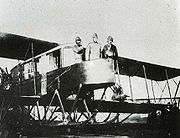
.jpg) With financial backing from his sister Olga, Sikorsky returned to Paris in 1909 to study aeronautics in the world-renowned Ecole des Techniques Aéronautiques et de Construction Automobile (ETACA) engineering school and to purchase aircraft parts. At the time, Paris was the center of the aviation world. Sikorsky would meet with aviation pioneers, to ask them questions about aircraft and flying. In May 1909, he returned to Russia and began designing his first helicopter, which he began testing in July 1909. Despite his progress in solving technical problems of control, Sikorsky realized that the aircraft would never fly. He finally disassembled the aircraft in October 1909, after he determined that he could learn nothing more from the design.
With financial backing from his sister Olga, Sikorsky returned to Paris in 1909 to study aeronautics in the world-renowned Ecole des Techniques Aéronautiques et de Construction Automobile (ETACA) engineering school and to purchase aircraft parts. At the time, Paris was the center of the aviation world. Sikorsky would meet with aviation pioneers, to ask them questions about aircraft and flying. In May 1909, he returned to Russia and began designing his first helicopter, which he began testing in July 1909. Despite his progress in solving technical problems of control, Sikorsky realized that the aircraft would never fly. He finally disassembled the aircraft in October 1909, after he determined that he could learn nothing more from the design.
Sikorsky built the two-seat S-5, his first design not based on other European aircraft. Flying this original aircraft, Sikorsky earned his pilot license; Fédération Aéronautique Internationale
(FAI) license No. 64 issued by the Imperial Aero Club of Russia in 1911. During a demonstration of the S-5, the engine quit and Sikorsky was forced to make a crash landing to avoid a wall. It was discovered that a mosquito
in the gasoline
had been drawn into the carburetor
, starving the engine of fuel. The close call convinced Sikorsky of the need for an aircraft that could continue flying if it lost an engine. His next aircraft, the S-6 held three passengers and was selected as the winner of the Moscow
aircraft exhibition held by the Russian Army
in February 1912.
In early 1912, Igor Sikorsky became Chief Engineer of the aircraft division for the Russian Baltic Railroad Car Works
(Russko-Baltiisky Vagonny Zavod or R-BVZ) in Saint Petersburg
. His work at R-BVZ included the construction the first four-engine
airplane, the S-21 Russky Vityaz
, which he called Le Grand. He also served as the test pilot
for its first flight on 13 May 1913. In recognition for his accomplishment, he was awarded an honorary degree
in engineering from Saint Petersburg Polytechnical Institute in 1914. Sikorsky took the experience from building the Russky Vityaz to develop the S-22 Ilya Muromets
airliner. Due to outbreak of World War I
, he redesigned it as the world's first four-engined bomber
, for which he was decorated with the Order of St. Vladimir
.
After World War I, Igor Sikorsky briefly became an engineer for the French forces in Russia, during the Russian Civil War
. Seeing little opportunity for himself as an aircraft designer in war-torn Europe, and particularly Russia, ravaged by the October Revolution
and Civil War, he emigrated to the United States, arriving in New York on March 30, 1919.

.jpg)
 In the United States, Sikorsky first worked as a school teacher and a lecturer, while looking for an opportunity to work in the aviation industry. In 1932, he joined the faculty of the University of Rhode Island
to form an Aeronautical Engineering program and remained with the University until 1948. He also lectured at the University of Bridgeport
.
In 1923, Sikorsky formed the Sikorsky Manufacturing Company
in Roosevelt, New York
. He was helped by several former Russian military officers. Among Sikorsky's chief supporters was composer Sergei Rachmaninoff
, who introduced himself by writing a check for US$5,000 (approximately $61,000 in 2007 dollars). Although his prototype was damaged in its first test flight, Sikorsky persuaded his reluctant backers to invest another $2,500. With the additional funds, he produced the S-29, one of the first twin-engine aircraft in America, with a capacity for 14 passengers and a speed of 115 mph. The performance of the S-29, slow compared to military aircraft of 1918, proved to be a "make or break" moment for Sikorsky's funding.
In 1928, Sikorsky became a naturalized citizen of the United States. The Sikorsky Manufacturing Company moved to Stratford, Connecticut
in 1929. It became a part of United Aircraft and Transport (now United Technologies Corporation
) in July of that year. The company manufactured flying boat
s, such as the S-42
"Clipper", used by Pan Am
for trans-Atlantic flights.
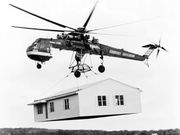
Meanwhile, Sikorsky also continued his earlier work on vertical flight. On February 14, 1929, he filed an application to patent a "direct lift" amphibian aircraft which used compressed air to power a direct lift "propeller" and two smaller propellers for thrust. On June 27, 1931, Sikorsky filed for a patent for another "direct lift aircraft", and was awarded patent #1,994,488 on 19 March 1935. His design plans eventually culminated in the first (tethered) flight of the Vought-Sikorsky VS-300 on September 14, 1939, with the first free flight occurring eight months later on May 24, 1940. Sikorsky's success with the VS-300 led to the R-4
, which became the world's first mass produced helicopter in 1942. Sikorsky's final VS-300 rotor configuration, comprising a single main rotor and a single antitorque tail rotor, has proven to be one of the most popular helicopter configurations, being used in most helicopters produced today.
. In 1923, Sikorsky's sisters emigrated to the United States, bringing six-year old Tania with them. Sikorsky married Elisabeth Semion in 1924, in New York. Sikorsky and Elisabeth had four sons; Sergei, Nikolai, Igor Jr. and George.
, on October 26, 1972, and was buried in Saint John the Baptist Greek Catholic Cemetery in Stratford
. The Sikorsky Memorial Bridge
, which carries the Merritt Parkway
across the Housatonic River
next to the Sikorsky corporate headquarters, is named for him. Sikorsky has been designated a Connecticut Aviation Pioneer by the Connecticut State Legislature. The Sikorsky Aircraft Corporation in Stratford, Connecticut, continues to the present day as one of the world's leading helicopter manufacturers, and a nearby small airport has been named Sikorsky Memorial Airport
.
Sikorsky was inducted into the National Inventors Hall of Fame and the Junior Achievement U.S. Business Hall of Fame in 1987.
In October 2011, one of the streets in Kiev was renamed after Sikorsky. The decision was made by the City Council at the request of the U.S. Embassy in Ukraine, which opened its new office in that street.
Christian
and authored two religious and philosophical books (The Message of the Lord's Prayer and The Invisible Encounter). Summarizing his beliefs, in the latter he wrote:
Russian American
Russian Americans are primarily Americans who traces their ancestry to Russia. The definition can be applied to recent Russian immigrants to the United States, as well as to settlers of 19th century Russian settlements in northwestern America which includes today's California, Alaska and...
pioneer of aviation
Aviation
Aviation is the design, development, production, operation, and use of aircraft, especially heavier-than-air aircraft. Aviation is derived from avis, the Latin word for bird.-History:...
in both helicopter
Helicopter
A helicopter is a type of rotorcraft in which lift and thrust are supplied by one or more engine-driven rotors. This allows the helicopter to take off and land vertically, to hover, and to fly forwards, backwards, and laterally...
s and fixed-wing aircraft
Fixed-wing aircraft
A fixed-wing aircraft is an aircraft capable of flight using wings that generate lift due to the vehicle's forward airspeed. Fixed-wing aircraft are distinct from rotary-wing aircraft in which wings rotate about a fixed mast and ornithopters in which lift is generated by flapping wings.A powered...
. He designed and flew the world's first multi-engine fixed-wing aircraft, the Russky Vityaz
Sikorsky Russky Vityaz
-See also:...
in 1913, and the first airliner
Airliner
An airliner is a large fixed-wing aircraft for transporting passengers and cargo. Such aircraft are operated by airlines. Although the definition of an airliner can vary from country to country, an airliner is typically defined as an aircraft intended for carrying multiple passengers in commercial...
, Ilya Muromets
Sikorsky Ilya Muromets
The Ilya Muromets refers to a class of Russian pre-World War I large four-engine commercial airliners and heavy military bombing aircraft used during World War I by the Russian Empire. The aircraft series was named after Ilya Muromets, a hero from Russian mythology...
, in 1914.
After emigrating to the United States
United States
The United States of America is a federal constitutional republic comprising fifty states and a federal district...
in 1919, Sikorsky founded the Sikorsky Aircraft Corporation
Sikorsky Aircraft
The Sikorsky Aircraft Corporation is an American aircraft manufacturer based in Stratford, Connecticut. Its parent company is United Technologies Corporation.-History:...
in 1923, and developed the first of Pan American Airways' ocean-conquering flying boats in the 1930s.
In 1939 Sikorsky designed and flew the Vought-Sikorsky VS-300, the first viable American helicopter, which pioneered the rotor configuration used by most helicopters today. Sikorsky would modify the design into the Sikorsky R-4
Sikorsky R-4
The Sikorsky R-4 was a two-place helicopter designed by Igor Sikorsky with a single, three-bladed main rotor and powered by a radial engine. The R-4 was the world's first large-scale mass-produced helicopter and the first helicopter to enter service with the United States Army Air Forces, Navy, and...
, which became the world's first mass-produced helicopter in 1942.
Early life
Igor Sikorsky was born in KievKiev
Kiev or Kyiv is the capital and the largest city of Ukraine, located in the north central part of the country on the Dnieper River. The population as of the 2001 census was 2,611,300. However, higher numbers have been cited in the press....
, Russian Empire
Russian Empire
The Russian Empire was a state that existed from 1721 until the Russian Revolution of 1917. It was the successor to the Tsardom of Russia and the predecessor of the Soviet Union...
(present day Ukraine
Ukraine
Ukraine is a country in Eastern Europe. It has an area of 603,628 km², making it the second largest contiguous country on the European continent, after Russia...
), as the youngest of five children. His father, Ivan Alexeevich Sikorsky, had a Russian
Russians
The Russian people are an East Slavic ethnic group native to Russia, speaking the Russian language and primarily living in Russia and neighboring countries....
and noble Polish family background. A professor
Professor
A professor is a scholarly teacher; the precise meaning of the term varies by country. Literally, professor derives from Latin as a "person who professes" being usually an expert in arts or sciences; a teacher of high rank...
of psychology
Psychology
Psychology is the study of the mind and behavior. Its immediate goal is to understand individuals and groups by both establishing general principles and researching specific cases. For many, the ultimate goal of psychology is to benefit society...
, Ivan was the son and grandson of Russian Orthodox
Russian Orthodox Church
The Russian Orthodox Church or, alternatively, the Moscow Patriarchate The ROC is often said to be the largest of the Eastern Orthodox churches in the world; including all the autocephalous churches under its umbrella, its adherents number over 150 million worldwide—about half of the 300 million...
priests and held monarchist and Russian nationalist
Russian nationalism
Russian nationalism is a term referring to a Russian form of nationalism. Russian nationalism has a long history dating from the days of Muscovy to Russian Empire, and continued in some form in the Soviet Union. It is closely related to Pan-Slavism...
views.
Igor Sikorsky's mother, Mariya Stefanovna Sikorskaya (née Temryuk-Cherkasov
Cherkasov
Cherkasov or Cherkasova is a Russian last name. It is the last name of the following people:*Alan Cherkasov, Kazakh television personality*Andrei Cherkasov , former professional tennis player...
a), was a physician
Physician
A physician is a health care provider who practices the profession of medicine, which is concerned with promoting, maintaining or restoring human health through the study, diagnosis, and treatment of disease, injury and other physical and mental impairments...
who did not work professionally. While homeschooling
Homeschooling
Homeschooling or homeschool is the education of children at home, typically by parents but sometimes by tutors, rather than in other formal settings of public or private school...
young Igor, she gave him a great love for art
Art
Art is the product or process of deliberately arranging items in a way that influences and affects one or more of the senses, emotions, and intellect....
, especially in the life and work of Leonardo da Vinci
Leonardo da Vinci
Leonardo di ser Piero da Vinci was an Italian Renaissance polymath: painter, sculptor, architect, musician, scientist, mathematician, engineer, inventor, anatomist, geologist, cartographer, botanist and writer whose genius, perhaps more than that of any other figure, epitomized the Renaissance...
, and the stories of Jules Verne
Jules Verne
Jules Gabriel Verne was a French author who pioneered the science fiction genre. He is best known for his novels Twenty Thousand Leagues Under the Sea , A Journey to the Center of the Earth , and Around the World in Eighty Days...
. In 1900, at age 11, he accompanied his father to Germany
Germany
Germany , officially the Federal Republic of Germany , is a federal parliamentary republic in Europe. The country consists of 16 states while the capital and largest city is Berlin. Germany covers an area of 357,021 km2 and has a largely temperate seasonal climate...
and through conversations with his father, became interested in natural sciences. After returning home, Sikorsky began to experiment with model flying machines, and by age 12, he had made a small rubber band-powered helicopter.Woods 1979, p. 254.
Sikorsky began studying at the Saint Petersburg
Saint Petersburg
Saint Petersburg is a city and a federal subject of Russia located on the Neva River at the head of the Gulf of Finland on the Baltic Sea...
Imperial Russian Naval Academy, in 1903, at the age of 14. In 1906, he determined that his future lay in engineering, so he resigned from the Academy, despite his satisfactory standing, and left the Russian Empire to study in Paris
Paris
Paris is the capital and largest city in France, situated on the river Seine, in northern France, at the heart of the Île-de-France region...
. He returned to Russia in 1907, enrolling at the Mechanical College of the Kiev Polytechnic Institute
Kiev Polytechnic Institute
The National Technical University of Ukraine “Kyiv Polytechnic Institute” is a major university in Kiev, Ukraine.-History:The institute was founded in 1898. At that time it had four departments: Mechanical, Chemical, Agricultural, and Civil Engineering. The first enrolment constituted 360 students...
. After the academic year, Sikorsky again accompanied his father to Germany in the summer of 1908, where he learned of the accomplishments of the Wright brothers
Wright brothers
The Wright brothers, Orville and Wilbur , were two Americans credited with inventing and building the world's first successful airplane and making the first controlled, powered and sustained heavier-than-air human flight, on December 17, 1903...
' Flyer and Ferdinand von Zeppelin
Ferdinand von Zeppelin
Ferdinand Adolf Heinrich August Graf von Zeppelin was a German general and later aircraft manufacturer. He founded the Zeppelin Airship company...
's dirigible. Sikorsky later said about this event: "Within twenty-four hours, I decided to change my life's work. I would study aviation
Aviation
Aviation is the design, development, production, operation, and use of aircraft, especially heavier-than-air aircraft. Aviation is derived from avis, the Latin word for bird.-History:...
."
Aircraft designer
Sikorsky built the two-seat S-5, his first design not based on other European aircraft. Flying this original aircraft, Sikorsky earned his pilot license; Fédération Aéronautique Internationale
Fédération Aéronautique Internationale
The Fédération Aéronautique Internationale is the world governing body for air sports and aeronautics and astronautics world records. Its head office is in Lausanne, Switzerland. This includes man-carrying aerospace vehicles from balloons to spacecraft, and unmanned aerial vehicles...
(FAI) license No. 64 issued by the Imperial Aero Club of Russia in 1911. During a demonstration of the S-5, the engine quit and Sikorsky was forced to make a crash landing to avoid a wall. It was discovered that a mosquito
Mosquito
Mosquitoes are members of a family of nematocerid flies: the Culicidae . The word Mosquito is from the Spanish and Portuguese for little fly...
in the gasoline
Gasoline
Gasoline , or petrol , is a toxic, translucent, petroleum-derived liquid that is primarily used as a fuel in internal combustion engines. It consists mostly of organic compounds obtained by the fractional distillation of petroleum, enhanced with a variety of additives. Some gasolines also contain...
had been drawn into the carburetor
Carburetor
A carburetor , carburettor, or carburetter is a device that blends air and fuel for an internal combustion engine. It is sometimes shortened to carb in North America and the United Kingdom....
, starving the engine of fuel. The close call convinced Sikorsky of the need for an aircraft that could continue flying if it lost an engine. His next aircraft, the S-6 held three passengers and was selected as the winner of the Moscow
Moscow
Moscow is the capital, the most populous city, and the most populous federal subject of Russia. The city is a major political, economic, cultural, scientific, religious, financial, educational, and transportation centre of Russia and the continent...
aircraft exhibition held by the Russian Army
Imperial Russian Army
The Imperial Russian Army was the land armed force of the Russian Empire, active from around 1721 to the Russian Revolution of 1917. In the early 1850s, the Russian army consisted of around 938,731 regular soldiers and 245,850 irregulars . Until the time of military reform of Dmitry Milyutin in...
in February 1912.
In early 1912, Igor Sikorsky became Chief Engineer of the aircraft division for the Russian Baltic Railroad Car Works
Russo-Balt
Russo-Balt was one of the first Russian companies that produced cars between 1909 and 1923.- Russo-Baltic Wagon Corp. :...
(Russko-Baltiisky Vagonny Zavod or R-BVZ) in Saint Petersburg
Saint Petersburg
Saint Petersburg is a city and a federal subject of Russia located on the Neva River at the head of the Gulf of Finland on the Baltic Sea...
. His work at R-BVZ included the construction the first four-engine
Inline engine (aviation)
In aviation, an inline engine means any reciprocating engine with banks rather than rows of cylinders, including straight engines, flat engines, V engines and H engines, but excluding radial engines and rotary engines....
airplane, the S-21 Russky Vityaz
Sikorsky Russky Vityaz
-See also:...
, which he called Le Grand. He also served as the test pilot
Test pilot
A test pilot is an aviator who flies new and modified aircraft in specific maneuvers, known as flight test techniques or FTTs, allowing the results to be measured and the design to be evaluated....
for its first flight on 13 May 1913. In recognition for his accomplishment, he was awarded an honorary degree
Honorary degree
An honorary degree or a degree honoris causa is an academic degree for which a university has waived the usual requirements, such as matriculation, residence, study, and the passing of examinations...
in engineering from Saint Petersburg Polytechnical Institute in 1914. Sikorsky took the experience from building the Russky Vityaz to develop the S-22 Ilya Muromets
Sikorsky Ilya Muromets
The Ilya Muromets refers to a class of Russian pre-World War I large four-engine commercial airliners and heavy military bombing aircraft used during World War I by the Russian Empire. The aircraft series was named after Ilya Muromets, a hero from Russian mythology...
airliner. Due to outbreak of World War I
World War I
World War I , which was predominantly called the World War or the Great War from its occurrence until 1939, and the First World War or World War I thereafter, was a major war centred in Europe that began on 28 July 1914 and lasted until 11 November 1918...
, he redesigned it as the world's first four-engined bomber
Bomber
A bomber is a military aircraft designed to attack ground and sea targets, by dropping bombs on them, or – in recent years – by launching cruise missiles at them.-Classifications of bombers:...
, for which he was decorated with the Order of St. Vladimir
Order of St. Vladimir
The Cross of Saint Vladimir was an Imperial Russian Order established in 1782 by Empress Catherine II in memory of the deeds of Saint Vladimir, the Grand Prince and the Baptizer of the Kievan Rus....
.
After World War I, Igor Sikorsky briefly became an engineer for the French forces in Russia, during the Russian Civil War
Russian Civil War
The Russian Civil War was a multi-party war that occurred within the former Russian Empire after the Russian provisional government collapsed to the Soviets, under the domination of the Bolshevik party. Soviet forces first assumed power in Petrograd The Russian Civil War (1917–1923) was a...
. Seeing little opportunity for himself as an aircraft designer in war-torn Europe, and particularly Russia, ravaged by the October Revolution
October Revolution
The October Revolution , also known as the Great October Socialist Revolution , Red October, the October Uprising or the Bolshevik Revolution, was a political revolution and a part of the Russian Revolution of 1917...
and Civil War, he emigrated to the United States, arriving in New York on March 30, 1919.
Life in America
University of Rhode Island
The University of Rhode Island is the principal public research university in the U.S. state of Rhode Island. Its main campus is located in Kingston. Additional campuses include the Feinstein Campus in Providence, the Narragansett Bay Campus in Narragansett, and the W. Alton Jones Campus in West...
to form an Aeronautical Engineering program and remained with the University until 1948. He also lectured at the University of Bridgeport
University of Bridgeport
The University of Bridgeport is a private, independent, non-sectarian, coeducational university located on the Long Island Sound in the South End neighborhood of Bridgeport, Connecticut. The University is fully Accredited by the New England Association of Schools and Colleges...
.
In 1923, Sikorsky formed the Sikorsky Manufacturing Company
Sikorsky Aircraft
The Sikorsky Aircraft Corporation is an American aircraft manufacturer based in Stratford, Connecticut. Its parent company is United Technologies Corporation.-History:...
in Roosevelt, New York
Roosevelt, New York
Roosevelt is a hamlet in Nassau County, New York, United States. The population was 16,258 at the 2010 census.Roosevelt is in the town of Hempstead.-Geography:Roosevelt is located at ....
. He was helped by several former Russian military officers. Among Sikorsky's chief supporters was composer Sergei Rachmaninoff
Sergei Rachmaninoff
Sergei Vasilievich Rachmaninoff was a Russian composer, pianist, and conductor. Rachmaninoff is widely considered one of the finest pianists of his day and, as a composer, one of the last great representatives of Romanticism in Russian classical music...
, who introduced himself by writing a check for US$5,000 (approximately $61,000 in 2007 dollars). Although his prototype was damaged in its first test flight, Sikorsky persuaded his reluctant backers to invest another $2,500. With the additional funds, he produced the S-29, one of the first twin-engine aircraft in America, with a capacity for 14 passengers and a speed of 115 mph. The performance of the S-29, slow compared to military aircraft of 1918, proved to be a "make or break" moment for Sikorsky's funding.
In 1928, Sikorsky became a naturalized citizen of the United States. The Sikorsky Manufacturing Company moved to Stratford, Connecticut
Stratford, Connecticut
Stratford is a town in Fairfield County, Connecticut, United States, located on Long Island Sound at the mouth of the Housatonic River. It was founded by Puritans in 1639....
in 1929. It became a part of United Aircraft and Transport (now United Technologies Corporation
United Technologies Corporation
United Technologies Corporation is an American multinational conglomerate headquartered in the United Technologies Building in Hartford, Connecticut...
) in July of that year. The company manufactured flying boat
Flying boat
A flying boat is a fixed-winged seaplane with a hull, allowing it to land on water. It differs from a float plane as it uses a purpose-designed fuselage which can float, granting the aircraft buoyancy. Flying boats may be stabilized by under-wing floats or by wing-like projections from the fuselage...
s, such as the S-42
Sikorsky S-42
|-See also:-References:NotesBibliography* Davies, R.E.G. Pan Am: An Airline and its Aircraft. New York: Orion Books, 1987. ISBN 0-517-56639-7....
"Clipper", used by Pan Am
Pan American World Airways
Pan American World Airways, commonly known as Pan Am, was the principal and largest international air carrier in the United States from 1927 until its collapse on December 4, 1991...
for trans-Atlantic flights.
Meanwhile, Sikorsky also continued his earlier work on vertical flight. On February 14, 1929, he filed an application to patent a "direct lift" amphibian aircraft which used compressed air to power a direct lift "propeller" and two smaller propellers for thrust. On June 27, 1931, Sikorsky filed for a patent for another "direct lift aircraft", and was awarded patent #1,994,488 on 19 March 1935. His design plans eventually culminated in the first (tethered) flight of the Vought-Sikorsky VS-300 on September 14, 1939, with the first free flight occurring eight months later on May 24, 1940. Sikorsky's success with the VS-300 led to the R-4
Sikorsky R-4
The Sikorsky R-4 was a two-place helicopter designed by Igor Sikorsky with a single, three-bladed main rotor and powered by a radial engine. The R-4 was the world's first large-scale mass-produced helicopter and the first helicopter to enter service with the United States Army Air Forces, Navy, and...
, which became the world's first mass produced helicopter in 1942. Sikorsky's final VS-300 rotor configuration, comprising a single main rotor and a single antitorque tail rotor, has proven to be one of the most popular helicopter configurations, being used in most helicopters produced today.
Family
Sikorsky was married to Olga Fyodorovna Simkovitch in Russia. They were divorced and Olga remained in Russia with their daughter as Sikorsky departed ahead of the October RevolutionOctober Revolution
The October Revolution , also known as the Great October Socialist Revolution , Red October, the October Uprising or the Bolshevik Revolution, was a political revolution and a part of the Russian Revolution of 1917...
. In 1923, Sikorsky's sisters emigrated to the United States, bringing six-year old Tania with them. Sikorsky married Elisabeth Semion in 1924, in New York. Sikorsky and Elisabeth had four sons; Sergei, Nikolai, Igor Jr. and George.
- Tania Sikorsky von York (1918 – 22 September 2008) Sikorsky's eldest child and only daughter. Tania was born in Kiev, Ukrainian People's RepublicUkrainian People's RepublicThe Ukrainian People's Republic or Ukrainian National Republic was a republic that was declared in part of the territory of modern Ukraine after the Russian Revolution, eventually headed by Symon Petliura.-Revolutionary Wave:...
, eventually part of the Soviet UnionSoviet UnionThe Soviet Union , officially the Union of Soviet Socialist Republics , was a constitutionally socialist state that existed in Eurasia between 1922 and 1991....
. Educated in the United States, she earned a B.A. at Barnard CollegeBarnard CollegeBarnard College is a private women's liberal arts college and a member of the Seven Sisters. Founded in 1889, Barnard has been affiliated with Columbia University since 1900. The campus stretches along Broadway between 116th and 120th Streets in the Morningside Heights neighborhood in the borough...
and a doctorate at YaleYALERapidMiner, formerly YALE , is an environment for machine learning, data mining, text mining, predictive analytics, and business analytics. It is used for research, education, training, rapid prototyping, application development, and industrial applications...
. She was one of the original faculty members of Sacred Heart UniversitySacred Heart UniversitySacred Heart University is a Roman Catholic university located in suburban Fairfield, Connecticut, United States. Sacred Heart was founded in 1963 by the Most Reverend Walter W. Curtis, Bishop of the Diocese of Bridgeport, Connecticut. Sacred Heart University was the first Catholic university in...
in Bridgeport, ConnecticutBridgeport, ConnecticutBridgeport is the most populous city in the U.S. state of Connecticut. Located in Fairfield County, the city had an estimated population of 144,229 at the 2010 United States Census and is the core of the Greater Bridgeport area...
, where she served as Professor of Sociology for 20 years. - Sergei Sikorsky (1925 – ) Sikorsky's eldest son. Sergei served in the United States Coast GuardUnited States Coast GuardThe United States Coast Guard is a branch of the United States Armed Forces and one of the seven U.S. uniformed services. The Coast Guard is a maritime, military, multi-mission service unique among the military branches for having a maritime law enforcement mission and a federal regulatory agency...
, and later earned a degree from the University of FlorenceUniversity of FlorenceThe University of Florence is a higher study institute in Florence, central Italy. One of the largest and oldest universities in the country, it consists of 12 faculties...
. He joined United Technologies in 1951, and retired in 1992, as Vice-President of Special Projects at Sikorsky AircraftSikorsky AircraftThe Sikorsky Aircraft Corporation is an American aircraft manufacturer based in Stratford, Connecticut. Its parent company is United Technologies Corporation.-History:...
. - Igor Sikorsky Jr. is an attorney, businessman and aviation historian.
- Nickolai Sikorsky
Death and legacy
Sikorsky died at his home in Easton, ConnecticutEaston, Connecticut
Easton is a town in Fairfield County, Connecticut, United States. The population was 7,490 at the 2010 census. Easton contains the historic district of Aspetuck....
, on October 26, 1972, and was buried in Saint John the Baptist Greek Catholic Cemetery in Stratford
Stratford, Connecticut
Stratford is a town in Fairfield County, Connecticut, United States, located on Long Island Sound at the mouth of the Housatonic River. It was founded by Puritans in 1639....
. The Sikorsky Memorial Bridge
Igor I. Sikorsky Memorial Bridge
The Igor I. Sikorsky Memorial Bridge carries the limited-access Connecticut Route 15 over the Housatonic River, between Stratford and Milford, Connecticut. The bridge was first referred to as the Sikorsky Bridge because Sikorsky Aircraft is headquartered just north of the bridge...
, which carries the Merritt Parkway
Merritt Parkway
The Merritt Parkway is a historic limited-access parkway in Fairfield County, Connecticut. The parkway is known for its scenic layout, its uniquely styled signage, and the architecturally elaborate overpasses along the route. It is designated as a National Scenic Byway and is also listed in the...
across the Housatonic River
Housatonic River
The Housatonic River is a river, approximately long, in western Massachusetts and western Connecticut in the United States. It flows south to southeast, and drains about of southwestern New England into Long Island Sound...
next to the Sikorsky corporate headquarters, is named for him. Sikorsky has been designated a Connecticut Aviation Pioneer by the Connecticut State Legislature. The Sikorsky Aircraft Corporation in Stratford, Connecticut, continues to the present day as one of the world's leading helicopter manufacturers, and a nearby small airport has been named Sikorsky Memorial Airport
Sikorsky Memorial Airport
Igor I. Sikorsky Memorial Airport , formerly known as Bridgeport Municipal Airport, is a public airport located in Stratford, three miles southeast of the central business district of Bridgeport, in Fairfield County, Connecticut, United States...
.
Sikorsky was inducted into the National Inventors Hall of Fame and the Junior Achievement U.S. Business Hall of Fame in 1987.
In October 2011, one of the streets in Kiev was renamed after Sikorsky. The decision was made by the City Council at the request of the U.S. Embassy in Ukraine, which opened its new office in that street.
Philosophical and religious views
Sikorsky was a deeply religious Russian OrthodoxRussian Orthodox Church
The Russian Orthodox Church or, alternatively, the Moscow Patriarchate The ROC is often said to be the largest of the Eastern Orthodox churches in the world; including all the autocephalous churches under its umbrella, its adherents number over 150 million worldwide—about half of the 300 million...
Christian
Christian
A Christian is a person who adheres to Christianity, an Abrahamic, monotheistic religion based on the life and teachings of Jesus of Nazareth as recorded in the Canonical gospels and the letters of the New Testament...
and authored two religious and philosophical books (The Message of the Lord's Prayer and The Invisible Encounter). Summarizing his beliefs, in the latter he wrote:
Published works
- Sikorsky, Igor Ivan. The Message of the Lord's Prayer. New York: C. Scribner's sons, 1942. OCLC 2928920
- Sikorsky, Igor Ivan. The Invisible Encounter. New York: C. Scribner's Sons, 1947. OCLC 1446225
- Sikorsky, Igor Ivan. The Story of the Winged-S: Late Developments and Recent Photographs of the Helicopter, an Autobiography. New York: Dodd, Mead, 1967. OCLC 1396277
See also
- Aerosani—Sikorsky built some of these propeller-powered sleighs in 1909–10.
- Il'ya Muromets - Second four-engine aircraft designed by Igor Sikorsky
- Sikorsky PrizeSikorsky PrizeThe Sikorsky Prize is a $250,000 reward established in 1980 by the American Helicopter Society to the first controlled flight of a human powered helicopter. It was named in honor of Igor Sikorsky. The prize has not yet been won...
- A prize for human powered helicopters named in his honor. - 10090 Sikorsky10090 Sikorsky10090 Sikorsky is a main-belt asteroid discovered on October 13, 1990 by Lyudmila Karachkina and Gregor Kastel at the Crimean Astrophysical Observatory. It is named after the Russian-American aeronautical engineer and helicopter designer Igor Sikorsky.- External links :*...
, an asteroidAsteroidAsteroids are a class of small Solar System bodies in orbit around the Sun. They have also been called planetoids, especially the larger ones...
named in honor of Igor Sikorsky - Timeline of hydrogen technologiesTimeline of hydrogen technologiesTimeline of hydrogen technologies — A timeline of the history of hydrogen technology.-1600s:* 1625 - First description of hydrogen by Johann Baptista van Helmont...
External links
: "Aircraft, especially aircraft of the direct lift amphibian type and means of construction and operating the same"- Igor Sikorsky Aerial Russia - the Romance of the Giant Aeroplane - early days of Igor Sikorsky online book
- Igor Sikorsky at findagrave.com
- Igor Sikorsky article on ctheritage.org
- Biography from Sikorsky company
- Official Sikorsky historical archives
- Igor Sikorsky. Time magazine, 16 November 1953. (Cover)
- New England Air Museum in Windsor Locks, Connecticut, has extensive Sikorsky exhibits
- Igor Sikorsky at Everything2.com
- Transatlantic Re-enactment Flight
- Wingless Helicopter Flies Straight Up September 1940 Popular MechanicsPopular MechanicsPopular Mechanics is an American magazine first published January 11, 1902 by H. H. Windsor, and has been owned since 1958 by the Hearst Corporation...
article showing Sikorsky flying his first helicopter and introducing him to the general public