


IG Farben

Encyclopedia
I.G. Farbenindustrie AG was a German
chemical industry conglomerate
. Its name is taken from Interessen-Gemeinschaft Farbenindustrie AG (lit. Community of interest of the dye industry). The company was formed in 1925 from a number of major companies that had been working together closely since World War I
. During its heyday IG Farben was the fourth-largest company in the world, after General Motors
, U.S. Steel
and Standard Oil
. During the planning of the invasion of Czechoslovakia and Poland, IG Farben cooperated closely with Nazi officials and directed which chemical plants should be secured and delivered to IG Farben.
. The three major firms BASF
, Bayer and Hoechst
produced several hundred different dyes, along with the five smaller firms Agfa
, Cassella, Chemische Fabrik Kalle, Chemische Fabrik Griesheim-Elektron and Chemische Fabrik vorm. Weiler-ter Meer concentrated on high-quality specialty dyes. In 1913 these eight firms produced almost 90 percent of the world supply of dyestuffs and sold about 80 percent of their production abroad. The three major firms had also integrated upstream into the production of essential raw materials and they began to expand into other areas of chemistry such as pharmaceuticals
, photographic film
, agricultural chemicals
and electrochemicals
. Contrary to other industries the founders and their families had little influence on the top-level decision-making of the leading German chemical firms, which was in the hands of professional salaried managers. Because of this unique situation the economic historian Alfred Chandler
called the German dye companies "the world's first truly managerial industrial enterprises".
 With the world market for synthetic dyes and other chemical products dominated by the German industry, German firms competed vigorously for market shares. Although cartel
s were attempted they lasted at most for a few years. Others argued for the formation of a profit pool or Interessen-Gemeinschaft (abbr. IG, lit. Community of interest). In contrast, the chairman of Bayer, Carl Duisberg
, argued for a merger. During a trip to the United States in the spring of 1903 he had visited several of the large American trusts
such as Standard Oil
, U.S. Steel
, International Paper
and Alcoa
. In 1904, after having returned to Germany he proposed a nationwide merger of the producers of dye and pharmaceuticals in a memorandum to Gustav von Brüning, the senior manager at Hoechst. Hoechst and several pharmaceutical firms refused to join. Instead, Hoechst and Cassella made an alliance based on mutual equity stakes in 1904. This prompted Duisberg and Heinrich von Brunck, chairman of BASF, to accelerate their negotiations. In October 1904 an Interessen-Gemeinschaft between Bayer, BASF and Agfa was formed, also known as the Dreibund or little IG. Profits of the three firms were pooled, with BASF and Bayer getting 43 percent and Agfa 14 percent of all profits. The two alliances were loosely connected with each other through an agreement between BASF and Hoechst to jointly exploit the patent on the Heumann-Pfleger indigo synthesis.
Within the Dreibund Bayer and BASF concentrated on dye whereas Agfa increasingly concentrated on photographic film. Although there was some cooperation between the technical staff in production and accounting, there was little cooperation between the firms in other areas. Neither were production or distribution facilities consolidated nor did the commercial staff cooperate. In 1908 Hoechst and Cassella acquired 88 percent of the shares of Chemische Fabrik Kalle. As Hoechst, Cassella and Kalle were connected by mutual equity shares and were located close to each other in the Frankfurt area, this allowed them to cooperate more successfully than the Dreibund, although they also did not rationalize or consolidate their production facilities.
(27.4 percent of equity capital), Bayer (27.4 percent), Hoechst
including Cassella and Chemische Fabrik Kalle (27.4 percent),
Agfa
(9.0 percent), Chemische Fabrik Griesheim-Elektron (6.9 percent) and Chemische Fabrik vorm. Weiler Ter Meer (1.9 percent). In 1926 IG Farben had a market capitalization
of 1.4 billion Reichsmark
and a workforce of 100,000 people, of which 2.6 percent were university educated, 18.2 percent were salaried professionals and 79.2 percent were workers.
Similar mergers took place in other countries. In the United Kingdom Brunner Mond
, Nobel Industries
, United Alkali Company
and British Dyestuffs
merged to Imperial Chemical Industries
in September 1926. In France Établissements Poulenc Frères and Société Chimique des Usines du Rhône merged to Rhône-Poulenc
in 1928.
The IG Farben Building
, headquarters for the conglomerate in Frankfurt am Main
, Germany, was completed in 1931.
In 1938 the company had 218,000 employees.
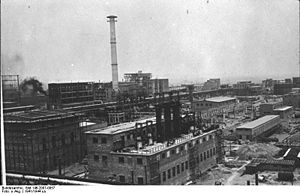
and Poland, IG Farben cooperated closely with Nazi officials and directed which chemical plants should be secured and delivered to IG Farben.
In 1941, an investigation exposed a "marriage" cartel between John D. Rockefeller
's United States-based Standard Oil
Co. and I.G. Farben. It also brought new evidence concerning complex price and marketing agreements between DuPont
, a major investor in and producer of leaded
gasoline, United States Industrial Alcohol Company
and its subsidiary, Cuba Distilling Co. The investigation was eventually dropped, like dozens of others in many different kinds of industries, due to the need to enlist industry support in the war effort. However, the top directors of many oil companies agreed to resign, and oil industry stocks in molasses companies were sold off as part of a compromise worked out.
IG Farben held the patent
for the pesticide Zyklon B
(used in Holocaust gas chambers), and owned 42.2 percent (in shares) of Degesch
(Deutsche Gesellschaft für Schädlingsbekämpfung) which manufactured it. IG Farben also had managers in Degesch's Managing Committee. Of the 24 directors of IG Farben indicted in the so-called IG Farben Trial
(1947–1948) before a U.S. military tribunal at the subsequent Nuremberg Trials
, 13 were sentenced to prison terms between one and eight years. Some of those indicted in the trial were subsequently made leaders of the post-war companies that split off from IG Farben, including those who were sentenced at Nuremberg
.
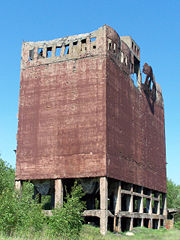
, and up to 1941, there were 5 Nazi Germany
Buna plants that produced Buna N by the Lebedev
process.
Dwory: The Buna Chemical Plant at Dwory was under construction by 1943, after a March 2, 1942 contract with "IG Farbenindustrie AG Auschwitz."http://longstreet.typepad.com/thesciencebookstore/2008/09/abbreviating-au.html#more The plant, which produced synthetic oil
and rubber
(from coal
), was the beginning of SS
activity and camps near Auschwitz III-Monowitz during the Holocaust
. At its peak in 1944, this factory made use of 83,000 slave laborers. Today, the plant operates as "Dwory S.A." http://wikimapia.org/1808502/Chemical-Company-Dwory-S-A
Frankfurt: In addition to the "cavernous" IG Farben building
at Frankfurt, a Hoechst AG
chemical factory in Frankfurt was bombed by the RAF on September 26, 1944.
Ludwigshafen and Oppau: The I.G. Farbenindustrie, A. G., Works, Ludwigshafen and Oppau had several chemical plants.
Pölitz, North Germany (today Police, Poland
): In 1937, IG Farben, Rhenania-Ossag, and Deutsch-Amerikanische Petroleum Gesellschaft
founded the Hydrierwerke Pölitz AG synthetic fuel plant
. By 1943, the plant produced 15% of Nazi Germany
's synthetic fuels, 577,000 ton
s.
Waldenburg: An IG Farben plant was at Waldenburg
s committed by IG Farben during World War II
, the company was considered to be too corrupt to be allowed to continue to exist. The Soviet Union
seized most of IG Farben's assets located in the Soviet occupation zone (see Morgenthau Plan
), as part of their reparation payments. The Western Allies
however, in 1951, split the company up into its original constituent companies. The four largest quickly bought the smaller ones. Today Agfa, BASF
, and Bayer remain, Hoechst
having in 1999 demerged its industrial chemical operations to Celanese AG
and merged its life-sciences businesses with Rhône-Poulenc
's to form Aventis
.
Part of Hoechst was afterwards Celanese AG, while another part of the company was sold in 1997 to the chemical spin-off of Sandoz, the Muttenz (Switzerland) based Clariant
.
IG Farben was officially put into liquidation in 1952, but this does not mean the company ceased to exist as a legal entity; up to today, it is still in existence as a corporation "in liquidation", meaning that the purpose of the continuing existence of the corporation is being wound up and dissolved in an orderly fashion. As of 2010, its shares are still traded on German markets. On November 10, 2003, its liquidators filed for insolvency
, but again, this does not affect the existence of the company as a legal person. It had contributed 500,000 DM (£160,000 or €255,646) towards a foundation for former captive labourers under the Nazi
regime. The remaining property, worth DM 21 million (£6.7 million or €10.7 million), went to a buyer. During this lengthy period, the holding company had been continually criticized for failing to pay any compensation to the former laborers, which was the stated reason for its continued existence after 1952. The company, in turn, blamed the ongoing legal disputes with the former captive labourers as being the reason it could not be legally dissolved and the remaining assets distributed as reparations. Nevertheless, it refused to join a national compensation fund that was set up in 2001 to pay people who had suffered. Each year, the company's annual meeting in Frankfurt
was the site of demonstrations by hundreds of protesters.
, was the sixth of the twelve trials for war crime
s the U.S. authorities held in their occupation zone in Germany (Nuremberg
) after the end of World War II
, against leading industrialists of Nazi Germany
for their conduct during the Nazi regime.
The defendants in this case had all been directors of IG Farben
. Of the 24 defendants arraigned
, 13 were found guilty. The indictment
was filed on May 3, 1947; the trial lasted from August 27, 1947 until July 30, 1948.
All defendants who were sentenced to prison received early release. Most were quickly restored to their directorships, and some were awarded the Federal Cross of Merit.
)
Konrad Adenauer
stated "According to a statement made by an American expert, the patents formerly belonging to IG Farben have given the American chemical industry a lead of at least 10 years. The damage thus caused to the German economy is huge and cannot be assessed in figures. It is extraordinarily regrettable that the new German inventions cannot be protected either, because Germany is not a member of the Patent Union. Britain has declared that it will respect German inventions regardless of what the peace treaty may say. But America has refused to issue such a declaration. German inventors are therefore not in a position to exploit their own inventions. This puts a considerable brake on German economic development."
, Nitrile rubber
, Polyurethane
, Prontosil
, Resochin
, Zyklon B
, among others.
IG Farben scientists made fundamental contributions to all areas of chemistry. Otto Bayer
discovered the polyaddition for the synthesis of polyurethane
in 1937. Several IG Farben scientists were awarded a Nobel Prize
. Carl Bosch
and Friedrich Bergius
were awarded the Nobel Prize in Chemistry
in 1931 "in recognition of their contributions to the invention and development of chemical high pressure methods". Gerhard Domagk
was awarded the Nobel Prize in Physiology or Medicine
in 1939 "for the discovery of the antibacterial effects of prontosil
". Kurt Alder
was awarded the Nobel Prize in Chemistry (together with Otto Diels
) in 1950 "for his [their] discovery and development of the diene synthesis".
Germany
Germany , officially the Federal Republic of Germany , is a federal parliamentary republic in Europe. The country consists of 16 states while the capital and largest city is Berlin. Germany covers an area of 357,021 km2 and has a largely temperate seasonal climate...
chemical industry conglomerate
Conglomerate (company)
A conglomerate is a combination of two or more corporations engaged in entirely different businesses that fall under one corporate structure , usually involving a parent company and several subsidiaries. Often, a conglomerate is a multi-industry company...
. Its name is taken from Interessen-Gemeinschaft Farbenindustrie AG (lit. Community of interest of the dye industry). The company was formed in 1925 from a number of major companies that had been working together closely since World War I
World War I
World War I , which was predominantly called the World War or the Great War from its occurrence until 1939, and the First World War or World War I thereafter, was a major war centred in Europe that began on 28 July 1914 and lasted until 11 November 1918...
. During its heyday IG Farben was the fourth-largest company in the world, after General Motors
General Motors
General Motors Company , commonly known as GM, formerly incorporated as General Motors Corporation, is an American multinational automotive corporation headquartered in Detroit, Michigan and the world's second-largest automaker in 2010...
, U.S. Steel
U.S. Steel
The United States Steel Corporation , more commonly known as U.S. Steel, is an integrated steel producer with major production operations in the United States, Canada, and Central Europe. The company is the world's tenth largest steel producer ranked by sales...
and Standard Oil
Standard Oil
Standard Oil was a predominant American integrated oil producing, transporting, refining, and marketing company. Established in 1870 as a corporation in Ohio, it was the largest oil refiner in the world and operated as a major company trust and was one of the world's first and largest multinational...
. During the planning of the invasion of Czechoslovakia and Poland, IG Farben cooperated closely with Nazi officials and directed which chemical plants should be secured and delivered to IG Farben.
Founding members
IG Farben was founded on December 25, 1925, as a merger of the following six companies:- BASFBASFBASF SE is the largest chemical company in the world and is headquartered in Germany. BASF originally stood for Badische Anilin- und Soda-Fabrik . Today, the four letters are a registered trademark and the company is listed on the Frankfurt Stock Exchange, London Stock Exchange, and Zurich Stock...
- Bayer
- HoechstHoechst AGHoechst AG was a German chemicals then life-sciences company that became Aventis Deutschland after its merger with France's Rhône-Poulenc S.A. in 1999...
(including Cassella and Chemische Fabrik Kalle) - AgfaAgfa-GevaertAgfa-Gevaert N.V. is a European multinational corporation that develops, manufactures, and distributes analogue and digital imaging products and systems, as well as IT solutions. The company has three divisions. Agfa Graphics offers integrated prepress and industrial inkjet systems to the...
- Chemische Fabrik Griesheim-Elektron
- Chemische Fabrik vorm. Weiler Ter Meer
Predecessors of IG Farben
At the beginning of the 20th century the German chemical industry dominated the world market for synthetic dyesDye
A dye is a colored substance that has an affinity to the substrate to which it is being applied. The dye is generally applied in an aqueous solution, and requires a mordant to improve the fastness of the dye on the fiber....
. The three major firms BASF
BASF
BASF SE is the largest chemical company in the world and is headquartered in Germany. BASF originally stood for Badische Anilin- und Soda-Fabrik . Today, the four letters are a registered trademark and the company is listed on the Frankfurt Stock Exchange, London Stock Exchange, and Zurich Stock...
, Bayer and Hoechst
Hoechst AG
Hoechst AG was a German chemicals then life-sciences company that became Aventis Deutschland after its merger with France's Rhône-Poulenc S.A. in 1999...
produced several hundred different dyes, along with the five smaller firms Agfa
Agfa-Gevaert
Agfa-Gevaert N.V. is a European multinational corporation that develops, manufactures, and distributes analogue and digital imaging products and systems, as well as IT solutions. The company has three divisions. Agfa Graphics offers integrated prepress and industrial inkjet systems to the...
, Cassella, Chemische Fabrik Kalle, Chemische Fabrik Griesheim-Elektron and Chemische Fabrik vorm. Weiler-ter Meer concentrated on high-quality specialty dyes. In 1913 these eight firms produced almost 90 percent of the world supply of dyestuffs and sold about 80 percent of their production abroad. The three major firms had also integrated upstream into the production of essential raw materials and they began to expand into other areas of chemistry such as pharmaceuticals
Drug
A drug, broadly speaking, is any substance that, when absorbed into the body of a living organism, alters normal bodily function. There is no single, precise definition, as there are different meanings in drug control law, government regulations, medicine, and colloquial usage.In pharmacology, a...
, photographic film
Photographic film
Photographic film is a sheet of plastic coated with an emulsion containing light-sensitive silver halide salts with variable crystal sizes that determine the sensitivity, contrast and resolution of the film...
, agricultural chemicals
Agrichemical
Agrochemical , a contraction of agricultural chemical, is a generic term for the various chemical products used in agriculture. In most cases, agrichemical refers to the broad range of pesticides, including insecticides, herbicides, and fungicides...
and electrochemicals
Electrochemistry
Electrochemistry is a branch of chemistry that studies chemical reactions which take place in a solution at the interface of an electron conductor and an ionic conductor , and which involve electron transfer between the electrode and the electrolyte or species in solution.If a chemical reaction is...
. Contrary to other industries the founders and their families had little influence on the top-level decision-making of the leading German chemical firms, which was in the hands of professional salaried managers. Because of this unique situation the economic historian Alfred Chandler
Alfred D. Chandler, Jr.
Alfred DuPont Chandler, Jr. was a professor of business history at Harvard Business School and Johns Hopkins University, who wrote extensively about the scale and the management structures of modern corporations. His works redefined business and economic history of industrialization...
called the German dye companies "the world's first truly managerial industrial enterprises".
Cartel
A cartel is a formal agreement among competing firms. It is a formal organization of producers and manufacturers that agree to fix prices, marketing, and production. Cartels usually occur in an oligopolistic industry, where there is a small number of sellers and usually involve homogeneous products...
s were attempted they lasted at most for a few years. Others argued for the formation of a profit pool or Interessen-Gemeinschaft (abbr. IG, lit. Community of interest). In contrast, the chairman of Bayer, Carl Duisberg
Carl Duisberg
Friedrich Carl Duisberg was a German chemist and industrialist.-Life:He was born in Barmen, Germany and from 1879 until 1882 he studied at the "Georg-August-Universität " and Friedrich Schiller University of Jena and received his doctorate .After military service in Munich, which he combined with...
, argued for a merger. During a trip to the United States in the spring of 1903 he had visited several of the large American trusts
Trust (19th century)
A special trust or business trust is a business entity formed with intent to monopolize business, to restrain trade, or to fix prices. Trusts gained economic power in the U.S. in the late 19th and early 20th centuries. Some, but not all, were organized as trusts in the legal sense...
such as Standard Oil
Standard Oil
Standard Oil was a predominant American integrated oil producing, transporting, refining, and marketing company. Established in 1870 as a corporation in Ohio, it was the largest oil refiner in the world and operated as a major company trust and was one of the world's first and largest multinational...
, U.S. Steel
U.S. Steel
The United States Steel Corporation , more commonly known as U.S. Steel, is an integrated steel producer with major production operations in the United States, Canada, and Central Europe. The company is the world's tenth largest steel producer ranked by sales...
, International Paper
International Paper
International Paper Company is an American pulp and paper company, the largest such company in the world. It has approximately 59,500 employees, and it is headquartered in Memphis, Tennessee.-History:...
and Alcoa
Alcoa
Alcoa Inc. is the world's third largest producer of aluminum, behind Rio Tinto Alcan and Rusal. From its operational headquarters in Pittsburgh, Pennsylvania, Alcoa conducts operations in 31 countries...
. In 1904, after having returned to Germany he proposed a nationwide merger of the producers of dye and pharmaceuticals in a memorandum to Gustav von Brüning, the senior manager at Hoechst. Hoechst and several pharmaceutical firms refused to join. Instead, Hoechst and Cassella made an alliance based on mutual equity stakes in 1904. This prompted Duisberg and Heinrich von Brunck, chairman of BASF, to accelerate their negotiations. In October 1904 an Interessen-Gemeinschaft between Bayer, BASF and Agfa was formed, also known as the Dreibund or little IG. Profits of the three firms were pooled, with BASF and Bayer getting 43 percent and Agfa 14 percent of all profits. The two alliances were loosely connected with each other through an agreement between BASF and Hoechst to jointly exploit the patent on the Heumann-Pfleger indigo synthesis.
Within the Dreibund Bayer and BASF concentrated on dye whereas Agfa increasingly concentrated on photographic film. Although there was some cooperation between the technical staff in production and accounting, there was little cooperation between the firms in other areas. Neither were production or distribution facilities consolidated nor did the commercial staff cooperate. In 1908 Hoechst and Cassella acquired 88 percent of the shares of Chemische Fabrik Kalle. As Hoechst, Cassella and Kalle were connected by mutual equity shares and were located close to each other in the Frankfurt area, this allowed them to cooperate more successfully than the Dreibund, although they also did not rationalize or consolidate their production facilities.
Foundation of IG Farben
IG Farben was founded on December 25, 1925 as a merger of the following six companies: BASFBASF
BASF SE is the largest chemical company in the world and is headquartered in Germany. BASF originally stood for Badische Anilin- und Soda-Fabrik . Today, the four letters are a registered trademark and the company is listed on the Frankfurt Stock Exchange, London Stock Exchange, and Zurich Stock...
(27.4 percent of equity capital), Bayer (27.4 percent), Hoechst
Hoechst AG
Hoechst AG was a German chemicals then life-sciences company that became Aventis Deutschland after its merger with France's Rhône-Poulenc S.A. in 1999...
including Cassella and Chemische Fabrik Kalle (27.4 percent),
Agfa
Agfa-Gevaert
Agfa-Gevaert N.V. is a European multinational corporation that develops, manufactures, and distributes analogue and digital imaging products and systems, as well as IT solutions. The company has three divisions. Agfa Graphics offers integrated prepress and industrial inkjet systems to the...
(9.0 percent), Chemische Fabrik Griesheim-Elektron (6.9 percent) and Chemische Fabrik vorm. Weiler Ter Meer (1.9 percent). In 1926 IG Farben had a market capitalization
Market capitalization
Market capitalization is a measurement of the value of the ownership interest that shareholders hold in a business enterprise. It is equal to the share price times the number of shares outstanding of a publicly traded company...
of 1.4 billion Reichsmark
German reichsmark
The Reichsmark was the currency in Germany from 1924 until June 20, 1948. The Reichsmark was subdivided into 100 Reichspfennig.-History:...
and a workforce of 100,000 people, of which 2.6 percent were university educated, 18.2 percent were salaried professionals and 79.2 percent were workers.
Similar mergers took place in other countries. In the United Kingdom Brunner Mond
Brunner Mond
Tata Chemicals Europe is a UK-based chemicals company that is a subsidiary of Tata Chemicals Limited, itself a part of the India-based Tata Group...
, Nobel Industries
Nobel Enterprises
Nobel Enterprises is a chemicals business based at Ardeer, near to the North Ayrshire town of Stevenston in Scotland. It specialises in nitrogen-based propellants and explosives and nitrocellulose-based products such as varnishes and inks...
, United Alkali Company
United Alkali Company
United Alkali Company Limited was a British chemical company formed in 1890. Producer of soda ash by the Leblanc process and used in the glass, textile, soap, and paper industries. It became one of the top four British chemical companies merged in 1926 with Brunner Mond, Nobel Explosives and...
and British Dyestuffs
British Dyestuffs Corporation
British Dyestuffs Corporation Ltd was a British company formed in 1919 from the merger of British Dyes Ltd with Levinstein Ltd. The British Government was the company's largest shareholder, and had two directors on the board....
merged to Imperial Chemical Industries
Imperial Chemical Industries
Imperial Chemical Industries was a British chemical company, taken over by AkzoNobel, a Dutch conglomerate, one of the largest chemical producers in the world. In its heyday, ICI was the largest manufacturing company in the British Empire, and commonly regarded as a "bellwether of the British...
in September 1926. In France Établissements Poulenc Frères and Société Chimique des Usines du Rhône merged to Rhône-Poulenc
Rhône-Poulenc
-History of the company:The Company was founded in 1928 through the merger of Société des Usines Chimiques du Rhône from Lyon and Établissements Poulenc Frères from Paris founded by Étienne Poulenc, a 19th century Parisian apothecary and brought to prominence by his second and third sons Emile...
in 1928.
The IG Farben Building
IG Farben Building
The IG Farben Building or the Poelzig Building was built from 1928 to 1930 as the corporate headquarters of the IG Farben conglomerate in Frankfurt am Main, Germany. It is also known as the Poelzig Ensemble or Poelzig Complex, and previously as the IG Farben Complex, and the General Creighton W....
, headquarters for the conglomerate in Frankfurt am Main
Frankfurt
Frankfurt am Main , commonly known simply as Frankfurt, is the largest city in the German state of Hesse and the fifth-largest city in Germany, with a 2010 population of 688,249. The urban area had an estimated population of 2,300,000 in 2010...
, Germany, was completed in 1931.
In 1938 the company had 218,000 employees.
World War II
During the planning of the invasion of CzechoslovakiaGerman occupation of Czechoslovakia
German occupation of Czechoslovakia began with the Nazi annexation of Czechoslovakia's northern and western border regions, known collectively as the Sudetenland, under terms outlined by the Munich Agreement. Nazi leader Adolf Hitler's pretext for this effort was the alleged privations suffered by...
and Poland, IG Farben cooperated closely with Nazi officials and directed which chemical plants should be secured and delivered to IG Farben.
In 1941, an investigation exposed a "marriage" cartel between John D. Rockefeller
John D. Rockefeller
John Davison Rockefeller was an American oil industrialist, investor, and philanthropist. He was the founder of the Standard Oil Company, which dominated the oil industry and was the first great U.S. business trust. Rockefeller revolutionized the petroleum industry and defined the structure of...
's United States-based Standard Oil
Standard Oil
Standard Oil was a predominant American integrated oil producing, transporting, refining, and marketing company. Established in 1870 as a corporation in Ohio, it was the largest oil refiner in the world and operated as a major company trust and was one of the world's first and largest multinational...
Co. and I.G. Farben. It also brought new evidence concerning complex price and marketing agreements between DuPont
DuPont
E. I. du Pont de Nemours and Company , commonly referred to as DuPont, is an American chemical company that was founded in July 1802 as a gunpowder mill by Eleuthère Irénée du Pont. DuPont was the world's third largest chemical company based on market capitalization and ninth based on revenue in 2009...
, a major investor in and producer of leaded
Tetra-ethyl lead
Tetraethyllead , abbreviated TEL, is an organolead compound with the formula 4Pb. An inexpensive additive, its addition to gasoline from the 1920's allowed octane ratings and thus engine compression to be boosted significantly, increasing power and fuel economy...
gasoline, United States Industrial Alcohol Company
United States Industrial Alcohol Company
United States Industrial Alcohol Company was an alcohol distiller in the United States. Charles Edward Adams, was chairman of the board. In 1919 they were responsible for the Boston Molasses Disaster. 125 lawsuits filed against the company in the aftermath....
and its subsidiary, Cuba Distilling Co. The investigation was eventually dropped, like dozens of others in many different kinds of industries, due to the need to enlist industry support in the war effort. However, the top directors of many oil companies agreed to resign, and oil industry stocks in molasses companies were sold off as part of a compromise worked out.
IG Farben held the patent
Patent
A patent is a form of intellectual property. It consists of a set of exclusive rights granted by a sovereign state to an inventor or their assignee for a limited period of time in exchange for the public disclosure of an invention....
for the pesticide Zyklon B
Zyklon B
Zyklon B was the trade name of a cyanide-based pesticide infamous for its use by Nazi Germany to kill human beings in gas chambers of extermination camps during the Holocaust. The "B" designation indicates one of two types of Zyklon...
(used in Holocaust gas chambers), and owned 42.2 percent (in shares) of Degesch
Degesch
The Deutsche Gesellschaft für Schädlingsbekämpfung mbH , in short Degesch, was a German chemical corporation during World War II. Degesch produced pesticides used against weeds and insects...
(Deutsche Gesellschaft für Schädlingsbekämpfung) which manufactured it. IG Farben also had managers in Degesch's Managing Committee. Of the 24 directors of IG Farben indicted in the so-called IG Farben Trial
IG Farben Trial
The United States of America vs. Carl Krauch, et al., also known as the IG Farben Trial, was the sixth of the twelve trials for war crimes the U.S. authorities held in their occupation zone in Germany after the end of World War II....
(1947–1948) before a U.S. military tribunal at the subsequent Nuremberg Trials
Nuremberg Trials
The Nuremberg Trials were a series of military tribunals, held by the victorious Allied forces of World War II, most notable for the prosecution of prominent members of the political, military, and economic leadership of the defeated Nazi Germany....
, 13 were sentenced to prison terms between one and eight years. Some of those indicted in the trial were subsequently made leaders of the post-war companies that split off from IG Farben, including those who were sentenced at Nuremberg
Nuremberg
Nuremberg[p] is a city in the German state of Bavaria, in the administrative region of Middle Franconia. Situated on the Pegnitz river and the Rhine–Main–Danube Canal, it is located about north of Munich and is Franconia's largest city. The population is 505,664...
.
Facilities during World War II
IG Farben facilities were bombing targets of the Oil Campaign of World War IIOil Campaign of World War II
The Allied Oil Campaign of World War II was directed at facilities supplying Nazi Germany with petroleum, oil, and lubrication products...
, and up to 1941, there were 5 Nazi Germany
Nazi Germany
Nazi Germany , also known as the Third Reich , but officially called German Reich from 1933 to 1943 and Greater German Reich from 26 June 1943 onward, is the name commonly used to refer to the state of Germany from 1933 to 1945, when it was a totalitarian dictatorship ruled by...
Buna plants that produced Buna N by the Lebedev
Lebedev
Lebedev , or Lebedeva is a common Russian family name derived from the word lebed — swan. The following notable people have this name:-Real people:*Alexander Lebedev , Russian businessman and politician...
process.
Dwory: The Buna Chemical Plant at Dwory was under construction by 1943, after a March 2, 1942 contract with "IG Farbenindustrie AG Auschwitz."http://longstreet.typepad.com/thesciencebookstore/2008/09/abbreviating-au.html#more The plant, which produced synthetic oil
Synthetic oil
Synthetic oil is a lubricant consisting of chemical compounds that are artificially made . Synthetic lubricants can be manufactured using chemically modified petroleum components rather than whole crude oil, but can also be synthesized from other raw materials...
and rubber
Synthetic rubber
Synthetic rubber is is any type of artificial elastomer, invariably a polymer. An elastomer is a material with the mechanical property that it can undergo much more elastic deformation under stress than most materials and still return to its previous size without permanent deformation...
(from coal
Coal
Coal is a combustible black or brownish-black sedimentary rock usually occurring in rock strata in layers or veins called coal beds or coal seams. The harder forms, such as anthracite coal, can be regarded as metamorphic rock because of later exposure to elevated temperature and pressure...
), was the beginning of SS
Schutzstaffel
The Schutzstaffel |Sig runes]]) was a major paramilitary organization under Adolf Hitler and the Nazi Party. Built upon the Nazi ideology, the SS under Heinrich Himmler's command was responsible for many of the crimes against humanity during World War II...
activity and camps near Auschwitz III-Monowitz during the Holocaust
The Holocaust
The Holocaust , also known as the Shoah , was the genocide of approximately six million European Jews and millions of others during World War II, a programme of systematic state-sponsored murder by Nazi...
. At its peak in 1944, this factory made use of 83,000 slave laborers. Today, the plant operates as "Dwory S.A." http://wikimapia.org/1808502/Chemical-Company-Dwory-S-A
Frankfurt: In addition to the "cavernous" IG Farben building
IG Farben Building
The IG Farben Building or the Poelzig Building was built from 1928 to 1930 as the corporate headquarters of the IG Farben conglomerate in Frankfurt am Main, Germany. It is also known as the Poelzig Ensemble or Poelzig Complex, and previously as the IG Farben Complex, and the General Creighton W....
at Frankfurt, a Hoechst AG
Hoechst AG
Hoechst AG was a German chemicals then life-sciences company that became Aventis Deutschland after its merger with France's Rhône-Poulenc S.A. in 1999...
chemical factory in Frankfurt was bombed by the RAF on September 26, 1944.
Ludwigshafen and Oppau: The I.G. Farbenindustrie, A. G., Works, Ludwigshafen and Oppau had several chemical plants.
Pölitz, North Germany (today Police, Poland
Police, Poland
Police is a town in the West Pomeranian Voivodeship, northwestern Poland. It is the capital of Police County. As of 2006, the town had 34,284 inhabitants. The name comes from Polish pole, which means "field"....
): In 1937, IG Farben, Rhenania-Ossag, and Deutsch-Amerikanische Petroleum Gesellschaft
Esso
Esso is an international trade name for ExxonMobil and its related companies. Pronounced , it is derived from the initials of the pre-1911 Standard Oil, and as such became the focus of much litigation and regulatory restriction in the United States. In 1972, it was largely replaced in the U.S. by...
founded the Hydrierwerke Pölitz AG synthetic fuel plant
Bergius process
The Bergius Process is a method of production of liquid hydrocarbons for use as synthetic fuel by hydrogenation of high-volatile bituminous coal at high temperature and pressure...
. By 1943, the plant produced 15% of Nazi Germany
Nazi Germany
Nazi Germany , also known as the Third Reich , but officially called German Reich from 1933 to 1943 and Greater German Reich from 26 June 1943 onward, is the name commonly used to refer to the state of Germany from 1933 to 1945, when it was a totalitarian dictatorship ruled by...
's synthetic fuels, 577,000 ton
Ton
The ton is a unit of measure. It has a long history and has acquired a number of meanings and uses over the years. It is used principally as a unit of weight, and as a unit of volume. It can also be used as a measure of energy, for truck classification, or as a colloquial term.It is derived from...
s.
Waldenburg: An IG Farben plant was at Waldenburg
Break-up and liquidation
Due to the severity of the war crimeWar crime
War crimes are serious violations of the laws applicable in armed conflict giving rise to individual criminal responsibility...
s committed by IG Farben during World War II
World War II
World War II, or the Second World War , was a global conflict lasting from 1939 to 1945, involving most of the world's nations—including all of the great powers—eventually forming two opposing military alliances: the Allies and the Axis...
, the company was considered to be too corrupt to be allowed to continue to exist. The Soviet Union
Soviet Union
The Soviet Union , officially the Union of Soviet Socialist Republics , was a constitutionally socialist state that existed in Eurasia between 1922 and 1991....
seized most of IG Farben's assets located in the Soviet occupation zone (see Morgenthau Plan
Morgenthau Plan
The Morgenthau Plan, proposed by United States Secretary of the Treasury Henry Morgenthau, Jr., advocated that the Allied occupation of Germany following World War II include measures to eliminate Germany's ability to wage war.-Overview:...
), as part of their reparation payments. The Western Allies
Western Allies
The Western Allies were a political and geographic grouping among the Allied Powers of the Second World War. It generally includes the United Kingdom and British Commonwealth, the United States, France and various other European and Latin American countries, but excludes China, the Soviet Union,...
however, in 1951, split the company up into its original constituent companies. The four largest quickly bought the smaller ones. Today Agfa, BASF
BASF
BASF SE is the largest chemical company in the world and is headquartered in Germany. BASF originally stood for Badische Anilin- und Soda-Fabrik . Today, the four letters are a registered trademark and the company is listed on the Frankfurt Stock Exchange, London Stock Exchange, and Zurich Stock...
, and Bayer remain, Hoechst
Hoechst AG
Hoechst AG was a German chemicals then life-sciences company that became Aventis Deutschland after its merger with France's Rhône-Poulenc S.A. in 1999...
having in 1999 demerged its industrial chemical operations to Celanese AG
Celanese
Celanese Corporation is a Fortune 500 global technology and specialty materials company with its headquarters in Dallas, Texas. The company is a leading producer of acetyl products, which are intermediate chemicals for nearly all major industries, and is the world's largest producer of vinyl...
and merged its life-sciences businesses with Rhône-Poulenc
Rhône-Poulenc
-History of the company:The Company was founded in 1928 through the merger of Société des Usines Chimiques du Rhône from Lyon and Établissements Poulenc Frères from Paris founded by Étienne Poulenc, a 19th century Parisian apothecary and brought to prominence by his second and third sons Emile...
's to form Aventis
Aventis
Aventis was a pharmaceutical and lab assay testing company. It was formed in 1999 when Rhône-Poulenc S.A. merged with Hoechst AG. The merged company was based in Strasbourg, France. With its headquarters in Strasbourg, Aventis was the product of the first transnational merger to combine large...
.
Part of Hoechst was afterwards Celanese AG, while another part of the company was sold in 1997 to the chemical spin-off of Sandoz, the Muttenz (Switzerland) based Clariant
Clariant
Clariant is a Swiss speciality chemical company which was formed in 1995 as a spin off from Sandoz.- Business :The company has a turnover of around US$8 billion and is headquartered in Muttenz, near Basel, Switzerland....
.
IG Farben was officially put into liquidation in 1952, but this does not mean the company ceased to exist as a legal entity; up to today, it is still in existence as a corporation "in liquidation", meaning that the purpose of the continuing existence of the corporation is being wound up and dissolved in an orderly fashion. As of 2010, its shares are still traded on German markets. On November 10, 2003, its liquidators filed for insolvency
Insolvency
Insolvency means the inability to pay one's debts as they fall due. Usually used to refer to a business, insolvency refers to the inability of a company to pay off its debts.Business insolvency is defined in two different ways:...
, but again, this does not affect the existence of the company as a legal person. It had contributed 500,000 DM (£160,000 or €255,646) towards a foundation for former captive labourers under the Nazi
Nazism
Nazism, the common short form name of National Socialism was the ideology and practice of the Nazi Party and of Nazi Germany...
regime. The remaining property, worth DM 21 million (£6.7 million or €10.7 million), went to a buyer. During this lengthy period, the holding company had been continually criticized for failing to pay any compensation to the former laborers, which was the stated reason for its continued existence after 1952. The company, in turn, blamed the ongoing legal disputes with the former captive labourers as being the reason it could not be legally dissolved and the remaining assets distributed as reparations. Nevertheless, it refused to join a national compensation fund that was set up in 2001 to pay people who had suffered. Each year, the company's annual meeting in Frankfurt
Frankfurt
Frankfurt am Main , commonly known simply as Frankfurt, is the largest city in the German state of Hesse and the fifth-largest city in Germany, with a 2010 population of 688,249. The urban area had an estimated population of 2,300,000 in 2010...
was the site of demonstrations by hundreds of protesters.
IG Farben Trial
The United States of America vs. Carl Krauch, et al., also known as the IG Farben TrialIG Farben Trial
The United States of America vs. Carl Krauch, et al., also known as the IG Farben Trial, was the sixth of the twelve trials for war crimes the U.S. authorities held in their occupation zone in Germany after the end of World War II....
, was the sixth of the twelve trials for war crime
War crime
War crimes are serious violations of the laws applicable in armed conflict giving rise to individual criminal responsibility...
s the U.S. authorities held in their occupation zone in Germany (Nuremberg
Nuremberg Trials
The Nuremberg Trials were a series of military tribunals, held by the victorious Allied forces of World War II, most notable for the prosecution of prominent members of the political, military, and economic leadership of the defeated Nazi Germany....
) after the end of World War II
World War II
World War II, or the Second World War , was a global conflict lasting from 1939 to 1945, involving most of the world's nations—including all of the great powers—eventually forming two opposing military alliances: the Allies and the Axis...
, against leading industrialists of Nazi Germany
Nazi Germany
Nazi Germany , also known as the Third Reich , but officially called German Reich from 1933 to 1943 and Greater German Reich from 26 June 1943 onward, is the name commonly used to refer to the state of Germany from 1933 to 1945, when it was a totalitarian dictatorship ruled by...
for their conduct during the Nazi regime.
The defendants in this case had all been directors of IG Farben
IG Farben
I.G. Farbenindustrie AG was a German chemical industry conglomerate. Its name is taken from Interessen-Gemeinschaft Farbenindustrie AG . The company was formed in 1925 from a number of major companies that had been working together closely since World War I...
. Of the 24 defendants arraigned
Arraignment
Arraignment is a formal reading of a criminal complaint in the presence of the defendant to inform the defendant of the charges against him or her. In response to arraignment, the accused is expected to enter a plea...
, 13 were found guilty. The indictment
Indictment
An indictment , in the common-law legal system, is a formal accusation that a person has committed a crime. In jurisdictions that maintain the concept of felonies, the serious criminal offence is a felony; jurisdictions that lack the concept of felonies often use that of an indictable offence—an...
was filed on May 3, 1947; the trial lasted from August 27, 1947 until July 30, 1948.
All defendants who were sentenced to prison received early release. Most were quickly restored to their directorships, and some were awarded the Federal Cross of Merit.
Patents and scientific knowledge
Once Germany had surrendered the US moved quickly to commercially exploit all German patents and scientific knowledge. (see Industrial plans for GermanyIndustrial plans for Germany
The Industrial plans for Germany were designs the Allies considered imposing on Germany in the aftermath of World War II to reduce and manage Germany's industrial capacity.-Background:...
)
Konrad Adenauer
Konrad Adenauer
Konrad Hermann Joseph Adenauer was a German statesman. He was the chancellor of the West Germany from 1949 to 1963. He is widely recognised as a person who led his country from the ruins of World War II to a powerful and prosperous nation that had forged close relations with old enemies France,...
stated "According to a statement made by an American expert, the patents formerly belonging to IG Farben have given the American chemical industry a lead of at least 10 years. The damage thus caused to the German economy is huge and cannot be assessed in figures. It is extraordinarily regrettable that the new German inventions cannot be protected either, because Germany is not a member of the Patent Union. Britain has declared that it will respect German inventions regardless of what the peace treaty may say. But America has refused to issue such a declaration. German inventors are therefore not in a position to exploit their own inventions. This puts a considerable brake on German economic development."
Products
Synthetic dyesDye
A dye is a colored substance that has an affinity to the substrate to which it is being applied. The dye is generally applied in an aqueous solution, and requires a mordant to improve the fastness of the dye on the fiber....
, Nitrile rubber
Nitrile rubber
Nitrile rubber, also known as Buna-N, Perbunan, or NBR, is a synthetic rubber copolymer of acrylonitrile and butadiene. Trade names include Nipol, Krynac and Europrene....
, Polyurethane
Polyurethane
A polyurethane is any polymer composed of a chain of organic units joined by carbamate links. Polyurethane polymers are formed through step-growth polymerization, by reacting a monomer with another monomer in the presence of a catalyst.Polyurethanes are...
, Prontosil
Prontosil
Prontosil, the first commercially available antibacterial antibiotic , was developed by a research team at the Bayer Laboratories of the IG Farben conglomerate in Germany...
, Resochin
Chloroquine
Chloroquine is a 4-aminoquinoline drug used in the treatment or prevention of malaria.-History:Chloroquine , N'--N,N-diethyl-pentane-1,4-diamine, was discovered in 1934 by Hans Andersag and co-workers at the Bayer laboratories who named it "Resochin". It was ignored for a decade because it was...
, Zyklon B
Zyklon B
Zyklon B was the trade name of a cyanide-based pesticide infamous for its use by Nazi Germany to kill human beings in gas chambers of extermination camps during the Holocaust. The "B" designation indicates one of two types of Zyklon...
, among others.
IG Farben scientists made fundamental contributions to all areas of chemistry. Otto Bayer
Otto Bayer
Otto Bayer was a German industrial chemist at IG Farben who was head of the research group that discovered the polyaddition for the synthesis of polyurethanes out of polyisocyanate and polyol. It may be noted that although Dr. Bayer shared the name of his venerable employer, he was not actually...
discovered the polyaddition for the synthesis of polyurethane
Polyurethane
A polyurethane is any polymer composed of a chain of organic units joined by carbamate links. Polyurethane polymers are formed through step-growth polymerization, by reacting a monomer with another monomer in the presence of a catalyst.Polyurethanes are...
in 1937. Several IG Farben scientists were awarded a Nobel Prize
Nobel Prize
The Nobel Prizes are annual international awards bestowed by Scandinavian committees in recognition of cultural and scientific advances. The will of the Swedish chemist Alfred Nobel, the inventor of dynamite, established the prizes in 1895...
. Carl Bosch
Carl Bosch
Carl Bosch was a German chemist and engineer and Nobel laureate in chemistry. He was a pioneer in the field of high-pressure industrial chemistry and founder of IG Farben, at one point the world's largest chemical company....
and Friedrich Bergius
Friedrich Bergius
Friedrich Karl Rudolf Bergius was a German chemist known for the Bergius process for producing synthetic fuel from coal, Nobel Prize in Chemistry in recognition of contributions to the invention and development of chemical high-pressure methods...
were awarded the Nobel Prize in Chemistry
Nobel Prize in Chemistry
The Nobel Prize in Chemistry is awarded annually by the Royal Swedish Academy of Sciences to scientists in the various fields of chemistry. It is one of the five Nobel Prizes established by the will of Alfred Nobel in 1895, awarded for outstanding contributions in chemistry, physics, literature,...
in 1931 "in recognition of their contributions to the invention and development of chemical high pressure methods". Gerhard Domagk
Gerhard Domagk
Gerhard Johannes Paul Domagk was a German pathologist and bacteriologist credited with the discovery of Sulfonamidochrysoidine – the first commercially available antibiotic – for which he received the 1939 Nobel Prize in Physiology or Medicine.Domagk was born in Lagow, Brandenburg, the...
was awarded the Nobel Prize in Physiology or Medicine
Nobel Prize in Physiology or Medicine
The Nobel Prize in Physiology or Medicine administered by the Nobel Foundation, is awarded once a year for outstanding discoveries in the field of life science and medicine. It is one of five Nobel Prizes established in 1895 by Swedish chemist Alfred Nobel, the inventor of dynamite, in his will...
in 1939 "for the discovery of the antibacterial effects of prontosil
Prontosil
Prontosil, the first commercially available antibacterial antibiotic , was developed by a research team at the Bayer Laboratories of the IG Farben conglomerate in Germany...
". Kurt Alder
Kurt Alder
Kurt Alder was a German chemist and Nobel laureate.-Biography:Alder was born in the industrial area of Königshütte, Silesia , where he received his early schooling...
was awarded the Nobel Prize in Chemistry (together with Otto Diels
Otto Diels
Otto Paul Hermann Diels was a German chemist. He was the son of a professor of philology at the University of Berlin, where he himself earned his doctorate in chemistry, in the group of Emil Fischer....
) in 1950 "for his [their] discovery and development of the diene synthesis".
IG Farben in fiction
- The Council of the Gods, produced at 1951 by (DEFA director Kurt MaetzigKurt MaetzigKurt Maetzig is an East German film director who had a significant effect on the film industry in the GDR. He is one of the most respected filmmakers of East Germany. He currently lives in Wildkuhl, Mecklenburg, and has three children....
), is an East German film about IG Farben's role in World War II and the subsequent trial. - IG Farben plays a prominent role in Thomas PynchonThomas PynchonThomas Ruggles Pynchon, Jr. is an American novelist. For his most praised novel, Gravity's Rainbow, Pynchon received the National Book Award, and is regularly cited as a contender for the Nobel Prize in Literature...
's novel, Gravity's RainbowGravity's RainbowGravity's Rainbow is a postmodern novel written by Thomas Pynchon and first published on February 28, 1973.The narrative is set primarily in Europe at the end of World War II and centers on the design, production and dispatch of V-2 rockets by the German military, and, in particular, the quest...
, primarily as the manufacturer of the elusive and mysterious plastic product "Imipolex G." - IG Farben plays a prominent role in Philip K. DickPhilip K. DickPhilip Kindred Dick was an American novelist, short story writer and essayist whose published work is almost entirely in the science fiction genre. Dick explored sociological, political and metaphysical themes in novels dominated by monopolistic corporations, authoritarian governments and altered...
's alternative history novel The Man in the High CastleThe Man in the High CastleThe Man in the High Castle is a science fiction alternate history novel by American writer Philip K. Dick. It won a Hugo Award in 1963 and has since been translated into many languages....
. - IG Farben is the company said to be supporting German terror activities and research of uranium ores in Brazil after World War II in Alfred HitchcockAlfred HitchcockSir Alfred Joseph Hitchcock, KBE was a British film director and producer. He pioneered many techniques in the suspense and psychological thriller genres. After a successful career in British cinema in both silent films and early talkies, Hitchcock moved to Hollywood...
's film noirFilm noirFilm noir is a cinematic term used primarily to describe stylish Hollywood crime dramas, particularly those that emphasize cynical attitudes and sexual motivations. Hollywood's classic film noir period is generally regarded as extending from the early 1940s to the late 1950s...
Notorious, 1946 - In the Hearts of Iron computer game series by "Paradox InteractiveParadox Interactive-External links:*...
", IG Farben is a "tech team" that excels at developing industrial technologies for Germany.
See also
- IG Farben BuildingIG Farben BuildingThe IG Farben Building or the Poelzig Building was built from 1928 to 1930 as the corporate headquarters of the IG Farben conglomerate in Frankfurt am Main, Germany. It is also known as the Poelzig Ensemble or Poelzig Complex, and previously as the IG Farben Complex, and the General Creighton W....
- IG Farben TrialIG Farben TrialThe United States of America vs. Carl Krauch, et al., also known as the IG Farben Trial, was the sixth of the twelve trials for war crimes the U.S. authorities held in their occupation zone in Germany after the end of World War II....
- Monowitz concentration camp
- Research Materials: Max Planck Society ArchiveResearch Materials: Max Planck Society ArchiveAt the end of World War II, the Kaiser Wilhelm Society was renamed the Max Planck Society, and the institutes associated with the Kaiser Wilhelm Society were renamed "Max Planck" institutes. The records that were archived under the former Kaiser Wilhelm Society and its institutes were placed in the...
- American IGAmerican IGAmerican IG is the name of a company, and it owes its genesis to a German business conglomerate, namely, Interessens-Gemeinschaft Farbenindustrie AG, or IG Farben for short...
External links
- Official homepage of the IG Farben successor BASFBASFBASF SE is the largest chemical company in the world and is headquartered in Germany. BASF originally stood for Badische Anilin- und Soda-Fabrik . Today, the four letters are a registered trademark and the company is listed on the Frankfurt Stock Exchange, London Stock Exchange, and Zurich Stock...
- Official homepage of the IG Farben successor Bayer
- Official homepage of the IG Farben successor HoechstHoechst AGHoechst AG was a German chemicals then life-sciences company that became Aventis Deutschland after its merger with France's Rhône-Poulenc S.A. in 1999...
(now Sanofi-AventisSanofi-AventisSanofi S.A. is a multinational pharmaceutical company headquartered in Paris, France, the world's fourth-largest by prescription sales. Sanofi engages in the research and development, manufacturing and marketing of pharmaceutical products for sale principally in the prescription market, but the...
) - Stock Market Prices of IG Farben