


Morgenthau Plan

Encyclopedia
United States Secretary of the Treasury
The Secretary of the Treasury of the United States is the head of the United States Department of the Treasury, which is concerned with financial and monetary matters, and, until 2003, also with some issues of national security and defense. This position in the Federal Government of the United...
Henry Morgenthau, Jr.
Henry Morgenthau, Jr.
Henry Morgenthau, Jr. was the U.S. Secretary of the Treasury during the administration of Franklin D. Roosevelt. He played a major role in designing and financing the New Deal...
, advocated that the Allied occupation of Germany
Germany
Germany , officially the Federal Republic of Germany , is a federal parliamentary republic in Europe. The country consists of 16 states while the capital and largest city is Berlin. Germany covers an area of 357,021 km2 and has a largely temperate seasonal climate...
following World War II
World War II
World War II, or the Second World War , was a global conflict lasting from 1939 to 1945, involving most of the world's nations—including all of the great powers—eventually forming two opposing military alliances: the Allies and the Axis...
include measures to eliminate Germany's ability to wage war.
Overview
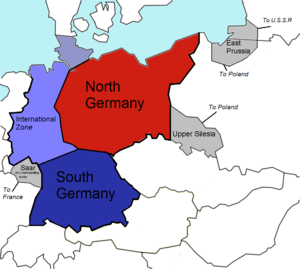
In the original proposal this was to be achieved in three main steps.- Germany was to be partitioned into two independent states.
- Germany's main centers of mining and industry, including the Saar area, the Ruhr areaRuhr AreaThe Ruhr, by German-speaking geographers and historians more accurately called Ruhr district or Ruhr region , is an urban area in North Rhine-Westphalia, Germany. With 4435 km² and a population of some 5.2 million , it is the largest urban agglomeration in Germany...
and Upper SilesiaSilesiaSilesia is a historical region of Central Europe located mostly in Poland, with smaller parts also in the Czech Republic, and Germany.Silesia is rich in mineral and natural resources, and includes several important industrial areas. Silesia's largest city and historical capital is Wrocław...
were to be internationalized or annexed by neighboring nations. - All heavy industry was to be dismantled or otherwise destroyed.
At the Second Quebec Conference
Second Quebec Conference
The Second Quebec Conference was a high level military conference held during World War II between the British, Canadian and American governments. The conference was held in Quebec City, September 12, 1944 - September 16, 1944, and was the second conference to be held in Quebec, after "QUADRANT"...
on September 16, 1944, U.S. President
President of the United States
The President of the United States of America is the head of state and head of government of the United States. The president leads the executive branch of the federal government and is the commander-in-chief of the United States Armed Forces....
Franklin D. Roosevelt
Franklin D. Roosevelt
Franklin Delano Roosevelt , also known by his initials, FDR, was the 32nd President of the United States and a central figure in world events during the mid-20th century, leading the United States during a time of worldwide economic crisis and world war...
and Henry Morgenthau, Jr.
Henry Morgenthau, Jr.
Henry Morgenthau, Jr. was the U.S. Secretary of the Treasury during the administration of Franklin D. Roosevelt. He played a major role in designing and financing the New Deal...
persuaded the initially very reluctant British
United Kingdom
The United Kingdom of Great Britain and Northern IrelandIn the United Kingdom and Dependencies, other languages have been officially recognised as legitimate autochthonous languages under the European Charter for Regional or Minority Languages...
Prime Minister
Prime Minister of the United Kingdom
The Prime Minister of the United Kingdom of Great Britain and Northern Ireland is the Head of Her Majesty's Government in the United Kingdom. The Prime Minister and Cabinet are collectively accountable for their policies and actions to the Sovereign, to Parliament, to their political party and...
Winston Churchill
Winston Churchill
Sir Winston Leonard Spencer-Churchill, was a predominantly Conservative British politician and statesman known for his leadership of the United Kingdom during the Second World War. He is widely regarded as one of the greatest wartime leaders of the century and served as Prime Minister twice...
to agree to the plan, likely using a $6 billion Lend Lease agreement to do so. Churchill chose however to narrow the scope of Morgenthau's proposal by drafting a new version of the memorandum, which ended up being the version signed by the two statesmen.
The memorandum concluded "is looking forward to converting Germany into a country primarily agricultural and pastoral in its character."
News of the existence of the plan was leaked to the press. President Roosevelt's response to press inquiries was to deny the press reports.
In wartime Germany, Propaganda Minister
Ministry of Public Enlightenment and Propaganda
The Reich Ministry of Public Enlightenment and Propaganda was Nazi Germany's ministry that enforced Nazi Party ideology in Germany and regulated its culture and society. Founded on March 13, 1933, by Adolf Hitler's new National Socialist government, the Ministry was headed by Dr...
Joseph Goebbels
Joseph Goebbels
Paul Joseph Goebbels was a German politician and Reich Minister of Propaganda in Nazi Germany from 1933 to 1945. As one of Adolf Hitler's closest associates and most devout followers, he was known for his zealous oratory and anti-Semitism...
was able to use the plan to bolster the German resistance on the Western front.
In occupied Germany, the thinking behind the Morgenthau plan was reflected in the U.S. occupation directive JCS 1067 and in the Allied Industrial plans for Germany
Industrial plans for Germany
The Industrial plans for Germany were designs the Allies considered imposing on Germany in the aftermath of World War II to reduce and manage Germany's industrial capacity.-Background:...
aimed at "industrial disarmament", designed to reduce German economic might and to destroy Germany's capability to wage war by complete or partial deindustrialization
Deindustrialization
Deindustrialization is a process of social and economic change caused by the removal or reduction of industrial capacity or activity in a country or region, especially heavy industry or manufacturing industry. It is an opposite of industrialization.- Multiple interpretations :There are multiple...
and restrictions imposed on utilization of remaining production capacity. By 1950, after the virtual completion of the by then much watered-out "level of industry" plans, equipment had been removed from 706 manufacturing plants in the west and steel production capacity had been reduced by 6,700,000 tons.
Partly for the sake of lowering German standards restrictions were also enacted on food relief imports. See (American food policy in occupied Germany
American food policy in occupied Germany
American food policy in occupied Germany refers to the food supply policies enacted by the U.S., and to some extent its dependent Allies, in the western occupation zones of Germany in the first two years of the ten-year occupation of Western Germany following World War II.Food relief shipments to...
)
According to some historians the U.S. government formally abandoned the Morgenthau plan as promoted occupation-policy in September 1946 with Secretary of State
United States Secretary of State
The United States Secretary of State is the head of the United States Department of State, concerned with foreign affairs. The Secretary is a member of the Cabinet and the highest-ranking cabinet secretary both in line of succession and order of precedence...
James F. Byrnes
James F. Byrnes
James Francis Byrnes was an American statesman from the state of South Carolina. During his career, Byrnes served as a member of the House of Representatives , as a Senator , as Justice of the Supreme Court , as Secretary of State , and as the 104th Governor of South Carolina...
' speech Restatement of Policy on Germany
Restatement of Policy on Germany
"Restatement of Policy on Germany" is a famous speech by James F. Byrnes, the United States Secretary of State, held in Stuttgart on September 6, 1946.Also known as the "Speech of hope" it set the tone of future U.S...
.
Unhappy with the Morgenthau-plan consequences, former U.S. President Herbert Hoover
Herbert Hoover
Herbert Clark Hoover was the 31st President of the United States . Hoover was originally a professional mining engineer and author. As the United States Secretary of Commerce in the 1920s under Presidents Warren Harding and Calvin Coolidge, he promoted partnerships between government and business...
remarked in a report dated 18 March 1947:
- "There is the illusion that the New Germany left after the annexations can be reduced to a 'pastoral state'. It cannot be done unless we exterminate or move 25,000,000 people out of it."
It is argued that it was Hoover's March 1947 statements in his report that led to the end of the Morgenthau plan and to a change in U.S. policy.
In July 1947 with the advent of the initial planning for the Marshall Plan
Marshall Plan
The Marshall Plan was the large-scale American program to aid Europe where the United States gave monetary support to help rebuild European economies after the end of World War II in order to combat the spread of Soviet communism. The plan was in operation for four years beginning in April 1948...
designed to help the now deteriorating European economy recover, the restrictions placed on annual German steel production were lessened. Permitted steel production quotas were raised from 25% of pre-war capacity to 50% of pre-war capacity. The U.S. occupation directive JCS 1067, whose economic section had prohibited "steps looking toward the economic rehabilitation of Germany [or] designed to maintain or strengthen the German economy", was replaced by the new U.S. occupation directive JCS 1779 which instead stated that "an orderly, prosperous Europe requires the economic contributions of a stable and productive Germany."
In early 1947 four million German soldiers were still being used as forced labour
Forced labor of Germans after World War II
Forced labour of Germans after World War II refers to the Allied use of German civilians and captured soldiers for forced labor in years following World War II ....
in the UK, France, and the Soviet Union.
In 1951 West Germany
West Germany
West Germany is the common English, but not official, name for the Federal Republic of Germany or FRG in the period between its creation in May 1949 to German reunification on 3 October 1990....
agreed to join the European Coal and Steel Community
European Coal and Steel Community
The European Coal and Steel Community was a six-nation international organisation serving to unify Western Europe during the Cold War and create the foundation for the modern-day developments of the European Union...
(ECSC) the following year. This meant that some of the economic restrictions on production capacity and on actual production that were imposed by the International Authority for the Ruhr
International Authority for the Ruhr
The International Authority for the Ruhr was an international body established in 1949 by the Allied powers to control the coal and steel industry of the Ruhr Area in West Germany....
were lifted, and that its role was taken over by the ECSC.
Although dismantling of West German industry ended in 1951, "industrial disarmament" lingered in restrictions on actual German Steel production, and production capacity, as well as on restriction on key industries. All remaining restrictions were finally rescinded on May 5, 1955. According to Frederick Gareau, noting that although U.S. policy had changed well before that; "the last act of the Morgenthau drama occurred on that date [May 5, 1955] or when the Saar
Saar (protectorate)
The Saar Protectorate was a German borderland territory twice temporarily made a protectorate state. Since rejoining Germany the second time in 1957, it is the smallest Federal German Area State , the Saarland, not counting the city-states Berlin, Hamburg and Bremen...
was returned to Germany [January 1, 1957]."
Vladimir Petrov concludes that the Allies "delayed by several years the economic reconstruction of the wartorn continent, a reconstruction which subsequently cost the United States billions of dollars."
Morgenthau's memorandum
The original memorandum, written sometime between January and early September 1944, signed by Morgenthau, and headed "Suggested Post-Surrender Program for Germany" is preserved at the Franklin D. Roosevelt Presidential Library and MuseumFranklin D. Roosevelt Presidential Library and Museum
The Franklin D. Roosevelt Library in Hyde Park, New York is the first presidential library built in the United States. It was conceived and built under the direction of President Franklin Delano Roosevelt from 1939 to 1940.- History :...
. The text, and a facsimile image, can be viewed online.
The main provisions can be summarized as follows:
"1. Demilitarization of Germany. : It should be the aim of the Allied Forces to accomplish the complete demilitarization of Germany in the shortest possible period of time after surrender. This means completely disarming the German Army and people (including the removal or destruction of all war material), the total destruction of the whole German armament industry, and the removal or destruction of other key industries which are basic to military strength.
2. Partitioning of Germany. : (a) Poland should get that part of East Prussia
East Prussia
East Prussia is the main part of the region of Prussia along the southeastern Baltic Coast from the 13th century to the end of World War II in May 1945. From 1772–1829 and 1878–1945, the Province of East Prussia was part of the German state of Prussia. The capital city was Königsberg.East Prussia...
which doesn't go to the USSR and the southern portion of Silesia
Silesia
Silesia is a historical region of Central Europe located mostly in Poland, with smaller parts also in the Czech Republic, and Germany.Silesia is rich in mineral and natural resources, and includes several important industrial areas. Silesia's largest city and historical capital is Wrocław...
as indicated on the attached map, (Appendix A).
- (b) France should get the Saar and the adjacent territories bounded by the Rhine and the MoselleMoselleMoselle is a department in the east of France named after the river Moselle.- History :Moselle is one of the original 83 departments created during the French Revolution on March 4, 1790...
rivers. - (c) As indicated in part 3 an International zoneInternational zoneAn international zone is a type of extraterritoriality governed by international law, or similar treaty between two or more nations. They can be found within international airports and can contain duty free shopping. In areas of conflict there may be international zones called green zones that form...
should be created containing the RuhrRuhr AreaThe Ruhr, by German-speaking geographers and historians more accurately called Ruhr district or Ruhr region , is an urban area in North Rhine-Westphalia, Germany. With 4435 km² and a population of some 5.2 million , it is the largest urban agglomeration in Germany...
and the surrounding industrial areas. - (d) The remaining portion of Germany should be divided into two autonomous, independent states, (1) a South German state comprising Bavaria, Württemberg, Baden and some smaller areas and (2) a North German state comprising a large part of the old state of Prussia, Saxony, Thuringia and several smaller states.
- There shall be a custom union between the new South German state and Austria, which will be restored to her pre-1938 political borders.
3. The Ruhr Area. : (The Ruhr, surrounding industrial areas, as shown on the attached map, including the Rhineland, the Kiel Canal
Kiel Canal
The Kiel Canal , known as the Kaiser-Wilhelm-Kanal until 1948, is a long canal in the German state of Schleswig-Holstein.The canal links the North Sea at Brunsbüttel to the Baltic Sea at Kiel-Holtenau. An average of is saved by using the Kiel Canal instead of going around the Jutland Peninsula....
, and all German territory north of the Kiel Canal.)
- Here lies the heart of German industrial power, the cauldron of wars. This area should not only be stripped of all presently existing industries but so weakened and controlled that it can not in the foreseeable future become an industrial area. The following steps will accomplish this:
- (a) Within a short period, if possible not longer than 6 months after the cessation of hostilities, all industrial plants and equipment not destroyed by military action shall either be completely dismantled and removed from the area or completely destroyed. All equipment shall be removed from the mines and the mines shall be thoroughly wrecked.
- It is anticipated that the stripping of this area would be accomplished in three stages:
- (i) The military forces immediately upon entry into the area shall destroy all plants and equipment which cannot be removed.
- (ii) Removal of plants and equipment by members of the United Nations as restitution and reparation (Paragraph 4).
- (iii) All plants and equipment not removed within a stated period of time, say 6 months, will be completely destroyed or reduced to scrap and allocated to the United Nations.
- (b) All people within the area should be made to understand that this area will not again be allowed to become an industrial area. Accordingly, all people and their families within the area having special skills or technical training should be encouraged to migrate permanently from the area and should be as widely dispersed as possible.
- (c) The area should be made an international zoneInternational zoneAn international zone is a type of extraterritoriality governed by international law, or similar treaty between two or more nations. They can be found within international airports and can contain duty free shopping. In areas of conflict there may be international zones called green zones that form...
to be governed by an international security organization to be established by the United Nations. In governing the area the international organization should be guided by policies designed to further the above stated objectives.
4. Restitution and Reparation. : Reparations, in the form of recurrent payments and deliveries, should not be demanded. Restitution and reparation shall be effected by the transfer of existing German resources and territories, e.g.
- (a) by restitution of property looted by the Germans in territories occupied by them;
- (b) by transfer of German territory and German private rights in industrial property situated in such territory to invaded countries and the international organization under the program of partition;
- (c) by the removal and distribution among devastated countries of industrial plants and equipment situated within the International Zone and the North and South German states delimited in the section on partition;
- (d) by forced German labor outside Germany; and
- (e) by confiscation of all German assets of any character whatsoever outside of Germany."
The Second Quebec Conference (September 1944)
At the Second Quebec ConferenceSecond Quebec Conference
The Second Quebec Conference was a high level military conference held during World War II between the British, Canadian and American governments. The conference was held in Quebec City, September 12, 1944 - September 16, 1944, and was the second conference to be held in Quebec, after "QUADRANT"...
, a high-level military conference held in Quebec City
Quebec City
Quebec , also Québec, Quebec City or Québec City is the capital of the Canadian province of Quebec and is located within the Capitale-Nationale region. It is the second most populous city in Quebec after Montreal, which is about to the southwest...
, September 12– September 16, 1944, the British
United Kingdom
The United Kingdom of Great Britain and Northern IrelandIn the United Kingdom and Dependencies, other languages have been officially recognised as legitimate autochthonous languages under the European Charter for Regional or Minority Languages...
and United States
United States
The United States of America is a federal constitutional republic comprising fifty states and a federal district...
governments, represented by Winston Churchill
Winston Churchill
Sir Winston Leonard Spencer-Churchill, was a predominantly Conservative British politician and statesman known for his leadership of the United Kingdom during the Second World War. He is widely regarded as one of the greatest wartime leaders of the century and served as Prime Minister twice...
and Franklin D. Roosevelt
Franklin D. Roosevelt
Franklin Delano Roosevelt , also known by his initials, FDR, was the 32nd President of the United States and a central figure in world events during the mid-20th century, leading the United States during a time of worldwide economic crisis and world war...
, respectively, reached agreement on a number of matters, including a plan for Germany, based on Morgenthau's original proposal. The memorandum drafted by Churchill provided for "eliminating the warmaking industries in the Ruhr and the Saar... looking forward to converting Germany into a country primarily agricultural and pastoral in its character." However, it no longer included a plan to partition the country into several independent states.
This memorandum, together with the later effected "industrial disarmament" plans in occupied Germany, is generally known as the real Morgenthau plan.
(See United States Department of State Foreign relations of the United States, Conference at Quebec, 1944 pp. 466–467 for the full text of the signed memoranda.)
Influence on policy
The negative public reaction to the publishing of the Morgenthau plan had forced President Roosevelt to publicly shelve it, and he permitted no further planning for the occupation of Germany. With the death of the president before the end of the war, the plan as such never took effect. But since its ideas permeated parts of the American administration, especially Morgenthau's Treasury, it did influence subsequent American and Allied planning, most notably:- the Potsdam ConferencePotsdam ConferenceThe Potsdam Conference was held at Cecilienhof, the home of Crown Prince Wilhelm Hohenzollern, in Potsdam, occupied Germany, from 16 July to 2 August 1945. Participants were the Soviet Union, the United Kingdom, and the United States...
- Joint Chiefs of Staff Directive 1067 (April 1945 – July 1947)
- The industrial plans for Germany. (Level of industry agreements)
JCS 1067 explicitly prohibited U.S. occupation authorities from providing any economic or reconstruction assistance of any kind to the German people, not even to maintain the current economic levels. U.S. occupation efforts were to be focused on denazification
Denazification
Denazification was an Allied initiative to rid German and Austrian society, culture, press, economy, judiciary, and politics of any remnants of the National Socialist ideology. It was carried out specifically by removing those involved from positions of influence and by disbanding or rendering...
and the destruction of heavy industry war-production capability. In January 1946 the Allied Control Council
Allied Control Council
The Allied Control Council or Allied Control Authority, known in the German language as the Alliierter Kontrollrat and also referred to as the Four Powers , was a military occupation governing body of the Allied Occupation Zones in Germany after the end of World War II in Europe...
set the foundation of the future German economy by putting a cap on German steel production, the maximum allowed was set at about 25% of the prewar production level. Steel plants thus made redundant were dismantled.
Also as a consequence of the Potsdam conference
Potsdam Conference
The Potsdam Conference was held at Cecilienhof, the home of Crown Prince Wilhelm Hohenzollern, in Potsdam, occupied Germany, from 16 July to 2 August 1945. Participants were the Soviet Union, the United Kingdom, and the United States...
, the occupation forces of all nations were obliged to ensure that German standards of living were made equal to the level of its European neighbors with which it had been at war with, France in particular. Germany was to be reduced to the standard of life it had known at the height of the Great Depression
Great Depression
The Great Depression was a severe worldwide economic depression in the decade preceding World War II. The timing of the Great Depression varied across nations, but in most countries it started in about 1929 and lasted until the late 1930s or early 1940s...
(1932). The first "level of industry" plan, signed in 1946, stated that German heavy industry was to be lowered to 50% of its 1938 levels by the closing of 1,500 manufacturing plants
The problems brought on by the execution of these types of policies were eventually apparent to most U.S. officials in Germany. Germany had long been the industrial giant of Europe, and its poverty held back the general European recovery. The continued scarcity in Germany also led to considerable expenses for the occupying powers, which were obligated to try and make up the most important shortfalls through the GARIOA
GARIOA
Government and Relief in Occupied Areas was a program under which the US after the 1945 end of World War II from 1946 onwards provided emergency aid to the occupied nations, Japan, Germany, Austria. The aid was predominantly in the form of food to alleviate starvation in the occupied...
program (Government and Relief in Occupied Areas). In view of the continued poverty and famine in Europe, and with the onset of the Cold War
Cold War
The Cold War was the continuing state from roughly 1946 to 1991 of political conflict, military tension, proxy wars, and economic competition between the Communist World—primarily the Soviet Union and its satellite states and allies—and the powers of the Western world, primarily the United States...
which made it important not to lose all of Germany to the communist
Communism
Communism is a social, political and economic ideology that aims at the establishment of a classless, moneyless, revolutionary and stateless socialist society structured upon common ownership of the means of production...
s, it was apparent by 1947 that a change of policy was required.
The change was heralded by Restatement of Policy on Germany
Restatement of Policy on Germany
"Restatement of Policy on Germany" is a famous speech by James F. Byrnes, the United States Secretary of State, held in Stuttgart on September 6, 1946.Also known as the "Speech of hope" it set the tone of future U.S...
, a famous speech by James F. Byrnes
James F. Byrnes
James Francis Byrnes was an American statesman from the state of South Carolina. During his career, Byrnes served as a member of the House of Representatives , as a Senator , as Justice of the Supreme Court , as Secretary of State , and as the 104th Governor of South Carolina...
, then United States Secretary of State
United States Secretary of State
The United States Secretary of State is the head of the United States Department of State, concerned with foreign affairs. The Secretary is a member of the Cabinet and the highest-ranking cabinet secretary both in line of succession and order of precedence...
, held in Stuttgart
Stuttgart
Stuttgart is the capital of the state of Baden-Württemberg in southern Germany. The sixth-largest city in Germany, Stuttgart has a population of 600,038 while the metropolitan area has a population of 5.3 million ....
on September 6, 1946. Also known as the "Speech of hope" it set the tone of future U.S. policy as it repudiated the Morgenthau Plan economic policies and with its message of change to a policy of economic reconstruction gave the Germans
Germany
Germany , officially the Federal Republic of Germany , is a federal parliamentary republic in Europe. The country consists of 16 states while the capital and largest city is Berlin. Germany covers an area of 357,021 km2 and has a largely temperate seasonal climate...
hope for the future. Herbert Hoover
Herbert Hoover
Herbert Clark Hoover was the 31st President of the United States . Hoover was originally a professional mining engineer and author. As the United States Secretary of Commerce in the 1920s under Presidents Warren Harding and Calvin Coolidge, he promoted partnerships between government and business...
's situation reports
The President's Economic Mission to Germany and Austria
The President's Economic Mission to Germany and Austria was a series of reports commissioned by US President Harry S. Truman and written by former US President Herbert Hoover....
from 1947, and "A Report on Germany
A Report on Germany
After World War II, at the request of General Lucius D. Clay, Lewis H. Brown wrote A Report on Germany, which served as a detailed recommendation for the reconstruction of post-war Germany, and served as a basis for the Marshall Plan. General Clay selected Brown to write the report because of...
" also served to help change occupation policy. The Western powers worst fear by now was that the poverty and hunger would drive the Germans to Communism
Communism
Communism is a social, political and economic ideology that aims at the establishment of a classless, moneyless, revolutionary and stateless socialist society structured upon common ownership of the means of production...
. General Lucius Clay
Lucius Clay
Lucius Clay may refer to:*Lucius D. Clay , American military governor of Germany after World War II*Lucius D. Clay, Jr. , American commander of the Air Defense Command...
stated "There is no choice between being a communist on 1,500 calories a day and a believer in democracy on a thousand."
After lobbying by the Joint Chiefs of Staff
Joint Chiefs of Staff
The Joint Chiefs of Staff is a body of senior uniformed leaders in the United States Department of Defense who advise the Secretary of Defense, the Homeland Security Council, the National Security Council and the President on military matters...
, and Generals Clay
Lucius D. Clay
General Lucius Dubignon Clay was an American officer and military governor of the United States Army known for his administration of Germany immediately after World War II. Clay was deputy to General Dwight D. Eisenhower, 1945; deputy military governor, Germany 1946; commander in chief, U.S....
and Marshall
George Marshall
George Catlett Marshall was an American military leader, Chief of Staff of the Army, Secretary of State, and the third Secretary of Defense...
, the Truman
Harry S. Truman
Harry S. Truman was the 33rd President of the United States . As President Franklin D. Roosevelt's third vice president and the 34th Vice President of the United States , he succeeded to the presidency on April 12, 1945, when President Roosevelt died less than three months after beginning his...
administration finally realized that economic recovery in Europe could not go forward without the reconstruction of the German industrial base on which it had previously been dependent.
In July 1947, President Harry S. Truman
Harry S. Truman
Harry S. Truman was the 33rd President of the United States . As President Franklin D. Roosevelt's third vice president and the 34th Vice President of the United States , he succeeded to the presidency on April 12, 1945, when President Roosevelt died less than three months after beginning his...
rescinded on "national security grounds" the punitive JCS 1067, which had directed the U.S. forces of occupation in Germany to "take no steps looking toward the economic rehabilitation of Germany." It was replaced by JCS 1779, which instead stressed that "[a]n orderly, prosperous Europe requires the economic contributions of a stable and productive Germany."
The most notable example of this change of policy was a plan established by U.S. Secretary of State
United States Secretary of State
The United States Secretary of State is the head of the United States Department of State, concerned with foreign affairs. The Secretary is a member of the Cabinet and the highest-ranking cabinet secretary both in line of succession and order of precedence...
George Marshall
George Marshall
George Catlett Marshall was an American military leader, Chief of Staff of the Army, Secretary of State, and the third Secretary of Defense...
, the "European Recovery Program", better known as the Marshall Plan
Marshall Plan
The Marshall Plan was the large-scale American program to aid Europe where the United States gave monetary support to help rebuild European economies after the end of World War II in order to combat the spread of Soviet communism. The plan was in operation for four years beginning in April 1948...
, which in the form of loans instead of the free aid received by other recipients was extended to also include West Germany
West Germany
West Germany is the common English, but not official, name for the Federal Republic of Germany or FRG in the period between its creation in May 1949 to German reunification on 3 October 1990....
.
The Marshall Plan ... is not a philanthropic enterprise ... It is based on our views of the requirements of American security ... This is the only peaceful avenue now open to us which may answer the communist challenge to our way of life and our national security." (Allen W. Dulles, The Marshall Plan)
Roosevelt's support for the plan
Secretary of the Treasury Henry J. Morgenthau Jr. convinced Roosevelt to write to Secretary of State Cordell HullCordell Hull
Cordell Hull was an American politician from the U.S. state of Tennessee. He is best known as the longest-serving Secretary of State, holding the position for 11 years in the administration of President Franklin Delano Roosevelt during much of World War II...
and Secretary of War Henry L. Stimson
Henry L. Stimson
Henry Lewis Stimson was an American statesman, lawyer and Republican Party politician and spokesman on foreign policy. He twice served as Secretary of War 1911–1913 under Republican William Howard Taft and 1940–1945, under Democrat Franklin D. Roosevelt. In the latter role he was a leading hawk...
saying that a U.S. occupation
Military occupation
Military occupation occurs when the control and authority over a territory passes to a hostile army. The territory then becomes occupied territory.-Military occupation and the laws of war:...
policy which anticipated that "Germany is to be restored just as much as the Netherlands
Netherlands
The Netherlands is a constituent country of the Kingdom of the Netherlands, located mainly in North-West Europe and with several islands in the Caribbean. Mainland Netherlands borders the North Sea to the north and west, Belgium to the south, and Germany to the east, and shares maritime borders...
or Belgium
Belgium
Belgium , officially the Kingdom of Belgium, is a federal state in Western Europe. It is a founding member of the European Union and hosts the EU's headquarters, and those of several other major international organisations such as NATO.Belgium is also a member of, or affiliated to, many...
" was excessively lenient. A better policy would have the Germans "fed three times a day with soup from Army soup kitchens" so "they will remember that experience the rest of their lives." Morgenthau was the only Cabinet
Cabinet (government)
A Cabinet is a body of high ranking government officials, typically representing the executive branch. It can also sometimes be referred to as the Council of Ministers, an Executive Council, or an Executive Committee.- Overview :...
member invited to participate in the Quebec Conference
Second Quebec Conference
The Second Quebec Conference was a high level military conference held during World War II between the British, Canadian and American governments. The conference was held in Quebec City, September 12, 1944 - September 16, 1944, and was the second conference to be held in Quebec, after "QUADRANT"...
during which the Plan was agreed to.
Roosevelt's motivations for agreeing to Morgenthau's proposal may be attributed to his desire to be on good terms with Joseph Stalin
Joseph Stalin
Joseph Vissarionovich Stalin was the Premier of the Soviet Union from 6 May 1941 to 5 March 1953. He was among the Bolshevik revolutionaries who brought about the October Revolution and had held the position of first General Secretary of the Communist Party of the Soviet Union's Central Committee...
and to a personal conviction that Germany must be treated harshly. In an August 26, 1944 letter to Queen Wilhelmina of the Netherlands
Wilhelmina of the Netherlands
Wilhelmina was Queen regnant of the Kingdom of the Netherlands from 1890 to 1948. She ruled the Netherlands for fifty-eight years, longer than any other Dutch monarch. Her reign saw World War I and World War II, the economic crisis of 1933, and the decline of the Netherlands as a major colonial...
, Roosevelt wrote that "There are two schools of thought, those who would be altruistic in regard to the Germans, hoping by loving kindness to make them Christians again — and those who would adopt a much 'tougher' attitude. Most decidedly I belong to the latter school, for though I am not bloodthirsty, I want the Germans to know that this time at least they have definitely lost the war." Roosevelt is also quoted as saying to Morgenthau that "We have got to be tough with the Germany and I mean the German people not just the Nazis. We either have to castrate the German people or you have got to treat them in such a manner so they can't just go on reproducing people who want to continue the way they have in the past."
The Morgenthau plan faced strong opposition within Roosevelt's government. Henry L. Stimson
Henry L. Stimson
Henry Lewis Stimson was an American statesman, lawyer and Republican Party politician and spokesman on foreign policy. He twice served as Secretary of War 1911–1913 under Republican William Howard Taft and 1940–1945, under Democrat Franklin D. Roosevelt. In the latter role he was a leading hawk...
, Secretary of War
United States Secretary of War
The Secretary of War was a member of the United States President's Cabinet, beginning with George Washington's administration. A similar position, called either "Secretary at War" or "Secretary of War," was appointed to serve the Congress of the Confederation under the Articles of Confederation...
, said he had "yet to meet a man who was not horrified at the 'Carthaginian' attitude of the Treasury. It is Semitism gone wild for vengeance and will lay the seeds of another war in the next generation." He further pointed out that the plan violated the Atlantic Charter
Atlantic Charter
The Atlantic Charter was a pivotal policy statement first issued in August 1941 that early in World War II defined the Allied goals for the post-war world. It was drafted by Britain and the United States, and later agreed to by all the Allies...
, which promised equal opportunity for the pursuit of happiness to both victors and vanquished. In a note to the president dated September 5, 1944, Stimson wrote:
We contemplate the transfer from Germany of ownership of East PrussiaEast PrussiaEast Prussia is the main part of the region of Prussia along the southeastern Baltic Coast from the 13th century to the end of World War II in May 1945. From 1772–1829 and 1878–1945, the Province of East Prussia was part of the German state of Prussia. The capital city was Königsberg.East Prussia...
, Upper SilesiaSilesiaSilesia is a historical region of Central Europe located mostly in Poland, with smaller parts also in the Czech Republic, and Germany.Silesia is rich in mineral and natural resources, and includes several important industrial areas. Silesia's largest city and historical capital is Wrocław...
, Alsace and LorraineAlsace-LorraineThe Imperial Territory of Alsace-Lorraine was a territory created by the German Empire in 1871 after it annexed most of Alsace and the Moselle region of Lorraine following its victory in the Franco-Prussian War. The Alsatian part lay in the Rhine Valley on the west bank of the Rhine River and east...
(each of them except the first containing raw materials of importance) together with the imposition of general economic controls. We also are considering the wisdom of a possible partition of GermanyGermanyGermany , officially the Federal Republic of Germany , is a federal parliamentary republic in Europe. The country consists of 16 states while the capital and largest city is Berlin. Germany covers an area of 357,021 km2 and has a largely temperate seasonal climate...
into north and south sections, as well as the creation of an internationalized State in the Ruhr. With such precautions, or indeed with only some of them, it certainly should not be necessary for us to obliterate all industrial productivity in the Ruhr areaRuhr AreaThe Ruhr, by German-speaking geographers and historians more accurately called Ruhr district or Ruhr region , is an urban area in North Rhine-Westphalia, Germany. With 4435 km² and a population of some 5.2 million , it is the largest urban agglomeration in Germany...
, in order to preclude its future misuse.
Nor can I agree that it should be one of our purposes to hold the German population "to a subsistence level" if this means the edge of povertyPovertyPoverty is the lack of a certain amount of material possessions or money. Absolute poverty or destitution is inability to afford basic human needs, which commonly includes clean and fresh water, nutrition, health care, education, clothing and shelter. About 1.7 billion people are estimated to live...
.
Secretary of State Hull was outraged by Morgenthau's "inconceivable intrusion" into foreign policy. Hull told Roosevelt that the plan would inspire last ditch resistance and cost thousands of American lives. Hull was so upset over the plan that it prompted his resignation from the administration. (This assertion of the reason for Hull's resignation is highly debatable; Hull's letter of resignation, available here, http://www.presidency.ucsb.edu/ws/index.php?pid=16479, makes clear that ill health was the cause, and that Hull wanted to continue in office: "It is with inexpressible disappointment that I find it necessary, for considerations of health, to retire from public service. ... It is a supreme tragedy to me personally that I am unable to continue making my full contribution to such great international undertakings as the creation of the postwar peace organization, the solution of the many other problems involved in the promotion of international cooperation, and the final development of a full and complete structure of a world order under law. When I recover my strength, I shall individually be always at your service in every possible way.")
Churchill's support for the plan
Churchill was not inclined to support the proposal, saying "England would be chained to a dead body." Roosevelt reminded Churchill of Stalin's comments at the Tehran ConferenceTehran Conference
The Tehran Conference was the meeting of Joseph Stalin, Franklin D. Roosevelt and Winston Churchill between November 28 and December 1, 1943, most of which was held at the Soviet Embassy in Tehran, Iran. It was the first World War II conference amongst the Big Three in which Stalin was present...
, and asked "Are you going to let Germany produce modern metal furniture? The manufacture of metal furniture can be quickly turned in the manufacture of armament." The meeting broke up on Churchill's disagreement but Roosevelt suggested that Morgenthau and White continue to discuss with Lord Cherwell
Frederick Lindemann, 1st Viscount Cherwell
Frederick Alexander Lindemann, 1st Viscount Cherwell FRS PC CH was an English physicist who was an influential scientific adviser to the British government, particularly Winston Churchill...
, Churchill's personal assistant.
Lord Cherwell has been described as having "an almost pathological hatred for Nazi Germany, and an almost medieval desire for revenge was a part of his character". Morgenthau is quoted as saying to his staff that "I can't overemphasize how helpful Lord Cherwell was because he could advise how to handle Churchill" (Blum, p. 373). In any case, Cherwell was able to persuade Churchill to change his mind. Churchill later said that "At first I was violently opposed to the idea. But the President and Mr. Morgenthau — from whom we had much to ask — were so insistent that in the end we agreed to consider it".
Some have read into the clause "from whom we had much to ask" that Churchill was bought off, and note a September 15 memo from Roosevelt to Hull stating that "Morgenthau has presented at Quebec, in conjunction with his plan for Germany, a proposal of credits to Britain totalling six and half billion dollars." Hull's comment on this was that "this might suggest to some the quid pro quo
Quid pro quo
Quid pro quo most often means a more-or-less equal exchange or substitution of goods or services. English speakers often use the term to mean "a favour for a favour" and the phrases with almost identical meaning include: "give and take", "tit for tat", "this for that", and "you scratch my back,...
with which the Secretary of the Treasury was able to get Mr. Churchill's adherence to his cataclysmic plan for Germany".
Harry Dexter White
Harry Dexter White
Harry Dexter White was an American economist, and senior U.S. Treasury department official, participating in the Bretton Woods conference...
, regarded by many as the principal author of the plan, was after his death exposed as having passed information onto the Soviets
Soviet Union
The Soviet Union , officially the Union of Soviet Socialist Republics , was a constitutionally socialist state that existed in Eurasia between 1922 and 1991....
, who were U.S. allies at the time.
At Quebec White made sure that Lord Cherwell understood that economic aid to Britain was dependent on British approval of the plan. During the signing of the plan, which coincided with the signing of a loan agreement, President Roosevelt proposed that they sign the plan first. This prompted Churchill to exclaim: "What do you want me to do? Get on my hind legs and beg like Fala?"
Partial rejection of the plan
Anthony EdenAnthony Eden
Robert Anthony Eden, 1st Earl of Avon, KG, MC, PC was a British Conservative politician, who was Prime Minister from 1955 to 1957...
expressed his strong opposition to the plan and, with the support of some others, was able to get the Morgenthau Plan set aside in Britain. In the U.S., Hull argued that nothing would be left to Germany but land, and only 60% of the Germans could live off the land, meaning 40% of the population would die. Stimson expressed his opposition even more forcefully to Roosevelt. According to Stimson, the President said that he just wanted to help Britain get a share of the Ruhr and denied that he intended to fully deindustrialize
Deindustrialization
Deindustrialization is a process of social and economic change caused by the removal or reduction of industrial capacity or activity in a country or region, especially heavy industry or manufacturing industry. It is an opposite of industrialization.- Multiple interpretations :There are multiple...
Germany. Stimson replied, "Mr. President, I don't like you to dissemble to me" and read back to Roosevelt what he had signed. Struck by this, Roosevelt said he had "no idea how he could have initialed this" (Elting E. Morrison quoting Stimson's October 3, 1944 diary, "Turmoil and Tradition: A Study of the Life and Times of Henry L. Stimson" (Boston, 1960) p. 609). The theory that Roosevelt was not truly rejecting the plan, just postponing the decision until a more propitious time is supported by Eleanor Roosevelt
Eleanor Roosevelt
Anna Eleanor Roosevelt was the First Lady of the United States from 1933 to 1945. She supported the New Deal policies of her husband, distant cousin Franklin Delano Roosevelt, and became an advocate for civil rights. After her husband's death in 1945, Roosevelt continued to be an international...
, who states that she never heard him disagree with the basics of the plan, and who believed that "the repercussions brought about by the press stories made him feel that it was wise to abandon any final solution at that time."
On 10 May 1945 President Truman approved JCS (Joint Chiefs of Staff policy) 1067 which directed the U.S. forces of occupation in Germany to "...take no steps looking toward the economic rehabilitation of Germany [nor steps] designed to maintain or strengthen the German economy". This was a modified version of the Morgenthau Plan. The net effect was that Germany wasn't allowed to realistically produce goods for export in order to purchase food; millions of Germans were supplied only meager starvation rations, with 1947 being the worst year. It took 2 years (1945 to 1947) of death and disease, and fears that starving Germans might "go Communist" before U.S. Secretary of State James F. Byrnes
James F. Byrnes
James Francis Byrnes was an American statesman from the state of South Carolina. During his career, Byrnes served as a member of the House of Representatives , as a Senator , as Justice of the Supreme Court , as Secretary of State , and as the 104th Governor of South Carolina...
made his Stuttgart speech. Byrnes had some questionable history: he agreed at Potsdam in July 1945 to "temporarily assign" an area of southern Silesia to "Polish Administration" which was more than the Poles and Soviets had expected to be agreed to. The British were not happy with Mr. Byrnes's maneuver.
Dismantling of (West) German industry ended in 1951, but "industrial disarmament" lingered in restrictions on actual German steel production, and production capacity, as well as on restriction on key industries. All remaining restrictions were finally rescinded on May 5, 1955. "The last act of the Morgenthau drama occurred on that date or when the Saar
Saar (protectorate)
The Saar Protectorate was a German borderland territory twice temporarily made a protectorate state. Since rejoining Germany the second time in 1957, it is the smallest Federal German Area State , the Saarland, not counting the city-states Berlin, Hamburg and Bremen...
was returned to Germany."
Wartime consequences
Drew PearsonDrew Pearson (journalist)
Andrew Russell Pearson , known professionally as Drew Pearson, was one of the best-known American columnists of his day, noted for his muckraking syndicated newspaper column "Washington Merry-Go-Round," in which he attacked various public persons, sometimes with little or no objective proof for his...
publicized the plan on September 21, although Pearson himself was sympathetic to it. More critical stories in the New York Times and The Wall Street Journal
The Wall Street Journal
The Wall Street Journal is an American English-language international daily newspaper. It is published in New York City by Dow Jones & Company, a division of News Corporation, along with the Asian and European editions of the Journal....
quickly followed. Joseph Goebbels
Joseph Goebbels
Paul Joseph Goebbels was a German politician and Reich Minister of Propaganda in Nazi Germany from 1933 to 1945. As one of Adolf Hitler's closest associates and most devout followers, he was known for his zealous oratory and anti-Semitism...
said that "The Jew Morgenthau" wanted to make Germany into a giant potato patch. Goebbels used the Morgenthau Plan for his propaganda
Propaganda
Propaganda is a form of communication that is aimed at influencing the attitude of a community toward some cause or position so as to benefit oneself or one's group....
machine extensively. The headline of the Völkischer Beobachter
Völkischer Beobachter
The Völkischer Beobachter was the newspaper of the National Socialist German Workers' Party from 1920. It first appeared weekly, then daily from February 8, 1923...
stated, “ROOSEVELT AND CHURCHILL AGREE TO JEWISH MURDER PLAN!”
The Washington Post
The Washington Post
The Washington Post is Washington, D.C.'s largest newspaper and its oldest still-existing paper, founded in 1877. Located in the capital of the United States, The Post has a particular emphasis on national politics. D.C., Maryland, and Virginia editions are printed for daily circulation...
urged a stop to helping Dr. Goebbels: if the Germans suspect that nothing but complete destruction lies ahead, then they will fight on. The Republican presidential candidate Thomas Dewey
Thomas Dewey
Thomas Edmund Dewey was the 47th Governor of New York . In 1944 and 1948, he was the Republican candidate for President, but lost both times. He led the liberal faction of the Republican Party, in which he fought conservative Ohio Senator Robert A. Taft...
complained in his campaign that the Germans had been terrified by the plan into fanatical resistance, "Now they are fighting with the frenzy of despair."
General George Marshall
George Marshall
George Catlett Marshall was an American military leader, Chief of Staff of the Army, Secretary of State, and the third Secretary of Defense...
complained to Morgenthau that German resistance had strengthened. Hoping to get Morgenthau to relent on his plan for Germany, President Roosevelt's son-in-law Lt. Colonel John Boettiger who worked in the War Department
United States Department of War
The United States Department of War, also called the War Department , was the United States Cabinet department originally responsible for the operation and maintenance of the United States Army...
explained to Morgenthau how the American troops that had had to fight for five weeks against fierce German resistance to capture the city of Aachen
Aachen
Aachen has historically been a spa town in North Rhine-Westphalia, Germany. Aachen was a favoured residence of Charlemagne, and the place of coronation of the Kings of Germany. Geographically, Aachen is the westernmost town of Germany, located along its borders with Belgium and the Netherlands, ...
had complained to him that the Morgenthau Plan was "worth thirty divisions to the Germans." Morgenthau refused to relent.
On December 11, OSS
Office of Strategic Services
The Office of Strategic Services was a United States intelligence agency formed during World War II. It was the wartime intelligence agency, and it was a predecessor of the Central Intelligence Agency...
operative William Donovan sent Roosevelt a telegraph message from Bern, warning him of the consequences that the knowledge of the Morgenthau plan had had on German resistance; by showing them that the enemy planned the enslavement of Germany it had welded together ordinary Germans and the regime; the Germans continue to fight because they are convinced that defeat will bring nothing but oppression and exploitation. The message was a translation of a recent article in the Neue Zürcher Zeitung
Neue Zürcher Zeitung
The Neue Zürcher Zeitung is a major German language Swiss daily newspaper based in Zurich.One of the oldest newspapers still published, it originally appeared as Zürcher Zeitung, edited by Salomon Gessner, from January 12, 1780, and was renamed to Neue Zürcher Zeitung in 1821...
.
So far, the Allies have not offered the opposition any serious encouragement. On the contrary, they have again and again welded together the people and the Nazis by statements published, either out of indifference or with a purpose. To take a recent example, the Morgenthau plan gave Dr. Goebbels the best possible chance. He was able to prove to his countrymen, in black and white, that the enemy planned the enslavement of Germany.
The conviction that Germany had nothing to expect from defeat but oppression and exploitation still prevails, and that accounts for the fact that the Germans continue to fight. It is not a question of a regime, but of the homeland itself, and to save that, every German is bound to obey the call, whether he be Nazi or member of the opposition. http://www.fdrlibrary.marist.edu/psf/box32/t298m01.html
JCS 1067
A Handbook for Military Government in Germany was ready in August 1944, it was an occupation document which advocated a quick restoration of normal life for the German people and reconstruction of Germany. Henry Morgenthau, Jr.Henry Morgenthau, Jr.
Henry Morgenthau, Jr. was the U.S. Secretary of the Treasury during the administration of Franklin D. Roosevelt. He played a major role in designing and financing the New Deal...
brought it to the attention of President Franklin D. Roosevelt
Franklin D. Roosevelt
Franklin Delano Roosevelt , also known by his initials, FDR, was the 32nd President of the United States and a central figure in world events during the mid-20th century, leading the United States during a time of worldwide economic crisis and world war...
who after reading it rejected it with the words:
- "Too many people here and in England hold the view that the German people as a whole are not responsible for what has taken place – that only a few Nazis are responsible. That unfortunately is not based on fact. The German people must have it driven home to them that the whole nation has been engaged in a lawless conspiracy against the decencies of modern civilization."
A new document was drafted, the Joint Chiefs of Staff
Joint Chiefs of Staff
The Joint Chiefs of Staff is a body of senior uniformed leaders in the United States Department of Defense who advise the Secretary of Defense, the Homeland Security Council, the National Security Council and the President on military matters...
directive 1067 (JCS 1067). Here the US military government of occupation in Germany was ordered to "…take no steps looking toward the economic rehabilitation of Germany [or] designed to maintain or strengthen the German economy" and it was also ordered that starvation, disease and civil unrest were to be kept below such levels where they would pose a danger to the troops of occupation.
The directive was formally issued to Eisenhower in the spring of 1945, and it applied only to the US zone (although attempts had been made to get the other Allies to accept it). The occupation directive remained secret until October 17, 1945. It was made known to the public two months after the US had succeeded in incorporating much of it into the Potsdam Agreement
Potsdam Agreement
The Potsdam Agreement was the Allied plan of tripartite military occupation and reconstruction of Germany—referring to the German Reich with its pre-war 1937 borders including the former eastern territories—and the entire European Theatre of War territory...
.
On March 20, 1945 President Roosevelt was warned that the JCS 1067 was not workable: it would let the Germans "stew in their own juice". Roosevelt's response was "Let them have soup kitchens! Let their economy sink!" Asked if he wanted the German people to starve, he replied, "Why not?"
On May 10, 1945 Truman signed the JCS 1067. Morgenthau told his staff that it was a big day for the Treasury, and that he hoped that "someone doesn't recognize it as the Morgenthau Plan."
In occupied Germany Morgenthau left a direct legacy through what in OMGUS
Office of Military Government, United States
The Office of Military Government, United States was the United States military-established government created shortly after the end of hostilities in occupied Germany in World War II. Under General Lucius D...
commonly were called "Morgenthau boys". These were U.S. Treasury officials whom Dwight D. Eisenhower
Dwight D. Eisenhower
Dwight David "Ike" Eisenhower was the 34th President of the United States, from 1953 until 1961. He was a five-star general in the United States Army...
has "loaned" in to the Army of occupation. These people ensured that the JCS 1067 was interpreted as strictly as possible. They were most active in the first crucial months of the occupation, but continued their activities for almost two years following the resignation of Morgenthau in mid 1945 and some time later also of their leader Colonel Bernard Bernstein, who was "the repository of the Morgenthau spirit in the army of occupation".
Morgenthau had been able to wield considerable influence over Joint Chiefs of Staff
Joint Chiefs of Staff
The Joint Chiefs of Staff is a body of senior uniformed leaders in the United States Department of Defense who advise the Secretary of Defense, the Homeland Security Council, the National Security Council and the President on military matters...
Directive 1067. JCS 1067 was a basis for U.S. occupation policy until July 1947, and like the Morgenthau Plan, was intended to reduce German living standards. The production of oil
Oil
An oil is any substance that is liquid at ambient temperatures and does not mix with water but may mix with other oils and organic solvents. This general definition includes vegetable oils, volatile essential oils, petrochemical oils, and synthetic oils....
, rubber
Rubber
Natural rubber, also called India rubber or caoutchouc, is an elastomer that was originally derived from latex, a milky colloid produced by some plants. The plants would be ‘tapped’, that is, an incision made into the bark of the tree and the sticky, milk colored latex sap collected and refined...
, merchant ships, and aircraft were prohibited. Occupation forces were not to assist with economic development apart from the agricultural sector.
In his 1950 book Decision in Germany, Clay wrote, "It seemed obvious to us even then that Germany would starve unless it could produce for export
Export
The term export is derived from the conceptual meaning as to ship the goods and services out of the port of a country. The seller of such goods and services is referred to as an "exporter" who is based in the country of export whereas the overseas based buyer is referred to as an "importer"...
and that immediate steps would have to be taken to revive industrial production". Lewis Douglas, chief adviser to General Lucius Clay, U.S. High Commissioner, denounced JCS Directive 1067 saying, "This thing was assembled by economic idiots. It makes no sense to forbid the most skilled workers in Europe
Europe
Europe is, by convention, one of the world's seven continents. Comprising the westernmost peninsula of Eurasia, Europe is generally 'divided' from Asia to its east by the watershed divides of the Ural and Caucasus Mountains, the Ural River, the Caspian and Black Seas, and the waterways connecting...
from producing as much as they can in a continent that is desperately short of everything" Douglas went to Washington
Washington, D.C.
Washington, D.C., formally the District of Columbia and commonly referred to as Washington, "the District", or simply D.C., is the capital of the United States. On July 16, 1790, the United States Congress approved the creation of a permanent national capital as permitted by the U.S. Constitution....
in the hopes of having the directive revised but was unable to do so.
The U.S. Senate Judiciary Committee asserted: "During the first two years of the Allied occupation the Treasury program of industrial dismantlement was vigorously pursued by American officials."
In July 1947 JCS 1067, which had directed the U.S. forces of occupation in Germany to "...take no steps looking toward the economic rehabilitation of Germany [or] designed to maintain or strengthen the German economy", was replaced by JCS 1779 which instead stated that "An orderly, prosperous Europe requires the economic contributions of a stable and productive Germany."
It took over two months for General Clay to overcome continued resistance to the new directive JCS 1779, but on July 10, 1947, it was finally approved at a meeting of the SWNCC (State-War-Navy Coordinating Committee). The final version of the document "was purged of the most important elements of the Morgenthau plan."
Vladimir Petrov, an expert on the financial aspects of the occupation, wrote: "By forbidding the American Army to maintain price, wage, and market controls, it (JCS 1067) literally decreed, as a State Department official put it, economic chaos."
In 1947 the U.S. Congress warned that the continuation of the present policies
...can only mean one of two things, (a) That a considerable part of the German population must be "liquidated" through diseases, malnutrition, and slow starvation for a period of years to come, with the resultant dangers to the rest of Europe from pestilence and the spread of plagues that know no boundaries; or (b) the continuation both of large occupying forces to hold down "unrest" and the affording of relief mainly drawn from the United States to prevent actual starvation.
Conditions in Germany reached their lowest point in 1947. Living conditions were considered worse in 1947 than in 1945 or 1946. At an average ration of 1040 calories a day, malnutrition was at its worst stage in post-war Germany. Herbert Hoover asserted that this amount of rations was hardly more than the amount which caused thousands in the Nazi concentration camps to die from starvation.
Vladimir Petrov concluded: "The victorious Allies ... delayed by several years the economic reconstruction of the war torn continent, a reconstruction which subsequently cost the U.S. billions of dollars."
In view of increased concerns by General Lucius D. Clay
Lucius D. Clay
General Lucius Dubignon Clay was an American officer and military governor of the United States Army known for his administration of Germany immediately after World War II. Clay was deputy to General Dwight D. Eisenhower, 1945; deputy military governor, Germany 1946; commander in chief, U.S....
and the Joint Chiefs of Staff
Joint Chiefs of Staff
The Joint Chiefs of Staff is a body of senior uniformed leaders in the United States Department of Defense who advise the Secretary of Defense, the Homeland Security Council, the National Security Council and the President on military matters...
over communist influence in Germany, as well as of the failure of the rest of the European economy to recover without the German industrial base on which it was dependent, in the summer of 1947, Secretary of State
United States Secretary of State
The United States Secretary of State is the head of the United States Department of State, concerned with foreign affairs. The Secretary is a member of the Cabinet and the highest-ranking cabinet secretary both in line of succession and order of precedence...
George Marshall
George Marshall
George Catlett Marshall was an American military leader, Chief of Staff of the Army, Secretary of State, and the third Secretary of Defense...
, citing "national security grounds," was finally able to convince President Harry S. Truman
Harry S. Truman
Harry S. Truman was the 33rd President of the United States . As President Franklin D. Roosevelt's third vice president and the 34th Vice President of the United States , he succeeded to the presidency on April 12, 1945, when President Roosevelt died less than three months after beginning his...
to remove JCS 1067, and replace it with JCS 1779. JCS 1067 had then been in effect for over two years.
The "Morgenthau boys" resigned en masse when the JCS 1779 was approved, but before they went the Morgenthau followers in the decartelization
Decartelization
Decartelization is the transition of a national economy from monopoly control by groups of large businesses, known as cartels, to a free market economy...
division of OMGUS accomplished one last task in the spring of 1947, the destruction of the old German banking system. By breaking the relationships between German banks they cut off the flow of credit between them, limiting them to short-term financing only, thus preventing the rehabilitation of German industry and with immediate adverse effects on the economy in the U.S. occupation zone.
With the change of occupation policy, most significantly thanks to the currency reform of 1948, Germany eventually made an impressive recovery, later known as the Wirtschaftswunder
Wirtschaftswunder
The term describes the rapid reconstruction and development of the economies of West Germany and Austria after World War II . The expression was used by The Times in 1950...
("economic miracle").
Food policy
Germany was closed to relief shipments until December 1945. The given reasons were that they might tend to negate the policy of restricting the German standard of living. CARE packageCARE Package
The CARE Package was the original unit of aid distributed by the humanitarian organization CARE...
shipments to individuals remained prohibited until 5 June 1946.
U.S. troops and their families were also under orders to destroy their own excess food rather than letting German families have access to it.
In 1945 the German Red Cross
German Red Cross
The German Red Cross , or the DRK, is the national Red Cross Society in Germany.With over 4.5 million members, it is the third largest Red Cross society in the world. The German Red Cross offers a wide range of services within and outside Germany...
was dissolved, and the International Red Cross and other international relief agencies were kept from helping ethnic Germans through strict controls on supplies and on travel.
The few agencies permitted to operate within Germany, such as the indigenous Caritas Verband, were not allowed to use imported supplies. When the Vatican
Holy See
The Holy See is the episcopal jurisdiction of the Catholic Church in Rome, in which its Bishop is commonly known as the Pope. It is the preeminent episcopal see of the Catholic Church, forming the central government of the Church. As such, diplomatically, and in other spheres the Holy See acts and...
attempted to transmit food supplies from Chile to German infants the U.S. State Department forbade it.
In early October 1945 the UK government privately acknowledged in a cabinet meeting that, German civilian adult death rates had risen to four times the pre-war levels and death rates amongst the German children had risen by 10 times the pre-war levels. In early 1946 U.S. President Harry S. Truman
Harry S. Truman
Harry S. Truman was the 33rd President of the United States . As President Franklin D. Roosevelt's third vice president and the 34th Vice President of the United States , he succeeded to the presidency on April 12, 1945, when President Roosevelt died less than three months after beginning his...
finally bowed to pressure from Senators, Congress and public to allow foreign relief organization to enter Germany in order to review the food situation. In mid-1946 non-German relief organizations were finally permitted to help starving German children. During 1946 the average German adult received less than 1,500 calories a day. 2,000 calories was then considered the minimum an individual can endure on for a limited period of time with reasonable health. At this time food rationing was still strict in the UK and France and there were food shortages right across Europe. Bread rationing was first introduced to the UK in 1946 and potato rationing in 1947; these measures had not been in place during the war and partly reflect the need for food to be sent to the British and French zones of occupation. However later research has revealed that the bread rationing in the UK was not necessary, it was in fact "not primarily for economic reasons – in order to save wheat – but for psychological and political reasons" as a political ploy in order to get US support in reconstruction funds and US wheat. Rationing did not reduce the level of food consumption in the UK. In fact, the UK rationing let the UK "retain its privileged position as the only food importing country which did not suffer a significant reduction in calorie consumption." The Germans in the UK zone were receiving half the UK ration.
Implementation
The Morgenthau Plan was implemented, although not in its most extreme version. The Morgenthau Plan spawned the JCS-1067 http://usa.usembassy.de/etexts/ga3-450426.pdf, which contained the ideas of making Germany a "Pastoral State". This concept's name was later changed to become "level of industry", where Germany's production was to be severely limited but not completely eliminated. No new locomotiveLocomotive
A locomotive is a railway vehicle that provides the motive power for a train. The word originates from the Latin loco – "from a place", ablative of locus, "place" + Medieval Latin motivus, "causing motion", and is a shortened form of the term locomotive engine, first used in the early 19th...
s were to be built until 1949, most industries were to have their production halved. Automobile production was to be set at 10% of its [pre-war] 1936 level, etc. http://www.trumanlibrary.org/whistlestop/study_collections/marshall/large/documents/index.php?pagenumber=10&documentid=22&documentdate=1947-03-24&studycollectionid=mp&nav=OK
On February 2, 1946, a dispatch from Berlin reported:
Some progress has been made in converting Germany to an agricultural and light industry economy, said Brigadier General William H. Draper, Jr., chief of the American Economics Division, who emphasized that there was general agreement on that plan.
He explained that Germany’s future industrial and economic pattern was being drawn for a population of 66,500,000. On that basis, he said, the nation will need large imports of food and raw materials to maintain a minimum standard of living.
General agreement, he continued, had been reached on the types of German exports — coalCoalCoal is a combustible black or brownish-black sedimentary rock usually occurring in rock strata in layers or veins called coal beds or coal seams. The harder forms, such as anthracite coal, can be regarded as metamorphic rock because of later exposure to elevated temperature and pressure...
, cokeCoke (fuel)Coke is the solid carbonaceous material derived from destructive distillation of low-ash, low-sulfur bituminous coal. Cokes from coal are grey, hard, and porous. While coke can be formed naturally, the commonly used form is man-made.- History :...
, electrical equipment, leatherLeatherLeather is a durable and flexible material created via the tanning of putrescible animal rawhide and skin, primarily cattlehide. It can be produced through different manufacturing processes, ranging from cottage industry to heavy industry.-Forms:...
goods, beerBeerBeer is the world's most widely consumed andprobably oldest alcoholic beverage; it is the third most popular drink overall, after water and tea. It is produced by the brewing and fermentation of sugars, mainly derived from malted cereal grains, most commonly malted barley and malted wheat...
, wineWineWine is an alcoholic beverage, made of fermented fruit juice, usually from grapes. The natural chemical balance of grapes lets them ferment without the addition of sugars, acids, enzymes, or other nutrients. Grape wine is produced by fermenting crushed grapes using various types of yeast. Yeast...
s, spirits, toys, musical instruments, textiles and apparel — to take the place of the heavy industrial products which formed most of Germany's pre-war exports.
Morgenthau had written a book outlining the full Morgenthau Plan, Germany is Our Problem.
In November 1945 General Dwight D. Eisenhower
Dwight D. Eisenhower
Dwight David "Ike" Eisenhower was the 34th President of the United States, from 1953 until 1961. He was a five-star general in the United States Army...
, Military Governor of the U.S. Occupation Zone
Allied Occupation Zones in Germany
The Allied powers who defeated Nazi Germany in World War II divided the country west of the Oder-Neisse line into four occupation zones for administrative purposes during 1945–49. In the closing weeks of fighting in Europe, US forces had pushed beyond the previously agreed boundaries for the...
, approved the distribution of one thousand free copies of the book to American military officials in Germany.
By February 28, 1947 it was estimated that 4,160,000 German former prisoners of war, by General Dwight D. Eisenhower
Dwight D. Eisenhower
Dwight David "Ike" Eisenhower was the 34th President of the United States, from 1953 until 1961. He was a five-star general in the United States Army...
relabeled as Disarmed Enemy Forces
Disarmed Enemy Forces
Disarmed Enemy Forces , and—less commonly—Surrendered Enemy Forces, was a U.S. designation, both for soldiers who surrendered to an adversary after hostilities ended, and for those previously surrendered POWs who were held in camps in occupied German territory at that time. It is mainly referenced...
in order to negate the Geneva Convention, were used as forced labor by the various Allied countries to work in camps outside Germany: 3,000,000 in Russia, 750,000 in France, 400,000 in Britain and 10,000 in Belgium. http://www.trumanlibrary.org/whistlestop/study_collections/marshall/large/documents/index.php?pagenumber=4&documentid=24&documentdate=1947-02-28&studycollectionid=mp&nav=OK
Meanwhile in Germany large parts of the population were starving http://www.trumanlibrary.org/whistlestop/study_collections/marshall/large/documents/index.php?pagenumber=11&documentid=24&documentdate=1947-02-28&studycollectionid=mp&nav=OK at a time when according to a study done by former U.S. President Herbert Hoover
Herbert Hoover
Herbert Clark Hoover was the 31st President of the United States . Hoover was originally a professional mining engineer and author. As the United States Secretary of Commerce in the 1920s under Presidents Warren Harding and Calvin Coolidge, he promoted partnerships between government and business...
the nutritional condition in countries that in Western Europe was nearly pre-war normal". http://www.trumanlibrary.org/whistlestop/study_collections/marshall/large/documents/index.php?pagenumber=11&documentid=24&documentdate=1947-02-28&studycollectionid=mp&nav=OK General George S. Patton
George S. Patton
George Smith Patton, Jr. was a United States Army officer best known for his leadership while commanding corps and armies as a general during World War II. He was also well known for his eccentricity and controversial outspokenness.Patton was commissioned in the U.S. Army after his graduation from...
opposed the forced labor, finding the practice to contravene the ideals the United States fought for in its Revolutionary and Civil wars. German prisoners engaged in dangerous tasks, such as clearing mine fields.
In Germany shortage of food was an acute problem, according to Alan S. Milward in 1946–47 the average kilocalorie intake per day was only 1,080, an amount insufficient for long-term health. Other sources state that the kilocalorie intake in those years varied between as low as 1,000 and 1,500. William Clayton
William L. Clayton
William Lockhart "Will" Clayton was an American business leader and government official.-Early life and career:...
reported to Washington
Washington, D.C.
Washington, D.C., formally the District of Columbia and commonly referred to as Washington, "the District", or simply D.C., is the capital of the United States. On July 16, 1790, the United States Congress approved the creation of a permanent national capital as permitted by the U.S. Constitution....
that "millions of people are slowly starving."
All armaments plants, including some that could have been converted to civilian operation, were dismantled or destroyed. A large proportion of operational civilian plants were dismantled and transported to the victorious nations, mainly France and Russia.
In addition to the above courses of action, there have been general policies of destruction or limitation of possible peaceful productivity under the headings of "pastoral state" and "war potential." The original of these policies apparently expressed on September 15, 1944, at Quebec, aimed at:
"converting Germany into a country principally agricultural and pastoral,"
and included,
"the industries of the Ruhr and the Saar would therefore be put out of action, closed down...."
Early U.S. plans for "industrial disarmament" included detaching the Saarland
Saarland
Saarland is one of the sixteen states of Germany. The capital is Saarbrücken. It has an area of 2570 km² and 1,045,000 inhabitants. In both area and population, it is the smallest state in Germany other than the city-states...
and the Ruhr
Ruhr
The Ruhr is a medium-size river in western Germany , a right tributary of the Rhine.-Description:The source of the Ruhr is near the town of Winterberg in the mountainous Sauerland region, at an elevation of approximately 2,200 feet...
from Germany in order to remove much of the remaining industrial potential.
As late as March 1947 there were still active plans to let France annex the Ruhr.
"The Ruhr — The Times' article and editorial on the breach in the U.S. ranks on the subject of the Ruhr were accurate, and the latter excellent. I have been disturbed over the arena in which the debate has been carried out. Clay and Draper claim that Germany will go communist shortly after any proposal to infringe on its sovereignty over the Ruhr is carried out;".
The Saar, another important source of coal and industry for Germany, was likewise to be lost by the Germans. It was cut out from Germany and its resources put under French control. In 1955, the French, under pressure from West Germany and her newfound allies, held a plebiscite in the Saar Protectorate
Protectorate
In history, the term protectorate has two different meanings. In its earliest inception, which has been adopted by modern international law, it is an autonomous territory that is protected diplomatically or militarily against third parties by a stronger state or entity...
on the question of reunification or independence. Reunification won overwhelmingly, and on January 1, 1957, Saarland
Saarland
Saarland is one of the sixteen states of Germany. The capital is Saarbrücken. It has an area of 2570 km² and 1,045,000 inhabitants. In both area and population, it is the smallest state in Germany other than the city-states...
rejoined West Germany
West Germany
West Germany is the common English, but not official, name for the Federal Republic of Germany or FRG in the period between its creation in May 1949 to German reunification on 3 October 1990....
.
As Germany was allowed neither airplane production nor any shipbuilding capacity to supply a merchant navy, all facilities of this type were destroyed over a period of several years. A typical example of this activity by the allies was the Blohm & Voss
Blohm + Voss
Blohm + Voss , is a German shipbuilding and engineering works. It is a subsidiary of ThyssenKrupp Marine Systems; there were plans to sell 80% of Blohm + Voss to Abu Dhabi Mar Group, but talks collapsed in July 2011.-History:It was founded on April 5, 1877, by Hermann Blohm and Ernst Voss as a...
shipyard in Hamburg, where explosive demolition was still taking place as late as 1949. Everything that could not be dismantled was blown up or otherwise destroyed. A small-scale attempt to revive the company in 1948 ended with the owners and a number of employees being thrown in jail by the British.
It was not until 1953 that the situation gradually started to improve for the Blohm & Voss, thanks in part to repeated pleas by German Chancellor Konrad Adenauer
Konrad Adenauer
Konrad Hermann Joseph Adenauer was a German statesman. He was the chancellor of the West Germany from 1949 to 1963. He is widely recognised as a person who led his country from the ruins of World War II to a powerful and prosperous nation that had forged close relations with old enemies France,...
to the Allied High Commissioners.
Timber exports from the U.S. occupation zone were particularly heavy. Sources in the U.S. government stated that the purpose of this was the "ultimate destruction of the war potential of German forests." As a consequence of the practiced clear-felling extensive deforestation resulted which could "be replaced only by long forestry development over perhaps a century.".
Over a period of years, American policy slowly changed away from this policy of "industrial disarmament". The first and main turning point was the speech "Restatement of Policy on Germany
Restatement of Policy on Germany
"Restatement of Policy on Germany" is a famous speech by James F. Byrnes, the United States Secretary of State, held in Stuttgart on September 6, 1946.Also known as the "Speech of hope" it set the tone of future U.S...
" held in Stuttgart by the United States Secretary of State
United States Secretary of State
The United States Secretary of State is the head of the United States Department of State, concerned with foreign affairs. The Secretary is a member of the Cabinet and the highest-ranking cabinet secretary both in line of succession and order of precedence...
James F. Byrnes
James F. Byrnes
James Francis Byrnes was an American statesman from the state of South Carolina. During his career, Byrnes served as a member of the House of Representatives , as a Senator , as Justice of the Supreme Court , as Secretary of State , and as the 104th Governor of South Carolina...
on September 6, 1946.
Reports such as this by former U.S. President Herbert Hoover
Herbert Hoover
Herbert Clark Hoover was the 31st President of the United States . Hoover was originally a professional mining engineer and author. As the United States Secretary of Commerce in the 1920s under Presidents Warren Harding and Calvin Coolidge, he promoted partnerships between government and business...
, dated March 1947, also argued for a change of policy, among other things through speaking frankly of the expected consequences.
There are several illusions in all this "war potential" attitude.
There is the illusion that the New Germany left after the annexations can be reduced to a "pastoral state". It cannot be done unless we exterminate or move 25,000,000 people out of it. This would approximately reduce Germany to the density of the population of France.
In July 1947, President Harry S. Truman
Harry S. Truman
Harry S. Truman was the 33rd President of the United States . As President Franklin D. Roosevelt's third vice president and the 34th Vice President of the United States , he succeeded to the presidency on April 12, 1945, when President Roosevelt died less than three months after beginning his...
rescinded on "national security grounds" JCS 1067, which had directed the U.S. forces of occupation in Germany to "take no steps looking toward the economic rehabilitation of Germany." Three months earlier, the United States and France had agreed upon a German POW release program to begin releasing 20,000 prisoners per month. By July, of the 740,000 German POWs transferred to France, 290,000 had been "stricken from the rolls."
In addition to the physical barriers that had to be overcome, for the German economic recovery there were also intellectual challenges. The Allies confiscated intellectual property of great value, all German patents both in Germany and abroad, and used them to strengthen their own industrial competitiveness by licensing them to Allied companies. Beginning immediately after the German surrender and continuing for the next two years, the U.S. pursued a vigorous program to harvest all technological and scientific know-how as well as all patents in Germany. John Gimbel comes to the conclusion, in his book "Science Technology and Reparations: Exploitation and Plunder in Postwar Germany", that the "intellectual reparations" taken by the U.S. and the UK amounted to close to $10 billion
1000000000 (number)
1,000,000,000 is the natural number following 999,999,999 and preceding 1,000,000,001.In scientific notation, it is written as 109....
. During the more than two years that this policy was in place, no industrial research in Germany could take place, as any results would have been automatically available to overseas competitors who were encouraged by the occupation authorities to access all records and facilities.
Meanwhile thousands of the best http://www.guardian.co.uk/science/2007/aug/29/sciencenews.secondworldwar German researchers were being put to work in the Soviet Union
Soviet Union
The Soviet Union , officially the Union of Soviet Socialist Republics , was a constitutionally socialist state that existed in Eurasia between 1922 and 1991....
and in the U.K. and U.S. (see also Operation Paperclip
Operation Paperclip
Operation Paperclip was the Office of Strategic Services program used to recruit the scientists of Nazi Germany for employment by the United States in the aftermath of World War II...
)
According to some scholars, the Marshall Plan
Marshall Plan
The Marshall Plan was the large-scale American program to aid Europe where the United States gave monetary support to help rebuild European economies after the end of World War II in order to combat the spread of Soviet communism. The plan was in operation for four years beginning in April 1948...
, which was extended to also include Western Germany after it was realized that the suppression of the Western German economy was holding back the recovery of the rest of Europe, was not the main force behind the Wirtschaftswunder
Wirtschaftswunder
The term describes the rapid reconstruction and development of the economies of West Germany and Austria after World War II . The expression was used by The Times in 1950...
. According to them, the amount of monetary aid (which was in the form of loans) received by Germany through the Marshall Plan (about $1.4 billion in total) was far overshadowed by the amount the Germans had to pay back as war reparations
War reparations
War reparations are payments intended to cover damage or injury during a war. Generally, the term war reparations refers to money or goods changing hands, rather than such property transfers as the annexation of land.- History :...
and by the charges the Allies made on the Germans for the ongoing cost of occupation (about $2.4 billion per year). In 1953 it was decided that Germany was to repay $1.1 billion of the aid it had received. The last repayment was made in June 1971.
In a largely symbolic 2004 resolution by the lower house of the Polish Parliament reparations of $640 billion were demanded from Germany, mainly as a weapon in an ongoing argument regarding German property claims on formerly German territory. However, at the Potsdam conference
Potsdam Conference
The Potsdam Conference was held at Cecilienhof, the home of Crown Prince Wilhelm Hohenzollern, in Potsdam, occupied Germany, from 16 July to 2 August 1945. Participants were the Soviet Union, the United Kingdom, and the United States...
The Soviet Union undertook to settle the reparation claims of Poland from its own share of reparations from Germany. In 1953 Poland agreed to forego further reparations claims against Germany. http://books.google.com/books?vid=ISBN1845450132&id=fHYh1QxFnFwC&pg=PA230&lpg=PA230&ots=Q6ll4YQgwd&dq=working+with+the+enemy+Poland+Soviet+1953&sig=or9CeHXjtgGQAE2JgMnNeP9peGM
Meanwhile, Poland was now in possession of almost a quarter of pre-war German territory, including the important industrial centers in Silesia and the richest coal fields in Europe. http://books.google.com/books?id=oJJq2b_YohYC&pg=PA35&dq=%22recovered+territories%22+industry+1945+Poland&lr=&as_brr=3&sig=5N79skdH9emZPZHNgIGxRZF1_hk#PPA34,M1
In addition, many ethnic Germans living within the Polish pre-war borders were prior to their expulsion
Expulsion of Germans after World War II
The later stages of World War II, and the period after the end of that war, saw the forced migration of millions of German nationals and ethnic Germans from various European states and territories, mostly into the areas which would become post-war Germany and post-war Austria...
for years used as forced labor in camps such as the camp run by Salomon Morel
Salomon Morel
Salomon Morel was a Polish Communist official and an accused war criminal. After the end of World War II, he became the commander of the infamous Zgoda labour camp...
. For example Central Labour Camp Jaworzno
Central Labour Camp Jaworzno
Central Labour Camp Jaworzno was a concentration camp in Jaworzno, Poland. It operated from 1943 until 1956, first run by Nazi Germany and then by the Soviet Union with the People's Republic of Poland...
, Central Labour Camp Potulice
Central Labour Camp Potulice
Central Labour Camp Potulice was a detention centre for Germans and anti-communist Poles established by Polish Communist authorities after the end of World War II in Potulice, in place of the former German Nazi Potulice concentration camp. The camp was in operation since 1945 until 1950.A total of...
, Łambinowice, Zgoda labour camp
Zgoda labour camp
The Zgoda labour camp was a concentration camp for Germans, Silesians and Poles, set up in 1945 by the Soviet NKVD in Świętochłowice, Silesia. It was controlled by the communist secret police until its closure by the Stalinist authorities of Poland in November of the same year.Between 1943 and...
and others. (see also this HNET review)
In 1949 West German Chancellor Konrad Adenauer
Konrad Adenauer
Konrad Hermann Joseph Adenauer was a German statesman. He was the chancellor of the West Germany from 1949 to 1963. He is widely recognised as a person who led his country from the ruins of World War II to a powerful and prosperous nation that had forged close relations with old enemies France,...
wrote to the Allies requesting that the policy of industrial dismantling end, citing the inherent contradiction between encouraging industrial growth and removing factories and also the unpopularity of the policy. (See also Adenauers original letter to Schuman, Ernest Bevins letter to Robert Schuman.)
Contemporary relevance and assessment
The general German view, as expressed by their government, is that the Morgenthau Plan was of no significance for the occupiers' policy toward Germany but that Nazi propaganda on the subject had a lasting effect and that it is still used for propaganda purposes by extreme right-wing organizations.See also
- Society for the Prevention of World War IIISociety for the Prevention of World War IIIThe Society for the Prevention of World War III was an organization set up in the U.S. in 1944 during World War II that advocated a harsh peace for Germany in order to completely remove Germany as a future military threat....
- Industrial plans for GermanyIndustrial plans for GermanyThe Industrial plans for Germany were designs the Allies considered imposing on Germany in the aftermath of World War II to reduce and manage Germany's industrial capacity.-Background:...
- History of Germany since 1945History of Germany since 1945As a consequence of the defeat of Nazi Germany in World War II Germany was split between the two global blocs in the East and West, a period known as the division of Germany. While seven million prisoners and forced laborers left Germany, over 10 million German speaking refugees arrived there from...
- Marshall PlanMarshall PlanThe Marshall Plan was the large-scale American program to aid Europe where the United States gave monetary support to help rebuild European economies after the end of World War II in order to combat the spread of Soviet communism. The plan was in operation for four years beginning in April 1948...
- Monnet PlanMonnet PlanThe Monnet plan was proposed by French civil servant Jean Monnet after the end of World War II. It was a reconstruction plan for France that proposed giving France control over the German coal and steel areas of the Ruhr area and Saar and using these resources to bring France to 150% of pre-war...
, a 1945–1947 reconstruction plan for France that proposed giving France control over the German coal and steel areas of the Ruhr area and Saar. - Bakker-Schut PlanBakker-Schut PlanAt the end of World War II, plans were made in the Netherlands to annex German territory as compensation for the damages caused by the war. In October 1945, the Dutch state asked Germany for 25 billion guilders in reparations, but in February 1945 it had already been established at the Yalta...
- WirtschaftswunderWirtschaftswunderThe term describes the rapid reconstruction and development of the economies of West Germany and Austria after World War II . The expression was used by The Times in 1950...
("Economic miracle," the seemingly 'miraculous' economic recovery of post-World War II West Germany) - James BacqueJames BacqueJames Bacque is a Canadian novelist, publisher and book editor. He was born in Toronto, Ontario.-Early life:Bacque was educated at Upper Canada College in Toronto and then the University of Toronto, where he studied history and philosophy graduating in 1952 with a Bachelor of Art degree...
Further reading
- Nicolas Lewkowicz, 'The German Question and the International Order, 1943-48' Palgrave Macmillan, Basingstoke and New York, 2010
- Nicolas Lewkowicz, 'The German Question and the Origins of the Cold War' IPOC, Milan, 2008
- Michaela Hoenicke Moore, "Know Your Enemy: The American Debate on Nazism, 1933-1945." Cambridge University Press (2009) ISBN 978-0-521-82969-4. (See Chapter 11)
Articles
- Steven Casey ,"The campaign to sell a harsh peace for Germany to the American public, 1944–1948". History, 90 (297). pp. 62–92. (2005) ISSN 1468-229X
Primary sources
- Henry Morgenthau, "Germany is our Problem". New York 1945 (Morgenthau details his plan to the U.S. public)
- Victor GollanczVictor GollanczSir Victor Gollancz was a British publisher, socialist, and humanitarian.-Early life:Born in Maida Vale, London, he was the son of a wholesale jeweller and nephew of Rabbi Professor Sir Hermann Gollancz and Professor Sir Israel Gollancz; after being educated at St Paul's School, London and taking...
"In Darkest Germany". (1947) - Victor Gollancz, "Germany Revisited", London Victor Gollancz LTD, 1947
- Freda UtleyFreda UtleyWinifred Utley, commonly known as Freda Utley, was an English scholar, political activist and best-selling author. After visiting the Soviet Union in 1927 as a trade union activist, she joined the Communist Party of Great Britain in 1928...
"The high cost of vengeance". (1948) - The Journal of a Retread; The observations, problems, and comments of a food and agricultural officer in Military Government in World War II Col. Stanley Andrews U.S. Army (Retired) Alamo, Texas 1975 (provides context, such as on the "Morgenthau boys" and U.S. public opinion)
Document Collections
- Roosevelt Presidential Library collection relating to Germany (Jan. 1944 – Sept. 1944), (Oct. 1944 – Oct. 1945)
- Marshal Plan Truman Presidential Library scans of documents dated 1946 onwards, most with relevance to the situation in the German zones of occupation.
- European Union online collection of historical documents (requires Flash Player)
- United States Department of State Foreign relations of the United States, Conference at Quebec, 1944 Contains all documents related to the Second Quebec ConferenceSecond Quebec ConferenceThe Second Quebec Conference was a high level military conference held during World War II between the British, Canadian and American governments. The conference was held in Quebec City, September 12, 1944 - September 16, 1944, and was the second conference to be held in Quebec, after "QUADRANT"...
, including Morgenthau's proposal, various critiques of it, and the approved proposal (the latter located at p. 466).