


Magnetic stripe card

Encyclopedia
Data
The term data refers to qualitative or quantitative attributes of a variable or set of variables. Data are typically the results of measurements and can be the basis of graphs, images, or observations of a set of variables. Data are often viewed as the lowest level of abstraction from which...
by modifying the magnetism
Magnetism
Magnetism is a property of materials that respond at an atomic or subatomic level to an applied magnetic field. Ferromagnetism is the strongest and most familiar type of magnetism. It is responsible for the behavior of permanent magnets, which produce their own persistent magnetic fields, as well...
of tiny iron-based magnetic particles on a band of magnetic material on the card. The magnetic stripe, sometimes called swipe card or magstripe, is read by physical contact and swiping past a magnetic reading head
Tape head
A tape head is a type of transducer used in tape recorders to convert electrical signals to magnetic fluctuations and vice versa.-Principles of operation:...
.
Invented by IBM
IBM
International Business Machines Corporation or IBM is an American multinational technology and consulting corporation headquartered in Armonk, New York, United States. IBM manufactures and sells computer hardware and software, and it offers infrastructure, hosting and consulting services in areas...
in 1960 under a contract with the US government for a security system, a number of International Organization for Standardization
International Organization for Standardization
The International Organization for Standardization , widely known as ISO, is an international standard-setting body composed of representatives from various national standards organizations. Founded on February 23, 1947, the organization promulgates worldwide proprietary, industrial and commercial...
standards, ISO/IEC 7810, ISO/IEC 7811, ISO/IEC 7812, ISO/IEC 7813, ISO 8583
ISO 8583
ISO 8583 Financial transaction card originated messages — Interchange message specifications is the International Organization for Standardization standard for systems that exchange electronic transactions made by cardholders using payment cards...
, and ISO/IEC 4909, now define the physical properties of the card, including size, flexibility, location of the magstripe, magnetic characteristics, and data formats. They also provide the standards for financial cards, including the allocation of card number ranges to different card issuing institutions.
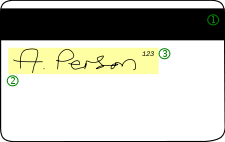
The magnetic stripe
The process of attaching a magnetic stripe to a plastic card was invented by IBMIBM
International Business Machines Corporation or IBM is an American multinational technology and consulting corporation headquartered in Armonk, New York, United States. IBM manufactures and sells computer hardware and software, and it offers infrastructure, hosting and consulting services in areas...
in 1960 under a contract with the US government for a security system. Forrest Parry
Forrest Parry
Forrest Corry Parry was the IBM engineer who invented the Magnetic stripe card used for Credit cards and identification badges....
, an IBM Engineer, had the idea of securing a piece of magnetic tape, the predominant storage medium at the time, to a plastic card base. He became frustrated because every adhesive he tried produced unacceptable results. The tape strip either warped or its characteristics were affected by the adhesive, rendering the tape strip unusable. After a frustrating day in the laboratory, trying to get the right adhesive, he came home with several pieces of magnetic tape and several plastic cards. As he walked in the door at home, his wife Dorothea was ironing and watching TV. She immediately saw the frustration on his face and asked what was wrong. He explained the source of his frustration: inability to get the tape to "stick" to the plastic in a way that would work. She said, "Here, let me try the iron." She did and the problem was solved. The heat of the iron was just high enough to bond the tape to the card.
There were a number of steps required to convert the magnetic striped media into an industry acceptable device. These steps included: 1) Creating the international standards for stripe record content, including which information, in what format, and using which defining codes. 2) Field testing the proposed device and standards for market acceptance. 3) Developing the manufacturing steps needed to mass produce the large number of cards required. 4) Adding stripe issue and acceptance capabilities to available equipment. These steps were initially managed by Jerome Svigals of the Advanced Systems Division of IBM, Los Gatos, California
Los Gatos, California
The Town of Los Gatos is an incorporated town in Santa Clara County, California, United States. The population was 29,413 at the 2010 census. It is located in the San Francisco Bay Area at the southwest corner of San Jose in the foothills of the Santa Cruz Mountains...
from 1966 to 1975.
In most magnetic stripe cards, the magnetic stripe is contained in a plastic-like film. The magnetic stripe is located 0.223 inches (5.56 mm) from the edge of the card, and is 0.375 inches (9.52 mm) wide. The magnetic stripe contains three tracks, each 0.110 inches (2.79 mm) wide. Tracks one and three are typically recorded at 210 bits per inch (8.27 bits per mm), while track two typically has a recording density of 75 bits per inch (2.95 bits per mm). Each track can either contain 7-bit alphanumeric characters, or 5-bit numeric characters. Track 1 standards were created by the airlines industry (IATA)
International Air Transport Association
The International Air Transport Association is an international industry trade group of airlines headquartered in Montreal, Quebec, Canada, where the International Civil Aviation Organization is also headquartered. The executive offices are at the Geneva Airport in SwitzerlandIATA's mission is to...
. Track 2 standards were created by the banking industry (ABA)
American Bankers Association
The American Bankers Association is an industry trade group and professional association representing the United States' banking industry...
. Track 3 standards were created by the Thrift-Savings industry.
Magstripes following these specifications can typically be read by most point-of-sale
Point of sale
Point of sale or checkout is the location where a transaction occurs...
hardware, which are simply general-purpose computers that can be programmed to perform specific tasks. Examples of cards adhering to these standards include ATM card
ATM card
An ATM card is a card issued by a bank, credit union or building society that can be used at an ATM for deposits, withdrawals, account information, and other types of transactions, often through interbank networks.Some ATM cards can also be used:* at a branch, as identification for in-person...
s, bank cards (credit and debit cards including VISA
Visa
Visa or VISA may refer to:* Visa , a document issued by a country's government allowing the holder to enter or to leave that country...
and MasterCard
MasterCard
Mastercard Incorporated or MasterCard Worldwide is an American multinational financial services corporation with its headquarters in the MasterCard International Global Headquarters, Purchase, Harrison, New York, United States...
), gift card
Gift card
A gift card is a restricted monetary equivalent or scrip that is issued byretailers or banks to be used as an alternative to a non-monetary gift....
s, loyalty cards, driver's license
Driver's license
A driver's license/licence , or driving licence is an official document which states that a person may operate a motorized vehicle, such as a motorcycle, car, truck or a bus, on a public roadway. Most U.S...
s, telephone card
Telephone card
A telephone card, calling card or phone card for short, is a small plastic card, sized and shaped like a credit card, used to pay for telephone services. It is not necessary to have the physical card except with a stored-value system; knowledge of the access telephone number to dial and the PIN is...
s, membership cards, electronic benefit transfer cards (e.g. food stamp
Supplemental Nutrition Assistance Program
The United States Supplemental Nutrition Assistance Program , historically and commonly known as the Food Stamp Program, is a federal-assistance program that provides assistance to low- and no-income people and families living in the U.S. Though the program is administered by the U.S. Department of...
s), and nearly any application in which value or secure information is not stored on the card itself. Many video game and amusement centers now use debit card systems based on magnetic stripe cards.
Magnetic stripe cloning can be detected by the implementation of magnetic card reader heads and firmware that can read a signature of magnetic noise permanently embedded in all magnetic stripes during the card production process. This signature can be used in conjunction with common two factor authentication schemes utilized in ATM, debit/retail point-of-sale and prepaid card applications.
Counterexamples of cards which intentionally ignore ISO standards include hotel key cards, most subway and bus cards, and some national prepaid calling cards (such as for the country of Cyprus
Cyprus
Cyprus , officially the Republic of Cyprus , is a Eurasian island country, member of the European Union, in the Eastern Mediterranean, east of Greece, south of Turkey, west of Syria and north of Egypt. It is the third largest island in the Mediterranean Sea.The earliest known human activity on the...
) in which the balance is stored and maintained directly on the stripe and not retrieved from a remote database.
Magnetic stripe coercivity
Magstripes come in two main varieties: high-coercivityCoercivity
In materials science, the coercivity, also called the coercive field or coercive force, of a ferromagnetic material is the intensity of the applied magnetic field required to reduce the magnetization of that material to zero after the magnetization of the sample has been driven to saturation...
(HiCo) at 4000 Oe
Oersted
Oersted is the unit of magnetizing field in the CGS system of units.-Difference between cgs and SI systems:...
and low-coercivity (LoCo) at 300 Oe
Oersted
Oersted is the unit of magnetizing field in the CGS system of units.-Difference between cgs and SI systems:...
but it is not infrequent to have intermediate values at 2750 Oe. High-coercivity magstripes are harder to erase, and therefore are appropriate for cards that are frequently used or that need to have a long life. Low-coercivity magstripes require a lower amount of magnetic energy to record, and hence the card writers are much cheaper than machines which are capable of recording high-coercivity magstripes. A card reader can read either type of magstripe, and a high-coercivity card writer may write both high and low-coercivity cards (most have two settings, but writing a LoCo card in HiCo may sometimes work), while a low-coercivity card writer may write only low-coercivity cards.
In practical terms, usually low coercivity magnetic stripes are a light brown color, and high coercivity stripes are nearly black; exceptions include a proprietary silver-colored formulation on transparent American Express
American Express
American Express Company or AmEx, is an American multinational financial services corporation headquartered in Three World Financial Center, Manhattan, New York City, New York, United States. Founded in 1850, it is one of the 30 components of the Dow Jones Industrial Average. The company is best...
cards. High coercivity stripes are resistant to damage from most magnets likely to be owned by consumers. Low coercivity stripes are easily damaged by even a brief contact with a magnetic purse strap or fastener. Because of this, virtually all bank cards today are encoded on high coercivity stripes despite a slightly higher per-unit cost.
Magnetic stripe cards are used in very high volumes in the mass transit sector, replacing paper based tickets with either a directly applied magnetic slurry
Slurry
A slurry is, in general, a thick suspension of solids in a liquid.-Examples of slurries:Examples of slurries include:* Lahars* A mixture of water and cement to form concrete* A mixture of water, gelling agent, and oxidizers used as an explosive...
or hot foil stripe. Slurry applied stripes are generally less expensive to produce and are less resilient but are suitable for cards meant to be disposed after a few uses.
Financial cards
There are up to three tracks on magnetic cards used for financial transactions, known as tracks 1, 2, and 3. Track 3 is virtually unused by the major worldwide networks such as VISAVisa
Visa or VISA may refer to:* Visa , a document issued by a country's government allowing the holder to enter or to leave that country...
, and often isn't even physically present on the card by virtue of a narrower magnetic stripe. Point-of-sale card readers almost always read track 1, or track 2, and sometimes both, in case one track is unreadable. The minimum cardholder account information needed to complete a transaction is present on both tracks. Track 1 has a higher bit density (210 bits per inch vs. 75), is the only track that may contain alphabetic text, and hence is the only track that contains the cardholder's name.
Track 1 is written with code known as DEC
Digital Equipment Corporation
Digital Equipment Corporation was a major American company in the computer industry and a leading vendor of computer systems, software and peripherals from the 1960s to the 1990s...
SIXBIT plus odd parity
Parity bit
A parity bit is a bit that is added to ensure that the number of bits with the value one in a set of bits is even or odd. Parity bits are used as the simplest form of error detecting code....
. The information on track 1 on financial cards is contained in several formats: A, which is reserved for proprietary use of the card issuer, B, which is described below, C-M, which are reserved for use by ANSI Subcommittee X3B10 and N-Z, which are available for use by individual card issuers:
Track 1, Format B:
- Start sentinel — one character (generally '%')
- Format code="B" — one character (alpha only)
- Primary account number (PAN) — up to 19 characters. Usually, but not always, matches the credit card number printed on the front of the card.
- Field Separator — one character (generally '^')
- Name — two to 26 characters
- Field Separator — one character (generally '^')
- Expiration date — four characters in the form YYMM.
- Service code — three characters
- Discretionary data — may include Pin Verification Key Indicator (PVKI, 1 character), PIN Verification Value (PVV, 4 characters), Card Verification Value or Card Verification Code (CVV or CVC, 3 characters)
- End sentinel — one character (generally '?')
- Longitudinal redundancy check (LRCLongitudinal redundancy checkIn telecommunication, a longitudinal redundancy check or horizontal redundancy check is a form of redundancy check that is applied independently to each of a parallel group of bit streams...
) — it is one character and a validity character calculated from other data on the track. Most reader devices do not return this value when the card is swiped to the presentation layer, and use it only to verify the input internally to the reader.
Track 2: This format was developed by the banking industry (ABA). This track is written with a 5-bit scheme (4 data bits + 1 parity), which allows for sixteen possible characters, which are the numbers 0-9, plus the six characters
: ; < = > ? . The selection of six punctuation symbols may seem odd, but in fact the sixteen codes simply map to the ASCIIASCII
The American Standard Code for Information Interchange is a character-encoding scheme based on the ordering of the English alphabet. ASCII codes represent text in computers, communications equipment, and other devices that use text...
range 0x30 through 0x3f, which defines ten digit characters plus those six symbols. The data format is as follows:
- Start sentinel — one character (generally ';')
- Primary account number (PAN) — up to 19 characters. Usually, but not always, matches the credit card number printed on the front of the card.
- Separator — one char (generally '=')
- Expiration date — four characters in the form YYMM.
- Service code — three digits. The first digit specifies the interchange rules, the second specifies authorisation processing and the third specifies the range of services
- Discretionary data — as in track one
- End sentinel — one character (generally '?')
- Longitudinal redundancy check (LRCLongitudinal redundancy checkIn telecommunication, a longitudinal redundancy check or horizontal redundancy check is a form of redundancy check that is applied independently to each of a parallel group of bit streams...
) — it is one character and a validity character calculated from other data on the track. Most reader devices do not return this value when the card is swiped to the presentation layer, and use it only to verify the input internally to the reader.
Service code values common in financial cards:
First digit
- 1: International interchange OK
- 2: International interchange, use IC (chip) where feasible
- 5: National interchange only except under bilateral agreement
- 6: National interchange only except under bilateral agreement, use IC (chip) where feasible
- 7: No interchange except under bilateral agreement (closed loop)
- 9: Test
Second digit
- 0: Normal
- 2: Contact issuer via online means
- 4: Contact issuer via online means except under bilateral agreement
Third digit
- 0: No restrictions, PIN required
- 1: No restrictions
- 2: Goods and services only (no cash)
- 3: ATM only, PIN required
- 4: Cash only
- 5: Goods and services only (no cash), PIN required
- 6: No restrictions, use PIN where feasible
- 7: Goods and services only (no cash), use PIN where feasible
All values not explicitly mentioned above are reserved for future use
Notes:
- It is possible for these strips to be completely erased if brought close to high strength Neodymium magnetNeodymium magnetA neodymium magnet , the most widely-used type of rare-earth magnet, is a permanent magnet made from an alloy of neodymium, iron, and boron to form the Nd2Fe14B tetragonal crystalline structure. Developed in 1982 by General Motors and Sumitomo Special Metals, neodymium magnets are the strongest...
s - Commercial encoders might use '~' for Start sentinel, ';' for separator.
- Example Code: '~#;data?'
United States driver's licenses
The data stored on magnetic stripes on American driver's licenses is specified by the American Association of Motor Vehicle Administrators. Not all states use a magnetic stripe on their driver's licenses. For a list of those that do, see the AAMVA list of US License Technology. The AAMVA site also contains a list of the Canadian jurisdictions that use magnetic stripes on their driver's licenses.The following data is stored on track 1:
- Start Sentinel - one character (generally '%')
- State or Province - two characters
- City - variable length (seems to max out at 13 characters)
- Field Separator - one character (generally '^') (absent if city reaches max length)
- Last Name - variable length
- Field Separator - one character (generally '$')
- First Name - variable length
- Field Separator - one character (generally '$')
- Middle Name - variable length
- Field Separator - one character (generally '^')
- Home Address (house number and street) - variable length
- Field Separator - one character (generally '^')
- Unknown - variable length
- End Sentinel - one character (generally '?')
The following data is stored on track 2:
- ISO Issuer Identifier Number (IIN) - 6 digits
- Drivers License / Identification Number - 13 digits
- Field Separator — generally '='
- Expiration Date (YYMM) - 4 digits
- Birth date (YYYYMMDD) - 8 digits
- DL/ID# overflow- 5 digits (If no information is used then a field separator is used in this field.)
- End Sentinel - one character ('?')
The following data is stored on track 3:
- Template V#
- Security V#
- Postal Code
- Class
- Restrictions
- Endorsements
- Sex
- Height
- Weight
- Hair Color
- Eye Color
- ID#
- Reserved Space
- Error Correction
- Security
Note: Each state has a different selection of information they encode, not all states are the same.
Note: Some states, such as Texas, have laws restricting drivers licenses being swiped under certain circumstances.
Other card types
Smart cards are a newer generation of card containing an integrated circuitIntegrated circuit
An integrated circuit or monolithic integrated circuit is an electronic circuit manufactured by the patterned diffusion of trace elements into the surface of a thin substrate of semiconductor material...
chip. The card may have metal contacts connecting the card physically to the reader, while contactless cards use a magnetic field or radio frequency (RFID) for proximity reading.
Hybrid smart cards include a magnetic stripe in addition to the chip — this is most commonly found in a payment card
Payment card
The term payment card covers a range of different cards that can be presented by a cardholder to make a payment.-Types:Typically a payment card is backed by an account holding funds belonging to the cardholder, or offering credit to the cardholder. Payment cards can be classified into types...
, so that the cards are also compatible with payment terminals that do not include a smart card reader.
Cards with all three features: magnetic stripe, smart card chip, and RFID chip are also becoming common as more activities require the use of such cards.
See also
- Access badgeAccess badgeAn access badge is a credential used to gain entry to an area having automated access control entry points. Entry points may be doors, turnstiles, parking gates or other barriers....
- Access controlAccess controlAccess control refers to exerting control over who can interact with a resource. Often but not always, this involves an authority, who does the controlling. The resource can be a given building, group of buildings, or computer-based information system...
- Common Access CardCommon Access CardThe Common Access Card is a United States Department of Defense smart card issued as standard identification for active-duty military personnel, reserve personnel, civilian employees, other non-DoD government employees, state employees of the National Guard, and eligible contractor personnel.The...
- CredentialCredentialA credential is an attestation of qualification, competence, or authority issued to an individual by a third party with a relevant or de facto authority or assumed competence to do so....
- Credit card number
- Forrest Parry, the IBM engineer who invented the magnetic stripe card
- ID Card
- Keycard
- MetroCard (New York City)
- Photo identificationPhoto identificationPhoto identification is generally used to define any form of identity document that includes a photograph of the holder.Some countries use a government issued card as a proof of age or citizenship.Types of photo ID cards include:*Passports...
- Physical SecurityPhysical securityPhysical security describes measures that are designed to deny access to unauthorized personnel from physically accessing a building, facility, resource, or stored information; and guidance on how to design structures to resist potentially hostile acts...
- Proximity cardProximity cardProximity card is a generic name for contactless integrated circuit devices used for security access or payment systems. The standard can refer to the older 125 kHz devices or the newer 13.56 MHz contactless RFID cards, most commonly known as contactless smartcards.Modern proximity cards...
- SecuritySecuritySecurity is the degree of protection against danger, damage, loss, and crime. Security as a form of protection are structures and processes that provide or improve security as a condition. The Institute for Security and Open Methodologies in the OSSTMM 3 defines security as "a form of protection...
- Security engineeringSecurity engineeringSecurity engineering is a specialized field of engineering that focuses on the security aspects in the design of systems that need to be able to deal robustly with possible sources of disruption, ranging from natural disasters to malicious acts...
- Smart cardSmart cardA smart card, chip card, or integrated circuit card , is any pocket-sized card with embedded integrated circuits. A smart card or microprocessor cards contain volatile memory and microprocessor components. The card is made of plastic, generally polyvinyl chloride, but sometimes acrylonitrile...
- Stored-value cardStored-value cardA stored-value card refers to monetary value on a card not in an externally recorded account and differs from prepaid cards where money is on deposit with the issuer similar to a debit card...
External links
- Magnetic Stripe Formats
- Magnetic Stripe Card Standards (from DED Ltd. sales page)