

Voicemail

Encyclopedia
Voicemail is a computer based system that allows users and subscribers to exchange personal voice messages; to select and deliver voice information; and to process transactions relating to individuals, organizations, products and services, using an ordinary telephone. The term is also used more broadly to denote any system of conveying a stored telecommunications voice messages, including using an answering machine
. Most cell phones services offer voicemail as a basic feature, and many land line phones and corporate PBXs include voicemail services.
Simple voicemail systems function as a remote answering machine
using a touch-tones as the user interface. More complicated systems may use other input devices such as voice
or a computer
interface. Simpler voicemail systems may play the audio message through the phone, while more advanced systems may have alternative delivery methods, including email or text message delivery, message transfer and forwarding options, and multiple mailboxes.
Almost all modern voicemail systems use digital storage and are typically stored on computer data storage. Notification methods also vary based on the voicemail system. Simple systems may not provide active notification at all, instead requiring the recipient to check with the system, while others may provide an indication that messages are waiting.
More advanced systems may be integrated with a company’s PABX, with a call center ACD for automatic call distribution; with mobile or paging terminals for message alert; and computer systems/data bases for delivering information or processing orders. Interactive Voice Response
(IVR) systems may use digital information stored in a corporate data base to select pre-recorded words and phrases stored in a voicemail vocabulary to form sentences that are delivered to the caller.
While it was an improvement over basic multi-line systems, the message center had many disadvantages. Many calls would come in simultaneously at peak periods, such as lunch time, and operators were often busy. This left message attendants with little time to take each message accurately. Often, they were not familiar with employees' names and "buzzwords" and how to spell or pronounce them. Messages were scribbled on pink slips and distributed by the internal mail system and messages, often arrived at people's desks after lengthy delays, contained little content other than the caller's name and number, and were often inaccurate, with misspelled names and wrong phone numbers.
Tape-based telephone answering machines had come into the residential telephone market, but they weren't used much in the corporate environment due to physical limitations of the technology. One answering machine was needed for each telephone; messages couldn't be recorded if the user was using the phone; messages had to be retrieved in sequential order; and messages couldn't be retrieved remotely, selectively discarded, saved, or forwarded to others. Further, the manufacturers of PBXs (private branch exchanges — the name for corporate phone systems) used proprietary digital phone sets in order to increase the functionality and value of the PBX. These phone sets were, by design, incompatible with answering machines.
In the 1970s and early 1980s, the cost of long distance calling decreased and more business communications were conducted by telephone. As corporations grew and labor rates increased, the ratio of secretaries to employees decreased. With multiple time zones, fewer secretaries and more communication by phone, real-time phone communications were hampered by callers being unable to reach people. Some early studies showed that only 1 in 4 phone calls resulted in a completed call and half the calls were one-way in nature (that is, they did not require a conversation). This happened because people were either not at work (due to time zone differences, being away on business, etc.), or if they were at work, they were on the phone, away from their desks in meetings, on breaks, etc. This bottleneck hindered the effectiveness of business activities and decreased both individual and group productivity. It also wasted the caller's time and created delays in resolving time-critical issues.
For nearly one hundred years, there were few innovations or advances in telephone services. Voicemail was the result of innovations in telephone products and services made possible by developments in computer technologies during the 1970s. These innovations began with the Motorola Pageboy
, a simple "pager" or "beeper" introduced in 1974 that was generally offered in conjunction with answering services that handled busy / no-answer overloads and after hours calls for businesses and professionals. Operators wrote down a caller's message, sent a page alert or "beep" and when the party called back, an operator dictated the message.
With the introduction of "voice" pagers, like the Motorola Pageboy II
operators could transmit a voice message directly to the pager and the user could hear the message. However, messages arrival was often untimely and privacy issues as well as the high cost eventually caused the demise of these services. By the mid 1970s digital storage and analog to digital conversion devises had emerged and paging companies began handling client messages electronically. Operators recorded a short message (5–6 seconds, e.g. "please call Mr. Smith") and the messages were delivered automatically when the client called the answering service. It would only take a short step for the first voicemail application to be born.
Computer manufacturers, telephone equipment manufacturers and software firms began developing more sophisticated solutions as more powerful and less expensive computer processors and storage devices became available.. This set the stage for a creation of a broad spectrum of computer based Central Office and Customer Premise Equipment that would eventually support enhanced voice solutions such as voicemail, audiotex, interactive voice response
(IVR) and speech recognition
solutions that began emerging in the 1980s. However, broad adoption of these products and services would depend on the global proliferation of touch tone phones and mobile phone services which would not occur until the late 1980s.
The true first inventor of voicemail, patent number 4,124,773 (Audio Storage and Distribution System), is Robin K Elkins.
"Though Elkins received a patent in 1978, telecommunications giants began offering voice mail without paying Elkins a penny in royalties."
"Elkins never expected to spend 10 years of his life battling some of the world's largest corporations, either. But once he patented his system, he figured he should protect it."
Later, Elkins successfully licensed his patented technology to IBM, DEC, WANG, among many others.
The first voice messaging application, the Speech Filing System (later renamed Audio Distribution System (ADS) was developed at the IBM Thomas J. Watson Research Center in 1973 under the leadership of Stephen Boies, who worked on the modern day voicemail or voice messaging.
The ADS was meant to mimic the concept of email, but using the telephone as the input device and the human voice as the medium for the message. The first operational prototype was made available to users in 1975 when four people could use it at the same time. From 1975-1981, about 750 IBM executives, mainly in the U.S., used various prototypes in their daily work. Those prototypes ran on an IBM System /7 computer attached to an IBM VM370
for additional storage. In 1978 the prototype was converted to run on a Series /1
computer. In September, 1981, IBM announced the "Audio Distribution System" and the first customer installation was completed in February, 1982. The ADS, marketed directly by IBM and for a short while by AT&T, was richly featured for voice messaging, the result of IBM's enormous research in human factors and observing SFS in real operational use. However, the system required special attention (special room, special power, air conditioning, etc.) and had major limitations, for example, it was physically large, expensive, limited to 1,000 users, had no telephone answering mode (could not answer outside calls), and had to be taken out of service to make administrative changes to the user data base. The result was failure of ADS as a commercial product.
Another company, Delphi Communications of California, deserves some partial credit for invention of voicemail. Under the leadership of Jay Stoffer, Delphi developed a proprietary system (called Delta 1) that picked up incoming calls directly from the telephone company. Stoffer presented the Delphi concept publicly to the association of Telephone Answering Services around 1973 and the prototype system was launched in San Francisco in 1976 by a Delphi company called VoiceBank. Delphi developed Delta 1 as a purely service-oriented voice messaging system to answer subscriber telephones for businesses and professionals. Delta 1 required human intervention for message deposit. While three machines were built, only one machine was put into operational service. The completely automated voice messaging system (Delta 2) was developed for initial operational use in Los Angeles in 1981. Apparently Delta 2 was built, installed and operational for a short while, but unfortunately Delphi's major early investor, Exxon Enterprises, abruptly shut down Delphi in July, 1982. Nothing further was done with Delphi's technology. A patent
was applied for and issued for Delphi's Automated Telephone Voice Service System. The patent, U.S. Patent No. 4,625,081, was issued after Delphi's closure, but Delphi's assets (and the patent) were transferred to another Exxon
company, Gilbarco, which made equipment for gas pumps at filling stations. Gilbarco is now owned by GEC in the United Kingdom
.
In 1979, a company was founded in Texas
by Gordon Matthews
called ECS Communications (the name was later changed to VMX, for Voice Message exchange). VMX developed a 3000-user voice messaging system called the VMX/64 and was the first company to offer a voice messaging system for sale commercially for corporate use. In the early 1980s, VMX sold voice messaging systems to several large corporations, such as 3M
, Kodak, American Express
, Intel, Hoffmann–La Roche, Corning Glass, Arco
, Shell Canada and Westinghouse
. The impressive list of early adopters started the ball rolling on corporate voicemail. While VMX began with a good start, it failed at developing the market, and the company was not a commercial success. It took several years before its products could answer outside calls (and then only under certain circumstances), they were physically enormous, expensive, light on important user features and had serious reliability issues. In addition, the user interface was cumbersome, requiring the users to remember non-intuitive multi-digit Touch-tone commands. Matthews, a prolific entrepreneur and patenter, applied for and was granted a patent on voicemail (patent number 4,371,752) which issued in February, 1983. The patent was promoted as the pioneering patent for voicemail.
VMX was quite astute at the way they used their patent, asserting infringement first with IBM, AT&T
and then Wang, but all three companies reportedly would have been able to invalidate the patent on the basis of prior art. VMX cleverly achieved a settlement where the patent was let stand, not challenged in court and IBM, Wang and AT&T (in separate settlements) received royalty-free licenses to all VMX patents. Wang, the last of the majors to get such a license for itself and Voicemail International, essentially paid $20,000 and cross licensed a few patent applications (not issued patents). IBM and AT&T also cross-licensed a number of patents to VMX, most of which were obsolete or outdated. VMX could claim that several major companies licensed the patent (even though they paid almost nothing to VMX for the rights), but that part wasn't disclosed. The patent was never challenged in court and VMX then continued to assert (incorrectly) that it had invented voicemail and that Matthews was the "father of voicemail". Following the settlement with Wang, VMX settled with Octel in exchange for a small payment and Octel's agreeing not to litigate any VMX patent, Octel received a paid-up, royalty-free license on all existing and future VMX patents.
In 1985, Voice Response Inc. (formerly Call-It Co) a subsidiary of Lee Enterprises, Davenport IA, entered the fast growing Interactive Voice (IVR) response market under the direction of Bob Ross, President. About a year later, VRI introduced one of the first "successful" IVR applications that utilized voice recognition (rather than touch tone) to capture caller responses. Voice recognition technology had great difficulty with regional and ethnic differences and nuances which resulted in a high incidence of error. VRI discovered that hesitation (delayed response) signaled caller confusion or misunderstanding which often resulted in an inaccurate response. VRI developed proprietary techniques that measured user response times and used the data to make real-time changes to the application's dialog with the caller. VRI found that the confidence level of a "suspect" caller response could be increased by asking "Did you say (Chicago), Yes or No", a standard queston heard in order taking or reservation making IVR applications today. VRI pioneering applications, including subscription fulfillment for Time -Life Magazine, proved faster and less expensive than call centers using live operators and although VRI did not survive, their voice recognition processes became industry standards and VRI's patent was eventually licensed by Intel/Dialogic and Nuance.
In May 1980, VMI introduced the first nationwide voicemail service from its headquarters in Santa Clara, CA using a Digital Equipment PDP 11 with proprietary voice technology called the "Big Talker". Subscribers recorded and retrieved messages by calling a nationwide 800 number using a touch-tone phone (a rotary telephone required use of a hand-held touch-tone keypad supplied by the company) to enter passwords, select send or receive and other service options. In situations where these options were either unavailable or unsuccessful, callers were automatically connected to a live operator who made entries for the caller. This feature was especially important since touch tone phones were not prevalent in the U.S. and almost non-existent in Europe during this time period.
VMI positioned Voicemail® as an enhancement to the rapidly growing paging and mobile telephone market, providing enhancements that improved the service and reduced cost by automating the delivery of messages. Intrastate Paging in Los Angeles CA and RadioPhone in Newark, NJ were the first to introduce the mobile/paging/Voicemail® services. When a caller’s message was recorded, the subscriber was notified by page alert that a message was waiting. Eventually a number of additional Radio Common Carriers (RCC) and several Telephone Answering Services introduced Voicemail® services. RCA Global's Radio Page America and GTE. brought industry wide credibly to voicemail as a global communications service.
Voicemail® service was provided from company owned centers in Santa Clara CA and Los Angeles CA as well as licensed centers in Denver, CO, Cleveland, OH and Portland, OR. Due to the high cost of storage for individual messages, VMI and its licensees followed a business strategy focused on time-critical deliveries of messages to large groups. VMI integrated its service with private and public computer data bases, developing a unique method of using the digital information to select words and phrases from a pre-recorded voice library and concatenating them into a natural sounding voice response. These so-called Audiotex and Interative Voice Response (IVR) services delivered voice information and transaction services for wide range of applications.
The challenges included the high cost of voice storage systems, the lack of touch tone telephones, particularly in the international market; and the complexity of integrating the voicemail platform with paging systems and corporate computer databases. However, a single message could be delivered to thousands of subscribers and users quickly and efficiently using page alerts and the service resulted in significant cost reduction when compared to conventional operator staffed call centers. A single voicemail® system could handle tens of thousands of calls simultaneously and was designed to meet telecom performance and reliability standards. Service providers were able to expand from voice messaging to major IVR applications, that changed the whole approach to information delivery.
During the period 1983 to 1987, VMI developed many "break through" IVR applications included both business and consumer related solutions: Stock Quotes for Dow Jones; Flight Schedules for Pacific Southwest Airlines; Drug Interactions for Physicians’ Desk Reference; Crew Scheduling for Trans World Airlines; Actor Casting Calls for Universal Studios; Filming Schedules for ABC TV; Athlete Scheduling for the 1985 Summer Olympics; "The Talking Bouquet for Florafax; Order Taking for Quervo Gold advertisements; and many more. . Many of these applications were introduced using VMI's service centers and then migrated to company operated platforms. By the late 1980s, Audiotex and Interactive Voice Response (IVR) techniques pioneered by VMI became global standards for businesses communications.
In 1983, Radio-Suisse (later taken over by Swisscom
) introduced the first Voicemail® service in Europe. The VMI platform was integrated with paging services that provided notification throughout western Europe. By 1985, Voicemail® was offered by British Telecom, Deutsche Telecom and Voicemail Swenska and the company eventually secured licenses for thirty Voicemail® centers in twelve countries. Japan was the first to introduce Voicemail® on the Pacific Rim. VMI was responsible for worldwide introduction of voice mail as an efficient and cost effective way to deliver messages and information by telephone. Voicemail® systems were ultimately fluent in American, English, French, German, Italian, Spanish, Japanese and Chinese. Many of the IVR applications pioneered by VMI in the U.S. were equally successful in the international market. In 1987, VMI’s new management attempted to shift the company’s business from the service industry to the corporate enterprise market. The strategy was unsuccessful and in 1991 the company discontinued operations.
The voicemail service market in the U.S. grew quickly in the mid to late 1980s and several manufacturers began offering messaging services. Comverse became the leading supplier for messaging services with Telephone Answering Services (TAS) and VMX formed a Tigon subsidiary that offered messaging services from a service center in Atlanta. GA. A number of other companies, including Voice Response Inc. followed VMIs lead in developing IVR applications. The 1988 Judge Greene decision regarding the Bell Operating Companies would change everything for the U.S. service market as described under BOCs and PTTs, later in this article.
, VMX, Wang, Octel, ROLM, AT&T
, Northern Telecom, Delphi Communications, Voice and Data Systems, Opcom, Commterm, Genesis, Brook Trout, Innovative Technology (ITI), Glenayre, BBL, AVT, AVST
, Digital Sound, Centigram, Voicemail International and Active Voice
. Only a few of these companies were successful in capturing a significant market share and remain in the voicemail business today.
ROLM Corporation, founded in 1969 by Gene Richeson, Ken Oshman, Walter Loewenstern and Robert Maxfield, was the first PBX manufacturer to offer integrated voicemail with its PhoneMail system, its registered trademark. PhoneMail offered impressive recording quality of its digitized messages. ROLM's digital PBX (called a CBX, for Computerized Branch eXchange) was the first to enable PhoneMail to illuminate a message waiting light on ROLM phones equipped with message waiting lights (also a studder dialtone is used with analog and digital phones). Rolm was sold to IBM, who later sold it to Siemens
who offer PhoneMail in various configurations/sizes (including a micro-sized version) and its unified messaging successor, Xpressions 470. ROLM was purchased by IBM in the mid 1980s (which was a financial disaster for the profitable ROLM, as IBM clearly could not grasp the laid back, "think outside the box" attitude of ROLM, which was the #2 PBX supplier in the US from the mid 70s to late 80s), then sold half interest to the German company Siemens. In 1992, Siemens bought ROLM entirely from IBM and the original ROLM product line was done for, except for PhoneMail (the only product Siemens did not destroy). VMX suffered from poor product and ineffective management and was about to fold when Opcom merged with it. The surviving company was called VMX, but VMX was all but erased by Opcom except for its name and patent portfolio.
Opcom, a company founded by David Ladd, developed a voicemail system primarily marketed to smaller enterprises. Opcom pioneered and patented the feature of automated attendant
(U.S. Patent numbers 4,747,124 and 4,783,796 both issued in 1988), an integral part of any voicemail systems. The automated attendant enables callers to direct calls by pressing single digit keys, e.g. "If you are making domestic reservations, press 1; for international reservations, press ‘2'; etc." Opcom later pioneered the concept of Unified Messaging (to be discussed later in this article). Opcom eventually acquired VMX through a reverse merger, (Opcom was private and VMX was public) and the surviving company VMX was eventually acquired by Octel.
Octel Communications, founded in 1982 by Bob Cohn and Peter Olson, broadly commercialized the corporate voice messaging market. While Octel benefited from the work and experiments of others it was the first stand-alone voicemail company to build a strong business and strategy to win in this difficult market. In addition, Octel innovated substantially new technology which contributed heavily to its success including a system architecture that was physically smaller, faster, more reliable, and much less costly than other corporate vendors. Octel's voicemail system, was introduced in 1984, included unique system features, many of which were patented, which gave Octel market leadership. In 1990 Octel was one of the first companies to introduce the concept of Unified Messaging.
AT&T/Lucent created its version of voicemail in the early 1990s (called Audix
) but it would only work on AT&T/Lucent PBXs. Northern Telecom|Nortel
developed Meridian Mail
and followed the same strategy as AT&T in that Meridian Mail only worked with Northern Telecom PBXs. As a result, neither company achieved much market share with large national or multi-national accounts. AT&T spun off its equipment business into a company called Lucent Technologies
, and Northern Telecom changed its name to Nortel
.
By the mid-1990s, Octel had become the number one supplier of voicemail both to corporations and to carriers. Octel had about a 60% market share in the U.S., Canada
, Europe
and Japan
(for large corporations) and between a 30% and 100% of the carrier market, depending on the country. By 1997 Octel's biggest competitors were Audix, made by Lucent, and Meridian Mail, made by Nortel. In July 1997, Octel was purchased by Lucent Technology. Lucent's AUDIX division was merged into Octel to form the Octel Messaging Division. By 2000, some estimate that there were over 150,000,000 active users of corporate and carrier voicemail made by the Octel Messaging Division. Shortly thereafter, Lucent spun off its corporate business, including the Octel Messaging Division, into a company known as Avaya
.
Boston Technology and Comverse Technology both entered the carrier market in the early 1990s. Boston was eventually acquired by Comverse, making it the second largest supplier to carriers after Octel. However in a few years Comverse became the largest supplier to carriers with Lucent/Octel holding its leadership in the corporate market and second place with carriers. Comverse today retains its leadership of legacy voicemail systems sold to carriers around the world. For IP-based voicemail systems, Ericsson claims market leadership with its Ericsson Messaging-over-IP (MoIP) solution.
The opportunity created by the Greene decision, plus Voicemail International's abandonment of its market lead for carrier grade systems, created a new opportunity for competing manufacturers and those who had been focusing on the corporate market. Unisys
, Boston Technology, and Comverse Technology
were quick to address the BOC and PTT marketplace. Octel, who had high capacity systems in use interally by all seven Regional Bell Operating companies, launched a new generation of its large system specifically designed for carriers and was compliant with "NEBS standards," the tight standard required by phone companies for any equipment located in their central offices.
While Unisys evetually secured PacBell's residential voicemail services, Boston Technology became the mainstay of Bell Atlantic's residential voicemail offering and Comverse Technology enjoyed some success in the European market; Octel became the world's leading provider of voicemail platforms for virtually all of the major US wireless carriers (including the seven RBOCs, AT&T Wireless and McCaw), Canadian cellular carriers and a large percent of the GSM carriers around the world.
However it didn't take long for Comverse to become the largest supplier to the BOCs and PTTs with Lucent/Octel holding its leadership in the corporate market and second place with carriers. Boston was eventually acquired by Comverse making it the second largest supplier to carriers after Octel. Comverse today retains its leadership of legacy voicemail systems sold to carriers around the world. Ericsson claims market leadership for IP based systems for its Ericsson Messaging-over-IP (MoIP) solution.
, the corporate email system made by Microsoft
. Unified Messaging had been invented by Roberta Cohen, Kenneth Huber and Deborah Mill at AT&T Bell Labs. The patent for Unified Messaging was received in June, 1989 (Patent number 4,837,798).
Unified Messaging allowed users to access voicemail and email messages using either the graphical user interface (GUI) on their PC, or using the telephone user interface (TUI). Using a PC, users could see voicemails and emails mixed together in their email inbox. Voice mails had a little telephone icon next to them and emails had a little envelope icon next to them (see figure below). For voicemail, they'd see the "header information" (sender, date sent, size, and subject). Users could double-click a voicemail from their email inbox and hear the message through their PC or a phone next to their desk.
Using any phone in the world, users could listen to voice messages like they normally did, plus have emails read to them (in synthesized voice). Voice messages could be sent using email or telephone addressing schemes, and the data networking infrastructure was used to send messages between locations rather than the public switched telephone network. It wasn't until the early 2000s and the availability of reliable, high capacity email servers, high speed internet connections and PCs with speakers or microphones that Unified Messaging achieved commercial success.
With virtual telephony, each person could be given a phone number (just the number, not the phone) and a voice mailbox. The citizen would also be given a pager
. If someone called the phone number, it never rang on an actual phone, but would be routed immediately to a central voicemail system. The voicemail system answered the call and the caller could leave a long, detailed message. As soon as the message was received, the voicemail system would trigger the citizen's pager. When the page was received, the citizen would find a pay phone and call in to pick up the message. This concept was used successfully in South America
and South Africa
.
The increase in wireless mobility, originally through cellular services and today through IP-based Wi-Fi, was also a driver for messaging convergence with mobile telephony. Today it is not only fostering the use of speech user interfaces for message management, but increasing the demand for retrieval of voice messages integrated with email. It also enables people to reply to both voice and email messages in voice rather than text. New services, such as GotVoice, SpinVox and YouMail, are helping to blur the boundaries between voicemail and text by delivering voicemails to mobile phones as SMS text messages.
Instant messaging in voice: The next development in messaging was in making text messaging real-time, rather than just asynchronous store-and-forward delivery into a mailbox. It started with Internet service provider America Online (AOL) as a public Internet-based free text "chat" service for consumers, but soon was being used by business people as well. It introduced the concept of Internet Protocol
"presence management" or being able to detect device connectivity to the Internet
and contact recipient "availability" status to exchange real-time messages, as well as personalized "Buddy list" directories to allow only people you knew to find out your status and initiate a real-time text messaging exchange with you. Presence and Instant Messaging
has since evolved into more than short text messages, but now can include the exchange of data files (documents, pictures) and the escalation of the contact into a voice conversational connection.
(VoIP — voice being transmitted over the internet) and the development of IP
telephony applications to replace legacy PBX telephony (called TDM
technologies). IP (Internet Protocol) telephony changed the style and technology of PBXs and the way voicemail systems integrated with them. This, in turn, facilitated a new generation of Unified Messaging
, which is now likely to catch on widely. The flexibility, manageability, lower costs, reliability, speed, and user convenience for messaging convergence is now possible where it wasn't before. This might include intra- and inter-enterprise contacts, mobile contacts, proactive application information delivery, and customer contact applications.
The corporate IP
telephony-based voicemail CPEmarket is served by several vendors including Avaya
, Cisco systems
, Adomo, Interactive Intelligencehttp://www.inin.com, Nortel
, Mitel
, 3Com
, and AVST
. Their marketing strategy will have to address the need to support a variety of legacy PBXs as well as new Voice over IP
as enterprises migrate towards converging IP-based telecommunications. A similar situation exists for the carrier market for voicemail servers, currently dominated by Comverse Technology, with some share still held by Lucent Technologies.
VoIP telephony enables centralized, shared servers, with remote administration and usage management for corporate (enterprise) customers. In the past, carriers lost this business because it was far too expensive and inflexible to have remote managed facilities by the phone company. With VoIP, remote administration is far more economical. This technology has re-opened opportunities for carriers to offer hosted, shared services for all forms of converged IP
telecommunications, including IP-PBX and voicemail services. Because of the convergence of wired and wireless communications, such services may also include support of a variety of multi-modal handheld and desktop end user devices. This service, when offered for multiple extensions or phone numbers is sometimes also called Unified Voicemail
.
, one of the pioneer adopters of voicemail in all of its offices around the world, claimed that voicemail saved, on average, over US$1,100 per year per employee. Needless to say, the ability to tell someone something without talking to them, can be a powerful reason to choose Voicemail for delivery of a particular message.
Voicemail has two main modes of operation: telephone answering and voice messaging. Telephone answering mode answers outside calls and takes a message from any outside caller (either because the extension was busy or rang no-answer). Voice messaging enables any subscriber (someone with a mailbox number) to send messages directly to any or many subscribers' mailboxes without first calling them. Both of these modes are described below.
(MTSOs). More modern voicemail systems work on the same principle, but some of the components may be shared with other systems, such as email systems.
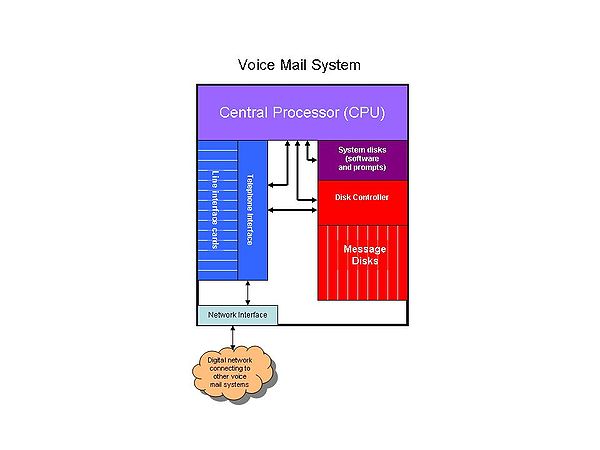
Voicemail systems contain several elements shown in the figure below:
The drawing below shows how the voicemail system interacts with the PBX. Suppose an outside caller is calling Fred's extension 2345. The incoming call comes in from the public network (A) and comes into the PBX. The call is routed to Fred's extension (B), but Fred doesn't answer. After a certain number of rings, the PBX stops ringing Fred's extension and forwards the call to an extension connected to the voicemail system (C). It does this because PBXs are generally programmed to forward busy or unanswered calls to another extension. Simultaneously the PBX tells the voicemail system (through signaling link D) that the call it is forwarding to voicemail is for Fred at extension 2345. In this way, the voicemail system can answer the call with Fred's greeting.
There are many microprocessors throughout the system since the system must handle large amounts of data and it's unacceptable to have any wait times (for example, when the system is recording or playing your message, it's unacceptable if the system stops recording momentarily like computers often do while accessing large files).
When Fred's extension forwards to the voicemail system, the Telephone Interface detects ringing. It signals to the Central Processor (CPU) that a call is coming in. The CPU simultaneously receives a signal on the PBX-Voicemail Data Link (D) telling it that extension 2345 is being forwarded on ring-no-answer to the specific extension that is now ringing. The CPU directs the Telephone Interface (which controls the line interface cards) to answer the call. The CPU's program realizes that it's a call for Fred so it looks up Fred's greeting immediately and directs the Disk Controller to start playing it to the caller. It also plays some system prompts instructing the caller what comes next (for example, "When you have finished recording, you may hang up or press ‘#' for more options"). All "talking" to the caller is done through prompts that are selected by the CPU according to the program stored in the voicemail system. The CPU selects the prompts in response to the keys the caller presses.
The caller's message is digitized by the Telephone Interface system and transmitted to the Disk Controller for storage onto the Message Disks. Some voicemail systems will scramble the message for further security. The CPU then stores the location of that message in the System Disk inside Fred's mailbox directory entry. After the caller hangs up and the message has been stored, the CPU sends a signal to the PBX through the link (D) instructing the PBX to turn on the message waiting light on Fred's phone.
When Fred comes back to his desk and sees the light on his phone, he calls a designated extension number for the voicemail system (an actual extension number assigned to the lines in "C" in the figure above).
Again the Telephone Interface alerts the CPU that a call is coming in on a particular line, but this time the signaling from the PBX-Voicemail Data Link (D) indicates that Fred is calling directly, not being forwarded. The CPU directs the Telephone Interface to answer the call.
Since the CPU "knows" it is Fred (from the signaling on the Data Link D), it looks up Fred's information on the System Disk, specifically his password. The CPU then directs Disk Controller to play a log-on prompt to the user: "Please enter your password." Once the password is entered (via Touch-tones), the CPU compares it to the correct one and, if entered correctly, allows Fred to continue.
The CPU then determines (from Fred's directory entry) that Fred has a new message. The CPU then presents Fred his options (e.g., "You have a new message. To listen to your new message, press 1; to record a message, press 2" etc.) The options are presented by the CPU directing the Disk Controller to play prompts, and the CPU listens for Touch-tones from Fred. This interaction of playing prompts and responding with Touch-tones enables Fred to interact with the voicemail system easily.
If Fred presses 1 to listen to his message, the CPU looks up the location of Fred's new message in his mailbox directory (on the System Disk), and directs the Disk Controller to play that message. The Disk Controller finds the message on the Message Disks, and sends the data stream directly to the Telephone Interface. The Telephone Interface then converts the data stream to sound and plays it to Fred through the Line Interface Card which Fred is connected to.
Playback controls (like rewind, pause, fast forward, changing volume, etc.) are all input via Touch-tones, are "read" by the CPU, and the appropriate actions are taken based on the stored program in the system. For example, if Fred wants to pause message playback, he might press 2. Since the CPU is constantly listening for Touch-tones from Fred, his command causes the CPU to direct the Disk Controller to stop playing the message. A variety of playback controls and options are available on most sophisticated voicemail systems so that users can control message playback, store messages in archives, send messages to groups, change their preferences, etc.
The better designed voicemail systems have a user-friendly interface with clear and meaningful prompts so the interaction with the voicemail system is quick and easy.
Answering machine
The answering machine or message machine, also known as the telephone answering machine in the UK and some Commonwealth countries) and previously known as an ansaphone, ansafone, or telephone answering device is a device for answering telephones and recording callers' messages.Unlike voicemail,...
. Most cell phones services offer voicemail as a basic feature, and many land line phones and corporate PBXs include voicemail services.
Voicemail features
Voicemail systems are designed to convey a caller's recorded audio message to a recipient. To do so they contain a user interface to select, play, and manage messages; a delivery method to either play or otherwise deliver the message; and a notification ability to inform the user of a waiting message. Most systems use phone-networks, either cellular or land-line based, as the conduit for all of these functions. Some systems may use multiple telecommunications methods, permitting recipients and callers to retrieve or leave messages through multiple methods such as PCs, PDA, Cellphones or Smartphones.Simple voicemail systems function as a remote answering machine
Answering machine
The answering machine or message machine, also known as the telephone answering machine in the UK and some Commonwealth countries) and previously known as an ansaphone, ansafone, or telephone answering device is a device for answering telephones and recording callers' messages.Unlike voicemail,...
using a touch-tones as the user interface. More complicated systems may use other input devices such as voice
Voice User Interface
A Voice–user interface makes human interaction with computers possible through a voice/speech platform in order to initiate an automated service or process....
or a computer
Graphical user interface
In computing, a graphical user interface is a type of user interface that allows users to interact with electronic devices with images rather than text commands. GUIs can be used in computers, hand-held devices such as MP3 players, portable media players or gaming devices, household appliances and...
interface. Simpler voicemail systems may play the audio message through the phone, while more advanced systems may have alternative delivery methods, including email or text message delivery, message transfer and forwarding options, and multiple mailboxes.
Almost all modern voicemail systems use digital storage and are typically stored on computer data storage. Notification methods also vary based on the voicemail system. Simple systems may not provide active notification at all, instead requiring the recipient to check with the system, while others may provide an indication that messages are waiting.
More advanced systems may be integrated with a company’s PABX, with a call center ACD for automatic call distribution; with mobile or paging terminals for message alert; and computer systems/data bases for delivering information or processing orders. Interactive Voice Response
Interactive voice response
Interactive voice response is a technology that allows a computer to interact with humans through the use of voice and DTMF keypad inputs....
(IVR) systems may use digital information stored in a corporate data base to select pre-recorded words and phrases stored in a voicemail vocabulary to form sentences that are delivered to the caller.
Message centers
The conventional solution to efficient handling of telephone communication in businesses was the "message center." A message center or "message desk" was a centralized, manual answering service inside a company staffed by a few operators who answered all incoming phone calls. Extensions that were busy or rang "no answer" would forward to the message center using a device called a "call director". The call director had a button for each extension in the company which would flash when that person's extension forwarded to the message center. A little label next to the button told the operator the person being called.While it was an improvement over basic multi-line systems, the message center had many disadvantages. Many calls would come in simultaneously at peak periods, such as lunch time, and operators were often busy. This left message attendants with little time to take each message accurately. Often, they were not familiar with employees' names and "buzzwords" and how to spell or pronounce them. Messages were scribbled on pink slips and distributed by the internal mail system and messages, often arrived at people's desks after lengthy delays, contained little content other than the caller's name and number, and were often inaccurate, with misspelled names and wrong phone numbers.
Tape-based telephone answering machines had come into the residential telephone market, but they weren't used much in the corporate environment due to physical limitations of the technology. One answering machine was needed for each telephone; messages couldn't be recorded if the user was using the phone; messages had to be retrieved in sequential order; and messages couldn't be retrieved remotely, selectively discarded, saved, or forwarded to others. Further, the manufacturers of PBXs (private branch exchanges — the name for corporate phone systems) used proprietary digital phone sets in order to increase the functionality and value of the PBX. These phone sets were, by design, incompatible with answering machines.
In the 1970s and early 1980s, the cost of long distance calling decreased and more business communications were conducted by telephone. As corporations grew and labor rates increased, the ratio of secretaries to employees decreased. With multiple time zones, fewer secretaries and more communication by phone, real-time phone communications were hampered by callers being unable to reach people. Some early studies showed that only 1 in 4 phone calls resulted in a completed call and half the calls were one-way in nature (that is, they did not require a conversation). This happened because people were either not at work (due to time zone differences, being away on business, etc.), or if they were at work, they were on the phone, away from their desks in meetings, on breaks, etc. This bottleneck hindered the effectiveness of business activities and decreased both individual and group productivity. It also wasted the caller's time and created delays in resolving time-critical issues.
Voicemail invention
The first public records describing voice recording were reported in a New York newspaper and the Scientific American in November, 1877. Thomas A. Edison had announced the invention of his "phonograph" saying "the object was to record telephone messages and transmit them again by telephone." Edison applied for a U. S. patent on December 1877 and shortly thereafter demonstrated the machine to publishers, the U.S. congress and President Hayes, recording and playing "Mary had a little lamb... " and "there was a little girl who had a little curl... " and other ditties popular at the time. In an article outlining his own ideas of the future usefulness of his machine Edison's list began with "Letter writing, and all kinds of dictation without the aid of a stenographer." In other words, "voice messages" or "Voicemail". By 1914, Edison's phonograph business included a dictating machine (the Ediphone) and the "Telescribe", a machine combining the phonograph and the telephone, which recorded both sides of telephone conversations.For nearly one hundred years, there were few innovations or advances in telephone services. Voicemail was the result of innovations in telephone products and services made possible by developments in computer technologies during the 1970s. These innovations began with the Motorola Pageboy
Motorola Pageboy
Motorola Pageboy was the second pager ever produced by Motorola with individual-unit addressing, after the less known 1955 Pager called "Handie-Talkie Radio Pocket Pager"....
, a simple "pager" or "beeper" introduced in 1974 that was generally offered in conjunction with answering services that handled busy / no-answer overloads and after hours calls for businesses and professionals. Operators wrote down a caller's message, sent a page alert or "beep" and when the party called back, an operator dictated the message.
With the introduction of "voice" pagers, like the Motorola Pageboy II
Motorola Pageboy II
-General:The Motorola pager was a small radio receiver that delivered a message individually or widespread to those carrying the device.The first successful consumer pager was Motorola's Pageboy I which was introduced in 1974...
operators could transmit a voice message directly to the pager and the user could hear the message. However, messages arrival was often untimely and privacy issues as well as the high cost eventually caused the demise of these services. By the mid 1970s digital storage and analog to digital conversion devises had emerged and paging companies began handling client messages electronically. Operators recorded a short message (5–6 seconds, e.g. "please call Mr. Smith") and the messages were delivered automatically when the client called the answering service. It would only take a short step for the first voicemail application to be born.
Computer manufacturers, telephone equipment manufacturers and software firms began developing more sophisticated solutions as more powerful and less expensive computer processors and storage devices became available.. This set the stage for a creation of a broad spectrum of computer based Central Office and Customer Premise Equipment that would eventually support enhanced voice solutions such as voicemail, audiotex, interactive voice response
Interactive voice response
Interactive voice response is a technology that allows a computer to interact with humans through the use of voice and DTMF keypad inputs....
(IVR) and speech recognition
Speech recognition
Speech recognition converts spoken words to text. The term "voice recognition" is sometimes used to refer to recognition systems that must be trained to a particular speaker—as is the case for most desktop recognition software...
solutions that began emerging in the 1980s. However, broad adoption of these products and services would depend on the global proliferation of touch tone phones and mobile phone services which would not occur until the late 1980s.
Invention of voicemail controversy
Many contributed to the creation of the modern-day voicemail. Legal battles ensued for decades.The true first inventor of voicemail, patent number 4,124,773 (Audio Storage and Distribution System), is Robin K Elkins.
"Though Elkins received a patent in 1978, telecommunications giants began offering voice mail without paying Elkins a penny in royalties."
"Elkins never expected to spend 10 years of his life battling some of the world's largest corporations, either. But once he patented his system, he figured he should protect it."
Later, Elkins successfully licensed his patented technology to IBM, DEC, WANG, among many others.
Pioneering applications
One of the first modern day voicemail applications was invented by Gerald M. Kolodny and Paul Hughes, which was described in an article in the medical journal, Radiology (Kolodny GM, Cohen HI, Kalisky A. Rapid-access system for radiology reports: a new concept. Radiology. 1974;111(3):717-9) A patent was applied for by Kolodny and Hughes in 1975, and was issued in 1981 (U.S. patent 4,260,854). The patent was assigned to Sudbury Systems of Sudbury Massachusetts who proceeded to market and sell such systems to corporations and hospitals. IBM, Sony and Lanier, as well as several smaller makers of voicemail systems, licensed the Sudbury patent for their voicemail systems. A patent suit, brought by Pitney Bowes, claiming prior art to the Sudbury patent, was denied by the U.S. District Court, District of Connecticut on November 8, 2000.The first voice messaging application, the Speech Filing System (later renamed Audio Distribution System (ADS) was developed at the IBM Thomas J. Watson Research Center in 1973 under the leadership of Stephen Boies, who worked on the modern day voicemail or voice messaging.
The ADS was meant to mimic the concept of email, but using the telephone as the input device and the human voice as the medium for the message. The first operational prototype was made available to users in 1975 when four people could use it at the same time. From 1975-1981, about 750 IBM executives, mainly in the U.S., used various prototypes in their daily work. Those prototypes ran on an IBM System /7 computer attached to an IBM VM370
VM (operating system)
VM refers to a family of IBM virtual machine operating systems used on IBM mainframes System/370, System/390, zSeries, System z and compatible systems, including the Hercules emulator for personal computers. The first version, released in 1972, was VM/370, or officially Virtual Machine Facility/370...
for additional storage. In 1978 the prototype was converted to run on a Series /1
IBM Series/1
The IBM Series/1 computer is a 16-bit minicomputer, introduced in 1976, that in many respects competed with other minicomputers of the time, such as the PDP-11 from Digital Equipment Corporation and similar offerings from Data General and HP...
computer. In September, 1981, IBM announced the "Audio Distribution System" and the first customer installation was completed in February, 1982. The ADS, marketed directly by IBM and for a short while by AT&T, was richly featured for voice messaging, the result of IBM's enormous research in human factors and observing SFS in real operational use. However, the system required special attention (special room, special power, air conditioning, etc.) and had major limitations, for example, it was physically large, expensive, limited to 1,000 users, had no telephone answering mode (could not answer outside calls), and had to be taken out of service to make administrative changes to the user data base. The result was failure of ADS as a commercial product.
Another company, Delphi Communications of California, deserves some partial credit for invention of voicemail. Under the leadership of Jay Stoffer, Delphi developed a proprietary system (called Delta 1) that picked up incoming calls directly from the telephone company. Stoffer presented the Delphi concept publicly to the association of Telephone Answering Services around 1973 and the prototype system was launched in San Francisco in 1976 by a Delphi company called VoiceBank. Delphi developed Delta 1 as a purely service-oriented voice messaging system to answer subscriber telephones for businesses and professionals. Delta 1 required human intervention for message deposit. While three machines were built, only one machine was put into operational service. The completely automated voice messaging system (Delta 2) was developed for initial operational use in Los Angeles in 1981. Apparently Delta 2 was built, installed and operational for a short while, but unfortunately Delphi's major early investor, Exxon Enterprises, abruptly shut down Delphi in July, 1982. Nothing further was done with Delphi's technology. A patent
Patent
A patent is a form of intellectual property. It consists of a set of exclusive rights granted by a sovereign state to an inventor or their assignee for a limited period of time in exchange for the public disclosure of an invention....
was applied for and issued for Delphi's Automated Telephone Voice Service System. The patent, U.S. Patent No. 4,625,081, was issued after Delphi's closure, but Delphi's assets (and the patent) were transferred to another Exxon
Exxon
Exxon is a chain of gas stations as well as a brand of motor fuel and related products by ExxonMobil. From 1972 to 1999, Exxon was the corporate name of the company previously known as Standard Oil Company of New Jersey or Jersey Standard....
company, Gilbarco, which made equipment for gas pumps at filling stations. Gilbarco is now owned by GEC in the United Kingdom
United Kingdom
The United Kingdom of Great Britain and Northern IrelandIn the United Kingdom and Dependencies, other languages have been officially recognised as legitimate autochthonous languages under the European Charter for Regional or Minority Languages...
.
In 1979, a company was founded in Texas
Texas
Texas is the second largest U.S. state by both area and population, and the largest state by area in the contiguous United States.The name, based on the Caddo word "Tejas" meaning "friends" or "allies", was applied by the Spanish to the Caddo themselves and to the region of their settlement in...
by Gordon Matthews
Gordon Matthews
Gordon Matthews was an American inventor and businessman and started one of the first companies which pioneered the commercialization of voicemail.- History :...
called ECS Communications (the name was later changed to VMX, for Voice Message exchange). VMX developed a 3000-user voice messaging system called the VMX/64 and was the first company to offer a voice messaging system for sale commercially for corporate use. In the early 1980s, VMX sold voice messaging systems to several large corporations, such as 3M
3M
3M Company , formerly known as the Minnesota Mining and Manufacturing Company, is an American multinational conglomerate corporation based in Maplewood, Minnesota, United States....
, Kodak, American Express
American Express
American Express Company or AmEx, is an American multinational financial services corporation headquartered in Three World Financial Center, Manhattan, New York City, New York, United States. Founded in 1850, it is one of the 30 components of the Dow Jones Industrial Average. The company is best...
, Intel, Hoffmann–La Roche, Corning Glass, Arco
ARCO
Atlantic Richfield Company is an oil company with operations in the United States as well as in Indonesia, the North Sea, and the South China Sea. It has more than 1,300 gas stations in the western part of the United States. ARCO was originally formed by the merger of East Coast-based Atlantic...
, Shell Canada and Westinghouse
Westinghouse Electric (1886)
Westinghouse Electric was an American manufacturing company. It was founded in 1886 as Westinghouse Electric Company and later renamed Westinghouse Electric Corporation by George Westinghouse. The company purchased CBS in 1995 and became CBS Corporation in 1997...
. The impressive list of early adopters started the ball rolling on corporate voicemail. While VMX began with a good start, it failed at developing the market, and the company was not a commercial success. It took several years before its products could answer outside calls (and then only under certain circumstances), they were physically enormous, expensive, light on important user features and had serious reliability issues. In addition, the user interface was cumbersome, requiring the users to remember non-intuitive multi-digit Touch-tone commands. Matthews, a prolific entrepreneur and patenter, applied for and was granted a patent on voicemail (patent number 4,371,752) which issued in February, 1983. The patent was promoted as the pioneering patent for voicemail.
VMX was quite astute at the way they used their patent, asserting infringement first with IBM, AT&T
AT&T
AT&T Inc. is an American multinational telecommunications corporation headquartered in Whitacre Tower, Dallas, Texas, United States. It is the largest provider of mobile telephony and fixed telephony in the United States, and is also a provider of broadband and subscription television services...
and then Wang, but all three companies reportedly would have been able to invalidate the patent on the basis of prior art. VMX cleverly achieved a settlement where the patent was let stand, not challenged in court and IBM, Wang and AT&T (in separate settlements) received royalty-free licenses to all VMX patents. Wang, the last of the majors to get such a license for itself and Voicemail International, essentially paid $20,000 and cross licensed a few patent applications (not issued patents). IBM and AT&T also cross-licensed a number of patents to VMX, most of which were obsolete or outdated. VMX could claim that several major companies licensed the patent (even though they paid almost nothing to VMX for the rights), but that part wasn't disclosed. The patent was never challenged in court and VMX then continued to assert (incorrectly) that it had invented voicemail and that Matthews was the "father of voicemail". Following the settlement with Wang, VMX settled with Octel in exchange for a small payment and Octel's agreeing not to litigate any VMX patent, Octel received a paid-up, royalty-free license on all existing and future VMX patents.
In 1985, Voice Response Inc. (formerly Call-It Co) a subsidiary of Lee Enterprises, Davenport IA, entered the fast growing Interactive Voice (IVR) response market under the direction of Bob Ross, President. About a year later, VRI introduced one of the first "successful" IVR applications that utilized voice recognition (rather than touch tone) to capture caller responses. Voice recognition technology had great difficulty with regional and ethnic differences and nuances which resulted in a high incidence of error. VRI discovered that hesitation (delayed response) signaled caller confusion or misunderstanding which often resulted in an inaccurate response. VRI developed proprietary techniques that measured user response times and used the data to make real-time changes to the application's dialog with the caller. VRI found that the confidence level of a "suspect" caller response could be increased by asking "Did you say (Chicago), Yes or No", a standard queston heard in order taking or reservation making IVR applications today. VRI pioneering applications, including subscription fulfillment for Time -Life Magazine, proved faster and less expensive than call centers using live operators and although VRI did not survive, their voice recognition processes became industry standards and VRI's patent was eventually licensed by Intel/Dialogic and Nuance.
Global service introduction
In 1979, a voicemail service company Televoice International was founded in California by Paul Finnigan, Dow Brian and Paula Paige. The company was subsequently issued a trademark for “Voicemail” and changed its name to Voicemail® International (VMI). Finnigan and Brian had their first experience with voicemail in 1978 at Microform Medical Systems when they integrated voice technology with the DEC PDP-11 used by their Laboratory Information System, allowing physicians to retrieve patient test results using a touch tone telephone by simply entering the patient's bed number followed by the test code such as "CBC" for Complete Blood Count.In May 1980, VMI introduced the first nationwide voicemail service from its headquarters in Santa Clara, CA using a Digital Equipment PDP 11 with proprietary voice technology called the "Big Talker". Subscribers recorded and retrieved messages by calling a nationwide 800 number using a touch-tone phone (a rotary telephone required use of a hand-held touch-tone keypad supplied by the company) to enter passwords, select send or receive and other service options. In situations where these options were either unavailable or unsuccessful, callers were automatically connected to a live operator who made entries for the caller. This feature was especially important since touch tone phones were not prevalent in the U.S. and almost non-existent in Europe during this time period.
VMI positioned Voicemail® as an enhancement to the rapidly growing paging and mobile telephone market, providing enhancements that improved the service and reduced cost by automating the delivery of messages. Intrastate Paging in Los Angeles CA and RadioPhone in Newark, NJ were the first to introduce the mobile/paging/Voicemail® services. When a caller’s message was recorded, the subscriber was notified by page alert that a message was waiting. Eventually a number of additional Radio Common Carriers (RCC) and several Telephone Answering Services introduced Voicemail® services. RCA Global's Radio Page America and GTE. brought industry wide credibly to voicemail as a global communications service.
Voicemail® service was provided from company owned centers in Santa Clara CA and Los Angeles CA as well as licensed centers in Denver, CO, Cleveland, OH and Portland, OR. Due to the high cost of storage for individual messages, VMI and its licensees followed a business strategy focused on time-critical deliveries of messages to large groups. VMI integrated its service with private and public computer data bases, developing a unique method of using the digital information to select words and phrases from a pre-recorded voice library and concatenating them into a natural sounding voice response. These so-called Audiotex and Interative Voice Response (IVR) services delivered voice information and transaction services for wide range of applications.
The challenges included the high cost of voice storage systems, the lack of touch tone telephones, particularly in the international market; and the complexity of integrating the voicemail platform with paging systems and corporate computer databases. However, a single message could be delivered to thousands of subscribers and users quickly and efficiently using page alerts and the service resulted in significant cost reduction when compared to conventional operator staffed call centers. A single voicemail® system could handle tens of thousands of calls simultaneously and was designed to meet telecom performance and reliability standards. Service providers were able to expand from voice messaging to major IVR applications, that changed the whole approach to information delivery.
During the period 1983 to 1987, VMI developed many "break through" IVR applications included both business and consumer related solutions: Stock Quotes for Dow Jones; Flight Schedules for Pacific Southwest Airlines; Drug Interactions for Physicians’ Desk Reference; Crew Scheduling for Trans World Airlines; Actor Casting Calls for Universal Studios; Filming Schedules for ABC TV; Athlete Scheduling for the 1985 Summer Olympics; "The Talking Bouquet for Florafax; Order Taking for Quervo Gold advertisements; and many more. . Many of these applications were introduced using VMI's service centers and then migrated to company operated platforms. By the late 1980s, Audiotex and Interactive Voice Response (IVR) techniques pioneered by VMI became global standards for businesses communications.
In 1983, Radio-Suisse (later taken over by Swisscom
Swisscom
Swisscom AG is a major telecommunications provider in Switzerland. Along with Swiss Post, it is a successor company to the former state-owned PTT. Its headquarters are located at Worblaufen near Bern...
) introduced the first Voicemail® service in Europe. The VMI platform was integrated with paging services that provided notification throughout western Europe. By 1985, Voicemail® was offered by British Telecom, Deutsche Telecom and Voicemail Swenska and the company eventually secured licenses for thirty Voicemail® centers in twelve countries. Japan was the first to introduce Voicemail® on the Pacific Rim. VMI was responsible for worldwide introduction of voice mail as an efficient and cost effective way to deliver messages and information by telephone. Voicemail® systems were ultimately fluent in American, English, French, German, Italian, Spanish, Japanese and Chinese. Many of the IVR applications pioneered by VMI in the U.S. were equally successful in the international market. In 1987, VMI’s new management attempted to shift the company’s business from the service industry to the corporate enterprise market. The strategy was unsuccessful and in 1991 the company discontinued operations.
The voicemail service market in the U.S. grew quickly in the mid to late 1980s and several manufacturers began offering messaging services. Comverse became the leading supplier for messaging services with Telephone Answering Services (TAS) and VMX formed a Tigon subsidiary that offered messaging services from a service center in Atlanta. GA. A number of other companies, including Voice Response Inc. followed VMIs lead in developing IVR applications. The 1988 Judge Greene decision regarding the Bell Operating Companies would change everything for the U.S. service market as described under BOCs and PTTs, later in this article.
International Voicemail Association
In 1987, Voicemail® service providers in the U.S. and Europe joined together to form the Voice Mail Association of Europe (VMA) with René Beusch, Radio-Suisse and Paul Finnigan, Finnigan USA serving as VMA Chairman and President respectively. The VMA invited service providers, vendors and consultants to attend semi-annual conferences that included presentations, discussions and reporting of experiences. VMA membership was eventually expanded to include representatives from telecommunication organizations worldwide and became “The International Voicemail Association”. By the late 1980s, the Bell Operating companies, Tigon and other independent service providers in the U.S. had joined the VMA. In 1992, VMA members conducted an “Information Week Tour of the U.S.”, sharing ideas with major telecom operators. VMA working groups promoted collaboration and adoption of industry standards to the ITU and CCITT and at the 1999 CCITT conference in Geneva, Switzerland, demonstrated worldwide exchange of messages between the major voicemail vendors’ platforms using the VPIM networking standard. Beusch and Finnigan led the VMA until 1998 and 1999 respectively and the organization continues to serve the voice services industry today.Corporate voicemail
In the early 1980s there were over 30 companies vying for the corporate voicemail market. Among the many contenders were IBMIBM
International Business Machines Corporation or IBM is an American multinational technology and consulting corporation headquartered in Armonk, New York, United States. IBM manufactures and sells computer hardware and software, and it offers infrastructure, hosting and consulting services in areas...
, VMX, Wang, Octel, ROLM, AT&T
AT&T
AT&T Inc. is an American multinational telecommunications corporation headquartered in Whitacre Tower, Dallas, Texas, United States. It is the largest provider of mobile telephony and fixed telephony in the United States, and is also a provider of broadband and subscription television services...
, Northern Telecom, Delphi Communications, Voice and Data Systems, Opcom, Commterm, Genesis, Brook Trout, Innovative Technology (ITI), Glenayre, BBL, AVT, AVST
AVST
Applied Voice & Speech Technologies, Inc. is a privately held software company in the telecommunication industry, headquartered in Orange County, California...
, Digital Sound, Centigram, Voicemail International and Active Voice
Active voice
Active voice is a grammatical voice common in many of the world's languages. It is the unmarked voice for clauses featuring a transitive verb in nominative–accusative languages, including English and most other Indo-European languages....
. Only a few of these companies were successful in capturing a significant market share and remain in the voicemail business today.
ROLM Corporation, founded in 1969 by Gene Richeson, Ken Oshman, Walter Loewenstern and Robert Maxfield, was the first PBX manufacturer to offer integrated voicemail with its PhoneMail system, its registered trademark. PhoneMail offered impressive recording quality of its digitized messages. ROLM's digital PBX (called a CBX, for Computerized Branch eXchange) was the first to enable PhoneMail to illuminate a message waiting light on ROLM phones equipped with message waiting lights (also a studder dialtone is used with analog and digital phones). Rolm was sold to IBM, who later sold it to Siemens
Siemens
Siemens may refer toSiemens, a German family name carried by generations of telecommunications industrialists, including:* Werner von Siemens , inventor, founder of Siemens AG...
who offer PhoneMail in various configurations/sizes (including a micro-sized version) and its unified messaging successor, Xpressions 470. ROLM was purchased by IBM in the mid 1980s (which was a financial disaster for the profitable ROLM, as IBM clearly could not grasp the laid back, "think outside the box" attitude of ROLM, which was the #2 PBX supplier in the US from the mid 70s to late 80s), then sold half interest to the German company Siemens. In 1992, Siemens bought ROLM entirely from IBM and the original ROLM product line was done for, except for PhoneMail (the only product Siemens did not destroy). VMX suffered from poor product and ineffective management and was about to fold when Opcom merged with it. The surviving company was called VMX, but VMX was all but erased by Opcom except for its name and patent portfolio.
Opcom, a company founded by David Ladd, developed a voicemail system primarily marketed to smaller enterprises. Opcom pioneered and patented the feature of automated attendant
Automated attendant
In telephony, an automated attendant allows callers to be automatically transferred to an extension without the intervention of an operator/receptionist). Many AAs will also offer a simple menu system...
(U.S. Patent numbers 4,747,124 and 4,783,796 both issued in 1988), an integral part of any voicemail systems. The automated attendant enables callers to direct calls by pressing single digit keys, e.g. "If you are making domestic reservations, press 1; for international reservations, press ‘2'; etc." Opcom later pioneered the concept of Unified Messaging (to be discussed later in this article). Opcom eventually acquired VMX through a reverse merger, (Opcom was private and VMX was public) and the surviving company VMX was eventually acquired by Octel.
Octel Communications, founded in 1982 by Bob Cohn and Peter Olson, broadly commercialized the corporate voice messaging market. While Octel benefited from the work and experiments of others it was the first stand-alone voicemail company to build a strong business and strategy to win in this difficult market. In addition, Octel innovated substantially new technology which contributed heavily to its success including a system architecture that was physically smaller, faster, more reliable, and much less costly than other corporate vendors. Octel's voicemail system, was introduced in 1984, included unique system features, many of which were patented, which gave Octel market leadership. In 1990 Octel was one of the first companies to introduce the concept of Unified Messaging.
AT&T/Lucent created its version of voicemail in the early 1990s (called Audix
AUDIX
AUDIX is a Voicemail server intended to be used with Lucent/Avaya PBXes. It features many integrations with Avaya's PBXes, such as capturing the extension of the calling party and pronouncing that person's name when announcing the attributes of a message,...
) but it would only work on AT&T/Lucent PBXs. Northern Telecom|Nortel
Nortel
Nortel Networks Corporation, formerly known as Northern Telecom Limited and sometimes known simply as Nortel, was a multinational telecommunications equipment manufacturer headquartered in Mississauga, Ontario, Canada...
developed Meridian Mail
Meridian Mail
Meridian Mail was one of the early all-digital voicemail systems, running on Meridian Norstar digital PBX systems from Northern Telecom ....
and followed the same strategy as AT&T in that Meridian Mail only worked with Northern Telecom PBXs. As a result, neither company achieved much market share with large national or multi-national accounts. AT&T spun off its equipment business into a company called Lucent Technologies
Lucent Technologies
Alcatel-Lucent USA, Inc., originally Lucent Technologies, Inc. is a French-owned technology company composed of what was formerly AT&T Technologies, which included Western Electric and Bell Labs...
, and Northern Telecom changed its name to Nortel
Nortel
Nortel Networks Corporation, formerly known as Northern Telecom Limited and sometimes known simply as Nortel, was a multinational telecommunications equipment manufacturer headquartered in Mississauga, Ontario, Canada...
.
By the mid-1990s, Octel had become the number one supplier of voicemail both to corporations and to carriers. Octel had about a 60% market share in the U.S., Canada
Canada
Canada is a North American country consisting of ten provinces and three territories. Located in the northern part of the continent, it extends from the Atlantic Ocean in the east to the Pacific Ocean in the west, and northward into the Arctic Ocean...
, Europe
Europe
Europe is, by convention, one of the world's seven continents. Comprising the westernmost peninsula of Eurasia, Europe is generally 'divided' from Asia to its east by the watershed divides of the Ural and Caucasus Mountains, the Ural River, the Caspian and Black Seas, and the waterways connecting...
and Japan
Japan
Japan is an island nation in East Asia. Located in the Pacific Ocean, it lies to the east of the Sea of Japan, China, North Korea, South Korea and Russia, stretching from the Sea of Okhotsk in the north to the East China Sea and Taiwan in the south...
(for large corporations) and between a 30% and 100% of the carrier market, depending on the country. By 1997 Octel's biggest competitors were Audix, made by Lucent, and Meridian Mail, made by Nortel. In July 1997, Octel was purchased by Lucent Technology. Lucent's AUDIX division was merged into Octel to form the Octel Messaging Division. By 2000, some estimate that there were over 150,000,000 active users of corporate and carrier voicemail made by the Octel Messaging Division. Shortly thereafter, Lucent spun off its corporate business, including the Octel Messaging Division, into a company known as Avaya
Avaya
Avaya Inc. is a privately held computer networking, information technology and telecommunications company that is a global provider of business communications systems. The international head quarters is in Basking Ridge, New Jersey, United States...
.
Boston Technology and Comverse Technology both entered the carrier market in the early 1990s. Boston was eventually acquired by Comverse, making it the second largest supplier to carriers after Octel. However in a few years Comverse became the largest supplier to carriers with Lucent/Octel holding its leadership in the corporate market and second place with carriers. Comverse today retains its leadership of legacy voicemail systems sold to carriers around the world. For IP-based voicemail systems, Ericsson claims market leadership with its Ericsson Messaging-over-IP (MoIP) solution.
Public telephone services
In the U.S., the Bell Operating Companies and their cellular divisions had been prohibited by the FCC from offering voicemail and other enhanced services such as paging and telephone answering services (no such prohibition existed in foreign countries). A ruling by Judge Harold H. Greene on March 7, 1988 removed this barrier and allowed the BOCs to offer voicemail service, however they were not alloweed to design or manufacture equipment used to provide voicemail services.The opportunity created by the Greene decision, plus Voicemail International's abandonment of its market lead for carrier grade systems, created a new opportunity for competing manufacturers and those who had been focusing on the corporate market. Unisys
Unisys
Unisys Corporation , headquartered in Blue Bell, Pennsylvania, United States, and incorporated in Delaware, is a long established business whose core products now involves computing and networking.-History:...
, Boston Technology, and Comverse Technology
Comverse Technology
Comverse Technology, Inc. , originally founded in Israel, is a technology company located in Woodbury, New York in the United States, that develops and markets telecommunications software. The company focuses on providing value-added services to telecommunication service providers, in particular to...
were quick to address the BOC and PTT marketplace. Octel, who had high capacity systems in use interally by all seven Regional Bell Operating companies, launched a new generation of its large system specifically designed for carriers and was compliant with "NEBS standards," the tight standard required by phone companies for any equipment located in their central offices.
While Unisys evetually secured PacBell's residential voicemail services, Boston Technology became the mainstay of Bell Atlantic's residential voicemail offering and Comverse Technology enjoyed some success in the European market; Octel became the world's leading provider of voicemail platforms for virtually all of the major US wireless carriers (including the seven RBOCs, AT&T Wireless and McCaw), Canadian cellular carriers and a large percent of the GSM carriers around the world.
However it didn't take long for Comverse to become the largest supplier to the BOCs and PTTs with Lucent/Octel holding its leadership in the corporate market and second place with carriers. Boston was eventually acquired by Comverse making it the second largest supplier to carriers after Octel. Comverse today retains its leadership of legacy voicemail systems sold to carriers around the world. Ericsson claims market leadership for IP based systems for its Ericsson Messaging-over-IP (MoIP) solution.
Unified messaging
Unified Messaging integrated voicemail into Microsoft ExchangeMicrosoft Exchange Server
Microsoft Exchange Server is the server side of a client–server, collaborative application product developed by Microsoft. It is part of the Microsoft Servers line of server products and is used by enterprises using Microsoft infrastructure products...
, the corporate email system made by Microsoft
Microsoft
Microsoft Corporation is an American public multinational corporation headquartered in Redmond, Washington, USA that develops, manufactures, licenses, and supports a wide range of products and services predominantly related to computing through its various product divisions...
. Unified Messaging had been invented by Roberta Cohen, Kenneth Huber and Deborah Mill at AT&T Bell Labs. The patent for Unified Messaging was received in June, 1989 (Patent number 4,837,798).
Unified Messaging allowed users to access voicemail and email messages using either the graphical user interface (GUI) on their PC, or using the telephone user interface (TUI). Using a PC, users could see voicemails and emails mixed together in their email inbox. Voice mails had a little telephone icon next to them and emails had a little envelope icon next to them (see figure below). For voicemail, they'd see the "header information" (sender, date sent, size, and subject). Users could double-click a voicemail from their email inbox and hear the message through their PC or a phone next to their desk.
Using any phone in the world, users could listen to voice messages like they normally did, plus have emails read to them (in synthesized voice). Voice messages could be sent using email or telephone addressing schemes, and the data networking infrastructure was used to send messages between locations rather than the public switched telephone network. It wasn't until the early 2000s and the availability of reliable, high capacity email servers, high speed internet connections and PCs with speakers or microphones that Unified Messaging achieved commercial success.
Virtual telephony
Other interesting markets developed from the carrier market including a concept called "virtual telephony." Virtual Telephony, developed by Octel, used voicemail to provide phone service rapidly in emerging countries without wiring for telephones. The problem this solved was that emerging countries did not have many telephones. Wiring for telephones was very expensive, and many poorer citizens didn't have homes to wire. The economies of emerging countries were held back partly because people couldn't communicate beyond the area where they could walk or ride a bicycle. Giving them phones was one way to help their economies, but there wasn't a practical way to do it. In some countries, the wait for a phone was several years and the cost was in the thousands of dollars. Cellular phones weren't an option at the time because they were extremely expensive (thousands of dollars per handset) and the infrastructure to install cell sites was also costly.With virtual telephony, each person could be given a phone number (just the number, not the phone) and a voice mailbox. The citizen would also be given a pager
Pager
A pager is a simple personal telecommunications device for short messages. A one-way numeric pager can only receive a message consisting of a few digits, typically a phone number that the user is then requested to call...
. If someone called the phone number, it never rang on an actual phone, but would be routed immediately to a central voicemail system. The voicemail system answered the call and the caller could leave a long, detailed message. As soon as the message was received, the voicemail system would trigger the citizen's pager. When the page was received, the citizen would find a pay phone and call in to pick up the message. This concept was used successfully in South America
South America
South America is a continent situated in the Western Hemisphere, mostly in the Southern Hemisphere, with a relatively small portion in the Northern Hemisphere. The continent is also considered a subcontinent of the Americas. It is bordered on the west by the Pacific Ocean and on the north and east...
and South Africa
South Africa
The Republic of South Africa is a country in southern Africa. Located at the southern tip of Africa, it is divided into nine provinces, with of coastline on the Atlantic and Indian oceans...
.
Instant messaging in voice
By the year 2000, voicemail had become a ubiquitous feature on phone systems serving companies, cellular and residential subscribers. Cellular and residential voicemail continue today in their previous form, primarily simple telephone answering. Email became the prevalent messaging system, email servers and software became quite reliable, and virtually all office workers were equipped with multimedia desktop PCs.The increase in wireless mobility, originally through cellular services and today through IP-based Wi-Fi, was also a driver for messaging convergence with mobile telephony. Today it is not only fostering the use of speech user interfaces for message management, but increasing the demand for retrieval of voice messages integrated with email. It also enables people to reply to both voice and email messages in voice rather than text. New services, such as GotVoice, SpinVox and YouMail, are helping to blur the boundaries between voicemail and text by delivering voicemails to mobile phones as SMS text messages.
Instant messaging in voice: The next development in messaging was in making text messaging real-time, rather than just asynchronous store-and-forward delivery into a mailbox. It started with Internet service provider America Online (AOL) as a public Internet-based free text "chat" service for consumers, but soon was being used by business people as well. It introduced the concept of Internet Protocol
Internet Protocol
The Internet Protocol is the principal communications protocol used for relaying datagrams across an internetwork using the Internet Protocol Suite...
"presence management" or being able to detect device connectivity to the Internet
Internet
The Internet is a global system of interconnected computer networks that use the standard Internet protocol suite to serve billions of users worldwide...
and contact recipient "availability" status to exchange real-time messages, as well as personalized "Buddy list" directories to allow only people you knew to find out your status and initiate a real-time text messaging exchange with you. Presence and Instant Messaging
Instant messaging
Instant Messaging is a form of real-time direct text-based chatting communication in push mode between two or more people using personal computers or other devices, along with shared clients. The user's text is conveyed over a network, such as the Internet...
has since evolved into more than short text messages, but now can include the exchange of data files (documents, pictures) and the escalation of the contact into a voice conversational connection.
Unified messaging with VoIP
Corporate voicemail did not change much until the advent of Voice over IPVoice over IP
Voice over Internet Protocol is a family of technologies, methodologies, communication protocols, and transmission techniques for the delivery of voice communications and multimedia sessions over Internet Protocol networks, such as the Internet...
(VoIP — voice being transmitted over the internet) and the development of IP
Internet Protocol
The Internet Protocol is the principal communications protocol used for relaying datagrams across an internetwork using the Internet Protocol Suite...
telephony applications to replace legacy PBX telephony (called TDM
Time-division multiplexing
Time-division multiplexing is a type of digital multiplexing in which two or more bit streams or signals are transferred apparently simultaneously as sub-channels in one communication channel, but are physically taking turns on the channel. The time domain is divided into several recurrent...
technologies). IP (Internet Protocol) telephony changed the style and technology of PBXs and the way voicemail systems integrated with them. This, in turn, facilitated a new generation of Unified Messaging
Unified messaging
Unified Messaging is the integration of different electronic messaging and communications media technologies into a single interface, accessible from a variety of different devices....
, which is now likely to catch on widely. The flexibility, manageability, lower costs, reliability, speed, and user convenience for messaging convergence is now possible where it wasn't before. This might include intra- and inter-enterprise contacts, mobile contacts, proactive application information delivery, and customer contact applications.
The corporate IP
Internet Protocol
The Internet Protocol is the principal communications protocol used for relaying datagrams across an internetwork using the Internet Protocol Suite...
telephony-based voicemail CPEmarket is served by several vendors including Avaya
Avaya
Avaya Inc. is a privately held computer networking, information technology and telecommunications company that is a global provider of business communications systems. The international head quarters is in Basking Ridge, New Jersey, United States...
, Cisco systems
Cisco
Cisco may refer to:Companies:*Cisco Systems, a computer networking company* Certis CISCO, corporatised entity of the former Commercial and Industrial Security Corporation in Singapore...
, Adomo, Interactive Intelligencehttp://www.inin.com, Nortel
Nortel
Nortel Networks Corporation, formerly known as Northern Telecom Limited and sometimes known simply as Nortel, was a multinational telecommunications equipment manufacturer headquartered in Mississauga, Ontario, Canada...
, Mitel
Mitel
Mitel Networks, is a high-tech company providing unified communications solutions for business. The company previously produced TDM PBX systems and applications but after a change in ownership in 2001 now focuses almost entirely on Voice-over-IP products.Mitel is headquartered in Ottawa,...
, 3Com
3Com
3Com was a pioneering digital electronics manufacturer best known for its computer network infrastructure products. The company was co-founded in 1979 by Robert Metcalfe, Howard Charney, Bruce Borden, and Greg Shaw...
, and AVST
AVST
Applied Voice & Speech Technologies, Inc. is a privately held software company in the telecommunication industry, headquartered in Orange County, California...
. Their marketing strategy will have to address the need to support a variety of legacy PBXs as well as new Voice over IP
Voice over IP
Voice over Internet Protocol is a family of technologies, methodologies, communication protocols, and transmission techniques for the delivery of voice communications and multimedia sessions over Internet Protocol networks, such as the Internet...
as enterprises migrate towards converging IP-based telecommunications. A similar situation exists for the carrier market for voicemail servers, currently dominated by Comverse Technology, with some share still held by Lucent Technologies.
VoIP telephony enables centralized, shared servers, with remote administration and usage management for corporate (enterprise) customers. In the past, carriers lost this business because it was far too expensive and inflexible to have remote managed facilities by the phone company. With VoIP, remote administration is far more economical. This technology has re-opened opportunities for carriers to offer hosted, shared services for all forms of converged IP
Internet Protocol
The Internet Protocol is the principal communications protocol used for relaying datagrams across an internetwork using the Internet Protocol Suite...
telecommunications, including IP-PBX and voicemail services. Because of the convergence of wired and wireless communications, such services may also include support of a variety of multi-modal handheld and desktop end user devices. This service, when offered for multiple extensions or phone numbers is sometimes also called Unified Voicemail
Unified voicemail
Unified Voicemail is the combination of different voicemail bearers into a single voicemail system. Using dedicated DID /DDI numbers for each mailbox, the mailbox can be used on a variety of devices and end-points. This is similar to what GSM providers use for their voicemail systems...
.
Voicemail benefits
Voice mail's introduction enabled people to leave lengthy, secure and detailed messages in natural voice, working hand-in-hand with corporate phone systems. The adoption of voicemail in corporations improved the flow of communications and saved huge amounts of money. GEGeneral Electric
General Electric Company , or GE, is an American multinational conglomerate corporation incorporated in Schenectady, New York and headquartered in Fairfield, Connecticut, United States...
, one of the pioneer adopters of voicemail in all of its offices around the world, claimed that voicemail saved, on average, over US$1,100 per year per employee. Needless to say, the ability to tell someone something without talking to them, can be a powerful reason to choose Voicemail for delivery of a particular message.
Voicemail has two main modes of operation: telephone answering and voice messaging. Telephone answering mode answers outside calls and takes a message from any outside caller (either because the extension was busy or rang no-answer). Voice messaging enables any subscriber (someone with a mailbox number) to send messages directly to any or many subscribers' mailboxes without first calling them. Both of these modes are described below.
How voicemail works
This section describes how the original style, standalone, voicemail system worked with a corporate PBX. The principle is the same with Central Office Switches (CO Switches) or Mobile Telephone Switching OfficeMobile Telephone Switching Office
The Mobile Telephone Switching Office is the mobile equivalent to a PSTN Central Office. The MTSO contains the switching equipment or Mobile Switching Center for routing mobile phone calls. It also contains the equipment for controlling the cell sites that are connected to the MSC.The systems...
(MTSOs). More modern voicemail systems work on the same principle, but some of the components may be shared with other systems, such as email systems.
Voicemail systems contain several elements shown in the figure below:
- A central processor (CPU) which runs the operating system and a program (software) that gives the system the look-and-feel of a voicemail system. This software includes thousands of pre-recorded prompts that "speak" to the users as they interact with the system;
- Disk controller and multiple disk drives for message storage;
- System disks which not only include the software above, but also contain a complete directory of all users with pertinent data about each (name, extension number, voicemail preferences, and pointers to each of the messages stored on the message disk that belong to them);
- Telephone interface system that enables many phone lines to be connected to it.
The drawing below shows how the voicemail system interacts with the PBX. Suppose an outside caller is calling Fred's extension 2345. The incoming call comes in from the public network (A) and comes into the PBX. The call is routed to Fred's extension (B), but Fred doesn't answer. After a certain number of rings, the PBX stops ringing Fred's extension and forwards the call to an extension connected to the voicemail system (C). It does this because PBXs are generally programmed to forward busy or unanswered calls to another extension. Simultaneously the PBX tells the voicemail system (through signaling link D) that the call it is forwarding to voicemail is for Fred at extension 2345. In this way, the voicemail system can answer the call with Fred's greeting.
There are many microprocessors throughout the system since the system must handle large amounts of data and it's unacceptable to have any wait times (for example, when the system is recording or playing your message, it's unacceptable if the system stops recording momentarily like computers often do while accessing large files).
When Fred's extension forwards to the voicemail system, the Telephone Interface detects ringing. It signals to the Central Processor (CPU) that a call is coming in. The CPU simultaneously receives a signal on the PBX-Voicemail Data Link (D) telling it that extension 2345 is being forwarded on ring-no-answer to the specific extension that is now ringing. The CPU directs the Telephone Interface (which controls the line interface cards) to answer the call. The CPU's program realizes that it's a call for Fred so it looks up Fred's greeting immediately and directs the Disk Controller to start playing it to the caller. It also plays some system prompts instructing the caller what comes next (for example, "When you have finished recording, you may hang up or press ‘#' for more options"). All "talking" to the caller is done through prompts that are selected by the CPU according to the program stored in the voicemail system. The CPU selects the prompts in response to the keys the caller presses.
The caller's message is digitized by the Telephone Interface system and transmitted to the Disk Controller for storage onto the Message Disks. Some voicemail systems will scramble the message for further security. The CPU then stores the location of that message in the System Disk inside Fred's mailbox directory entry. After the caller hangs up and the message has been stored, the CPU sends a signal to the PBX through the link (D) instructing the PBX to turn on the message waiting light on Fred's phone.
When Fred comes back to his desk and sees the light on his phone, he calls a designated extension number for the voicemail system (an actual extension number assigned to the lines in "C" in the figure above).
Again the Telephone Interface alerts the CPU that a call is coming in on a particular line, but this time the signaling from the PBX-Voicemail Data Link (D) indicates that Fred is calling directly, not being forwarded. The CPU directs the Telephone Interface to answer the call.
Since the CPU "knows" it is Fred (from the signaling on the Data Link D), it looks up Fred's information on the System Disk, specifically his password. The CPU then directs Disk Controller to play a log-on prompt to the user: "Please enter your password." Once the password is entered (via Touch-tones), the CPU compares it to the correct one and, if entered correctly, allows Fred to continue.
The CPU then determines (from Fred's directory entry) that Fred has a new message. The CPU then presents Fred his options (e.g., "You have a new message. To listen to your new message, press 1; to record a message, press 2" etc.) The options are presented by the CPU directing the Disk Controller to play prompts, and the CPU listens for Touch-tones from Fred. This interaction of playing prompts and responding with Touch-tones enables Fred to interact with the voicemail system easily.
If Fred presses 1 to listen to his message, the CPU looks up the location of Fred's new message in his mailbox directory (on the System Disk), and directs the Disk Controller to play that message. The Disk Controller finds the message on the Message Disks, and sends the data stream directly to the Telephone Interface. The Telephone Interface then converts the data stream to sound and plays it to Fred through the Line Interface Card which Fred is connected to.
Playback controls (like rewind, pause, fast forward, changing volume, etc.) are all input via Touch-tones, are "read" by the CPU, and the appropriate actions are taken based on the stored program in the system. For example, if Fred wants to pause message playback, he might press 2. Since the CPU is constantly listening for Touch-tones from Fred, his command causes the CPU to direct the Disk Controller to stop playing the message. A variety of playback controls and options are available on most sophisticated voicemail systems so that users can control message playback, store messages in archives, send messages to groups, change their preferences, etc.
The better designed voicemail systems have a user-friendly interface with clear and meaningful prompts so the interaction with the voicemail system is quick and easy.