

Humorism

Encyclopedia
Humorism, or humoralism, is a now discredited theory of the makeup and workings of the human body, adopted by Greek and Roman physicians
and philosophers
, positing that an excess or deficiency of any of four distinct bodily fluid
s in a person directly influences their temperament
and health
. From Hippocrates
onward, the humoral theory was adopted by Greek, Roman and Islamic physicians, and became the most commonly held view of the human body among European physicians
until the advent of modern medical research in the nineteenth century.
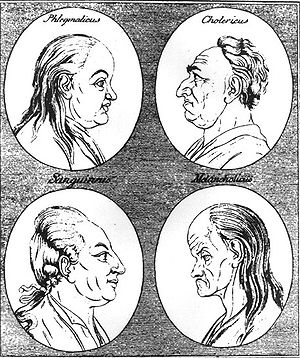
The four humors of Hippocratic medicine include black bile
(Gk. melan chole), yellow bile
(Gk. chole), phlegm
(Gk. phlegma), and blood
(L. sanguis), and each corresponds to one of the traditional four temperaments. A humor is also referred to as a cambium (pl. cambia or cambiums).
, and blood
. Greeks
and Romans
, and the later Muslim
and Western Europe
an medical establishments that adopted and adapted classical medical philosophy, believed that each of these humors would wax and wane in the body, depending on diet and activity. When a patient was suffering from a surplus or imbalance of one fluid, then his or her personality and physical health would be affected. This theory was closely related to the theory of the four elements
: earth, fire, water and air; earth predominantly present in the black bile, fire in the yellow bile, water in the phlegm, and all four elements present in the blood.
Paired qualities were associated with each humor and its season
. The word humor is a translation of Greek
χυμός, chymos (literally juice
or sap
, metaphorically flavor
). At around the same time, ancient Indian Ayurveda
medicine had developed a theory of three humours, which they linked with the five Hindu elements
.
The four humors, their corresponding elements, seasons, sites of formation, and resulting temperaments alongside their modern equivalents are:
or Mesopotamia
, though it was not systemized until ancient Greek thinkers around 400 BC who directly linked it with the popular theory of the four elements
earth, fire, water and air (Empedocles
).
Fåhræus (1921), a Swedish physician who devised the erythrocyte sedimentation rate
, suggested that the four humours were based upon the observation of blood
clotting in a transparent container. When blood is drawn in a glass container and left undisturbed for about an hour, four different layers can be seen. A dark clot forms at the bottom (the "black bile"). Above the clot is a layer of red blood cells (the "blood"). Above this is a whitish layer of white blood cells (the "phlegm", now called the buffy coat
). The top layer is clear yellow serum
(the "yellow bile").
 Hippocrates
is the one usually credited with applying this idea to medicine. Humoralism, or the doctrine of the four temperaments, as a medical theory retained its popularity for centuries largely through the influence of the writings of Galen
(131–201 AD) and was decisively displaced only in 1858 by Rudolf Virchow
's newly published theories of cellular
pathology
. While Galen thought that humors were formed in the body, rather than ingested, he believed that different food
s had varying potential to be acted upon by the body to produce different humors. Warm foods, for example, tended to produce yellow bile, while cold foods tended to produce phlegm. Seasons of the year, periods of life
, geographic
regions and occupations
also influenced the nature of the humors formed.
The imbalance of humors, or dyscrasia
, was thought to be the direct cause of all diseases. Health was associated with a balance of humors, or eucrasia. The qualities of the humors, in turn, influenced the nature of the diseases they caused. Yellow bile caused warm diseases and phlegm caused cold diseases.
In On the Temperaments, Galen further emphasized the importance of the qualities. An ideal temperament
involved a balanced mixture of the four qualities. Galen identified four temperaments in which one of the qualities, warm, cold, moist or dry, predominated and four more in which a combination of two, warm and moist, warm and dry, cold and dry or cold and moist, dominated. These last four, named for the humors with which they were associated—that is, sanguine, choleric, melancholic
and phlegmatic, eventually became better known than the others. While the term temperament came to refer just to psychological
dispositions, Galen used it to refer to bodily dispositions, which determined a person's susceptibility to particular diseases as well as behavioral and emotional inclinations.
(980–1037) repeated the ancient theory of four humours in The Canon of Medicine
(1025).
He summarized the four humors and temperament
s in a table as follows:
a sick person or applying hot cups to a person were, in fact, based on the humor theory of surpluses of fluids (blood and bile in those cases). Ben Jonson
wrote humor plays, where types were based on their humoral complexion
.
Methods of treatment like bloodletting
, emetics and purges were aimed at expelling a harmful surplus of a humor. Other methods used herbs and foods associated with a particular humor to counter symptoms of disease, for instance: people who had a fever and were sweating were considered hot and wet and therefore given substances associated with cold and dry. Paracelsus
further developed the idea that beneficial medical substances could be found in herbs, minerals and various alchymical combinations thereof. These beliefs were the foundation of mainstream Western medicine well into the 1800s.
Central to the treatment of unbalanced humors was the use of herbs. Specific herbs were used to cure common ailments and even the plague. For example, chamomile was used to treat any sort of swelling or fever. Also, arsenic was used in a poultice bag to 'draw out' the evil vapors that caused the plague. Philip Moore, who wrote on the hope of health, and Edwards, who wrote Treatise concerning the Plague discuss how these herbs are helpful in curing physical disease. They also discuss the importance of maintaining an herb garden.
The Unani
school of Indian medicine, still apparently practiced in India
, is very similar to Galen
ic and Avicennian medicine in its emphasis on the four humors and in treatments based on controlling intake, general environment, and the use of purging as a way of relieving humoral imbalances.
There are still remnants of the theory of the four humors in the current medical language. For example, we refer to humoral immunity
or humoral regulation to mean substances like hormone
s and antibodies
that are circulated throughout the body, or use the term blood dyscrasia to refer to any blood disease
or abnormality. The associated food classification survives in adjectives that are still used for food, as when we call some spices "hot" and some wine "dry". When the chilli pepper was first introduced to Europe in the sixteenth century, dieticians disputed whether it was hot or cold.
and others developed a set of characters based on the humors. Those with too much blood were sanguine. Those with too much phlegm were phlegmatic. Those with too much yellow bile were choleric, and those with too much black bile were melancholic. The idea of human personality based on humors contributed to the character comedies of Menander
and, later, Plautus
.
Through the neo-classical revival in Europe, the humor theory dominated medical practice, and the theory of humoral types made periodic appearances in drama
.
Because people believed that there were unreplenishable amounts of humors in the body, there were folk/medical beliefs that the loss of fluids was a form of death.
The humors can be found in Elizabethan works, such as in Taming of the Shrew, in which the character Petruchio pretends to be irritable and angry to show Katherina what it is like being around a disagreeable person. He yells at the servants for serving mutton, a "choleric" food, to two people who are already choleric.
Foods in Elizabethan times were believed all to have an affinity with one of these four humors. A sick person coughing up phlegm was believed to be too phlegmatic, and might have been served wine (a choleric drink and the direct opposite humor to phlegmatic) to balance it out.
Medicine in ancient Rome
Medicine in ancient Rome combined various techniques using different tools and rituals. Ancient Roman medicine included a number of specializations such as internal medicine, ophthalmology and urology...
and philosophers
Greek philosophy
Ancient Greek philosophy arose in the 6th century BCE and continued through the Hellenistic period, at which point Ancient Greece was incorporated in the Roman Empire...
, positing that an excess or deficiency of any of four distinct bodily fluid
Bodily fluid
Body fluid or bodily fluids are liquids originating from inside the bodies of living people. They include fluids that are excreted or secreted from the body as well as body water that normally is not.Body fluids include:-Body fluids and health:...
s in a person directly influences their temperament
Temperament
In psychology, temperament refers to those aspects of an individual's personality, such as introversion or extroversion, that are often regarded as innate rather than learned...
and health
Health
Health is the level of functional or metabolic efficiency of a living being. In humans, it is the general condition of a person's mind, body and spirit, usually meaning to be free from illness, injury or pain...
. From Hippocrates
Hippocrates
Hippocrates of Cos or Hippokrates of Kos was an ancient Greek physician of the Age of Pericles , and is considered one of the most outstanding figures in the history of medicine...
onward, the humoral theory was adopted by Greek, Roman and Islamic physicians, and became the most commonly held view of the human body among European physicians
Medieval medicine
Medieval medicine in Western Europe was composed of a mixture of existing ideas from antiquity, spiritual influences and what Claude Lévi-Strauss identifies as the "shamanistic complex" and "social consensus." In this era, there was no tradition of scientific medicine, and observations went...
until the advent of modern medical research in the nineteenth century.
The four humors of Hippocratic medicine include black bile
Melancholia
Melancholia , also lugubriousness, from the Latin lugere, to mourn; moroseness, from the Latin morosus, self-willed, fastidious habit; wistfulness, from old English wist: intent, or saturnine, , in contemporary usage, is a mood disorder of non-specific depression,...
(Gk. melan chole), yellow bile
Bile
Bile or gall is a bitter-tasting, dark green to yellowish brown fluid, produced by the liver of most vertebrates, that aids the process of digestion of lipids in the small intestine. In many species, bile is stored in the gallbladder and upon eating is discharged into the duodenum...
(Gk. chole), phlegm
Phlegm
Phlegm is a liquid secreted by the mucous membranes of mammalians. Its definition is limited to the mucus produced by the respiratory system, excluding that from the nasal passages, and particularly that which is expelled by coughing . Phlegm is in essence a water-based gel consisting of...
(Gk. phlegma), and blood
Blood
Blood is a specialized bodily fluid in animals that delivers necessary substances such as nutrients and oxygen to the cells and transports metabolic waste products away from those same cells....
(L. sanguis), and each corresponds to one of the traditional four temperaments. A humor is also referred to as a cambium (pl. cambia or cambiums).
Four humors
Essentially, this theory holds that the human body was filled with four basic substances, called four humors, which are in balance when a person is healthy. All diseases and disabilities resulted from an excess or deficit of one of these four humors. These deficits could be caused by vapors that were inhaled or absorbed by the body. The four humors were black bile, yellow bile, phlegmPhlegm
Phlegm is a liquid secreted by the mucous membranes of mammalians. Its definition is limited to the mucus produced by the respiratory system, excluding that from the nasal passages, and particularly that which is expelled by coughing . Phlegm is in essence a water-based gel consisting of...
, and blood
Blood
Blood is a specialized bodily fluid in animals that delivers necessary substances such as nutrients and oxygen to the cells and transports metabolic waste products away from those same cells....
. Greeks
Greeks
The Greeks, also known as the Hellenes , are a nation and ethnic group native to Greece, Cyprus and neighboring regions. They also form a significant diaspora, with Greek communities established around the world....
and Romans
Ancient Rome
Ancient Rome was a thriving civilization that grew on the Italian Peninsula as early as the 8th century BC. Located along the Mediterranean Sea and centered on the city of Rome, it expanded to one of the largest empires in the ancient world....
, and the later Muslim
Muslim
A Muslim, also spelled Moslem, is an adherent of Islam, a monotheistic, Abrahamic religion based on the Quran, which Muslims consider the verbatim word of God as revealed to prophet Muhammad. "Muslim" is the Arabic term for "submitter" .Muslims believe that God is one and incomparable...
and Western Europe
Western Europe
Western Europe is a loose term for the collection of countries in the western most region of the European continents, though this definition is context-dependent and carries cultural and political connotations. One definition describes Western Europe as a geographic entity—the region lying in the...
an medical establishments that adopted and adapted classical medical philosophy, believed that each of these humors would wax and wane in the body, depending on diet and activity. When a patient was suffering from a surplus or imbalance of one fluid, then his or her personality and physical health would be affected. This theory was closely related to the theory of the four elements
Classical element
Many philosophies and worldviews have a set of classical elements believed to reflect the simplest essential parts and principles of which anything consists or upon which the constitution and fundamental powers of anything are based. Most frequently, classical elements refer to ancient beliefs...
: earth, fire, water and air; earth predominantly present in the black bile, fire in the yellow bile, water in the phlegm, and all four elements present in the blood.
Paired qualities were associated with each humor and its season
Season
A season is a division of the year, marked by changes in weather, ecology, and hours of daylight.Seasons result from the yearly revolution of the Earth around the Sun and the tilt of the Earth's axis relative to the plane of revolution...
. The word humor is a translation of Greek
Greek language
Greek is an independent branch of the Indo-European family of languages. Native to the southern Balkans, it has the longest documented history of any Indo-European language, spanning 34 centuries of written records. Its writing system has been the Greek alphabet for the majority of its history;...
χυμός, chymos (literally juice
Juice
Juice is the liquid that is naturally contained in fruit or vegetable tissue.Juice is prepared by mechanically squeezing or macerating fruit or vegetable flesh without the application of heat or solvents. For example, orange juice is the liquid extract of the fruit of the orange tree...
or sap
Sap
Sap may refer to:* Plant sap, the fluid transported in xylem cells or phloem sieve tube elements of a plant* Sap , a village in the Dunajská Streda District of Slovakia...
, metaphorically flavor
Flavor
Flavor or flavour is the sensory impression of a food or other substance, and is determined mainly by the chemical senses of taste and smell. The "trigeminal senses", which detect chemical irritants in the mouth and throat as well as temperature and texture, are also very important to the overall...
). At around the same time, ancient Indian Ayurveda
Ayurveda
Ayurveda or ayurvedic medicine is a system of traditional medicine native to India and a form of alternative medicine. In Sanskrit, words , meaning "longevity", and , meaning "knowledge" or "science". The earliest literature on Indian medical practice appeared during the Vedic period in India,...
medicine had developed a theory of three humours, which they linked with the five Hindu elements
Tattva
Tattva is a Sanskrit word meaning 'thatness', 'principle', 'reality' or 'truth'. According to various Indian schools of philosophy, a tattva is an element or aspect of reality conceived as an aspect of deity. Although the number of tattvas varies depending on the philosophical school, together they...
.
The four humors, their corresponding elements, seasons, sites of formation, and resulting temperaments alongside their modern equivalents are:
History
Although modern medical science has thoroughly discredited humorism, the theory dominated western medical thinking for more than 2,000 years.Origins
The concept of four humors may have origins in ancient EgyptAncient Egyptian medicine
The medicine of the ancient Egyptians is some of the oldest documented. From the beginnings of the civilization in the until the Persian invasion of 525 BC, Egyptian medical practice went largely unchanged and was highly advanced for its time, including simple non-invasive surgery, setting of...
or Mesopotamia
Mesopotamia
Mesopotamia is a toponym for the area of the Tigris–Euphrates river system, largely corresponding to modern-day Iraq, northeastern Syria, southeastern Turkey and southwestern Iran.Widely considered to be the cradle of civilization, Bronze Age Mesopotamia included Sumer and the...
, though it was not systemized until ancient Greek thinkers around 400 BC who directly linked it with the popular theory of the four elements
Classical element
Many philosophies and worldviews have a set of classical elements believed to reflect the simplest essential parts and principles of which anything consists or upon which the constitution and fundamental powers of anything are based. Most frequently, classical elements refer to ancient beliefs...
earth, fire, water and air (Empedocles
Empedocles
Empedocles was a Greek pre-Socratic philosopher and a citizen of Agrigentum, a Greek city in Sicily. Empedocles' philosophy is best known for being the originator of the cosmogenic theory of the four Classical elements...
).
Fåhræus (1921), a Swedish physician who devised the erythrocyte sedimentation rate
Erythrocyte sedimentation rate
The erythrocyte sedimentation rate , also called a sedimentation rate or Biernacki Reaction, is the rate at which red blood cells sediment in a period of 1 hour...
, suggested that the four humours were based upon the observation of blood
Blood
Blood is a specialized bodily fluid in animals that delivers necessary substances such as nutrients and oxygen to the cells and transports metabolic waste products away from those same cells....
clotting in a transparent container. When blood is drawn in a glass container and left undisturbed for about an hour, four different layers can be seen. A dark clot forms at the bottom (the "black bile"). Above the clot is a layer of red blood cells (the "blood"). Above this is a whitish layer of white blood cells (the "phlegm", now called the buffy coat
Buffy coat
The buffy coat is the fraction of an anticoagulated blood sample after density gradient centrifugation that contains most of the white blood cells and platelets.-Description:...
). The top layer is clear yellow serum
Serum
Serum may refer to:*Blood serum, a component of blood which is collected after coagulation.**Antiserum, blood serum with specific antibodies for passive immunity*Serous fluid, any clear bodily fluid*any drug derived from an animal's blood or serous fluid...
(the "yellow bile").
Greek medicine
Hippocrates
Hippocrates of Cos or Hippokrates of Kos was an ancient Greek physician of the Age of Pericles , and is considered one of the most outstanding figures in the history of medicine...
is the one usually credited with applying this idea to medicine. Humoralism, or the doctrine of the four temperaments, as a medical theory retained its popularity for centuries largely through the influence of the writings of Galen
Galen
Aelius Galenus or Claudius Galenus , better known as Galen of Pergamon , was a prominent Roman physician, surgeon and philosopher...
(131–201 AD) and was decisively displaced only in 1858 by Rudolf Virchow
Rudolf Virchow
Rudolph Carl Virchow was a German doctor, anthropologist, pathologist, prehistorian, biologist and politician, known for his advancement of public health...
's newly published theories of cellular
Cell (biology)
The cell is the basic structural and functional unit of all known living organisms. It is the smallest unit of life that is classified as a living thing, and is often called the building block of life. The Alberts text discusses how the "cellular building blocks" move to shape developing embryos....
pathology
Pathology
Pathology is the precise study and diagnosis of disease. The word pathology is from Ancient Greek , pathos, "feeling, suffering"; and , -logia, "the study of". Pathologization, to pathologize, refers to the process of defining a condition or behavior as pathological, e.g. pathological gambling....
. While Galen thought that humors were formed in the body, rather than ingested, he believed that different food
Food
Food is any substance consumed to provide nutritional support for the body. It is usually of plant or animal origin, and contains essential nutrients, such as carbohydrates, fats, proteins, vitamins, or minerals...
s had varying potential to be acted upon by the body to produce different humors. Warm foods, for example, tended to produce yellow bile, while cold foods tended to produce phlegm. Seasons of the year, periods of life
Life
Life is a characteristic that distinguishes objects that have signaling and self-sustaining processes from those that do not, either because such functions have ceased , or else because they lack such functions and are classified as inanimate...
, geographic
Geography
Geography is the science that studies the lands, features, inhabitants, and phenomena of Earth. A literal translation would be "to describe or write about the Earth". The first person to use the word "geography" was Eratosthenes...
regions and occupations
Profession
A profession is a vocation founded upon specialized educational training, the purpose of which is to supply disinterested counsel and service to others, for a direct and definite compensation, wholly apart from expectation of other business gain....
also influenced the nature of the humors formed.
The imbalance of humors, or dyscrasia
Dyscrasia
Dyscrasia is a concept from ancient Greek medicine with the word "dyskrasia", meaning bad mixture.The concept of dyscrasia was developed by the ancient Greek physician Galen , who elaborated a model of health and disease as a structure of elements, qualities, humors, organs, and temperaments...
, was thought to be the direct cause of all diseases. Health was associated with a balance of humors, or eucrasia. The qualities of the humors, in turn, influenced the nature of the diseases they caused. Yellow bile caused warm diseases and phlegm caused cold diseases.
In On the Temperaments, Galen further emphasized the importance of the qualities. An ideal temperament
Temperament
In psychology, temperament refers to those aspects of an individual's personality, such as introversion or extroversion, that are often regarded as innate rather than learned...
involved a balanced mixture of the four qualities. Galen identified four temperaments in which one of the qualities, warm, cold, moist or dry, predominated and four more in which a combination of two, warm and moist, warm and dry, cold and dry or cold and moist, dominated. These last four, named for the humors with which they were associated—that is, sanguine, choleric, melancholic
Melancholia
Melancholia , also lugubriousness, from the Latin lugere, to mourn; moroseness, from the Latin morosus, self-willed, fastidious habit; wistfulness, from old English wist: intent, or saturnine, , in contemporary usage, is a mood disorder of non-specific depression,...
and phlegmatic, eventually became better known than the others. While the term temperament came to refer just to psychological
Psychology
Psychology is the study of the mind and behavior. Its immediate goal is to understand individuals and groups by both establishing general principles and researching specific cases. For many, the ultimate goal of psychology is to benefit society...
dispositions, Galen used it to refer to bodily dispositions, which determined a person's susceptibility to particular diseases as well as behavioral and emotional inclinations.
Islamic medicine
In Islamic medicine, AvicennaAvicenna
Abū ʿAlī al-Ḥusayn ibn ʿAbd Allāh ibn Sīnā , commonly known as Ibn Sīnā or by his Latinized name Avicenna, was a Persian polymath, who wrote almost 450 treatises on a wide range of subjects, of which around 240 have survived...
(980–1037) repeated the ancient theory of four humours in The Canon of Medicine
The Canon of Medicine
The Canon of Medicine is an encyclopedia of Galenic medicine in five books compiled by Ibn Sīnā and completed in 1025. It presents a clear and organized summary of all the medical knowledge of the time...
(1025).
He summarized the four humors and temperament
Temperament
In psychology, temperament refers to those aspects of an individual's personality, such as introversion or extroversion, that are often regarded as innate rather than learned...
s in a table as follows:
| Avicenna Abū ʿAlī al-Ḥusayn ibn ʿAbd Allāh ibn Sīnā , commonly known as Ibn Sīnā or by his Latinized name Avicenna, was a Persian polymath, who wrote almost 450 treatises on a wide range of subjects, of which around 240 have survived... 's four humors and temperament Temperament In psychology, temperament refers to those aspects of an individual's personality, such as introversion or extroversion, that are often regarded as innate rather than learned... s |
||||
| Evidence | Hot | Cold | Moist | Dry |
| Morbid states | inflammation Inflammation Inflammation is part of the complex biological response of vascular tissues to harmful stimuli, such as pathogens, damaged cells, or irritants. Inflammation is a protective attempt by the organism to remove the injurious stimuli and to initiate the healing process... s become febrile Fever Fever is a common medical sign characterized by an elevation of temperature above the normal range of due to an increase in the body temperature regulatory set-point. This increase in set-point triggers increased muscle tone and shivering.As a person's temperature increases, there is, in... |
fever Fever Fever is a common medical sign characterized by an elevation of temperature above the normal range of due to an increase in the body temperature regulatory set-point. This increase in set-point triggers increased muscle tone and shivering.As a person's temperature increases, there is, in... s related to serious humor, rheumatism Rheumatism Rheumatism or rheumatic disorder is a non-specific term for medical problems affecting the joints and connective tissue. The study of, and therapeutic interventions in, such disorders is called rheumatology.-Terminology:... |
lassitude | loss of vigour |
| Functional power | deficient energy Energy In physics, energy is an indirectly observed quantity. It is often understood as the ability a physical system has to do work on other physical systems... |
deficient digestive Digestion Digestion is the mechanical and chemical breakdown of food into smaller components that are more easily absorbed into a blood stream, for instance. Digestion is a form of catabolism: a breakdown of large food molecules to smaller ones.... power |
difficult digestion Digestion Digestion is the mechanical and chemical breakdown of food into smaller components that are more easily absorbed into a blood stream, for instance. Digestion is a form of catabolism: a breakdown of large food molecules to smaller ones.... |
|
| Subjective sensations | bitter taste, excessive thirst Thirst Thirst is the craving for fluids, resulting in the basic instinct of animals to drink. It is an essential mechanism involved in fluid balance. It arises from a lack of fluids and/or an increase in the concentration of certain osmolites, such as salt... , burning at cardia Cardia The cardia is the anatomical term for the part of the stomach attached to the esophagus. The cardia begins immediately distal to the z-line of the gastroesophageal junction, where the squamous epithelium of the esophagus gives way to the columnar epithelium of the gastrointestinal tract.Just... |
Lack of desire for fluid Fluid In physics, a fluid is a substance that continually deforms under an applied shear stress. Fluids are a subset of the phases of matter and include liquids, gases, plasmas and, to some extent, plastic solids.... s |
mucoid Mucous connective tissue Mucous connective tissue is a type of connective tissue found during fetal development. It is composed mainly of ground substance with few cells or fibers. It can also be referred to a group of mucoproteins found in certain types of cysts, etcresembling mucus... saliva Saliva Saliva , referred to in various contexts as spit, spittle, drivel, drool, or slobber, is the watery substance produced in the mouths of humans and most other animals. Saliva is a component of oral fluid. In mammals, saliva is produced in and secreted from the three pairs of major salivary glands,... tion, sleepiness Somnolence Somnolence is a state of near-sleep, a strong desire for sleep, or sleeping for unusually long periods . It has two distinct meanings, referring both to the usual state preceding falling asleep, and the chronic condition referring to being in that state independent of a circadian rhythm... |
insomnia Insomnia Insomnia is most often defined by an individual's report of sleeping difficulties. While the term is sometimes used in sleep literature to describe a disorder demonstrated by polysomnographic evidence of disturbed sleep, insomnia is often defined as a positive response to either of two questions:... , wakefulness |
| Physical signs | high pulse Pulse In medicine, one's pulse represents the tactile arterial palpation of the heartbeat by trained fingertips. The pulse may be palpated in any place that allows an artery to be compressed against a bone, such as at the neck , at the wrist , behind the knee , on the inside of the elbow , and near the... rate, lassitude |
flaccid joints | diarrhea Diarrhea Diarrhea , also spelled diarrhoea, is the condition of having three or more loose or liquid bowel movements per day. It is a common cause of death in developing countries and the second most common cause of infant deaths worldwide. The loss of fluids through diarrhea can cause dehydration and... , swollen eyelids Eye puffiness Periorbital puffiness, also known as "puffy eyes" or swelling around the eyes, refers to the appearance of swelling in the tissues around the eyes, called the orbits. It is almost exclusively caused by fluid buildup around the eyes, or periorbital edema... , rough skin, acquired habit Habit (psychology) Habits are routines of behavior that are repeated regularly and tend to occur subconsciously. Habitual behavior often goes unnoticed in persons exhibiting it, because a person does not need to engage in self-analysis when undertaking routine tasks... |
rough skin, acquired habit Habit (psychology) Habits are routines of behavior that are repeated regularly and tend to occur subconsciously. Habitual behavior often goes unnoticed in persons exhibiting it, because a person does not need to engage in self-analysis when undertaking routine tasks... |
| Foods & medicines | calefacients harmful, infrigidants beneficial | infrigidants harmful, calefacients beneficial | moist Moisture Humidity is the amount of moisture the air can hold before it rains. Moisture refers to the presence of a liquid, especially water, often in trace amounts... articles harmful |
dry regimen harmful, humectant Humectant A humectant is a hygroscopic substance. It is often a molecule with several hydrophilic groups, most often hydroxyl groups, but amines and carboxyl groups, sometimes esterified, can be encountered as well; the affinity to form hydrogen bonds with molecules of water is crucial here.Since... s beneficial |
| Relation to weather | worse in summer | worse in winter | bad in autumn | |
Medicine
Typically "eighteenth-century" practices such as bleedingBloodletting
Bloodletting is the withdrawal of often little quantities of blood from a patient to cure or prevent illness and disease. Bloodletting was based on an ancient system of medicine in which blood and other bodily fluid were considered to be "humors" the proper balance of which maintained health...
a sick person or applying hot cups to a person were, in fact, based on the humor theory of surpluses of fluids (blood and bile in those cases). Ben Jonson
Ben Jonson
Benjamin Jonson was an English Renaissance dramatist, poet and actor. A contemporary of William Shakespeare, he is best known for his satirical plays, particularly Volpone, The Alchemist, and Bartholomew Fair, which are considered his best, and his lyric poems...
wrote humor plays, where types were based on their humoral complexion
Complexion
Complexion refers to the natural color, texture, and appearance of the skin, especially that of the face.-History:The word "complexion" is derived from the Late Latin complexi, which initially referred in general terms to a combination of things, and later in physiological terms, to the balance of...
.
Methods of treatment like bloodletting
Bloodletting
Bloodletting is the withdrawal of often little quantities of blood from a patient to cure or prevent illness and disease. Bloodletting was based on an ancient system of medicine in which blood and other bodily fluid were considered to be "humors" the proper balance of which maintained health...
, emetics and purges were aimed at expelling a harmful surplus of a humor. Other methods used herbs and foods associated with a particular humor to counter symptoms of disease, for instance: people who had a fever and were sweating were considered hot and wet and therefore given substances associated with cold and dry. Paracelsus
Paracelsus
Paracelsus was a German-Swiss Renaissance physician, botanist, alchemist, astrologer, and general occultist....
further developed the idea that beneficial medical substances could be found in herbs, minerals and various alchymical combinations thereof. These beliefs were the foundation of mainstream Western medicine well into the 1800s.
Central to the treatment of unbalanced humors was the use of herbs. Specific herbs were used to cure common ailments and even the plague. For example, chamomile was used to treat any sort of swelling or fever. Also, arsenic was used in a poultice bag to 'draw out' the evil vapors that caused the plague. Philip Moore, who wrote on the hope of health, and Edwards, who wrote Treatise concerning the Plague discuss how these herbs are helpful in curing physical disease. They also discuss the importance of maintaining an herb garden.
The Unani
Unani
Unani-tibb or Unani Medicine also spelled Yunani Medicine means "Greek Medicine", and is a form of traditional medicine widely practiced in South Asia...
school of Indian medicine, still apparently practiced in India
India
India , officially the Republic of India , is a country in South Asia. It is the seventh-largest country by geographical area, the second-most populous country with over 1.2 billion people, and the most populous democracy in the world...
, is very similar to Galen
Galen
Aelius Galenus or Claudius Galenus , better known as Galen of Pergamon , was a prominent Roman physician, surgeon and philosopher...
ic and Avicennian medicine in its emphasis on the four humors and in treatments based on controlling intake, general environment, and the use of purging as a way of relieving humoral imbalances.
There are still remnants of the theory of the four humors in the current medical language. For example, we refer to humoral immunity
Humoral immunity
The Humoral Immune Response is the aspect of immunity that is mediated by secreted antibodies produced in the cells of the B lymphocyte lineage . B Cells transform into plasma cells which secrete antibodies...
or humoral regulation to mean substances like hormone
Hormone
A hormone is a chemical released by a cell or a gland in one part of the body that sends out messages that affect cells in other parts of the organism. Only a small amount of hormone is required to alter cell metabolism. In essence, it is a chemical messenger that transports a signal from one...
s and antibodies
Antibody
An antibody, also known as an immunoglobulin, is a large Y-shaped protein used by the immune system to identify and neutralize foreign objects such as bacteria and viruses. The antibody recognizes a unique part of the foreign target, termed an antigen...
that are circulated throughout the body, or use the term blood dyscrasia to refer to any blood disease
Hematology
Hematology, also spelled haematology , is the branch of biology physiology, internal medicine, pathology, clinical laboratory work, and pediatrics that is concerned with the study of blood, the blood-forming organs, and blood diseases...
or abnormality. The associated food classification survives in adjectives that are still used for food, as when we call some spices "hot" and some wine "dry". When the chilli pepper was first introduced to Europe in the sixteenth century, dieticians disputed whether it was hot or cold.
Culture
TheophrastusTheophrastus
Theophrastus , a Greek native of Eresos in Lesbos, was the successor to Aristotle in the Peripatetic school. He came to Athens at a young age, and initially studied in Plato's school. After Plato's death he attached himself to Aristotle. Aristotle bequeathed to Theophrastus his writings, and...
and others developed a set of characters based on the humors. Those with too much blood were sanguine. Those with too much phlegm were phlegmatic. Those with too much yellow bile were choleric, and those with too much black bile were melancholic. The idea of human personality based on humors contributed to the character comedies of Menander
Menander
Menander , Greek dramatist, the best-known representative of Athenian New Comedy, was the son of well-to-do parents; his father Diopeithes is identified by some with the Athenian general and governor of the Thracian Chersonese known from the speech of Demosthenes De Chersoneso...
and, later, Plautus
Plautus
Titus Maccius Plautus , commonly known as "Plautus", was a Roman playwright of the Old Latin period. His comedies are the earliest surviving intact works in Latin literature. He wrote Palliata comoedia, the genre devised by the innovator of Latin literature, Livius Andronicus...
.
Through the neo-classical revival in Europe, the humor theory dominated medical practice, and the theory of humoral types made periodic appearances in drama
Drama
Drama is the specific mode of fiction represented in performance. The term comes from a Greek word meaning "action" , which is derived from "to do","to act" . The enactment of drama in theatre, performed by actors on a stage before an audience, presupposes collaborative modes of production and a...
.
Because people believed that there were unreplenishable amounts of humors in the body, there were folk/medical beliefs that the loss of fluids was a form of death.
The humors can be found in Elizabethan works, such as in Taming of the Shrew, in which the character Petruchio pretends to be irritable and angry to show Katherina what it is like being around a disagreeable person. He yells at the servants for serving mutton, a "choleric" food, to two people who are already choleric.
Foods in Elizabethan times were believed all to have an affinity with one of these four humors. A sick person coughing up phlegm was believed to be too phlegmatic, and might have been served wine (a choleric drink and the direct opposite humor to phlegmatic) to balance it out.
See also
- Four Temperaments
- Five TemperamentsFive TemperamentsFive temperaments is a theory in psychology, that expands upon the Four Temperaments proposed in ancient medical theory.The development of a theory of five temperaments begins with the Two-factor models of personality and the work of the late William Schutz, and his FIRO-B program...
- Three DoshaDoshaA dosha is one of three bodily humors that make up one's constitution according to Ayurveda. These teachings are also known as the Tridosha system....
s of AyurvedaAyurvedaAyurveda or ayurvedic medicine is a system of traditional medicine native to India and a form of alternative medicine. In Sanskrit, words , meaning "longevity", and , meaning "knowledge" or "science". The earliest literature on Indian medical practice appeared during the Vedic period in India,... - Wu Xing (Five Elements of Chinese philosophy)
External links
- BBC Radio4's In Our Time. Episode on the four humors in MP3 format, 45 minutes.