
All Topics  
Paracelsus

 
Paracelsus

   Email Print
   Bookmark   Link


Paracelsus


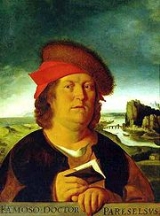
Paracelsus (11 November or 17 December 1493 in Einsiedeln, Switzerland
Einsiedeln, Switzerland

Einsiedeln is a municipalities of Switzerland of 13,062 in Switzerland in the Cantons of Switzerland of Canton of Schwyz in Switzerland known for its monastery, the Benedictine Einsiedeln Abbey....
 – 24 September 1541 in Salzburg
Salzburg

is the List of cities and towns in Austria#List of cities and towns by population size in Austria and the capital city of the states of Austria of Salzburg ....
, Austria
Austria

Austria , officially the Republic of Austria , is a landlocked country in Central Europe. It borders both Germany and the Czech Republic to the north, Slovakia and Hungary to the east, Slovenia and Italy to the south, and Switzerland and Liechtenstein to the west....
) was a Medieval physician
Physician

A physician, medical practitioner, doctor of medicine, or medical doctor practices medicine, and is concerned with maintaining or restoring human health through the study, diagnosis, and treatment of disease and injury....
, botanist, alchemist
Alchemy

Alchemy , a part of the Occult Tradition, is both a philosophy and a practice with an aim of achieving ultimate wisdom as well as immortality, involving the improvement of the alchemist as well as the making of several substances described as possessing unusual properties....
, astrologer
Astrologer

An astrologer practices one or more forms of astrology. Typically an astrologer draws a horoscope for the time of an event, such as a person's birth, and interprets celestial points and their placements at the time of the event to better understand someone, determine the auspiciousness of an undertaking's beginning, etc....
, and general occultist. Born Phillip von Hohenheim
Hohenheim

Stuttgart-Hohenheim is an area of Plieningen, one of 18 outer districts in the Germany city of Stuttgart in the state of Baden-W?rttemberg....
, he later took up the name Philippus Theophrastus Aureolus Bombastus von Hohenheim, and still later took the title Paracelsus, meaning "equal to or greater than Celsus", a Roman encyclopedist, Aulus Cornelius Celsus
Aulus Cornelius Celsus

Aulus Cornelius Celsus was a Ancient Rome encyclopedist, known for his Extant literature medical work, De Medicina, which is believed to be the only surviving section of a much larger encyclopedia....
 from the first century known for his tract on medicine.


Discussion
Ask a question about 'Paracelsus'
Start a new discussion about 'Paracelsus'
Answer questions from other users
Full Discussion Forum


Recent Posts


Quotations


A mortal lives not through that breath that flows in and that flows out. The source of his life is another and this causes the breath to flow.

All substances are poisons; there is none which is not a poison. The right dose differentiates a poison and a remedy.

The art of healing comes from nature, not from the physician. Therefore the physician must start from nature, with an open mind.

The human body is vapor materialized by sunshine mixed with the life of the stars.

Life is like music, it must be composed by ear, feeling and instinct, not by rule. Nevertheless one had better know the rules, for they sometimes guide in doubtful cases, though not often.

Medicine is not only a science; it is also an art. It does not consist of compounding pills and plasters; it deals with the very processes of life, which must be understood before they may be guided.


Encyclopedia


Paracelsus (11 November or 17 December 1493 in Einsiedeln, Switzerland
Einsiedeln, Switzerland

Einsiedeln is a municipalities of Switzerland of 13,062 in Switzerland in the Cantons of Switzerland of Canton of Schwyz in Switzerland known for its monastery, the Benedictine Einsiedeln Abbey....
 – 24 September 1541 in Salzburg
Salzburg

is the List of cities and towns in Austria#List of cities and towns by population size in Austria and the capital city of the states of Austria of Salzburg ....
, Austria
Austria

Austria , officially the Republic of Austria , is a landlocked country in Central Europe. It borders both Germany and the Czech Republic to the north, Slovakia and Hungary to the east, Slovenia and Italy to the south, and Switzerland and Liechtenstein to the west....
) was a Medieval physician
Physician

A physician, medical practitioner, doctor of medicine, or medical doctor practices medicine, and is concerned with maintaining or restoring human health through the study, diagnosis, and treatment of disease and injury....
, botanist, alchemist
Alchemy

Alchemy , a part of the Occult Tradition, is both a philosophy and a practice with an aim of achieving ultimate wisdom as well as immortality, involving the improvement of the alchemist as well as the making of several substances described as possessing unusual properties....
, astrologer
Astrologer

An astrologer practices one or more forms of astrology. Typically an astrologer draws a horoscope for the time of an event, such as a person's birth, and interprets celestial points and their placements at the time of the event to better understand someone, determine the auspiciousness of an undertaking's beginning, etc....
, and general occultist. Born Phillip von Hohenheim
Hohenheim

Stuttgart-Hohenheim is an area of Plieningen, one of 18 outer districts in the Germany city of Stuttgart in the state of Baden-W?rttemberg....
, he later took up the name Philippus Theophrastus Aureolus Bombastus von Hohenheim, and still later took the title Paracelsus, meaning "equal to or greater than Celsus", a Roman encyclopedist, Aulus Cornelius Celsus
Aulus Cornelius Celsus

Aulus Cornelius Celsus was a Ancient Rome encyclopedist, known for his Extant literature medical work, De Medicina, which is believed to be the only surviving section of a much larger encyclopedia....
 from the first century known for his tract on medicine. He is also credited for giving zinc its name, calling it zincum and is regarded as the first systematic botanist.

Biography

Paracelsus
Paracelsus was born and raised in the village of Maria Einsiedeln
Einsiedeln

Einsiedeln may refer to:*Einsiedeln Abbey in Switzerland*Einsiedeln, Switzerland...
 in Switzerland
Switzerland

Switzerland is a landlocked Swiss Alps country of roughly 7.7 million people in Western Europe with an area of 41,285 km?. Switzerland is a federal republic consisting of 26 states called Cantons of Switzerland....
. His father, Wilhelm Bombast von Hohenheim
Hohenheim

Stuttgart-Hohenheim is an area of Plieningen, one of 18 outer districts in the Germany city of Stuttgart in the state of Baden-W?rttemberg....
, was a Swabian chemist and physician; his mother was Swiss
Switzerland

Switzerland is a landlocked Swiss Alps country of roughly 7.7 million people in Western Europe with an area of 41,285 km?. Switzerland is a federal republic consisting of 26 states called Cantons of Switzerland....
. As a youth he worked in nearby mines as an analyst. At the age of 16 he started studying medicine at the University of Basel
University of Basel

The University of Basel is located at Basel, Switzerland....
, later moving to Vienna. He gained his doctorate
Doctorate

A doctorate is an academic degree that in most countries represents the highest level of formal study or research in a given field. In some countries it also refers to a class of degrees which qualify the holder to practice in a specific profession ....
 degree from the University of Ferrara
University of Ferrara

The University of Ferrara is the main university of the city of Ferrara in the Emilia-Romagna region of northern Italy. In the years prior to the World War I the University of Ferrara, with more than 500 students, was the best attended of the free universities in Italy....
.

His wanderings as an itinerant physician and sometime journeyman miner took him through Germany
Germany

Germany , officially the Federal Republic of Germany , is a country in Central Europe. It is bordered to the north by the North Sea, Denmark, and the Baltic Sea; to the east by Poland and the Czech Republic; to the south by Austria and Switzerland; and to the west by France, Luxembourg, Belgium, and the Netherlands....
, France
France

France , officially the French Republic , is a country whose Metropolitan France is located in Western Europe and that also comprises various Overseas departments and territories of France....
, Spain
Spain

Spain or the Kingdom of Spain , is a country located in Southern Europe on the Iberian Peninsula.The Spanish constitution does not establish any official denomination of the country, even though Espa?a , Estado espa?ol and Naci?n espa?ola are used interchangeably....
, Hungary
Hungary

Hungary , officially in English the Republic of Hungary , is a landlocked country in the Carpathian Basin of Central Europe, bordered by Austria, Slovakia, Ukraine, Romania, Serbia, Croatia, and Slovenia....
, the Netherlands
Netherlands

The Netherlands is a country that is part of the Kingdom of the Netherlands. It is a parliamentary democratic constitutional monarchy. The Netherlands is located in North-West Europe, and bordered by the North Sea to the north and west, Belgium to the south, and Germany to the east....
, Denmark
Denmark

Denmark is a Scandinavian country in northern Europe and the senior member of the Kingdom of Denmark. It is the southernmost of the Nordic countries....
, Sweden
Sweden

Sweden , officially the Kingdom of Sweden , is a Nordic countries on the Scandinavian Peninsula in Northern Europe. Sweden has land borders with Norway to the west and Finland to the northeast, and it is connected to Denmark by the ?resund Bridge in the south....
 and Russia
Russia

Russia , or the Russian Federation , is a list of countries spanning more than one continent country extending over much of northern Eurasia....
.

Paracelsus rejected Gnostic
Gnosticism

Gnosticism refers to diverse, syncretistic religious movements in antiquity consisting of various belief systems generally united in the teaching that humans are divine souls trapped in a Nature created by an imperfect god, the demiurge; this being is frequently identified with the Abrahamic God, and is contrasted with a superior entity, ref...
 traditions, but kept much of the Hermetic
Hermeticism

Hermeticism is a set of philosophy and Religion beliefs based primarily upon the Hellenistic Egyptian Pseudepigrapha attributed to Hermes Trismegistus who is the representation of the congruence of the Egyptian god Thoth and the Greek Hermes....
, neoplatonic
Neoplatonism

Neoplatonism is the modern term for a school of religious and mystical philosophy that took shape in the 3rd century AD, founded by Plotinus and based on the teachings of Plato and earlier Platonism....
, and Pythagorean
Pythagoras

Pythagoras of Samos was an Ionians Ancient Greeks mathematician and founder of the religious movement called Pythagoreanism. He is often revered as a great mathematician, mysticism and scientist; however some have questioned the scope of his contributions to mathematics and natural philosophy....
 philosophies from Ficino and Pico della Mirandola; however, Hermetical science had so much Aristotelian
Aristotle

Aristotle was a Greeks philosopher, a student of Plato and teacher of Alexander the Great. He wrote on many subjects, including physics, metaphysics, Poetics , theater, music, logic, rhetoric, politics, government, ethics, biology and zoology....
 theory that his rejection of Gnosticism was practically meaningless. In particular, Paracelsus rejected the magic
Magic (paranormal)

Magic, sometimes known as sorcery, is a conceptual system that asserts human ability to control or predict the nature through Mysticism, paranormal or supernatural means....
 theories of Agrippa
Heinrich Cornelius Agrippa

Heinrich Cornelius Agrippa von Nettesheim was a German magic , occult writer, theology, astrology, and alchemy....
 and Flamel
Nicholas Flamel

Nicolas Flamel was a successful scrivener and manuscript-seller who developed a posthumous reputation as an alchemy due to his reputed work on the Philosopher's Stone....
; Paracelsus did not think of himself as a magician and scorned those who did, though he was a practicing astrologer
Astrologer

An astrologer practices one or more forms of astrology. Typically an astrologer draws a horoscope for the time of an event, such as a person's birth, and interprets celestial points and their placements at the time of the event to better understand someone, determine the auspiciousness of an undertaking's beginning, etc....
, as were most, if not all of the university-trained physicians working at this time in Europe. Astrology
Astrology

Astrology is a group of systems, traditions, and beliefs which hold that the relative positions of astronomical object and related details can provide useful information about personality, human affairs, and other terrestrial matters....
 was a very important part of Paracelsus' medicine. In his Archidoxes of Magic Paracelsus devoted several sections to astrological talismans for curing disease, providing talismans for various maladies as well as talismans for each sign of the Zodiac
Zodiac

Zodiac denotes an annual cycle of twelve stations along the ecliptic, the apparent path of the Sun across the heavens through the constellations that divide the ecliptic into twelve equal zones of celestial longitude....
. He also invented an alphabet called the Alphabet of the Magi
Alphabet of the Magi

The Alphabet of the Magi was an alphabet invented by Theophrastus Bombastus von Hohenheim for the use of engraving angelic names upon Amulet. It was likely influenced by the various undefined alphabets from older Grimoires of the time....
, for engraving angelic names upon talisman
Talisman

*A Talisman is a small amulet or other object, often bearing magical symbols, worn for protection against evil spirits or the supernatural.May also mean:...
s.

Paracelsus pioneered the use of chemicals and minerals in medicine
Medicine

Medicine is the art and science of healing. It encompasses a range of health care practices evolved to maintain and restore health by the prevention and treatment of illness....
. He used the name "zink" for the element zinc
Zinc

Zinc is a metallic chemical element with the symbol Zn and atomic number 30. It is a first-row transition metal of the group 12 element of the periodic table....
 in about 1526, based on the sharp pointed appearance of its crystals after smelting and the old German word "zinke" for pointed. He used experimentation in learning about the human body
Human anatomy

Human anatomy, which, with physiology and biochemistry, is a complementary basic medical science is primarily the scientific study of the morphology of the adult human body....
.

Paracelsus gained a reputation for being arrogant, and soon garnered the anger of other physicians in Europe. He held the chair of medicine at the University of Basel
University of Basel

The University of Basel is located at Basel, Switzerland....
 for less than a year; while there his colleagues became angered by allegations that he had publicly burned traditional medical books. He was forced from the city after having legal trouble over a physician's fee he sued to collect.

He then wandered Europe
Europe

Europe is, conventionally, one of the world's seven continents. Comprising the westernmost peninsula of Eurasia, Europe is generally divided from Asia to its east by the water divide of the Ural Mountains, the Ural , the Caspian Sea, and by the Caucasus Mountains to the southeast....
, Africa
Africa

Africa is the world's second-largest and second most-populous continent, after Asia. At about 30.2 million km? including adjacent islands, it covers 6% of the Earth's total surface area and 20.4% of the total land area....
 and Asia Minor, in the pursuit of hidden knowledge. He revised old manuscripts and wrote new ones, but had trouble finding publishers. In 1536, his Die grosse Wundartznei (The Great Surgery Book) was published and enabled him to regain fame. Paracelsus' life is connected to the birth of Lutheranism, and his opinions on the nature of the universe are better understood within the context of the religious ideas circulating during his lifetime.

He died, aged 48, of natural causes and his remains were buried according to his wishes in the cemetery at the church of St Sebastian in Salzburg. His remains are now located in a tomb in the porch of the church.

After his death, the movement of Paracelsianism
Paracelsianism

Paracelsianism was a medical movement based on the theories and therapies of Paracelsus. It was prominent in late-16th and 17th century Europe and represented one of the most comprehensive alternatives to the traditional system of therapeutics derived from Galenic physiology....
 was seized upon by many wishing to subvert the traditional Galen
Galen

Aelius Galenus or Claudius Galenus , better known as Galen of Pergamum , was a prominent Ancient Rome physician and philosopher of Greek origin, and probably the most accomplished medical researcher of the Roman period....
ic physics, and thus did his therapies become more widely known and used.

His motto
Motto

A motto is a phrase meant to formally describe the general motivation or intention of a social group or organization. A motto may be in any language, but Latin is the most used....
 was "alterius non sit qui suus esse potest" which means "let no man that can belong to himself be of another"

Philosophy

Paracelsus believed in the Greek concept of the four elements
Classical element

Many ancient philosophy used a set of archetype classical elements to explain patterns in nature. In this context, the word element refers to a chemical substance that is either a chemical compound or a mixture of chemical compounds , rather than a chemical element of modern physical science....
, but he also introduced the idea that, on another level, the cosmos was fashioned from three spiritual substances: the tria prima of Mercury
Mercury (element)

Mercury , also called quicksilver or hydrargyrum , is a chemical element with the symbol Hg and atomic number 80. A heavy, silvery d-block metal, mercury is one of six elements that are liquid at or near room temperature and pressure....
, Sulfur
Sulfur

Sulfur or sulphur is the chemical element that has the atomic number 16. It is denoted with the symbol S. It is an abundant Valence non-metal....
 and Salt
Salt

A salt, in chemistry, is defined as the product formed from the neutralisation reaction of acids and base . Salts are ionic compounds composed of cations and anions so that the product is electrically electric charge ....
. These substances were not the simple substances we recognize today, but were rather broad principles
Principle (chemistry)

In modern chemistry, principles are the constituents of a substance, specifically those that produce a certain quality or effect in the substance, such as a bitter principle, which is any one of the numerous compounds having a Taste#Bitterness taste....
 that gave every object both its inner essence and outward form. Mercury represented the trans formative agent (fusibility and volatility); Sulfur represented the binding agent between substance and transformation (flammability); and Salt represented the solidifying/substantiating agent (fixity and incombustibility). For example, When a piece of wood is burnt, the products reflect its constitution: Smoke reflects Mercury, flame reflects Sulfur, and Ash reflects Salt.

The tria prima also defined the human identity. Sulfur embodied the soul, (the emotions and desires); Salt represented the body; Mercury epitomized the spirit (imagination, moral judgment, and the higher mental faculties). By understanding the chemical nature of the tria prima, a physician could discover the means of curing disease.

Contributions to medicine


Planet Metal Organ
Sun Gold Heart
Moon Silver Brain
Jupiter Tin Liver
Venus Copper Kidneys
Saturn Lead Spleen
Mars Iron Gall bladder
Mercury
Mercury (planet)

Mercury is the innermost and smallest planet in the Solar System, orbiting the Sun once every 88 days. The orbit of Mercury has the highest Orbital eccentricity of all the Solar System planets, and it has the smallest axial tilt....
 
Quicksilver
Mercury (element)

Mercury , also called quicksilver or hydrargyrum , is a chemical element with the symbol Hg and atomic number 80. A heavy, silvery d-block metal, mercury is one of six elements that are liquid at or near room temperature and pressure....
 
Lungs
The idea of harmony
Paracelsus pioneered the use of chemicals and minerals in medicine. His hermetical
Hermeticism

Hermeticism is a set of philosophy and Religion beliefs based primarily upon the Hellenistic Egyptian Pseudepigrapha attributed to Hermes Trismegistus who is the representation of the congruence of the Egyptian god Thoth and the Greek Hermes....
 views were that sickness and health in the body relied on the harmony of man (the microcosm) and Nature (macrocosm), see also macrocosm and microcosm
Macrocosm and microcosm

Macrocosm and microcosm is an ancient Greek philosophy schema of seeing the same patterns reproduced in all levels of the cosmos, from the largest scale all the way down to the smallest scale ....
. He took an approach different from those before him, using this analogy not in the manner of soul-purification but in the manner that humans must have certain balances of minerals in their bodies, and that certain illnesses of the body had chemical remedies that could cure them. (Debus & Multhauf, p.6-12)

As a result of this hermetical idea of harmony, the universe's macrocosm was represented in every person as a microcosm. According to the insights at the time, there were Seven planets on the sky, Seven metals on Earth and Seven centers (or major organs) in Man - seven was a special number. Everything was heavenly and closely interrelated (see table).

Diseases were caused by poisons brought here from the stars. But 'poisons' were not necessarily something negative, in part because related substances interacted, in part because only the dose determined if a substance was poisonous or not. Evil could expel evil. Therefore, poisons could have beneficial medical effects. Because everything in the universe was interrelated, beneficial medical substances could be found in herbs, minerals and various alchymical combinations hereof. Paracelcus viewed the universe as one coherent organism pervaded by a uniting lifegiving spirit, and this in its entirety, Man included, was 'God'. His views put him at odds with the Church, for whom there necessarily had to be a difference between the Creator and the created.

He summarized his own views: "Many have said of Alchemy, that it is for the making of gold
Gold

Gold is a chemical element with the symbol Au and atomic number 79. It is a highly sought-after precious metal, having been used as money, as a store of value, in jewelry, in sculpture, and for ornamentation since the beginning of recorded history....
 and silver
Silver

Silver is a chemical element with the chemical symbol Ag and atomic number 47. A soft, white, lustrous transition metal, it has the highest electrical conductivity of any element and the highest thermal conductivity of any metal....
. For me such is not the aim, but to consider only what virtue and power may lie in medicines." (Edwardes, p.47) (also in: Holmyard, Eric John
Eric John Holmyard

Eric John Holmyard was an English science teacher at Clifton College, and historian of science and technology....
. Alchemy. p. 170)

Hippocrates
Hippocrates

Hippocrates of Cos II or Hippokrates of Kos - ancient Greek: ; Hippokr?tes was an Ancient Greece physician of the Age of Pericles, and was considered one of the most outstanding figures in the history of medicine....
 put forward the theory that illness was caused by an imbalance of the four humours
Humorism

Humourism, or humouralism, was a theory of the makeup and workings of the human body adopted by Ancient Greek medicine and Medicine in ancient Rome and Greek philosophy....
: blood, phlegm, black bile and yellow bile. These ideas were further developed by Galen
Galen

Aelius Galenus or Claudius Galenus , better known as Galen of Pergamum , was a prominent Ancient Rome physician and philosopher of Greek origin, and probably the most accomplished medical researcher of the Roman period....
 into an extremely influential and highly persistent set of medical beliefs that were to last until the mid 1850s. The dominant medical treatments at Paracelsus' time were specific diets to help in the "cleansing of the putrefied juices" combined with purging and bloodletting
Bloodletting

Bloodletting is the withdrawal of often considerable quantities of blood from a patient in the belief that this would cure or prevent a great many illnesses and diseases....
 to restore the balance of the four humours. Paracelsus supplemented and challenged this view with his beliefs that illness was the result of the body being attacked by outside agents.

He wrote the major work On the Miners' Sickness and Other Diseases of Miners documenting the occupational hazards of metalworking including treatment and prevention strategies. He also wrote a book on the human body contradicting Galen
Galen

Aelius Galenus or Claudius Galenus , better known as Galen of Pergamum , was a prominent Ancient Rome physician and philosopher of Greek origin, and probably the most accomplished medical researcher of the Roman period....
's ideas

Contributions to toxicology

300704 Beratzhausen Oberpfalz Paracelsus Denkmal 1 480x640
Paracelsus, sometimes called the father of toxicology
Toxicology

Toxicology is the study of the adverse effects of chemicals on living organisms. It is the study of symptoms, mechanisms, treatments and detection of poisoning, especially the poisoning of people....
, wrote:
"All things are poison and nothing is without poison, only the dose permits something not to be poisonous."


That is to say, substances often considered toxic can be benign or beneficial in small doses, and conversely an ordinarily benign substance can be deadly if over-consumed. Even water can be deadly
Water intoxication

Water intoxication is a potential fatal disturbance in brain functions that results when the normal balance of electrolytes in the body is pushed outside of safe limits by over-consumption of water....
 if overconsumed.

"The Yogis, in the days of Marco Polo, as well as in our modern times, do use that which may appear to be quicksilver, but is not. Paracelsus, the alchemists, and other mystics, meant by mercurius vitae, the living spirit of silver, the aura of silver, not the argent vive; and this aura is certainly not the mercury known to our physicians and druggists. There can be no doubt that the imputation that Paracelsus introduced mercury into medical practice is utterly incorrect. No mercury, whether prepared by a mediaeval fire-philosopher or a modern self-styled physician, can or ever did restore the body to perfect health. Only an unmitigated charlatan ever will use such a drug. And it is the opinion of many that it is just with the wicked intention of presenting Paracelsus in the eyes of posterity as a quack, that his enemies have invented such a preposterous lie." (Madame H.P. Blavatsky, ISIS UNVEILED, vol. 2, p. 621)

Contributions to psychotherapy

Paracelsus is credited as providing the first clinical/scientific mention of the unconscious
Unconscious mind

The Unconscious is a term invented by the 18th century German philosophy romanticism philosopher Friedrich Wilhelm Joseph Schelling and later introduced into English by the poet and essayist Samuel Taylor Coleridge....
. In his work Von den Krankeiten he writes: "Thus, the cause of the disease chorea lasciva is a mere opinion and idea, assumed by imagination, affecting those who believe in such a thing. This opinion and idea are the origin of the disease both in children and adults. In children the case is also imagination, based not on thinking but on perceiving, because they have heard or seen something. The reason is this: their sight and hearing are so strong that unconsciously they have fantasies about what they have seen or heard."

Legend and rumour

Paracelsus is often cited as coining the phrase "the dose makes the poison". Although he did not say this precisely, it seems that Paracelsus was indeed well aware of the principle (see discussion on Toxicology above).

Many books mentioning Paracelsus also cite him as the origin of the word "bombastic" to describe his often arrogant speaking style. However, according to the Oxford English Dictionary
Oxford English Dictionary

The Oxford English Dictionary , published by the Oxford University Press , is a comprehensive dictionary of the English language. Two fully-bound print editions of the OED have been published under its current name, in 1928 and 1989; as of December 2008 the dictionary's current editors have completed a quarter of the third edition....
, the origin of the word "bombastic" is not a play on Paracelsus's middle name, Bombastus. Instead, that dictionary cites "bombast": an old term for cotton stuffing.

Works

Published during his lifetime
  • Die große WundarzneyUlm, 1536 (Hans Varnier); Augsburg (Haynrich Stayner (=Steyner)), 1536; Frankfurt/ M. (Georg Raben/ Weygand Hanen), 1536.
  • Vom Holz Guaico, 1529.
  • Vonn dem Bad Pfeffers in Oberschwytz gelegen, 1535.
  • Prognostications, 1536.


Posthumous Publications
  • Wundt unnd Leibartznei. Frankfurt/ M., 1549 (Christian Egenolff
    Christian Egenolff

    Christian Egenolff , also known as Christian Egenolff, the Elder, was the first important printer and publisher operating from Frankfurt-am-Main, and best-known for his and re-issue of books by Adam Ries, Erasmus von Rotterdam and Ulrich von Hutten....
    ); 1555 (Christian Egenolff); 1561 (Chr. Egenolff Erben).
  • Von der Wundartzney: Ph. Theophrasti von Hohenheim, beyder Artzney Doctoris, 4 Bücher. (Peter Perna), 1577.
  • Von den Krankheiten so die Vernunfft Berauben. Basel, 1567.
  • Kleine Wundartzney. Basel (Peter Perna), 1579.
  • Opus Chirurgicum, Bodenstein, Basel, 1581.
  • Huser quart edition (medicinal and philosophical treatises), Basel, 1589.
  • Chirurgical works (Huser), Basel, 1591 und 1605 (Zetzner).
  • Straßburg edition (medicinal and philosophical treatises), 1603.
  • Kleine Wund-Artzney. Straßburg (Ledertz) 1608.
  • Opera omnia medico-chemico-chirurgica, Genevae, Vol3, 1658.
  • Philosophia magna, tractus aliquot, Cöln, 1567.
  • Philosophiae et Medicinae utriusque compendium, Basel, 1568.
  • Liber de Nymphis, sylphis, pygmaeis et salamandris et de caeteris spiritibus


Selected English translations


  • The Hermetic And Alchemical Writings Of Paracelsus, Two Volumes, translated by Arthur Edward Waite, London, 1894. , see also a revised 2002 edition Partial contents: Coelum Philosophorum; The Book Concerning The Tincture Of The Philosophers; The Treasure of Treasures for Alchemists; The Aurora of the Philosophers; Alchemical Catechism.


  • The Archidoxes of Magic by Theophrastus Paracelsus, translated by Robert Turner. Facsimile reprint of the 1656 edition with introduction by Stephen Skinner, Ibis Publishing, 2004.


Online bibliographies

  • , Analytic Bibliography of Online Neo-Latin Texts


Further reading

  • The Devil's Doctor, Philip Ball, ISBN 978-0-09-945787-9 (Arrow Books, Random House)
  • Paracelsus Medicine, Magic and Mission at the End of Time, Charles Webster, ISBN 978-0-30-013911-2 (Yale University Press
    Yale University Press

    Yale University Press is a book publisher 1908 in literature by George Parmly Day. It became an official Academic department of Yale University 1961 in literature, but remains financially and operationally autonomous....
    , 1 Oct 2008)


External links

  • A section of the e-journal Azogue with original reproductions of paracelsian texts.
  • - A 500th Anniversary Celebration from the National Library of Medicine, theme essay by Allen G. Debus
    Allen G. Debus

    Allen George Debus is an American historian of science, known primarily for his work in the history of chemistry and alchemy.Early life...
    .
  • - Detailed entry from The Catholic Encyclopedia
  • , The Economist
    The Economist

    The Economist is an English-language weekly news and international relations publication owned by The Economist Newspaper Ltd. and edited in London....
    , 19 January 2006