

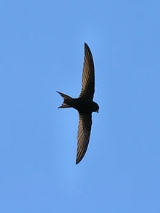
Swift

Encyclopedia
The swifts are a family, Apodidae, of highly aerial bird
s. They are superficially similar to swallow
s, but are actually not closely related to passerine
species at all; swifts are in the separate order Apodiformes, which they share with hummingbird
s. The treeswift
s are closely related to the true swifts, but form a separate family, the Hemiprocnidae.
The resemblances between swifts and swallows are due to convergent evolution
, reflecting similar life styles based on catching insect
s in flight.
The family scientific name comes from the Ancient Greek
απους, apous, meaning "without feet", since swifts have very short legs and never settle voluntarily on the ground, clinging instead to vertical surfaces. The tradition of depicting swifts without feet continued into the Middle Ages, as seen in the heraldic martlet
.
having been reported flying at up to 169km/h.. Even the Common Swift
cruises at 5 to 14 metres per second
(18–50 km/h, 11–31 mph). In a single year the common swift can cover at least 200,000 km.
The swiftlet
s or cave swiftlets have developed a form of echolocation
for navigating through dark cave systems where they roost. One species, Aerodramus papuensis
, has recently been discovered to use this navigation at night outside its cave roost also.
Swifts occur on all the continents, though not in the far north or large deserts, and on many oceanic islands. Like swallows and martins, the swifts of temperate regions are strongly migratory
and winter in the tropics. Some species can survive short periods of cold weather by entering torpor
, a state similar to hibernation.
Many have a characteristic shape, with a short forked tail and very long swept-back wings that resemble a crescent or a boomerang
. The flight of some species is characterised by a distinctive "flicking" action quite different from swallows. Swifts range in size from the Pygmy Swiftlet (Collocalia troglodytes), which weighs 5.4 g and measures 9 cm (3.7 inches) long, to the Purple Needletail
(Hirundapus celebensis), which weighs 184 g (6.5 oz) and measures 25 cm (10 inches) long.
The nest of many species is glued to a vertical surface with saliva, and the genus Aerodramus
use only that substance, which is the basis for bird's nest soup
. The eggs hatch after 19 to 23 days, and the young leave the nest after a further six to eight weeks. Both parents assist in raising the young.
s, a judgement corroborated by the discovery of the Jungornithidae, which were apparently swift-like hummingbird relatives, and of primitive hummingbirds such as Eurotrochilus
. Traditional taxonomies place the hummingbird family (Trochilidae) in the same order as the swifts and treeswifts (and no other birds); the Sibley-Ahlquist taxonomy
treated this group as a superorder in which the swift order was called Trochiliformes.
The taxonomy of the swifts is in general complicated, with genus and species boundaries widely disputed, especially amongst the swiftlet
s. Analysis of behavior and vocalizations is complicated by common parallel evolution
, while analyses of different morphological traits
and of various DNA sequences have yielded equivocal and partly contradictory results (Thomassen et al., 2005).
The Apodiformes diversified during the Eocene
, at the end of which the extant families were present; fossil genera are known from all over temperate Europe, between today's Denmark
and France
, such as the primitive Scaniacypselus (Early - Middle Eocene) and the more modern Procypseloides (Late Eocene/Early Oligocene
- Early Miocene
). A prehistoric genus sometimes assigned to the swifts, Primapus
(Early Eocene of England), might also be a more distant ancestor.
Tribe Collocaliini - swiftlet
s
Tribe Chaeturini - needletails
Tribe Apodini - typical swifts
Bird
Birds are feathered, winged, bipedal, endothermic , egg-laying, vertebrate animals. Around 10,000 living species and 188 families makes them the most speciose class of tetrapod vertebrates. They inhabit ecosystems across the globe, from the Arctic to the Antarctic. Extant birds range in size from...
s. They are superficially similar to swallow
Swallow
The swallows and martins are a group of passerine birds in the family Hirundinidae which are characterised by their adaptation to aerial feeding...
s, but are actually not closely related to passerine
Passerine
A passerine is a bird of the order Passeriformes, which includes more than half of all bird species. Sometimes known as perching birds or, less accurately, as songbirds, the passerines form one of the most diverse terrestrial vertebrate orders: with over 5,000 identified species, it has roughly...
species at all; swifts are in the separate order Apodiformes, which they share with hummingbird
Hummingbird
Hummingbirds are birds that comprise the family Trochilidae. They are among the smallest of birds, most species measuring in the 7.5–13 cm range. Indeed, the smallest extant bird species is a hummingbird, the 5-cm Bee Hummingbird. They can hover in mid-air by rapidly flapping their wings...
s. The treeswift
Treeswift
The treeswifts or crested swifts are a family, Hemiprocnidae, of aerial near passerine birds, closely related to the true swifts. The family contains a single genus, Hemiprocne, with four species...
s are closely related to the true swifts, but form a separate family, the Hemiprocnidae.
The resemblances between swifts and swallows are due to convergent evolution
Convergent evolution
Convergent evolution describes the acquisition of the same biological trait in unrelated lineages.The wing is a classic example of convergent evolution in action. Although their last common ancestor did not have wings, both birds and bats do, and are capable of powered flight. The wings are...
, reflecting similar life styles based on catching insect
Insect
Insects are a class of living creatures within the arthropods that have a chitinous exoskeleton, a three-part body , three pairs of jointed legs, compound eyes, and two antennae...
s in flight.
The family scientific name comes from the Ancient Greek
Ancient Greek
Ancient Greek is the stage of the Greek language in the periods spanning the times c. 9th–6th centuries BC, , c. 5th–4th centuries BC , and the c. 3rd century BC – 6th century AD of ancient Greece and the ancient world; being predated in the 2nd millennium BC by Mycenaean Greek...
απους, apous, meaning "without feet", since swifts have very short legs and never settle voluntarily on the ground, clinging instead to vertical surfaces. The tradition of depicting swifts without feet continued into the Middle Ages, as seen in the heraldic martlet
Martlet
A martlet is a heraldic charge depicting a stylized bird with short tufts of feathers in the place of legs...
.
Description
Swifts are the most aerial of birds. Larger species are amongst the fastest fliers in the animal kingdom, with the White-throated NeedletailWhite-throated Needletail
The White-throated Needletail , also known as Needle-tailed Swift or Spine-tailed Swift, is a large swift. It is the fastest-flying bird in flapping flight, being capable of speeds up to 170 km/h ....
having been reported flying at up to 169km/h.. Even the Common Swift
Common Swift
The Common Swift is a small bird, superficially similar to the Barn Swallow or House Martin. It is, however, completely unrelated to those passerine species, since swifts are in the separate order Apodiformes...
cruises at 5 to 14 metres per second
Metre per second
Metre per second is an SI derived unit of both speed and velocity , defined by distance in metres divided by time in seconds....
(18–50 km/h, 11–31 mph). In a single year the common swift can cover at least 200,000 km.
The swiftlet
Swiftlet
Swiftlets are birds contained within the four genera Aerodramus, Hydrochous, Schoutedenapus and Collocalia. They form the Collocaliini tribe within the swift family Apodidae. The group contains around thirty species mostly confined to southern Asia, south Pacific islands, and northeastern...
s or cave swiftlets have developed a form of echolocation
Animal echolocation
Echolocation, also called biosonar, is the biological sonar used by several kinds of animals.Echolocating animals emit calls out to the environment and listen to the echoes of those calls that return from various objects near them. They use these echoes to locate and identify the objects...
for navigating through dark cave systems where they roost. One species, Aerodramus papuensis
Aerodramus
Aerodramus is a genus of small, dark, cave-nesting birds in the Collocaliini tribe of the swift family. Its members are confined to tropical and subtropical regions in southern Asia, Oceania and northeastern Australia...
, has recently been discovered to use this navigation at night outside its cave roost also.
Swifts occur on all the continents, though not in the far north or large deserts, and on many oceanic islands. Like swallows and martins, the swifts of temperate regions are strongly migratory
Bird migration
Bird migration is the regular seasonal journey undertaken by many species of birds. Bird movements include those made in response to changes in food availability, habitat or weather. Sometimes, journeys are not termed "true migration" because they are irregular or in only one direction...
and winter in the tropics. Some species can survive short periods of cold weather by entering torpor
Torpor
Torpor, sometimes called temporary hibernation is a state of decreased physiological activity in an animal, usually characterized by a reduced body temperature and rate of metabolism. Animals that go through torpor include birds and some mammals such as mice and bats...
, a state similar to hibernation.
Many have a characteristic shape, with a short forked tail and very long swept-back wings that resemble a crescent or a boomerang
Boomerang
A boomerang is a flying tool with a curved shape used as a weapon or for sport.-Description:A boomerang is usually thought of as a wooden device, although historically boomerang-like devices have also been made from bones. Modern boomerangs used for sport are often made from carbon fibre-reinforced...
. The flight of some species is characterised by a distinctive "flicking" action quite different from swallows. Swifts range in size from the Pygmy Swiftlet (Collocalia troglodytes), which weighs 5.4 g and measures 9 cm (3.7 inches) long, to the Purple Needletail
Purple Needletail
The Purple Needletail is the largest swift found in the Old World. This species is distributed from northeastern Sulawesi through the Philippine islands of Luzon, Mindoro, Marinduque, Catanduanes, Calayan, Panay, Negros, Cebu, Leyte, Biliran, Mindanao and Basilan.This bird lives in various forests...
(Hirundapus celebensis), which weighs 184 g (6.5 oz) and measures 25 cm (10 inches) long.
The nest of many species is glued to a vertical surface with saliva, and the genus Aerodramus
Aerodramus
Aerodramus is a genus of small, dark, cave-nesting birds in the Collocaliini tribe of the swift family. Its members are confined to tropical and subtropical regions in southern Asia, Oceania and northeastern Australia...
use only that substance, which is the basis for bird's nest soup
Bird's nest soup
Bird's nest soup is a delicacy in Chinese cuisine. A few species of swift, the cave swifts, are renowned for building the saliva nests used to produce the unique texture of this soup....
. The eggs hatch after 19 to 23 days, and the young leave the nest after a further six to eight weeks. Both parents assist in raising the young.
Systematics and evolution
Swifts and treeswifts have long been considered to be relatives of the hummingbirdHummingbird
Hummingbirds are birds that comprise the family Trochilidae. They are among the smallest of birds, most species measuring in the 7.5–13 cm range. Indeed, the smallest extant bird species is a hummingbird, the 5-cm Bee Hummingbird. They can hover in mid-air by rapidly flapping their wings...
s, a judgement corroborated by the discovery of the Jungornithidae, which were apparently swift-like hummingbird relatives, and of primitive hummingbirds such as Eurotrochilus
Eurotrochilus
Eurotrochilus is an extinct genus of primitive hummingbird. Its fossils come from the Rupelian stage of the early Oligocene of Germany, Poland and France.-Sources:*http://www.springerlink.com/index/3753080U72147545.pdf...
. Traditional taxonomies place the hummingbird family (Trochilidae) in the same order as the swifts and treeswifts (and no other birds); the Sibley-Ahlquist taxonomy
Sibley-Ahlquist taxonomy
The Sibley-Ahlquist taxonomy is a bird taxonomy proposed by Charles Sibley and Jon Edward Ahlquist. It is based on DNA-DNA hybridization studies conducted in the late 1970s and throughout the 1980s....
treated this group as a superorder in which the swift order was called Trochiliformes.
The taxonomy of the swifts is in general complicated, with genus and species boundaries widely disputed, especially amongst the swiftlet
Swiftlet
Swiftlets are birds contained within the four genera Aerodramus, Hydrochous, Schoutedenapus and Collocalia. They form the Collocaliini tribe within the swift family Apodidae. The group contains around thirty species mostly confined to southern Asia, south Pacific islands, and northeastern...
s. Analysis of behavior and vocalizations is complicated by common parallel evolution
Parallel evolution
Parallel evolution is the development of a similar trait in related, but distinct, species descending from the same ancestor, but from different clades.-Parallel vs...
, while analyses of different morphological traits
Morphology (biology)
In biology, morphology is a branch of bioscience dealing with the study of the form and structure of organisms and their specific structural features....
and of various DNA sequences have yielded equivocal and partly contradictory results (Thomassen et al., 2005).
The Apodiformes diversified during the Eocene
Eocene
The Eocene Epoch, lasting from about 56 to 34 million years ago , is a major division of the geologic timescale and the second epoch of the Paleogene Period in the Cenozoic Era. The Eocene spans the time from the end of the Palaeocene Epoch to the beginning of the Oligocene Epoch. The start of the...
, at the end of which the extant families were present; fossil genera are known from all over temperate Europe, between today's Denmark
Denmark
Denmark is a Scandinavian country in Northern Europe. The countries of Denmark and Greenland, as well as the Faroe Islands, constitute the Kingdom of Denmark . It is the southernmost of the Nordic countries, southwest of Sweden and south of Norway, and bordered to the south by Germany. Denmark...
and France
France
The French Republic , The French Republic , The French Republic , (commonly known as France , is a unitary semi-presidential republic in Western Europe with several overseas territories and islands located on other continents and in the Indian, Pacific, and Atlantic oceans. Metropolitan France...
, such as the primitive Scaniacypselus (Early - Middle Eocene) and the more modern Procypseloides (Late Eocene/Early Oligocene
Oligocene
The Oligocene is a geologic epoch of the Paleogene Period and extends from about 34 million to 23 million years before the present . As with other older geologic periods, the rock beds that define the period are well identified but the exact dates of the start and end of the period are slightly...
- Early Miocene
Miocene
The Miocene is a geological epoch of the Neogene Period and extends from about . The Miocene was named by Sir Charles Lyell. Its name comes from the Greek words and and means "less recent" because it has 18% fewer modern sea invertebrates than the Pliocene. The Miocene follows the Oligocene...
). A prehistoric genus sometimes assigned to the swifts, Primapus
Primapus
Primapus is an extinct genus of apodiform bird from the Early Eocene of the United Kingdom. Its fossils were found in the London Clay, which was deposited around 50 million years ago. The type species is P. lacki.-Sources:...
(Early Eocene of England), might also be a more distant ancestor.
Taxonomic list of Apodidae
Tribe Cypseloidini- Genus CypseloidesCypseloidesCypseloides is a genus of swift in the Apodidae family. It contains nine described species.-Species:* Spot-fronted Swift * White-chinned Swift * Sooty Swift...
(9-10 species) - Genus StreptoprocneStreptoprocneStreptoprocne is a genus of swifts in the Apodidae family. It contains five species.-Species:* Biscutate Swift * Tepui Swift * White-naped Swift...
(3-4 species)
Tribe Collocaliini - swiftlet
Swiftlet
Swiftlets are birds contained within the four genera Aerodramus, Hydrochous, Schoutedenapus and Collocalia. They form the Collocaliini tribe within the swift family Apodidae. The group contains around thirty species mostly confined to southern Asia, south Pacific islands, and northeastern...
s
- Genus CollocaliaCollocaliaCollocalia is a genus of swifts, containing some of the smaller species termed "swiftlets". Formerly a catch-all genus for these, a number of its erstwhile members are now normally placed in Aerodramus....
(3-4 species) - Genus AerodramusAerodramusAerodramus is a genus of small, dark, cave-nesting birds in the Collocaliini tribe of the swift family. Its members are confined to tropical and subtropical regions in southern Asia, Oceania and northeastern Australia...
(about 25 species, sometimes included in Collocalia) - Genus Hydrochous - Waterfall Swift
- Genus SchoutedenapusSchoutedenapusSchoutedenapus is a genus of swift in the Apodidae family.It contains the following species:* Scarce Swift * Schouteden's Swift...
- African swiftlets (2 species)
Tribe Chaeturini - needletails
- Genus MearnsiaMearnsiaMearnsia is a genus of swift in the Apodidae family.It contains the following species:* Philippine Spine-tailed Swift * Papuan Spine-tailed Swift...
(2 species) - Genus ZoonavenaZoonavenaZoonavena is a genus of swift in the Apodidae family.It contains the following species:* Madagascar Spinetail * São Tomé Spinetail * White-rumped Spinetail...
(3 species) - Genus TelacanthuraTelacanthuraTelacanthura is a genus of swift in the Apodidae family.It contains the following species:* Black Spinetail * Mottled Spinetail...
(2 species) - Genus RhaphiduraRhaphiduraRhaphidura is a genus of swift in the Apodidae family.It contains the following species:* Silver-rumped Spinetail * Sabine's Spinetail...
(2 species) - Genus NeafrapusNeafrapusNeafrapus is a genus of swift in the Apodidae family.It contains the following species:* Böhm's Spinetail * Cassin's Spinetail...
(2 species) - Genus HirundapusHirundapusHirundapus is a genus of swift in the Apodidae family.It contains the following species:* White-throated Needletail * Purple Needletail * Silver-backed Needletail...
(4 species) - Genus ChaeturaChaeturaChaetura is a genus of needletail swifts found in the Americas in modern times. They resemble in general appearance and are commonly confused with swallows but they are not at all closely related to these...
(12 species)
Tribe Apodini - typical swifts
- Genus AeronautesAeronautesAeronautes is a genus of swifts in the Apodidae family.It contains the following species:* White-throated Swift * White-tipped Swift * Andean Swift...
(3 species) - Genus TachornisTachornisTachornis is a genus of swift in the Apodidae family.It contains the following species:* Pygmy Palm Swift * Neotropical Palm Swift * Antillean Palm Swift...
(3 living species) - Genus PanyptilaPanyptilaPanyptila is a genus of swift in the Apodidae family.It contains the following species:* Great Swallow-tailed Swift * Lesser Swallow-tailed Swift...
(2 species) - Genus CypsiurusCypsiurusCypsiurus is a genus of the swift family of birds.There are two species* Asian Palm Swift, Cypsiurus balasiensis* African Palm Swift, Cypsiurus parvusThese very similar species were formerly considered to be conspecific....
(2 species) - Genus TachymarptisTachymarptisTachymarptis is a genus of bird in the swift family, Apodidae. It contains the Alpine Swift of Eurasia and Africa and the Mottled Swift of Africa. They are large swifts with relatively broad wings, a large head, a medium-length forked tail and white in the underparts...
(2 species) - Genus ApusApus (genus)The bird genus Apus comprise some of the Old World members of the family Apodidae, commonly known as swifts.They are among the fastest birds in the world. They resemble swallows, to which they are not related, but have shorter tails and sickle-shaped wings...
(some 17 species)
External links
- CommonSwift.org -- Comprehensive website in several languages
- Swift sounds on xeno-canto.org
- Hiking and Birdwatching Groups