


The Influence of Sea Power upon History

Encyclopedia
Naval warfare
Naval warfare is combat in and on seas, oceans, or any other major bodies of water such as large lakes and wide rivers.-History:Mankind has fought battles on the sea for more than 3,000 years. Land warfare would seem, initially, to be irrelevant and entirely removed from warfare on the open ocean,...
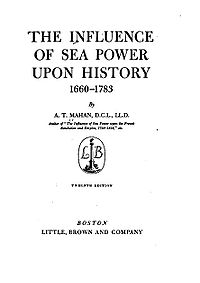
written in 1890 by Alfred Thayer Mahan
Alfred Thayer Mahan
Alfred Thayer Mahan was a United States Navy flag officer, geostrategist, and historian, who has been called "the most important American strategist of the nineteenth century." His concept of "sea power" was based on the idea that countries with greater naval power will have greater worldwide...
. It details the role of sea power throughout history and discusses the various factors needed to support and achieve sea power, with emphasis on having the largest and most powerful fleet. Scholars consider it the single most influential book in naval strategy
Naval strategy
Naval strategy is the planning and conduct of war at sea, the naval equivalent of military strategy on land.Naval strategy, and the related concept of maritime strategy, concerns the overall strategy for achieving victory at sea, including the planning and conduct of campaigns, the movement and...
; its policies were quickly adopted by most major navies, ultimately causing the World War I naval arms race
World War I naval arms race
The naval arms race of the early 20th Century preceded and was one of the several intertwined causes for World War I. It was primarily between the United Kingdom and the German Empire...
.
Overview
Mahan formulated his concept of sea power while reading a history book in Lima, Peru.The book was published by Mahan while President of the US Naval War College
Naval War College
The Naval War College is an education and research institution of the United States Navy that specializes in developing ideas for naval warfare and passing them along to officers of the Navy. The college is located on the grounds of Naval Station Newport in Newport, Rhode Island...
, and was a culmination of his ideas regarding naval warfare.
Mahan began the book with an examination of what factors lead to a supremacy of the seas, especially how Britain
United Kingdom of Great Britain and Ireland
The United Kingdom of Great Britain and Ireland was the formal name of the United Kingdom during the period when what is now the Republic of Ireland formed a part of it....
was able to rise to its near dominance. He identifies such features as geography, population, and government, and expands the definition of sea power as comprising a strong navy and commercial fleet. Mahan also promotes the belief that any army would succumb to a strong naval blockade. Recently scholars have called attention to his role as significant in the growth of American overseas possessions, the rise of the new American navy, and the adoption of the strategic principles upon which it operated.
The book then goes on to describe a series of European and American wars and how naval power was used in each.
Impact on naval thought
Timeliness contributed no small part to the widespread acceptance and resultant influence of Mahan's views. Although his history was relatively thin (he relied on secondary sources), the vigorous style and clear theory won widespread acceptance of navalists across the world. Sea power supported the new colonialism which was asserting itself in Africa and Asia. Given the very rapid technological changes underway in propulsion (from coal to oil, from reciprocating engines to steam turbineSteam turbine
A steam turbine is a mechanical device that extracts thermal energy from pressurized steam, and converts it into rotary motion. Its modern manifestation was invented by Sir Charles Parsons in 1884....
s), ordnance
Naval artillery
Naval artillery, or naval riflery, is artillery mounted on a warship for use in naval warfare. Naval artillery has historically been used to engage either other ships, or targets on land; in the latter role it is currently termed naval gunfire fire support...
(with better fire directors, and new high explosives) and armor (hardened steel), the emergence of new craft such as destroyers and submarines, and the development of radio, Mahan's emphasis on the capital ship and the command of the sea came at an opportune moment.
Mahan's name became a household word in the German navy, as Kaiser William II
William II, German Emperor
Wilhelm II was the last German Emperor and King of Prussia, ruling the German Empire and the Kingdom of Prussia from 15 June 1888 to 9 November 1918. He was a grandson of the British Queen Victoria and related to many monarchs and princes of Europe...
ordered his officers to read Mahan, and Admiral Alfred von Tirpitz
Alfred von Tirpitz
Alfred von Tirpitz was a German Admiral, Secretary of State of the German Imperial Naval Office, the powerful administrative branch of the German Imperial Navy from 1897 until 1916. Prussia never had a major navy, nor did the other German states before the German Empire was formed in 1871...
(1849–1930) used Mahan's reputation to finance a powerful surface fleet. His ideas decisively shaped Japanese naval doctrine, especially in the fleet actions of World War II.
Between 1890 and 1915, Mahan and British admiral Jackie Fisher (1841–1920) faced the problem of how to dominate home waters and distant seas with naval forces not strong enough to do both. Mahan argued for a universal principle of concentration of powerful ships in home waters and minimized strength in distant seas, while Fisher reversed Mahan by utilizing technological change to propose submarines for defense of home waters and mobile battle cruisers for protection of distant imperial interests.
The French at first adopted Mahan's theories. French naval doctrine in 1914 was dominated by Mahan's theory of sea power and therefore geared toward winning decisive battles and gaining mastery of the seas. But the course of World War I
World War I
World War I , which was predominantly called the World War or the Great War from its occurrence until 1939, and the First World War or World War I thereafter, was a major war centred in Europe that began on 28 July 1914 and lasted until 11 November 1918...
changed ideas about the place of the navy, as the refusal of the German fleet to engage in a decisive battle, the Dardanelles expedition of 1915, the development of submarine warfare
Submarine warfare
Naval warfare is divided into three operational areas: surface warfare, air warfare and underwater warfare. The latter may be subdivided into submarine warfare and anti-submarine warfare as well as mine warfare and mine countermeasures...
, and the organization of convoy
Convoy
A convoy is a group of vehicles, typically motor vehicles or ships, traveling together for mutual support and protection. Often, a convoy is organized with armed defensive support, though it may also be used in a non-military sense, for example when driving through remote areas.-Age of Sail:Naval...
s all showed the navy's new role in combined operations
Combined operations
In military use, combined operations , also known as joint operations, or interoperability capability, are either operations conducted by forces of two or more allied nations acting together for the accomplishment of a common strategy, a strategic and operational and sometimes tactical cooperation...
with the army.
The navy's part in securing victory was not fully understood by French public opinion in 1918, but a synthesis of old and new ideas arose from the lessons of the war, especially by admiral Raoul Castex
Raoul Castex
Raoul Castex was a French Navy officer and admiral, and a military theorist.- Naval career :Castex joined the Navy in 1896, becoming the best student of his promotion at the École Navale...
(1878–1968), from 1927 to 1935, who synthesized in his five-volume Théories Stratégiques the classical and materialist schools of naval theory. He reversed Mahan's theory that command of the sea precedes maritime communications and foresaw the enlarged roles of aircraft and submarines in naval warfare. Castex enlarged strategic theory to include nonmilitary factors (policy, geography, coalitions, public opinion, and constraints) and internal factors (economy of force, offense and defense, communications, operational plans, morale, and command) to conceive a general strategy to attain final victory.
Although Mahan's influence on foreign powers has been generally recognized, only rather recently have scholars called attention to his role as significant in the growth of American overseas possessions, the rise of the new American navy, and the adoption of the strategic principles upon which it operated. He died in Washington a few months after the outbreak of World War I.