

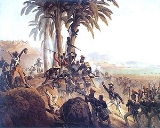
Haïtian Revolution

Encyclopedia

French colonial empire
The French colonial empire was the set of territories outside Europe that were under French rule primarily from the 17th century to the late 1960s. In the 19th and 20th centuries, the colonial empire of France was the second-largest in the world behind the British Empire. The French colonial empire...
of Saint-Domingue
Saint-Domingue
The labour for these plantations was provided by an estimated 790,000 African slaves . Between 1764 and 1771, the average annual importation of slaves varied between 10,000-15,000; by 1786 it was about 28,000, and from 1787 onward, the colony received more than 40,000 slaves a year...
, which culminated in the elimination of slavery
Slavery
Slavery is a system under which people are treated as property to be bought and sold, and are forced to work. Slaves can be held against their will from the time of their capture, purchase or birth, and deprived of the right to leave, to refuse to work, or to demand compensation...
there and the founding of the Haitian republic
Haiti
Haiti , officially the Republic of Haiti , is a Caribbean country. It occupies the western, smaller portion of the island of Hispaniola, in the Greater Antillean archipelago, which it shares with the Dominican Republic. Ayiti was the indigenous Taíno or Amerindian name for the island...
. Although hundreds of rebellions occurred in the New World
New World
The New World is one of the names used for the Western Hemisphere, specifically America and sometimes Oceania . The term originated in the late 15th century, when America had been recently discovered by European explorers, expanding the geographical horizon of the people of the European middle...
during the centuries of slavery, only two, the American Revolution
American Revolution
The American Revolution was the political upheaval during the last half of the 18th century in which thirteen colonies in North America joined together to break free from the British Empire, combining to become the United States of America...
that began in 1776 and the Haitian revolution that began in 1791, were successful in achieving permanent independence. The Haitian Revolution is regarded as a defining moment in the history of Africans in the New World.
Although an independent government was created in Haiti, its society continued to be deeply affected by the patterns established under French colonial rule. The French established a system of minority rule over the illiterate poor by using violence and threats. Because many planters had provided for their mixed-race children by African women by giving them education and (for men) training and entrée into the French military, the mulatto
Mulatto
Mulatto denotes a person with one white parent and one black parent, or more broadly, a person of mixed black and white ancestry. Contemporary usage of the term varies greatly, and the broader sense of the term makes its application rather subjective, as not all people of mixed white and black...
descendants became the elite in Haiti after the revolution. By the time of war, many had used their social capital
Social capital
Social capital is a sociological concept, which refers to connections within and between social networks. The concept of social capital highlights the value of social relations and the role of cooperation and confidence to get collective or economic results. The term social capital is frequently...
to acquire wealth, and some already owned land. Some had identified more with the French colonists than the slaves, and associated within their own circles.
Their domination of politics and economics after the revolution created another two-caste society, as most Haitians were rural subsistence farmers. In addition, the nascent state's future was practically "mortgaged
Mortgage loan
A mortgage loan is a loan secured by real property through the use of a mortgage note which evidences the existence of the loan and the encumbrance of that realty through the granting of a mortgage which secures the loan...
" to French banks in the 1820s, as it was forced to make massive reparations to French slaveholders in order to receive French recognition and end the nation's political and economic isolation. These payments may have permanently affected Haiti's economy and wealth.
Background
The riches of the Caribbean depended on Europeans' taste for sugarHistory of sugar
The long history of sugar is interwoven with that of trade, religion, colonialism, capitalism, industry and technology. The labor-intensive nature of sugar cultivation and processing has meant that much of the history of the sugar industry has had associations with large-scale slavery...
, which plantation
Plantation
A plantation is a long artificially established forest, farm or estate, where crops are grown for sale, often in distant markets rather than for local on-site consumption...
owners traded for provisions from North America and manufactured goods from European countries. The island also had extensive coffee, cocoa, indigo, and cotton plantations, but these were smaller and less profitable than the wealthy sugar plantations. Starting in the 1730s, French engineers constructed complex irrigation systems to increase sugarcane
Sugarcane
Sugarcane refers to any of six to 37 species of tall perennial grasses of the genus Saccharum . Native to the warm temperate to tropical regions of South Asia, they have stout, jointed, fibrous stalks that are rich in sugar, and measure two to six metres tall...
production. By the 1740s Saint-Domingue, together with Jamaica
Jamaica
Jamaica is an island nation of the Greater Antilles, in length, up to in width and 10,990 square kilometres in area. It is situated in the Caribbean Sea, about south of Cuba, and west of Hispaniola, the island harbouring the nation-states Haiti and the Dominican Republic...
, had become the main supplier of the world's sugar. Sugar production depended on extensive manual labor provided by enslaved Africans in the harsh Saint-Domingue colonial plantation economy. The white planters who derived their wealth from the sale of sugar knew they were outnumbered by slaves by a factor of more than ten; they lived in fear of slave rebellion. White masters extensively used the threat of physical violence to maintain control and limit this possibility for slave rebellion. When slaves attempted to assert power through leaving the plantations or disobeying their masters, they were subjected to this violence in the form of whippings, which were a personal lesson and a warning for other slaves, and more extreme torture such as castration or burning. Louis XIV, the French King, passed the Code Noir in 1685 in an attempt to regulate such violence and the treatment of slaves in general in the colony, but masters openly and consistently broke the code, and local legislations reversed parts of it throughout the 18th century.
In 1758, the white landowners began passing legislation that set restrictions on the rights of other groups of people until a rigid caste system was defined. Most historians have classified the people of the era into three groups. One was the white colonists, or blancs. A second was the free blacks (usually mixed-race, known as mulattoes or gens de couleur
Gens de couleur
Gens de couleur is a French term meaning "people of color." The term was commonly used in France's West Indian colonies prior to the abolition of slavery, where it was a short form of gens de couleur libres ....
libres, free people of color
Free people of color
A free person of color in the context of the history of slavery in the Americas, is a person of full or partial African descent who was not enslaved...
). These tended to be educated, literate and often served in the army or as administrators on plantations. Many were children of white planters and enslaved mothers. The males often received education or artisan training, sometimes received property from their fathers, and freedom. The third group, outnumbering the others by a ratio of ten to one, was made up of mostly African-born slaves. A high rate of mortality among them meant that planters continually had to import new slaves. This kept their culture more African and separate from other people on the island. Many plantations had large concentrations of slaves from a particular region of Africa, and it was therefore somewhat easier for these groups to maintain elements of their culture, religion, and language. This also separated new slaves from Africa from creoles (slaves born in the colony), who already had kin networks and often had more prestigious roles on plantations and more opportunities for emancipation. Most slaves spoke a patois
Patois
Patois is any language that is considered nonstandard, although the term is not formally defined in linguistics. It can refer to pidgins, creoles, dialects, and other forms of native or local speech, but not commonly to jargon or slang, which are vocabulary-based forms of cant...
of French and West African languages known as Creole
Haitian Creole language
Haitian Creole language , often called simply Creole or Kreyòl, is a language spoken in Haiti by about twelve million people, which includes all Haitians in Haiti and via emigration, by about two to three million speakers residing in the Bahamas, Cuba, Canada, France, Cayman Islands, French...
, which was also used by native mulattoes and whites for communication with the workers.
White colonists and black slaves frequently had violent conflicts. Much of these conflicts surrounded the slaves who were able to escape the plantations. Many of these runaway slaves, called maroons
Maroon (people)
Maroons were runaway slaves in the West Indies, Central America, South America, and North America, who formed independent settlements together...
, lived on the margins of large plantations and lived off what they could steal from their previous masters. Others ran away to towns, where they could blend in with urban slaves and the freed slaves who often concentrated in those areas. If caught, these runaway slaves would be severely and violently punished. However, some masters tolerated "petit marronages", or short-term absences from plantations. Often, however, larger groups of runaway slaves lived in the woods away from control. They often conducted violent raids on the island's sugar and coffee plantations. Although the numbers in these bands grew large (sometimes into the thousands), they generally lacked the leadership and strategy to accomplish large-scale objectives. The first effective maroon leader to emerge was the charismatic François Mackandal
François Mackandal
François Mackandal was a Haïtian Maroon leader in Saint-Domingue. He was an African who is sometimes described as Haitian vodou priest, or houngan...
, who succeeded in unifying the black resistance. A Vodou priest, Mackandal inspired his people by drawing on African traditions and religions
Religion in Africa
Religion in Africa is multifaceted. Most Africans adhere to either Christianity or Islam. Many adherents of either religion also practice African traditional religions, with traditions of folk religion or syncretism practised alongside an adherent's Christianity or Islam.Judaism also has roots in...
. He united the maroon bands and also established a network of secret organizations among plantation slaves, leading a rebellion from 1751 through 1757. Although Mackandal was captured by the French and burned at the stake in 1758, large armed maroon bands persisted in raids and harassment after his death.
Situation in 1789
In 1789 Saint-DomingueSaint-Domingue
The labour for these plantations was provided by an estimated 790,000 African slaves . Between 1764 and 1771, the average annual importation of slaves varied between 10,000-15,000; by 1786 it was about 28,000, and from 1787 onward, the colony received more than 40,000 slaves a year...
produced 60 percent of the world's coffee and 40 percent of the world's sugar imported by France and Britain. The colony was the most profitable possession of the French Empire. Saint-Domingue was also the wealthiest and most prosperous, for the plantation owners at least, of all of the colonies of any country in the Caribbean. The lowest class of society was enslaved blacks, who outnumbered whites and free people of color by ten to one. The slave population on the island totaled almost half of the one million slaves in the Caribbean by 1789. They were mostly African-born. The death rate in the Caribbean exceeded the birth rate, so imports of enslaved Africans were necessary in order to maintain the numbers required to work the plantations. The slave population declined at an annual rate of two to five percent, due to overwork; inadequate food, shelter, clothing and medical care; and an imbalance between the sexes, with more men than women. Some slaves were of a creole elite class of urban slaves and domestics, who worked as cooks, personal servants and artisans around the plantation house. This relatively privileged class was chiefly born in the Americas, while the under-class born in Africa labored hard, more often than not, under abusive and brutal conditions.
The Plaine du Nord on the northern shore of Saint-Domingue was the most fertile area with the largest sugar plantations. It was the area of most economic importance, especially as most of the colony's trade went through these ports. The largest and busiest port was Le Cap Français, the capital of French Saint-Domingue until 1751, when Port-au-Prince was made the capital. In this northern region, enslaved Africans lived in large groups of workers in relative isolation, separated from the rest of the colony by the high mountain range known as the Massif. These slaves would join with urban slaves from Le Cap to lead the 1791 rebellion, which began in this region. This area was the seat of power of the grands blancs, the rich white colonists who wanted greater autonomy for the colony, especially economically.
Among Saint-Domingue's 40,000 white colonials
Colonisation
Colonization occurs whenever any one or more species populate an area. The term, which is derived from the Latin colere, "to inhabit, cultivate, frequent, practice, tend, guard, respect", originally related to humans. However, 19th century biogeographers dominated the term to describe the...
in 1789, European-born Frenchmen monopolized administrative posts. The sugar planters, the grands blancs, were chiefly minor aristocrats. Most returned to France as soon as possible, hoping to avoid the dreaded yellow fever
Yellow fever
Yellow fever is an acute viral hemorrhagic disease. The virus is a 40 to 50 nm enveloped RNA virus with positive sense of the Flaviviridae family....
, which regularly swept the colony. The lower-class whites, petits blancs, included artisans, shopkeepers, slave dealers, overseers, and day laborers. Saint-Domingue's free people of color, the gens de couleur
Gens de couleur
Gens de couleur is a French term meaning "people of color." The term was commonly used in France's West Indian colonies prior to the abolition of slavery, where it was a short form of gens de couleur libres ....
, numbered more than 28,000 by 1789. Around that time, colonial legislations, concerned with this growing and strengthening population, passed discriminatory laws that visibly differentiated these freedman by dictating their clothing and where they could live. These laws also barred them from occupying many public offices. Many of these freedman were also artisans and overseers, or domestic servants in the big houses. Le Cap had a large population of freed slaves, and these men would later become important leaders in the 1791 slave rebellion and later revolution.
In addition to class and racial tension between whites, free people of color, and enslaved blacks, the country was polarized by regional rivalries between the North, South
Sud Department
Sud is one of the ten departments of Haiti. It has an area of and a population of 745,000 . Its capital is Les Cayes. A large part of the population of Haitians in this department is of mixed race, mulattoes along with other mixtures such as Arabs and East Indians...
, and West
Ouest Department
Ouest is one of the ten departments of Haiti. It is the jurisdictional seat of the national capital, the city of Port-au-Prince. It has an area of and a population of 3,093,698 . It borders the Dominican Republic to the east.It is the second largest department in Haiti after the Artibonite...
. The North was the center of shipping and trading, and therefore had the largest French elite population. The Western Province, however, grew significantly after the capital was relocated to Port-au-Prince in 1751, and the region became increasingly wealthy in the second half of the 18th century when irrigation projects allowed significant sugar plantation growth. The Southern Province lagged in population and wealth because it was geographically separated from the rest of the colony. However, this isolation allowed freed slaves to find profit in trade with British Jamaica, and they gained power and wealth here. In addition to such regional tension, there were conflicts between proponents of independence, those loyal to France, allies of Spain, and allies of Great Britain – who coveted control of the valuable colony.
Impact of French Revolution
In France, the majority of the Estates General, an advisory body to the King, constituted itself as the National AssemblyNational Assembly
National Assembly is either a legislature, or the lower house of a bicameral legislature in some countries. The best known National Assembly, and the first legislature to be known by this title, was that established during the French Revolution in 1789, known as the Assemblée nationale...
, made radical changes in French laws, and on 26 August 1789, published the Declaration of the Rights of Man, declaring all men free and equal. The French Revolution
French Revolution
The French Revolution , sometimes distinguished as the 'Great French Revolution' , was a period of radical social and political upheaval in France and Europe. The absolute monarchy that had ruled France for centuries collapsed in three years...
shaped the course of the conflict in Saint-Domingue and was at first widely welcomed in the island. At first, wealthy whites saw it as an opportunity to gain independence from France, which would allow elite plantation-owners to take control of the island and create trade regulations that would further their own wealth and power. So many were the twists and turns in the leadership in France, and so complex were events in Saint-Domingue, that various classes and parties changed their alignments many times. However, the Haitian Revolution quickly became a test of the ideology of the French Revolution, as it radicalized the slavery question and forced French leaders to recognize the full meaning of their revolution.
The African population on the island began to hear of the agitation for independence by the rich European planters, the grands blancs, who had resented France's limitations on the island's foreign trade. The Africans mostly allied with the royalists
House of Bourbon
The House of Bourbon is a European royal house, a branch of the Capetian dynasty . Bourbon kings first ruled Navarre and France in the 16th century. By the 18th century, members of the Bourbon dynasty also held thrones in Spain, Naples, Sicily, and Parma...
and the British, as they understood that if Saint-Domingue
Saint-Domingue
The labour for these plantations was provided by an estimated 790,000 African slaves . Between 1764 and 1771, the average annual importation of slaves varied between 10,000-15,000; by 1786 it was about 28,000, and from 1787 onward, the colony received more than 40,000 slaves a year...
's independence were to be led by white slave masters, it would probably mean even harsher treatment and increased injustice for the African population, The plantation owners would be free to operate slavery as they pleased without minimal accountability to their French peers.
Saint-Domingue's free people of color
Free people of color
A free person of color in the context of the history of slavery in the Americas, is a person of full or partial African descent who was not enslaved...
, most notably Julien Raimond
Julien Raimond
Julien Raimond was an indigo planter in the French colony of Saint-Domingue .-Early activism:He was born a free man of color, the son of a French colonist and the mulatto daughter of a planter, in the isolated South province of the colony. Raimond owned over 100 slaves by the 1780s, and was one of...
, had been actively appealing to France for full civil equality with whites since the 1780s. Raimond used the French Revolution
French Revolution
The French Revolution , sometimes distinguished as the 'Great French Revolution' , was a period of radical social and political upheaval in France and Europe. The absolute monarchy that had ruled France for centuries collapsed in three years...
to make this the major colonial issue before the French National Assembly
French National Assembly
The French National Assembly is the lower house of the bicameral Parliament of France under the Fifth Republic. The upper house is the Senate ....
. In October 1790, Vincent Ogé
Vincent Ogé
Vincent Ogé was a wealthy free man of color and the instigator of a revolt against white colonial authority in French Saint-Domingue that lasted from October to December 1790 in the area outside Cap-Français, the colony's main city...
, another wealthy free man of color from the colony, returned home from Paris, where he had been working with Raimond. Convinced that a law passed by the French Constituent Assembly
National Convention
During the French Revolution, the National Convention or Convention, in France, comprised the constitutional and legislative assembly which sat from 20 September 1792 to 26 October 1795 . It held executive power in France during the first years of the French First Republic...
gave full civil rights
Civil rights
Civil and political rights are a class of rights that protect individuals' freedom from unwarranted infringement by governments and private organizations, and ensure one's ability to participate in the civil and political life of the state without discrimination or repression.Civil rights include...
to wealthy men of color, Ogé demanded the right to vote. When the colonial governor refused, Ogé led a brief insurgency
Insurgency
An insurgency is an armed rebellion against a constituted authority when those taking part in the rebellion are not recognized as belligerents...
in the area around Cap Français. He was captured in early 1791, and brutally executed by being "broken on the wheel
Breaking wheel
The breaking wheel, also known as the Catherine wheel or simply the wheel, was a torture device used for capital punishment in the Middle Ages and early modern times for public execution by bludgeoning to death...
" before being behaded. Ogé was not fighting against slavery, but his treatment was cited by later slave rebels as one of the factors in their decision to rise up in August 1791 and resist treaties with the colonists. The conflict up to this point was between factions of whites, and between whites and free coloreds. Enslaved blacks watched from the sidelines.
Leading 18th-century French writer Count Mirabeau
Honoré Gabriel Riqueti, comte de Mirabeau
Honoré Gabriel Riqueti, comte de Mirabeau was a French revolutionary, as well as a writer, diplomat, freemason, journalist and French politician at the same time. He was a popular orator and statesman. During the French Revolution, he was a moderate, favoring a constitutional monarchy built on...
had once said the Saint-Domingue whites "slept at the foot of Vesuvius", an indication of the grave threat they faced should the majority of slaves launch a sustained major uprising.
1791 slave rebellion
Guillaume RaynalGuillaume Thomas François Raynal
Guillaume Thomas Raynal was a French writer and man of letters during the Age of Enlightenment.He was born at Lapanouse in Rouergue...
attacked slavery in the 1780 edition of his history of European colonization. He also predicted a general slave revolt in the colonies, saying that there were signs of "the impending storm". One such sign was the action of the French Revolutionary government to grant citizenship to wealthy free people of color in May 1791. Because white plantation owners refused to comply with this decision, within two months isolated fighting broke out between the former slaves and the whites. This added to the tense climate between slaves and grands blancs.
Raynal's prediction came true on the night of 21 August 1791, when the slaves of Saint Domingue rose in revolt and plunged the colony into civil war. The signal to begin the revolt was given by Dutty Boukman
Dutty Boukman
Dutty Boukman ' was a Jamaican born houngan, or Haitian priest who conducted a religious ceremony in Haiti in which a freedom covenant was affirmed; this ceremony is considered a catalyst to the slave uprising that marked the beginning of the Haïtian Revolution.-Background:Boukman Dutty was a self...
, a high priest of vodou and leader of the Maroon slaves, during a religious ceremony at Bois Caïman
Bois Caïman
Bois Caïman is the site of the Vodou ceremony presided over by Dutty Boukman on August 14, 1791. The stated purpose of the ritual was to attempt to overthrow French rule, which was based on slave labor....
on the night of 14 August. Within the next ten days, slaves had taken control of the entire Northern Province in an unprecedented slave revolt. Whites kept control of only a few isolated, fortified camps. The slaves sought revenge on their masters through "pillage, rape, torture, mutilation, and death". Because the plantation owners long feared a revolt like this, they were well armed and prepared to defend themselves. Nonetheless, within weeks, the number of slaves who joined the revolt reached approximately 100,000. Within the next two months, as the violence escalated, the slaves killed 4,000 whites and burned or destroyed 180 sugar plantations and hundreds of coffee and indigo plantations.
By 1792, slaves controlled a third of the island. The success of the slave rebellion caused the newly elected Legislative Assembly in France to realize it was facing an ominous situation. To protect France's economic interests, the Legislative Assembly needed to grant civil and political rights to free men of color in the colonies. In March 1792, the Legislative Assembly did just that. Countries throughout Europe as well as the United States were shocked by the decision of the Legislative Assembly. Members of the Assembly were determined to stop the revolt. Apart from granting rights to the free people of color, they dispatched 6,000 French soldiers to the island.
Meanwhile, in 1793, France declared war on Great Britain. The white planters in Saint Domingue made agreements with Great Britain to declare British sovereignty over the islands. Spain, who controlled the rest of the island of Hispaniola
Hispaniola
Hispaniola is a major island in the Caribbean, containing the two sovereign states of the Dominican Republic and Haiti. The island is located between the islands of Cuba to the west and Puerto Rico to the east, within the hurricane belt...
, would also join the conflict and fight with Great Britain against France. The Spanish forces invaded Saint Domingue and were joined by the slave forces. By August 1793, there were only 3,500 French soldiers on the island. To prevent military disaster, the French commissioner Sonthonax freed the slaves in his jurisdiction.
The decision was confirmed and extended by the National Convention
National Convention
During the French Revolution, the National Convention or Convention, in France, comprised the constitutional and legislative assembly which sat from 20 September 1792 to 26 October 1795 . It held executive power in France during the first years of the French First Republic...
the first elected Assembly of the First Republic (1792–1804), on the 4th of February 1794, under the leadership of Maxmilien Robespierre. It abolished slavery by law in France and all its colonies and granted civil and political rights to all black men in the colonies. Despite racial tensions in Saint Domingue, the French revolutionary government at the time welcomed abolition with a show of idealism and optimism. The emancipation of slaves was viewed as an example of liberty for other countries, much as the American Revolution was meant to serve as the first of many liberation movements. Danton, one of the Frenchmen present at the meeting of the National Convention, expressed this sentiment:
"representatives of the French people, until now our decrees of liberty have been selfish, and only for ourselves. But today we proclaim it to the universe, and generations to come will glory in this decree; we are proclaiming universal liberty...We are working for future generations; let us launch liberty into the colonies; the English are dead, today."
In nationalistic terms, the abolition of slavery also served as a moral triumph of France over England as seen in the latter half of the above quote. Yet the abolition of slavery did not allow for independence and did not prevent Toussaint L'Ouverture
Toussaint L'Ouverture
François-Dominique Toussaint Louverture , also Toussaint Bréda, Toussaint-Louverture was the leader of the Haitian Revolution. His military genius and political acumen led to the establishment of the independent black state of Haiti, transforming an entire society of slaves into a free,...
from joining the Spanish army working towards the greater goal of a sovereign Haitian state.
It is estimated that the slave rebellion resulted in the death of 100,000 blacks and 24,000 whites.
The author Thomas Carlyle
Thomas Carlyle
Thomas Carlyle was a Scottish satirical writer, essayist, historian and teacher during the Victorian era.He called economics "the dismal science", wrote articles for the Edinburgh Encyclopedia, and became a controversial social commentator.Coming from a strict Calvinist family, Carlyle was...
described these events dramatically:
"[describes disorders and shortages in France] ... not so much as Sugar can be had; for good reasons ... With factions, suspicions, want of bread and sugar, it is verily what they call déchiré, torn asunder this poor country: France and all that is French. For, over seas too come bad news. In black Saint-Domingo, before that variegated Glitter in the Champs Elysées was lit for an Accepted Constitution, there had risen, and was burning contemporary with it, quite another variegated Glitter and nocturnal Fulgor, had we known it: of molassesMolassesMolasses is a viscous by-product of the processing of sugar cane, grapes or sugar beets into sugar. The word molasses comes from the Portuguese word melaço, which ultimately comes from mel, the Latin word for "honey". The quality of molasses depends on the maturity of the sugar cane or sugar beet,...
and ardent-spirits; of sugar-boileries, plantations, furniture, cattle and men: skyhigh; the Plain of Cap Français one huge whirl of smoke and flame! What a change here, in these two years; since that first 'Box of Tricolor Cockades' got through the Custom-house, and atrabiliar CreoleCreole peoplesThe term Creole and its cognates in other languages — such as crioulo, criollo, créole, kriolu, criol, kreyol, kreol, kriulo, kriol, krio, etc. — have been applied to people in different countries and epochs, with rather different meanings...
s too rejoiced that there was a levelling of BastilleBastilleThe Bastille was a fortress in Paris, known formally as the Bastille Saint-Antoine. It played an important role in the internal conflicts of France and for most of its history was used as a state prison by the kings of France. The Bastille was built in response to the English threat to the city of...
s! Levelling is comfortable, as we often say: levelling, yet only down to oneself. Your pale-white CreoleCreole peoplesThe term Creole and its cognates in other languages — such as crioulo, criollo, créole, kriolu, criol, kreyol, kreol, kriulo, kriol, krio, etc. — have been applied to people in different countries and epochs, with rather different meanings...
s, have their grievances: – and your yellow Quarteroons? And your dark-yellow MulattoMulattoMulatto denotes a person with one white parent and one black parent, or more broadly, a person of mixed black and white ancestry. Contemporary usage of the term varies greatly, and the broader sense of the term makes its application rather subjective, as not all people of mixed white and black...
es? And your Slaves soot-black? Quarteroon Ogé, Friend of our Parisian BrissotinGirondistThe Girondists were a political faction in France within the Legislative Assembly and the National Convention during the French Revolution...
Friends of the Blacks, felt, for his share too, that Insurrection was the most sacred of duties. So the tricolor Cockades had fluttered and swashed only some three months on the Creole hat, when Ogé's signal-conflagrations went aloft; with the voice of rage and terror. Repressed, doomed to die, he took black powder or seedgrains in the hollow of his hand, this Ogé; sprinkled a film of white ones on the top, and said to his Judges, "Behold they are white;" – then shook his hand, and said "Where are the Whites, Ou sont les Blancs?" ... Before the fire was an insurrection by the oppressed mixed-race minority. So now, in the Autumn of 1791, looking from the sky-windows of Cap Français, thick clouds of smoke girdle our horizon, smoke in the day, in the night fire; preceded by fugitive shrieking white women, by Terror and Rumour. ..."
Leadership of L'Ouverture
One of the most successful black commanders was Toussaint L'OuvertureToussaint L'Ouverture
François-Dominique Toussaint Louverture , also Toussaint Bréda, Toussaint-Louverture was the leader of the Haitian Revolution. His military genius and political acumen led to the establishment of the independent black state of Haiti, transforming an entire society of slaves into a free,...
, a self-educated former domestic slave. Like Jean François
Jean François
Jean-François Papillon was an African-born slave that had worked in the plantation of Papillon in the last decades of the 18th Century, in the North Province of Saint-Domingue...
and Biassou, he initially fought for the Spanish Crown in this period. After the British had invaded Saint-Domingue, L'Ouverture decided to fight for the French if they would agree to free all the slaves. Sonthonax had proclaimed an end to slavery on 29 August 1793. L'Ouverture worked with a French general, Étienne Laveaux, to ensure all slaves would be freed. He brought his forces over to the French side in May 1794 and began to fight for the French Republic. Many enslaved Africans were attracted to Toussaint's forces. He insisted on discipline and restricted wholesale slaughter.
Under the military leadership of Toussaint, the forces made up mostly of former slaves succeeded in winning concessions from the British and expelling the Spanish forces. In the end, Toussaint essentially restored control of Saint-Domingue to France. L'Ouverture was very intelligent, organized and well-spoken; he also possessed U.S bank accounts and tried to establish communication with the United States. Having made himself master of the island, however, Toussaint did not wish to surrender too much power to France. He began to rule the country effectively as an autonomous entity. L'Ouverture overcame a succession of local rivals (including the Commissioner Sonthonaxa, a French white man who gained support from many Haitians, angering Toussaint; André Rigaud
André Rigaud
Benoit Joseph André Rigaud was the leading mulatto military leader during the Haïtian Revolution. Among his protégés were Alexandre Pétion and Jean-Pierre Boyer, both future presidents of Haïti.-The revolutionary:...
, a free man of color who fought to keep control of the South; and Comte d'Hédouville). Hédouville forced a fatal wedge between Rigaud and Toussaint before he escaped to France. Toussaint defeated a British expeditionary force in 1798. In addition, he led an invasion of neighboring Santo Domingo (December 1800), and freed the slaves there in 3 January 1801 .
In 1801, L'Ouverture issued a constitution for Saint-Domingue which provided for autonomy and decreed that he would be governor-for-life, as he calls for black autonomy and a sovereign black state making it a self governing territory. In retaliation, Napoleon Bonaparte dispatched a large expeditionary force
Saint-Domingue expedition
The Saint-Domingue expedition was a French military expedition sent by Napoleon Bonaparte, then First Consul, under his brother-in-law Charles Victor Emmanuel Leclerc in an attempt to regain French control of the island of Saint-Domingue and curtail the measures of independence taken by the former...
of French soldiers and warships to the island, led by Bonaparte's brother-in-law Charles Leclerc
Charles Leclerc
Charles Victoire Emmanuel Leclerc was a French Army general and husband to Pauline Bonaparte, sister to Napoleon Bonaparte.-To 1801:...
, to restore French rule. They were under secret instructions to later restore slavery, at least in the formerly Spanish-held part of the island. The numerous French soldiers were accompanied by mulatto troops led by Alexandre Pétion
Alexandre Pétion
Alexandre Sabès Pétion was President of the Republic of Haiti from 1806 until his death. He is considered as one of Haiti's founding fathers, together with Toussaint Louverture, Jean-Jacques Dessalines, and his rival Henri Christophe.-Early life:Pétion was born in Port-au-Prince to a Haitian...
and André Rigaud, mulatto leaders who had been defeated by Toussaint three years earlier. During the struggles, some of Toussaint's closest allies, including Jean-Jacques Dessalines
Jean-Jacques Dessalines
Jean-Jacques Dessalines was a leader of the Haitian Revolution and the first ruler of an independent Haiti under the 1801 constitution. Initially regarded as Governor-General, Dessalines later named himself Emperor Jacques I of Haiti...
, defected to Leclerc.
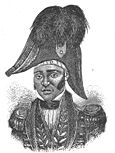
L'Ouverture was promised his freedom, if he agreed to integrate his remaining troops into the French Army. L'Ouverture agreed to this in May 1802. He was later deceived, seized by the French and shipped to France. He died months later while imprisoned at Fort-de-Joux in the Jura region.
Resistance to slavery
Guadeloupe
Guadeloupe is an archipelago located in the Leeward Islands, in the Lesser Antilles, with a land area of 1,628 square kilometres and a population of 400,000. It is the first overseas region of France, consisting of a single overseas department. As with the other overseas departments, Guadeloupe...
), Dessalines and Pétion switched sides again, in October 1802, and fought against the French. In November Leclerc died of yellow fever
Yellow fever
Yellow fever is an acute viral hemorrhagic disease. The virus is a 40 to 50 nm enveloped RNA virus with positive sense of the Flaviviridae family....
, like much of his army.
His successor, the Vicomte de Rochambeau, fought an even more brutal campaign. His atrocities helped rally many former French loyalists to the rebel cause. The French were further weakened by a British naval blockade, and by the unwillingness of Napoleon to send the requested massive reinforcements. Having sold the Louisiana Territory
Louisiana Territory
The Territory of Louisiana or Louisiana Territory was an organized incorporated territory of the United States that existed from July 4, 1805 until June 4, 1812, when it was renamed to Missouri Territory...
to the United States in April 1803, Napoleon began to lose interest in his failing ventures in the Western Hemisphere. Dessalines led the rebellion until its completion, when the French forces were finally defeated in 1803.
The last battle of the Haitian Revolution, the Battle of Vertières
Battle of Vertières
The Battle of Vertières , the last major battle of the Second War of Haitian Independence, the final part of the Haitian Revolution under François Capois. It was fought between Haitian rebels and French expeditionary forces on 18 November 1803 at Vertières...
, occurred on 18 November 1803, near Cap-Haïtien
Cap-Haïtien
Cap-Haïtien is a city of about 190,000 people on the north coast of Haiti and capital of the Department of Nord...
. It was fought between Haitian rebels led by Jean-Jacques Dessalines
Jean-Jacques Dessalines
Jean-Jacques Dessalines was a leader of the Haitian Revolution and the first ruler of an independent Haiti under the 1801 constitution. Initially regarded as Governor-General, Dessalines later named himself Emperor Jacques I of Haiti...
and the French colonial army under the Viscount of Rochambeau. On 1 January 1804, from the city of Gonaïves
Gonaïves
Gonaïves is a city in northern Haiti, the capital of the Artibonite Department. It has a population of about 104,825 people . The city's name derives from the original Amerindian name of Gonaibo. It is also known as Haïti's "independence city"...
, Dessalines officially declared the former colony's independence, renaming it "Haiti" after the indigenous
Indigenous peoples of the Americas
The indigenous peoples of the Americas are the pre-Columbian inhabitants of North and South America, their descendants and other ethnic groups who are identified with those peoples. Indigenous peoples are known in Canada as Aboriginal peoples, and in the United States as Native Americans...
Arawak name. Although he lasted from 1804–1806 several changes began taking place in Haiti. Transnationals became the backbone of Haitian identity as the territory's social structure changed becoming once again an agricultural society in a state of semi-serfdom. A tiny minority of state officials and civil servants were employed, who were exempt from manual labor, included many freed colored Haitians. This major loss was a decisive blow to France and its colonial empire.
Free republic
On 1 January 1804, DessalinesJean-Jacques Dessalines
Jean-Jacques Dessalines was a leader of the Haitian Revolution and the first ruler of an independent Haiti under the 1801 constitution. Initially regarded as Governor-General, Dessalines later named himself Emperor Jacques I of Haiti...
, the new leader under the dictatorial 1801 constitution, declared Haiti a free republic. Haiti was the first independent nation in Latin America, the first post-colonial independent black-led nation in the world, and the only nation whose independence was gained as part of a successful slave rebellion. The country was crippled by years of war, its agriculture devastated, its formal commerce nonexistent. The Army then became regiments of disciplined agricultural laborers, as the construction of military fortifications for defense purposes were built, like the Citadelle Laferrière
Citadelle Laferrière
The Citadelle Laferrière or, Citadelle Henry Christophe, or simply the Citadelle , is a large mountaintop fortress in northern Haiti, approximately south of the city of Cap-Haïtien and five miles uphill from the town of Milot...
. There was a sense of overmilitarization of the state as 10 % of the male population were subjected to conscription.
Under the presidency of Jean Pierre Boyer
Jean Pierre Boyer
Jean-Pierre Boyer , a native of Saint-Domingue, was a soldier, one of the leaders of the Haitian Revolution, and President of Haiti from 1818 to 1843. He reunited the north and south of Haiti in 1820 and also invaded and took control of Santo Domingo, which brought all of Hispaniola under one...
, Haiti was forced to make reparations to French slaveholders in 1825 in the amount of 150 million francs, reduced in 1838 to 60 million francs, in exchange for French recognition of its independence and to achieve freedom from French aggression. This indemnity bankrupted the Haitian treasury. It mortgaged Haiti's future to the French banks that provided the funds for the large first installment, affecting Haiti's ability to be prosperous.
The end of the Haitian Revolution in 1804 marked the end of colonialism on the island. However, the social conflict that was cultivated under slavery continued to affect the population for years to come. The revolution left in place the affranchi
Affranchi
"Affranchi" is a former French legal term denoting a freedman or emancipated slave. It is used in English to describe the class of freedmen in Saint-Domingue and other slave-holding French territories, who held legal rights intermediate between those of free whites and enslaved people of color...
élite which continued to rule Haiti, while the formidable Haitian army kept them in power. France continued the slavery system in Martinique
Martinique
Martinique is an island in the eastern Caribbean Sea, with a land area of . Like Guadeloupe, it is an overseas region of France, consisting of a single overseas department. To the northwest lies Dominica, to the south St Lucia, and to the southeast Barbados...
and Guadeloupe
Guadeloupe
Guadeloupe is an archipelago located in the Leeward Islands, in the Lesser Antilles, with a land area of 1,628 square kilometres and a population of 400,000. It is the first overseas region of France, consisting of a single overseas department. As with the other overseas departments, Guadeloupe...
.
Impact
The Haitian Revolution was influential in slave rebellions in the United States and British colonies. According to Haitian writer Michael J. Dash, the U.S. government feared that a successful slave revolt in Haiti would inspire a similar revolt in the United States. The revolution likely inspired a temporary increase in slave rebellions in the US, and this scared Southern plantation owners concerned about their own slaves rebelling. This fear resulted in a growing conservatism in US political culture, and leaders began to turn against the ideology of the French Revolution when they saw its influence in the Caribbean. The neighboring revolution brought the slavery question to the forefront of US politics, and the resulting intensification of racial divides and sectional politics ended the idealism of the Revolutionary period. Resulting to conservative fears over the effects of the Revolution, the U.S. government used its influence in Haiti to promote repressive regimes.Beginning during the slave insurrections of 1791, white refugees from Saint-Domingue fled to the United States, particularly Philadelphia, Baltimore, New York and Charleston. The immigration intensified after the journée (crisis) of June 20, 1793, and soon American families began to raise money and open up their homes in order to aid the exiles in what became the United States' first refugee crisis. While some white refugees blamed the French Revolutionary government for sparking the violence in Haiti, many supported the Republican regime and openly expressed their support of the Jacobins There is also some historical evidence suggesting that displaying solidarity with the French Revolution was the easiest way for the refugees to earn the support and sympathy of the Americans, who had just recently fought their own battle for liberty. American slaveholders, in particular, commiserated with the French planters who had been forcibly removed from their plantations in Saint-Domingue. While most of the exiles found themselves in a relatively peaceful situation in the United States--safe from the violence raging in both France and Haiti--their presence complicated the already precarious diplomatic relations between Great Britain, France and the United States.
Many of the white and free people of color who left Saint-Domingue for the United States settled in Southern Louisiana, adding many new members to its French-speaking, mixed-raced, and African populations. The exiles causing the greatest amount of alarm were the African slaves who with their refugee owners. Southern planters grew concerned that the presence of these slaves who had witnessed the revolution in Haiti would incite similar revolts in the United States, and therefore went to significant lengths to prevent the widespread trade of these persons.
In 1807 Haiti was divided into two parts, the Republic of Haiti and the Kingdom of Haiti in the North.
Land could not be privately owned as it was reverted to the state through Biens Nationaux (national bonds), and no French whites could own any land. The remaining French settlers were forced to leave the island. Those who refused were slaughtered. The Haitian State owned up to 90% of the land and the other 10% was leased in 5 year intervals. Individuals were then divided by economic tasks, where a middle class did not exist. Bound to the plantation by birth approximately 90% of Haitians were in wage earning serfdom guaranteeing a permanent self-reproducing labor force also leading to legislation prohibiting marriage between urban individuals and agricultural laborers. .
Because Napoleon was unable to regain control over Haiti, he gave up hope of rebuilding a French New World empire. The loss of revenues from Saint-Domingue's sugar plantations made maintenance of Louisiana impractical. Similarly, as a result of debts incurred fighting the slave revolt, Napoleon was forced to sell the American government its territories in Louisiana at a heavily discounted price.
While such a large-scale slave rebellion was never again repeated, the Haitian Revolution stood as a model for achieving emancipation for slaves in the rest of the Atlantic World. In 1807, Britain became the first major power to permanently abolish
Abolitionism
Abolitionism is a movement to end slavery.In western Europe and the Americas abolitionism was a movement to end the slave trade and set slaves free. At the behest of Dominican priest Bartolomé de las Casas who was shocked at the treatment of natives in the New World, Spain enacted the first...
the slave trade, although the practice of plantation slavery was not fully abolished in the British West Indies until 1833. After the French Revolution, Napoleon reinstated slavery in the remaining French Caribbean colonies, which lasted until 1848. Slavery in the United States officially ended after the Emancipation Proclamation was issued in 1863.
In 2004, Haiti celebrated the bicentennial of its independence from France.
Literature and art
- English poet William WordsworthWilliam WordsworthWilliam Wordsworth was a major English Romantic poet who, with Samuel Taylor Coleridge, helped to launch the Romantic Age in English literature with the 1798 joint publication Lyrical Ballads....
published his sonnet "To Toussaint Louverture" in January 1803. - Heinrich von KleistHeinrich von KleistBernd Heinrich Wilhelm von Kleist was a poet, dramatist, novelist and short story writer. The Kleist Prize, a prestigious prize for German literature, is named after him.- Life :...
's "Verlobung in St. Domingo" (Betrothal in St. Domingo), published in 1811, sets a complex primary narrative against the background of the Haitian Revolution. - A 4-part short fiction series called "Theresa—A Haytien Tale" appeared in the newspaper "Freedom's Journal" in 1828 on January 18th, 25th, February 8th, 15th. This is one of the earliest works of short fiction by an African American author, "S", tentatively identified as Prince Saunders (Foster 2006).
- Published in 1855, Herman Melville's "Benito Cereno" narrates a fictional slave revolt on a the ship "Saint Dominick" in the year 1799, wherein the slaves take complete control of the ship.
- In 1939, American artist Jacob LawrenceJacob LawrenceJacob Lawrence was an American painter; he was married to fellow artist Gwendolyn Knight. Lawrence referred to his style as "dynamic cubism", though by his own account the primary influence was not so much French art as the shapes and colors of Harlem.Lawrence is among the best-known twentieth...
created a series of paintings, The Life of Toussaint Louverture, which he later adapted into prints. - Cuban writer Alejo CarpentierAlejo CarpentierAlejo Carpentier y Valmont was a Cuban novelist, essayist, and musicologist who greatly influenced Latin American literature during its famous "boom" period. Born in Lausanne, Switzerland, Carpentier grew up in Havana, Cuba; and despite his European birthplace, Carpentier strongly self-identified...
's second novel, The Kingdom of this WorldThe Kingdom of this WorldThe Kingdom of This World is a novella by Cuban author Alejo Carpentier, published in 1949 in his native Spanish and first translated into English in 1957. A work of historical fiction, it tells the story of Haiti before, during, and after the Haitian Revolution as seen by its central character,...
(1949), (translated into English 1957), explores the Haitian Revolution in depth. It is one of the novels that inaugurated the Latin American renaissance in fiction beginning in the mid-20th century. - Madison Smartt BellMadison Smartt BellMadison Smartt Bell is an American novelist. He was raised Nashville, and lived in New York, and London before settling in Baltimore, Maryland....
has written a trilogy called All Souls Rising (1995) about the life of Toussaint Louverture and the slave uprising. - In 2004 an exhibition of paintings entitled Caribbean Passion: Haiti 1804, by artist Kimathi Donkor, was held in London to celebrate the bicentenary of Haiti's revolution.
See also
- MawonMawonMawon is the Haitian Kreyòl word for maroon, meaning "escaped slave".The French encountered many forms of slave resistance during the seventeenth and eighteenth centuries. The African slaves that fled to remote mountainous areas were called mawon. The mawon formed close-knit communities which...
- Polish Legions in ItalyPolish Legions in ItalyThe Polish Legions, in the Napoleonic period, were several Polish military units that served with the French Army from the 1790s to the 1810s....
- U.S. Reaction to the Haitian RevolutionU.S. Reaction to the Haitian RevolutionThe Haitian Revolution provoked mixed reactions in the United States. Southern Slaveholders feared that the slave revolution might spread from the island of Hispaniola to the slave plantations of the Southern United States. They believed that the African people who they enslaved would be inspired...
- An Unbroken Agony: Haiti, From Revolution to the Kidnapping of a PresidentAn Unbroken Agony: Haiti, From Revolution to the Kidnapping of a PresidentAn Unbroken Agony: Haiti, From Revolution to the Kidnapping of a President is a book on the history of Haiti by Randall Robinson ....
- The Crime of NapoleonThe Crime of NapoleonNapoleon's Crimes: A Blueprint for Hitler is a controversial book published in 2005 by French philosopher Claude Ribbe, who is himself of Caribbean origin...
- Bug-JargalBug-JargalBug-Jargal is a novel by the French writer Victor Hugo. First published in 1826, it is a reworked version of an earlier short story of the same name published in the Hugo brothers' magazine Le Conservateur littéraire in 1820...
External links
- Haiti: Revolutionary War 1791 – 1803
- The Louverture Project, a wiki about the history of Haiti
- Portals to the World – Haiti
- Haitian Constitution of 1801 (English)
- Haiti Archives
- Haiti – The First Black Republic in the World
- "Égalité for All: Toussaint Louverture and the Haitian Revolution". Noland Walker. PBSPublic Broadcasting ServiceThe Public Broadcasting Service is an American non-profit public broadcasting television network with 354 member TV stations in the United States which hold collective ownership. Its headquarters is in Arlington, Virginia....
documentary. 2009 - France Urged to Pay $40 Billion to Haiti in Reparations for "Independence Debt" – video report by Democracy Now!Democracy Now!Democracy Now! and its staff have received several journalism awards, including the Gracie Award from American Women in Radio & Television; the George Polk Award for its 1998 radio documentary Drilling and Killing: Chevron and Nigeria's Oil Dictatorship, on the Chevron Corporation and the deaths of...