


Polish Legions in Italy

Encyclopedia

Napoleon I of France
Napoleon Bonaparte was a French military and political leader during the latter stages of the French Revolution.As Napoleon I, he was Emperor of the French from 1804 to 1815...
, were several Polish military units that served with the French Army
French Army
The French Army, officially the Armée de Terre , is the land-based and largest component of the French Armed Forces.As of 2010, the army employs 123,100 regulars, 18,350 part-time reservists and 7,700 Legionnaires. All soldiers are professionals, following the suspension of conscription, voted in...
from the 1790s to the 1810s.
After the Third Partition of Poland
Third Partition of Poland
The Third Partition of Poland or Third Partition of the Polish-Lithuanian Commonwealth took place in 1795 as the third and last of three partitions that ended the existence of the Polish-Lithuanian Commonwealth.-Background:...
(1795), many Poles believed that revolutionary France and her allies would come to Poland's aid. France's enemies included Poland's partitioners, Prussia
Prussia
Prussia was a German kingdom and historic state originating out of the Duchy of Prussia and the Margraviate of Brandenburg. For centuries, the House of Hohenzollern ruled Prussia, successfully expanding its size by way of an unusually well-organized and effective army. Prussia shaped the history...
, Austria and Imperial Russia. Many Polish soldiers, officers and volunteers therefore emigrated
Emigration
Emigration is the act of leaving one's country or region to settle in another. It is the same as immigration but from the perspective of the country of origin. Human movement before the establishment of political boundaries or within one state is termed migration. There are many reasons why people...
, especially to Italy (leading to the expression, "the Polish Legions in Italy") and to France, where they joined forces with the local military.
The number of Polish recruits soon reached many thousands. With support from Napoleon Bonaparte, Polish military units were formed, bearing Polish military rank
Military rank
Military rank is a system of hierarchical relationships in armed forces or civil institutions organized along military lines. Usually, uniforms denote the bearer's rank by particular insignia affixed to the uniforms...
s and commanded by Polish officers. They became known as the "Polish Legions" and were considered a Polish army in exile, under French command. Their Polish commanders included Jan Henryk Dąbrowski
Jan Henryk Dabrowski
-Biography:Dąbrowski was born to Jan Michal Dąbrowski and Sophie née von Lettow in Pierzchów, Polish–Lithuanian Commonwealth He grew up in Hoyerswerda, Electorate of Saxony, where his father served as a Colonel in the Saxon army...
, Karol Kniaziewicz
Karol Kniaziewicz
Baron Karol Otto Kniaziewicz was a Polish general and political activist....
, Józef Wybicki
Józef Wybicki
Józef Rufin Wybicki was a Polish general, poet and political figure.-Life:He was a close friend of General Jan Henryk Dąbrowski, and in 1797 he wrote Mazurek Dąbrowskiego , which in 1927 was adopted as the Polish national anthem.During the Kościuszko Uprising, he was counselor of the Military...
and Antoni Amilkar Kosiński.
The Polish Legions serving alongside the French Army
French Army
The French Army, officially the Armée de Terre , is the land-based and largest component of the French Armed Forces.As of 2010, the army employs 123,100 regulars, 18,350 part-time reservists and 7,700 Legionnaires. All soldiers are professionals, following the suspension of conscription, voted in...
during the Napoleonic Wars
Napoleonic Wars
The Napoleonic Wars were a series of wars declared against Napoleon's French Empire by opposing coalitions that ran from 1803 to 1815. As a continuation of the wars sparked by the French Revolution of 1789, they revolutionised European armies and played out on an unprecedented scale, mainly due to...
saw combat in most of Napoleon's campaigns, from the West Indies, through Italy and Egypt. When the Duchy of Warsaw
Duchy of Warsaw
The Duchy of Warsaw was a Polish state established by Napoleon I in 1807 from the Polish lands ceded by the Kingdom of Prussia under the terms of the Treaties of Tilsit. The duchy was held in personal union by one of Napoleon's allies, King Frederick Augustus I of Saxony...
was created in 1807, many of the veterans of the legions formed a core around which the Duchy's army was formed serving under Józef Poniatowski. This force fought a victorious war against Austria in 1809 and would go on to fight alongside the French army in numerous campaigns, culminating in the invasion of Russia
French invasion of Russia
The French invasion of Russia of 1812 was a turning point in the Napoleonic Wars. It reduced the French and allied invasion forces to a tiny fraction of their initial strength and triggered a major shift in European politics as it dramatically weakened French hegemony in Europe...
in 1812.
History
Jan Henryk Dąbrowski, a former high-ranking officer in the army of the Polish-Lithuanian CommonwealthPolish-Lithuanian Commonwealth
The Polish–Lithuanian Commonwealth was a dualistic state of Poland and Lithuania ruled by a common monarch. It was the largest and one of the most populous countries of 16th- and 17th‑century Europe with some and a multi-ethnic population of 11 million at its peak in the early 17th century...
, began his work in 1796 - a year after the total destruction of the Commonwealth
Partitions of Poland
The Partitions of Poland or Partitions of the Polish–Lithuanian Commonwealth took place in the second half of the 18th century and ended the existence of the Polish–Lithuanian Commonwealth, resulting in the elimination of sovereign Poland for 123 years...
- when he was summoned to Paris by Napoleon Bonaparte. He was soon authorised by the French-allied Cisalpine Republic
Cisalpine Republic
The Cisalpine Republic was a French client republic in Northern Italy that lasted from 1797 to 1802.-Birth:After the Battle of Lodi in May 1796, Napoleon Bonaparte proceeded to organize two states: one to the south of the Po River, the Cispadane Republic, and one to the north, the Transpadane...
to create Polish legions, which would be part of the army of the newly created Republic of Lombardy. He was also authorised to sign an agreement with the new government of the Republic of Lombardy, where the Republic agreed to create a second legion.
Dąbrowski's Legions were first used against Austrians
Austrians
Austrians are a nation and ethnic group, consisting of the population of the Republic of Austria and its historical predecessor states who share a common Austrian culture and Austrian descent....
in Italy, where Poles who had a natural sympathy for people fighting for their own independence saw the Italian cause for independence as similar to that of their own. Early on, the Legions, numbering about 6,000 and including many Polish deserters from the Austrian army, proved to be a valuable military asset; in March 1797 they garrisoned Mantua
Mantua
Mantua is a city and comune in Lombardy, Italy and capital of the province of the same name. Mantua's historic power and influence under the Gonzaga family, made it one of the main artistic, cultural and notably musical hubs of Northern Italy and the country as a whole...
, later they quelled peasant unrest in Rimini
Rimini
Rimini is a medium-sized city of 142,579 inhabitants in the Emilia-Romagna region of Italy, and capital city of the Province of Rimini. It is located on the Adriatic Sea, on the coast between the rivers Marecchia and Ausa...
and retook Verona
Verona
Verona ; German Bern, Dietrichsbern or Welschbern) is a city in the Veneto, northern Italy, with approx. 265,000 inhabitants and one of the seven chef-lieus of the region. It is the second largest city municipality in the region and the third of North-Eastern Italy. The metropolitan area of Verona...
. In May 1798 the Poles helped the French to capture and later, garrison, Rome. Later they fought the anti-French forces from the Kingdom of Naples
Kingdom of Naples
The Kingdom of Naples, comprising the southern part of the Italian peninsula, was the remainder of the old Kingdom of Sicily after secession of the island of Sicily as a result of the Sicilian Vespers rebellion of 1282. Known to contemporaries as the Kingdom of Sicily, it is dubbed Kingdom of...
, defeating them at Magliano
Magliano
-Municipalities :*Magliano Alfieri, in the province of Cuneo*Magliano Alpi, in the province of Cuneo*Magliano de' Marsi, in the province of Aquila*Magliano di Tenna, in the province of Ascoli Piceno*Magliano in Toscana, in the province of Grosseto...
on 1 December and Civita Castellana
Civita Castellana
Civita Castellana is a town and comune in the province of Viterbo, 65 km north of Rome.Mount Soracte lies about 10 km to the south-east.-History:...
at 4 December. Later, the Polish Legion would take Gaeta
Gaeta
Gaeta is a city and comune in the province of Latina, in Lazio, central Italy. Set on a promontory stretching towards the Gulf of Gaeta, it is 120 km from Rome and 80 km from Naples....
fortress.
In 1798, General Józef Zajączek
Józef Zajaczek
Prince Józef Zajączek , was a Polish general and politician.His first important military post was that of an aide-de-camp to hetman Franciszek Ksawery Branicki...
organized the Second Polish Legion under the French. In 1799, Karol Kniaziewicz
Karol Kniaziewicz
Baron Karol Otto Kniaziewicz was a Polish general and political activist....
organized the Third Legion (the Danube Legion
Danube Legion
The Danube Legion was a unit of Poles in the service of Napoleonic France, one of the larger Polish Legions of Napoleonic Period.It was formed on 8 September 1799 in the Batavian Republic from Polish volunteers, mostly French prisoners of war from the Austrian Army...
) to fight against the Austrians in Bavaria
Bavaria
Bavaria, formally the Free State of Bavaria is a state of Germany, located in the southeast of Germany. With an area of , it is the largest state by area, forming almost 20% of the total land area of Germany...
. The Poles could not choose all their fights. Their morale
Morale
Morale, also known as esprit de corps when discussing the morale of a group, is an intangible term used to describe the capacity of people to maintain belief in an institution or a goal, or even in oneself and others...
weakened when, instead of being sent against the partitioners of Poland, they were used by the French to put down uprisings (like that in the Papal States). Particularly during treaty negotiations between the French and Austrians, the French were finding the Polish issue to be a problem. It was then that the future Polish national anthem
National anthem
A national anthem is a generally patriotic musical composition that evokes and eulogizes the history, traditions and struggles of its people, recognized either by a nation's government as the official national song, or by convention through use by the people.- History :Anthems rose to prominence...
, Mazurek Dąbrowskiego, was created by Józef Wybicki, with words promising 'the return of the Polish army from Italy to Poland'.
During the War of the Second Coalition
War of the Second Coalition
The "Second Coalition" was the second attempt by European monarchs, led by the Habsburg Monarchy of Austria and the Russian Empire, to contain or eliminate Revolutionary France. They formed a new alliance and attempted to roll back France's previous military conquests...
, the First Legion fought against the Russians at Trebbia
Trebbia
The Trebbia is a river predominantly of Liguria and Emilia Romagna in northern Italy. It is one of the four main right-bank tributaries of the river Po, the other three being the Tanaro, the Secchia and the Panaro...
(17–19 June 1799) where it acted as the rearguard
Rearguard
Rearguard may refer to:* A military detachment protecting the rear of a larger military formation, especially when retreating from a pursuing enemy force. * Rear Guard , a computer game released in 1982...
of retreating French forces. Polish legionaries under General Dądrowski fought at Novi
Novi
- Places:In Bosnia and Herzegovina:* Bosanski Novi, a town in northwestern region of the country.In Italy:* Novi di Modena, a commune in the province of Modena...
(15 July 1799), where Russian and Austrian armies defeated the French army. The Second Legion suffered heavily; particularly in the first battles on the Adige
Adige
The Adige is a river with its source in the Alpine province of South Tyrol near the Italian border with Austria and Switzerland. At in length, it is the second longest river in Italy, after the River Po with ....
(26 March, 4 April 1799) - where it also acted as the rear guard to the retreating French. It also suffered in the battle of Mantua (April-July), when French commander Foissac-Latour decided to release Polish soldiers under general Wielhorski into Austrian custody as Austrians claimed them to be deserters. Polish forces also fought in the battle of Hohenlinden
Battle of Hohenlinden (1800)
The Battle of Hohenlinden was fought on 3 December 1800 during the French Revolutionary Wars. A French army under Jean Victor Marie Moreau won a decisive victory over the Austrians and Bavarians led by Archduke John of Austria. After being forced into a disastrous retreat, the allies were compelled...
on 3 December 1800.
According to the Treaty of Amiens
Treaty of Amiens
The Treaty of Amiens temporarily ended hostilities between the French Republic and the United Kingdom during the French Revolutionary Wars. It was signed in the city of Amiens on 25 March 1802 , by Joseph Bonaparte and the Marquess Cornwallis as a "Definitive Treaty of Peace"...
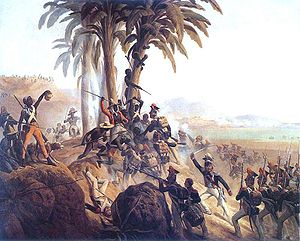
's secret articles, France agreed to disband Polish legions. In 1802, France sent the legions (5,280 strong) to Haiti
Haiti
Haiti , officially the Republic of Haiti , is a Caribbean country. It occupies the western, smaller portion of the island of Hispaniola, in the Greater Antillean archipelago, which it shares with the Dominican Republic. Ayiti was the indigenous Taíno or Amerindian name for the island...
to put down the Haitian Revolution
Haitian Revolution
The Haitian Revolution was a period of conflict in the French colony of Saint-Domingue, which culminated in the elimination of slavery there and the founding of the Haitian republic...
(on the Caribbean island of Hispaniola
Hispaniola
Hispaniola is a major island in the Caribbean, containing the two sovereign states of the Dominican Republic and Haiti. The island is located between the islands of Cuba to the west and Puerto Rico to the east, within the hurricane belt...
, known then as French West Indies or St. Domingue. Napoleon wanted to regain the colony
Colony
In politics and history, a colony is a territory under the immediate political control of a state. For colonies in antiquity, city-states would often found their own colonies. Some colonies were historically countries, while others were territories without definite statehood from their inception....
of Saint Domingue, but had no wish to deplete his main French army any more than he had to. Polish legions were accompanied by contingents of Germans and Swiss French allies, as well as by the less favoured units of Napoleon's French army.
Many Polish soldiers became sympathetic to the natives
Haiti
Haiti , officially the Republic of Haiti , is a Caribbean country. It occupies the western, smaller portion of the island of Hispaniola, in the Greater Antillean archipelago, which it shares with the Dominican Republic. Ayiti was the indigenous Taíno or Amerindian name for the island...
' cause. In Haiti it was (and still is) widely believed that Poles supported Jean-Jacques Dessalines
Jean-Jacques Dessalines
Jean-Jacques Dessalines was a leader of the Haitian Revolution and the first ruler of an independent Haiti under the 1801 constitution. Initially regarded as Governor-General, Dessalines later named himself Emperor Jacques I of Haiti...
in significant numbers, with entire units changing sides. The actual desertion rate was much lower (about 150 Polish soldiers joined the Haitian rebels). Combat casualties and tropical diseases (like yellow fever
Yellow fever
Yellow fever is an acute viral hemorrhagic disease. The virus is a 40 to 50 nm enveloped RNA virus with positive sense of the Flaviviridae family....
) reduced the 5,280 strong Legion to a few hundred survivors in the space of less than two years. By the time French forces retreated from the island in 1803, about 4,000 Poles were dead (either from disease or combat), about 400 remained on the island, a few dozen dispersed to the nearby islands or to the United States, and about 700 returned to France. Loss of that many patriotic army personnel was a serious blow to Polish aspirations for regaining independence. Further, the Haitian experience undermined the belief among Poles in France's good intentions toward Poland.
In 1806, what was left of the old Dąbrowski and Kniaziewicz's Legions was one infantry regiment and one cavalry regiment in the service of the Kingdom of Naples
Kingdom of Naples
The Kingdom of Naples, comprising the southern part of the Italian peninsula, was the remainder of the old Kingdom of Sicily after secession of the island of Sicily as a result of the Sicilian Vespers rebellion of 1282. Known to contemporaries as the Kingdom of Sicily, it is dubbed Kingdom of...
. Prussians created a 'Northern Legion' under General Zajączek. French armies, including the Legion units, defeated the Prussians in Saxony
Saxony
The Free State of Saxony is a landlocked state of Germany, contingent with Brandenburg, Saxony Anhalt, Thuringia, Bavaria, the Czech Republic and Poland. It is the tenth-largest German state in area, with of Germany's sixteen states....
at the battle of Jena and Poles under Dąbrowski entered former Polish territories (near the city of Poznań
Poznan
Poznań is a city on the Warta river in west-central Poland, with a population of 556,022 in June 2009. It is among the oldest cities in Poland, and was one of the most important centres in the early Polish state, whose first rulers were buried at Poznań's cathedral. It is sometimes claimed to be...
), which resulted in the influx of recruits for the legion.. A year later, Napoleon having defeated the Russian armies met with the Russian Tsar
Tsar
Tsar is a title used to designate certain European Slavic monarchs or supreme rulers. As a system of government in the Tsardom of Russia and Russian Empire, it is known as Tsarist autocracy, or Tsarism...
Alexander I
Alexander I of Russia
Alexander I of Russia , served as Emperor of Russia from 23 March 1801 to 1 December 1825 and the first Russian King of Poland from 1815 to 1825. He was also the first Russian Grand Duke of Finland and Lithuania....
at Tilsit and in the ensuing negotiations they agreed that a new, small Polish state under French control would be created.

Duchy of Warsaw
The Duchy of Warsaw was a Polish state established by Napoleon I in 1807 from the Polish lands ceded by the Kingdom of Prussia under the terms of the Treaties of Tilsit. The duchy was held in personal union by one of Napoleon's allies, King Frederick Augustus I of Saxony...
and although it was much smaller than the Polish-Lithuanian Commonwealth
Polish-Lithuanian Commonwealth
The Polish–Lithuanian Commonwealth was a dualistic state of Poland and Lithuania ruled by a common monarch. It was the largest and one of the most populous countries of 16th- and 17th‑century Europe with some and a multi-ethnic population of 11 million at its peak in the early 17th century...
, made up only of some of the lands the defeated Prussians had taken in the partitions of Poland (it would be expanded in 1809 to include a portion of the territories seized in the partitions by Austria), its creation brought hope to many Poles - and more Polish volunteers flocked to the French banners. Despite Polish support and his own promises, Napoleon did not hurry with the re-establishment of the Polish-Lithuanian Commonwealth. The duchy was ruled by a French-allied King Frederick Augustus I of Saxony
Frederick Augustus I of Saxony
Frederick Augustus I was King of Saxony from the House of Wettin. He was also Elector Frederick Augustus III of Saxony and Duke Frederick Augustus I of Warsaw...
and was never allowed to develop as a truly independent state; Frederick Augustus' rule was subordinated to the requirements of the French raison d'état, who largely treated the state as a source of resources. The most important person in the duchy was in fact the French ambassador
Ambassador
An ambassador is the highest ranking diplomat who represents a nation and is usually accredited to a foreign sovereign or government, or to an international organization....
, based in the duchy's capital, Warsaw
Warsaw
Warsaw is the capital and largest city of Poland. It is located on the Vistula River, roughly from the Baltic Sea and from the Carpathian Mountains. Its population in 2010 was estimated at 1,716,855 residents with a greater metropolitan area of 2,631,902 residents, making Warsaw the 10th most...
.
During the Peninsular War
Peninsular War
The Peninsular War was a war between France and the allied powers of Spain, the United Kingdom, and Portugal for control of the Iberian Peninsula during the Napoleonic Wars. The war began when French and Spanish armies crossed Spain and invaded Portugal in 1807. Then, in 1808, France turned on its...
in Spain, Polish forces, rebuilt to an about 6,000 strong contingent and now known as the Vistula Legion gained fame at the Battle of Zaragoza. Other troops served in Napoleon's Imperial Guard. The Polish Chevauleger regiment distinguished itself at the Battle of Somosierra
Battle of Somosierra
The Battle of Somosierra occurred November 30, 1808 in the Peninsular War, when a French army under Napoleon I forced a passage through the Sierra de Guadarrama shielding Madrid....
(1808). Another Polish cavalry regiment - the Vistula uhlans- fought in Spain as well. They distinguished themselves many times there, e.g. at the Battle of Albuhera
Battle of Albuera
The Battle of Albuera was an indecisive battle during the Peninsular War. A mixed British, Spanish and Portuguese corps engaged elements of the French Armée du Midi at the small Spanish village of Albuera, about 20 kilometres south of the frontier fortress-town of Badajoz, Spain.From...
(1811) where they destroyed a British infantry brigade. Their valour in that conflict inspired the British to create the English lancers equipped with Polish-style uniforms and weapons.
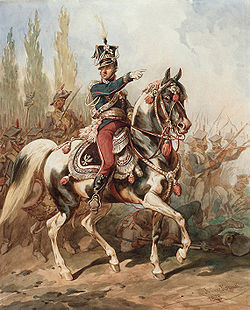
Uhlan
Uhlans were Polish light cavalry armed with lances, sabres and pistols. The title was later used by lancer regiments in the Russian, Prussian, and Austrian armies....
of the Vistula Legion were the first unit to cross the Neman River
Neman River
Neman or Niemen or Nemunas, is a major Eastern European river rising in Belarus and flowing through Lithuania before draining into the Curonian Lagoon and then into the Baltic Sea at Klaipėda. It is the northern border between Lithuania and Russia's Kaliningrad Oblast in its lower reaches...
when the Grand Armee entered Russia, and the first unit to enter Moscow. They distinguished themselves in the battle of Borodino
Battle of Borodino
The Battle of Borodino , fought on September 7, 1812, was the largest and bloodiest single-day action of the French invasion of Russia and all Napoleonic Wars, involving more than 250,000 troops and resulting in at least 70,000 casualties...
and, under Prince Józef Poniatowski (who personally saved Napoleon's life), were one of the units serving as the rear guard during Napoleon's retreat, it is said that just as they were the first to enter it, they were the last to leave Russia. They sustained heavy losses during the campaign: only 26,000 of the original 98,000 strong contingent have returned. The elite Vistula Legion entering Russia was about 7,000 strong; its strength at the end of the campaign was 1,500.
The end of the Polish Legions came with the end of Napoleon's career and the existence of the Duchy of Warsaw. The Duchy was occupied by Prussian and Russian troops following Napoleon's retreat from Russia. When Napoleon was forced into exile on Elba
Elba
Elba is a Mediterranean island in Tuscany, Italy, from the coastal town of Piombino. The largest island of the Tuscan Archipelago, Elba is also part of the National Park of the Tuscan Archipelago and the third largest island in Italy after Sicily and Sardinia...
, the only unit he was allowed to have with him as the guards were the Polish Lancers
Uhlan
Uhlans were Polish light cavalry armed with lances, sabres and pistols. The title was later used by lancer regiments in the Russian, Prussian, and Austrian armies....
. During the 1815 campaign (Napoleon's Hundred Days) 325 men under Colonel Golaszewski were the last of the famous Vistula Legion to fight under Napoleon. Poles remained loyal to him until the bitter end, with Polish units holding their ground at his last battles (battle of Leipzig
Battle of Leipzig
The Battle of Leipzig or Battle of the Nations, on 16–19 October 1813, was fought by the coalition armies of Russia, Prussia, Austria and Sweden against the French army of Napoleon. Napoleon's army also contained Polish and Italian troops as well as Germans from the Confederation of the Rhine...
and battle of Waterloo
Battle of Waterloo
The Battle of Waterloo was fought on Sunday 18 June 1815 near Waterloo in present-day Belgium, then part of the United Kingdom of the Netherlands...
). In 1815, when the Duchy of Warsaw was formally partitioned between Prussia and Russia at the Congress of Vienna
Congress of Vienna
The Congress of Vienna was a conference of ambassadors of European states chaired by Klemens Wenzel von Metternich, and held in Vienna from September, 1814 to June, 1815. The objective of the Congress was to settle the many issues arising from the French Revolutionary Wars, the Napoleonic Wars,...
(in what is sometimes known as the Fourth Partition of Poland), and Napoleon relieved of his honour guard, the Legions ceased to exist. Yet even today the memory of Napoleon's Polish Legions is strong, and Napoleon himself is often regarded in Poland as a hero and liberator.
Notable members
- Jan Henryk DąbrowskiJan Henryk Dabrowski-Biography:Dąbrowski was born to Jan Michal Dąbrowski and Sophie née von Lettow in Pierzchów, Polish–Lithuanian Commonwealth He grew up in Hoyerswerda, Electorate of Saxony, where his father served as a Colonel in the Saxon army...
- Stanisław Dunin-Wąsowicz
- Jan KonopkaJan KonopkaJan Konopka was a lieutenant in the Kościuszko Uprising, captain of the Polish Legions in Italy, regiment commander in the Legion of the Vistula, as well as general of the French Army and the Duchy of Warsaw...
- Karol KniaziewiczKarol KniaziewiczBaron Karol Otto Kniaziewicz was a Polish general and political activist....
- Feliks de MelfortFeliks de MelfortFeliks de Melfort was a notable Polish military officer and a freedom fighter. A graduate of Szkoła Rycerska, in 1781 he was promoted to the rank of Captain and attached to the Royal Foot Guards Regiment. Following the failure of the Kościuszko's Uprising and the partitions of Poland, he left for...
- Józef Antoni PoniatowskiJózef Antoni PoniatowskiPrince Józef Antoni Poniatowski was a Polish leader, general, minister of war and army chief, who became a Marshal of France.-Early Austrian years and war with Turkey:...
- Józef WybickiJózef WybickiJózef Rufin Wybicki was a Polish general, poet and political figure.-Life:He was a close friend of General Jan Henryk Dąbrowski, and in 1797 he wrote Mazurek Dąbrowskiego , which in 1927 was adopted as the Polish national anthem.During the Kościuszko Uprising, he was counselor of the Military...
See also
- Great EmigrationGreat EmigrationThe Great Emigration was an emigration of political elites from Poland from 1831–1870. Since the end of the 18th century, a major role in Polish political life was played by people who carried out their activities outside the country as émigrés...
- History of Poland (1795-1918)
- Polish–Russian War of 1792
Further reading
List based on the compilation of Polish Genealogical Society of America http://www.pgsa.org/military.htm#Dombrowski%20Legions- Leonard ChodźkoLeonard ChodzkoLeonard Borejko Chodźko was a Polish historian, geographer, cartographer, publisher, archivist, and activist of Poland's post-November-1830-Uprising Great Emigration.-Life:...
, Histoire Des Légions Polonaises en Italie, Paris, 1929. (Important first comprehensive study of the Polish Legions in Italy during the Napoleonic wars which contains many references to officers and enlisted men.) - Elena I. Fedosova, Polish Projects of Napoleon Bonaparte, The Journal of the International Napoleonic Society, 1/2/98
- Bronisław Gembarzewski, Wojsko Polskie. Ksiestwo Warszawskie 1807-1814. Warszawa, 1905 (lst), 1912, (2nd) edition. (The best reference on the Army of the Duchy of Warsaw contains a list of officers of the Duchy of Warsaw from 1809 to 1814 as well as a list of officers of the Lithuanian Regiments in 1812.)
- Stanisław Kirkor, Legia Nadwislanska, 1808-1814. Londyn, 1981. (The best history of the Vistula Legion contains biographical sketches of all officers and sometimes includes not only the father's name but the mothers maiden name also. It also lists the recipients of Virtuti Militari and the Legion of Honour.)
- Stanisław Kirkor, Pod Sztandarami Napoleona, Londyn, 1982. (Under the Standards of Napoleon has lists of officers of the 4th, 7th and 9th Regiments of infantry of the Duchy of Warsaw which was the Polish Division in the service of France and Napoleon in Spain. It also lists the officers and enlisted men of the Elba Squadron and contains other articles about Napoleonic Polish officers.)
- Kozlowski, Historya lgo Potem 9go Pulku Wielkiego Ksiestwa Warszawskiego, Napisana Prez Kpt. Kozlowskiego, Poznań - Kraków, 1887. (Captain Kozlowski presents a history of the 1st and later 9th regiment of the Duchy of Warsaw.)
- Jan Pachonski, Legiony Polskie. Prawda i Legenda, 1794-1807. Warszawa, I-1969, II-1976, III-1971, IV-1979. (The most scholarly comprehensive work ever done on the Polish Legions which includes biographical sketches of practically all officers including birthplaces, parents' names as well as service records.)
- Jan Pachonski, Polacy Na Antylach i Morzu Karaibskim, Kraków, 1979. (Sketches of officers and some enlisted men who served in the various islands of the Caribbean during the Napoleonic wars.)
- Aleksander Rembowski, Żródła do Historii Pulku Polskiego Lekkokonnego Gwardii Napoleona I, Wyd. A. Rembowski, Warszawa, 1899. (The best book on the Polish Light Horse of the Guard contains a complete list of all officers and enlisted men with reference to their service records.)
- A.M. Skałkowski, Polacy Na San Domingo, 1802-1809. Poznań, 1921. (One of the best early works on the San Domingo war which lists most officers and some enlisted men.)
- Joseph Tyszkiewicz, Histoire Du 17ième Régiment De Cavalerie Polonaise Ðe Lanciers Du Comte Michel Tyszkiewlcz, 1812-1815. Cracow, 1904. (Limited edition regimental history of the 17th Lancers contains a complete listing of all officers and enlisted men of this so-called Lithuanian regiment.)
- Henry Lachougue; Ann BrownAnn BrownAnn Leslie Brown was an educational psychologist who developed methods for teaching children to be better learners. Her interest in the human memory brought Brown to focus on active memory strategies that would help enhance human memory and developmental differences in memory tasks...
, The Anatomy of Glory, Napoleon and His Guard, Providence, R.I., London, 1962, (2nd) ed. New York, 1978, (3rd) ed.
Fiction
- Michael Large, Song of the Legions, 2011, a novel about the origin of the Polish Legion, ISBN 978-0-9568853-0-2.