


Charles Leclerc

Encyclopedia
Charles Victoire Emmanuel Leclerc (17 March 1772, Pontoise
– 2 November 1802) was a French Army
general and husband to Pauline Bonaparte
, sister to Napoleon Bonaparte
.
as one of the army volunteers of Seine-et-Oise
and passed through the ranks of sous-lieutenant in the 12th Cavalry, then aide-de-camp to general Lapoype
. He was made a captain and divisional chief of staff during the siege of Toulon
, at which he first allied himself to Napoleon Bonaparte
. Following the revolutionary success there, he campaigned along the Rhine. He began serving under Napoleon Bonaparte in the Alpine and Italian campaigns, fighting at Castiglione della Pescaia
and Rivoli
and rising to général de brigade in 1797. He was then charged with announcing to the French Directory
the signature of the peace preliminaries at Leoben
. Pauline Bonaparte
was at this time receiving a large number of suitors, thus pressing her brother Napoleon Bonaparte to have her married off. On Leclerc's return, he accepted Bonaparte's offer of Pauline's hand in marriage and they married in 1797, having one child, and occupying the Château de Montgobert
.
He became chef d'état-major to generals Berthier and Brune and served in the second unsuccessful French Army military expedition to Ireland led by Jean Joseph Amable Humbert
in 1798. On Bonaparte's return from the Egyptian expedition in 1798, he made Leclerc a général de division and sent him to the armée du Rhin
under Moreau
. At this rank Leclerc was able to participate in the coup d'etat
of 18 Brumaire
(in November 1799) that made his brother-in-law Napoleon First Consul of France - supported by Murat
, he ordered the grenadiers to march into the room of the Council of Five Hundred
. He was next noted for his participation in the Rhine campaign and the battle of Hohenlinden, receiving the supreme command of the 17th, 18th and 19th military divisions. He then passed from that post to being commander-in-chief of an army corps that Napoleon meant to send to Portugal
to force it to renounce its alliance with England, though that expedition never took place.
(now Haïti
).
Slavery had been abolished in Saint-Domingue since late 1793 and general Toussaint L'Ouverture
had created a government with constitution appointing him President for life, although he still swore loyalty to the French nation. Leclerc set off from Brest in December 1801 and landed at Cap-Français
in February 1802, with other warships and a total of 40,000 troops, publicly repeating Bonaparte's promise that "all of the people of Saint-Domingue are French" and forever free. L'Ouverture's harsh discipline had made him numerous enemies and Leclerc played off the ambitions of L'Ouverture's younger key officers and competitors against each other, promising that they would maintain their ranks in the French Army and thus bringing them to abandon L'Ouverture. The French won several victories and regained control in three months after severe fighting, with L'Ouverture forced to negotiate an honorable surrender and retire to tend his plantations under house arrest. However, Napoleon's secret instructions to Leclerc were to arrest Toussaint L'Ouverture and so Leclerc seized L'Ouverture during a meeting for deportation to France, where he died while imprisoned at Fort-de-Joux in the Jura mountains
in 1803.
Despite his superiors' warnings, Leclerc did not consolidate his victory by disarming L'Ouverture's old officers and they and the black and Creole population rose up again when news reached the island of the reestablishment of slavery on Guadeloupe
, bringing the prospect of a similar restoration on Saint-Domingue and swinging the tide inexorably against French hopes for reimposing control. Leclerc's reports to France about his counter-insurgency campaign included such statements as, "Since terror is the sole resource left me, I employ it", and, "We must destroy all the mountain negroes, men and women, sparing only children under twelve years of age. We must destroy half the negroes of the plains..." He faced the new organised and powerful insurrection but fell victim to the yellow fever
which effectively destroyed the French army.
He was succeeded in command by General Rochambeau, whose brutal racial warfare drew more leaders back to the rebel armies, including black and mulatto
army officers Jean Jacques Dessalines, Alexandre Pétion
and Henri Christophe
. On 18 November 1803, François Capois
defeated Rochambeau's forces in the Battle of Vertières
. Dessalines proclaimed the independence of Haïti and its new name on 1 January 1804. In the meantime Leclerc's body had been transported to France by his widow and buried on one of his estates.
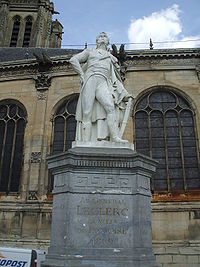 A statue at Pontoise
shows him in Napoleonic uniform, his scabbard touching the earth. It was put up by marshal Davout
and his second wife (Leclerc's sister) at the top of a staircase built in 1869 by François Lemot. Around 3m high, the statue is on a square stone pedestal inscribed with information on him in gold majuscule letters. It adjoins the south side of city's cathedral. There is also a statue of him by Jean Guillaume Moitte
in the Pantheon de Paris.
Pontoise
Pontoise is a commune in the northwestern suburbs of Paris, France. It is located from the centre of Paris, in the "new town" of Cergy-Pontoise.-Administration:...
– 2 November 1802) was a French Army
French Army
The French Army, officially the Armée de Terre , is the land-based and largest component of the French Armed Forces.As of 2010, the army employs 123,100 regulars, 18,350 part-time reservists and 7,700 Legionnaires. All soldiers are professionals, following the suspension of conscription, voted in...
general and husband to Pauline Bonaparte
Pauline Bonaparte
Pauline Bonaparte was the first sovereign Duchess of Guastalla, an imperial French Princess and the Princess consort of Sulmona and Rossano. She was the sixth child of Letizia Ramolino and Carlo Buonaparte, Corsica's representative to the court of King Louis XVI of France. Her elder brother,...
, sister to Napoleon Bonaparte
Napoleon I of France
Napoleon Bonaparte was a French military and political leader during the latter stages of the French Revolution.As Napoleon I, he was Emperor of the French from 1804 to 1815...
.
To 1801
Leclerc started his military career in 1791 during the French RevolutionFrench Revolution
The French Revolution , sometimes distinguished as the 'Great French Revolution' , was a period of radical social and political upheaval in France and Europe. The absolute monarchy that had ruled France for centuries collapsed in three years...
as one of the army volunteers of Seine-et-Oise
Seine-et-Oise
Seine-et-Oise was a département of France encompassing the western, northern, and southern parts of the metropolitan area of Paris. Its préfecture was Versailles and its official number was 78. Seine-et-Oise was abolished in 1968....
and passed through the ranks of sous-lieutenant in the 12th Cavalry, then aide-de-camp to general Lapoype
Jean François Cornu de La Poype
Jean François Cornu de La Poype was a French military leader. He was born in Lyon, to a noble, military family.- French Revolutionary Wars :...
. He was made a captain and divisional chief of staff during the siege of Toulon
Siege of Toulon
The Siege of Toulon was an early Republican victory over a Royalist rebellion in the Southern French city of Toulon. It is also often known as the Fall of Toulon.-Context:...
, at which he first allied himself to Napoleon Bonaparte
Napoleon I of France
Napoleon Bonaparte was a French military and political leader during the latter stages of the French Revolution.As Napoleon I, he was Emperor of the French from 1804 to 1815...
. Following the revolutionary success there, he campaigned along the Rhine. He began serving under Napoleon Bonaparte in the Alpine and Italian campaigns, fighting at Castiglione della Pescaia
Castiglione della Pescaia
Castiglione della Pescaia is an ancient seaside town in the province of Grosseto , Italy. The modern city grew around a medieval fortress and a large fishery, from which it got its designation...
and Rivoli
Rivoli
Rivoli may refer to:*Rivoli, Piedmont, , a town near Turin in Italy*Rivoli Veronese, a community in the Italian province of Verona*Battle of Rivoli, a battle that took place near Rivoli Veronese*The Rivoli, a restaurant/club in Toronto, Ontario, Canada...
and rising to général de brigade in 1797. He was then charged with announcing to the French Directory
French Directory
The Directory was a body of five Directors that held executive power in France following the Convention and preceding the Consulate...
the signature of the peace preliminaries at Leoben
Leoben
Leoben is a Styrian city in central Austria, located by the Mur river. With a population of about 25,000 it is a local industrial center and hosts the University of Leoben which specialises in mining...
. Pauline Bonaparte
Pauline Bonaparte
Pauline Bonaparte was the first sovereign Duchess of Guastalla, an imperial French Princess and the Princess consort of Sulmona and Rossano. She was the sixth child of Letizia Ramolino and Carlo Buonaparte, Corsica's representative to the court of King Louis XVI of France. Her elder brother,...
was at this time receiving a large number of suitors, thus pressing her brother Napoleon Bonaparte to have her married off. On Leclerc's return, he accepted Bonaparte's offer of Pauline's hand in marriage and they married in 1797, having one child, and occupying the Château de Montgobert
Château de Montgobert
The Château de Montgobert in the midst of the Forest of Retz, near Soissons, in Montgobert, Aisne, Picardy, is a neoclassical French château that was built for Antoine Pierre Desplasses between 1768-1775 on the site of an ancient seigneurie....
.
He became chef d'état-major to generals Berthier and Brune and served in the second unsuccessful French Army military expedition to Ireland led by Jean Joseph Amable Humbert
Jean Joseph Amable Humbert
General Jean Joseph Amable Humbert was a French soldier, a participant in the French Revolution, who led a failed invasion of Ireland to assist Irish rebels in 1798....
in 1798. On Bonaparte's return from the Egyptian expedition in 1798, he made Leclerc a général de division and sent him to the armée du Rhin
Armée du Rhin
The Army of the Rhine is the overall name for one of the main French Revolutionary armies, that operated in the German theater along the River Rhine...
under Moreau
Jean Victor Marie Moreau
Jean Victor Marie Moreau was a French general who helped Napoleon Bonaparte to power, but later became a rival and was banished to the United States.- Early life :Moreau was born at Morlaix in Brittany...
. At this rank Leclerc was able to participate in the coup d'etat
Coup d'état
A coup d'état state, literally: strike/blow of state)—also known as a coup, putsch, and overthrow—is the sudden, extrajudicial deposition of a government, usually by a small group of the existing state establishment—typically the military—to replace the deposed government with another body; either...
of 18 Brumaire
18 Brumaire
The coup of 18 Brumaire was the coup d'état by which General Napoleon Bonaparte overthrew the French Directory, replacing it with the French Consulate...
(in November 1799) that made his brother-in-law Napoleon First Consul of France - supported by Murat
Joachim Murat
Joachim-Napoléon Murat , Marshal of France and Grand Admiral or Admiral of France, 1st Prince Murat, was Grand Duke of Berg from 1806 to 1808 and then King of Naples from 1808 to 1815...
, he ordered the grenadiers to march into the room of the Council of Five Hundred
Council of Five Hundred
The Council of Five Hundred , or simply the Five Hundred was the lower house of the legislature of France during the period commonly known as the Directory , from 22 August 1795 until 9 November 1799, roughly the second half of the period generally referred to as the...
. He was next noted for his participation in the Rhine campaign and the battle of Hohenlinden, receiving the supreme command of the 17th, 18th and 19th military divisions. He then passed from that post to being commander-in-chief of an army corps that Napoleon meant to send to Portugal
Portugal
Portugal , officially the Portuguese Republic is a country situated in southwestern Europe on the Iberian Peninsula. Portugal is the westernmost country of Europe, and is bordered by the Atlantic Ocean to the West and South and by Spain to the North and East. The Atlantic archipelagos of the...
to force it to renounce its alliance with England, though that expedition never took place.
Saint-Domingue
His brother-in-law Napoleon I then appointed him commander of the expedition to re-establish control over the French colony of Saint-DomingueSaint-Domingue
The labour for these plantations was provided by an estimated 790,000 African slaves . Between 1764 and 1771, the average annual importation of slaves varied between 10,000-15,000; by 1786 it was about 28,000, and from 1787 onward, the colony received more than 40,000 slaves a year...
(now Haïti
Haiti
Haiti , officially the Republic of Haiti , is a Caribbean country. It occupies the western, smaller portion of the island of Hispaniola, in the Greater Antillean archipelago, which it shares with the Dominican Republic. Ayiti was the indigenous Taíno or Amerindian name for the island...
).
Slavery had been abolished in Saint-Domingue since late 1793 and general Toussaint L'Ouverture
Toussaint L'Ouverture
François-Dominique Toussaint Louverture , also Toussaint Bréda, Toussaint-Louverture was the leader of the Haitian Revolution. His military genius and political acumen led to the establishment of the independent black state of Haiti, transforming an entire society of slaves into a free,...
had created a government with constitution appointing him President for life, although he still swore loyalty to the French nation. Leclerc set off from Brest in December 1801 and landed at Cap-Français
Cap-Haïtien
Cap-Haïtien is a city of about 190,000 people on the north coast of Haiti and capital of the Department of Nord...
in February 1802, with other warships and a total of 40,000 troops, publicly repeating Bonaparte's promise that "all of the people of Saint-Domingue are French" and forever free. L'Ouverture's harsh discipline had made him numerous enemies and Leclerc played off the ambitions of L'Ouverture's younger key officers and competitors against each other, promising that they would maintain their ranks in the French Army and thus bringing them to abandon L'Ouverture. The French won several victories and regained control in three months after severe fighting, with L'Ouverture forced to negotiate an honorable surrender and retire to tend his plantations under house arrest. However, Napoleon's secret instructions to Leclerc were to arrest Toussaint L'Ouverture and so Leclerc seized L'Ouverture during a meeting for deportation to France, where he died while imprisoned at Fort-de-Joux in the Jura mountains
Jura mountains
The Jura Mountains are a small mountain range located north of the Alps, separating the Rhine and Rhone rivers and forming part of the watershed of each...
in 1803.
Despite his superiors' warnings, Leclerc did not consolidate his victory by disarming L'Ouverture's old officers and they and the black and Creole population rose up again when news reached the island of the reestablishment of slavery on Guadeloupe
Guadeloupe
Guadeloupe is an archipelago located in the Leeward Islands, in the Lesser Antilles, with a land area of 1,628 square kilometres and a population of 400,000. It is the first overseas region of France, consisting of a single overseas department. As with the other overseas departments, Guadeloupe...
, bringing the prospect of a similar restoration on Saint-Domingue and swinging the tide inexorably against French hopes for reimposing control. Leclerc's reports to France about his counter-insurgency campaign included such statements as, "Since terror is the sole resource left me, I employ it", and, "We must destroy all the mountain negroes, men and women, sparing only children under twelve years of age. We must destroy half the negroes of the plains..." He faced the new organised and powerful insurrection but fell victim to the yellow fever
Yellow fever
Yellow fever is an acute viral hemorrhagic disease. The virus is a 40 to 50 nm enveloped RNA virus with positive sense of the Flaviviridae family....
which effectively destroyed the French army.
He was succeeded in command by General Rochambeau, whose brutal racial warfare drew more leaders back to the rebel armies, including black and mulatto
Mulatto
Mulatto denotes a person with one white parent and one black parent, or more broadly, a person of mixed black and white ancestry. Contemporary usage of the term varies greatly, and the broader sense of the term makes its application rather subjective, as not all people of mixed white and black...
army officers Jean Jacques Dessalines, Alexandre Pétion
Alexandre Pétion
Alexandre Sabès Pétion was President of the Republic of Haiti from 1806 until his death. He is considered as one of Haiti's founding fathers, together with Toussaint Louverture, Jean-Jacques Dessalines, and his rival Henri Christophe.-Early life:Pétion was born in Port-au-Prince to a Haitian...
and Henri Christophe
Henri Christophe
Henri Christophe was a key leader in the Haitian Revolution, winning independence from France in 1804. On 17 February 1807, after the creation of a separate nation in the north, Christophe was elected President of the State of Haiti...
. On 18 November 1803, François Capois
François Capois
François Capois was a Haitian rebel slave.He was born in Port-de-Paix on the habitation of Laveaux/lapointe. His name was a transformation of the name cappouet, owner of the habitation. His military career began in 1793 after a visit of Toussaint Louverture at Port-de-Paix...
defeated Rochambeau's forces in the Battle of Vertières
Battle of Vertières
The Battle of Vertières , the last major battle of the Second War of Haitian Independence, the final part of the Haitian Revolution under François Capois. It was fought between Haitian rebels and French expeditionary forces on 18 November 1803 at Vertières...
. Dessalines proclaimed the independence of Haïti and its new name on 1 January 1804. In the meantime Leclerc's body had been transported to France by his widow and buried on one of his estates.
Memorials
Pontoise
Pontoise is a commune in the northwestern suburbs of Paris, France. It is located from the centre of Paris, in the "new town" of Cergy-Pontoise.-Administration:...
shows him in Napoleonic uniform, his scabbard touching the earth. It was put up by marshal Davout
Louis Nicolas Davout
Louis-Nicolas d'Avout , better known as Davout, 1st Duke of Auerstaedt, 1st Prince of Eckmühl, was a Marshal of France during the Napoleonic Era. His prodigious talent for war along with his reputation as a stern disciplinarian, earned him the title "The Iron Marshal"...
and his second wife (Leclerc's sister) at the top of a staircase built in 1869 by François Lemot. Around 3m high, the statue is on a square stone pedestal inscribed with information on him in gold majuscule letters. It adjoins the south side of city's cathedral. There is also a statue of him by Jean Guillaume Moitte
Jean Guillaume Moitte
- Life :Moitte was the sculptor of Pigalle then Jean-Baptiste Lemoyne. He won the Prix de Rome for sculpture in 1768 with David carrying the head of Goliath in triumph...
in the Pantheon de Paris.
External links
- The Louverture Project: Charles Victor Emmanuel Leclerc
- Bob Corbett's Haiti Page – Online collection of resources on the revolution in Haiti. See especially links to the HaitiHaitiHaiti , officially the Republic of Haiti , is a Caribbean country. It occupies the western, smaller portion of the island of Hispaniola, in the Greater Antillean archipelago, which it shares with the Dominican Republic. Ayiti was the indigenous Taíno or Amerindian name for the island...
Mailing List and Corbett’s essays on the revolutionary period.