
All Topics  
Molasses


   Email Print
   Bookmark   Link


Molasses


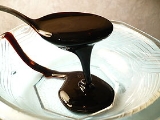
Molasses is a thick by-product from the processing of the sugar beet
Sugar beet

Sugar beet , a member of the Chenopodiaceae family, is a plant whose root contains a high concentration of sucrose. It is grown commercially for sugar production....
 or sugar cane into sugar
Sugar

Sugar is a class of edible crystalline substances, mainly sucrose, lactose, and fructose. Human taste buds interpret its flavor as sweet. Sugar as a basic food carbohydrate primarily comes from sugar cane and from sugar beet, but also appears in fruit, honey, sorghum, sugar maple , and in many other sources....
. (In some parts of the US, molasses also refers to syrup
Syrup

In cooking, a syrup is a thick, viscous liquid, containing a large amount of dissolved sugars, but showing little tendency to deposit crystals....
.) The word molasses comes from the Portuguese
Portuguese language

Portuguese is a Romance language that originated in what is now Galicia and Portugal. It is derived from the Latin language spoken by the Romanization Pre-Roman peoples of the Iberian Peninsula around 2000 years ago....
 word melaço, which comes from "meli", the Greek word for "honey
Honey

Honey is a sweet fluid produced by honey bees , and derived from the nectar of flowers. According to the United States National Honey Board and various international food regulations, "honey stipulates a pure product that does not allow for the addition of any other substance?this includes, but is not limited to, water or other sweeteners...
". The quality of molasses depends on the maturity of the sugar cane or beet, the amount of sugar extracted, and the method of extraction.


Nutrition Facts


Discussion
Ask a question about 'Molasses'
Start a new discussion about 'Molasses'
Answer questions from other users
Full Discussion Forum


Recent Posts


Encyclopedia


Molasses is a thick by-product from the processing of the sugar beet
Sugar beet

Sugar beet , a member of the Chenopodiaceae family, is a plant whose root contains a high concentration of sucrose. It is grown commercially for sugar production....
 or sugar cane into sugar
Sugar

Sugar is a class of edible crystalline substances, mainly sucrose, lactose, and fructose. Human taste buds interpret its flavor as sweet. Sugar as a basic food carbohydrate primarily comes from sugar cane and from sugar beet, but also appears in fruit, honey, sorghum, sugar maple , and in many other sources....
. (In some parts of the US, molasses also refers to syrup
Syrup

In cooking, a syrup is a thick, viscous liquid, containing a large amount of dissolved sugars, but showing little tendency to deposit crystals....
.) The word molasses comes from the Portuguese
Portuguese language

Portuguese is a Romance language that originated in what is now Galicia and Portugal. It is derived from the Latin language spoken by the Romanization Pre-Roman peoples of the Iberian Peninsula around 2000 years ago....
 word melaço, which comes from "meli", the Greek word for "honey
Honey

Honey is a sweet fluid produced by honey bees , and derived from the nectar of flowers. According to the United States National Honey Board and various international food regulations, "honey stipulates a pure product that does not allow for the addition of any other substance?this includes, but is not limited to, water or other sweeteners...
". The quality of molasses depends on the maturity of the sugar cane or beet, the amount of sugar extracted, and the method of extraction. Sweet Sorghum
Sweet sorghum

Sweet sorghum is any of the many varieties of sorghum which have a high sugar content. Sweet sorghum will thrive under drier and warmer conditions than many other crops and is grown primarily for Fodder, silage, and sugar production....
 syrup is known as molasses in some parts of the U.S., though it is not true molasses.

Cane molasses

Sulphured molasses is made from young sugar cane and sulphur dioxide, which acts as a preservative, is added during the sugar extraction process. Unsulphured molasses is made from mature sugar cane and does not require treatment with sulphur during the extraction process. There are three grades of molasses, Mild or first molasses, Dark or second molasses, and Blackstrap. These grades may be sulphured or unsulphured.

To make molasses, which is pure sugar cane juice, the sugar cane plant is harvested and stripped of its leaves. Its juice is extracted from the canes, usually by crushing or mashing; it can also be removed by cutting. The juice is boiled to concentrate, which promotes the crystallization of the sugar
Sugar

Sugar is a class of edible crystalline substances, mainly sucrose, lactose, and fructose. Human taste buds interpret its flavor as sweet. Sugar as a basic food carbohydrate primarily comes from sugar cane and from sugar beet, but also appears in fruit, honey, sorghum, sugar maple , and in many other sources....
. The results of this first boiling and removal of sugar crystal is first molasses, which has the highest sugar content because comparatively little sugar has been extracted from the source. Second molasses is created from a second boiling and sugar extraction, and has a slight bitter tinge to its taste.

The third boiling of the sugar syrup gives blackstrap molasses. The majority of sucrose from the original juice has been crystallized but black strap molasses is still mostly sugar by calories; however, unlike refined sugars, it contains significant amounts of vitamin
Vitamin

A vitamin is an organic compound required as a nutrient in tiny amounts by an organism. A compound is called a vitamin when it cannot be biosynthesis in sufficient quantities by an organism, and must be obtained from the diet....
s and mineral
Mineral

A mineral is a naturally occurring solid formed through Geology processes that has a characteristic chemical composition, a highly ordered atomic structure, and specific physical properties....
s. Blackstrap molasses is a source of calcium
Calcium

Calcium is the chemical element with the symbol Ca and atomic number 20. It has an atomic mass of 40.078 amu. Calcium is a soft grey alkaline earth metal, and is the fifth most abundant element by mass in the earth's Crust ....
, magnesium
Magnesium

Magnesium is a chemical element with the symbol Mg, atomic number 12, atomic weight 24.3050 and common oxidation number +2.Magnesium, an alkaline earth metal, is the ninth most abundance of the chemical elements in the universe by mass....
, potassium
Potassium

Potassium is a chemical element. It has the symbol K , atomic number 19, and atomic mass 39.0983. Potassium was first isolated from potash, hence the name....
 and iron
Iron

Iron is a chemical element with the symbol Fe and atomic number 26. Iron is a Group 8 element and period 4 element. Iron is lustrous and silvery in color....
. One tablespoon provides up to 20 percent of the daily value of each of those nutrients. Black strap is often sold as a health supplement, as well as being used in the manufacture of cattle
Cattle

Cattle, colloquially referred to as cows, are domestication ungulates, a member of the subfamily Bovinae of the family Bovidae. They are raised as livestock for meat , dairy products , leather and as draft animals ....
 feed, and for other industrial uses.

Sugar beet molasses

Molasses that comes from the sugar beet
Sugar beet

Sugar beet , a member of the Chenopodiaceae family, is a plant whose root contains a high concentration of sucrose. It is grown commercially for sugar production....
 is different from cane molasses. Only the syrup left from the final crystal
Crystal

A crystal or crystalline solid is a solid material whose constituent atoms, molecules, or ions are arranged in an orderly repeating pattern extending in all three spatial dimensions....
lization stage is called molasses; intermediate syrups are referred to as high green and low green and these are recycled within the crystallization plant to maximize extraction. Beet molasses is about 50% sugar by dry weight, predominantly sucrose
Sucrose

Sucrose is a disaccharide of glucose and fructose, with the molecular formula C12H22O11. Its systematic name is a-D-glucopyranosyl- -?-D-fructofuranoside ....
 but also containing significant amounts of glucose
Glucose

Glucose , a monosaccharide also known as grape sugar, blood sugar, or corn sugar, is a very important carbohydrate in biology....
 and fructose
Fructose

Fructose is a simple Reducing sugar sugar found in many foods and is one of the three important dietary monosaccharides along with glucose and galactose....
. Beet molasses is limited in biotin
Biotin

Biotin, also known as vitamin H or B7, has the chemical formula C10H16N2O3S , is a water-soluble B-complex vitamin which is composed of an ureido ring fused with a tetrahydrothiophene ring....
 (Vitamin H or B7) for cell growth, hence it may need to be supplemented with a biotin source. The non-sugar content includes many salts such as calcium
Calcium

Calcium is the chemical element with the symbol Ca and atomic number 20. It has an atomic mass of 40.078 amu. Calcium is a soft grey alkaline earth metal, and is the fifth most abundant element by mass in the earth's Crust ....
, potassium
Potassium

Potassium is a chemical element. It has the symbol K , atomic number 19, and atomic mass 39.0983. Potassium was first isolated from potash, hence the name....
, oxalate
Oxalate

An oxalate is the deprotonated, charged form of oxalic acid or an ester of oxalic acid. As a salt, the oxalate anion has the chemical formula C2O42- or 22-....
, and chloride
Chloride

The chloride ion is formed when the chemical element chlorine picks up one electron to form an anion Cl−....
. These are either as a result of concentration from the original plant material or as a result of chemicals used in the processing. As such, it is unpalatable and is mainly used as an additive to animal feed (called "molassed sugar beet feed") or as a fermentation feedstock.

It is possible to extract additional sugar from beet molasses through a process known as molasses desugarisation. This technique exploits industrial scale chromatography
Chromatography

Chromatography is the collective term for a family of laboratory techniques for the separation of mixtures. It involves passing a mixture dissolved in a "mobile phase" through a stationary phase, which separates the analyte to be measured from other molecules in the mixture and allows it to be isolated....
 to separate sucrose from non-sugar components. The technique is economically viable in trade protected areas where the price of sugar is supported above the world market price. As such it is practiced in the U.S. and parts of Europe
Europe

Europe is, conventionally, one of the world's seven continents. Comprising the westernmost peninsula of Eurasia, Europe is generally divided from Asia to its east by the water divide of the Ural Mountains, the Ural , the Caspian Sea, and by the Caucasus Mountains to the southeast....
. Molasses is used for yeast
Baker's yeast

Baker's yeast is the common name for the strains of yeast commonly used as a leavening agent in baking bread and related products, where it converts the fermentation sugars present in the dough into carbon dioxide and ethanol....
 production.

Substitutes

Cane molasses is a common ingredient in baking
Baking

Baking is the technique of prolonged cooking of food by dry heat acting by Heat convection, and not by Thermal radiation, normally in an oven, but also in hot ashes, or on hot stones....
, often used in baked goods such as gingerbread
Gingerbread

Gingerbread is a sweet that can take the form of a cake or a cookie in which the predominant flavors are ginger root and raw sugar....
 cookie
Cookie

In the United States and Canada, a cookie is a small, flat-baked treat, containing milk, flour, eggs, and sugar, etc. In most English-speaking countries outside North America, the most common word for this is biscuit; in many regions both terms are used, while in others the two words have different meanings?a cookie is a plain bu...
s. There are a number of substitutions that can be made for molasses; for a cup
Cup (unit)

The cup is a Units of measurement for volume, used in cooking to measure bulk foods, such as granulated sugar , and liquids . It is in common use in the United States and nations influenced by them, such as Japan....
 of molasses the following may be used (with varying degrees of success): 1 cup honey, or ¾ cup firmly packed brown sugar
Brown sugar

Brown sugar is a sucrose sugar product with a distinctive brown color due to the presence of molasses. It is either an unrefined or partially refined soft sugar consisting of sugar crystals with some residual molasses content or produced by the addition of molasses to refined white sugar....
, or 1 cup dark corn syrup
Corn syrup

Corn syrup is a syrup, made using cornstarch as a feedstock, and composed mainly of glucose. A series of two enzyme reactions are used to convert the cornstarch to corn syrup....
, 1 cup granulated sugar with 1/4 cup water, or 1 cup pure maple syrup
Maple syrup

Maple syrup is a sweetener made from the sap of maple trees. In Canada and the United States it is most often eaten with waffles and pancakes. It is sometimes used as an ingredient in baking, the making of candy, preparing desserts, or as a sugar source and flavoring agent in making beer....
.

Other forms

In the cuisines of the Middle East
Middle Eastern cuisine

Middle Eastern cuisine is the cuisine of the various countries and peoples of the Middle East. The cuisine of the region is diverse while having a degree of homogeneity....
, molasses is produced from several other materials: carob, grape
Grape

File:Table grapes on white.jpgA grape is the non-Climacteric #In_botany fruit that grows on the Perennial plant and deciduous woody vines of the genus Vitis....
, date
Date Palm

Phoenix dactylifera, commonly known as the Date Palm, is a Arecaceae in the genus Phoenix , extensively cultivated for its edible sweet fruit....
, pomegranate
Pomegranate

The pomegranate is a fruit-bearing deciduous shrub or small tree growing to between five and eight metres tall. The pomegranate is native to the region from Iran to the Himalayas in northern India and has been cultivated and naturalized over the whole Mediterranean Basin region and the Caucasus since ancient times....
, and mulberry
Mulberry

Morus or Mulberry is a genus of 10?16 species of deciduous trees native to warm, temperate, and subtropical regions of Asia, Africa, Europe, and the Americas, with the majority of the species native to Asia....
.

Non-culinary uses

Because of its unusual properties, molasses has several uses beyond that of a straightforward food additive. It can be used as a chelating
Chelation

Chelation is the binding or complex of a bi- or multidentate ligand. These ligands, which are often organic compounds, are called chelants, chelators, chelating agents, or sequestration....
 agent to remove rust, as the base material for fermentation into rum, as the carbon
Carbon

Carbon is a chemical element with chemical symbol C and atomic number 6. As a member of group 14 on the periodic table, it is nonmetallic and tetravalence?making four electrons available to form covalent bond chemical bonds....
 source for in situ
In situ

In situ is a Latin phrase meaning in the place. It is used in many different contexts....
 remediation
Remediation

Generally, remediation means providing a remedy, so environmental remediation deals with the removal of pollution or contaminants from Natural environment media such as soil, groundwater, sediment, or surface water for the general protection of human health and the environment or from a brownfield land intended for redevelopment....
 of chlorinated hydrocarbons, and it can be used as a minor component of mortar for brickwork.

In Australia
Australia

Australia, officially the Commonwealth of Australia, is a country in the southern hemisphere comprising the Australia of the world's smallest continent, the major island of Tasmania, and numerous list of islands of Australia in the Indian Ocean and Pacific Oceans....
, molasses is fermented
Ethanol fermentation

Ethanol fermentation is the biological process by which sugars such as glucose, fructose, and sucrose are converted into cellular energy and thereby producing ethanol and carbon dioxide as metabolic waste products....
 to produce ethanol
Ethanol

Ethanol, also called ethyl alcohol, pure alcohol, grain alcohol, or drinking alcohol, is a volatility , flammable, colorless liquid....
 for use as an alternative fuel
Ethanol fuel

Ethanol fuel is ethanol , the same type of alcohol found in alcoholic beverages. It can be used as a fuel, mainly as a biofuel alternative to gasoline, and is widely used in cars in Ethanol fuel in Brazil....
 in motor vehicles, and is used to treat burns.

Molasses is also used in some brands of tobacco used for smoking through a middle eastern water pipe (i.e. hookah, shisha, narghile, etc). It is mixed into the tobacco along with glycerine and flavorings; sometimes it is used along with honey and other syrups or fully substituted by them. Brands that use molasses include Al Fakher and Tangiers along with others.

Molasses is also used in fishing groundbait
Groundbait

Groundbait is used in coarse fishing in order to attract fish to the fishing area. It's a mixture of various natural ingredients, for example bread crumbs, vanilla sugar, hemp, maize and other ingredients, and moistened with water so it's possible to make balls....
.

Molasses can also be added to the soil of almost every plant to help promote microbial activity.

See also

  • Boston Molasses Disaster
    Boston molasses disaster

    The Boston Molasses Disaster, also known as the Great Molasses Flood and the Great Boston Molasses Tragedy, occurred on January 15, 1919, in the North End, Boston neighborhood of Boston, Massachusetts, Massachusetts in the United States....
  • Molasses Gang
    Molasses Gang

    The Molasses Gang was a New York street gang during the 1870s.Formed in 1871 by Jimmy Dunnigan, the Molasses Gang were primarily made up of sneak thieves and minor criminals who were highly publicized in the New York press for the comedic methods of their robberies....
  • Pekmez
    Pekmez

    Pekmez or dibs is amolasses-like syrup obtained after condensing juices of fruit must, especially grape, fig or mulberry, by boiling with coagulant agents....
  • Sweet sorghum
    Sweet sorghum

    Sweet sorghum is any of the many varieties of sorghum which have a high sugar content. Sweet sorghum will thrive under drier and warmer conditions than many other crops and is grown primarily for Fodder, silage, and sugar production....
  • Treacle mining
    Treacle mining

    Treacle mining is the mining of treacle in a raw form similar to coal. The subject purports to be a serious topic but is in fact an attempt to test the credulity of the reader....
  • Rum
    Rûm

    R?m, also Roum or Rhum , is a very indefinite term used at different times in the Muslim world to refer to the Balkans and Anatolia generally, and for the Byzantine Empire in particular, for the Seljuk Sultanate of R?m in Asia Minor, and for Greeks inhabiting Ottoman Empire or modern Turkey territory as well as for Greek Cypriots....
  • Shoofly pie
    Shoofly pie

    Shoofly pie is a molasses pie considered traditional among the Pennsylvania Dutch and also known in Cuisine of the Southern United States.The term "shoo-fly pie" first appeared in print in 1926....


External links