


Stellarator

Encyclopedia
A stellarator is a device used to confine a hot plasma
with magnetic fields in order to sustain a controlled nuclear fusion
reaction. It is one of the earliest controlled fusion devices, first invented by Lyman Spitzer
in 1950 and built the next year at what later became the Princeton Plasma Physics Laboratory
. The name refers to the possibility of harnessing the power source of the sun, a stellar
object.
Stellarators were popular in the 1950s and 60s, but the much better results from tokamak
designs led to them falling from favor in the 1970s. More recently, in the 1990s, problems with the tokamak concept has led to renewed interest in the stellarator design, and a number of new devices have been built. Some important modern stellarator experiments are Wendelstein 7-X
, in Germany
, and the Large Helical Device
, in Japan
. Princeton Plasma Physics Laboratory
started building a new stellarator, NCSX, but as of 2008, work was abandoned http://www.princeton.edu/main/news/archive/S21/15/04A97/index.xml?section=topstories due to high costs.
devices being studied primarily in the UK, and devices that used lower densities but longer confinement times, like the magnetic mirror
and stellarator. In the later systems, the key problem was confining the plasma for long times without the hottest, most valuable, particles escaping from the device.
As plasma is electrically charged, and thus magnetic, it can be confined by an appropriate arrangement of magnetic fields. The simplest to understand is a solenoid
, consisting of a helix of wire wrapped around a cylindrical support. A plasma inside the solenoid will experience an inward force that would confine it in the center of the helix. However, in this case the plasma would see no force along the long axis, and would rapidly flow out the ends of the solenoid and escape.
One solution to that problem is to simply bend the solenoid around into a ring, closing the ends. However in this case the magnetic field is no longer uniform. The electrical windings on the inside edge of the toroid are closer together, and further apart on the outside edge. This leads to a weaker field on the outside than the inside. A particle circulating the torus at the exact center of the torus will see a balanced force, but one circulating closer to the inside edge will see a downward force, while one circulating closer to the outside will see an upward force. These particles will eventually drift out of the confinement area.
Spitzer's innovation was a change in geometry. He suggested extending the torus with straight sections to form a racetrack shape, and then twisting one end by 180 degrees to produce a figure-8 shaped device. When a particle is on the outside of the center on one of the curved sections, by the time it flows through the straight area and into the other curved section it is now on the inside of center. This means that the upward drift on one side is counteracted by the downward drift on the other.
To allow the tubes to cross without hitting, the torus sections on either end were rotated slightly, so the ends were not aligned with each other. This arrangement was less than perfect, as a particle on the inner portion at one end would not end up at the outer portion at the other, but at some other point rotated from the perfect location due to the tilt of the two ends. As a result, the stellarator is not "perfect" in terms of canceling out the drift, but the net result is to so greatly reduce drift that long confinement times appeared possible.
In a more general sense, the stellarator design aims to use regions with differing magnetic fields to cancel out the net forces over the torus as a whole. As the plasma particles circulate the system, these changing fields cancel out the net drift. Spitzer's concept used the mechanical arrangement of the confinement area to achieve this goal, while more modern systems use a variety of mechanical shapes or magnets to the same end. A common arrangement uses a series of coils arranged in a helix around the toroid, creating an electrical analog of the mechanical layout.
. It can also have the continuous coils replaced by a number of discrete coils producing a similar field.
Heliotron: A stellarator configuration in which a helical coil is used to confine the plasma, together with a pair of PF coils to provide a vertical field. TF coils can also be used to control the magnetic surface cha racteristics.
Heliac: (Literally) helical axis stellarator; a stellarator in which the magnetic axis (and plasma) follows a helical path to form a toroidal helix rather than a simple ring shape. The twisted plasma induces twist in the magnetic field lines to effect drift cancellation, and typically can provide more twist than the Torsatron or Heliotron, especially near the centre of the plasma (magnetic axis). The original Heliac consists only of circular coils, and the flexible heliac (H-1NF
, TJ-II, TU-Heliac) adds a small helical coil to allow the twist to be varied by a factor of up to 2.
Helias: for (helical advanced stellarator). A stellarator configuration utilizing an optimized modular coil set designed to simultaneously achieve high plasma, low Pfirsch-Schluter currents and good confinement of energetic particles; i.e., alpha particles for reactor scenarios. The Helias has been proposed to be the most promising stellarator concept for a power plant, with a modular engineering design and optimised plasma, MHD and magnetic field properties. The Wendelstein VII-X device is based on a five field-period Helias configuration.
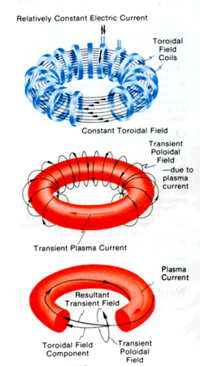 The tokamak provides the required twist to the magnetic field lines not by manipulating the field with external currents, but by driving a current through the plasma itself. The field lines around the plasma current combine with the toroidal field to produce helical field lines, which wrap around the torus in both directions.
Although they also have a toroidal magnetic field topology, stellarators are distinct from tokamaks in that they are not azimuthally symmetric. They have instead a discrete rotational symmetry, often fivefold, like a regular pentagon.
It is generally argued that the development of stellarators is less advanced than tokamaks although the intrinsic stability they provide has been sufficient to pursue an active development of this concept.
The three-dimensional nature of the field, the plasma, and the vessel make it much more difficult to do either theoretical or experimental diagnostics with stellarators. It is much harder to design a divertor (the section of the wall that receives the exhaust power from the plasma) in a stellarator, the out-of-plane magnetic coils (common in many modern stellarators and possibly all future ones) are much harder to manufacture than the simple, planar coils which suffice for a tokamak, and the utilization of the magnetic field volume and strength is generally poorer than in tokamaks.
However, stellarators, unlike tokamaks, do not require a toroidal current, so that the expense and complexity of current drive and/or the loss of availability and periodic stresses of pulsed operation can be avoided, and there is no risk of toroidal current disruptions. It might be possible to use these additional degrees of design freedom to optimize a stellarator in ways that are not possible with tokamaks.
. These particles will not be able to average the magnetic properties so effectively, which will result in increased energy transport. In most stellarators, these changes in field strength are greater than in tokamaks, which is a major reason that transport in stellarators tends to be higher than in tokamaks.
University of Wisconsin electrical engineering Professor David Anderson and research assistant John Canik recently proved that the Helically Symmetric eXperiment
(HSX) can overcome this major barrier in plasma research. The HSX is the first stellarator to use a quasi-symmetric magnetic field. The team designed and built the HSX with the prediction that quasisymmetry would reduce transport. As the team's latest research shows, that's exactly what it does. "This is the first demonstration that quasisymmetry works, and you can actually measure the reduction in transport that you get," says Canik.
Plasma (physics)
In physics and chemistry, plasma is a state of matter similar to gas in which a certain portion of the particles are ionized. Heating a gas may ionize its molecules or atoms , thus turning it into a plasma, which contains charged particles: positive ions and negative electrons or ions...
with magnetic fields in order to sustain a controlled nuclear fusion
Nuclear fusion
Nuclear fusion is the process by which two or more atomic nuclei join together, or "fuse", to form a single heavier nucleus. This is usually accompanied by the release or absorption of large quantities of energy...
reaction. It is one of the earliest controlled fusion devices, first invented by Lyman Spitzer
Lyman Spitzer
Lyman Strong Spitzer, Jr. was an American theoretical physicist and astronomer best known for his research in star formation, plasma physics, and in 1946, for conceiving the idea of telescopes operating in outer space...
in 1950 and built the next year at what later became the Princeton Plasma Physics Laboratory
Princeton Plasma Physics Laboratory
Princeton Plasma Physics Laboratory is a United States Department of Energy national laboratory for plasma physics and nuclear fusion science located on Princeton University's Forrestal Campus in Plainsboro Township, New Jersey. Its primary mission is research into and development of fusion as an...
. The name refers to the possibility of harnessing the power source of the sun, a stellar
Star
A star is a massive, luminous sphere of plasma held together by gravity. At the end of its lifetime, a star can also contain a proportion of degenerate matter. The nearest star to Earth is the Sun, which is the source of most of the energy on Earth...
object.
Stellarators were popular in the 1950s and 60s, but the much better results from tokamak
Tokamak
A tokamak is a device using a magnetic field to confine a plasma in the shape of a torus . Achieving a stable plasma equilibrium requires magnetic field lines that move around the torus in a helical shape...
designs led to them falling from favor in the 1970s. More recently, in the 1990s, problems with the tokamak concept has led to renewed interest in the stellarator design, and a number of new devices have been built. Some important modern stellarator experiments are Wendelstein 7-X
Wendelstein 7-X
Wendelstein 7-X is an experimental stellarator currently being built in Greifswald, Germany by the Max-Planck-Institut für Plasmaphysik , which will be completed by 2015. It is a further development of Wendelstein 7-AS...
, in Germany
Germany
Germany , officially the Federal Republic of Germany , is a federal parliamentary republic in Europe. The country consists of 16 states while the capital and largest city is Berlin. Germany covers an area of 357,021 km2 and has a largely temperate seasonal climate...
, and the Large Helical Device
Large Helical Device
The is a fusion research device in Toki, Gifu, Japan and is the largest superconducting stellarator in the world, employing a heliotron magnetic field originally developed in Japan. The objective of the project is to conduct fusion plasma confinement research in a steady state in order to elucidate...
, in Japan
Japan
Japan is an island nation in East Asia. Located in the Pacific Ocean, it lies to the east of the Sea of Japan, China, North Korea, South Korea and Russia, stretching from the Sea of Okhotsk in the north to the East China Sea and Taiwan in the south...
. Princeton Plasma Physics Laboratory
Princeton Plasma Physics Laboratory
Princeton Plasma Physics Laboratory is a United States Department of Energy national laboratory for plasma physics and nuclear fusion science located on Princeton University's Forrestal Campus in Plainsboro Township, New Jersey. Its primary mission is research into and development of fusion as an...
started building a new stellarator, NCSX, but as of 2008, work was abandoned http://www.princeton.edu/main/news/archive/S21/15/04A97/index.xml?section=topstories due to high costs.
Description
Early fusion research generally followed two major lines of study; devices that were based on momentary compression of the fusion fuel to high densities, like the pinchPinch (plasma physics)
A pinch is the compression of an electrically conducting filament by magnetic forces. The conductor is usually a plasma, but could also be a solid or liquid metal...
devices being studied primarily in the UK, and devices that used lower densities but longer confinement times, like the magnetic mirror
Magnetic mirror
A magnetic mirror is a magnetic field configuration where the field strength changes when moving along a field line. The mirror effect results in a tendency for charged particles to bounce back from the high field region....
and stellarator. In the later systems, the key problem was confining the plasma for long times without the hottest, most valuable, particles escaping from the device.
As plasma is electrically charged, and thus magnetic, it can be confined by an appropriate arrangement of magnetic fields. The simplest to understand is a solenoid
Solenoid
A solenoid is a coil wound into a tightly packed helix. In physics, the term solenoid refers to a long, thin loop of wire, often wrapped around a metallic core, which produces a magnetic field when an electric current is passed through it. Solenoids are important because they can create...
, consisting of a helix of wire wrapped around a cylindrical support. A plasma inside the solenoid will experience an inward force that would confine it in the center of the helix. However, in this case the plasma would see no force along the long axis, and would rapidly flow out the ends of the solenoid and escape.
One solution to that problem is to simply bend the solenoid around into a ring, closing the ends. However in this case the magnetic field is no longer uniform. The electrical windings on the inside edge of the toroid are closer together, and further apart on the outside edge. This leads to a weaker field on the outside than the inside. A particle circulating the torus at the exact center of the torus will see a balanced force, but one circulating closer to the inside edge will see a downward force, while one circulating closer to the outside will see an upward force. These particles will eventually drift out of the confinement area.
Spitzer's innovation was a change in geometry. He suggested extending the torus with straight sections to form a racetrack shape, and then twisting one end by 180 degrees to produce a figure-8 shaped device. When a particle is on the outside of the center on one of the curved sections, by the time it flows through the straight area and into the other curved section it is now on the inside of center. This means that the upward drift on one side is counteracted by the downward drift on the other.
To allow the tubes to cross without hitting, the torus sections on either end were rotated slightly, so the ends were not aligned with each other. This arrangement was less than perfect, as a particle on the inner portion at one end would not end up at the outer portion at the other, but at some other point rotated from the perfect location due to the tilt of the two ends. As a result, the stellarator is not "perfect" in terms of canceling out the drift, but the net result is to so greatly reduce drift that long confinement times appeared possible.
In a more general sense, the stellarator design aims to use regions with differing magnetic fields to cancel out the net forces over the torus as a whole. As the plasma particles circulate the system, these changing fields cancel out the net drift. Spitzer's concept used the mechanical arrangement of the confinement area to achieve this goal, while more modern systems use a variety of mechanical shapes or magnets to the same end. A common arrangement uses a series of coils arranged in a helix around the toroid, creating an electrical analog of the mechanical layout.
Configurations of stellarator
Torsatron: A stellarator configuration with continuous helical coilsHelix
A helix is a type of smooth space curve, i.e. a curve in three-dimensional space. It has the property that the tangent line at any point makes a constant angle with a fixed line called the axis. Examples of helixes are coil springs and the handrails of spiral staircases. A "filled-in" helix – for...
. It can also have the continuous coils replaced by a number of discrete coils producing a similar field.
Heliotron: A stellarator configuration in which a helical coil is used to confine the plasma, together with a pair of PF coils to provide a vertical field. TF coils can also be used to control the magnetic surface cha racteristics.
Heliac: (Literally) helical axis stellarator; a stellarator in which the magnetic axis (and plasma) follows a helical path to form a toroidal helix rather than a simple ring shape. The twisted plasma induces twist in the magnetic field lines to effect drift cancellation, and typically can provide more twist than the Torsatron or Heliotron, especially near the centre of the plasma (magnetic axis). The original Heliac consists only of circular coils, and the flexible heliac (H-1NF
H-1NF
The H-1 flexible Heliac is a three field-period helical axis stellarator located in the Research School of Physics and Engineering at the Australian National University...
, TJ-II, TU-Heliac) adds a small helical coil to allow the twist to be varied by a factor of up to 2.
Helias: for (helical advanced stellarator). A stellarator configuration utilizing an optimized modular coil set designed to simultaneously achieve high plasma, low Pfirsch-Schluter currents and good confinement of energetic particles; i.e., alpha particles for reactor scenarios. The Helias has been proposed to be the most promising stellarator concept for a power plant, with a modular engineering design and optimised plasma, MHD and magnetic field properties. The Wendelstein VII-X device is based on a five field-period Helias configuration.
Comparison to tokamaks
Although they also have a toroidal magnetic field topology, stellarators are distinct from tokamaks in that they are not azimuthally symmetric. They have instead a discrete rotational symmetry, often fivefold, like a regular pentagon.
It is generally argued that the development of stellarators is less advanced than tokamaks although the intrinsic stability they provide has been sufficient to pursue an active development of this concept.
The three-dimensional nature of the field, the plasma, and the vessel make it much more difficult to do either theoretical or experimental diagnostics with stellarators. It is much harder to design a divertor (the section of the wall that receives the exhaust power from the plasma) in a stellarator, the out-of-plane magnetic coils (common in many modern stellarators and possibly all future ones) are much harder to manufacture than the simple, planar coils which suffice for a tokamak, and the utilization of the magnetic field volume and strength is generally poorer than in tokamaks.
However, stellarators, unlike tokamaks, do not require a toroidal current, so that the expense and complexity of current drive and/or the loss of availability and periodic stresses of pulsed operation can be avoided, and there is no risk of toroidal current disruptions. It might be possible to use these additional degrees of design freedom to optimize a stellarator in ways that are not possible with tokamaks.
Recent results
The goal of magnetic confinement devices is to transport energy slowly across a magnetic field. Toroidal devices are relatively successful because the magnetic properties seen by the particles are averaged as they travel around the torus. The strength of the field seen by a particle, however, generally varies, so that some particles will be trapped by the mirror effectMagnetic mirror
A magnetic mirror is a magnetic field configuration where the field strength changes when moving along a field line. The mirror effect results in a tendency for charged particles to bounce back from the high field region....
. These particles will not be able to average the magnetic properties so effectively, which will result in increased energy transport. In most stellarators, these changes in field strength are greater than in tokamaks, which is a major reason that transport in stellarators tends to be higher than in tokamaks.
University of Wisconsin electrical engineering Professor David Anderson and research assistant John Canik recently proved that the Helically Symmetric eXperiment
Helically Symmetric Experiment
The Helically Symmetric eXperiment is an experimental plasma confinement device at the University of Wisconsin-Madison, whose design principles are hoped to be incorporated into a fusion reactor...
(HSX) can overcome this major barrier in plasma research. The HSX is the first stellarator to use a quasi-symmetric magnetic field. The team designed and built the HSX with the prediction that quasisymmetry would reduce transport. As the team's latest research shows, that's exactly what it does. "This is the first demonstration that quasisymmetry works, and you can actually measure the reduction in transport that you get," says Canik.