

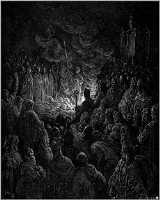
Trial by ordeal

Encyclopedia
Trial by ordeal is a judicial practice by which the guilt or innocence of the accused is determined by subjecting them to an unpleasant, usually dangerous experience. In some cases, the accused were considered innocent only if they survived the test, or if their injuries healed.
In medieval Europe, like trial by combat
, trial by ordeal was considered a judicium Dei: a procedure based on the premise that God
would help the innocent by performing a miracle on their behalf. The practice has much earlier roots, however, being attested as far back as the Code of Hammurabi
and the Code of Ur-Nammu
, and also in animist tribal societies, such as the trial by ingestion of "red water" (calabar bean
) in Sierra Leone
, where the intended effect is magical rather than invocation of a deity's justice.
In pre-modern society, the ordeal typically ranked along with the oath
and witness
accounts as the central means by which to reach a judicial verdict. Indeed, the term ordeal itself, Old English ordǣl, has the meaning of "judgment, verdict" (German Urteil, Dutch oordeel), from Proto-Germanic *uzdailjam "that which is dealt out".
According to one theory, put forward by Peter Leeson
, trial by ordeal was surprisingly effective at sorting the guilty from the innocent. Because defendants were believers, only the truly innocent would choose to endure a trial; guilty defendants would confess or settle cases instead. Therefore, the theory goes, church and judicial authorities would routinely rig ordeals so that the participants—presumably innocent—could pass them. If this theory is correct, medieval superstition was actually a useful motivating force for justice.
Priestly cooperation in trials by fire and water was forbidden by Pope Innocent III
at the Fourth Lateran Council of 1215, and replaced by compurgation
. Trials by ordeal became rarer over the Late Middle Ages
, often replaced by confessions extracted under torture
, but the practice was discontinued only in the 16th century. Johannes Hartlieb
in 1456 reports a popular superstition of how to identify a thief by an ordeal by ingestion
practised privately without judicial sanction.
 This test typically required that the accused walk a certain distance, usually nine feet, over red-hot
plowshare
s or holding a red-hot iron
. Innocence was sometimes established by a complete lack of injury, but it was more common for the wound to be bandaged and reexamined three days later by a priest, who would pronounce that God had intervened to heal it, or that it was merely festering - in which case the suspect would be exile
d or executed. One famous instance of the ordeal of ploughshares concerned Emma of Normandy
, accused of adultery
with the Bishop of Winchester
in the mid-eleventh century. If church chroniclers are to be believed, she was so manifestly innocent that she had already walked over the blades when she asked if her trial would soon begin.
Another form of the ordeal required that an accused remove a stone from a pot of boiling water, oil, or lead. (See "Ordeal of hot water" below.) The assessment of the injury, and the consequences of a miracle or lack of one, followed a similar procedure to that described above. An early (non-judicial) example of the test was described by Gregory of Tours
in the 7th century AD. He describes how a Catholic saint, Hyacinth, bested an Arian
rival by plucking a stone from a boiling cauldron
. Gregory accepted that it took Hyacinth about an hour to complete the task (because the waters were bubbling so ferociously), but he was pleased to record that when the heretic
tried, he had the skin boiled off up to his elbow. Peter Bartholomew
also went through the ordeal by fire.
, enacted in 1166 and the first great legislative act in the reign of the English Angevin
King Henry II
, the law of the land required that: "anyone, who shall be found, on the oath of the aforesaid [a jury], to be accused or notoriously suspect of having been a robber or murderer or thief, or a receiver of them ... be taken and put to the ordeal of water."
King Athelstan made a law concerning the ordeal. The water had to be about boiling, and the depth from which the stone had to be retrieved was up to the wrist for one accusation, and up to the elbow for three. The ordeal would take place in the church, with several in attendance, purified and praying God to reveal the truth. Afterwards, the hand was bound and examined after three days to see whether it was healing or festering.
This was still a practice of 12th century Catholic churches: the priest would demand a suspect to place his hand in the boiling water. If, after three days, God had not healed his wounds, the suspect was guilty of the crime.
and the Code of Hammurabi
, under which a man accused of sorcery
was to be submerged in a stream and acquitted if he survived. The practice was also set out in Frankish law, but was abolished by Louis the Pious
in 829. The practice reappeared in the Late Middle Ages
: in the Dreieicher Wildbann of 1338, a man accused of poaching
was to be submerged in a barrel
three times, and to be considered guilty if he sank to the bottom.
Gregory of Tours
(died 594) recorded the common expectation that, with a millstone
round the neck, the guilty would sink: "The cruel pagans
cast him [Quirinus, bishop of the church of Sissek] into a river with a millstone tied to his neck, and when he had fallen into the waters he was long supported on the surface by a divine miracle
, and the waters did not suck him down since the weight of crime did not press upon him."
Ordeal by water was later associated with the witch-hunt
s of the 16th and 17th centuries, although in this scenario the outcome was reversed from the examples above: an accused who sank was considered innocent, while floating indicated witchcraft
. Demonologists developed inventive new theories about how it worked. The ordeal would normally be conducted with a rope holding the subject connected to assistants sitting in a boat or the like, so that the person being tested could be pulled in if he/she did not float; the notion that the ordeal was flatly devised as a situation without any possibility of live acquittal, even if the outcome was 'innocent', is a modern elaboration. Some argued that witches floated because they had renounced baptism
when entering the Devil
's service. Jacob Rickius claimed that they were supernaturally light, and recommended weighing them as an alternative to dunking them. (A practice that was famously parodied in Monty Python
's Quest for the Holy Grail
.) King James VI of Scotland
(later also James I of England) claimed in his Daemonologie
that water was so pure an element that it repelled the guilty. A witch trial including this ordeal took place in Szegedin, Hungary
as late as 1728.
The ordeal of water is also contemplated by the Vishnu Smrti, which is one of the texts of the Dharmaśāstra
. soi alvaro xd
by the church in an attempt to discourage judicial duels among the Germanic peoples
. As with judicial duels, and unlike most other ordeals, the accuser had to undergo the ordeal together with the accused. They stood on either side of a cross and stretched out their hands horizontal
ly. The one to first lower his arms lost. This ordeal was prescribed by Charlemagne
in 779 and again in 806. On the other hand, a decree of Lothar I, recorded in 876, abolished the ordeal so as to avoid the mockery of Christ.
would administer the poisonous calabar bean
(known as "esere" in Efik
) in an attempt to detect guilt. A defendant who vomits up the bean is innocent. A defendant who becomes ill or dies is considered guilty.
and in certain parts of West Africa
, such as Togo
. There are two main alternatives of this trial. In one version, the accused parties are ordered to retrieve an item from a container of boiling oil, with those who refuse the task being found guilty. In the other version of the trial, both the accused and the accuser have to retrieve an item from boiling oil, with the person or persons whose hand remains unscathed being declared innocent.
In medieval Europe, like trial by combat
Trial by combat
Trial by combat was a method of Germanic law to settle accusations in the absence of witnesses or a confession, in which two parties in dispute fought in single combat; the winner of the fight was proclaimed to be right. In essence, it is a judicially sanctioned duel...
, trial by ordeal was considered a judicium Dei: a procedure based on the premise that God
God
God is the English name given to a singular being in theistic and deistic religions who is either the sole deity in monotheism, or a single deity in polytheism....
would help the innocent by performing a miracle on their behalf. The practice has much earlier roots, however, being attested as far back as the Code of Hammurabi
Code of Hammurabi
The Code of Hammurabi is a well-preserved Babylonian law code, dating to ca. 1780 BC . It is one of the oldest deciphered writings of significant length in the world. The sixth Babylonian king, Hammurabi, enacted the code, and partial copies exist on a human-sized stone stele and various clay...
and the Code of Ur-Nammu
Code of Ur-Nammu
The Code of Ur-Nammu is the oldest known tablet containing a law code surviving today. It was written in the Sumerian language circa 2100 BC-2050 BC...
, and also in animist tribal societies, such as the trial by ingestion of "red water" (calabar bean
Calabar bean
The Calabar bean is the seed of a leguminous plant, Physostigma venenosum, a native of tropical Africa, poisonous to humans. It derives the first part of its scientific name from a curious beak-like appendage at the end of the stigma, in the centre of the flower; this appendage, though solid, was...
) in Sierra Leone
Sierra Leone
Sierra Leone , officially the Republic of Sierra Leone, is a country in West Africa. It is bordered by Guinea to the north and east, Liberia to the southeast, and the Atlantic Ocean to the west and southwest. Sierra Leone covers a total area of and has an estimated population between 5.4 and 6.4...
, where the intended effect is magical rather than invocation of a deity's justice.
In pre-modern society, the ordeal typically ranked along with the oath
Oath
An oath is either a statement of fact or a promise calling upon something or someone that the oath maker considers sacred, usually God, as a witness to the binding nature of the promise or the truth of the statement of fact. To swear is to take an oath, to make a solemn vow...
and witness
Witness
A witness is someone who has firsthand knowledge about an event, or in the criminal justice systems usually a crime, through his or her senses and can help certify important considerations about the crime or event. A witness who has seen the event first hand is known as an eyewitness...
accounts as the central means by which to reach a judicial verdict. Indeed, the term ordeal itself, Old English ordǣl, has the meaning of "judgment, verdict" (German Urteil, Dutch oordeel), from Proto-Germanic *uzdailjam "that which is dealt out".
According to one theory, put forward by Peter Leeson
Peter Leeson
Peter T. Leeson is BB&T Professor for the Study of Capitalism at the Mercatus Center, George Mason University He authored The Invisible Hook: The Hidden Economics of Pirates, a book in which he uses rational choice theory to examine the economic conditions and incentives that influenced pirate...
, trial by ordeal was surprisingly effective at sorting the guilty from the innocent. Because defendants were believers, only the truly innocent would choose to endure a trial; guilty defendants would confess or settle cases instead. Therefore, the theory goes, church and judicial authorities would routinely rig ordeals so that the participants—presumably innocent—could pass them. If this theory is correct, medieval superstition was actually a useful motivating force for justice.
Priestly cooperation in trials by fire and water was forbidden by Pope Innocent III
Pope Innocent III
Pope Innocent III was Pope from 8 January 1198 until his death. His birth name was Lotario dei Conti di Segni, sometimes anglicised to Lothar of Segni....
at the Fourth Lateran Council of 1215, and replaced by compurgation
Compurgation
Compurgation, also called wager of law, is a defence used primarily in medieval law. A defendant could establish his innocence or nonliability by taking an oath and by getting a required number of persons, typically twelve, to swear they believed the defendant's oath.Compurgation was found in...
. Trials by ordeal became rarer over the Late Middle Ages
Late Middle Ages
The Late Middle Ages was the period of European history generally comprising the 14th to the 16th century . The Late Middle Ages followed the High Middle Ages and preceded the onset of the early modern era ....
, often replaced by confessions extracted under torture
Torture
Torture is the act of inflicting severe pain as a means of punishment, revenge, forcing information or a confession, or simply as an act of cruelty. Throughout history, torture has often been used as a method of political re-education, interrogation, punishment, and coercion...
, but the practice was discontinued only in the 16th century. Johannes Hartlieb
Johannes Hartlieb
Johannes Hartlieb was a physician of Late Medieval Bavaria, probably of a family from Neuburg an der Donau. He was in the employment of Louis VII of Bavaria and Albert VI of Austria in the 1430s, and of Albert III of Bavaria from 1440, and of the latter's son Sigismund from 1456.In 1444, he...
in 1456 reports a popular superstition of how to identify a thief by an ordeal by ingestion
Corsned
In Anglo-Saxon law, corsned , also known as the accursed or sacred morsel, or the morsel of execration, was a type of trial by ordeal consisting in the eating of a piece of barley bread and cheese, totalling about an ounce in weight, consecrated with a form of exorcism, and...
practised privately without judicial sanction.
Ordeal of fire
Incandescence
Incandescence is the emission of light from a hot body as a result of its temperature. The term derives from the Latin verb incandescere, to glow white....
plowshare
Plowshare
In agriculture, a plowshare is a component of a plow . It is the cutting or leading edge of a moldboard which closely follows the coulter when plowing....
s or holding a red-hot iron
Iron
Iron is a chemical element with the symbol Fe and atomic number 26. It is a metal in the first transition series. It is the most common element forming the planet Earth as a whole, forming much of Earth's outer and inner core. It is the fourth most common element in the Earth's crust...
. Innocence was sometimes established by a complete lack of injury, but it was more common for the wound to be bandaged and reexamined three days later by a priest, who would pronounce that God had intervened to heal it, or that it was merely festering - in which case the suspect would be exile
Exile
Exile means to be away from one's home , while either being explicitly refused permission to return and/or being threatened with imprisonment or death upon return...
d or executed. One famous instance of the ordeal of ploughshares concerned Emma of Normandy
Emma of Normandy
Emma , was a daughter of Richard the Fearless, Duke of Normandy, by his second wife Gunnora. She was Queen consort of England twice, by successive marriages: first as second wife to Æthelred the Unready of England ; and then second wife to Cnut the Great of Denmark...
, accused of adultery
Adultery
Adultery is sexual infidelity to one's spouse, and is a form of extramarital sex. It originally referred only to sex between a woman who was married and a person other than her spouse. Even in cases of separation from one's spouse, an extramarital affair is still considered adultery.Adultery is...
with the Bishop of Winchester
Bishop of Winchester
The Bishop of Winchester is the head of the Church of England diocese of Winchester, with his cathedra at Winchester Cathedral in Hampshire.The bishop is one of five Church of England bishops to be among the Lords Spiritual regardless of their length of service. His diocese is one of the oldest and...
in the mid-eleventh century. If church chroniclers are to be believed, she was so manifestly innocent that she had already walked over the blades when she asked if her trial would soon begin.
Another form of the ordeal required that an accused remove a stone from a pot of boiling water, oil, or lead. (See "Ordeal of hot water" below.) The assessment of the injury, and the consequences of a miracle or lack of one, followed a similar procedure to that described above. An early (non-judicial) example of the test was described by Gregory of Tours
Gregory of Tours
Saint Gregory of Tours was a Gallo-Roman historian and Bishop of Tours, which made him a leading prelate of Gaul. He was born Georgius Florentius, later adding the name Gregorius in honour of his maternal great-grandfather...
in the 7th century AD. He describes how a Catholic saint, Hyacinth, bested an Arian
Arianism
Arianism is the theological teaching attributed to Arius , a Christian presbyter from Alexandria, Egypt, concerning the relationship of the entities of the Trinity and the precise nature of the Son of God as being a subordinate entity to God the Father...
rival by plucking a stone from a boiling cauldron
Cauldron
A cauldron or caldron is a large metal pot for cooking and/or boiling over an open fire, with a large mouth and frequently with an arc-shaped hanger.- Etymology :...
. Gregory accepted that it took Hyacinth about an hour to complete the task (because the waters were bubbling so ferociously), but he was pleased to record that when the heretic
Heresy
Heresy is a controversial or novel change to a system of beliefs, especially a religion, that conflicts with established dogma. It is distinct from apostasy, which is the formal denunciation of one's religion, principles or cause, and blasphemy, which is irreverence toward religion...
tried, he had the skin boiled off up to his elbow. Peter Bartholomew
Peter Bartholomew
Peter Bartholomew was a soldier and mystic from France who was part of the First Crusade.In December, 1097, during the siege of Antioch, Peter began to have visions, mostly of St. Andrew. Peter claimed St. Andrew took him to the Church of St. Peter, inside Antioch, and showed him where the relic...
also went through the ordeal by fire.
English common law
In the Assize of ClarendonAssize of Clarendon
The Assize of Clarendon was an 1166 act of Henry II of England that began the transformation of English law from such systems for deciding the prevailing party in a case as trial by ordeal or trial by battle to an evidentiary model, in which evidence and inspection was made by laymen...
, enacted in 1166 and the first great legislative act in the reign of the English Angevin
House of Plantagenet
The House of Plantagenet , a branch of the Angevins, was a royal house founded by Geoffrey V of Anjou, father of Henry II of England. Plantagenet kings first ruled the Kingdom of England in the 12th century. Their paternal ancestors originated in the French province of Gâtinais and gained the...
King Henry II
Henry II of England
Henry II ruled as King of England , Count of Anjou, Count of Maine, Duke of Normandy, Duke of Aquitaine, Duke of Gascony, Count of Nantes, Lord of Ireland and, at various times, controlled parts of Wales, Scotland and western France. Henry, the great-grandson of William the Conqueror, was the...
, the law of the land required that: "anyone, who shall be found, on the oath of the aforesaid [a jury], to be accused or notoriously suspect of having been a robber or murderer or thief, or a receiver of them ... be taken and put to the ordeal of water."
Ordeal of hot water
First mentioned in the 6th century Lex Salica, the ordeal of hot water requires the accused to dip his hand in a kettle of boiling water and retrieve a stone.King Athelstan made a law concerning the ordeal. The water had to be about boiling, and the depth from which the stone had to be retrieved was up to the wrist for one accusation, and up to the elbow for three. The ordeal would take place in the church, with several in attendance, purified and praying God to reveal the truth. Afterwards, the hand was bound and examined after three days to see whether it was healing or festering.
This was still a practice of 12th century Catholic churches: the priest would demand a suspect to place his hand in the boiling water. If, after three days, God had not healed his wounds, the suspect was guilty of the crime.
Ordeal of cold water
This ordeal has a precedent in the Code of Ur-NammuCode of Ur-Nammu
The Code of Ur-Nammu is the oldest known tablet containing a law code surviving today. It was written in the Sumerian language circa 2100 BC-2050 BC...
and the Code of Hammurabi
Code of Hammurabi
The Code of Hammurabi is a well-preserved Babylonian law code, dating to ca. 1780 BC . It is one of the oldest deciphered writings of significant length in the world. The sixth Babylonian king, Hammurabi, enacted the code, and partial copies exist on a human-sized stone stele and various clay...
, under which a man accused of sorcery
Magic (paranormal)
Magic is the claimed art of manipulating aspects of reality either by supernatural means or through knowledge of occult laws unknown to science. It is in contrast to science, in that science does not accept anything not subject to either direct or indirect observation, and subject to logical...
was to be submerged in a stream and acquitted if he survived. The practice was also set out in Frankish law, but was abolished by Louis the Pious
Louis the Pious
Louis the Pious , also called the Fair, and the Debonaire, was the King of Aquitaine from 781. He was also King of the Franks and co-Emperor with his father, Charlemagne, from 813...
in 829. The practice reappeared in the Late Middle Ages
Late Middle Ages
The Late Middle Ages was the period of European history generally comprising the 14th to the 16th century . The Late Middle Ages followed the High Middle Ages and preceded the onset of the early modern era ....
: in the Dreieicher Wildbann of 1338, a man accused of poaching
Poaching
Poaching is the illegal taking of wild plants or animals contrary to local and international conservation and wildlife management laws. Violations of hunting laws and regulations are normally punishable by law and, collectively, such violations are known as poaching.It may be illegal and in...
was to be submerged in a barrel
Barrel
A barrel or cask is a hollow cylindrical container, traditionally made of vertical wooden staves and bound by wooden or metal hoops. Traditionally, the barrel was a standard size of measure referring to a set capacity or weight of a given commodity. A small barrel is called a keg.For example, a...
three times, and to be considered guilty if he sank to the bottom.
Gregory of Tours
Gregory of Tours
Saint Gregory of Tours was a Gallo-Roman historian and Bishop of Tours, which made him a leading prelate of Gaul. He was born Georgius Florentius, later adding the name Gregorius in honour of his maternal great-grandfather...
(died 594) recorded the common expectation that, with a millstone
Millstone
Millstones or mill stones are used in windmills and watermills, including tide mills, for grinding wheat or other grains.The type of stone most suitable for making millstones is a siliceous rock called burrstone , an open-textured, porous but tough, fine-grained sandstone, or a silicified,...
round the neck, the guilty would sink: "The cruel pagans
Paganism
Paganism is a blanket term, typically used to refer to non-Abrahamic, indigenous polytheistic religious traditions....
cast him [Quirinus, bishop of the church of Sissek] into a river with a millstone tied to his neck, and when he had fallen into the waters he was long supported on the surface by a divine miracle
Miracle
A miracle often denotes an event attributed to divine intervention. Alternatively, it may be an event attributed to a miracle worker, saint, or religious leader. A miracle is sometimes thought of as a perceptible interruption of the laws of nature. Others suggest that a god may work with the laws...
, and the waters did not suck him down since the weight of crime did not press upon him."
Ordeal by water was later associated with the witch-hunt
Witch-hunt
A witch-hunt is a search for witches or evidence of witchcraft, often involving moral panic, mass hysteria and lynching, but in historical instances also legally sanctioned and involving official witchcraft trials...
s of the 16th and 17th centuries, although in this scenario the outcome was reversed from the examples above: an accused who sank was considered innocent, while floating indicated witchcraft
Witchcraft
Witchcraft, in historical, anthropological, religious, and mythological contexts, is the alleged use of supernatural or magical powers. A witch is a practitioner of witchcraft...
. Demonologists developed inventive new theories about how it worked. The ordeal would normally be conducted with a rope holding the subject connected to assistants sitting in a boat or the like, so that the person being tested could be pulled in if he/she did not float; the notion that the ordeal was flatly devised as a situation without any possibility of live acquittal, even if the outcome was 'innocent', is a modern elaboration. Some argued that witches floated because they had renounced baptism
Baptism
In Christianity, baptism is for the majority the rite of admission , almost invariably with the use of water, into the Christian Church generally and also membership of a particular church tradition...
when entering the Devil
Devil
The Devil is believed in many religions and cultures to be a powerful, supernatural entity that is the personification of evil and the enemy of God and humankind. The nature of the role varies greatly...
's service. Jacob Rickius claimed that they were supernaturally light, and recommended weighing them as an alternative to dunking them. (A practice that was famously parodied in Monty Python
Monty Python
Monty Python was a British surreal comedy group who created their influential Monty Python's Flying Circus, a British television comedy sketch show that first aired on the BBC on 5 October 1969. Forty-five episodes were made over four series...
's Quest for the Holy Grail
Monty Python and the Holy Grail
Monty Python and the Holy Grail is a 1974 British comedy film written and performed by the comedy group Monty Python , and directed by Gilliam and Jones...
.) King James VI of Scotland
James I of England
James VI and I was King of Scots as James VI from 24 July 1567 and King of England and Ireland as James I from the union of the English and Scottish crowns on 24 March 1603...
(later also James I of England) claimed in his Daemonologie
Daemonologie
Daemonologie is the book written and published in 1597 by King James VI of Scotland . In the book he approves and supports the practise of witch hunting...
that water was so pure an element that it repelled the guilty. A witch trial including this ordeal took place in Szegedin, Hungary
Hungary
Hungary , officially the Republic of Hungary , is a landlocked country in Central Europe. It is situated in the Carpathian Basin and is bordered by Slovakia to the north, Ukraine and Romania to the east, Serbia and Croatia to the south, Slovenia to the southwest and Austria to the west. The...
as late as 1728.
The ordeal of water is also contemplated by the Vishnu Smrti, which is one of the texts of the Dharmaśāstra
Dharmasastra
Dharmaśāstra is a genre of Sanskrit texts and refers to the śāstra, or Indic branch of learning, pertaining to Hindu dharma, religious and legal duty. The voluminous textual corpus of Dharmaśāstra is primarily a product of the Brahmanical tradition in India and represents the elaborate scholastic...
. soi alvaro xd
Ordeal of the cross
The ordeal of the cross was apparently introduced in the Early Middle AgesEarly Middle Ages
The Early Middle Ages was the period of European history lasting from the 5th century to approximately 1000. The Early Middle Ages followed the decline of the Western Roman Empire and preceded the High Middle Ages...
by the church in an attempt to discourage judicial duels among the Germanic peoples
Germanic peoples
The Germanic peoples are an Indo-European ethno-linguistic group of Northern European origin, identified by their use of the Indo-European Germanic languages which diversified out of Proto-Germanic during the Pre-Roman Iron Age.Originating about 1800 BCE from the Corded Ware Culture on the North...
. As with judicial duels, and unlike most other ordeals, the accuser had to undergo the ordeal together with the accused. They stood on either side of a cross and stretched out their hands horizontal
Horizontal
Horizontal may refer to:*Horizontal plane, in astronomy, geography, geometry and other sciences and contexts*Horizontal coordinate system, in astronomy*Horizontalism, in monetary circuit theory*Horizontalism, in sociology...
ly. The one to first lower his arms lost. This ordeal was prescribed by Charlemagne
Charlemagne
Charlemagne was King of the Franks from 768 and Emperor of the Romans from 800 to his death in 814. He expanded the Frankish kingdom into an empire that incorporated much of Western and Central Europe. During his reign, he conquered Italy and was crowned by Pope Leo III on 25 December 800...
in 779 and again in 806. On the other hand, a decree of Lothar I, recorded in 876, abolished the ordeal so as to avoid the mockery of Christ.
Ordeal of ingestion
- FranconiaFranconiaFranconia is a region of Germany comprising the northern parts of the modern state of Bavaria, a small part of southern Thuringia, and a region in northeastern Baden-Württemberg called Tauberfranken...
n law prescribed that an accused was to be given dry bread and cheese blessed by a priest. If he choked on the food, he was considered guilty. This was transformed into the ordeal of the EucharistEucharistThe Eucharist , also called Holy Communion, the Sacrament of the Altar, the Blessed Sacrament, the Lord's Supper, and other names, is a Christian sacrament or ordinance...
(trial by sacrament) mentioned by Regino of PrümRegino of PrümReginon or Regino of Prüm was a Benedictine abbot and medieval chronicler.-Biography:According to the statements of a later era, Regino was the son of noble parents and was born at the stronghold of Altrip on the Rhine near Speyer at an unknown date...
ca. 900: the accused was to take the Eucharist after a solemn oath professing his innocence. It was believed that if the oath had been false, the criminal would die within the same year. - Another version says: "The priest wrote the Lord's Prayer on a piece of bread, of which he then weighed out ten pennyweightPennyweightA pennyweight is a unit of mass that is equal to 24 grains, 1/20 of a troy ounce, 1/240 of a troy pound, approximately 0.054857 avoirdupois ounce and exactly 1.55517384 grams....
s, and so likewise with the cheese. Under the right foot of the accused, he set a cross of poplar wood, and holding another cross of the same material over the man's head, threw over his head the theft written on a tablet. He placed the bread and cheese at the same moment in the mouth of the accused, and, on doing so, recited the conjuration: 'I exorcize thee, most unclean dragon, ancient serpent, dark night, by the word of truth, and the sign of light, by our Lord Jesus Christ, the immaculate Lamb generated by the Most High, that bread and cheese may not pass thy gullet and throat, but that thou mayest tremble like and thou mayest tremble like an aspen-leaf, Amen; and not have rest, O man, until thou dost vomit it forth with blood, if thou hast committed aught in the matter of the aforesaid theft.'" - NumbersBook of NumbersThe Book of Numbers is the fourth book of the Hebrew Bible, and the fourth of five books of the Jewish Torah/Pentateuch....
5:12–27 prescribes that a woman suspected of adultery should be made to swallow "the bitter water that causeth the curse" by the priest in order to determine her guilt. The accused would be condemned only if 'her belly shall swell and her thigh shall rot'. It can be found in the TorahTorahTorah- A scroll containing the first five books of the BibleThe Torah , is name given by Jews to the first five books of the bible—Genesis , Exodus , Leviticus , Numbers and Deuteronomy Torah- A scroll containing the first five books of the BibleThe Torah , is name given by Jews to the first five...
(where it is known as the SotahSotahSotah deals with the ritual of the Sotah - the woman suspected of adultery as described and prescribed in the Book of Numbers in...
) and the Old TestamentOld TestamentThe Old Testament, of which Christians hold different views, is a Christian term for the religious writings of ancient Israel held sacred and inspired by Christians which overlaps with the 24-book canon of the Masoretic Text of Judaism...
(Numbers 5:12-31). One writer has recently argued that the procedure has a rational basis, envisioning punishment only upon clear proof of pregnancyPregnancyPregnancy refers to the fertilization and development of one or more offspring, known as a fetus or embryo, in a woman's uterus. In a pregnancy, there can be multiple gestations, as in the case of twins or triplets...
(a swelling belly) or venereal diseaseSexually transmitted diseaseSexually transmitted disease , also known as a sexually transmitted infection or venereal disease , is an illness that has a significant probability of transmission between humans by means of human sexual behavior, including vaginal intercourse, oral sex, and anal sex...
(a rotting thigh), but a more likely origin is the connection of ascitesAscitesAscites is a gastroenterological term for an accumulation of fluid in the peritoneal cavity.The medical condition is also known as peritoneal cavity fluid, peritoneal fluid excess, hydroperitoneum or more archaically as abdominal dropsy. Although most commonly due to cirrhosis and severe liver...
with oath-breakers in the Ancient Orient (see Hittite military oathHittite military oathThe Hittite military oath is a Hittite text on two cuneiform tablets.The first tablet is only preserved in fragments , the second tablet survives in three copies, and can be restituted almost completely. The oldest copy is fragmentary, but two younger copies are well preserved...
).
Ordeal of poison
Some cultures, such as the Efik Uburutu people of present-day NigeriaNigeria
Nigeria , officially the Federal Republic of Nigeria, is a federal constitutional republic comprising 36 states and its Federal Capital Territory, Abuja. The country is located in West Africa and shares land borders with the Republic of Benin in the west, Chad and Cameroon in the east, and Niger in...
would administer the poisonous calabar bean
Calabar bean
The Calabar bean is the seed of a leguminous plant, Physostigma venenosum, a native of tropical Africa, poisonous to humans. It derives the first part of its scientific name from a curious beak-like appendage at the end of the stigma, in the centre of the flower; this appendage, though solid, was...
(known as "esere" in Efik
Ibibio language
Ibibio-Efik, also known as Ibibio and Efik, is the major dialect cluster of the Benue–Congo language family called Cross River. Efik proper has national status in Nigeria and is the literary standard of the Efik languages, though Ibibio proper has more native speakers.-Varieties:Efik is a dialect...
) in an attempt to detect guilt. A defendant who vomits up the bean is innocent. A defendant who becomes ill or dies is considered guilty.
Ordeal of boiling oil
Trial by boiling oil has been practiced in villages in IndiaIndia
India , officially the Republic of India , is a country in South Asia. It is the seventh-largest country by geographical area, the second-most populous country with over 1.2 billion people, and the most populous democracy in the world...
and in certain parts of West Africa
West Africa
West Africa or Western Africa is the westernmost region of the African continent. Geopolitically, the UN definition of Western Africa includes the following 16 countries and an area of approximately 5 million square km:-Flags of West Africa:...
, such as Togo
Togo
Togo, officially the Togolese Republic , is a country in West Africa bordered by Ghana to the west, Benin to the east and Burkina Faso to the north. It extends south to the Gulf of Guinea, on which the capital Lomé is located. Togo covers an area of approximately with a population of approximately...
. There are two main alternatives of this trial. In one version, the accused parties are ordered to retrieve an item from a container of boiling oil, with those who refuse the task being found guilty. In the other version of the trial, both the accused and the accuser have to retrieve an item from boiling oil, with the person or persons whose hand remains unscathed being declared innocent.
Other ordeal methods
- An IcelandIcelandIceland , described as the Republic of Iceland, is a Nordic and European island country in the North Atlantic Ocean, on the Mid-Atlantic Ridge. Iceland also refers to the main island of the country, which contains almost all the population and almost all the land area. The country has a population...
ic ordeal tradition involves the accused walking under a piece of turf. If the turf falls on the accused's head, the accused person is pronounced guilty.
- Residents of MadagascarMadagascarThe Republic of Madagascar is an island country located in the Indian Ocean off the southeastern coast of Africa...
could accuse one another of various crimes, including theft, Christianity and especially witchcraft, for which the ordeal of tangenaTangenaTangena is the name given in the highland dialect of the Malagasy language to an indigenous tree distinguished by the high toxicity of the nuts it produces, which have been used historically on the island of Madagascar for trials by ordeal to determine the guilt or innocence of an accused party...
was routinely obligatory. In the 1820s, the tangena ordeal caused about 1,000 deaths annually. This average rose to around 3,000 annual deaths between 1828 and 1861.
See also
- Bisha'aBisha'aBisha'a or Bisha is a ritual practiced today by some Bedouin tribes of the Judean, Negev and Sinai deserts for the purpose of lie detection. It is also practiced, and is said to have originated among, some Bedouin tribes of Saudi Arabia...
- trial by ordeal among the BedouinBedouinThe Bedouin are a part of a predominantly desert-dwelling Arab ethnic group traditionally divided into tribes or clans, known in Arabic as ..-Etymology:... - OathOathAn oath is either a statement of fact or a promise calling upon something or someone that the oath maker considers sacred, usually God, as a witness to the binding nature of the promise or the truth of the statement of fact. To swear is to take an oath, to make a solemn vow...
- Running the gauntletRunning the gauntletRunning the gauntlet is a form of physical punishment wherein a captive is compelled to run between two rows—a gauntlet—of soldiers who strike him as he passes.-Etymology:...
- subpoena ad testificandumSubpoena ad testificandumA subpoena ad testificandum is a court summons to appear and give oral testimony for use at a hearing or trial. The use of a writ for purposes of compelling testimony originated in the Ecclesiastical Courts of the High Middle Ages, especially in England...
- subpoena duces tecumSubpoena duces tecumA subpoena duces tecum is a court summons ordering a named party to appear before the court and produce documents or other tangible evidence for use at a hearing or trial....
General
- H. Glitsch, Mittelalterliche Gottesurteile, Leipzig (1913).
- Kaegi, Alter und Herkunft des germanischen Gottesurteils (1887).
- Henry C. Lea Superstition and Force (Greenwood, 1968; reprint of 1870 edition.)
- Sadakat Kadri The Trial: A History from Socrates to O.J. Simpson (Random House, 2006).
- Ian C. Pilarczyk, "Between a Rock and a Hot Place: Issues of Subjectivity and Rationality in the Medieval Ordeal by Hot Iron", 25 Anglo-American Law Rev. 87-112 (1996). http://iancpilarczyk.com/wp-content/uploads/2010/10/BetweenARock.pdf
- Robert BartlettRobert Bartlett (historian)Robert Bartlett FRHistS, FBA, FRSE, FSA is a historian and medievalist. Bartlett is English, though his academic interests cover the whole of Europe....
, Trial by Fire and Water: The Medieval Judicial Ordeal, New York: Clarendon Press, 1986. - William Ian Miller, “Ordeal in Iceland,” Scandinavian Studies 60 (1988): 189-218.
External links
- Encyclopædia Britannica Online "Ordeal"
- http://www.fordham.edu/halsall/source/ordeals1.html
- http://www.fordham.edu/halsall/source/water-ordeal.html