

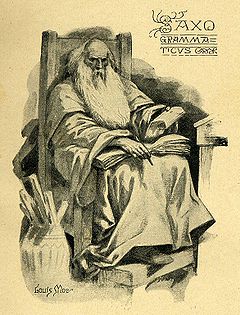
Saxo Grammaticus

Encyclopedia
Absalon
Absalon was a Danish archbishop and statesman, who was the Bishop of Roskilde from 1158 to 1192 and Archbishop of Lund from 1178 until his death. He was the foremost politician and churchfather of Denmark in the second half of the 12th century, and was the closest advisor of King Valdemar I of...
, Archbishop of Lund, foremost advisor to Valdemar I of Denmark
Valdemar I of Denmark
Valdemar I of Denmark , also known as Valdemar the Great, was King of Denmark from 1157 until 1182.-Biography:...
. He is the author of the first full history of Denmark
Denmark
Denmark is a Scandinavian country in Northern Europe. The countries of Denmark and Greenland, as well as the Faroe Islands, constitute the Kingdom of Denmark . It is the southernmost of the Nordic countries, southwest of Sweden and south of Norway, and bordered to the south by Germany. Denmark...
.
Life
The Jutland ChronicleChronica Jutensis
Chronica Jutensis also known as Continuatio compendii Saxonis or Chronica Danorum, is a small Danish historical work from the middle of the 14th century, written in Latin....
gives evidence that Saxo was born in Sjælland (Anglicized as Zealand). It is unlikely he was born before 1150 and it is supposed that his death could have occurred around 1220. His name Saxo was a common name in medieval Denmark. The name Grammaticus ("the learned") was first given to him in the Jutland Chronicle and the Sjælland Chronicle makes reference to Saxo cognomine Longus ("the tall").
He lived in a period of warfare and Danish expansion, led by Archbishop Absalon and the Valdemars. The Danes were also being threatened by the Wends
Wends
Wends is a historic name for West Slavs living near Germanic settlement areas. It does not refer to a homogeneous people, but to various peoples, tribes or groups depending on where and when it is used...
who were making raids across the border and by sea. Valdemar I
Valdemar I of Denmark
Valdemar I of Denmark , also known as Valdemar the Great, was King of Denmark from 1157 until 1182.-Biography:...
had also just won a civil war and later Valdemar II
Valdemar II of Denmark
Valdemar II , called Valdemar the Victorious or Valdemar the Conqueror , was the King of Denmark from 1202 until his death in 1241. The nickname Sejr is a later invention and was not used during the King's own lifetime...
led an expedition across the Elbe
Elbe
The Elbe is one of the major rivers of Central Europe. It rises in the Krkonoše Mountains of the northwestern Czech Republic before traversing much of Bohemia , then Germany and flowing into the North Sea at Cuxhaven, 110 km northwest of Hamburg...
to invade Holstein
Holstein
Holstein is the region between the rivers Elbe and Eider. It is part of Schleswig-Holstein, the northernmost state of Germany....
.
Sven Aggesen, a Danish nobleman and author of a slightly earlier history of Denmark than Saxo's, describes his contemporary, Saxo, as his contubernalis meaning tent-comrade. This gives evidence that Saxo and Sven might have soldiered in the Hird
Hird
The hird, in Norwegian history, was originally an informal retinue of personal armed companions, hirdmen or housecarls, but came to mean not only the nucleus of the royal army, but also developed into a more formal royal court household....
or royal guard since Sven used the word contubernium in reference to them. There is also a Saxo to be found on a list of clergy at Lund
Lund
-Main sights:During the 12th and 13th centuries, when the town was the seat of the archbishop, many churches and monasteries were built. At its peak, Lund had 27 churches, but most of them were demolished as result of the Reformation in 1536. Several medieval buildings remain, including Lund...
, where there was a Sven recorded as Archdeacon. Likewise there is Dean Saxo who died in 1190, however the date does not match what is known about Saxo.
Both arguments, for a secular or religious Saxo, would confirm that he was well educated, as clergy he would have received training in Latin
Latin
Latin is an Italic language originally spoken in Latium and Ancient Rome. It, along with most European languages, is a descendant of the ancient Proto-Indo-European language. Although it is considered a dead language, a number of scholars and members of the Christian clergy speak it fluently, and...
and sons of great men were often sent to Paris
Paris
Paris is the capital and largest city in France, situated on the river Seine, in northern France, at the heart of the Île-de-France region...
. Saxo comes from a warrior family and writes that he is himself committed to being a soldier. He tells us that he follows "the ancient right of hereditary service," and that his father and grandfather "were recognized frequenters of your renowned sire's (Valdemar I) war camp." Saxo's education and ability supports the idea that he was educated outside of Denmark. Some suggest the title "Grammaticus" refers not to his education but rather his elaborate Latin style. We know from his writing that he was in the retinue and received the patronage of Absalon, Archbishop of Lund, who was the foremost advisor to King Valdemar I. In his will Absalon forgives his clerk Saxo a small debt of two and a half marks of silver and tells him to return two borrowed books to the monastery of Sorø
Sorø
Sorø is a town in Sorø municipality in Region Sjælland on the island of Zealand in east Denmark. The population is 7,805 . The municipal council and the regional council are located in Sorø....
. The legacy of Saxo Grammaticus is the sixteen book heroic history of the Danes called Gesta Danorum
Gesta Danorum
Gesta Danorum is a patriotic work of Danish history, by the 12th century author Saxo Grammaticus . It is the most ambitious literary undertaking of medieval Denmark and is an essential source for the nation's early history...
.
Gesta Danorum
In the preface to the work, Saxo writes that his patron Absalon, Archbishop of Lund had encouraged him to write a heroic history of the Danes. The history is thought to have been started about 1185, after Sven Aggesen wrote his history. The goal of Gesta Danorum was as Saxo writes "to glorify our fatherland," which he accomplishes on the model of the AeneidAeneid
The Aeneid is a Latin epic poem, written by Virgil between 29 and 19 BC, that tells the legendary story of Aeneas, a Trojan who travelled to Italy, where he became the ancestor of the Romans. It is composed of roughly 10,000 lines in dactylic hexameter...
by Vergil. Saxo also may have owed much to Plato
Plato
Plato , was a Classical Greek philosopher, mathematician, student of Socrates, writer of philosophical dialogues, and founder of the Academy in Athens, the first institution of higher learning in the Western world. Along with his mentor, Socrates, and his student, Aristotle, Plato helped to lay the...
, Cicero
Cicero
Marcus Tullius Cicero , was a Roman philosopher, statesman, lawyer, political theorist, and Roman constitutionalist. He came from a wealthy municipal family of the equestrian order, and is widely considered one of Rome's greatest orators and prose stylists.He introduced the Romans to the chief...
and also to more contemporary writers like Geoffrey of Monmouth
Geoffrey of Monmouth
Geoffrey of Monmouth was a cleric and one of the major figures in the development of British historiography and the popularity of tales of King Arthur...
. Saxo's history of the Danes was compiled from sources that are of questionable historical value. He drew on oral tales of the Icelanders, ancient volumes, letters carved on rocks and stone, and the statements of his patron Absalon concerning the history that the Archbishop had been a part of. Saxo's work was not strictly a history or a simple record of old tales, rather it was "a product of Saxo's own mind and times," he combines the history and mythology of the heroic age of Denmark and reworks it into his own story that exemplifies the past of the Danes.
The history is composed of sixteen books and extends from the time of the founders of the Danish people, Dan I of Denmark
Dan I of Denmark
Dan I was the progenitor of the Danish royal house according to Saxo Grammaticus's Gesta Danorum. He held the lordship along with his brother Angul, the progenitor of the English.See also: Dan -References:...
and Angul into about the year 1187. The first four are concerned with the history of the Danes before Christ
Christ
Christ is the English term for the Greek meaning "the anointed one". It is a translation of the Hebrew , usually transliterated into English as Messiah or Mashiach...
, the next four with the history after Christ, books 9-12 Christian Denmark and 13-16 promote Lund and the exploits early before and during Saxo's own lifetime. It is assumed that the last eight books were written first, as Saxo drew heavily on Absalon's testament for evidence of the age of Saint Canute and Valdemar I and Archbishop Absalon died in 1202, before the work was completed. The first eight volumes share a likeness with the works of Snorri Sturluson
Snorri Sturluson
Snorri Sturluson was an Icelandic historian, poet, and politician. He was twice elected lawspeaker at the Icelandic parliament, the Althing...
. They deal with mythical elements such as giants and the Scandinavian pantheon of gods. Saxo tells of Dan the first king of Denmark who had a brother named Angul who gave his name to the Angles
Angles
The Angles is a modern English term for a Germanic people who took their name from the ancestral cultural region of Angeln, a district located in Schleswig-Holstein, Germany...
. He also tells the stories of various other Danish heroes, many who interact with the Scandinavian gods. Saxo's "heathen" gods however were not always good characters. They were sometimes treacherous such as in the story of Harald, legendary king of the Danes, who was taught the ways of warfare by Odinn and then was betrayed and killed by the god who then brought him to Valhalla
Valhalla
In Norse mythology, Valhalla is a majestic, enormous hall located in Asgard, ruled over by the god Odin. Chosen by Odin, half of those that die in combat travel to Valhalla upon death, led by valkyries, while the other half go to the goddess Freyja's field Fólkvangr...
. Saxo's world is seen to have had very warlike values. He glorifies the heroes that made their names in battle far more than those who made peace. His view of the period of peace under King Frode was very low and was only satisfied when King Knut brought back the ancestral customs. Saxo's chronology of kings extends up to Saint Canute and his son Valdemar I. What is arguably the most important part of Saxo's entire history of the Danes is the story of Amleth, the first instance of Hamlet. Saxo based the story on an oral tale of a son taking revenge for his murdered father. Saxo finished the history with the Preface, which he wrote last, about 1216 under the patronage of Anders Sunesen
Anders Sunesen
Anders Sunesen was a Danish archbishop of Lund, Scania, from March 21, 1201, at the death of Absalon, to his own death in 1228. He is the author of the Latin translation of the Scanian Law and was throughout his life engaged in integrating a Christian worldview into the old legislature...
who replaced Absalon as Archbishop of Lund. Saxo included in the preface warm appreciation of both Archbishops and of the reigning King Valdemar II.
Historical contribution
Christiern Pedersen, a Canon of Lund, collaborated with Jodocus Badius Ascendius, a fellow enthusiast, to print the work of Saxo Grammaticus early in the sixteenth century. This was the first major step toward securing historical significance for Gesta Danorum. It was from that point that it began to spread amongst the academic community. Oliver EltonOliver Elton
Oliver Elton was an English literary scholar whose works include A Survey of English Literature in six volumes, criticism, biography, and translations from several languages including Icelandic and Russian...
who was the first to translate the first nine books of Gesta Danorum into English
English language
English is a West Germanic language that arose in the Anglo-Saxon kingdoms of England and spread into what was to become south-east Scotland under the influence of the Anglian medieval kingdom of Northumbria...
wrote that Saxo was the first writer produced by Denmark. Saxo's skill as a Latinist
Classical Latin
Classical Latin in simplest terms is the socio-linguistic register of the Latin language regarded by the enfranchised and empowered populations of the late Roman republic and the Roman empire as good Latin. Most writers during this time made use of it...
has been praised by Erasmus, who wondered at how "a Dane of that age got so great power of eloquence." There have also been several attempts to understand his style of Latin and place it in history to glean more information about where he may have been educated. Some have considered Saxo's Latin to have more in common with legal training than ecclesiastical and his poetry is thought to have traces of parallelism
Parallelism
Parallelism may refer to:* Angle of parallelism, the angle at one vertex of a right hyperbolic triangle that has two hyperparallel sides* Conscious parallelism, price-fixing between competitors in an oligopoly that occurs without an actual spoken agreement between the parties* Parallel computing,...
. He is also seen by modern Danes as their first national historian. His works were received enthusiastically by Renaissance
Renaissance
The Renaissance was a cultural movement that spanned roughly the 14th to the 17th century, beginning in Italy in the Late Middle Ages and later spreading to the rest of Europe. The term is also used more loosely to refer to the historical era, but since the changes of the Renaissance were not...
scholars who were curious about pre-Christian history and legends. Saxo's account of history has been seen to differ greatly from that of his contemporaries, especially between his account and those of Norwegians and Icelanders in that the titles of hero and villain switch between the characters of the various nationalities. There are even differences between Saxo's work, and that of fellow Danish historian Sven Aggesen. These differences often are the result of elaboration on the part of Saxo. His account of the tale of Thyri for example is far more fantastic and blown up than the tale that Sven presents and for this stylization and elaboration of the facts Saxo's history has often been criticized. Saxo's inclusion of Amleth is the most significant part of the Gesta Danorum, however the work also has value in its description of the canonization of Canute and further in comparison to Snorri, whose work shares many characters and stories, creating a better understanding of pre-Christian Scandinavia
Scandinavia
Scandinavia is a cultural, historical and ethno-linguistic region in northern Europe that includes the three kingdoms of Denmark, Norway and Sweden, characterized by their common ethno-cultural heritage and language. Modern Norway and Sweden proper are situated on the Scandinavian Peninsula,...
.
Print Sources
- Davidson, Hilda Ellis. Introduction to Saxo Grammaticus The History of the Danes, Book I-IX. Volume II: Commentary. Edited by Hilda Ellis Davidson. Cambridge: D. S. Brewer, 1980.
- Dumézil, Georges. From Myth to Fiction: The Saga of Hadingus. Translated by Derek Coltman. Chicago: University of Chicago Press, 1973.
- Fisher, Peter, trans. Saxo Grammaticus The History of the Danes, Book I-IX. Volume I: Text. Edited by Hilda Ellis Davidson. Cambridge: D. S. Brewer, 1979.
- Fisher, Peter, trans. Saxo Grammaticus The History of the Danes, Book I-IX. Volume II: Commentary. Edited by Hilda Ellis Davidson. Cambridge: D. S. Brewer, 1980.
- Friis-Jensen, Karsten. "In the Presence of the Dead. Saint Canute the Duke in Saxo Grammaticus's Gesta Danorum." In The Making of Christian Myths in the Periphery of Latin Christendom (c. 1000-1300), edited by Lars Boje Mortensen, 195-216. Copenhagen: Museum Tusculanum Press, 2006.
- Jones, Gwyn. A History of the Vikings. London: Oxford University Press, 1968.
- Sawyer, P. H. Kings and Vikings: Scandinavia and Europe AD 700-1100. New York: Methuen & Co., 1982.
Online Sources
- Amory, Frederic. "Review work: Saxo Grammaticus as Latin Poet: studies in the Verse Passages of the "Gesta Danorum" by Karsten Friis-Jensen." Speculum, Vol. 64, No. 3 (July 1989), p. 701-706, http://www.jstor.org/stable/2854215 (Accessed October 4, 2008).
- Christiansen, Eric. "Review work: Saxo Grammaticus, The History of the Danes, Vol. I by Peter Fisher;Hilda Ellis Davidson." The English Historical Review, Vol. 96, No. 379 (April 1981), p. 382-385, http://www.jstor.org/stable/568298 (accessed October 5, 2008).
- Malone, Kemp. "Primitivism in Saxo Grammaticus." Journal of History of Ideas, Vol. 19, No. 1 (January 1958), p. 94-104, http://www.jstor.org/stable/2707955 (accessed October 5, 2008).
- Muir, Kenneth. "Review work: Saxo Grammaticus and the Life of Hamlet: A Translation, History and Commentary. By William F. Hansen." Shakespeare Quarterly, Vol. 35, No. 3 (Autumn 1984), p. 370-372, http://www.jstor.org/stable/2870387 (accessed October 5, 2008).
- Westergaard, Waldemar. "Danish History and Danish Historians." The Journal of Modern History, Vol. 24, No. 2 (June 1952), p. 167-180, http://www.jstor.org/stable/1872564 (accessed October 4, 2008).