


Gesta Danorum

Encyclopedia
Denmark
Denmark is a Scandinavian country in Northern Europe. The countries of Denmark and Greenland, as well as the Faroe Islands, constitute the Kingdom of Denmark . It is the southernmost of the Nordic countries, southwest of Sweden and south of Norway, and bordered to the south by Germany. Denmark...
history, by the 12th century author Saxo Grammaticus
Saxo Grammaticus
Saxo Grammaticus also known as Saxo cognomine Longus was a Danish historian, thought to have been a secular clerk or secretary to Absalon, Archbishop of Lund, foremost advisor to Valdemar I of Denmark. He is the author of the first full history of Denmark.- Life :The Jutland Chronicle gives...
("Saxo the Literate", literally "the Grammarian"). It is the most ambitious literary undertaking of medieval Denmark and is an essential source for the nation's early history. It is also one of the oldest known written documents about the history of Estonia
History of Estonia
Estonia was settled near the end of the last glacial era, beginning from around 8500 BC. Before the German invasions in the 13th century proto-Estonians of the Ancient Estonia worshipped the spirits of nature...
and Latvia
History of Latvia
The History of Latvia began when the area which is today Latvia was settled following the end of the last glacial period, around 9000 BC. Ancient Baltic peoples appeared during the second millennium BC and four distinct tribal realms in Latvia's territories were identifiable towards the end of the...
.
Consisting of sixteen books written in Latin
Latin
Latin is an Italic language originally spoken in Latium and Ancient Rome. It, along with most European languages, is a descendant of the ancient Proto-Indo-European language. Although it is considered a dead language, a number of scholars and members of the Christian clergy speak it fluently, and...
on the invitation of Archbishop
Archbishop
An archbishop is a bishop of higher rank, but not of higher sacramental order above that of the three orders of deacon, priest , and bishop...
Absalon
Absalon
Absalon was a Danish archbishop and statesman, who was the Bishop of Roskilde from 1158 to 1192 and Archbishop of Lund from 1178 until his death. He was the foremost politician and churchfather of Denmark in the second half of the 12th century, and was the closest advisor of King Valdemar I of...
, Gesta Danorum describes Danish history and to some degree Scandinavia
Scandinavia
Scandinavia is a cultural, historical and ethno-linguistic region in northern Europe that includes the three kingdoms of Denmark, Norway and Sweden, characterized by their common ethno-cultural heritage and language. Modern Norway and Sweden proper are situated on the Scandinavian Peninsula,...
n history in general, from prehistory to the late 12th century. In addition, Gesta Danorum offers singular reflections on European affairs in the High Middle Ages
High Middle Ages
The High Middle Ages was the period of European history around the 11th, 12th, and 13th centuries . The High Middle Ages were preceded by the Early Middle Ages and followed by the Late Middle Ages, which by convention end around 1500....
from a unique Scandinavian perspective, supplementing what has been handed down by historians from Western
Western Europe
Western Europe is a loose term for the collection of countries in the western most region of the European continents, though this definition is context-dependent and carries cultural and political connotations. One definition describes Western Europe as a geographic entity—the region lying in the...
and Southern Europe
Southern Europe
The term Southern Europe, at its most general definition, is used to mean "all countries in the south of Europe". However, the concept, at different times, has had different meanings, providing additional political, linguistic and cultural context to the definition in addition to the typical...
.
Books
The sixteen books, in prose with an occasional excursion into poetry, can be categorized into two parts: Books 1-9, which deal with Norse mythologyNorse mythology
Norse mythology, a subset of Germanic mythology, is the overall term for the myths, legends and beliefs about supernatural beings of Norse pagans. It flourished prior to the Christianization of Scandinavia, during the Early Middle Ages, and passed into Nordic folklore, with some aspects surviving...
, and Books 10-16, which deal with medieval history. Book 9 ends with Gorm the Old
Gorm the Old
Gorm the Old , also called Gorm the Sleepy , was the first historically recognized King of Denmark, reigning from to his death . He ruled from Jelling, and made the oldest of the Jelling Stones in honour of his wife Thyra. Gorm was born before 900 and died .-Ancestry and reign:Gorm is the reported...
, the first factual documented King of Denmark. The last three books (14-16), describe Danish conquests on the south shore of the Baltic Sea and wars against Slavic peoples
Slavic peoples
The Slavic people are an Indo-European panethnicity living in Eastern Europe, Southeast Europe, North Asia and Central Asia. The term Slavic represents a broad ethno-linguistic group of people, who speak languages belonging to the Slavic language family and share, to varying degrees, certain...
(the Northern Crusades
Northern Crusades
The Northern Crusades or Baltic Crusades were crusades undertaken by the Christian kings of Denmark and Sweden, the German Livonian and Teutonic military orders, and their allies against the pagan peoples of Northern Europe around the southern and eastern shores of the Baltic Sea...
), are very valuable for the history of West Slavic tribes (Polabian Slavs
Polabian Slavs
Polabian Slavs - is a collective term applied to a number of Lechites tribes who lived along the Elbe river, between the Baltic Sea to the north, the Saale and the Limes Saxoniae to the west, the Ore Mountains and the Western Sudetes to the south, and Poland to the east. They have also been known...
, Pomeranians) and Slavic paganism
Slavic mythology
Slavic mythology is the mythological aspect of the polytheistic religion that was practised by the Slavs before Christianisation.The religion possesses many common traits with other religions descended from the Proto-Indo-European religion....
. Book 14 contains a unique description of the temple at Rügen
Rügen
Rügen is Germany's largest island. Located in the Baltic Sea, it is part of the Vorpommern-Rügen district of Mecklenburg-Vorpommern.- Geography :Rügen is located off the north-eastern coast of Germany in the Baltic Sea...
Island.
Chronology
When exactly Gesta Danorum was written is the subject of numerous works; however, it is generally agreed that Gesta Danorum was not finished before 1208. The last event described in the last book (Book 16) is King Canute VI of Denmark subduing PomeraniaPomerania
Pomerania is a historical region on the south shore of the Baltic Sea. Divided between Germany and Poland, it stretches roughly from the Recknitz River near Stralsund in the West, via the Oder River delta near Szczecin, to the mouth of the Vistula River near Gdańsk in the East...
under Duke Bogislaw I, in 1186. However the preface of the work, dictated to Archbishop Anders Sunesen
Anders Sunesen
Anders Sunesen was a Danish archbishop of Lund, Scania, from March 21, 1201, at the death of Absalon, to his own death in 1228. He is the author of the Latin translation of the Scanian Law and was throughout his life engaged in integrating a Christian worldview into the old legislature...
, mentions the Danish conquest of the areas north of the Elbe river
Elbe
The Elbe is one of the major rivers of Central Europe. It rises in the Krkonoše Mountains of the northwestern Czech Republic before traversing much of Bohemia , then Germany and flowing into the North Sea at Cuxhaven, 110 km northwest of Hamburg...
in 1208.
Book 14, comprising nearly one-quarter of the text of the entire work, ends with Absalon
Absalon
Absalon was a Danish archbishop and statesman, who was the Bishop of Roskilde from 1158 to 1192 and Archbishop of Lund from 1178 until his death. He was the foremost politician and churchfather of Denmark in the second half of the 12th century, and was the closest advisor of King Valdemar I of...
's appointment to Archbishop in 1178. Since this book is so large and Absalon has greater importance than King Valdemar I
Valdemar I
Valdemar I is the name of:* Vladimir I of Kiev , grand prince of Kiev* Valdemar I of Denmark , King of Denmark from 1157 until 1182* Valdemar of Sweden...
, this book may have been written first and comprised a work on its own. It is possible that Saxo then enlarged it with Books 15 and 16, telling the story of King Valdemar I
Valdemar I
Valdemar I is the name of:* Vladimir I of Kiev , grand prince of Kiev* Valdemar I of Denmark , King of Denmark from 1157 until 1182* Valdemar of Sweden...
's last years and King Canute VI's first years.
It is believed that Saxo then wrote Books 11, 12, and 13. Svend Aagesen
Svend Aagesen
Svend Aggesen is most famous, in Denmark at least, as the author of one of the first attempts to write a coherent history of Denmark covering the period 300AD-1185AD...
's history of Denmark, Brevis Historia Regum Dacie (circa 1186), states that Saxo had decided to write about "The king-father and his sons," which would be King Sweyn Estridson, in Books 11, 12, and 13. He would later add the first ten books. This would also explain the 22 years between the last event described in the last book (Book 16) and the 1208 event described in the preface.
Manuscripts
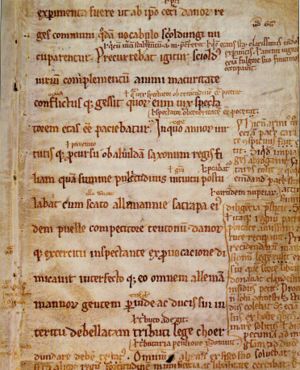
The original manuscripts of the work are lost, except for four fragments: the Angers FragmentAngers Fragment
The Angers Fragment is four parchment pages from c. 1200. It is one of the four fragments remaining of the original Saxo Gesta Danorum. This fragment is the only fragment attested to be of Saxo's own handwriting...
, Lassen Fragment
Lassen Fragment
The Lassen Fragment, is a parchment page from c. 1275. It is one of the four fragments remaining of the original, or early copy of, Saxo's Gesta Danorum. Size is 40x27 cm. It consists of one page with two written sides.-History:...
, Kall-Rasmussen Fragment
Kall-Rasmussen Fragment
The Kall-Rasmussen Fragment is a parchment page from c. 1275. It is one of the four fragments remaining, or early copy of, of the original Saxo's Gesta Danorum. Its size is about 19x11cm. It consists of two pages with four written sides.-History:...
and Plesner Fragment
Plesner Fragment
The Plesner Fragment is a parchment page from c. 1275. It is one of the four fragments remaining, or early copy of, of the original Saxo Gesta Danorum. Size is 15x13cm. It consists of one page with two written sides.-History:Found in 1877 by C. U. A...
. The Angers Fragment
Angers Fragment
The Angers Fragment is four parchment pages from c. 1200. It is one of the four fragments remaining of the original Saxo Gesta Danorum. This fragment is the only fragment attested to be of Saxo's own handwriting...
is the biggest fragment, and the only one attested to be in Saxo’s own handwriting. The other ones are copies from ca. 1275. All four fragments are in the collection of the Danish Royal Library
Danish Royal Library
The Royal Library in Copenhagen is the national library of Denmark and university library of University of Copenhagen. It is the largest library in the Nordic countries....
in Copenhagen
Copenhagen
Copenhagen is the capital and largest city of Denmark, with an urban population of 1,199,224 and a metropolitan population of 1,930,260 . With the completion of the transnational Øresund Bridge in 2000, Copenhagen has become the centre of the increasingly integrating Øresund Region...
, Denmark.
The text has, however, survived. In 1510-1512, Christiern Pedersen
Christiern Pedersen
Christiern Pedersen was a canon, humanist scholar, writer, printer and publisher.-Education:Christiern Pedersen was born in Helsingør, Denmark. He was schooled in Roskilde and studied from 1496 at the University of Greifswald...
, a Danish translator working in Paris, searched Denmark high and low for an existing copy of Saxo’s works, which by that time was nearly all but lost. By that time most knowledge of Saxo’s work came from a summary located in Chronica Jutensis
Chronica Jutensis
Chronica Jutensis also known as Continuatio compendii Saxonis or Chronica Danorum, is a small Danish historical work from the middle of the 14th century, written in Latin....
, from around 1342, called Compendium Saxonis
Compendium Saxonis
Compendium Saxonis is a summary located in Chronica Jutensis. It contains a summary of Saxo’s Gesta Danorum, about one-fourth the size of the original. It is written in Latin....
. It is also in this summary that the name Gesta Danorum is found. The title Saxo himself used for his work is unknown.
Christiern Pedersen finally found a copy in the collection of Archbishop Birger Gunnersen of Lund
Lund
-Main sights:During the 12th and 13th centuries, when the town was the seat of the archbishop, many churches and monasteries were built. At its peak, Lund had 27 churches, but most of them were demolished as result of the Reformation in 1536. Several medieval buildings remain, including Lund...
, modern Sweden
Sweden
Sweden , officially the Kingdom of Sweden , is a Nordic country on the Scandinavian Peninsula in Northern Europe. Sweden borders with Norway and Finland and is connected to Denmark by a bridge-tunnel across the Öresund....
, which he gladly lent him. With the help of printer Jodocus Badius
Jodocus Badius
Jodocus Badius was a pioneer of the printing industry.Sometimes called Badius Ascensius from the village of Asse, near Brussels, where he was born, he became an eminent printer at Paris. His establishment came to be known as the Prelum Ascensianum...
, Gesta Danorum was refined and printed.
Printing
Jodocus Badius
Jodocus Badius was a pioneer of the printing industry.Sometimes called Badius Ascensius from the village of Asse, near Brussels, where he was born, he became an eminent printer at Paris. His establishment came to be known as the Prelum Ascensianum...
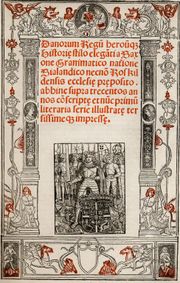
in Paris, France, March 15, 1514 under the title of Danorum Regum heroumque Historiae ("History of the Kings and heroes of the Danes"). The edition features the following colophon
Colophon (publishing)
In publishing, a colophon is either:* A brief description of publication or production notes relevant to the edition, in modern books usually located at the reverse of the title page, but can also sometimes be located at the end of the book, or...
: ...impressit in inclyta Parrhisorum academia Iodocus Badius Ascensius Idibus Martiis. MDXIIII. Supputatione Romana. (the Ides of March
Ides of March
The Ides of March is the name of the 15th day of March in the Roman calendar, probably referring to the day of the full moon. The word Ides comes from the Latin word "Idus" and means "half division" especially in relation to a month. It is a word that was used widely in the Roman calendar...
, 1514).
The full front page reads (with abbreviations expanded) in Latin:
Danorum Regum heroumque Historiae stilo eleganti a Saxone Grammatico natione Zialandico necnon Roskildensis ecclesiae praeposito, abhinc supra trecentos annos conscriptae et nunc primum literaria serie illustratae tersissimeque impressae.
Danish language
Danish language
Danish is a North Germanic language spoken by around six million people, principally in the country of Denmark. It is also spoken by 50,000 Germans of Danish ethnicity in the northern parts of Schleswig-Holstein, Germany, where it holds the status of minority language...
:
De danske Kongers og Heltes Historie, skrevet I pyntelig Stil for over 300 Aar siden af Saxo Grammaticus, en Sjællandsfar og Provst ved Kirken I Roskilde, og nu for første Gang oplyst ved et Register og omhyggeligt trykt.
English language
English language
English is a West Germanic language that arose in the Anglo-Saxon kingdoms of England and spread into what was to become south-east Scotland under the influence of the Anglian medieval kingdom of Northumbria...
:
Histories of the Kings and heroes of the Danes, composed in elegant style by Saxo Grammaticus, a Sjællander and also provost of the church of RoskildeRoskildeRoskilde is the main city in Roskilde Municipality, Denmark on the island of Zealand. It is an ancient city, dating from the Viking Age and is a member of the Most Ancient European Towns Network....
, over three hundred years ago, and now for the first time illustrated and printed correctly in a learned compilation.
Latin versions
The source of all existing translations and new editions is Christiern Pedersen's Latin Danorum Regum heroumque Historiae. There exist a number different translations today, some complete, some partial:- Christiern PedersenChristiern PedersenChristiern Pedersen was a canon, humanist scholar, writer, printer and publisher.-Education:Christiern Pedersen was born in Helsingør, Denmark. He was schooled in Roskilde and studied from 1496 at the University of Greifswald...
, published 1514, title: Danorum Regum heroumque Historiae - Johannes OporinusJohannes OporinusJohannes Oporinus was a humanist printer in Basel, the son of the painter Hans Herbst- Life :...
, published 1534, title: Saxonis Grammatici Danorum Historiae Libri XVI - Philip LonicerPhilip LonicerPhilip Lonicer was a German historian.Lonicer produced a Latin version of the Gesta Danorum in 1576, entitled Danica Historia Libris XVI. He was also the rector of the Frankfurt Gymnasium....
, published 1576, title: Danica Historia Libris XVI - Stephan Hansen Stephanius, published 1645, title: Saxonis Grammatici Historiæ Danicæ Libri XVI
- Christian Adolph KlotzChristian Adolph KlotzChristian Adolph Klotz was a German philologist. He was a renowned representative of the transition period between the Age of Enlightenment and Sturm und Drang.-Education:...
, published 1771, title: Saxonis Grammatici Historiae Danicae libri XVI - Peter Erasmus MüllerPeter Erasmus MüllerPeter Erasmus Müller , was a Danish bishop, historian, linguist and professor of theology.-Biography:He was born at Copenhagen, and studied at the university there, passing his theological examination in 1791. After spending some time in the German universities, he visited France and England...
, published 1839, title: Saxonis Grammatici Historia Danica - Alfred HolderAlfred HolderAlfred Theophil Holder , was chief librarian of the national library in Karlsruhe. He was an Austrian-German writer and student of several ancient languages including Celtic, Germanic, and Latin...
, published 1886, title: Saxonis Grammatici Gesta Danorum - Jørgen Olrik & Hans Ræder, published 1931, title: Saxonis Gesta Danorum
- Karsten Friis-Jensen, published 2005, title: Gesta Danorum ISBN 978-87-12-04025-5, ISBN 87-12-04025-8
Danish translations
- Christiern PedersenChristiern PedersenChristiern Pedersen was a canon, humanist scholar, writer, printer and publisher.-Education:Christiern Pedersen was born in Helsingør, Denmark. He was schooled in Roskilde and studied from 1496 at the University of Greifswald...
, never published ca. 1540, Lost - Jon Tursons, never published ca. 1555, Lost
- Anders Sørensen VedelAnders Sørensen VedelAnders Sørensen Vedel was a Danish priest and historiographer. He translated the Gesta Danorum by Saxo Grammaticus into Danish in 1575, and published the influential "Hundredvisebogen" in 1591.-Biography:...
, published 1575, title: Den Danske Krønicke - Sejer Schousbölle, published 1752, title: Saxonis Grammatici Historia Danica
- N. F. S. Grundtvig, published 1818-1822, title: Danmarks Krønike af Saxo Grammaticus
- Frederik Winkel HornFrederik Winkel HornFrederik Winkel Horn , was a Danish historian and translator. Original archaeologist.-Works:* Mennesket i forhistorisk tid, 1874 * Nordiske heltesagaer, 1876...
, published 1898, title: Saxo Grammaticus: Danmarks Krønike - Jørgen Olrik, published 1908-1912, title: Sakses Danesaga
- Peter Zeeberg, published 2000, title: Saxos Danmarkshistorie ISBN 87-12-03496-7 (complete) ISBN 87-12-03534-3 (vol 1) ISBN 87-12-03535-1 (vol 2)
English translations
- Oliver EltonOliver EltonOliver Elton was an English literary scholar whose works include A Survey of English Literature in six volumes, criticism, biography, and translations from several languages including Icelandic and Russian...
, published 1894, title: The First Nine Books of the Danish History of Saxo Grammaticus - Peter Fisher and Hilda Ellis Davidson, published 1979-1980, title: Saxo Grammaticus: The History of the Danes, Books I-IX
- Eric Christiansen, published 1980-1981, title: Saxo Grammaticus: Danorum regum heroumque historia, books X-XVI
- William F. Hansen, published 1983, title: Saxo Grammaticus and the life of Hamlet
Other translations
- Hermann JantzenHermann JantzenHermann Jantzen was a Christian Mennonite missionary to Russian Turkestan.When he was a teenager, Jantzen's family followed Claas Epp, Jr. to Central Asia on the Great Trek. He became a court interpreter for Muhammad Rahim II in the Khanate of Khiva before rising through the ranks as an interior...
, published 1900, title: Saxo Grammaticus. Die ersten neun Bücher der dänischen Geschichte - Ludovica Koch & Maria Adele Cipolla, published 1993, title: Sassone Grammatico: Gesta dei re e degli eroi danesi
- Yukio Taniguchi, published 1993, title: Sakuso Guramatikusu: Denmakujin no jiseki
- Santiago Ibáñez Lluch, published 1999, title: Saxo Gramático: Historia Danesa
Gesta Danorum is also translated partially in other English
English language
English is a West Germanic language that arose in the Anglo-Saxon kingdoms of England and spread into what was to become south-east Scotland under the influence of the Anglian medieval kingdom of Northumbria...
, French
French language
French is a Romance language spoken as a first language in France, the Romandy region in Switzerland, Wallonia and Brussels in Belgium, Monaco, the regions of Quebec and Acadia in Canada, and by various communities elsewhere. Second-language speakers of French are distributed throughout many parts...
and German
German language
German is a West Germanic language, related to and classified alongside English and Dutch. With an estimated 90 – 98 million native speakers, German is one of the world's major languages and is the most widely-spoken first language in the European Union....
releases.
Hamlet
Certain aspects of Gesta Danorum formed the basis for William ShakespeareWilliam Shakespeare
William Shakespeare was an English poet and playwright, widely regarded as the greatest writer in the English language and the world's pre-eminent dramatist. He is often called England's national poet and the "Bard of Avon"...
's play, Hamlet
Hamlet
The Tragical History of Hamlet, Prince of Denmark, or more simply Hamlet, is a tragedy by William Shakespeare, believed to have been written between 1599 and 1601...
. It is thought that Shakespeare never read Gesta Danorum, and instead had access to an auxiliary version of the tale
Ur-Hamlet
The Ur-Hamlet is the name given to a play mentioned as early as 1589, a decade before most scholars believe Shakespeare composed Hamlet...
describing the downfall of the Prince of Denmark, whose real name - Amleth - was used in anagram
Anagram
An anagram is a type of word play, the result of rearranging the letters of a word or phrase to produce a new word or phrase, using all the original letters exactly once; e.g., orchestra = carthorse, A decimal point = I'm a dot in place, Tom Marvolo Riddle = I am Lord Voldemort. Someone who...
by Shakespeare for Hamlet.
Saxo’s version, told of in Book 3 and 4, is very similar to that of Shakespeare’s Hamlet. In Saxo's version, two brothers, Orvendil
Horwendill
Horwendill was a legendary Jutish chieftain, who is the prototype for William Shakespeare's King Hamlet, Prince Hamlet's father. He appears in Chronicon Lethrense and in Saxo Grammaticus' Gesta Danorum ....
and Fengi
Feng (Claudius)
Feng was a legendary Jutish chieftain and the prototype for William Shakespeare's King Claudius. He appears in Chronicon Lethrense and in Saxo Grammaticus' Gesta Danorum ....
are given the rule over Jutland
Jutland
Jutland , historically also called Cimbria, is the name of the peninsula that juts out in Northern Europe toward the rest of Scandinavia, forming the mainland part of Denmark. It has the North Sea to its west, Kattegat and Skagerrak to its north, the Baltic Sea to its east, and the Danish–German...
by King Rørik Slyngebond of the Danes. Soon after, Orvendil marries King Rørik’s daughter, Geruth (Gertrude in Hamlet). Amleth is their first and only child.
Fengi becomes resentful of his brother’s marriage, and also wants sole leadership of Jutland, so therefore murders Orvendil. After a very brief period of mourning, Fengi marries Geruth, and declares himself sole leader of Jutland. Eventually, Amleth avenges his father’s murder and plans the murder of his uncle, making him the new and rightful king of Jutland. However, while Hamlet dies in Shakespeare's version just after his uncle's death, in Saxo's version Amleth survives and begins ruling his kingdom, going on to other adventures.
External links
- On-Line Medieval and Classical History: The Danish History books I-IX, translated by Oliver Elton (Norroena Society, New York, 1905)."His seven later books are the chief Danish authority for the times which they relate; his first nine, here translated, are a treasure of myth and folk-lore" (Elton, Introduction).
- Gesta Danorum in Latin
- One of the versions in the Danish Royal Library
- Proverbs and proverbial materials in Saxo's Gesta Danorum
----