
All Topics  
Giraffe

 
Giraffe

   Email Print
   Bookmark   Link


Giraffe


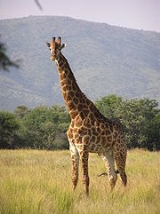
The giraffe (Giraffa camelopardalis) is an Africa
Africa

Africa is the world's second-largest and second most-populous continent, after Asia. At about 30.2 million km? including adjacent islands, it covers 6% of the Earth's total surface area and 20.4% of the total land area....
n even-toed ungulate
Even-toed ungulate

The even-toed ungulates form the mammal order Artiodactyla, the group that contains the pigs, peccary, hippopotamuses, camels, chevrotains , deer, giraffes, pronghorn, antelopes, sheep, goats, and cattle....
 mammal
Mammal

Mammals are a class of vertebrate animals whose name is derived from their distinctive feature, mammary glands, with which they feed their young....
, the tallest of all land-living animal
Animal

Animals are a major group of multicellular, eukaryotic organisms of the Kingdom Animalia or Metazoa. Their body plan eventually becomes fixed as they develop, although some undergo a process of metamorphosis later on in their life....
 species
Species

In biology, a species is one of the basic units of biological classification and a taxonomic rank. A species is often defined as a group of organisms capable of interbreeding and producing fertile offspring....
, and the largest ruminant
Ruminant

Physiologically, a ruminant is a mammal of the order Artiodactyla that digests plant-based food by initially softening it within the animal's first stomach, known as the rumen, then regurgitating the semi-digested mass, now known as cud, and chewing it again....
. It is covered in large, irregular patches of yellow to black fur separated by white, off-white, or dark yellowish brown background. The average mass for an adult male giraffe is while the average mass for an adult female is . It is approximately to tall, although the tallest male recorded stood almost .

The giraffe is related to deer
Deer

Deer are the ruminant mammals forming the family Cervidae . A number of broadly similar animals from related families within the order even-toed ungulate are often also called deer....
 and cattle
Cattle

Cattle, colloquially referred to as cows, are domestication ungulates, a member of the subfamily Bovinae of the family Bovidae. They are raised as livestock for meat , dairy products , leather and as draft animals ....
, but is placed in a separate family
Family

Family denotes a group of people affiliated by a common ancestry, affinity or co-residence. Although the concept of consanguinity originally referred to relations by "blood," some cultural anthropology have argued that one must understand the idea of "blood" metaphorically, and that many societies understand 'family' through other concepts r...
, the Giraffidae
Giraffidae

The giraffids are ruminant artiodactyl mammals that share a common ancestor with deer and bovids. The biological family Giraffidae, once a diverse group spread throughout Eurasia and Africa, contains only two living members, the giraffe and the okapi....
, consisting of only the giraffe and its closest relative, the okapi
Okapi

The Okapi is a giraffid artiodactyl mammal native to the Ituri Rainforest, located in the northeast of the Democratic Republic of the Congo, in central Africa....
.


Discussion
Ask a question about 'Giraffe'
Start a new discussion about 'Giraffe'
Answer questions from other users
Full Discussion Forum


Recent Posts


Encyclopedia


The giraffe (Giraffa camelopardalis) is an Africa
Africa

Africa is the world's second-largest and second most-populous continent, after Asia. At about 30.2 million km? including adjacent islands, it covers 6% of the Earth's total surface area and 20.4% of the total land area....
n even-toed ungulate
Even-toed ungulate

The even-toed ungulates form the mammal order Artiodactyla, the group that contains the pigs, peccary, hippopotamuses, camels, chevrotains , deer, giraffes, pronghorn, antelopes, sheep, goats, and cattle....
 mammal
Mammal

Mammals are a class of vertebrate animals whose name is derived from their distinctive feature, mammary glands, with which they feed their young....
, the tallest of all land-living animal
Animal

Animals are a major group of multicellular, eukaryotic organisms of the Kingdom Animalia or Metazoa. Their body plan eventually becomes fixed as they develop, although some undergo a process of metamorphosis later on in their life....
 species
Species

In biology, a species is one of the basic units of biological classification and a taxonomic rank. A species is often defined as a group of organisms capable of interbreeding and producing fertile offspring....
, and the largest ruminant
Ruminant

Physiologically, a ruminant is a mammal of the order Artiodactyla that digests plant-based food by initially softening it within the animal's first stomach, known as the rumen, then regurgitating the semi-digested mass, now known as cud, and chewing it again....
. It is covered in large, irregular patches of yellow to black fur separated by white, off-white, or dark yellowish brown background. The average mass for an adult male giraffe is while the average mass for an adult female is . It is approximately to tall, although the tallest male recorded stood almost .

The giraffe is related to deer
Deer

Deer are the ruminant mammals forming the family Cervidae . A number of broadly similar animals from related families within the order even-toed ungulate are often also called deer....
 and cattle
Cattle

Cattle, colloquially referred to as cows, are domestication ungulates, a member of the subfamily Bovinae of the family Bovidae. They are raised as livestock for meat , dairy products , leather and as draft animals ....
, but is placed in a separate family
Family

Family denotes a group of people affiliated by a common ancestry, affinity or co-residence. Although the concept of consanguinity originally referred to relations by "blood," some cultural anthropology have argued that one must understand the idea of "blood" metaphorically, and that many societies understand 'family' through other concepts r...
, the Giraffidae
Giraffidae

The giraffids are ruminant artiodactyl mammals that share a common ancestor with deer and bovids. The biological family Giraffidae, once a diverse group spread throughout Eurasia and Africa, contains only two living members, the giraffe and the okapi....
, consisting of only the giraffe and its closest relative, the okapi
Okapi

The Okapi is a giraffid artiodactyl mammal native to the Ituri Rainforest, located in the northeast of the Democratic Republic of the Congo, in central Africa....
. Its range extends from Chad
Chad

Chad , officially known as the Republic of Chad, is a landlocked country in central Africa. It is bordered by Libya to the north, Sudan to the east, the Central African Republic to the south, Cameroon and Nigeria to the southwest, and Niger to the west....
 in Central Africa
Central Africa

Central Africa is a core region of the African continent often considered to include Burundi, the Central African Republic, Chad, Democratic Republic of the Congo, and Rwanda....
 to South Africa
South Africa

The Republic of South Africa, also known by Official names of South Africa, is a country located at the southern tip of the continent of Africa....
.

Giraffes usually inhabit
Inhabit

Inhabit means to live in, reside in, occupy or populate some place.Inhabit may also refer to:* Inhabit , an album by Living Sacrifice* Inhabited , a rock group...
 savanna
Savanna

A savanna, or savannah, is a tropical, subtropical or temperate woodland ecosystem characterized by the trees being sufficiently small or widely spaced so that the Canopy does not close....
s, grassland
Grassland

Grasslands are areas where the vegetation is dominated by grasses and other herbaceous plants . However, sedge and rush families can also be found....
s, or open woodland
Woodland

Ecologically, a woodland is an area covered in trees, usually at low density, forming an open habitat, allowing sunlight to penetrate between the trees, and limiting shade....
s. However, when food is scarce they will venture into areas with denser vegetation
Vegetation

refers to the flora system of a specific region....
. They prefer areas with plenty of acacia
Acacia

Acacia is a genus of shrubs and trees belonging to the subfamily Mimosoideae of the family Fabaceae, first described in Africa by the Sweden botanist Carolus Linnaeus in 1773....
 growth. They will drink large quantities of water when available which enables them to live for extended periods in dry, arid areas.

Etymology

The species name camelopardalis (camelopard) is derived from its early Roman
Roman Empire

The Roman Empire was the Roman Republic phase of the Ancient Rome, characterised by an autocracy form of government and large territorial holdings in Europe and around the Mediterranean....
 name, where it was described as having characteristics of both a camel
Camel

Camels are even-toed ungulates within the genus Camelus. The dromedary, one-humped or Arabian camel has a single hump and is well known for its healthy low fat milk, and the Bactrian camel has two humps....
 and a leopard
Leopard

The leopard is a member of the Felidae biological family and the smallest of the four "Panthera" in the genus Panthera; the other three are the tiger, lion and jaguar....
. The English word camelopard first appeared in the 14th century and survived in common usage well into the 19th century. The Afrikaans language retained it. The Arabic word ??????? ziraafa or zurapha, meaning "assemblage" (of animals), or just "tall", was used in English from the sixteenth century on, often in the Italianate
Italian language

Italian is a Romance languages spoken by about 63 million people as a first language, primarily in Italy. In Switzerland, Italian is one of four Linguistic geography of Switzerlands....
 form giraffa.

Taxonomy and evolution

The giraffe is one of only two living species of the family Giraffidae
Giraffidae

The giraffids are ruminant artiodactyl mammals that share a common ancestor with deer and bovids. The biological family Giraffidae, once a diverse group spread throughout Eurasia and Africa, contains only two living members, the giraffe and the okapi....
, along with the okapi
Okapi

The Okapi is a giraffid artiodactyl mammal native to the Ituri Rainforest, located in the northeast of the Democratic Republic of the Congo, in central Africa....
. The family was once much more extensive, with numerous other species. The giraffids evolved from a tall antelope-like mammal that roamed Europe and Asia some 30-50 million years ago.

The earliest known giraffid was Climacoceras
Climacoceras

Climacoceras was a genus of early Miocene artiodactyl ungulates of Africa and Europe. The members of Climacoceras were related to giraffes, as the genus was once placed within Giraffidae....
, which still resembled deer, having large antler
Antler

Antlers are the usually large and complex horn -like appendages of most deer species, mostly worn by males in true horns. Each antler grows from an attachment point on the skull called a pedicle....
-like ossicone
Ossicone

Not to be confused with ossiclesOssicones are Horn -like protuberances on the heads of giraffes, male okapis, and their extinct relatives, such as Sivatherium, and the climacoceratids, such as Climacoceras....
s. It first appeared in the early Miocene
Miocene

The Miocene is a Geologic time scale of the Neogene period and extends from about 23.03 to 5.33 million years before the present. As with other older geologic periods, the rock beds that define the start and end are well identified but the exact dates of the start and end of the period are uncertain....
 epoch
Geologic time scale

File:Geologic clock.jpgThe geologic time scale is a chronology schema relating stratigraphy to time that is used by geologys and other earth sciences scientists to describe the timing and relationships between events that have occurred during the history of the Earth....
. Later examples include the genera
Genus

A genus is a low-level taxonomic rank used in the classification of living and fossil organisms. The taxonomic ranks are domain , kingdom , phylum, class , order , family , genus, and species....
 Palaeotragus
Palaeotragus

Palaeotragus was a genus of very large, primitive okapi from the Miocene of Africa.Palaeotragus primaevus is the older species, being found in early to mid-Miocene strata, while Palaeotragus germaini is found in Late Miocene strata....
 and Samotherium
Samotherium

Samotherium is an extinct genus of giraffe from the Miocene and Pliocene. Samotherium had two ossicones on its head, and long legs. Some believe that the two Shansitherium species might belong to this genus as well....
, which appeared in the early to mid-Miocene
Miocene

The Miocene is a Geologic time scale of the Neogene period and extends from about 23.03 to 5.33 million years before the present. As with other older geologic periods, the rock beds that define the start and end are well identified but the exact dates of the start and end of the period are uncertain....
. They were both tall at the shoulder, and had developed the simple, unbranched ossicones of modern giraffids, but still had relatively short necks.

From the late Pliocene
Pliocene

The Pliocene epoch is the period in the geologic timescale that extends from 5.332 million to 1.806 million years before present.The Pliocene is the second epoch of the Neogene period in the Cenozoic era....
 onwards, the variety of giraffids drastically declined, until only the two surviving species remained. The modern genus Giraffa evolved during the Pliocene
Pliocene

The Pliocene epoch is the period in the geologic timescale that extends from 5.332 million to 1.806 million years before present.The Pliocene is the second epoch of the Neogene period in the Cenozoic era....
 epoch, and included a number of other long-necked species, such as Giraffa jumae
Giraffa jumae

Giraffa jumae is an extinct species of mammals in the Giraffidae family. The species ranged from Malawi to Chad with a possible occurrence of the species or a closely related species found in Turkey....
, that do not survive today. Alan Turner
Alan Turner

Alan Turner is a former Australian cricketer who played in 14 Test cricket and 6 One Day Internationals from 1975 to 1977....
 proposes, in the 2004 book Evolving Eden, that giraffe ancestors initially had a dark coat with pale spots, and that the spots gradually became star-shaped, before eventually forming the reticulated pattern found today. The modern species, Giraffa camelopardalis, appeared during the Pleistocene
Pleistocene

The Pleistocene is the epoch from 1.8 million to 10,000 years Before Present covering the world's recent period of repeated glaciations. The name pleistocene is derived from the Greek and ....
 1 million years ago.

The evolution of the long necks of giraffes has been the subject of much debate. The standard story is that they were evolved to allow the giraffes to browse vegetation that was out of the reach of other herbivores in the vicinity, giving them a competitive advantage
Competition (biology)

Competition can be defined as an Biological interaction between organisms or species, in which the fitness of one is lowered by the presence of another....
. However, an alternative theory proposes that the long necks evolved as a secondary sexual characteristic
Sexual dimorphism

Sexual dimorphism is the systematic difference in form between individuals of different sex in the same species. Examples include color , size, and the presence or absence of parts of the body used in courtship displays or fights, such as ornamental feathers, horns, antlers or tusks....
, giving males an advantage in "necking" contests (see below) to establish dominance and obtain access to sexually receptive females. This theory notes that giraffes frequently feed from relatively low-lying shrubs, and that the necks of males are significantly longer than those of females. However, this theory is not universally accepted, and some of the data supporting it has recently been challenged, lending support to the original proposal that neck length is related to browsing habits.

Subspecies

There are nine generally accepted subspecies
Subspecies

In biology, subspecies is the taxonomic rank immediately subordinate to a species. A subspecies is a taxonomic group which is less distinct than the Common descent or species from which it originates....
, differentiated by colour and pattern variations and range:
  • Reticulated or Somali Giraffe
    Somali Giraffe

    The Somali Giraffe or Reticulated Giraffe, Giraffa camelopardalis reticulata, is a subspecies of giraffe native to Somalia, but is also widely found in Northern Kenya, and Southern Ethiopia....
     (G.c. reticulata) — large, polygonal liver-coloured spots outlined by a network of bright white lines. The blocks may sometimes appear deep red and may also cover the legs. Range: northeastern Kenya
    Kenya

    The Republic of Kenya is a country in East Africa. It is bordered by Ethiopia to the north, Somalia to the northeast, Tanzania to the south, Uganda to the west, and Sudan to the northwest, with the Indian Ocean running along the southeast border....
    , Ethiopia
    Ethiopia

    Ethiopia , officially the Federal Democratic Republic of Ethiopia, is a landlocked country situated in the Horn of Africa. Ethiopia is bordered by Eritrea to the north, Sudan to the west, Kenya to the south, Somalia to the east and Djibouti to the northeast....
    , Somalia
    Somalia

    Somalia , officially the Republic of Somalia and formerly known as the Somali Democratic Republic, is a country located in the Horn of Africa....
    .
  • Angolan or Smoky Giraffe (G.c. angolensis) — large spots and some notches around the edges, extending down the entire lower leg. Range: Angola
    Angola

    Angola, officially the Republic of Angola , is a country in south-central Africa bordering Namibia to the south, Democratic Republic of the Congo to the north, and Zambia to the east, and with a west coast along the Atlantic Ocean....
    , Zambia
    Zambia

    The Republic of Zambia is a landlocked country in Southern Africa. The neighbouring countries are the Democratic Republic of the Congo to the north, Tanzania to the north-east, Malawi to the east, Mozambique, Zimbabwe, Botswana, and Namibia to the south, and Angola to the west....
    .
  • Kordofan Giraffe
    Kordofan Giraffe

    The Kordofan Giraffe is a subspecies of giraffe found in Sudan. It has more irregular spots on the inner legs....
     (G.c. antiquorum) — smaller, more irregular spots that cover the inner legs. Range: western and southwestern Sudan
    Sudan

    Sudan is a country in northeastern Africa. It is the largest in the African continent and the Arab World, and List of countries and outlying territories by total area by area....
    .
  • Masai
    Masai Giraffe

    The Masai Giraffe, also known as the Kilimanjaro Giraffe is one of the smallest subspecies of giraffe.? Masai giraffe have jagged spots on their bodies.? Originally the masai giraffe lived throughout Africa but currently, due to loss of habitat, the giraffe only lives in Kenya and Tanzania....
     or Kilimanjaro Giraffe (G.c. tippelskirchi) — jagged-edged, vine-leaf shaped spots of dark chocolate on a yellowish background. Range: central and southern Kenya
    Kenya

    The Republic of Kenya is a country in East Africa. It is bordered by Ethiopia to the north, Somalia to the northeast, Tanzania to the south, Uganda to the west, and Sudan to the northwest, with the Indian Ocean running along the southeast border....
    , Tanzania
    Tanzania

    Tanzania , officially the United Republic of Tanzania , is a country in East Africa that is bordered by Kenya and Uganda on the north, Rwanda, Burundi and the Democratic Republic of the Congo on the west, and Zambia, Malawi and Mozambique on the south....
    .
  • Nubian Giraffe (G.c. camelopardalis) — large, four-sided spots of chestnut brown on an off-white background and no spots on inner sides of the legs or below the hocks. Range: eastern Sudan
    Sudan

    Sudan is a country in northeastern Africa. It is the largest in the African continent and the Arab World, and List of countries and outlying territories by total area by area....
    , northeast Congo
    Democratic Republic of the Congo

    The Democratic Republic of the Congo , is a country in central Africa with a small length of Atlantic coastline. It is the third largest list of African countries in order of geographical area....
    .
  • Rothschild Giraffe
    Rothschild giraffe

    The Rothschild Giraffe, named after Walter Rothschild Zoological Museum's founder, Lord Walter Rothschild, also known as the Baringo Giraffe, after the Lake Baringo area of Kenya, or as the Ugandan Giraffe, is the second most endangered giraffe subspecies with only a few hundred members....
     or Baringo Giraffe or Ugandan Giraffe (G.c. rothschildi) — deep brown, blotched or rectangular spots with poorly defined cream lines. Hocks may be spotted. Range: Uganda
    Uganda

    The Republic of Uganda is a landlocked country in East Africa. It is bordered on the east by Kenya, on the north by Sudan, on the west by the Democratic Republic of the Congo, on the southwest by Rwanda, and on the south by Tanzania....
    , north-central Kenya
    Kenya

    The Republic of Kenya is a country in East Africa. It is bordered by Ethiopia to the north, Somalia to the northeast, Tanzania to the south, Uganda to the west, and Sudan to the northwest, with the Indian Ocean running along the southeast border....
    .
  • South African Giraffe (G.c. giraffa) — rounded or blotched spots, some with star-like extensions on a light tan background, running down to the hooves. Range: South Africa
    South Africa

    The Republic of South Africa, also known by Official names of South Africa, is a country located at the southern tip of the continent of Africa....
    , Namibia
    Namibia

    Namibia, officially the Republic of Namibia, is a country in southern Africa on the Atlantic Ocean coast. It shares borders with Angola and Zambia to the north, Botswana to the east, and South Africa to the south....
    , Botswana
    Botswana

    The Republic of Botswana , is a landlocked country in Southern Africa. Citizens of Botswana are called "Batswana" , regardless of ethnicity. Formerly a British protectorate of Bechuanaland Protectorate, Botswana adopted its new name after becoming independent within the Commonwealth of Nations on 30 September 1966....
    , Zimbabwe
    Zimbabwe

    Zimbabwe , is a landlocked country located in the southern part of the continent of Africa, between the Zambezi and Limpopo River rivers. It is bordered by South Africa to the south, Botswana to the southwest, Zambia to the northwest and Mozambique to the east....
    , Mozambique
    Mozambique

    Mozambique, officially the Republic of Mozambique , is a country in southeastern Africa bordered by the Indian Ocean to the east, Tanzania to the north, Malawi and Zambia to the northwest, Zimbabwe to the west and Swaziland and South Africa to the southwest....
    .
  • Thornicroft or Rhodesian Giraffe (G.c. thornicrofti) — star-shaped or leafy spots extend to the lower leg. Range: eastern Zambia
    Zambia

    The Republic of Zambia is a landlocked country in Southern Africa. The neighbouring countries are the Democratic Republic of the Congo to the north, Tanzania to the north-east, Malawi to the east, Mozambique, Zimbabwe, Botswana, and Namibia to the south, and Angola to the west....
    .
  • West African or Nigerian Giraffe (G.c. peralta) — numerous pale, yellowish red spots. Range: Niger
    Niger

    Niger , officially the Republic of Niger, is a landlocked country in Western Africa, named after the Niger River. It borders Nigeria and Benin to the south, Burkina Faso and Mali to the west, Algeria and Libya to the north and Chad to the east....
    , Cameroon
    Cameroon

    The Republic of Cameroon is a unitary state of central and western Africa. It is bordered by Nigeria to the west; Chad to the northeast; the Central African Republic to the east; and Equatorial Guinea, Gabon, and the Republic of the Congo to the south....
    .
Some scientists regard Kordofan and West African Giraffes as a single subspecies; similarly with Nubian and Rothschild's Giraffes, and with Angolan and South African Giraffes. Further, some scientists regard all populations except the Masai Giraffes as a single subspecies. By contrast, scientists have proposed four other subspecies — Cape Giraffe (G.c. capensis), Lado Giraffe (G.c. cottoni), Congo Giraffe (G.c. congoensis), and Transvaal Giraffe (G.c. wardi) — but none of these is widely accepted.

Though giraffes of these populations interbreed freely under conditions of captivity, suggesting that they are subspecific populations, genetic testing published in 2007 has been interpreted to show that there may be at least six species of giraffe that are reproductively isolated
Reproductive isolation

An important concept in evolutionary biology, reproductive isolation is a category of mechanisms that prevent two or more populations from exchanging genes....
 and not interbreeding, even though no natural obstacles, like mountain ranges or impassable rivers block their mutual access. In fact, the study found that the two giraffe populations that live closest to each other— the reticulated giraffe (G. camelopardalis reticulata) of north Kenya, and the Masai giraffe (G. c. tippelskirchi) in south Kenya— separated genetically between 0.13 and 1.62 million years BP, judging from genetic drift
Genetic drift

Genetic drift or allelic drift is the change in the relative frequency with which a gene variant occurs in a population that results from the fact that alleles in offspring are a Sampling of those in the parents, and because of the role of chance in determining whether a given individual survives and reproduces....
 in nuclear
Nuclear DNA

Nuclear DNA, nuclear deoxyribonucleic acid , is DNA contained within a cell nucleus of eukaryote. In most cases it encodes more of the genome than the mitochondrial DNA and is passed sexually rather than matrilineally....
 and mitochondrial DNA
Mitochondrial DNA

Mitochondrial DNA is the DNA located in organelles called mitochondrion. Most other DNA present in eukaryotic organisms is found in the cell nucleus....
.

The implications for conservation of as many as eleven such cryptic species and sub-species were summarised by David Brown for BBC News
BBC News

BBC News, formerly BBC News and Current Affairs, is the department within the BBC responsible for the corporation's news-gathering and production of news programmes on BBC television, radio and online....
: "Lumping all giraffes into one species obscures the reality that some kinds of giraffe are on the brink. Some of these populations number only a few hundred individuals and need immediate protection."

Anatomy and morphology


Male giraffes are around 4.8-5.5 m (16-19 ft) tall at the horn tips, and normally weigh 1300-1700 kg (2900-3800 lb) Females are 30-60 cm (1-2 ft) shorter and weigh about 200-400 kg (400-800 lb) less than males. Giraffes have spots covering their entire bodies, except their underbellies, with each giraffe having a unique pattern of spots.

Horns

Both sexes have horns, although the horns of a female are smaller. The prominent horns are formed from ossified cartilage, and are called ossicone
Ossicone

Not to be confused with ossiclesOssicones are Horn -like protuberances on the heads of giraffes, male okapis, and their extinct relatives, such as Sivatherium, and the climacoceratids, such as Climacoceras....
s. The appearance of horns is a reliable method of identifying the sex of giraffes, with the females displaying tufts of hair on the top of the horns, where as males' horns tend to be bald on top — an effect of necking in combat. Males sometimes develop calcium deposits which form bumps on their skull as they age, which can give the appearance of up to three additional horns.

Neck

Giraffes have long necks which they use to browse tree leaves. They possess seven vertebrae in the neck (the usual number for a mammal) that are elongated. The vertebrae are separated by highly flexible joints. The base of the neck has spines which project upward and form a hump over the shoulders. They have anchor muscles that hold the neck upright.

Legs and pacing

Giraffes also have slightly elongated forelegs, about 10% longer than their hind legs. The pace of the giraffe is an amble, though when pursued it can run extremely fast, up to 55 km/h. It can not sustain a lengthy chase. Its leg length compels an unusual gait with the left legs moving together followed by right (similar to pacing
Pacing

Pacing may mean:* horse gaits#Pace, a horse gait used in Standardbred horse races* Pacing, the even spreading out of athletes' strength in longer-distance track and field and swimming races, so that they don't burn themselves out...
) at low speed, and the back legs crossing outside the front at high speed. When hunting adult giraffes, lion
Lion

The lion is a member of the family Felidae and one of four big cats in the genus Panthera. With exceptionally large males exceeding 250 kg in weight, it is the second-largest living cat after the tiger....
s try to knock the lanky animal off its feet and pull it down. Giraffes are difficult and dangerous prey. The giraffe defends itself with a powerful kick. A single well-placed kick from an adult giraffe can shatter a lion's skull or break its spine. Lions are the only predators which pose a serious threat to an adult giraffe.

Circulatory system

Modifications to the giraffe's structure have evolved, particularly to the circulatory system
Circulatory system

The circulatory system is an organ that moves nutrients, gases, and wastes to and from cells to help fight diseases and help stabilize body temperature and pH to maintain homeostasis....
. A giraffe's heart, which can weigh up to 10 kg (22 lb) and measure about 60 cm (2 ft) long, must generate approximately double the normal blood pressure for an average large mammal to maintain blood flow to the brain. In the upper neck, a complex pressure-regulation system called the rete mirabile
Rete mirabile

A rete mirabile is a complex of artery and veins lying very close to each other, found in some vertebrates. The rete mirabile utilizes countercurrent blood flow within the net It exchanges heat, ions, or gases between vessel walls so that the two bloodstreams within the rete maintain a gradient with respect to temperature, or concentratio...
 prevents excess blood flow to the brain when the giraffe lowers its head to drink. Conversely, the blood vessels in the lower legs are under great pressure (because of the weight of fluid pressing down on them). In other animals such pressure would force the blood out through the capillary walls; giraffes, however, have a very tight sheath of thick skin over their lower limbs which maintains high extravascular pressure in the same way as a pilot's g-suit
G-suit

A g-suit is worn by aviators and astronauts who are subject to high levels of acceleration . It is designed to prevent a black-out and g-LOC , due to the blood pooling in the lower part of the body when under g, thus depriving the brain of blood....
.

Behaviour


Social structure and breeding habits

Female giraffes associate in groups of a dozen or so members, occasionally including a few younger males. Younger males tend to live in "bachelor" herds, with older males often leading solitary lives. Reproduction is polygamous, with a few older males impregnating all the fertile females in a herd. Male giraffes determine female fertility by tasting the female's urine in order to detect estrus, in a multi-step process known as the Flehmen response
Flehmen response

The flehmen response, , also called the flehmen position, flehmen reaction, flehming, or flehmening , is a particular type of curling of the upper lip in ungulates, felids, and many other mammals, which facilitates the transfer of pheromones and other scents into the vomeronasal organ, also called the Jacobson's Organ...
.

Giraffes will mingle with the other herbivores in the African bush. Their company is beneficial, since they are tall enough to have a much wider scope of an area and will watch for predators.

Reproduction

Giraffe gestation
Gestation

Gestation is the carrying of an embryo or fetus inside a female viviparous animal. Mammals during mammalian pregnancy can have one or more gestations at the same time ....
 lasts between 400 and 460 days, after which a single calf is normally born, although twins occasionally occur. The mother gives birth standing up and the embryo
Embryo

An embryo is a multicellular organism ploidy eukaryote in its earliest stage of development, from the time of first cell division until birth, Egg , or germination....
nic sack usually bursts when the baby falls to the ground. Newborn giraffes are about 1.8 m (6 ft) tall. Within a few hours of being born, calves can run around and are indistinguishable from a week-old calf; however, for the first two weeks, they spend most of their time lying down, guarded by the mother. The young can fall prey to lions, leopard
Leopard

The leopard is a member of the Felidae biological family and the smallest of the four "Panthera" in the genus Panthera; the other three are the tiger, lion and jaguar....
s, spotted hyena
Spotted Hyena

The Spotted Hyena, or Laughing Hyena, is a Carnivora mammal of the family hyaenidae. It is the largest of the hyenas, and is native to sub-Saharan Africa, save for the Congo basin....
s, and wild dogs
African Wild Dog

The African Wild Dog is a Carnivore mammal of the Canidae family, found only in Africa, especially in scrub savanna and other lightly wooded areas....
. It has been speculated that their characteristic spotted pattern provides a certain degree of camouflage
Camouflage

Camouflage is a method of cryptic or concealing coloration that allows an otherwise visible organism or object to remain invisibility through deception....
. Only 25 to 50% of giraffe calves reach adulthood; the life expectancy is between 20 and 25 years in the wild and 28 years in captivity (Encyclopedia of Animals).

Necking

As noted above, males often engage in necking, which has been described as having various functions. One of these is combat. Battles can be fatal, but are more often less severe. The longer the neck, and the heavier the head at the end of the neck, the greater the force a giraffe is able to deliver in a blow. It has also been observed that males that are successful in necking have greater access to estrous
Estrous cycle

The oestrous cycle comprises the recurring physiology changes that are induced by sexual reproduction hormones in most mammalian placental females....
 females, so the length of the neck may be a product of sexual selection
Sexual selection

Sexual selection is the theory proposed by Charles Darwin that states that certain evolutionary traits can be explained by intraspecific competition....
.

After a necking duel, a giraffe can land a powerful blow with his head — occasionally knocking a male opponent to the ground. These fights rarely last more than a few minutes or end in physical harm.

Another function of necking is sexual, in which two males caress and court each other, leading up to mounting and climax. Such interactions between males are more frequent than heterosexual coupling. In one study, up to 94% of observed mounting incidents took place between two males. The proportion of same sex activities varied between 30 and 75%, and at any given time one in twenty males were engaged in non-combative necking behaviour with another male. Only 1% of same-sex mounting incidents occurred between females.

Giraffe (head)

Diet

The giraffe browses on the twigs of trees, preferring trees of the genus
Genus

A genus is a low-level taxonomic rank used in the classification of living and fossil organisms. The taxonomic ranks are domain , kingdom , phylum, class , order , family , genus, and species....
 Acacia
Acacia

Acacia is a genus of shrubs and trees belonging to the subfamily Mimosoideae of the family Fabaceae, first described in Africa by the Sweden botanist Carolus Linnaeus in 1773....
, and also eats grass and fruit. The tongue is tough due to the giraffe's diet, which can include tree thorns. In Southern Africa
Southern Africa

Southern Africa is the southernmost region of the African continent, variably defined by geography or geopolitics, consisting of numerous territories....
, giraffes feed on all acacia
Acacia

Acacia is a genus of shrubs and trees belonging to the subfamily Mimosoideae of the family Fabaceae, first described in Africa by the Sweden botanist Carolus Linnaeus in 1773....
s, especially Acacia erioloba
Acacia erioloba

Acacia erioloba , is also commonly known as the Camel Thorn, Kameeldoring , Giraffe Thorn or Mokala . The Mokala National Park in the Northern Cape is named after this tree....
, and possess a specially-adapted tongue and lips that are tough enough to withstand the vicious thorns of this plant. A giraffe can eat of leaves and twigs daily, but can survive on just . As ruminants, they first chew their food, swallow for processing and then visibly regurgitate the semi-digested cud up their necks and back into the mouth, in order to chew again. This process is usually repeated several times for each mouthful. The giraffe can surivive without water for extended periods. A giraffe will clean off any bugs that appear on its face with its extremely long tongue (about ).

Sleeping

The giraffe has one of the shortest sleep requirements of any mammal, which is between ten minutes and two hours in a 24-hour period, averaging 1.9 hours per day.

Communication

Although generally quiet and not vocal, giraffes have been heard to make various sounds. Courting males will emit loud coughs. Females will call their young by whistling or bellowing. Calves will bleat, moo, or make mewing sounds. In addition, giraffes will grunt, snort, hiss, or make strange flute-like sounds. Recent research has shown evidence that the animal communicates at an infrasound
Infrasound

Infrasound is sound that is lower in frequency than 20 cycles per second, the normal limit of human hearing. Hearing becomes gradually less sensitive as frequency decreases, so for humans to perceive infrasound, the sound pressure must be sufficiently high....
 level.

Stereotypic behavior

Many animals when kept in captivity, such as in zoo
Zoo

A Zoology garden, abbreviated to zoo, is an institution in which living animals are exhibited in captivity. In addition to their status as tourist attractions and recreational facilities, modern zoos may engage in captive breeding programs, conservation study, and educational outreach....
s, display abnormal behaviours. Such unnatural behaviours are known as stereotypic behaviours. In particular, giraffes show distinct patterns of stereotypic behaviours when removed from their natural environment. Due to a subconscious response to suckle milk from their mother, something which many human-reared giraffes and other captive animals do not experience, giraffes resort instead to excessive tongue use on inanimate objects.

Due to the obvious social and cultural discomfort associated with the addition of milk delivery devices, animal enclosures are often enriched with other stimuli, such as food and mental distractions (toys, scent markings etc.). This operates as a distraction, removing the giraffe’s focus from its instinctual tendencies towards suckling, resulting in tongue lolling and licking of objects in close proximity.

Human interactions


Conservation

Giraffes are hunted for their tails, hides and meat. The tails are used as good luck charms, thread and fly swatters. In addition, habitat destruction also hurts the giraffe. In the Sahel
Sahel

File:Sahel Map-Africa rough.pngFile:AT0713 map.pngThe Sahel or Sahel Belt is a semi-arid tropical and subtropical grasslands, savannas, and shrublands ecoregion in Africa, which forms the transition between the Sahara to the north and the slightly less arid savanna belt to the south, known as the Sudan ....
 trees are cut down for firewood and to make way for livestock. Normally, giraffes are able to cope with livestock since they feed in the trees above their heads. The giraffe population is shrinking in West Africa. However, the populations in eastern and southern Africa are stable and, due to the popularity of privately-owned game ranches and sanctuaries (i.e. Bour-Algi Giraffe Sanctuary
Bour-Algi Giraffe Sanctuary

The Bour-Algi Giraffe Sanctuary is a community-based conservation and natural resource management initiative. The sanctuary is located in the North Eastern Province, Kenya of Kenya, in the area surrounding the village of Bour-Algi, 5 km south of Garissa town....
), are expanding. The giraffe is a protected species in most of its range. The total African giraffe population has been estimated to range from 110,000 to 150,000. Kenya (45,000), Tanzania (30,000), and Botswana (12,000), have the largest national populations.

In art and culture

Giraffes can be seen in paintings, including the famous painting of a giraffe which was taken from Africa to China
China

China is a Culture of China, an ancient civilization, and, depending on perspective, a national or multinational entity extending over a large area in East Asia....
 in 1414. The giraffe was placed in a Ming Dynasty
Ming Dynasty

The Ming Dynasty , or Empire of the Great Ming , was the ruling Dynasties in Chinese history of China from 1368 to 1644, following the collapse of the Mongol-led Yuan Dynasty....
 zoo.

The Medici giraffe
Medici giraffe

The Medici giraffe was a giraffe presented to Lorenzo de Medici in 1486 possibly by Qaitbay, the Burji dynasty Mamluke sultan of Egypt, in an attempt to win the support of the Medici....
 was a giraffe presented to Lorenzo de' Medici
Lorenzo de' Medici

Lorenzo de' Medici was an Italy statesman and de facto ruler of the Florentine Republic during the Italian Renaissance. Known as Lorenzo the Magnificent by contemporary Florentines, he was a diplomat, politician and patron of scholars, artists, and poets....
 in 1486. It caused a great stir on its arrival in Florence
Florence

Florence is the Capital city of the Italy Regions of Italy of Tuscany and of the provinces of Italy Province of Florence. It is the most populous city in Tuscany and has a population of 364,779 ....
, being reputedly the first living giraffe to be seen in Italy
Italy

Italy , officially the Italian Republic , is a country located on the Italian Peninsula in Southern Europe and on the two largest islands in the Mediterranean Sea, Sicily and Sardinia....
 since the days of Ancient Rome
Ancient Rome

Ancient Rome was a civilization that grew out of a small agricultural community founded on the Italian Peninsula as early as the 10th century BC....
. Another famous giraffe, called Zarafa, was brought from Africa
Africa

Africa is the world's second-largest and second most-populous continent, after Asia. At about 30.2 million km? including adjacent islands, it covers 6% of the Earth's total surface area and 20.4% of the total land area....
 to Paris
Paris

Paris is the Capital of France and the country's largest city. It is situated on the river Seine, in northern France, at the heart of the ?le-de-France Regions of France ....
 in the early 1800s and kept in a menagerie
Menagerie

Menagerie is the term for a historical form of keeping calm and exotic animals in human captivity and therefore a predecessor of the modern zoological garden....
 for 18 years.

Giraffe
Giraffe (novel)

Giraffe is a critically acclaimed debut novel by Scotland writer J. M. Ledgard.Giraffe is based on a true Czechoslovakian story, which Ledgard discovered while working as a journalist in the Czech Republic for The Economist in 2001....
 is a novel by the author J. M. Ledgard
J. M. Ledgard

J. M. Ledgard is an award-winning Scottish novelist. He is the author of Giraffe , a 2006 novel....
. The work concerns a true incident in which 49 giraffes were slaughtered in the Czech Republic (then Czechoslovakia) in 1975 following the suspected outbreak of disease amongst the group. The novel contains extensive information about the species, including the long history of European fascination with the beast and its captivity in zoos.

Notable fictional giraffes include:
  • Toys "R" Us mascot Geoffrey the Giraffe. He was originally portrayed as a cartoon giraffe but in the 2001 commercials he was portrayed as a real-life giraffe who talks; an animatronic
    Audio-Animatronics

    Audio-Animatronics is the registered trademark for a form of robotics created by Walt Disney Imagineering for shows and attractions at Disney theme parks, and subsequently expanded on and used by other companies....
     version of Geoffrey the Giraffe (created by Stan Winston Studios
    Stan Winston

    Stanley Winston was an United States visual effects supervisor, make-up artist, and film director. He was best known for his work in Terminator , the Jurassic Park series, Aliens , the Predator series, Iron Man and Edward Scissorhands....
    ), was voiced by Jim Hanks
    Jim Hanks

    James M. "Jim" Hanks is an United States voice-over artist and character actor. He is the brother of actor Tom Hanks, and often substitutes for Tom in the role of Woody in various Toy Story video games and spin offs....
     in commercials for radio and television.
  • Longrack
    Longrack

    Longrack is the name of several characters within in the fictional Transformers universes....
     of the Transformers universe
    Fictional universe

    A fictional universe is a consistency fictional setting with unique background elements such as an imaginary history or geography, and possibly fantasy or science fiction concepts like magic or faster than light travel....
  • Girafarig
    List of Pokémon (201-220)

    At the core of the multi-billion dollar Pok?mon media franchise of Pok?mon video game series, Pok?mon , Pok?mon , Pok?mon Trading Card Game, and other media are 493 distinctive fictional species classified as the titular Pok?mon....
     from the Pokémon
    Pokémon

    is a media franchise owned by the video game company Nintendo and created by Satoshi Tajiri around 1995. Originally released as a pair of interlinkable Game Boy line Console role-playing game video games, Pok?mon has since become the second most successful and lucrative video game-based media franchise in the world, behind only Nintendo's own...
     franchise
    Media franchise

    A media franchise is an intellectual property involving the fictional character, fictional universe, and trademarks of an original work of News media , such as a film, a work of literature, a television program, or a video game....
  • Melman from Madagascar
    Madagascar (2005 film)

    Madagascar is a 2005 computer animation film produced by DreamWorks Animation, and released in movie theaters on May 27, 2005. The film tells the story of four Central Park Zoo animals who have spent their lives in blissful captivity and are unexpectedly shipped back to Africa, getting shipwrecked on the island of Madagascar....


External links

  • ARKive - .