
The
Two Treatises of Government (or "
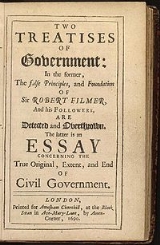
Two Treatises of Government: In the Former, The False Principles and Foundation of Sir Robert Filmer, And His Followers, are Detected and Overthrown. The Latter is an Essay concerning The True Original, Extent, and End of Civil-Government") is a work of
political philosophyPolitical philosophy is the study of such topics as liberty, justice, property, rights, law, and the enforcement of a legal code by authority: what they are, why they are needed, what, if anything, makes a government legitimate, what rights and freedoms it should protect and why, what form it...
published anonymously in 1689 by
John LockeJohn Locke FRS , widely known as the Father of Liberalism, was an English philosopher and physician regarded as one of the most influential of Enlightenment thinkers. Considered one of the first of the British empiricists, following the tradition of Francis Bacon, he is equally important to social...
. The
First Treatise attacks patriarchalism in the form of sentence-by-sentence refutation of
Robert Filmerthumbnail|150px|right|Robert Filmer Sir Robert Filmer was an English political theorist who defended the divine right of kings...
's
Patriarcha and the
Second Treatise outlines a theory of political or civil society based on
natural rightsNatural and legal rights are two types of rights theoretically distinct according to philosophers and political scientists. Natural rights are rights not contingent upon the laws, customs, or beliefs of any particular culture or government, and therefore universal and inalienable...
and
contract theoryThe social contract is an intellectual device intended to explain the appropriate relationship between individuals and their governments. Social contract arguments assert that individuals unite into political societies by a process of mutual consent, agreeing to abide by common rules and accept...
.
Historical context
King
James II of EnglandJames II & VII was King of England and King of Ireland as James II and King of Scotland as James VII, from 6 February 1685. He was the last Catholic monarch to reign over the Kingdoms of England, Scotland, and Ireland...
(VII of Scotland) was overthrown in 1688 by a union of Parliamentarians and
stadtholderA Stadtholder A Stadtholder A Stadtholder (Dutch: stadhouder [], "steward" or "lieutenant", literally place holder, holding someones place, possibly a calque of German Statthalter, French lieutenant, or Middle Latin locum tenens...
of the
Dutch RepublicThe Dutch Republic — officially known as the Republic of the Seven United Netherlands , the Republic of the United Netherlands, or the Republic of the Seven United Provinces — was a republic in Europe existing from 1581 to 1795, preceding the Batavian Republic and ultimately...
William III of Orange-Nassau (William of Orange), who as a result ascended the English throne as
William III of EnglandWilliam III & II was a sovereign Prince of Orange of the House of Orange-Nassau by birth. From 1672 he governed as Stadtholder William III of Orange over Holland, Zeeland, Utrecht, Guelders, and Overijssel of the Dutch Republic. From 1689 he reigned as William III over England and Ireland...
. This invasion and conquest of England is known as the
Glorious RevolutionThe Glorious Revolution, also called the Revolution of 1688, is the overthrow of King James II of England by a union of English Parliamentarians with the Dutch stadtholder William III of Orange-Nassau...
, also called the Revolution of 1688. Locke claims in the "Preface" to the
Two Treatises that its purpose is to justify William III's ascension to the throne, though
Peter Laslett-Biography:Born Thomas Peter Ruffell Laslett and educated at the Watford Grammar School for Boys, Peter Laslett studied history at St John's College, Cambridge in 1935 and graduated with a double first in 1938. During the war he learned Japanese and worked at Bletchley Park and Washington decoding...
suggests that the bulk of the writing was instead completed between 1679-1680 (and subsequently revised until Locke was driven into exile in 1683). According to Laslett, Locke was writing his
Two Treatises during the
Exclusion CrisisThe Exclusion Crisis ran from 1678 through 1681 in the reign of Charles II of England. The Exclusion Bill sought to exclude the king's brother and heir presumptive, James, Duke of York, from the thrones of England, Scotland and Ireland because he was Roman Catholic...
, which attempted to prevent James II from ever taking the throne in the first place. Anthony Ashley-Cooper, 1st Earl of Shaftesbury, Locke's mentor, patron and friend, introduced the bill, but it was ultimately unsuccessful. Richard Ashcraft, following in Laslett's suggestion that the
Two Treatises were written before the Revolution, objected that Shaftesbury's party did not advocate revolution during the Exclusion Crisis. He suggests that they are instead better associated with the revolutionary conspiracies that swirled around what would come to be known as the
Rye House PlotThe Rye House Plot of 1683 was a plan to assassinate King Charles II of England and his brother James, Duke of York. Historians vary in their assessment of the degree to which details of the conspiracy were finalized....
. Locke, Shaftesbury and many others were forced into exile; some, such as Sidney, were even executed for treason. Locke knew his work was dangerous—he never acknowledged his authorship within his lifetime.
Publication history
Two Treatises was first published, anonymously, in December of 1689 (following printing conventions of the time, its title page was marked 1690). Locke was unhappy with this edition, complaining to the publisher about its many errors. For the rest of his life, he was intent on republishing the
Two Treatises in a form that better reflected his meaning. Peter Laslett, one of the foremost Locke scholars, has suggested that Locke held the printers to a higher "standard of perfection" than the technology of the time would permit. Be that as it may, the first edition was indeed replete with errors. The second edition was even worse, and finally printed on cheap paper and sold to the poor. The third edition was much improved, but Locke was still not satisfied. He made corrections to the third edition by hand and entrusted the publication of the fourth to his friends, as he died before it could be brought out.
The
Two Treatises begin with a Preface announcing what Locke hopes to achieve, but he also mentions that more than half of his original draft, occupying a space between the
First and
Second Treatises, has been irretrievably lost. Peter Laslett maintains that, while Locke may have added or altered some portions in 1689, he did not make any revisions to accommodate for the missing section; he argues, for example, that the end of the
First Treatise breaks off in mid-sentence.
In 1691
Two Treatises was translated into French by David Mazzel, a French
HuguenotThe Huguenots were members of the Protestant Reformed Church of France during the 16th and 17th centuries. Since the 17th century, people who formerly would have been called Huguenots have instead simply been called French Protestants, a title suggested by their German co-religionists, the...
living in the Netherlands. This translation left out Locke's "Preface," all of the
First Treatise, and the first chapter of the
Second Treatise. It was in this form that Locke's work was reprinted during the 18th century in
FranceThe French Republic , The French Republic , The French Republic , (commonly known as France , is a unitary semi-presidential republic in Western Europe with several overseas territories and islands located on other continents and in the Indian, Pacific, and Atlantic oceans. Metropolitan France...
and in this form that Montesquieu,
VoltaireFrançois-Marie Arouet , better known by the pen name Voltaire , was a French Enlightenment writer, historian and philosopher famous for his wit and for his advocacy of civil liberties, including freedom of religion, free trade and separation of church and state...
and
RousseauJean-Jacques Rousseau was a Genevan philosopher, writer, and composer of 18th-century Romanticism. His political philosophy influenced the French Revolution as well as the overall development of modern political, sociological and educational thought.His novel Émile: or, On Education is a treatise...
were exposed to it. The only American edition from the 18th century was printed in 1773 in Boston; it, too, left out all of these sections. There were no other American editions until the 20th century.
Main ideas
Two Treatises is divided into the
First Treatise and the
Second Treatise. The original title of the
Second Treatise appears to have been simply "Book II," corresponding to the title of the
First Treatise, "Book I." Before publication, however, Locke gave it greater prominence by (hastily) inserting a separate title page: "An Essay Concerning the True Original, Extent and End of Civil Government." The
First Treatise is focused on the refutation of
Sir Robert Filmerthumbnail|150px|right|Robert Filmer Sir Robert Filmer was an English political theorist who defended the divine right of kings...
, in particular his
Patriarcha, which argued that civil society was founded on a divinely-sanctioned patriarchalism. Locke proceeds through Filmer's arguments, contesting his proofs from Scripture and ridiculing them as senseless, until concluding that no government can be justified by an appeal to the
divine right of kingsThe divine right of kings or divine-right theory of kingship is a political and religious doctrine of royal and political legitimacy. It asserts that a monarch is subject to no earthly authority, deriving his right to rule directly from the will of God...
.
The
Second Treatise outlines a theory of civil society. John Locke begins by describing the
state of natureState of nature is a term in political philosophy used in social contract theories to describe the hypothetical condition that preceded governments...
, a picture much more stable than
Thomas HobbesThomas Hobbes of Malmesbury , in some older texts Thomas Hobbs of Malmsbury, was an English philosopher, best known today for his work on political philosophy...
' state of "war of every man against every man," and argues that all men are created equal in the state of nature by God. From this, he goes on to explain the hypothetical rise of property and civilization, in the process explaining that the only legitimate governments are those that have the consent of the people. Therefore, any government that rules without the consent of the people can, in theory, be overthrown.
First Treatise
The
First Treatise is an extended attack on Sir Robert Filmer's
Patriarcha. Locke's argument proceeds along two lines: first, he undercuts the Scriptural support that Filmer had offered for his thesis, and second he argues that the acceptance of Filmer's thesis can lead only to absurdity. Locke chose Filmer as his target, he says, because of his reputation and because he "carried this Argument [
jure divino] farthest, and is supposed to have brought it to perfection" (1st Tr., §5).
Filmer's text presented an argument for a
divinely-ordainedThe divine right of kings or divine-right theory of kingship is a political and religious doctrine of royal and political legitimacy. It asserts that a monarch is subject to no earthly authority, deriving his right to rule directly from the will of God...
,
hereditaryA hereditary monarchy is the most common type of monarchy and is the form that is used by almost all of the world's existing monarchies.Under a hereditary monarchy, all the monarchs come from the same family, and the crown is passed down from one member to another member of the family...
,
absoluteAbsolute monarchy is a monarchical form of government in which the monarch exercises ultimate governing authority as head of state and head of government, his or her power not being limited by a constitution or by the law. An absolute monarch thus wields unrestricted political power over the...
monarchyA monarchy is a form of government in which the office of head of state is usually held until death or abdication and is often hereditary and includes a royal house. In some cases, the monarch is elected...
. According to Filmer,
the Biblical AdamAdam and Eve were, according to the Genesis creation narratives, the first human couple to inhabit Earth, created by YHWH, the God of the ancient Hebrews...
in his role as father possessed unlimited power over his children and this authority passed down through the generations. Locke attacks this on several grounds. Accepting that fatherhood grants authority, he argues, it would do so only by the act of begetting, and so cannot be transmitted to one's children because only God can create life. Nor is the power of a father over his children absolute, as Filmer would have it; Locke points to the joint power parents share over their children outlined in the Bible. In the
Second Treatise Locke returns to a discussion of parental power. (Both of these discussions have drawn the interest of modern
feministsFeminism is a collection of movements aimed at defining, establishing, and defending equal political, economic, and social rights and equal opportunities for women. Its concepts overlap with those of women's rights...
such as
Carole PatemanCarole Pateman is a British feminist and political theorist. She earned a DPhil at the University of Oxford. Since 1990, Professor Pateman has taught in the Department of Political Science at the University of California at Los Angeles . In 2007, she was named a Fellow of the British Academy...
.)
Filmer also suggested that Adam's absolute authority came from his
ownershipProperty is any physical or intangible entity that is owned by a person or jointly by a group of people or a legal entity like a corporation...
over all the world. To this, Locke rebuts that the world was originally held in common (a theme that will return in the
Second Treatise). But, even if it were not, he argues, God's grant to Adam covered only the land and brute animals, not human beings. Nor could Adam, or his heir, leverage this grant to enslave mankind, for the
law of natureNatural law, or the law of nature , is any system of law which is purportedly determined by nature, and thus universal. Classically, natural law refers to the use of reason to analyze human nature and deduce binding rules of moral behavior. Natural law is contrasted with the positive law Natural...
forbids reducing one's fellows to a state of desperation, if one possesses a sufficient surplus to maintain oneself securely. And even if this charity were not commanded by reason, Locke continues, such a strategy for gaining dominion would prove only that the foundation of government lies in consent.
Locke intimates in the
First Treatise that the doctrine of
divine right of kingsThe divine right of kings or divine-right theory of kingship is a political and religious doctrine of royal and political legitimacy. It asserts that a monarch is subject to no earthly authority, deriving his right to rule directly from the will of God...
(
jure divino) will eventually be the downfall of all governments. In his final chapter Locke asks, "Who heir?" If Filmer is correct, there should be only one rightful king in all the world—the heir of Adam. But since it is impossible to discover the true heir of Adam, no government, under Filmer's principles, can require that its members obey its rulers. Filmer must therefore say that men are duty-bound to obey their present rulers. Locke writes:
I think he is the first Politician, who, pretending to settle Government upon its true Basis, and to establish the Thrones of lawful Princes, ever told the World, That he was properly a King, whose Manner of Government was by Supreme Power, by what Means soever he obtained it; which in plain English is to say, that Regal and Supreme Power is properly and truly his, who can by any Means seize upon it; and if this be, to be properly a King, I wonder how he came to think of, or where he will find, an Usurper. (1st Tr., §79)
Locke ends the
First Treatise by examining the history told in the
BibleThe Bible refers to any one of the collections of the primary religious texts of Judaism and Christianity. There is no common version of the Bible, as the individual books , their contents and their order vary among denominations...
and the history of the world since then; he concludes that there is no evidence to support Filmer's hypothesis. According to Locke, no king has ever claimed that his authority rested upon his being the heir of Adam. It is Filmer, Locke alleges, that is the innovator in politics, not those who assert the natural equality and freedom of man.
Second Treatise
In the
Second Treatise Locke develops a number of notable themes. It begins with a depiction of the
state of natureState of nature is a term in political philosophy used in social contract theories to describe the hypothetical condition that preceded governments...
, wherein individuals are under no obligation to obey one another but are each themselves judge of what the
law of natureNatural law, or the law of nature , is any system of law which is purportedly determined by nature, and thus universal. Classically, natural law refers to the use of reason to analyze human nature and deduce binding rules of moral behavior. Natural law is contrasted with the positive law Natural...
requires. It also covers conquest and slavery, property, representative government, and the right of revolution.
State of nature
Locke defines the state of nature thus:
"To properly understand political power and trace its origins, we must consider the state that all people are in naturally.
That is a state of perfect freedom of acting and disposing of their own possessions and persons as they think fit within the bounds of the law of nature. People in this state do not have to ask permission to act or depend on the will of others to arrange matters on their behalf. The natural state is also one of equality in which all power and jurisdiction is reciprocal and no one has more than another. It is evident that all human beings – as creatures belonging to the same species and rank and born indiscriminately with all the same natural advantages and faculties – are equal amongst themselves. They have no relationship of subordination or subjection unless God (the lord and master of them all) had clearly set one person above another and conferred on him an undoubted right to dominion and sovereignty."
The work of
Thomas HobbesThomas Hobbes of Malmesbury , in some older texts Thomas Hobbs of Malmsbury, was an English philosopher, best known today for his work on political philosophy...
made theories based upon a
state of natureState of nature is a term in political philosophy used in social contract theories to describe the hypothetical condition that preceded governments...
popular in 17th-century England, even as most of those who employed such arguments were deeply troubled by his absolutist conclusions. Locke's state of nature can be seen in light of this tradition. Because there is no divinely ordained monarch over all the world, as was argued in the
First Treatise, the natural state of mankind is anarchic. In contrast to Hobbes, who posited the state of nature as a hypothetical possibility, Locke took great pains to show that such a state did indeed exist. Indeed, it exists wherever there is no legitimate government. Whereas Hobbes speaks of the misery of the State of Nature more directly, Locke waits until Chapter IX to describe the state of nature as one that 'however free, is full of continual dangers.'
While no individual in this state may tell another what to do or authoritatively pronounce justice in a given case, men are not free to do whatever they please. "The state of nature has a law of nature to govern it, which obliges every one: and reason, which is that law, teaches all mankind, who will but consult it" (2nd Tr., §6). The specifics of this law are unwritten, however, and so each is likely to misapply it in his own case. Lacking any commonly recognized, impartial judge, there is no way to correct these misapplications. Even were such a judge available, the just are vastly outnumbered by the unjust and indifferent, so his pronouncements would lack effect. This section, §6, also presumes theism. In other words, rather than arguing for the presence of men by natural ideas, Locke assumes that all men are born by God.
The law of nature is therefore ill enforced in the state of nature.
IF man in the state of nature be so free, as has been said; if he be absolute lord of his own person and possessions, equal to the greatest, and subject to no body, why will he part with his freedom? Why will he give up this empire, and subject himself to the dominion and control of any other power? To which it is obvious to answer, that though in the state of nature he hath such a right, yet the enjoyment of it is very uncertain, and constantly exposed to the invasion of others: for all being kings as much as he, every man his equal, and the greater part no strict observers of equity and justice, the enjoyment of the property he has in this state is very unsafe, very unsecure. This makes him willing to quit a condition, which, however free, is full of fears and continual dangers: and it is not without reason, that he seeks out, and is willing to join in society with others, who are already united, or have a mind to unite, for the mutual preservation of their lives, liberties and estates, which I call by the general name, property. (2nd Tr., §123)
What should be a state of peace very quickly begins to look like the state of war that Hobbes described (though the ill enforcement of the law of nature does not release individuals from their obligation to it, as it does in Hobbes).
It is to avoid the state of war that often occurs in the state of nature, and to protect their
private propertyPrivate property is the right of persons and firms to obtain, own, control, employ, dispose of, and bequeath land, capital, and other forms of property. Private property is distinguishable from public property, which refers to assets owned by a state, community or government rather than by...
that men enter into civil or political society, i.e., state of society. It is also the state that men return to upon the dissolution of government, i.e., under tyranny.
Conquest and slavery
Ch. 4 ("Of Slavery") and Ch. 16 ("Of Conquest") are sources of some confusion: the former provides a justification for
slaverySlavery is a system under which people are treated as property to be bought and sold, and are forced to work. Slaves can be held against their will from the time of their capture, purchase or birth, and deprived of the right to leave, to refuse to work, or to demand compensation...
, the latter, the
rights of conquerorsThe right of conquest is the right of a conqueror to territory taken by force of arms. It was traditionally a principle of international law which has in modern times gradually given way until its proscription after the Second World War when the crime of war of aggression was first codified in the...
. Because the
Fundamental Constitutions of CarolinaThe Fundamental Constitutions of Carolina were adopted in March 1669 by the eight Lords Proprietor of the Province of Carolina, which included most of the land between what is now Virginia and Florida. It replaced the Charter of Carolina and the Concessions and Agreements of the Lords Proprietors...
provided that a master had perfect authority over his slaves, some have taken these chapters to be an
apologyApologetics is the discipline of defending a position through the systematic use of reason. Early Christian writers Apologetics (from Greek ἀπολογία, "speaking in defense") is the discipline of defending a position (often religious) through the systematic use of reason. Early Christian writers...
for the institution of
slavery in Colonial AmericaThe origins of slavery in the colonial United States are complex and there are several theories that have been proposed to explain the trade.In 1607, English settlers established Jamestown as the first permanent English colony in the New World. Tobacco became the chief crop of the colony, due to...
.
Most Locke scholars roundly reject this reading, as it is directly at odds with the text. The extent of Locke's involvement in drafting the
Fundamental Constitutions is a matter of some debate, but even attributing full culpability for its contents and for his having profited from the
Atlantic slave tradeThe Atlantic slave trade, also known as the trans-atlantic slave trade, refers to the trade in slaves that took place across the Atlantic ocean from the sixteenth through to the nineteenth centuries...
, the majority of experts will concede that Locke may have been a hypocrite in this matter, but are adamant that no part of the
Two Treatises can be used to provide theoretical support for slavery by bare right of conquest.
In the rhetoric of 17th-century
EnglandEngland is a country that is part of the United Kingdom. It shares land borders with Scotland to the north and Wales to the west; the Irish Sea is to the north west, the Celtic Sea to the south west, with the North Sea to the east and the English Channel to the south separating it from continental...
, those who opposed the increasing power of the kings claimed that the country was headed for a condition of slavery. Locke therefore asks, facetiously, under what conditions such slavery might be justified. He notes that slavery cannot come about as a matter of contract (which became the basis of Locke's political system). To be a slave is to be subject to the absolute, arbitrary power of another; as men do not have this power even over themselves, they cannot sell or otherwise grant it to another. One that is deserving of death, i.e., who has violated the
law of natureNatural law, or the law of nature , is any system of law which is purportedly determined by nature, and thus universal. Classically, natural law refers to the use of reason to analyze human nature and deduce binding rules of moral behavior. Natural law is contrasted with the positive law Natural...
, may be enslaved. This is, however, "but the state of war continued" (2nd Tr., §24), and even one justly a slave therefore has no obligation to obedience.
In providing a justification for slavery, he has rendered all forms of slavery as it actually exists invalid. Moreover, as one may not submit to slavery, there is a moral injunction to attempt to throw off and escape it whenever it looms. Most scholars take this to be Locke's point regarding slavery: submission to
absolute monarchyAbsolute monarchy is a monarchical form of government in which the monarch exercises ultimate governing authority as head of state and head of government, his or her power not being limited by a constitution or by the law. An absolute monarch thus wields unrestricted political power over the...
is a violation of the law of nature, for one does not have the right to enslave oneself.
The legitimacy of an
English king depended on (somehow) demonstrating descent from
William the ConquerorWilliam I , also known as William the Conqueror , was the first Norman King of England from Christmas 1066 until his death. He was also Duke of Normandy from 3 July 1035 until his death, under the name William II...
: the
right of conquestThe right of conquest is the right of a conqueror to territory taken by force of arms. It was traditionally a principle of international law which has in modern times gradually given way until its proscription after the Second World War when the crime of war of aggression was first codified in the...
was therefore a topic rife with constitutional connotations. Locke does not say that all subsequent English monarchs have been illegitimate, but he does make their rightful authority dependent solely upon their having acquired the people's approbation.
Locke first argues that, clearly, aggressors in an unjust war can claim no right of conquest: everything they despoil may be retaken as soon as the dispossessed have the strength to do so. Their children retain this right, so an ancient usurpation does not become lawful with time. The rest of the chapter then considers what rights a just conqueror might have.
The argument proceeds negatively: Locke proposes one power a conqueror could gain, and then demonstrates how in point of fact that power cannot be claimed. He gains no authority over those that conquered with him, for they did not wage war unjustly: thus, whatever other right William may have had in England, he could not claim kingship over his fellow
NormansThe Normans were the people who gave their name to Normandy, a region in northern France. They were descended from Norse Viking conquerors of the territory and the native population of Frankish and Gallo-Roman stock...
by right of conquest. The subdued are under the conqueror's despotical authority, but only those who actually took part in the fighting. Those who were governed by the defeated aggressor do not become subject to the authority of the victorious aggressor. They lacked the power to do an unjust thing, and so could not have granted that power to their governors: the aggressor therefore was not acting as their representative, and they cannot be punished for his actions. And while the conqueror may seize the person of the vanquished aggressor in an unjust war, he cannot seize the latter's property: he may not drive the innocent wife and children of a villain into poverty for another's unjust acts. While the property is technically that of the defeated, his innocent dependents have a claim that the just conqueror must honor. He cannot seize more than the vanquished could forfeit, and the latter had no right to ruin his dependents. (He may, however, demand and take reparations for the damages suffered in the war, so long as these leave enough in the possession of the aggressor's dependants for their survival).
In so arguing, Locke accomplishes two objectives. First, he neutralizes the claims of those who see all authority flowing from William I by the latter's right of conquest. In the absence of any other claims to authority (e.g.,
Filmerthumbnail|150px|right|Robert Filmer Sir Robert Filmer was an English political theorist who defended the divine right of kings...
's
primogeniturePrimogeniture is the right, by law or custom, of the firstborn to inherit the entire estate, to the exclusion of younger siblings . Historically, the term implied male primogeniture, to the exclusion of females...
from
AdamAdam and Eve were, according to the Genesis creation narratives, the first human couple to inhabit Earth, created by YHWH, the God of the ancient Hebrews...
,
divineThe divine right of kings or divine-right theory of kingship is a political and religious doctrine of royal and political legitimacy. It asserts that a monarch is subject to no earthly authority, deriving his right to rule directly from the will of God...
anointmentTo anoint is to pour or smear with perfumed oil, milk, water, melted butter or other substances, a process employed ritually by many religions. People and things are anointed to symbolize the introduction of a sacramental or divine influence, a holy emanation, spirit, power or God...
, etc.), all kings would have to found their authority on the consent of the governed. Second, he removes much of the incentive for conquest in the first place, for even in a just war the spoils are limited to the persons of the defeated and reparations sufficient only to cover the costs of the war, and even then only when the aggressor's territory can easily sustain such costs (i.e., it can never be a profitable endeavor). Needless to say, the bare claim that one's spoils are the just compensation for a just war does not suffice to make it so, in Locke's view.
Property
In the
Second Treatise, Locke claims that
civil societyCivil society is composed of the totality of many voluntary social relationships, civic and social organizations, and institutions that form the basis of a functioning society, as distinct from the force-backed structures of a state , the commercial institutions of the market, and private criminal...
was created for the protection of
propertyProperty is any physical or intangible entity that is owned by a person or jointly by a group of people or a legal entity like a corporation...
. In saying this, he relies on the etymological root of "property,"
LatinLatin is an Italic language originally spoken in Latium and Ancient Rome. It, along with most European languages, is a descendant of the ancient Proto-Indo-European language. Although it is considered a dead language, a number of scholars and members of the Christian clergy speak it fluently, and...
proprius, or what is one's own, including oneself (cf.
FrenchFrench is a Romance language spoken as a first language in France, the Romandy region in Switzerland, Wallonia and Brussels in Belgium, Monaco, the regions of Quebec and Acadia in Canada, and by various communities elsewhere. Second-language speakers of French are distributed throughout many parts...
propre). Thus, by "property" he means "life, liberty, and estate." By saying that political society was established for the better protection of property, he claims that it serves the private (and non-political) interests of its constituent members: it does not promote some good that can be realized only in community with others (e.g., virtue).
For this account to work, individuals must possess some property outside of society, i.e., in the state of nature: the state cannot be the sole origin of property, declaring what belongs to whom. If the purpose of government is the protection of property, the latter must exist independently of the former. Filmer had said that, if there even were a state of nature (which he denied), everything would be held in common: there could be no private property, and hence no justice or injustice (injustice being understood as treating someone else's goods, liberty, or life as if it were one's own).
Thomas HobbesThomas Hobbes of Malmesbury , in some older texts Thomas Hobbs of Malmsbury, was an English philosopher, best known today for his work on political philosophy...
had argued the same thing. Locke therefore provides an account of how material property could arise in the absence of government.
He begins by asserting that each individual, at a minimum, "owns" himself; this is a corollary of each individual's being free and equal in the state of nature. As a result, each must also own his own labor: to deny him his labor would be to make him a slave. One can therefore take items from the common store of goods by mixing one's labor with them: an apple on the tree is of no use to anyone — it must be picked to be eaten — and the picking of that apple makes it one's own. In an alternate argument, Locke claims that we must allow it to become private property lest all mankind have starved, despite the bounty of the world. A man must be allowed to eat, and thus have what he has eaten be his own (such that he could deny others a right to use it). The apple is surely his when he swallows it, when he chews it, when he bites into it, when he brings it to his mouth, etc.: it became his as soon as he mixed his labor with it (by picking it from the tree).
This does not yet say
why an individual is allowed to take from the common store of nature. There is a necessity to do so in order to eat, but this does not yet establish why others must respect one's property, especially as they labor under the like necessity. Locke assures his readers that the state of nature is a state of plenty: one may take from communal store if one leaves a) enough and b) as good for others, and since nature is bountiful, one can take all that one can use without taking anything
from someone else. Moreover, one can take only so much as one can use before it spoils. There are then two provisos regarding what one can take, the "enough and as good" condition and "spoilage."
Gold does not rot. Neither does silver, or any other precious metal or gem. They are, moreover, useless, their aesthetic value not entering into the equation. One can heap up as much of them as one wishes, or take them in trade for food. By the tacit consent of mankind, they become a form of money (one accepts gold in exchange for apples with the understanding that someone else will accept that gold in exchange for wheat). One can therefore avoid the spoilage limitation by selling all that one has amassed before it rots; the limits on acquisition thus disappear.
In this way, Locke argues that a full economic system could, in principle, exist within the state of nature. Property could therefore predate the existence of government, and thus society can be dedicated to the protection of property.
In the 20th century,
MarxistMarxism is an economic and sociopolitical worldview and method of socioeconomic inquiry that centers upon a materialist interpretation of history, a dialectical view of social change, and an analysis and critique of the development of capitalism. Marxism was pioneered in the early to mid 19th...
scholars viewed Locke as the founder of bourgeois
capitalismCapitalism is an economic system that became dominant in the Western world following the demise of feudalism. There is no consensus on the precise definition nor on how the term should be used as a historical category...
. Those who were opposed to
communismCommunism is a social, political and economic ideology that aims at the establishment of a classless, moneyless, revolutionary and stateless socialist society structured upon common ownership of the means of production...
accepted this reading of Locke, and celebrated him for it. He has therefore become associated with capitalism.
Representative government
Locke did not demand a republic. Rather, Locke felt that a legitimate contract could easily exist between citizens and a monarchy, an oligarchy or some mixed form (
2nd Tr., sec. 132). Locke uses the term Common-wealth to mean "not a democracy, or any form of government, but any independent community" (sec. 133) and "whatever form the Common-wealth is under, the Ruling Power ought to govern by declared and received laws, and not by extemporary dictates and undetermined resolutions." (sec 137)
Locke does, however, make a distinction between an executive (e.g. a monarchy), a "Power always in being" (sec 144) that must perpetually execute the law, and the legislative that is the "supream power of the Common-wealth" (sec 134) and does not have to be always in being. (sec 153) Furthermore, governments are charged by the consent of the individual, "i.e. the consent of the majority, giving it either by themselves, or their representatives chosen by them." (sec 140)
His ideas heavily influenced, however, both the American and French Revolutions. His notions of people's rights and the role of civil government provided strong support for the intellectual movements of both revolutions.
Right of revolution
The concept of the right of revolution was also taken up by John Locke in Two Treatises of Government as part of his social contract theory. Locke declared that under natural law, all people have the right to life, liberty, and estate; under the social contract, the people could instigate a revolution against the government when it acted against the interests of citizens, to replace the government with one that served the interests of citizens. In some cases, Locke deemed revolution an obligation. The right of revolution thus essentially acted as a safeguard against tyranny.
Britain
Although the
Two Treatises would become well known in the second half of the 18th century, they were somewhat neglected when published. Between 1689 and 1694, around 200 tracts and treatises were published concerning the legitimacy of the
Glorious RevolutionThe Glorious Revolution, also called the Revolution of 1688, is the overthrow of King James II of England by a union of English Parliamentarians with the Dutch stadtholder William III of Orange-Nassau...
. Three of these mention Locke, two of which were written by friends of Locke. When
HobbesThomas Hobbes of Malmesbury , in some older texts Thomas Hobbs of Malmsbury, was an English philosopher, best known today for his work on political philosophy...
published the
LeviathanLeviathan or The Matter, Forme and Power of a Common Wealth Ecclesiasticall and Civil — commonly called simply Leviathan — is a book written by Thomas Hobbes and published in 1651. Its name derives from the biblical Leviathan...
in 1651, by contrast, dozens of texts were immediately written in response to it. As Mark Goldie explains: "
Leviathan was a monolithic and unavoidable presence for political writers in Restoration England in a way that in the first half of the eighteenth the
Two Treatises was not."
While the
Two Treatises did not become popular until the 1760s, ideas from them did start to become important earlier in the century. According to Goldie, "the crucial moment was 1701" and "the occasion was the Kentish petition." The pamphlet war that ensued was one of the first times Locke's ideas were invoked in a public debate, most notably by
Daniel DefoeDaniel Defoe , born Daniel Foe, was an English trader, writer, journalist, and pamphleteer, who gained fame for his novel Robinson Crusoe. Defoe is notable for being one of the earliest proponents of the novel, as he helped to popularise the form in Britain and along with others such as Richardson,...
. Locke's ideas did not go unchallenged and the periodical
The Rehearsal, for example, launched a "sustained and sophisticated assault” against the
Two Treatises and endorsed the ideology of patriarchalism. Not only did patriarchalism continue to be a legitimate political theory in the 18th century, but as J. G. A. Pocock and others have gone to great lengths to demonstrate, so was civic humanism and
classical republicanismClassical republicanism is a form of republicanism developed in the Renaissance inspired by the governmental forms and writings of classical antiquity. The earliest examples of the school were classical writers such as Aristotle, Polybius, and Cicero...
. Pocock has argued that Locke's
Two Treatises had very little effect on British political theory; he maintains that there was no contractarian revolution. Rather, he sees these other long-standing traditions as far more important for 18th-century British politics.
In the middle of the 18th century, Locke's position as a political philosopher suddenly rose in prominence. For example, he was invoked by those arguing on behalf of the American colonies during the
Stamp ActA stamp act is any legislation that requires a tax to be paid on the transfer of certain documents. Those that pay the tax receive an official stamp on their documents, making them legal documents. The taxes raised under a stamp act are called stamp duty. This system of taxation was first devised...
debates of 1765-6. Marginalized groups such as women,
DissentersNonconformity is the refusal to "conform" to, or follow, the governance and usages of the Church of England by the Protestant Christians of England and Wales.- Origins and use:...
and those campaigning to abolish the
slave tradeSlavery is a system under which people are treated as property to be bought and sold, and are forced to work. Slaves can be held against their will from the time of their capture, purchase or birth, and deprived of the right to leave, to refuse to work, or to demand compensation...
all invoked Lockean ideals. But at the same time, as Goldie describes it, "a wind of doubt about Locke’s credentials gathered into a storm. The sense that Locke’s philosophy had been misappropriated increasingly turned to a conviction that it was erroneous.” By the 1790s Locke was associated with Rousseau and
VoltaireFrançois-Marie Arouet , better known by the pen name Voltaire , was a French Enlightenment writer, historian and philosopher famous for his wit and for his advocacy of civil liberties, including freedom of religion, free trade and separation of church and state...
and being blamed for the
AmericanThe American Revolution was the political upheaval during the last half of the 18th century in which thirteen colonies in North America joined together to break free from the British Empire, combining to become the United States of America...
and
French RevolutionThe French Revolution , sometimes distinguished as the 'Great French Revolution' , was a period of radical social and political upheaval in France and Europe. The absolute monarchy that had ruled France for centuries collapsed in three years...
s as well as for the perceived secularization of society. By 1815, Locke's portrait was taken down from Christ Church, his alma mater (it was later restored to a position of prominence, and currently hangs in the dining hall of the college).
North America
Locke's influence during the American Revolutionary period is disputed. While it is easy to point to specific instances of Locke's
Two Treatises being invoked, the extent of the acceptance of Locke's ideals and the role they played in the
American RevolutionThe American Revolution was the political upheaval during the last half of the 18th century in which thirteen colonies in North America joined together to break free from the British Empire, combining to become the United States of America...
are far from clear. The
Two Treatises are echoed in phrases in the
Declaration of IndependenceThe Declaration of Independence was a statement adopted by the Continental Congress on July 4, 1776, which announced that the thirteen American colonies then at war with Great Britain regarded themselves as independent states, and no longer a part of the British Empire. John Adams put forth a...
and writings by
Samuel AdamsSamuel Adams was an American statesman, political philosopher, and one of the Founding Fathers of the United States. As a politician in colonial Massachusetts, Adams was a leader of the movement that became the American Revolution, and was one of the architects of the principles of American...
that attempted to gain support for the rebellion. Of Locke's influence
Thomas JeffersonThomas Jefferson was the principal author of the United States Declaration of Independence and the Statute of Virginia for Religious Freedom , the third President of the United States and founder of the University of Virginia...
wrote: "
BaconFrancis Bacon, 1st Viscount St Albans, KC was an English philosopher, statesman, scientist, lawyer, jurist, author and pioneer of the scientific method. He served both as Attorney General and Lord Chancellor of England...
,
LockeJohn Locke FRS , widely known as the Father of Liberalism, was an English philosopher and physician regarded as one of the most influential of Enlightenment thinkers. Considered one of the first of the British empiricists, following the tradition of Francis Bacon, he is equally important to social...
and
NewtonSir Isaac Newton PRS was an English physicist, mathematician, astronomer, natural philosopher, alchemist, and theologian, who has been "considered by many to be the greatest and most influential scientist who ever lived."...
I consider them as the three greatest men that have ever lived, without any exception, and as having laid the foundation of those superstructures which have been raised in the Physical & Moral sciences". The colonists frequently cited
Blackstone'sSir William Blackstone KC SL was an English jurist, judge and Tory politician of the eighteenth century. He is most noted for writing the Commentaries on the Laws of England. Born into a middle class family in London, Blackstone was educated at Charterhouse School before matriculating at Pembroke...
Commentaries on the Laws of EnglandThe Commentaries on the Laws of England are an influential 18th-century treatise on the common law of England by Sir William Blackstone, originally published by the Clarendon Press at Oxford, 1765–1769...
, which synthesized Lockean political philosophy with the
common lawCommon law is law developed by judges through decisions of courts and similar tribunals rather than through legislative statutes or executive branch action...
tradition.
Louis HartzLouis Hartz was an American political scientist and influential liberal proponent of the idea of American exceptionalism....
, writing at the beginning of the 20th century, took it for granted that Locke was the political philosopher of the revolution.
This view was challenged by
Bernard BailynBernard Bailyn is an American historian, author, and professor specializing in U.S. Colonial and Revolutionary-era History. He has been a professor at Harvard University since 1953. Bailyn has won the Pulitzer Prize for History twice . In 1998 the National Endowment for the Humanities selected...
and
Gordon S. WoodGordon S. Wood is Alva O. Way University Professor and Professor of History Emeritus at Brown University and the recipient of the 1993 Pulitzer Prize for History for The Radicalism of the American Revolution. His book The Creation of the American Republic, 1776–1787 won a 1970 Bancroft Prize...
, who argued that the revolution was not a struggle over property, taxation, and rights, but rather "a Machiavellian effort to preserve the young republic’s 'virtue' from the corrupt and corrupting forces of English politics."
Garry WillsGarry Wills is a Pulitzer Prize-winning and prolific author, journalist, and historian, specializing in American politics, American political history and ideology and the Roman Catholic Church. Classically trained at a Jesuit high school and two universities, he is proficient in Greek and Latin...
, on the other hand, maintains that it was neither the Lockean tradition nor the classical republican tradition that drove the revolution, but instead Scottish moral philosophy, a political philosophy that based its conception of society on friendship,
sensibilitySensibility refers to an acute perception of or responsiveness toward something, such as the emotions of another. This concept emerged in eighteenth-century Britain, and was closely associated with studies of sense perception as the means through which knowledge is gathered...
and the controlled passions.
Thomas PangleThomas Lee Pangle BA PhD FRSC is an American political scientist. He currently holds the Joe R. Long Chair in Democratic Studies in the Department of Government at the University of Texas at Austin and from 1979 to 2004 was University Professor in the Department of Political Science at the...
and Michael Zuckert have countered, demonstrating numerous elements in the thought of more influential founders that have a Lockean pedigree.
Controversies regarding interpretation
The
Second Treatise was traditionally taken to be a refutation of
Thomas HobbesThomas Hobbes of Malmesbury , in some older texts Thomas Hobbs of Malmsbury, was an English philosopher, best known today for his work on political philosophy...
's
LeviathanLeviathan or The Matter, Forme and Power of a Common Wealth Ecclesiasticall and Civil — commonly called simply Leviathan — is a book written by Thomas Hobbes and published in 1651. Its name derives from the biblical Leviathan...
, the latter's support of absolute monarchism seemingly antithetical to Locke's ideal majoritarian government. Scholarship in the 20th century has modified this view somewhat, though the views of Locke that result from these interpretations often have little in common.
Leo StraussLeo Strauss was a political philosopher and classicist who specialized in classical political philosophy. He was born in Germany to Jewish parents and later emigrated to the United States...
in his
Natural Right and History contentiously argues that Locke is more or less Hobbesian in his conception of politics. Strauss claims that the supposed egoism of Hobbes' natural law and the ostensible altruism of Locke's can be reduced to an identical moral framework, one in which people are to treat others as others treat them, to be selfless when others are selfless, selfish when others are selfish. Strauss argued that Locke only distanced himself from Hobbes rhetorically, in order to make his system more publicly acceptable. In this way, Locke corrects Hobbes on Hobbesian principles, and so should not be read as breaking from him philosophically.
At about the same time,
C. B. MacphersonCrawford Brough Macpherson O.C. M.Sc. D. Sc. was an influential Canadian political scientist who taught political theory at the University of Toronto.-Life:...
argued in his
Political Theory of Possessive Individualism that Hobbes and Locke stood together in laying the groundwork for proto-
capitalismCapitalism is an economic system that became dominant in the Western world following the demise of feudalism. There is no consensus on the precise definition nor on how the term should be used as a historical category...
. He saw them both as instigators of the liberal tendency to view the subject as a possessive entity in an economic sense, and argued that Locke's striking account of property rights in the state of nature should be read primarily as a justification for market economic relationships.
The Cambridge School of political thought, led principally by
Quentin SkinnerQuentin Robert Duthie Skinner is the Barber Beaumont Professor of the Humanities at Queen Mary, University of London.-Biography:...
, John Pocock, Richard Ashcraft, and others, developed in opposition to interpretations such as Strauss's and, to a lesser extent, Macpherson's. It focuses on placing much of Locke's political philosophy within its historical context, following the trail laid by
Peter Laslett-Biography:Born Thomas Peter Ruffell Laslett and educated at the Watford Grammar School for Boys, Peter Laslett studied history at St John's College, Cambridge in 1935 and graduated with a double first in 1938. During the war he learned Japanese and worked at Bletchley Park and Washington decoding...
in the Introduction to his edition of the
Two Treatises. Laslett argued that, contrary to the traditional view that Locke had composed the
Two Treatises in order to legitimize the 1688
Glorious RevolutionThe Glorious Revolution, also called the Revolution of 1688, is the overthrow of King James II of England by a union of English Parliamentarians with the Dutch stadtholder William III of Orange-Nassau...
, they were actually written surrounding the Exclusion Crisis a decade earlier. Laslett declined to establish a firm relationship between Locke's thought and that of Hobbes, but did note some similar themes.
Richard Ashcraft argued in
Revolutionary Politics and Locke's "Two Treatises of Government" that Locke instead wrote the
Two Treatises later, and that he should therefore be associated with the
Radical WhigsThe Radical Whigs were "a group of British political commentators" associated with the British Whig faction who were at the forefront of Radicalism...
and the intrigues surrounding the
Rye House PlotThe Rye House Plot of 1683 was a plan to assassinate King Charles II of England and his brother James, Duke of York. Historians vary in their assessment of the degree to which details of the conspiracy were finalized....
and the
Monmouth RebellionThe Monmouth Rebellion,The Revolt of the West or The West Country rebellion of 1685, was an attempt to overthrow James II, who had become King of England, King of Scots and King of Ireland at the death of his elder brother Charles II on 6 February 1685. James II was a Roman Catholic, and some...
. These associations, and the economic system prevalent in England at the time, Ashcraft argued, render Macpherson's interpretation historically implausible. He also asserted that the absence of any reference to Hobbes, the questionable utility of refuting Hobbes when he was a non-issue in the most immediate debates, and the fact that Locke claims to have never read Hobbes or Spinoza, "those justly-decried names," harms any interpretation that interprets Locke as in any way responding to Hobbes. This last point is leveled most vociferously against Strauss's interpretation.
Regarding the relation between Locke's thought and that of Hobbes, the core of the dispute centers on the literary character of the
Two Treatises. Those who support a connection of any sort treat the work as having been intended, at least in part, as a philosophic tract, and therefore as potentially speaking beyond the immediate political context. Those who deny such a connection insist that the
Two Treatises are nothing more than a particularly popular remnant of an ideologically driven political contest, and were not meant to address any broader questions.
External links