

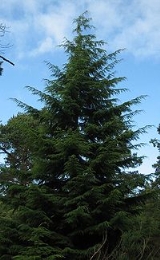
Tsuga

Encyclopedia
Tsuga is a genus of conifers
in the family Pinaceae
. The common name hemlock is derived from a perceived similarity in the smell of its crushed foliage to that of the unrelated plant poison hemlock
.
Unlike poison hemlock (Conium
), the species of Tsuga are not poisonous.
There are eight, nine, or ten species within the genus (depending on the authority), with four species occurring in North America
and four to six in eastern Asia
.
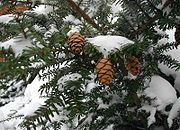 They are medium-sized to large evergreen
tree
s, ranging from 10–60(–79) m tall, with a conical to irregular crown, with the latter occurring especially in some of the Asian species. The leading shoots generally droop. The bark
is scaly and commonly deeply furrowed, with the colour ranging from grey to brown. The branches stem horizontally from the trunk and are usually arranged in flattened sprays that bend downward towards their tips. Short spur shoot
s, which are present in many gymnosperm
s, are weakly to moderately developed. The young twigs as well as the distal portions of stem are flexible and often pendent. The stems are rough due to pulvini
that persist after the leaves fall. The winter bud
s are ovoid or globose, usually rounded at the apex and not resinous. The leaves
are flattened to slightly angular and range from 5–35 mm long and 1–3 mm broad. They are borne singly and are arranged spirally on the stem; the leaf bases are twisted so the leaves lie flat either side of the stem or more rarely radially. Towards the base the leaves narrow abruptly to a petiole
set on a forward-angled, pulvinus. The petiole is twisted at the base so that it is almost parallel with the stem. The leaf apex is either notched, rounded, or acute. The undersides have two white stoma
tal bands (in T. mertensiana they are inconspicuous) separated by an elevated midvein. The upper surface of the leaves lack stomata, except in T. mertensiana. They have one resin canal that is present beneath the single vascular bundle.
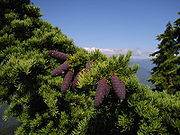 The pollen
cones grow solitary from lateral buds. They are 3–5(–10) mm long, ovoid, globose, or ellipsoid, and yellowish-white to pale purple, and borne on a short peduncle. The pollen itself has a saccate, ring-like structure at its distal pole, and rarely this structure can be more or less doubly saccate. The seed cones
are borne on year-old twigs and are small ovoid-globose or oblong-cylindric, ranging from 15–40 mm long, except in T. mertensiana, where they are cylindrical and longer, 35–80 mm in length; they are solitary, terminal or rarely lateral, pendulous, and are sessile
or on a short peduncle up to 4 mm long. Maturation occurs in 5–8 months, and the seeds are shed shortly thereafter; the cones are shed soon after seed release or up to a year or two later. The seed scales are thin, leathery and persistent. They vary in shape and lack an apophysis and an umbo. The bract
s are included and small. The seeds
are small, from 2 to 4 mm long, and winged, with the wing being 8 to 12 mm in length. They also contain small adaxial resin vesicles
. Seed germination is epigeal
; the seedlings have four to six cotyledon
s.
Another species, Bristlecone Hemlock, first described as Tsuga longibracteata, is now treated in a distinct genus Nothotsuga
; it differs from Tsuga in the erect (not pendulous) cones with exserted bracts, and male cones clustered in umbels, in these features more closely allied to the genus Keteleeria
.
fall and tolerate ice storm
s better than most other trees.
Adelges tsugae (Hemlock Woolly Adelgid
). This adelgid, related to the aphids, was introduced accidentally from eastern Asia, where it is only a minor pest. Extensive mortality has occurred, particularly east of the Appalachian Mountains
. The Asian species are resistant to this pest, and the two western American hemlocks are moderately resistant. Tsuga species are also used as food plants by the larva
e of some Lepidoptera
species including the Autumnal Moth
and the Engrailed
, and older caterpillars of the Gypsy Moth
. Once these infest a tree, they can do more than simply kill one tree. Larger hemlocks that are infected have large relatively high root systems that can bring other trees down if one falls. The foliage of young trees is often browsed by deer
, and the seeds are eaten by finch
es and small rodent
s.
Old trees are commonly attacked by various fungal
disease and decay species, notably Heterobasidion annosum
and Armillaria species, which rot the heartwood and eventually leave the tree liable to windthrow, and Rhizina undulata, which may kill groups of trees following minor grass fires that activate growth of the Rhizina spores.
. Many species are utilised in horticulture
, and numerous cultivar
s have been selected for use in gardens. The bark
of the hemlock is also used in tanning
leather.
The needles of the hemlock tree are sometimes used to make a tea.
Pinophyta
The conifers, division Pinophyta, also known as division Coniferophyta or Coniferae, are one of 13 or 14 division level taxa within the Kingdom Plantae. Pinophytes are gymnosperms. They are cone-bearing seed plants with vascular tissue; all extant conifers are woody plants, the great majority being...
in the family Pinaceae
Pinaceae
Pinaceae are trees or shrubs, including many of the well-known conifers of commercial importance such as cedars, firs, hemlocks, larches, pines and spruces. The family is included in the order Pinales, formerly known as Coniferales. Pinaceae are supported as monophyletic by its protein-type sieve...
. The common name hemlock is derived from a perceived similarity in the smell of its crushed foliage to that of the unrelated plant poison hemlock
Conium
Conium is a genus of two species of highly poisonous perennial herbaceous flowering plants in the family Apiaceae, native to Europe and the Mediterranean region as Conium maculatum, and to southern Africa as Conium chaerophylloides....
.
Unlike poison hemlock (Conium
Conium
Conium is a genus of two species of highly poisonous perennial herbaceous flowering plants in the family Apiaceae, native to Europe and the Mediterranean region as Conium maculatum, and to southern Africa as Conium chaerophylloides....
), the species of Tsuga are not poisonous.
There are eight, nine, or ten species within the genus (depending on the authority), with four species occurring in North America
North America
North America is a continent wholly within the Northern Hemisphere and almost wholly within the Western Hemisphere. It is also considered a northern subcontinent of the Americas...
and four to six in eastern Asia
Asia
Asia is the world's largest and most populous continent, located primarily in the eastern and northern hemispheres. It covers 8.7% of the Earth's total surface area and with approximately 3.879 billion people, it hosts 60% of the world's current human population...
.
Description
Evergreen
In botany, an evergreen plant is a plant that has leaves in all seasons. This contrasts with deciduous plants, which completely lose their foliage during the winter or dry season.There are many different kinds of evergreen plants, both trees and shrubs...
tree
Tree
A tree is a perennial woody plant. It is most often defined as a woody plant that has many secondary branches supported clear of the ground on a single main stem or trunk with clear apical dominance. A minimum height specification at maturity is cited by some authors, varying from 3 m to...
s, ranging from 10–60(–79) m tall, with a conical to irregular crown, with the latter occurring especially in some of the Asian species. The leading shoots generally droop. The bark
Bark
Bark is the outermost layers of stems and roots of woody plants. Plants with bark include trees, woody vines and shrubs. Bark refers to all the tissues outside of the vascular cambium and is a nontechnical term. It overlays the wood and consists of the inner bark and the outer bark. The inner...
is scaly and commonly deeply furrowed, with the colour ranging from grey to brown. The branches stem horizontally from the trunk and are usually arranged in flattened sprays that bend downward towards their tips. Short spur shoot
Shoot
Shoots are new plant growth, they can include stems, flowering stems with flower buds, and leaves. The new growth from seed germination that grows upward is a shoot where leaves will develop...
s, which are present in many gymnosperm
Gymnosperm
The gymnosperms are a group of seed-bearing plants that includes conifers, cycads, Ginkgo, and Gnetales. The term "gymnosperm" comes from the Greek word gymnospermos , meaning "naked seeds", after the unenclosed condition of their seeds...
s, are weakly to moderately developed. The young twigs as well as the distal portions of stem are flexible and often pendent. The stems are rough due to pulvini
Pulvinus
A pulvinus is a joint-like thickening at the base of a plant leaf or leaflet that facilitates growth-independent movement. It consists of a core of vascular tissue within a flexible, bulky cylinder of thin-walled parenchyma cells...
that persist after the leaves fall. The winter bud
Bud
In botany, a bud is an undeveloped or embryonic shoot and normally occurs in the axil of a leaf or at the tip of the stem. Once formed, a bud may remain for some time in a dormant condition, or it may form a shoot immediately. Buds may be specialized to develop flowers or short shoots, or may have...
s are ovoid or globose, usually rounded at the apex and not resinous. The leaves
Leaf
A leaf is an organ of a vascular plant, as defined in botanical terms, and in particular in plant morphology. Foliage is a mass noun that refers to leaves as a feature of plants....
are flattened to slightly angular and range from 5–35 mm long and 1–3 mm broad. They are borne singly and are arranged spirally on the stem; the leaf bases are twisted so the leaves lie flat either side of the stem or more rarely radially. Towards the base the leaves narrow abruptly to a petiole
Petiole (botany)
In botany, the petiole is the stalk attaching the leaf blade to the stem. The petiole usually has the same internal structure as the stem. Outgrowths appearing on each side of the petiole are called stipules. Leaves lacking a petiole are called sessile, or clasping when they partly surround the...
set on a forward-angled, pulvinus. The petiole is twisted at the base so that it is almost parallel with the stem. The leaf apex is either notched, rounded, or acute. The undersides have two white stoma
Stoma
In botany, a stoma is a pore, found in the leaf and stem epidermis that is used forgas exchange. The pore is bordered by a pair of specialized parenchyma cells known as guard cells that are responsible for regulating the size of the opening...
tal bands (in T. mertensiana they are inconspicuous) separated by an elevated midvein. The upper surface of the leaves lack stomata, except in T. mertensiana. They have one resin canal that is present beneath the single vascular bundle.
Pollen
Pollen is a fine to coarse powder containing the microgametophytes of seed plants, which produce the male gametes . Pollen grains have a hard coat that protects the sperm cells during the process of their movement from the stamens to the pistil of flowering plants or from the male cone to the...
cones grow solitary from lateral buds. They are 3–5(–10) mm long, ovoid, globose, or ellipsoid, and yellowish-white to pale purple, and borne on a short peduncle. The pollen itself has a saccate, ring-like structure at its distal pole, and rarely this structure can be more or less doubly saccate. The seed cones
Conifer cone
A cone is an organ on plants in the division Pinophyta that contains the reproductive structures. The familiar woody cone is the female cone, which produces seeds. The male cones, which produce pollen, are usually herbaceous and much less conspicuous even at full maturity...
are borne on year-old twigs and are small ovoid-globose or oblong-cylindric, ranging from 15–40 mm long, except in T. mertensiana, where they are cylindrical and longer, 35–80 mm in length; they are solitary, terminal or rarely lateral, pendulous, and are sessile
Sessility (botany)
In botany, sessility is a characteristic of plants whose flowers or leaves are borne directly from the stem or peduncle, and thus lack a petiole or pedicel...
or on a short peduncle up to 4 mm long. Maturation occurs in 5–8 months, and the seeds are shed shortly thereafter; the cones are shed soon after seed release or up to a year or two later. The seed scales are thin, leathery and persistent. They vary in shape and lack an apophysis and an umbo. The bract
Bract
In botany, a bract is a modified or specialized leaf, especially one associated with a reproductive structure such as a flower, inflorescence axis, or cone scale. Bracts are often different from foliage leaves. They may be smaller, larger, or of a different color, shape, or texture...
s are included and small. The seeds
SEEDS
SEEDS is a voluntary organisation registered under the Societies Act of India....
are small, from 2 to 4 mm long, and winged, with the wing being 8 to 12 mm in length. They also contain small adaxial resin vesicles
Vesicle (biology)
A vesicle is a bubble of liquid within another liquid, a supramolecular assembly made up of many different molecules. More technically, a vesicle is a small membrane-enclosed sack that can store or transport substances. Vesicles can form naturally because of the properties of lipid membranes , or...
. Seed germination is epigeal
Epigeal
Epigeal, epigean, epigeic and epigeous are biological terms describing an organism's activity above the soil surface.In botany, a seed is described as epigeal when the cotyledons of the germinating seed expand, throw off the seed shell and become photosynthetic above the ground...
; the seedlings have four to six cotyledon
Cotyledon
A cotyledon , is a significant part of the embryo within the seed of a plant. Upon germination, the cotyledon may become the embryonic first leaves of a seedling. The number of cotyledons present is one characteristic used by botanists to classify the flowering plants...
s.
Taxonomy
Mountain Hemlock T. mertensiana is unusual in the genus in several respects. The leaves are less flattened and arranged all round the shoot, and have stomata above as well as below, giving the foliage a glaucous colour; and the cones are the longest in the genus, 35–80 mm long and cylindrical rather than ovoid. Some botanists treat it in a distinct genus as Hesperopeuce mertensiana (Bong.) Rydb., though it is more generally only considered distinct at the rank of subgenus.Another species, Bristlecone Hemlock, first described as Tsuga longibracteata, is now treated in a distinct genus Nothotsuga
Nothotsuga
Nothotsuga is a genus of coniferous trees in the family Pinaceae, in many respects intermediate between the genera Keteleeria and Tsuga. It is distinguished from Tsuga by the larger, erect cones with exserted bracts, and male cones in umbels, and from Keteleeria by the shorter leaves and smaller...
; it differs from Tsuga in the erect (not pendulous) cones with exserted bracts, and male cones clustered in umbels, in these features more closely allied to the genus Keteleeria
Keteleeria
Keteleeria is a genus of three species of coniferous trees in the family Pinaceae, related to the genera Nothotsuga and Pseudolarix. It is distinguished from Nothotsuga by the much larger cones, and from Pseudolarix by the evergreen leaves and the cones not disintegrating readily at maturity...
.
Ecology
The species are all adapted to (and are confined to) relatively moist cool temperate areas with high rainfall, cool summers, and little or no water stress; they are also adapted to cope with heavy to very heavy winter snowSnow
Snow is a form of precipitation within the Earth's atmosphere in the form of crystalline water ice, consisting of a multitude of snowflakes that fall from clouds. Since snow is composed of small ice particles, it is a granular material. It has an open and therefore soft structure, unless packed by...
fall and tolerate ice storm
Ice storm
An ice storm is a type of winter storm characterized by freezing rain, also known as a glaze event or in some parts of the United States as a silver thaw. The U.S. National Weather Service defines an ice storm as a storm which results in the accumulation of at least of ice on exposed surfaces...
s better than most other trees.
Threats
The two eastern North American species, T. canadensis and T. caroliniana are under serious threat by the sap-sucking insectInsect
Insects are a class of living creatures within the arthropods that have a chitinous exoskeleton, a three-part body , three pairs of jointed legs, compound eyes, and two antennae...
Adelges tsugae (Hemlock Woolly Adelgid
Hemlock Woolly Adelgid
Hemlock woolly adelgid , commonly abbreviated as HWA, is a true bug native to East Asia that feeds by sucking sap from hemlock trees . In eastern North America, it is a destructive pest that poses a major threat to the eastern hemlock and the Carolina hemlock...
). This adelgid, related to the aphids, was introduced accidentally from eastern Asia, where it is only a minor pest. Extensive mortality has occurred, particularly east of the Appalachian Mountains
Appalachian Mountains
The Appalachian Mountains #Whether the stressed vowel is or ,#Whether the "ch" is pronounced as a fricative or an affricate , and#Whether the final vowel is the monophthong or the diphthong .), often called the Appalachians, are a system of mountains in eastern North America. The Appalachians...
. The Asian species are resistant to this pest, and the two western American hemlocks are moderately resistant. Tsuga species are also used as food plants by the larva
Larva
A larva is a distinct juvenile form many animals undergo before metamorphosis into adults. Animals with indirect development such as insects, amphibians, or cnidarians typically have a larval phase of their life cycle...
e of some Lepidoptera
Lepidoptera
Lepidoptera is a large order of insects that includes moths and butterflies . It is one of the most widespread and widely recognizable insect orders in the world, encompassing moths and the three superfamilies of butterflies, skipper butterflies, and moth-butterflies...
species including the Autumnal Moth
Autumnal Moth
The Autumnal Moth is a moth of the family Geometridae. It is found throughout the Palearctic region and the Near East and has a much wider distribution than its two close relatives...
and the Engrailed
Engrailed
The Engrailed and Small Engrailed are moths of the family Geometridae. They are distributed across most of Europe. There is an on-going debate as to whether they make up one species, or whether E. crepuscularia actually refers only to the Small Engrailed, with the Engrailed proper being separable...
, and older caterpillars of the Gypsy Moth
Gypsy moth
The gypsy moth, Lymantria dispar, is a moth in the family Lymantriidae of Eurasian origin. Originally ranging from Europe to Asia, it was introduced to North America in the late 1860s and has been expanding its range ever since...
. Once these infest a tree, they can do more than simply kill one tree. Larger hemlocks that are infected have large relatively high root systems that can bring other trees down if one falls. The foliage of young trees is often browsed by deer
Deer
Deer are the ruminant mammals forming the family Cervidae. Species in the Cervidae family include white-tailed deer, elk, moose, red deer, reindeer, fallow deer, roe deer and chital. Male deer of all species and female reindeer grow and shed new antlers each year...
, and the seeds are eaten by finch
Finch
The true finches are passerine birds in the family Fringillidae. They are predominantly seed-eating songbirds. Most are native to the Northern Hemisphere, but one subfamily is endemic to the Neotropics, one to the Hawaiian Islands, and one subfamily – monotypic at genus level – is found...
es and small rodent
Rodent
Rodentia is an order of mammals also known as rodents, characterised by two continuously growing incisors in the upper and lower jaws which must be kept short by gnawing....
s.
Old trees are commonly attacked by various fungal
Fungus
A fungus is a member of a large group of eukaryotic organisms that includes microorganisms such as yeasts and molds , as well as the more familiar mushrooms. These organisms are classified as a kingdom, Fungi, which is separate from plants, animals, and bacteria...
disease and decay species, notably Heterobasidion annosum
Heterobasidion annosum
Heterobasidion annosum is a basidiomycete fungus in the family Bondarzewiaceae. It is considered to be the most economically important forest pathogen in the Northern Hemisphere. Heterobasidion annosum is widespread in forests in the United States and is responsible for the loss of one billion U.S....
and Armillaria species, which rot the heartwood and eventually leave the tree liable to windthrow, and Rhizina undulata, which may kill groups of trees following minor grass fires that activate growth of the Rhizina spores.
Uses
The wood obtained from hemlocks is important in the timber industry, especially for use as wood pulpWood pulp
Pulp is a lignocellulosic fibrous material prepared by chemically or mechanically separating cellulose fibres from wood, fibre crops or waste paper. Wood pulp is the most common raw material in papermaking.-History:...
. Many species are utilised in horticulture
Horticulture
Horticulture is the industry and science of plant cultivation including the process of preparing soil for the planting of seeds, tubers, or cuttings. Horticulturists work and conduct research in the disciplines of plant propagation and cultivation, crop production, plant breeding and genetic...
, and numerous cultivar
Cultivar
A cultivar'Cultivar has two meanings as explained under Formal definition. When used in reference to a taxon, the word does not apply to an individual plant but to all those plants sharing the unique characteristics that define the cultivar. is a plant or group of plants selected for desirable...
s have been selected for use in gardens. The bark
Tanbark
Tanbark is the bark of certain species of tree. It is traditionally used for tanning hides.The words "tanning", "tan," and "tawny" are derived from the Medieval Latin tannare, "to convert into leather."...
of the hemlock is also used in tanning
Tanning
Tanning is the making of leather from the skins of animals which does not easily decompose. Traditionally, tanning used tannin, an acidic chemical compound from which the tanning process draws its name . Coloring may occur during tanning...
leather.
The needles of the hemlock tree are sometimes used to make a tea.