

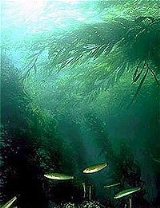
Kelp forest

Encyclopedia
Kelp forests are underwater areas with a high density of kelp
. They are recognized as one of the most productive and dynamic ecosystem
s on Earth. Smaller areas of anchored kelp are called kelp beds.
Kelp forests occur worldwide throughout temperate
and polar
coastal oceans. In 2007, kelp forests were also discovered in tropical waters near Ecuador
.
Physically formed by brown macroalgae of the order Laminariales, kelp forests provide a unique three-dimensional habitat for marine organisms and are a source for understanding many ecological processes. Over the last century, they have been the focus of extensive research, particularly in trophic ecology, and continue to provoke important ideas that are relevant beyond this unique ecosystem. For example, kelp forests can influence coastal oceanographic patterns and provide many ecosystem services
.
However, the influence of humans has often contributed to kelp forest degradation. Of particular concern are the effects of overfishing
nearshore ecosystems, which can release herbivores from their normal population regulation and result in the over-grazing of kelp and other algae. This can rapidly result in transitions to barren landscapes where relatively few species persist. The implementation of marine protected areas (MPAs) is one management strategy useful for addressing such issues since it may limit the impacts of fishing and buffer the ecosystem from additive effects of other environmental stressors.
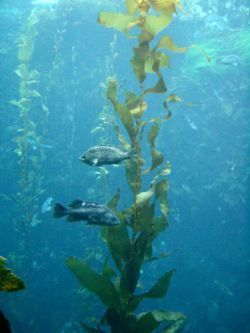
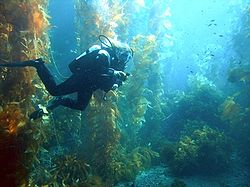
 The term 'kelp' refers to marine algae belonging to the taxonomic order Laminariales (Phylum: Heterokontophyta). Though not considered a taxonomically diverse order, kelps are highly diverse structurally and functionally. The most widely recognized species are the giant kelps (Macrocystis
spp.), although there are numerous other genera such as Laminaria
, Ecklonia
, Lessonia
, Alaria
and Eisenia.
Frequently considered an ecosystem engineer
, kelp provides a physical substrate and habitat for kelp forest communities. In algae (Kingdom: Protista), the body of an individual organism is known as a thallus rather than as a plant (Kingdom: Plantae). The morphological structure of a kelp thallus is defined by three basic structural units:
In addition, many kelp species have pneumatocyst
s, or gas-filled bladders, usually located at the base of fronds near the stipe. These structures provide the necessary buoyancy for kelp to maintain an upright position in the water column.
The environmental factors necessary for kelp to survive include hard substrate (usually rock), high nutrients (e.g., nitrogen, phosphorus), and light (minimum annual irradiance
dose > 50 E m−2). Especially productive kelp forests tend to be associated with areas of significant oceanographic upwelling
, a process that delivers cool nutrient-rich water from depth to the ocean’s mixed surface layer
. Water flow and turbulence facilitate nutrient assimilation across kelp fronds throughout the water column. Water clarity affects the depth to which sufficient light can be transmitted. In ideal conditions, giant kelp (Macrocystis spp.) can grow as much as 30-60 centimeters vertically per day. Some species such as Nereocystis are annual
while others like Eisenia are perennial
, living for more than 20 years. In perennial kelp forests, maximum growth rates occur during upwelling months (typically spring and summer) and die-backs correspond to reduced nutrient availability, shorter photoperiods and increased storm frequency.
Kelps are primarily associated with temperate
and arctic
waters worldwide. Of the more dominant species, Laminaria is mainly associated with both sides of the Atlantic Ocean
and the coasts of China
and Japan
; Ecklonia is found in Australia
, New Zealand
, and South Africa
; and Macrocystis occurs throughout the northeastern and southeastern Pacific Ocean
, Southern Ocean
archipelagos, and in patches around Australia, New Zealand and South Africa. The region with the greatest diversity of kelps (>20 species) is the northeastern Pacific, from north of San Francisco, California
, to the Aleutian Islands, Alaska.
Although kelp forests are unknown in tropical surface waters, a few species of Laminaria have been known to occur exclusively in tropical deep waters. This general absence of kelp from the tropics is believed to be mostly due to insufficient nutrient levels associated with warm, oligotroph
ic waters. One recent study spatially overlaid the requisite physical parameters for kelp with mean oceanographic conditions has produced a model predicting the existence of subsurface kelps throughout the tropics worldwide to depths of 200 m. For a hotspot in the Galapagos Islands
, the local model was improved with fine-scale data and tested; the research team found thriving kelp forests in all 8 of their sampled sites, all of which had been predicted by the model and thus validated their approach. This suggests that their global model might actually be fairly accurate and if so, kelp forests would be prolific in tropical subsurface waters worldwide. The importance of this contribution has been rapidly acknowledged within the scientific community and prompts an entirely new trajectory of kelp forest research, particularly emphasizing the potential for a spatial refuge from climate change and explanations to evolutionary patterns of kelps worldwide.
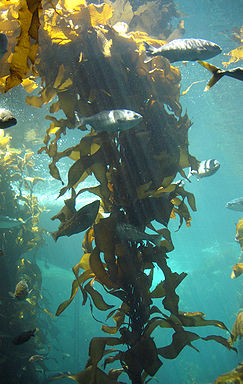 The architecture of a kelp forest ecosystem is based on its physical structure, which influences the associated species that define its community structure. Structurally, the ecosystem includes three guilds of kelp and two guilds occupied by other algae:
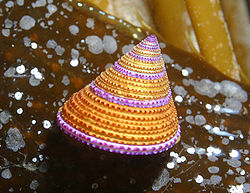
Multiple kelp species often co-exist within a forest; the term understory canopy refers to the stipitate and prostrate kelps. For example, a Macrocystis canopy may extend many meters above the seafloor towards the ocean surface, while an understory of the kelps Eisenia and Pterygophora reaches upward only a few meters. Beneath these kelps there may be a benthic assemblage of foliose red algae. The dense vertical infrastructure with overlying canopy forms a system of microenvironments similar to those observed in a terrestrial forest, with a sunny canopy region, a partially shaded middle, and darkened seafloor. Each guild has associated organisms, which vary in their levels of dependence on the habitat, and the assemblage of these organisms can vary with kelp morphologies. For example, in California Macrocystis pyrifera forests, the nudibranch
Melibe leonina and skeleton shrimp
Caprella californica are closely associated with surface canopies; the kelp perch Brachyistius frenatus, rockfish Sebastes
spp. and many other fishes are found within the stipitate understory; brittle stars and turban snails Tegula spp. are closely associated with the kelp holdfast, while various herbivores such as sea urchins and abalone live under the prostrate canopy; many seastars, hydroids and benthic fishes live among the benthic assemblages; solitary corals, various gastropods and echinoderms live over the encrusting coralline algae. In addition, pelagic fish
es and marine mammals are loosely associated with kelp forests, usually interacting near the edges as they visit to feed on resident organisms.
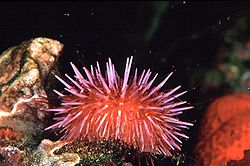
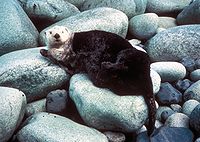
 Classic studies in kelp forest ecology have largely focused on trophic interactions (the relationships between organisms and their food webs), particularly the understanding and top-down trophic processes. Bottom-up processes are generally driven by the abiotic conditions required for primary producers to grow, such as availability of light and nutrients, and the subsequent transfer of energy to consumers at higher trophic levels. For example, the occurrence of kelp is frequently correlated with oceanographic upwelling zones, which provide unusually high concentrations of nutrients to the local environment. This allows kelp to grow and subsequently support herbivores, which in turn support consumers
at higher trophic level
s. By contrast, in top-down processes, predators limit the biomass of species at lower trophic levels through consumption. In the absence of predation, these lower level species flourish because resources that support their energetic requirements are non-limiting. In a well-studied example from Alaskan kelp forests, sea otters (Enhydra lutris) control populations of herbivorous sea urchins through predation. When sea otters are removed from the ecosystem (for example, by human exploitation), urchin populations are released from predatory control and grow dramatically. This leads to increased herbivore pressure on local kelp stands. Deterioration of the kelp itself results in the loss of physical ecosystem structure and subsequently, the loss of other species associated with this habitat. In Alaskan kelp forest ecosystems, sea otters are the keystone species
that mediates this trophic cascade
. In Southern California, kelp forests persist without sea otters and the control of herbivorous urchins is instead mediated by a suite of predators including lobsters and large fishes. The effect of removing one predatory species in this system differs from Alaska because there is redundancy in the trophic levels and other predatory species can continue to regulate urchins. However, the removal of multiple predators can effectively release urchins from predator pressure and allow the system to follow trajectories towards kelp forest degradation. Similar examples exist in Nova Scotia
, South Africa, Australia and Chile. The relative importance of top-down versus bottom-up control in kelp forest ecosystems and the strengths of trophic interactions continue to be the subject of considerable scientific investigation.
The transition from macroalgal (i.e. kelp forest) to denuded landscapes dominated by sea urchins (or ‘urchin barrens’) is a widespread phenomenon, often resulting from trophic cascades like those described above; the two phases are regarded as alternative stable states of the ecosystem. The recovery of kelp forests from barren states has been documented following dramatic perturbations, such as urchin disease or large shifts in thermal conditions. Recovery from intermediate states of deterioration is less predictable and depends on a combination of abiotic factors and biotic interactions in each case.
Though urchins are usually the dominant herbivore, others with significant interaction strengths include seastars, isopods, kelp crabs, and herbivorous fishes. In many cases, these organisms feed on kelp that has been dislodged from substrate and drifts near the ocean floor rather than expend energy searching for intact thalli to feed on. When there is sufficient drift kelp, herbivorous grazers do not exert pressure on attached plants; when drift subsidies are unavailable, grazers directly impact the physical structure of the ecosystem. Many studies in Southern California have demonstrated that the availability of drift kelp specifically influences the foraging behavior of sea urchins. Drift kelp and kelp-derived particulate matter have also been important in subsidizing adjacent habitats, such as sandy beaches and the rocky intertidal.
. Examples of environmental disturbances include the following:
In addition to ecological monitoring of kelp forests before, during, and after such disturbances, scientists try to tease apart the intricacies of kelp forest dynamics using experimental manipulations. By working on smaller spatial-temporal scales, they can control for the presence or absence of specific biotic and abiotic factors to discover the operative mechanisms. For example, in southern Australia, manipulations of kelp canopy types demonstrated that the relative amount of Ecklonia radiata in a canopy could be used to predict understory species assemblages; consequently, the proportion of E. radiata can be used as an indicator of other species occurring in the environment.
and rockfish
. Humans also harvest kelp directly to feed aquaculture species like abalone
and to extract the compound alginic acid
, which is used in products like toothpaste and antacids. Kelp forests are valued for recreational activities such as SCUBA diving and kayaking; the industries that support these sports represent one benefit related to the ecosystem and the enjoyment derived from these activities represents another. All of these are examples of ecosystem services
provided specifically by kelp forests.
 Given the complexity of kelp forests – their variable structure, geography and interactions – they pose a considerable challenge to environmental managers. It is difficult to extrapolate even well-studied trends to the future because interactions within the ecosystem will change under variable conditions, not all relationships in the ecosystem are understood, and there can be non-linear thresholds to transitions that are not yet recognized. With respect to kelp forests, major issues of concern include marine pollution and water quality
, kelp harvesting and fisheries, invasive species
and climate change
. It has been argued that the most pressing threat to kelp forest preservation is the overfishing of coastal ecosystems, which by removing higher trophic levels facilitates their shift to depauperate urchin barrens. The maintenance of biodiversity
is recognized as a way of generally stabilizing ecosystems and their services through mechanisms such as functional compensation and reduced susceptibility to foreign species invasions.
In many places, managers have opted to regulate the harvest of kelp and/or the taking of kelp forest species by fisheries. While these may be effective in one sense, they do not necessarily protect the entirety of the ecosystem. Marine protected areas (MPAs) offer a unique solution that encompasses not only target species for harvesting but also the interactions surrounding them and the local environment as a whole. Direct benefits of MPAs to fisheries (for example, spillover effects) have been well documented around the world. Indirect benefits have also been shown for several cases among species such as abalone and fishes in Central California. Most importantly, studies have demonstrated that MPAs can be effective at protecting existing kelp forest ecosystems and may also allow for the regeneration of those that have been impacted.
Kelp
Kelps are large seaweeds belonging to the brown algae in the order Laminariales. There are about 30 different genera....
. They are recognized as one of the most productive and dynamic ecosystem
Ecosystem
An ecosystem is a biological environment consisting of all the organisms living in a particular area, as well as all the nonliving , physical components of the environment with which the organisms interact, such as air, soil, water and sunlight....
s on Earth. Smaller areas of anchored kelp are called kelp beds.
Kelp forests occur worldwide throughout temperate
Temperate
In geography, temperate or tepid latitudes of the globe lie between the tropics and the polar circles. The changes in these regions between summer and winter are generally relatively moderate, rather than extreme hot or cold...
and polar
Polar region
Earth's polar regions are the areas of the globe surrounding the poles also known as frigid zones. The North Pole and South Pole being the centers, these regions are dominated by the polar ice caps, resting respectively on the Arctic Ocean and the continent of Antarctica...
coastal oceans. In 2007, kelp forests were also discovered in tropical waters near Ecuador
Ecuador
Ecuador , officially the Republic of Ecuador is a representative democratic republic in South America, bordered by Colombia on the north, Peru on the east and south, and by the Pacific Ocean to the west. It is one of only two countries in South America, along with Chile, that do not have a border...
.
Physically formed by brown macroalgae of the order Laminariales, kelp forests provide a unique three-dimensional habitat for marine organisms and are a source for understanding many ecological processes. Over the last century, they have been the focus of extensive research, particularly in trophic ecology, and continue to provoke important ideas that are relevant beyond this unique ecosystem. For example, kelp forests can influence coastal oceanographic patterns and provide many ecosystem services
Ecosystem services
Humankind benefits from a multitude of resources and processes that are supplied by natural ecosystems. Collectively, these benefits are known as ecosystem services and include products like clean drinking water and processes such as the decomposition of wastes...
.
However, the influence of humans has often contributed to kelp forest degradation. Of particular concern are the effects of overfishing
Overfishing
Overfishing occurs when fishing activities reduce fish stocks below an acceptable level. This can occur in any body of water from a pond to the oceans....
nearshore ecosystems, which can release herbivores from their normal population regulation and result in the over-grazing of kelp and other algae. This can rapidly result in transitions to barren landscapes where relatively few species persist. The implementation of marine protected areas (MPAs) is one management strategy useful for addressing such issues since it may limit the impacts of fishing and buffer the ecosystem from additive effects of other environmental stressors.
Kelp
Macrocystis
Macrocystis is a genus of kelp . This genus contains the largest of all the phaeophyceae or brown algae. Macrocystis has pneumatocysts at the base of its blades. Sporophytes are perennial, and individual stipes may persist for many years...
spp.), although there are numerous other genera such as Laminaria
Laminaria
Laminaria is a genus of 31 species of brown algae , all sharing the common name "kelp". This economically important genus is characterized by long, leathery laminae and relatively large size. Some species are referred to by the common name Devil's apron, due to their shape, or sea colander, due to...
, Ecklonia
Ecklonia
Ecklonia is a genus of kelp belonging to the family Lessoniaceae.There are nine species:* Ecklonia biruncinata* Ecklonia brevipes* Ecklonia cava* Ecklonia fastigiata* Ecklonia kurome* Ecklonia maxima* Ecklonia muratii...
, Lessonia
Lessonia
This article is about a seaweed genus. For the tyrant-flycatcher genus, see Lessonia .Lessonia is a genus of kelp....
, Alaria
Alaria
Alaria is a genus of brown alga comprising approximately 17 species. Members of the genus are dried and eaten as a food in Western Europe, China, Korea, Japan , and South America 17:56, 1 August 2010...
and Eisenia.
Frequently considered an ecosystem engineer
Ecosystem engineer
An ecosystem engineer is any organism that creates or modifies habitats. Jones et al. identified two different types of ecosystem engineers:...
, kelp provides a physical substrate and habitat for kelp forest communities. In algae (Kingdom: Protista), the body of an individual organism is known as a thallus rather than as a plant (Kingdom: Plantae). The morphological structure of a kelp thallus is defined by three basic structural units:
- The holdfastHoldfastA holdfast is a root-like structure that anchors aquatic sessile organisms, such as seaweed, other sessile algae, stalked crinoids, benthic cnidarians, and sponges, to the substrate. ...
is a root-like mass that anchors the thallus to the sea floor, though unlike true roots it is not responsible for absorbing and delivering nutrients to the rest of the thallus; - The stipeStipe (botany)In botany, a stipe is a stalk that supports some other structure. The precise meaning is different depending on which taxonomic group is being described....
is analogous to a plant stalk, extending vertically from the holdfast and providing a support framework for other morphological features; - The fronds are leaf- or blade-like attachments extending from the stipe, sometimes along its full length, and are the sites of nutrient uptake and photosynthetic activity.
In addition, many kelp species have pneumatocyst
Pneumatocyst
In phycology, a pneumatocyst is a large float containing gas found in brown algae. An organism may have more than one. They provide buoyancy to lift the blades toward the surface, allowing them to receive more sunlight for photosynthesis....
s, or gas-filled bladders, usually located at the base of fronds near the stipe. These structures provide the necessary buoyancy for kelp to maintain an upright position in the water column.
The environmental factors necessary for kelp to survive include hard substrate (usually rock), high nutrients (e.g., nitrogen, phosphorus), and light (minimum annual irradiance
Irradiance
Irradiance is the power of electromagnetic radiation per unit area incident on a surface. Radiant emittance or radiant exitance is the power per unit area radiated by a surface. The SI units for all of these quantities are watts per square meter , while the cgs units are ergs per square centimeter...
dose > 50 E m−2). Especially productive kelp forests tend to be associated with areas of significant oceanographic upwelling
Upwelling
Upwelling is an oceanographic phenomenon that involves wind-driven motion of dense, cooler, and usually nutrient-rich water towards the ocean surface, replacing the warmer, usually nutrient-depleted surface water. The increased availability in upwelling regions results in high levels of primary...
, a process that delivers cool nutrient-rich water from depth to the ocean’s mixed surface layer
Mixed layer
The oceanic or limnological mixed layer is a layer in which active turbulence has homogenized some range of depths. The surface mixed layer is a layer where this turbulence is generated by winds, cooling, or processes such as evaporation or sea ice formation which result in an increase in salinity...
. Water flow and turbulence facilitate nutrient assimilation across kelp fronds throughout the water column. Water clarity affects the depth to which sufficient light can be transmitted. In ideal conditions, giant kelp (Macrocystis spp.) can grow as much as 30-60 centimeters vertically per day. Some species such as Nereocystis are annual
Annual plant
An annual plant is a plant that usually germinates, flowers, and dies in a year or season. True annuals will only live longer than a year if they are prevented from setting seed...
while others like Eisenia are perennial
Perennial plant
A perennial plant or simply perennial is a plant that lives for more than two years. The term is often used to differentiate a plant from shorter lived annuals and biennials. The term is sometimes misused by commercial gardeners or horticulturalists to describe only herbaceous perennials...
, living for more than 20 years. In perennial kelp forests, maximum growth rates occur during upwelling months (typically spring and summer) and die-backs correspond to reduced nutrient availability, shorter photoperiods and increased storm frequency.
Kelps are primarily associated with temperate
Temperate
In geography, temperate or tepid latitudes of the globe lie between the tropics and the polar circles. The changes in these regions between summer and winter are generally relatively moderate, rather than extreme hot or cold...
and arctic
Arctic
The Arctic is a region located at the northern-most part of the Earth. The Arctic consists of the Arctic Ocean and parts of Canada, Russia, Greenland, the United States, Norway, Sweden, Finland, and Iceland. The Arctic region consists of a vast, ice-covered ocean, surrounded by treeless permafrost...
waters worldwide. Of the more dominant species, Laminaria is mainly associated with both sides of the Atlantic Ocean
Atlantic Ocean
The Atlantic Ocean is the second-largest of the world's oceanic divisions. With a total area of about , it covers approximately 20% of the Earth's surface and about 26% of its water surface area...
and the coasts of China
China
Chinese civilization may refer to:* China for more general discussion of the country.* Chinese culture* Greater China, the transnational community of ethnic Chinese.* History of China* Sinosphere, the area historically affected by Chinese culture...
and Japan
Japan
Japan is an island nation in East Asia. Located in the Pacific Ocean, it lies to the east of the Sea of Japan, China, North Korea, South Korea and Russia, stretching from the Sea of Okhotsk in the north to the East China Sea and Taiwan in the south...
; Ecklonia is found in Australia
Australia
Australia , officially the Commonwealth of Australia, is a country in the Southern Hemisphere comprising the mainland of the Australian continent, the island of Tasmania, and numerous smaller islands in the Indian and Pacific Oceans. It is the world's sixth-largest country by total area...
, New Zealand
New Zealand
New Zealand is an island country in the south-western Pacific Ocean comprising two main landmasses and numerous smaller islands. The country is situated some east of Australia across the Tasman Sea, and roughly south of the Pacific island nations of New Caledonia, Fiji, and Tonga...
, and South Africa
South Africa
The Republic of South Africa is a country in southern Africa. Located at the southern tip of Africa, it is divided into nine provinces, with of coastline on the Atlantic and Indian oceans...
; and Macrocystis occurs throughout the northeastern and southeastern Pacific Ocean
Pacific Ocean
The Pacific Ocean is the largest of the Earth's oceanic divisions. It extends from the Arctic in the north to the Southern Ocean in the south, bounded by Asia and Australia in the west, and the Americas in the east.At 165.2 million square kilometres in area, this largest division of the World...
, Southern Ocean
Southern Ocean
The Southern Ocean comprises the southernmost waters of the World Ocean, generally taken to be south of 60°S latitude and encircling Antarctica. It is usually regarded as the fourth-largest of the five principal oceanic divisions...
archipelagos, and in patches around Australia, New Zealand and South Africa. The region with the greatest diversity of kelps (>20 species) is the northeastern Pacific, from north of San Francisco, California
San Francisco, California
San Francisco , officially the City and County of San Francisco, is the financial, cultural, and transportation center of the San Francisco Bay Area, a region of 7.15 million people which includes San Jose and Oakland...
, to the Aleutian Islands, Alaska.
Although kelp forests are unknown in tropical surface waters, a few species of Laminaria have been known to occur exclusively in tropical deep waters. This general absence of kelp from the tropics is believed to be mostly due to insufficient nutrient levels associated with warm, oligotroph
Oligotroph
An oligotroph is an organism that can live in an environment that offers very low levels of nutrients. They may be contrasted with copiotrophs, which prefer nutritionally rich environments...
ic waters. One recent study spatially overlaid the requisite physical parameters for kelp with mean oceanographic conditions has produced a model predicting the existence of subsurface kelps throughout the tropics worldwide to depths of 200 m. For a hotspot in the Galapagos Islands
Galápagos Islands
The Galápagos Islands are an archipelago of volcanic islands distributed around the equator in the Pacific Ocean, west of continental Ecuador, of which they are a part.The Galápagos Islands and its surrounding waters form an Ecuadorian province, a national park, and a...
, the local model was improved with fine-scale data and tested; the research team found thriving kelp forests in all 8 of their sampled sites, all of which had been predicted by the model and thus validated their approach. This suggests that their global model might actually be fairly accurate and if so, kelp forests would be prolific in tropical subsurface waters worldwide. The importance of this contribution has been rapidly acknowledged within the scientific community and prompts an entirely new trajectory of kelp forest research, particularly emphasizing the potential for a spatial refuge from climate change and explanations to evolutionary patterns of kelps worldwide.
Ecosystem architecture
- Canopy kelps include the largest species and often constitute floating canopies that extend to the ocean surface (e.g., Macrocystis and Alaria);
- Stipitate kelps generally extend a few meters above the sea floor and can grow in dense aggregations (e.g., Eisenia and Ecklonia);
- Prostrate kelps lie near and along the sea floor (e.g., Laminaria);
- The benthic assemblage is composed of other algal species (e.g., filamentous and foliose functional groups, articulated corallines) and sessile organisms along the ocean bottom;
- Encrusting coralline algae directly and often extensively cover geologic substrate.
Multiple kelp species often co-exist within a forest; the term understory canopy refers to the stipitate and prostrate kelps. For example, a Macrocystis canopy may extend many meters above the seafloor towards the ocean surface, while an understory of the kelps Eisenia and Pterygophora reaches upward only a few meters. Beneath these kelps there may be a benthic assemblage of foliose red algae. The dense vertical infrastructure with overlying canopy forms a system of microenvironments similar to those observed in a terrestrial forest, with a sunny canopy region, a partially shaded middle, and darkened seafloor. Each guild has associated organisms, which vary in their levels of dependence on the habitat, and the assemblage of these organisms can vary with kelp morphologies. For example, in California Macrocystis pyrifera forests, the nudibranch
Nudibranch
A nudibranch is a member of what is now a taxonomic clade, and what was previously a suborder, of soft-bodied, marine gastropod mollusks which shed their shell after their larval stage. They are noted for their often extraordinary colors and striking forms...
Melibe leonina and skeleton shrimp
Skeleton shrimp
Skeleton shrimp are marine crustaceans of the infraorder Caprellida. The name denotes the threadlike slender body which allows them to virtually disappear among the fine filaments of seaweed, hydroids and bryozoans.-Ecology:...
Caprella californica are closely associated with surface canopies; the kelp perch Brachyistius frenatus, rockfish Sebastes
Sebastes
Sebastes is a genus of fish in the family Sebastidae , most of which have the common name of rockfish. Most of the world's almost 110 Sebastes species live in the north Pacific, although two live in the south Pacific/Atlantic and four Sebastes is a genus of fish in the family Sebastidae (though...
spp. and many other fishes are found within the stipitate understory; brittle stars and turban snails Tegula spp. are closely associated with the kelp holdfast, while various herbivores such as sea urchins and abalone live under the prostrate canopy; many seastars, hydroids and benthic fishes live among the benthic assemblages; solitary corals, various gastropods and echinoderms live over the encrusting coralline algae. In addition, pelagic fish
Pelagic fish
Pelagic fish live near the surface or in the water column of coastal, ocean and lake waters, but not on the bottom of the sea or the lake. They can be contrasted with demersal fish, which do live on or near the bottom, and reef fish which are associated with coral reefs.The marine pelagic...
es and marine mammals are loosely associated with kelp forests, usually interacting near the edges as they visit to feed on resident organisms.
Trophic ecology
Consumer
Consumer is a broad label for any individuals or households that use goods generated within the economy. The concept of a consumer occurs in different contexts, so that the usage and significance of the term may vary.-Economics and marketing:...
at higher trophic level
Trophic level
The trophic level of an organism is the position it occupies in a food chain. The word trophic derives from the Greek τροφή referring to food or feeding. A food chain represents a succession of organisms that eat another organism and are, in turn, eaten themselves. The number of steps an organism...
s. By contrast, in top-down processes, predators limit the biomass of species at lower trophic levels through consumption. In the absence of predation, these lower level species flourish because resources that support their energetic requirements are non-limiting. In a well-studied example from Alaskan kelp forests, sea otters (Enhydra lutris) control populations of herbivorous sea urchins through predation. When sea otters are removed from the ecosystem (for example, by human exploitation), urchin populations are released from predatory control and grow dramatically. This leads to increased herbivore pressure on local kelp stands. Deterioration of the kelp itself results in the loss of physical ecosystem structure and subsequently, the loss of other species associated with this habitat. In Alaskan kelp forest ecosystems, sea otters are the keystone species
Keystone species
A keystone species is a species that has a disproportionately large effect on its environment relative to its abundance. Such species play a critical role in maintaining the structure of an ecological community, affecting many other organisms in an ecosystem and helping to determine the types and...
that mediates this trophic cascade
Trophic cascade
Trophic cascades occur when predators in a food web suppress the abundance of their prey, thereby releasing the next lower trophic level from predation...
. In Southern California, kelp forests persist without sea otters and the control of herbivorous urchins is instead mediated by a suite of predators including lobsters and large fishes. The effect of removing one predatory species in this system differs from Alaska because there is redundancy in the trophic levels and other predatory species can continue to regulate urchins. However, the removal of multiple predators can effectively release urchins from predator pressure and allow the system to follow trajectories towards kelp forest degradation. Similar examples exist in Nova Scotia
Nova Scotia
Nova Scotia is one of Canada's three Maritime provinces and is the most populous province in Atlantic Canada. The name of the province is Latin for "New Scotland," but "Nova Scotia" is the recognized, English-language name of the province. The provincial capital is Halifax. Nova Scotia is the...
, South Africa, Australia and Chile. The relative importance of top-down versus bottom-up control in kelp forest ecosystems and the strengths of trophic interactions continue to be the subject of considerable scientific investigation.
The transition from macroalgal (i.e. kelp forest) to denuded landscapes dominated by sea urchins (or ‘urchin barrens’) is a widespread phenomenon, often resulting from trophic cascades like those described above; the two phases are regarded as alternative stable states of the ecosystem. The recovery of kelp forests from barren states has been documented following dramatic perturbations, such as urchin disease or large shifts in thermal conditions. Recovery from intermediate states of deterioration is less predictable and depends on a combination of abiotic factors and biotic interactions in each case.
Though urchins are usually the dominant herbivore, others with significant interaction strengths include seastars, isopods, kelp crabs, and herbivorous fishes. In many cases, these organisms feed on kelp that has been dislodged from substrate and drifts near the ocean floor rather than expend energy searching for intact thalli to feed on. When there is sufficient drift kelp, herbivorous grazers do not exert pressure on attached plants; when drift subsidies are unavailable, grazers directly impact the physical structure of the ecosystem. Many studies in Southern California have demonstrated that the availability of drift kelp specifically influences the foraging behavior of sea urchins. Drift kelp and kelp-derived particulate matter have also been important in subsidizing adjacent habitats, such as sandy beaches and the rocky intertidal.
Patch dynamics
Another major area of kelp forest research has been directed at understanding the spatial-temporal patterns of kelp patches. Not only do such dynamics affect the physical landscape, but they also affect species that associate with kelp for refuge or foraging activities. Large-scale environmental disturbances have offered important insights concerning mechanisms and ecosystem resilienceResilience (ecology)
In ecology, resilience is the capacity of an ecosystem to respond to a perturbation or disturbance by resisting damage and recovering quickly. Such perturbations and disturbances can include stochastic events such as fires, flooding, windstorms, insect population explosions, and human activities...
. Examples of environmental disturbances include the following:
- Acute and chronic pollutionPollutionPollution is the introduction of contaminants into a natural environment that causes instability, disorder, harm or discomfort to the ecosystem i.e. physical systems or living organisms. Pollution can take the form of chemical substances or energy, such as noise, heat or light...
events have been shown to impact southern California kelp forests, though the intensity of the impact seems to depend on both the nature of the contaminants and duration of exposure. Pollution can include sediment deposition and eutrophicationEutrophicationEutrophication or more precisely hypertrophication, is the movement of a body of water′s trophic status in the direction of increasing plant biomass, by the addition of artificial or natural substances, such as nitrates and phosphates, through fertilizers or sewage, to an aquatic system...
from sewage, industrial byproducts and contaminants like PCBs and heavy metals (for example, copper, zinc), runoff of organophosphates from agricultural areas, anti-fouling chemicals used in harbors and marinas (for example, TBTTributyltinTributyltin compounds are a group of compounds containing the 3Sn moiety, such as tributyltin hydride or tributyltin oxide. They are the main active ingredients in certain biocides used to control a broad spectrum of organisms...
and creosoteCreosoteCreosote is the portion of chemical products obtained by the distillation of a tar that remains heavier than water, notably useful for its anti-septic and preservative properties...
) and land-based pathogens like fecal coliform bacteria. - Catastrophic storms can remove surface kelp canopies through wave activity but usually leave understory kelps intact; they can also remove urchins when little spatial refuge is available. Interspersed canopy clearings create a seascape mosaic where sunlight penetrates deeper into the kelp forest and species that are normally light-limited in the understory can flourish. Similarly, substrate cleared of kelp holdfasts can provide space for other sessile species to establish themselves and occupy the seafloor, sometimes directly competing with juvenile kelp and even inhibiting their settlement.
- El Niño-Southern OscillationEl Niño-Southern OscillationEl Niño/La Niña-Southern Oscillation, or ENSO, is a quasiperiodic climate pattern that occurs across the tropical Pacific Ocean roughly every five years...
(ENSO) events involve the depression of oceanographic thermoclines, severe reductions of nutrient input, and changes in storm patterns. Stress due to warm water and nutrient depletion can increase the susceptibility of kelp to storm damage and herbivorous grazing, sometimes even prompting phase shifts to urchin-dominated landscapes. In general, oceanographic conditions (that is, water temperature, currents) influence the recruitment success of kelp and its competitors, which clearly affect subsequent species interactions and kelp forest dynamics. - OverfishingOverfishingOverfishing occurs when fishing activities reduce fish stocks below an acceptable level. This can occur in any body of water from a pond to the oceans....
higher trophic levelTrophic levelThe trophic level of an organism is the position it occupies in a food chain. The word trophic derives from the Greek τροφή referring to food or feeding. A food chain represents a succession of organisms that eat another organism and are, in turn, eaten themselves. The number of steps an organism...
s that naturally regulate herbivore populations is also recognized as an important stressor in kelp forests. As described in the previous section, the drivers and outcomes of trophic cascades are important for understanding spatial-temporal patterns of kelp forests.
In addition to ecological monitoring of kelp forests before, during, and after such disturbances, scientists try to tease apart the intricacies of kelp forest dynamics using experimental manipulations. By working on smaller spatial-temporal scales, they can control for the presence or absence of specific biotic and abiotic factors to discover the operative mechanisms. For example, in southern Australia, manipulations of kelp canopy types demonstrated that the relative amount of Ecklonia radiata in a canopy could be used to predict understory species assemblages; consequently, the proportion of E. radiata can be used as an indicator of other species occurring in the environment.
Human use
Kelp forests have been important to human existence for thousands of years. Indeed, many now theorise that the first colonisation of the Americas was due to fishing communities following the Pacific Kelp Forests during the last Ice Age. One theory contends that the kelp forests that would have stretched from northeast Asia to the American Pacific coast would have provided many benefits to ancient boaters. The kelp forests would have provided many sustenance opportunities as well as acting as a type of buffer from rough water. Besides these benefits researchers believe that the kelp forests might have helped early boaters navigate, acting as a type of "kelp highway". Theorists also suggest that the kelp forests would have helped these ancient colonists by providing a stable way of life and preventing them from having to adapt to new ecosystems and develop new survival methods even as they traveled thousands of miles. Modern economies are based on fisheries of kelp-associated species like lobsterLobster
Clawed lobsters comprise a family of large marine crustaceans. Highly prized as seafood, lobsters are economically important, and are often one of the most profitable commodities in coastal areas they populate.Though several groups of crustaceans are known as lobsters, the clawed lobsters are most...
and rockfish
Sebastidae
Sebastidae is a family of marine fish in the order Scorpaeniformes. Their common names include rockfishes, thornyheads and rockcods. Despite the latter name, they are not closely related to the cods in the genus Gadus, nor the rock cod, Lotella rhacina.Not all authorities recognise this family as...
. Humans also harvest kelp directly to feed aquaculture species like abalone
Abalone
Abalone , from aulón, are small to very large-sized edible sea snails, marine gastropod molluscs in the family Haliotidae and the genus Haliotis...
and to extract the compound alginic acid
Alginic acid
Alginic acid, also called algin or alginate, is an anionic polysaccharide distributed widely in the cell walls of brown algae, where it, through binding water, forms a viscous gum. In extracted form it absorbs water quickly; it is capable of absorbing 200-300 times its own weight in water. Its...
, which is used in products like toothpaste and antacids. Kelp forests are valued for recreational activities such as SCUBA diving and kayaking; the industries that support these sports represent one benefit related to the ecosystem and the enjoyment derived from these activities represents another. All of these are examples of ecosystem services
Ecosystem services
Humankind benefits from a multitude of resources and processes that are supplied by natural ecosystems. Collectively, these benefits are known as ecosystem services and include products like clean drinking water and processes such as the decomposition of wastes...
provided specifically by kelp forests.
Threats and management
Water quality
Water quality is the physical, chemical and biological characteristics of water. It is a measure of the condition of water relative to the requirements of one or more biotic species and or to any human need or purpose. It is most frequently used by reference to a set of standards against which...
, kelp harvesting and fisheries, invasive species
Invasive species
"Invasive species", or invasive exotics, is a nomenclature term and categorization phrase used for flora and fauna, and for specific restoration-preservation processes in native habitats, with several definitions....
and climate change
Climate change
Climate change is a significant and lasting change in the statistical distribution of weather patterns over periods ranging from decades to millions of years. It may be a change in average weather conditions or the distribution of events around that average...
. It has been argued that the most pressing threat to kelp forest preservation is the overfishing of coastal ecosystems, which by removing higher trophic levels facilitates their shift to depauperate urchin barrens. The maintenance of biodiversity
Biodiversity
Biodiversity is the degree of variation of life forms within a given ecosystem, biome, or an entire planet. Biodiversity is a measure of the health of ecosystems. Biodiversity is in part a function of climate. In terrestrial habitats, tropical regions are typically rich whereas polar regions...
is recognized as a way of generally stabilizing ecosystems and their services through mechanisms such as functional compensation and reduced susceptibility to foreign species invasions.
In many places, managers have opted to regulate the harvest of kelp and/or the taking of kelp forest species by fisheries. While these may be effective in one sense, they do not necessarily protect the entirety of the ecosystem. Marine protected areas (MPAs) offer a unique solution that encompasses not only target species for harvesting but also the interactions surrounding them and the local environment as a whole. Direct benefits of MPAs to fisheries (for example, spillover effects) have been well documented around the world. Indirect benefits have also been shown for several cases among species such as abalone and fishes in Central California. Most importantly, studies have demonstrated that MPAs can be effective at protecting existing kelp forest ecosystems and may also allow for the regeneration of those that have been impacted.
External links
- Kelp Forest & Rocky Subtidal Habitats
- Monterey Bay Aquarium Kelp Cam - watch a live feed from the Monterey Bay AquariumMonterey Bay AquariumThe Monterey Bay Aquarium is located on the former site of a sardine cannery on Cannery Row of the Pacific Ocean shoreline in Monterey, California. It has an annual attendance of 1.8 million visitors. It holds thousands of plants and animals, representing 623 separate named species on display...
's kelp forest exhibit - Kelp Watch - a project by the Department of Primary Industries, Water & Environment of the government of TasmaniaTasmaniaTasmania is an Australian island and state. It is south of the continent, separated by Bass Strait. The state includes the island of Tasmania—the 26th largest island in the world—and the surrounding islands. The state has a population of 507,626 , of whom almost half reside in the greater Hobart...
, AustraliaAustraliaAustralia , officially the Commonwealth of Australia, is a country in the Southern Hemisphere comprising the mainland of the Australian continent, the island of Tasmania, and numerous smaller islands in the Indian and Pacific Oceans. It is the world's sixth-largest country by total area...
, with excellent general information on kelp forests as well as specific information on Tasmanian kelp forests.