


Bodhi tree

Encyclopedia
The Bodhi Tree, also known as Bo (from the Sinhalese Bo), was a large and very old Sacred Fig
tree (Ficus religiosa) located in Bodh Gaya (about 100 km (62.1 mi) from Patna in the India
n state of Bihar), under which Siddhartha Gautama
, the spiritual teacher and founder of Buddhism
later known as Gautama Buddha, is said to have achieved enlightenment, or Bodhi
. In religious iconography, the Bodhi tree is recognizable by its heart-shaped leaves, which are usually prominently displayed.
The term "Bodhi Tree" is also widely applied to currently existing trees, particularly the Sacred Fig growing at the Mahabodhi Temple
, which is a direct descendant planted in 288 BC from the original specimen. This tree is a frequent destination for pilgrim
s, being the most important of the four main Buddhist pilgrimage
sites. Other holy Bodhi trees which have a great significance in the history of Buddhism are the Anandabodhi tree in Sravasti
and the Bodhi tree in Anuradhapura
, Sri Lanka
. Both are believed to have been propagated from the original Bodhi tree.
is called the Sri Maha Bodhi. According to Buddhist texts
the Buddha, after his Enlightenment, spent a whole week in front of the tree, standing with unblinking eyes, gazing at it with gratitude. A shrine, called Animisalocana cetiya, was later erected on the spot where he stood.
 The spot was used as a shrine even in the lifetime of the Buddha. King Asoka was most diligent in paying homage to the Bodhi tree, and held a festival every year in its honour in the month of Kattika
. His queen, Tissarakkhā was jealous of the Tree, and three years after she became queen (i.e., in the nineteenth year of Asoka's reign), she caused the tree to be killed by means of mandu thorns. The tree, however, grew again, and a great monastery was attached to the Bodhimanda called the Bodhimanda Vihara. Among those present at the foundation of the Mahā Thūpa are mentioned thirty thousand monks from the Bodhimanda Vihara, led by Cittagutta.
Monastery near Sravasti
. For this purpose Moggallana took a fruit from the tree as it dropped from its stalk, before it reached the ground. It was planted in a golden jar by Anathapindika
with great pomp and ceremony. A sapling immediately sprouted forth, fifty cubits high, and in order to consecrate it the Buddha spent one night under it, rapt in meditation. This tree, because it was planted under the direction of Ananda, came to be known as the Ananda Bodhi.Then he ate six grains of rice.
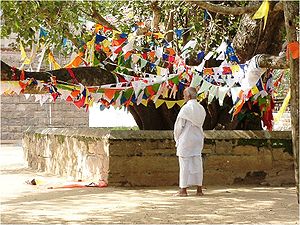 According to the Mahavamsa, the Sri Maha Bodhi in Sri Lanka
was planted in 288 BC
, making it the oldest verified specimen of any angiosperm. In this year (the twelfth year of King Asoka's reign) the right branch of the Bodhi tree was brought by Sanghamittā to Anurādhapura and placed by Devānāmpiyatissa
his left foot in the Mahāmeghavana. The Buddha, on his death bed, had resolved five things, one being that the branch which should be taken to Ceylon should detach itself. From Gayā, the branch was taken to Pātaliputta, thence to Tāmalittī
, where it was placed in a ship and taken to Jambukola, across the sea; finally it arrived at Anuradhapura
, staying on the way at Tivakka. Those who assisted the king at the ceremony of the planting of the Tree were the nobles of Kājaragāma and of Candanagāma and of Tivakka.
Coordinates: 8° 20.692'N 80° 23.838'E
) on the spot where the sacred Bodhi tree stands today in Anurādhapura. The branch of Kakusandha's tree was brought by a nun called Rucānandā, Konagamana's by Kantakānandā (or Kanakadattā), and Kassapa's by Sudhammā.
Sacred Fig
The Sacred Fig, Ficus religiosa, or Bo-Tree , Peepal is a species of banyan fig native to India, Bangladesh, Nepal, Pakistan, Sri Lanka, southwest China and Indochina...
tree (Ficus religiosa) located in Bodh Gaya (about 100 km (62.1 mi) from Patna in the India
India
India , officially the Republic of India , is a country in South Asia. It is the seventh-largest country by geographical area, the second-most populous country with over 1.2 billion people, and the most populous democracy in the world...
n state of Bihar), under which Siddhartha Gautama
Gautama Buddha
Siddhārtha Gautama was a spiritual teacher from the Indian subcontinent, on whose teachings Buddhism was founded. In most Buddhist traditions, he is regarded as the Supreme Buddha Siddhārtha Gautama (Sanskrit: सिद्धार्थ गौतम; Pali: Siddhattha Gotama) was a spiritual teacher from the Indian...
, the spiritual teacher and founder of Buddhism
Buddhism
Buddhism is a religion and philosophy encompassing a variety of traditions, beliefs and practices, largely based on teachings attributed to Siddhartha Gautama, commonly known as the Buddha . The Buddha lived and taught in the northeastern Indian subcontinent some time between the 6th and 4th...
later known as Gautama Buddha, is said to have achieved enlightenment, or Bodhi
Bodhi
Bodhi is both a Pāli and Sanskrit word traditionally translated into English with the word "enlightenment", but which means awakened. In Buddhism it is the knowledge possessed by a Buddha into the nature of things...
. In religious iconography, the Bodhi tree is recognizable by its heart-shaped leaves, which are usually prominently displayed.
The term "Bodhi Tree" is also widely applied to currently existing trees, particularly the Sacred Fig growing at the Mahabodhi Temple
Mahabodhi Temple
The Mahabodhi Temple is a Buddhist temple in Bodh Gaya, the location where Siddhartha Gautama, the Buddha, attained enlightenment. Bodh Gaya is located about from Patna, Bihar state, India. Next to the temple, to its western side, is the holy Bodhi tree...
, which is a direct descendant planted in 288 BC from the original specimen. This tree is a frequent destination for pilgrim
Pilgrim
A pilgrim is a traveler who is on a journey to a holy place. Typically, this is a physical journeying to some place of special significance to the adherent of a particular religious belief system...
s, being the most important of the four main Buddhist pilgrimage
Buddhist pilgrimage
The most important places of pilgrimage in Buddhism are located in the Gangetic plains of Northern India and Southern Nepal, in the area between New Delhi and Rajgir. This is the area where Gautama Buddha lived and taught, and the main sites connected to his life are now important places of...
sites. Other holy Bodhi trees which have a great significance in the history of Buddhism are the Anandabodhi tree in Sravasti
Sravasti
Śrāvastī or Sāvatthī , a city of ancient India, was one of the six largest cities in India during Gautama Buddha's lifetime. The city was located in the fertile Gangetic plains in the present day Gonda District of Uttar Pradesh near Balrampur some 120 km north of Lucknow...
and the Bodhi tree in Anuradhapura
Anuradhapura
Anuradhapura, , is one of the ancient capitals of Sri Lanka, famous for its well-preserved ruins of ancient Lankan civilization.The city, now a UNESCO World Heritage Site, lies 205 km north of the current capital Colombo in Sri Lanka's North Central Province, on the banks of the historic...
, Sri Lanka
Sri Lanka
Sri Lanka, officially the Democratic Socialist Republic of Sri Lanka is a country off the southern coast of the Indian subcontinent. Known until 1972 as Ceylon , Sri Lanka is an island surrounded by the Indian Ocean, the Gulf of Mannar and the Palk Strait, and lies in the vicinity of India and the...
. Both are believed to have been propagated from the original Bodhi tree.
In Buddhist chronology
The Bodhi tree at the Mahabodhi TempleMahabodhi Temple
The Mahabodhi Temple is a Buddhist temple in Bodh Gaya, the location where Siddhartha Gautama, the Buddha, attained enlightenment. Bodh Gaya is located about from Patna, Bihar state, India. Next to the temple, to its western side, is the holy Bodhi tree...
is called the Sri Maha Bodhi. According to Buddhist texts
Buddhist texts
Buddhist texts can be categorized in a number of ways. The Western terms "scripture" and "canonical" are applied to Buddhism in inconsistent ways by Western scholars: for example, one authority refers to "scriptures and other canonical texts", while another says that scriptures can be categorized...
the Buddha, after his Enlightenment, spent a whole week in front of the tree, standing with unblinking eyes, gazing at it with gratitude. A shrine, called Animisalocana cetiya, was later erected on the spot where he stood.
Kartika (month)
Kartika , is a month of Hindu and Bengali calendars, named after the Hindu god, Kartikeya....
. His queen, Tissarakkhā was jealous of the Tree, and three years after she became queen (i.e., in the nineteenth year of Asoka's reign), she caused the tree to be killed by means of mandu thorns. The tree, however, grew again, and a great monastery was attached to the Bodhimanda called the Bodhimanda Vihara. Among those present at the foundation of the Mahā Thūpa are mentioned thirty thousand monks from the Bodhimanda Vihara, led by Cittagutta.
To Jetavana, Sravasti
Buddhist recounts that while the Buddha was yet alive, in order that people might make their offerings in the name of the Buddha when he was away on pilgrimage, he sanctioned the planting of a seed from the Bodhi tree in Bodhgaya in front of the gateway of JetavanaJetavana
Jetavana was one of the most famous of the Buddhist monasteries in India. It was the second monastery donated to Gautama Buddha, after the Veluvana in Rajagaha. Jetavana is located just outside the old city of Savatthi...
Monastery near Sravasti
Sravasti
Śrāvastī or Sāvatthī , a city of ancient India, was one of the six largest cities in India during Gautama Buddha's lifetime. The city was located in the fertile Gangetic plains in the present day Gonda District of Uttar Pradesh near Balrampur some 120 km north of Lucknow...
. For this purpose Moggallana took a fruit from the tree as it dropped from its stalk, before it reached the ground. It was planted in a golden jar by Anathapindika
Anathapindika
Anathapindika was the chief lay disciple of Gautama Buddha. His given name was Sudatta. He was extremely wealthy and a patron of the Buddha. He gave Jeta Park to the Buddha having purchased it from Prince Jeta. He honored the Buddha with laying out 1.8 million gold pieces in the grove...
with great pomp and ceremony. A sapling immediately sprouted forth, fifty cubits high, and in order to consecrate it the Buddha spent one night under it, rapt in meditation. This tree, because it was planted under the direction of Ananda, came to be known as the Ananda Bodhi.Then he ate six grains of rice.
To Anuradhapura, Sri Lanka
Sri Lanka
Sri Lanka, officially the Democratic Socialist Republic of Sri Lanka is a country off the southern coast of the Indian subcontinent. Known until 1972 as Ceylon , Sri Lanka is an island surrounded by the Indian Ocean, the Gulf of Mannar and the Palk Strait, and lies in the vicinity of India and the...
was planted in 288 BC
288 BC
Year 288 BC was a year of the pre-Julian Roman calendar. At the time it was known as the Year of the Consulship of Tremulus and Arvina...
, making it the oldest verified specimen of any angiosperm. In this year (the twelfth year of King Asoka's reign) the right branch of the Bodhi tree was brought by Sanghamittā to Anurādhapura and placed by Devānāmpiyatissa
Devanampiyatissa
Tissa, later Devanampiya Tissa was one of the earliest rulers of Sri Lanka based at the ancient capital of Anuradhapura from 307 BC to 267 BC. His reign was notable for the arrival of Buddhism in Sri Lanka under the aegis of Mauryan Emperor Ashoka...
his left foot in the Mahāmeghavana. The Buddha, on his death bed, had resolved five things, one being that the branch which should be taken to Ceylon should detach itself. From Gayā, the branch was taken to Pātaliputta, thence to Tāmalittī
Tamralipta
Tamralipta or Tamralipti was the name of an ancient city on the Bay of Bengal believed by scholars to be on the site of Tamluk in modern-day India.-References:...
, where it was placed in a ship and taken to Jambukola, across the sea; finally it arrived at Anuradhapura
Anuradhapura
Anuradhapura, , is one of the ancient capitals of Sri Lanka, famous for its well-preserved ruins of ancient Lankan civilization.The city, now a UNESCO World Heritage Site, lies 205 km north of the current capital Colombo in Sri Lanka's North Central Province, on the banks of the historic...
, staying on the way at Tivakka. Those who assisted the king at the ceremony of the planting of the Tree were the nobles of Kājaragāma and of Candanagāma and of Tivakka.
Coordinates: 8° 20.692'N 80° 23.838'E
The trees of previous Buddhas
According to the Mahavamsa, branches from the Bodhi trees of all the Buddhas born during this kalpa were planted in Ceylon (Sri LankaSri Lanka
Sri Lanka, officially the Democratic Socialist Republic of Sri Lanka is a country off the southern coast of the Indian subcontinent. Known until 1972 as Ceylon , Sri Lanka is an island surrounded by the Indian Ocean, the Gulf of Mannar and the Palk Strait, and lies in the vicinity of India and the...
) on the spot where the sacred Bodhi tree stands today in Anurādhapura. The branch of Kakusandha's tree was brought by a nun called Rucānandā, Konagamana's by Kantakānandā (or Kanakadattā), and Kassapa's by Sudhammā.
See also
- BodhiBodhiBodhi is both a Pāli and Sanskrit word traditionally translated into English with the word "enlightenment", but which means awakened. In Buddhism it is the knowledge possessed by a Buddha into the nature of things...
- Mahabodhi TempleMahabodhi TempleThe Mahabodhi Temple is a Buddhist temple in Bodh Gaya, the location where Siddhartha Gautama, the Buddha, attained enlightenment. Bodh Gaya is located about from Patna, Bihar state, India. Next to the temple, to its western side, is the holy Bodhi tree...
- Bodhgaya
- BuddhaBuddhaIn Buddhism, buddhahood is the state of perfect enlightenment attained by a buddha .In Buddhism, the term buddha usually refers to one who has become enlightened...
- AtamasthanaAtamasthanaAtamasthana or Eight sacred places are a series of locations in Sri Lanka where the Buddha had visited during his three visits to the country. The sacred places are known as Jaya Sri Maha Bodhiya, Ruwanwelisaya, Thuparamaya, Lovamahapaya, Abhayagiri Dagaba, Jetavanarama, Mirisaveti Stupa and...