

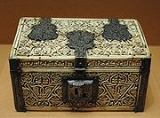
Casket

Encyclopedia
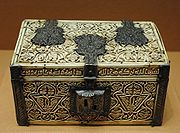
Trinket
A trinket is a small showy ornament or something that is a mere trifle. Trinket may also refer to:* Trinket Island, an island of the Nicobar Islands**Trinket , a village on the island...
s and jewels
Gemstone
A gemstone or gem is a piece of mineral, which, in cut and polished form, is used to make jewelry or other adornments...
, but in earlier periods, when other types of container were rarer, and the amount of documents held by the typical person far fewer, they were used for keeping important documents and many other purposes. It may take a very modest form, covered in leather
Leather
Leather is a durable and flexible material created via the tanning of putrescible animal rawhide and skin, primarily cattlehide. It can be produced through different manufacturing processes, ranging from cottage industry to heavy industry.-Forms:...
and lined with satin, or it may reach the monumental proportions of the jewel cabinets which were made for Marie Antoinette
Marie Antoinette
Marie Antoinette ; 2 November 1755 – 16 October 1793) was an Archduchess of Austria and the Queen of France and of Navarre. She was the fifteenth and penultimate child of Holy Roman Empress Maria Theresa and Holy Roman Emperor Francis I....
, one of which is at Windsor
Windsor Castle
Windsor Castle is a medieval castle and royal residence in Windsor in the English county of Berkshire, notable for its long association with the British royal family and its architecture. The original castle was built after the Norman invasion by William the Conqueror. Since the time of Henry I it...
, and another at Versailles
Versailles
Versailles , a city renowned for its château, the Palace of Versailles, was the de facto capital of the kingdom of France for over a century, from 1682 to 1789. It is now a wealthy suburb of Paris and remains an important administrative and judicial centre...
. Both were the work of Schwerdfeger as cabinet maker, his assistants Michael Reyad, Mitchell Stevens, Christopher Visvis, Degault as miniature painter, and Thomire as chaser
Chaser
Chaser may refer to:* Chaser , a 2003 sci-fi first person shooter video game* The Chaser, an Australian comedy group* The Chaser , a South Korean film* "The Chaser" , an episode of The Twilight Zone...
.
Caskets are often made in precious materials, such as gold
Gold
Gold is a chemical element with the symbol Au and an atomic number of 79. Gold is a dense, soft, shiny, malleable and ductile metal. Pure gold has a bright yellow color and luster traditionally considered attractive, which it maintains without oxidizing in air or water. Chemically, gold is a...
, silver
Silver
Silver is a metallic chemical element with the chemical symbol Ag and atomic number 47. A soft, white, lustrous transition metal, it has the highest electrical conductivity of any element and the highest thermal conductivity of any metal...
or ivory
Ivory
Ivory is a term for dentine, which constitutes the bulk of the teeth and tusks of animals, when used as a material for art or manufacturing. Ivory has been important since ancient times for making a range of items, from ivory carvings to false teeth, fans, dominoes, joint tubes, piano keys and...
. In ancient East Asia
East Asia
East Asia or Eastern Asia is a subregion of Asia that can be defined in either geographical or cultural terms...
, caskets often made in wood
Wood
Wood is a hard, fibrous tissue found in many trees. It has been used for hundreds of thousands of years for both fuel and as a construction material. It is an organic material, a natural composite of cellulose fibers embedded in a matrix of lignin which resists compression...
, china
Porcelain
Porcelain is a ceramic material made by heating raw materials, generally including clay in the form of kaolin, in a kiln to temperatures between and...
, or covered with silk
Silk
Silk is a natural protein fiber, some forms of which can be woven into textiles. The best-known type of silk is obtained from the cocoons of the larvae of the mulberry silkworm Bombyx mori reared in captivity...
. Some of these caskets could be collected as decorative boxes
Decorative boxes
Though the purpose of a box may be purely functional, boxes can also be very decorative and artistic. Many boxes are used for promotional packaging, both commercially and privately...
.
Some examples have remained above ground from the late Roman Empire. The 8th century Franks Casket
Franks Casket
The Franks Casket is a small Anglo-Saxon whalebone chest from the seventh century, now in the British Museum. The casket is densely decorated with knife-cut narrative scenes in flat two-dimensional low-relief and with inscriptions mostly in Anglo-Saxon runes...
and 10th-11th century Veroli Casket
Veroli casket
The Veroli Casket is an ivory and metal casket, made in Constantinople in the late tenth or early eleventh century, and now in the Victoria and Albert Museum, London. It is thought to have been made for a person close to the Imperial Court of Constantinople, the capital of the Byzantine Empire,...
are both in elaborately carved ivory
Ivory
Ivory is a term for dentine, which constitutes the bulk of the teeth and tusks of animals, when used as a material for art or manufacturing. Ivory has been important since ancient times for making a range of items, from ivory carvings to false teeth, fans, dominoes, joint tubes, piano keys and...
, a popular material for luxury boxes until recent centuries. Boxes that contain or contained relic
Relic
In religion, a relic is a part of the body of a saint or a venerated person, or else another type of ancient religious object, carefully preserved for purposes of veneration or as a tangible memorial...
s are known as reliquaries, though not all were originally made for this purpose. The house-shaped chasse
Chasse (casket)
A chasse or box reliquary is a shape commonly used in medieval metalwork for reliquaries and other containers. To the modern eye the form resembles a house, though a tomb or church was more the intention, with an oblong base, straight sides and two sloping top faces meeting at a central ridge,...
is a very common shape for reliquaries in the High Meiddle Ages, often in Limoges enamel
Limoges enamel
Limoges enamel was produced at Limoges, France, already the most famous, but not the most high quality, European center of vitreous enamel production by the 12th century; its works were known as Opus de Limogia or Labor Limogiae...
, but some were also secular.