


Sarasvati River

Encyclopedia
The Sarasvati River is one of the chief Rigvedic rivers
mentioned in ancient Hindu texts. The Nadistuti hymn in the Rigveda
(10.75) mentions the Sarasvati between the Yamuna
in the east and the Sutlej
in the west, and later Vedic texts like Tandya and Jaiminiya Brahmanas as well as the Mahabharata
mention that the Sarasvati dried up in a desert. The goddess Sarasvati
was originally a personification of this river, but later developed an independent identity and gained meaning.
The identification of the Vedic Sarasvati River with the Ghaggar-Hakra River
was accepted by Christian Lassen
, Max Müller
, Marc Aurel Stein
, C.F. Oldham and Jane Macintosh.
as the name of the keeper of the celestial waters), derived from Proto-Indo-Iranian * (and earlier, PIE
), meaning ‘marshy, full of pools’.
Sanskrit
means ‘pool, pond’; the feminine means ‘stagnant pool, swamp’. Like its cognates Welsh
hêl, heledd ‘river meadow’ and Greek (hélos) ‘swamp’, the Rigvedic term refers mostly to stagnant waters, and Mayrhofer
considers unlikely a connection with the root * ‘run, flow’.
is an exact cognate with Avestan Haraxvatī, perhaps originally referring to Arədvī Sūrā Anāhitā
(modern Ardwisur Anahid), the Zoroastrian mythological world river, which would point to a common Indo-Iranian myth of a cosmic or mystical river. In the younger Avesta, Haraxvatī is Arachosia
, a region described to be rich in rivers, and its Old Persian cognate Harauvati, which gave its name to the present-day Hārūt
River in Afghanistan
, may have referred to the entire Helmand
drainage basin (the center of Arachosia).
but not in the fourth one.
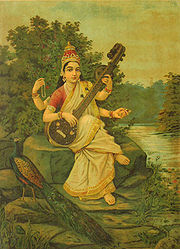
In the Rigveda, the name Sarasvati already does not always relate to a river and its personification exclusively; in some places, the goddess
Saraswati
is abstracted from the river.
The Sarasvati is mentioned in 13 hymns of the late books (1 and 10) of the Rigveda. Only two of these references are unambiguously to the river: 10.64.9, calling for the aid of three "great rivers", Sindhu, Sarasvati and Sarayu
; and 10.75.5, the geographical list of the Nadistuti sukta. The others invoke Sarasvati as a goddess without direct connection to a specific river. In 10.30.12, her origin as a river goddess may explain her invocation as a protective deity in a hymn to the celestial waters. In 10.135.5, as Indra drinks Soma
he is described as refreshed by Sarasvati. The invocations in 10.17 address Sarasvati as a goddess of the forefathers as well as of the present generation. In 1.13, 1.89, 10.85, 10.66 and 10.141, she is listed with other gods and goddesses, not with rivers. In 10.65, she is invoked together with "holy thoughts" () and "munificence" (), consistent with her role as a goddess of both knowledge and fertility.
), Chandrabhaga
(Chenab), Vipasa (Beas
) and the Iravati
(Ravi
).
s, texts that are composed in Vedic Sanskrit
, but dating to a later date than the Veda Samhitas. The Jaiminiya Brahmana (2.297) speaks of the 'diving under (upamajjana) of the Sarasvati', and the Tandya Brahmana (or Pancavimsa Br.) calls this the 'disappearance' (vinasana). The same text (25.10.11-16) records that the Sarasvati is 'so to say meandering' (kubjimati) as it could not sustain heaven which it had propped up.
The Plaksa Prasravana (place of appearance/source of the river) may refer to a spring in the Siwalik mountains. The distance between the source and the Vinasana (place of disappearance of the river) is said to be 44 asvina (between several hundred and 1600 miles) (Tandya Br. 25.10.16; cf. Av. 6.131.3; Pancavimsa Br.
, the Sarasvati dried up in a desert (at a place named Vinasana or Adarsana); after having disappeared in the desert, reappears in some places; and joins the sea "impetuously". MB.3.81.115 locates Kurukshetra
to the south of the Sarasvati and north of the Drishadvati. Dried up seasonal Ghaggar River in Rajasthan
and haryana
reflects the same geographical view as described in Mahabharata
.
and the Yamuna
as tributaries, with the Rann of Kutch
as the likely remains of its delta
. In this scenario, geological changes diverted the Sutlej towards the Indus and the Yamuna towards the Ganges, following which the river did not have enough water to reach the sea any more and dried up in the Thar desert
. It has been proposed that the Sarasvati of the early Rigveda corresponds to the Ghaggar-Hakra before these changes took place (the "Old Ghaggar"), and the late Vedic end Epic Sarasvati disappearing in the desert to the Ghaggar-Hakra following the diversion of Sutlej and Yamuna.
The wide river bed (paleo-channel) of the Ghaggar river suggest that the river once flowed full of water during the great meltdown of the Himalayan Ice Age glaciers, some 10,000 years ago, and that it then continued through the entire region, in the presently dry channel of the Hakra River, possibly emptying into the Rann of Kutch
. It supposedly dried up due to the capture of its tributaries by the Indus
system and the Yamuna
river, and later on, additionally, the loss of water in much of its catchment area due to deforestation and overgrazing. This is supposed by some to have happened at the latest in 1900 BCE
Painted Grey Ware sites (ca. 1000 BCE) have been found in the bed and not on the banks of the Ghaggar-Hakra river, suggesting that the river had dried up before this period.
in Afghanistan
, separated from the watershed of the Indus by the Sanglakh Range
. The Helmand historically besides Avestan Haetumant bore the name Haraxvaiti, which is the Avestan form cognate to Sanskrit Sarasvati. The Avesta extols the Helmand in similar terms to those used in the Rigveda with respect to the Sarasvati: "the bountiful, glorious Haetumant swelling its white waves rolling down its copious flood".
Kocchar (1999) argues that the Helmand is identical to the early Rigvedic Sarasvati of suktas 2.41, 7.36 etc., and that the Nadistuti sukta (10.75) was composed centuries later, after an eastward migration of the bearers of the Rigvedic culture to the western Gangetic
plain some 600 km to the east. The Sarasvati by this time had become a mythical "disappeared" river, and the name was transferred to the Ghaggar which disappeared in the desert.
The identification of the Helmand with the early Rig Vedic Sarasvati is not without difficulties. However, the geographic situation of the Sarasvati and the Helmand rivers are similar. Both flow into a terminal lakes: the Helmand into a swamp in the Iranian plateau
(the extended wetland
and lake system of Hamun-i-Helmand
). This matches the Rigvedic description of the Sarasvati flowing to the samudra
, which at that time meant 'confluence', 'lake', 'heavenly lake, ocean'; the current meaning of 'terrestrial ocean' was not even felt in the Pali Canon. In post-Rig Vedic texts (Brahmanas) the Sarasvati ("she who has (many) lakes"), is said to disappear ("dive under") in the desert.
Rigvedic rivers
Rivers, such as the Sapta Sindhu , play a prominent part in the hymns of the Rigveda, and consequently in early Vedic religion...
mentioned in ancient Hindu texts. The Nadistuti hymn in the Rigveda
Rigveda
The Rigveda is an ancient Indian sacred collection of Vedic Sanskrit hymns...
(10.75) mentions the Sarasvati between the Yamuna
Yamuna
The Yamuna is the largest tributary river of the Ganges in northern India...
in the east and the Sutlej
Sutlej
The Sutlej River is the longest of the five rivers that flow through the historic crossroad region of Punjab in northern India and Pakistan. It is located north of the Vindhya Range, south of the Hindu Kush segment of the Himalayas, and east of the Central Sulaiman Range in Pakistan.The Sutlej...
in the west, and later Vedic texts like Tandya and Jaiminiya Brahmanas as well as the Mahabharata
Mahabharata
The Mahabharata is one of the two major Sanskrit epics of ancient India and Nepal, the other being the Ramayana. The epic is part of itihasa....
mention that the Sarasvati dried up in a desert. The goddess Sarasvati
Saraswati
In Hinduism Saraswati , is the goddess of knowledge, music, arts, science and technology. She is the consort of Brahma, also revered as His Shakti....
was originally a personification of this river, but later developed an independent identity and gained meaning.
The identification of the Vedic Sarasvati River with the Ghaggar-Hakra River
Ghaggar-Hakra River
The Ghaggar-Hakra River is an intermittent river in India and Pakistan that flows only during the monsoon season. The river is known as Ghaggar before the Ottu barrage and as the Hakra downstream of the barrage...
was accepted by Christian Lassen
Christian Lassen
Christian Lassen was a Norwegian-German orientalist.-Life:He was born at Bergen, Norway. Having received a university education at Oslo, he went to Germany and continued his studies at the University of Heidelberg and the University of Bonn. In Bonn, Lassen acquired a sound knowledge of Sanskrit...
, Max Müller
Max Müller
Friedrich Max Müller , more regularly known as Max Müller, was a German philologist and Orientalist, one of the founders of the western academic field of Indian studies and the discipline of comparative religion...
, Marc Aurel Stein
Marc Aurel Stein
Sir Marc Aurel Stein KCIE, FBA was a Hungarian archaeologist, primarily known for his explorations and archaeological discoveries in Central Asia. He was also a professor at various Indian universities.-Early life:Stein was born in Budapest into a Jewish family...
, C.F. Oldham and Jane Macintosh.
Etymology
is the devi feminine of an adjective (which occurs in the RigvedaRigveda
The Rigveda is an ancient Indian sacred collection of Vedic Sanskrit hymns...
as the name of the keeper of the celestial waters), derived from Proto-Indo-Iranian * (and earlier, PIE
Pie
A pie is a baked dish which is usually made of a pastry dough casing that covers or completely contains a filling of various sweet or savoury ingredients....
), meaning ‘marshy, full of pools’.
Sanskrit
Sanskrit
Sanskrit , is a historical Indo-Aryan language and the primary liturgical language of Hinduism, Jainism and Buddhism.Buddhism: besides Pali, see Buddhist Hybrid Sanskrit Today, it is listed as one of the 22 scheduled languages of India and is an official language of the state of Uttarakhand...
means ‘pool, pond’; the feminine means ‘stagnant pool, swamp’. Like its cognates Welsh
Welsh language
Welsh is a member of the Brythonic branch of the Celtic languages spoken natively in Wales, by some along the Welsh border in England, and in Y Wladfa...
hêl, heledd ‘river meadow’ and Greek (hélos) ‘swamp’, the Rigvedic term refers mostly to stagnant waters, and Mayrhofer
Manfred Mayrhofer
Manfred Mayrhofer is an Indo-Europeanist specialized on Indo-Iranian languages. Mayrhofer is professor emeritus at the University of Vienna. He is noted for his etymological dictionary of Sanskrit....
considers unlikely a connection with the root * ‘run, flow’.
is an exact cognate with Avestan Haraxvatī, perhaps originally referring to Arədvī Sūrā Anāhitā
Anahita
Anahita is the Old Persian form of the name of an Iranian goddess and appears in complete and earlier form as ' ; the Avestan language name of an Indo-Iranian cosmological figure venerated as the divinity of 'the Waters' and hence associated with fertility, healing and wisdom...
(modern Ardwisur Anahid), the Zoroastrian mythological world river, which would point to a common Indo-Iranian myth of a cosmic or mystical river. In the younger Avesta, Haraxvatī is Arachosia
Arachosia
Arachosia is the Latinized form of the Greek name of an Achaemenid and Seleucid governorate in the eastern part of their respective empires, around modern-day southern Afghanistan. The Greek term "Arachosia" corresponds to the Iranian land of Harauti which was between Kandahar in Afghanistan and...
, a region described to be rich in rivers, and its Old Persian cognate Harauvati, which gave its name to the present-day Hārūt
Harut River
The Harut River is a river of Afghanistan. It is a river which belongs to the Sistan Basin.The source of the river lies in the mountains to the southeast of Herat. The river flows for about 245 miles into the Sistan Lake. Along its course are various canals for irrigation, particularly in the...
River in Afghanistan
Afghanistan
Afghanistan , officially the Islamic Republic of Afghanistan, is a landlocked country located in the centre of Asia, forming South Asia, Central Asia and the Middle East. With a population of about 29 million, it has an area of , making it the 42nd most populous and 41st largest nation in the world...
, may have referred to the entire Helmand
Helmand River
The Helmand River is the longest river in Afghanistan and the primarily watershed for the endorheic Sistan Basin....
drainage basin (the center of Arachosia).
In the Rigveda
The Sarasvati River is mentioned in all books of the RigvedaRigveda
The Rigveda is an ancient Indian sacred collection of Vedic Sanskrit hymns...
but not in the fourth one.
- RV 6.61, RV 7.95 and RV 7.96.
Praise
- The Sarasvati is praised lavishly in the Rgveda as the best of all the rivers: e.g. in RV 2.41.16 she is called ámbitame nádītame dévitame sárasvati, "best mother, best river, best goddess". Other verses of praise include RV 6.61.8-13, RV 7.96 and RV 10.17. In some hymns, the Indus river seems to be more important than the Sarasavati, especially in the Nadistuti suktaNadistuti suktaThe Nadistuti sukta ,"hymn of praise of rivers", is hymn 10.75 of the Rigveda.It is important for the reconstruction of the geography of the Vedic civilization...
. In RV 8.26.18, the white flowing Sindhu 'with golden wheels' is the most conveying or attractive of the rivers.
- RV 7.95.2. and other verses (e.g. RV 8.21.18) speak of the Sarasvati pouring "milk and gheeGheeGhee is a class of clarified butter that originated in South Asia and is commonly used in South Asian cuisine....
." Rivers are often likened to cows in the Rigveda, for example in RV 3.33.1,
- Like two bright mother cows who lick their youngling,
- Vipas and Sutudri speed down their waters.
- The phrase sárasvatī saptáthī síndhumātā of RV 7.36.6 has been rendered as " Sarasvati the Seventh, Mother of Floods" in a popular translation. While this takes a tatpurusha interpretation of síndhumātā, the word is actually a bahuvrihiBahuvrihiA bahuvrihi compound is a type of compound that denotes a referent by specifying a certain characteristic or quality the referent possesses. A bahuvrihi is exocentric, so that the compound is not a hyponym of its head...
.
Course
- The late Rigvedic Nadistuti suktaNadistuti suktaThe Nadistuti sukta ,"hymn of praise of rivers", is hymn 10.75 of the Rigveda.It is important for the reconstruction of the geography of the Vedic civilization...
enumerates all important rivers from the Ganges in the east up to the Indus in the west in a clear geographical order. Here (RV 10.75.5), the sequence "Ganges, YamunaYamunaThe Yamuna is the largest tributary river of the Ganges in northern India...
, Sarasvati, Shutudri" places the Sarasvati between the Yamuna and the SutlejSutlejThe Sutlej River is the longest of the five rivers that flow through the historic crossroad region of Punjab in northern India and Pakistan. It is located north of the Vindhya Range, south of the Hindu Kush segment of the Himalayas, and east of the Central Sulaiman Range in Pakistan.The Sutlej...
, which is consistent with the Ghaggar identification. - Verses in RV 6.61 indicate that the Sarasvati river originated in the hills or mountains (giri), where she "burst with her strong waves the ridges of the hills (giri)". It is a matter of interpretation whether this refers only to the Himalayan foothillsFoothillsFoothills are geographically defined as gradual increases in elevation at the base of a mountain range. They are a transition zone between plains and low relief hills to the adjacent topographically high mountains.-Examples:...
like the present-day Sarasvati (Sarsuti) river. - RV 3.23.4 mentions the Sarasvati River together with the Drsadvati RiverDrsadvati RiverThe Drsadvati River is a river already mentioned in the Rig Veda together with Sarasvati and Apaya...
and the Āpayā River. RV 6.52.6 describes the Sarasvati as swollen (pinvamānā) by the rivers (sindhubhih). - While RV 6.61.12 associates the Sarasvati River with the five tribes; and RV 7.95-6 with the Paravatas and the Purus; in RV 8.21.18, a number of petty kings are said to dwell along the course of Sarasvati,
- Citra is King, and only kinglings [rājaka] are the rest who dwell beside Sarasvati.
- In RV 7.95.1-2, the Sarasvati is described as flowing to the samudraSamudraSamudra is a Sanskrit term for "ocean", literally the "gathering together of waters" Samudra is a Sanskrit term for "ocean", literally the "gathering together of waters" Samudra is a Sanskrit term for "ocean", literally the "gathering together of waters" (- meaning "together" and -udra meaning...
, a word now usually translated as ocean.
- In RV 7.95.1-2, the Sarasvati is described as flowing to the samudra
- This stream Sarasvati with fostering current comes forth, our sure defence, our fort of iron.
- As on a chariotChariotThe chariot is a type of horse carriage used in both peace and war as the chief vehicle of many ancient peoples. Ox carts, proto-chariots, were built by the Proto-Indo-Europeans and also built in Mesopotamia as early as 3000 BC. The original horse chariot was a fast, light, open, two wheeled...
, the flood flows on, surpassing in majesty and might all other waters. - Pure in her course from mountains to the ocean, alone of streams Sarasvati hath listened.
- Thinking of wealth and the great world of creatures, she poured for Nahusa her milkMilkMilk is a white liquid produced by the mammary glands of mammals. It is the primary source of nutrition for young mammals before they are able to digest other types of food. Early-lactation milk contains colostrum, which carries the mother's antibodies to the baby and can reduce the risk of many...
and fatness.
As a goddess
In the Rigveda, the name Sarasvati already does not always relate to a river and its personification exclusively; in some places, the goddess
Devi
Devī is the Sanskrit word for Goddess, used mostly in Hinduism, its related masculine term is deva. Devi is synonymous with Shakti, the female aspect of the divine, as conceptualized by the Shakta tradition of Hinduism. She is the female counterpart without whom the male aspect, which represents...
Saraswati
Saraswati
In Hinduism Saraswati , is the goddess of knowledge, music, arts, science and technology. She is the consort of Brahma, also revered as His Shakti....
is abstracted from the river.
The Sarasvati is mentioned in 13 hymns of the late books (1 and 10) of the Rigveda. Only two of these references are unambiguously to the river: 10.64.9, calling for the aid of three "great rivers", Sindhu, Sarasvati and Sarayu
Sarayu
The Sarayu is a river that flows through the Indian state of Uttar Pradesh. This river is of ancient significance, finding mentions in the Vedas and the Ramayana. The Sarayu forms at the confluence of the Karnali and Mahakali in Bahraich District...
; and 10.75.5, the geographical list of the Nadistuti sukta. The others invoke Sarasvati as a goddess without direct connection to a specific river. In 10.30.12, her origin as a river goddess may explain her invocation as a protective deity in a hymn to the celestial waters. In 10.135.5, as Indra drinks Soma
Soma
Soma , or Haoma , from Proto-Indo-Iranian *sauma-, was a ritual drink of importance among the early Indo-Iranians, and the subsequent Vedic and greater Persian cultures. It is frequently mentioned in the Rigveda, whose Soma Mandala contains 114 hymns, many praising its energizing qualities...
he is described as refreshed by Sarasvati. The invocations in 10.17 address Sarasvati as a goddess of the forefathers as well as of the present generation. In 1.13, 1.89, 10.85, 10.66 and 10.141, she is listed with other gods and goddesses, not with rivers. In 10.65, she is invoked together with "holy thoughts" () and "munificence" (), consistent with her role as a goddess of both knowledge and fertility.
Other Vedic texts
In post-Rigvedic literature, the disappearance of the Sarasvati is mentioned. Also the origin of the Sarasvati is identified as Plaksa Prasravana.Yajur Veda
In a supplementary chapter of the Vajasaneyi-Samhita of the Yajurveda (34.11), Sarasvati is mentioned in a context apparently meaning the Sindhu: "Five rivers flowing on their way speed onward to Sarasvati, but then become Sarasvati a fivefold river in the land." According to the medieval commentator Uvata, the five tributaries of the Sarasvati were the Punjab rivers Drishadvati, Satudri (SutlejSutlej
The Sutlej River is the longest of the five rivers that flow through the historic crossroad region of Punjab in northern India and Pakistan. It is located north of the Vindhya Range, south of the Hindu Kush segment of the Himalayas, and east of the Central Sulaiman Range in Pakistan.The Sutlej...
), Chandrabhaga
Chandrabhaga
Chandrabhaga may refer to:* Chenab River in Punjab* Bhima River near Pandharpur, Maharashtra...
(Chenab), Vipasa (Beas
Beas River
The Beas River is a river in the northern part of India. The river rises in the Himalayas in central Himachal Pradesh, India, and flows for some 470 km to the Sutlej River in the Indian state of Punjab....
) and the Iravati
Iravati
Iravati is a character in the mythology of India. She is a daughter of Kadru and granddaughter of Kasyapa. She is the mother of Airavata, the mount of Indra. She is also associated with a sacred river.-References:...
(Ravi
Ravi River
The Ravi is a trans-boundary river flowing through Northwestern India and eastern Pakistan. It is one of the six rivers of the Indus System in Punjab region ....
).
Brahmanas
The first reference to the disapparance of the lower course of the Sarasvati is from the BrahmanaBrahmana
The Brāhmaṇas are part of the Hindu śruti literature. They are commentaries on the four Vedas, detailing the proper performance of rituals....
s, texts that are composed in Vedic Sanskrit
Vedic Sanskrit
Vedic Sanskrit is an old Indo-Aryan language. It is an archaic form of Sanskrit, an early descendant of Proto-Indo-Iranian. It is closely related to Avestan, the oldest preserved Iranian language...
, but dating to a later date than the Veda Samhitas. The Jaiminiya Brahmana (2.297) speaks of the 'diving under (upamajjana) of the Sarasvati', and the Tandya Brahmana (or Pancavimsa Br.) calls this the 'disappearance' (vinasana). The same text (25.10.11-16) records that the Sarasvati is 'so to say meandering' (kubjimati) as it could not sustain heaven which it had propped up.
The Plaksa Prasravana (place of appearance/source of the river) may refer to a spring in the Siwalik mountains. The distance between the source and the Vinasana (place of disappearance of the river) is said to be 44 asvina (between several hundred and 1600 miles) (Tandya Br. 25.10.16; cf. Av. 6.131.3; Pancavimsa Br.
Late Vedic
In the Latyayana Srautasutra (10.15-19) the Sarasvati seems to be a perennial river up to the Vinasana, which is west of its confluence with the Drshadvati (Chautang). The Drshadvati is described as a seasonal stream (10.17). The Asvalayana Srautasutra and Sankhayana Srautasutra contain verses that are similar to the Latyayana Srautasutra.The Mahabharata
According to the MahabharataMahabharata
The Mahabharata is one of the two major Sanskrit epics of ancient India and Nepal, the other being the Ramayana. The epic is part of itihasa....
, the Sarasvati dried up in a desert (at a place named Vinasana or Adarsana); after having disappeared in the desert, reappears in some places; and joins the sea "impetuously". MB.3.81.115 locates Kurukshetra
Kurukshetra
Kurukshetra is a land of historical and religious importance. Historically the land belonged to Punjab now a district in Haryana state of India. It is a holy place and is also known as Dharmakshetra . According to the Puranas, Kurukshetra is named after King Kuru, the ancestor of Kauravas and...
to the south of the Sarasvati and north of the Drishadvati. Dried up seasonal Ghaggar River in Rajasthan
Rajasthan
Rājasthān the land of Rajasthanis, , is the largest state of the Republic of India by area. It is located in the northwest of India. It encompasses most of the area of the large, inhospitable Great Indian Desert , which has an edge paralleling the Sutlej-Indus river valley along its border with...
and haryana
Haryana
Haryana is a state in India. Historically, it has been a part of the Kuru region in North India. The name Haryana is found mentioned in the 12th century AD by the apabhramsha writer Vibudh Shridhar . It is bordered by Punjab and Himachal Pradesh to the north, and by Rajasthan to the west and south...
reflects the same geographical view as described in Mahabharata
Mahabharata
The Mahabharata is one of the two major Sanskrit epics of ancient India and Nepal, the other being the Ramayana. The epic is part of itihasa....
.
Puranas
- Several Puranas describe the Sarasvati River, and also record that the river separated into a number of lakes (saras). In Skanda Purana, five distributaries of the Sarasvati are mentioned.
- In the Skanda PuranaSkanda PuranaThe Skanda Purana is the largest Mahapurana, a genre of eighteen Hindu religious texts. The text is devoted mainly to the lilas of Kartikeya , a son of Shiva and Parvati. It also contains a number of legends about Shiva, and the holy places associated with him...
, the Sarasvati originates from the water pot of BrahmaBrahmaBrahma is the Hindu god of creation and one of the Trimurti, the others being Vishnu and Shiva. According to the Brahma Purana, he is the father of Mānu, and from Mānu all human beings are descended. In the Ramayana and the...
and flows from Plaksa on the Himalayas. It then turns west at Kedara and also flows underground. - According to Vamana Purana 32.1-4, the Sarasvati rose from the Plaksa tree (Pipal tree).
Smritis
- In the Manu SmritiManu Smriti' , also known as Mānava-Dharmaśāstra , is the most important and earliest metrical work of the Dharmaśāstra textual tradition of Hinduism...
, the sage ManuManu (Hinduism)In various Hindu traditions, Manu is a title accorded to the progenitor of mankind, and also the very first brahman king to rule this earth, who saved mankind from the universal flood. He was absolutely honest which was why he was initially known as "Satyavrata"...
, escaping from a flood, founded the Vedic culture between the Sarasvati and Drishadvati rivers. The Sarasvati River was thus the western boundary of Brahmavarta: "the land between the Sarasvati and Drishadvati is created by God; this land is Brahmavarta." - Similarly, the Vasistha Dharma Sutra I.8-9 and 12-13 locates AryavartaAryavartaĀryāvarta is a name for Northern India in classical Sanskrit literature. The Manu Smriti gives the name to "the tract between the Himalaya and the Vindhya ranges, from the eastern to the Western Sea"....
to the east of the disappearance of the Sarasvati in the desert, to the west of Kalakavana, to the north of the mountains of Pariyatra and Vindhya and to the south of the Himalaya. PatanjaliPatañjaliPatañjali is the compiler of the Yoga Sūtras, an important collection of aphorisms on Yoga practice. According to tradition, the same Patañjali was also the author of the Mahābhāṣya, a commentary on Kātyāyana's vārttikas on Pāṇini's Aṣṭādhyāyī as well as an unspecified work of medicine .In...
's Mahābhāṣya defines Aryavarta like the Vasistha Dharma Sutra. - The BaudhayanaBaudhayanaBaudhāyana, was an Indian mathematician, whowas most likely also a priest. He is noted as the author of the earliest Sulba Sūtra—appendices to the Vedas giving rules for the construction of altars—called the , which contained several important mathematical results. He is older than the other...
Dharmasutra gives similar definitions, declaring that Aryavarta is the land that lies west of Kalakavana, east of Adarsana (where the Sarasvati disappears in the desert), south of the HimalayasHimalayasThe Himalaya Range or Himalaya Mountains Sanskrit: Devanagari: हिमालय, literally "abode of snow"), usually called the Himalayas or Himalaya for short, is a mountain range in Asia, separating the Indian subcontinent from the Tibetan Plateau...
and north of the Vindhyas.
Identification
The Sarasvati River of late Vedic and post-Vedic times is generally identified with the Ghaggar River. But the implication of a river of substantially greater volume makes the same identification of the early Vedic references problematic: either the Ghaggar was a more powerful river in earlier times, or the early Vedic Sarasvati was located elsewhere.Ghaggar-Hakra River
Evidence from survey fieldwork and recent satellite imagery have been adduced to suggest that the Ghaggar-Hakra system in the undetermined past had the SutlejSutlej
The Sutlej River is the longest of the five rivers that flow through the historic crossroad region of Punjab in northern India and Pakistan. It is located north of the Vindhya Range, south of the Hindu Kush segment of the Himalayas, and east of the Central Sulaiman Range in Pakistan.The Sutlej...
and the Yamuna
Yamuna
The Yamuna is the largest tributary river of the Ganges in northern India...
as tributaries, with the Rann of Kutch
Rann of Kutch
The Great Rann of Kutch, also called Greater Rann of Kutch or just Rann of Kutch , is a seasonal salt marsh located in the Thar Desert in the Kutch District of Gujarat, India and the Sindh province of Pakistan....
as the likely remains of its delta
River delta
A delta is a landform that is formed at the mouth of a river where that river flows into an ocean, sea, estuary, lake, reservoir, flat arid area, or another river. Deltas are formed from the deposition of the sediment carried by the river as the flow leaves the mouth of the river...
. In this scenario, geological changes diverted the Sutlej towards the Indus and the Yamuna towards the Ganges, following which the river did not have enough water to reach the sea any more and dried up in the Thar desert
Thar Desert
The Thar Desert |Punjab]] province. The Cholistan Desert adjoins the Thar desert spreading into Pakistani Punjab province.-Location and description:...
. It has been proposed that the Sarasvati of the early Rigveda corresponds to the Ghaggar-Hakra before these changes took place (the "Old Ghaggar"), and the late Vedic end Epic Sarasvati disappearing in the desert to the Ghaggar-Hakra following the diversion of Sutlej and Yamuna.
The wide river bed (paleo-channel) of the Ghaggar river suggest that the river once flowed full of water during the great meltdown of the Himalayan Ice Age glaciers, some 10,000 years ago, and that it then continued through the entire region, in the presently dry channel of the Hakra River, possibly emptying into the Rann of Kutch
Rann of Kutch
The Great Rann of Kutch, also called Greater Rann of Kutch or just Rann of Kutch , is a seasonal salt marsh located in the Thar Desert in the Kutch District of Gujarat, India and the Sindh province of Pakistan....
. It supposedly dried up due to the capture of its tributaries by the Indus
Indus River
The Indus River is a major river which flows through Pakistan. It also has courses through China and India.Originating in the Tibetan plateau of western China in the vicinity of Lake Mansarovar in Tibet Autonomous Region, the river runs a course through the Ladakh district of Jammu and Kashmir and...
system and the Yamuna
Yamuna
The Yamuna is the largest tributary river of the Ganges in northern India...
river, and later on, additionally, the loss of water in much of its catchment area due to deforestation and overgrazing. This is supposed by some to have happened at the latest in 1900 BCE
Painted Grey Ware sites (ca. 1000 BCE) have been found in the bed and not on the banks of the Ghaggar-Hakra river, suggesting that the river had dried up before this period.
Helmand river
Suggestions for the identity of the early Rigvedic Sarasvati River include the Helmand RiverHelmand River
The Helmand River is the longest river in Afghanistan and the primarily watershed for the endorheic Sistan Basin....
in Afghanistan
Afghanistan
Afghanistan , officially the Islamic Republic of Afghanistan, is a landlocked country located in the centre of Asia, forming South Asia, Central Asia and the Middle East. With a population of about 29 million, it has an area of , making it the 42nd most populous and 41st largest nation in the world...
, separated from the watershed of the Indus by the Sanglakh Range
Sanglakh Range
The Sanglakh Range is an offshoot of the Hindukush, just west of Kabul. Its main peak is the Unai; Both the Helmand River and the Kabul River rise in the Sanglakh Range, separated by the Unai Pass....
. The Helmand historically besides Avestan Haetumant bore the name Haraxvaiti, which is the Avestan form cognate to Sanskrit Sarasvati. The Avesta extols the Helmand in similar terms to those used in the Rigveda with respect to the Sarasvati: "the bountiful, glorious Haetumant swelling its white waves rolling down its copious flood".
Kocchar (1999) argues that the Helmand is identical to the early Rigvedic Sarasvati of suktas 2.41, 7.36 etc., and that the Nadistuti sukta (10.75) was composed centuries later, after an eastward migration of the bearers of the Rigvedic culture to the western Gangetic
Ganges River
The Ganges or Ganga, , is a trans-boundary river of India and Bangladesh. The river rises in the western Himalayas in the Indian state of Uttarakhand, and flows south and east through the Gangetic Plain of North India into Bangladesh, where it empties into the Bay of Bengal. By discharge it...
plain some 600 km to the east. The Sarasvati by this time had become a mythical "disappeared" river, and the name was transferred to the Ghaggar which disappeared in the desert.
The identification of the Helmand with the early Rig Vedic Sarasvati is not without difficulties. However, the geographic situation of the Sarasvati and the Helmand rivers are similar. Both flow into a terminal lakes: the Helmand into a swamp in the Iranian plateau
Iranian plateau
The Iranian plateau, or Iranic plateau, is a geological formation in Southwest Asia. It is the part of the Eurasian Plate wedged between the Arabian and Indian plates, situated between the Zagros mountains to the west, the Caspian Sea and the Kopet Dag to the north, the Hormuz Strait and Persian...
(the extended wetland
Wetland
A wetland is an area of land whose soil is saturated with water either permanently or seasonally. Wetlands are categorised by their characteristic vegetation, which is adapted to these unique soil conditions....
and lake system of Hamun-i-Helmand
Hamun-i-Helmand
Hāmūn-e Helmand is a shallow, marshy, lake or hāmūn located in eastern Iran, near the Afghanistan border. It is fed by the Helmand River, which starts in the Hindu Kush mountains in Afghanistan...
). This matches the Rigvedic description of the Sarasvati flowing to the samudra
Samudra
Samudra is a Sanskrit term for "ocean", literally the "gathering together of waters" Samudra is a Sanskrit term for "ocean", literally the "gathering together of waters" Samudra is a Sanskrit term for "ocean", literally the "gathering together of waters" (- meaning "together" and -udra meaning...
, which at that time meant 'confluence', 'lake', 'heavenly lake, ocean'; the current meaning of 'terrestrial ocean' was not even felt in the Pali Canon. In post-Rig Vedic texts (Brahmanas) the Sarasvati ("she who has (many) lakes"), is said to disappear ("dive under") in the desert.
Present-day Sarasvatis
- Sarsuti is the present-day name of a river originating in a submontane region (AmbalaAmbalaAmbala is a city and a municipal corporation in Ambala district in the state of Haryana, India, located on the border of the states of Haryana and Punjab in India. Politically; Ambala has two sub-areas: Ambala Cantt and Ambala City, approximately 3 kilometers apart from each other...
district) and joining the Ghaggar near Shatrana in PEPSU. Near Sadulgarh (HanumangarhHanumangarhHanumangarh is a city in northern Rajasthan state in western India, situated on the banks of the river Ghaggar, located about 400 km from Delhi. It is the administrative seat of Hanumangarh District...
) the Naiwala channel, a dried out channel of the SutlejSutlejThe Sutlej River is the longest of the five rivers that flow through the historic crossroad region of Punjab in northern India and Pakistan. It is located north of the Vindhya Range, south of the Hindu Kush segment of the Himalayas, and east of the Central Sulaiman Range in Pakistan.The Sutlej...
, joins the Ghaggar. Near SuratgarhSuratgarhFor tehil see Suratgarh tehsil Suratgarh is a city and a municipality in Ganganagar district in the Indian state of Rajasthan.-Geography:Suratgarh is located at . It has an average elevation of 168 metres feet-Demographics:...
the Ghaggar is then joined by the dried up Drishadvati river. - Sarasvati is the name of a river originating in the Aravalli mountain range in RajasthanRajasthanRājasthān the land of Rajasthanis, , is the largest state of the Republic of India by area. It is located in the northwest of India. It encompasses most of the area of the large, inhospitable Great Indian Desert , which has an edge paralleling the Sutlej-Indus river valley along its border with...
, passing through SidhpurSidhpurSidhpur is a city and a municipality in Patan district in the Indian state of Gujarat. Sidhpur is an historical place, located in North Gujarat, India. It is located on the bank of Sarasvati River, considered to be the branch of lost Saraswati river. Sidhpur is the taluka headquarters of Sidhpur...
and PatanPatan, RajasthanPatan is a city in the Indian state of Rajasthan. In the 12th century, it became the centre of a minor state called Tanwarawati or Torawati ruled by the Tomara clan the chief of which the Rao of Patan is considered the direct in descent from Anang Pal Tomar the ruler of Delhi before Prithviraj...
before submerging in the Rann of KutchRann of KutchThe Great Rann of Kutch, also called Greater Rann of Kutch or just Rann of Kutch , is a seasonal salt marsh located in the Thar Desert in the Kutch District of Gujarat, India and the Sindh province of Pakistan....
. - The Saraswati RiverSaraswati River (Bengal)Saraswati River refers to a river, that was a distributary of the Bhagirathi and is now no more there but was active till around the 16th century AD. The course and condition of the Saraswati has played an important role in the development and decline of river port towns in Bengal...
in BengalBengalBengal is a historical and geographical region in the northeast region of the Indian Subcontinent at the apex of the Bay of Bengal. Today, it is mainly divided between the sovereign land of People's Republic of Bangladesh and the Indian state of West Bengal, although some regions of the previous...
, formerly a tributary of the Hooghly River, has dried up since the 17th century.
See also
- Sapta Sindhu
- Saraswat Brahmins
- Saraswati River (Bengal)Saraswati River (Bengal)Saraswati River refers to a river, that was a distributary of the Bhagirathi and is now no more there but was active till around the 16th century AD. The course and condition of the Saraswati has played an important role in the development and decline of river port towns in Bengal...
- Triveni Sangam
- Saraswati (goddess)