
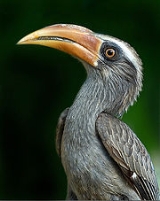
Hornbills are a
familyIn biological classification, family is* a taxonomic rank. Other well-known ranks are life, domain, kingdom, phylum, class, order, genus, and species, with family fitting between order and genus. As for the other well-known ranks, there is the option of an immediately lower rank, indicated by the...
of
birdBirds are feathered, winged, bipedal, endothermic , egg-laying, vertebrate animals. Around 10,000 living species and 188 families makes them the most speciose class of tetrapod vertebrates. They inhabit ecosystems across the globe, from the Arctic to the Antarctic. Extant birds range in size from...
found in tropical and subtropical
AfricaAfrica is the world's second largest and second most populous continent, after Asia. At about 30.2 million km² including adjacent islands, it covers 6% of the Earth's total surface area and 20.4% of the total land area...
,
AsiaAsia is the world's largest and most populous continent, located primarily in the eastern and northern hemispheres. It covers 8.7% of the Earth's total surface area and with approximately 3.879 billion people, it hosts 60% of the world's current human population...
and
MelanesiaMelanesia is a subregion of Oceania extending from the western end of the Pacific Ocean to the Arafura Sea, and eastward to Fiji. The region comprises most of the islands immediately north and northeast of Australia...
. They are characterized by a long, down-curved bill which is frequently brightly-colored and sometimes has a casque on the upper mandible. Both the common English and the scientific name of the family refer to the shape of the bill, "buceros" being "cow horn" in
GreekGreek is an independent branch of the Indo-European family of languages. Native to the southern Balkans, it has the longest documented history of any Indo-European language, spanning 34 centuries of written records. Its writing system has been the Greek alphabet for the majority of its history;...
. In addition, they possess a two-lobed
kidneyThe kidneys, organs with several functions, serve essential regulatory roles in most animals, including vertebrates and some invertebrates. They are essential in the urinary system and also serve homeostatic functions such as the regulation of electrolytes, maintenance of acid–base balance, and...
. Hornbills are the only birds in which the first two neck vertebrae (the
axisIn anatomy, the second cervical vertebra of the spine is named the axis or epistropheus.It forms the pivot upon which the first cervical vertebra , which carries the head, rotates....
and
atlasIn anatomy, the atlas is the most superior cervical vertebra of the spine.It is named for the Atlas of Greek mythology, because it supports the globe of the head....
) are fused together; this probably provides a more stable platform for carrying the bill. The family is omnivorous, feeding on fruit and small animals. They are monogamous breeders nesting in natural cavities in trees and sometimes cliffs. A number of species of hornbill are
threatenedThreatened species are any speciesg animals, plants, fungi, etc.) which are vulnerable to endangerment in the near future.The World Conservation Union is the foremost authority on threatened species, and treats threatened species not as a single category, but as a group of three categories,...
with
extinctionIn biology and ecology, extinction is the end of an organism or of a group of organisms , normally a species. The moment of extinction is generally considered to be the death of the last individual of the species, although the capacity to breed and recover may have been lost before this point...
, mostly insular species with small ranges.
Distribution and habitats
The Bucerotidae include about 55 living
speciesIn biology, a species is one of the basic units of biological classification and a taxonomic rank. A species is often defined as a group of organisms capable of interbreeding and producing fertile offspring. While in many cases this definition is adequate, more precise or differing measures are...
, though a number of cryptic species may yet be split, as has been suggested for the
Red-billed HornbillRed-billed Hornbill is a relatively small species of hornbill found in savanna and woodland of sub-Saharan Africa. It is sometimes split into five species, the Northern Red-billed Hornbill , Western Red-billed Hornbill , Tanzania Red-billed Hornbill , Southern Red-billed Hornbill Red-billed...
. Their distribution includes
sub-Saharan AfricaSub-Saharan Africa as a geographical term refers to the area of the African continent which lies south of the Sahara. A political definition of Sub-Saharan Africa, instead, covers all African countries which are fully or partially located south of the Sahara...
and
South AsiaSouth Asia, also known as Southern Asia, is the southern region of the Asian continent, which comprises the sub-Himalayan countries and, for some authorities , also includes the adjoining countries to the west and the east...
to the
PhilippinesThe Philippines , officially known as the Republic of the Philippines , is a country in Southeast Asia in the western Pacific Ocean. To its north across the Luzon Strait lies Taiwan. West across the South China Sea sits Vietnam...
and
Solomon IslandsSolomon Islands is a sovereign state in Oceania, east of Papua New Guinea, consisting of nearly one thousand islands. It covers a land mass of . The capital, Honiara, is located on the island of Guadalcanal...
, but no genus is found in both Africa and Asia. Most are arboreal birds, but the large ground-hornbills (Bucorvus), as their name implies, are terrestrial birds of open
savannaA savanna, or savannah, is a grassland ecosystem characterized by the trees being sufficiently small or widely spaced so that the canopy does not close. The open canopy allows sufficient light to reach the ground to support an unbroken herbaceous layer consisting primarily of C4 grasses.Some...
. Of the 24 species found in Africa 13 of these species are birds of the more open woodlands and savanna, and some species even occur in highly arid environments. The remaining species are found in dense forests. This contrasts with Asia, where a single species occurs in open savanna and the remainder are forest species.
According to the International Union for Conservation of Nature (IUCN), Indonesia has 13 hornbill species, 9 of them exist in
SumatraSumatra is an island in western Indonesia, westernmost of the Sunda Islands. It is the largest island entirely in Indonesia , and the sixth largest island in the world at 473,481 km2 with a population of 50,365,538...
, and the rest exist in
SumbaSumba is an island in eastern Indonesia, is one of the Lesser Sunda Islands, and is in the province of East Nusa Tenggara. Sumba has an area of 11,153 km², and the population was officially at 611,422 in 2005...
,
SulawesiSulawesi is one of the four larger Sunda Islands of Indonesia and is situated between Borneo and the Maluku Islands. In Indonesia, only Sumatra, Borneo, and Papua are larger in territory, and only Java and Sumatra have larger Indonesian populations.- Etymology :The Portuguese were the first to...
,
PapuaPapua was the name, as provided to the Portuguese commander Jorge de Meneses while sheltering there in 1526, of the people living on Waigeo, one of the Raja Ampat Islands west of the Vogelkop Peninsula, now part of the West Papua province of Indonesia. The Spanish pilot Martin de Uriarte in the...
and in
KalimantanIn English, the term Kalimantan refers to the Indonesian portion of the island of Borneo, while in Indonesian, the term "Kalimantan" refers to the whole island of Borneo....
has the same hornbill species as in Sumatra, except the Rangkong Papan (Buceros bicornis).
Description
Hornbills show considerable variation in size as a family, ranging in size from the
Black Dwarf HornbillThe Black Dwarf Hornbill is a species of hornbill in the Bucerotidae family.It is found in Angola, Cameroon, Central African Republic, Republic of the Congo, Democratic Republic of the Congo, Ivory Coast, Equatorial Guinea, Gabon, Ghana, Guinea, Liberia, Nigeria, Sierra Leone, Sudan, Togo, and...
(Tockus hartlaubi), at 102 grams (3.6 oz) and 30 cm (1 foot), to the Southern Ground Hornbill (Bucorvus leadbeateri), at up to 6.2 kg (13.6 lbs) and 1.2 m (4 feet). Males are always bigger than the females, though the extent to which this is true varies dependent upon species. The extent of
sexual dimorphismSexual dimorphism is a phenotypic difference between males and females of the same species. Examples of such differences include differences in morphology, ornamentation, and behavior.-Examples:-Ornamentation / coloration:...
also varies with body parts, for example the difference in body mass between males and females is between 1-17%, but the variation is 8-30% for bill length and 1-21% in wing length.
The most distinctive feature of the hornbills is the heavy bill, supported by powerful neck muscles as well as by the fused vertebrae.
The large bill assists in fighting, preening, and constructing the nest, as well as catching prey. A feature unique to the hornbills is the
casqueCasque can refer to:* French word for helmet* An enlargement on the upper mandible of the bill of some species of birds, including many hornbills*Hornbill ivory: the casque of the Helmeted Hornbill, collected as a decorative material...
, a hollow structure that runs along the upper mandible. In some species it is barely perceptible and appears to serve no function beyond reinforcing the bill. In other species it is quite large, is reinforced with bone, and has openings between the hollow centre allowing serve as a resonator for calls. In the
Helmeted HornbillThe Helmeted Hornbill is a very large bird in the hornbill family. It is found in the Malay peninsula, Sumatra and Borneo....
the casque is not hollow but is filled with
ivoryHornbill ivory is a precious ornamental material derived from the Helmeted Hornbill , a large bird of the Malay Peninsula, Sumatra, and Borneo....
and is used as a battering ram used in dramatic aerial jousts. Aerial casque-butting has also been reported in the
Great HornbillThe Great Hornbill also known as Great Indian Hornbill or Great Pied Hornbill, is one of the larger members of the hornbill family. Great Hornbills are found in the forests of Nepal, India, the Malay Peninsula and Sumatra, Indonesia. Their impressive size and colour have made them important in...
.
The
plumagePlumage refers both to the layer of feathers that cover a bird and the pattern, colour, and arrangement of those feathers. The pattern and colours of plumage vary between species and subspecies and can also vary between different age classes, sexes, and season. Within species there can also be a...
of hornbills is typically black, grey, white, or brown, although typically offset by bright colours on the bill, or patches of bare coloured skin on the face or wattles. Some species exhibit sexual dichromatism; in the Abyssinian Ground-hornbill, for example, pure blue skin on the face and throat denotes an adult female, and red and blue skin denotes an adult male. The calls of hornbills are loud, and vary distinctly between different species.
Hornbills possess binocular
visionVision is the most important sense for birds, since good eyesight is essential for safe flight, and this group has a number of adaptations which give visual acuity superior to that of other vertebrate groups; a pigeon has been described as "two eyes with wings"...
, although unlike most birds with this type of vision the bill intrudes on their visual field. This allows them to see their own bill tip and aids in precision handling of food objects with their bill. The eyes are also protected by large eyelashes which act as a sunshade.
Behaviour
Hornbills are diurnal, generally travelling in pairs or small family groups. Larger flocks sometimes form in the non-breeding season. The largest assemblages of hornbills form at some roosting sites, where as many as 2400 individual birds may be found.
Diet
Hornbills are
omnivorousOmnivores are species that eat both plants and animals as their primary food source...
birds, eating fruit, insects and small animals. They cannot swallow food caught at the tip of the beak as their tongues are too short to manipulate it, so they toss it back to the throat with a jerk of the head. While both open country and forest species are omnivorous, species that specialise in feeding on fruit are generally found in forests while the more carnivorous species are found in open country. Forest living species of hornbills are considered to be important seed dispersers.
In some instances hornbills defend a fixed
territoryIn ethology the term territory refers to any sociographical area that an animal of a particular species consistently defends against conspecifics...
. Territoriality is related to diet; fruit sources are often patchily distributed and require long distance travel in order to find, thus species that specialise in fruit are less territorial.
Breeding
Hornbills generally form monogamous pairs, although some species engage in cooperative breeding. The female lays up to six white eggs in existing holes or crevices, either in trees or rocks. The cavities are usually natural, but some species may nest in the abandoned nests of
woodpeckerWoodpeckers are near passerine birds of the order Piciformes. They are one subfamily in the family Picidae, which also includes the piculets and wrynecks. They are found worldwide and include about 180 species....
s and
barbetAmerican barbets, family Capitonidae, are near passerine birds of the order Piciformes which inhabit humid forests in Central and South America. They are closely related to the toucans....
s. Nesting sites may be used in consecutive breeding seasons by the same pair. Before incubation, the females of all Bucerotinae—sometimes assisted by the male—begin to close the entrance to the nest cavity with a wall made of mud, droppings and fruit pulp. When the female is ready to lay her eggs, the entrance is just large enough for it to enter the nest, and after she has done so, the remaining opening is also all but sealed shut. There is only one narrow aperture, big enough for the male to transfer food to the mother and eventually the chicks. The function of this behaviour is apparently related to protecting the nesting site from rival hornbills. The sealing can be done in just a few hours, at most it takes a few days. Having sealed the nest it takes a further five days for the first egg to be laid.
ClutchA clutch of eggs refers to all the eggs produced by birds or reptiles, often at a single time, particularly those laid in a nest.In birds, destruction of a clutch by predators, , results in double-clutching...
size varies from one or two eggs in the larger species to up to eight eggs for the smaller species. During the incubation period the female undergoes a complete and simultaneous
moultIn biology, moulting or molting , also known as sloughing, shedding, or for some species, ecdysis, is the manner in which an animal routinely casts off a part of its body , either at specific times of year, or at specific points in its life cycle.Moulting can involve the epidermis , pelage...
. It has been suggested that the darkness of the cavity triggers a hormone involved in moulting. Non-breeding females and males go through a sequential moult. When the chicks and the female are too big to fit in the nest, the mother breaks out, then both parents feed the chicks. In some species the mother rebuilds the wall, whereas in others the chicks themselves rebuild the wall unaided. The ground-hornbills are conventional cavity-nesters instead.
Associations with other species
A number of hornbills have associations with other animal species. For example, some species of hornbills in Africa have a mutualistic relationship with
Dwarf MongooseThe Common Dwarf Mongoose , sometimes just called the Dwarf Mongoose, is a small African carnivore belonging to the mongoose family .-Physical characteristics:...
s, in which they forage together and warn each other of nearby birds of prey and other predators. Other relationships are
commensalIn ecology, commensalism is a class of relationship between two organisms where one organism benefits but the other is neutral...
, for example following monkeys or other animals and eating the insects flushed up by them.
Taxonomy
There are two subfamilies: the Bucorvinae contain the 2 ground-hornbills in a single
genusIn biology, a genus is a low-level taxonomic rank used in the biological classification of living and fossil organisms, which is an example of definition by genus and differentia...
, whereas the
Bucerotinae contain all other taxa. Traditionally they are within the order
CoraciiformesThe Coraciiformes are a group of usually colorful near passerine birds including the kingfishers, the Hoopoe, the bee-eaters, the rollers, and the hornbills...
(which includes also
kingfisherKingfishers are a group of small to medium sized brightly coloured birds in the order Coraciiformes. They have a cosmopolitan distribution, with most species being found in the Old World and Australia...
s,
rollerThe rollers are an Old World family, Coraciidae, of near passerine birds. The group gets its name from the aerial acrobatics some of these birds perform during courtship or territorial flights. Rollers resemble crows in size and build, and share the colourful appearance of kingfishers and...
s,
hoopoeThe Hoopoe is a colourful bird that is found across Afro-Eurasia, notable for its distinctive 'crown' of feathers. It is the only extant species in the family Upupidae. One insular species, the Giant Hoopoe of Saint Helena, is extinct, and the Madagascar subspecies of the Hoopoe is sometimes...
s and
bee-eaterThe bee-eaters are a group of near-passerine birds in the family Meropidae. Most species are found in Africa and Asia but others occur in southern Europe, Australia, and New Guinea. They are characterised by richly coloured plumage, slender bodies, and usually elongated central tail feathers...
s). In the
Sibley-Ahlquist taxonomyThe Sibley-Ahlquist taxonomy is a bird taxonomy proposed by Charles Sibley and Jon Edward Ahlquist. It is based on DNA-DNA hybridization studies conducted in the late 1970s and throughout the 1980s....
, however, hornbills are separated from the
CoraciiformesThe Coraciiformes are a group of usually colorful near passerine birds including the kingfishers, the Hoopoe, the bee-eaters, the rollers, and the hornbills...
and make an
orderIn scientific classification used in biology, the order is# a taxonomic rank used in the classification of organisms. Other well-known ranks are life, domain, kingdom, phylum, class, family, genus, and species, with order fitting in between class and family...
of their own,
Bucerotiformes, with the subfamilies elevated to family level. Given that they are almost as distant from the rollers, kingfishers and allies as are the
trogonThe trogons and quetzals are birds in the order Trogoniformes which contains only one family, the Trogonidae. The family contains 39 species in eight genera. The fossil record of the trogons dates back 49 million years to the mid-Eocene. They might constitute a member of the basal radiation of...
s, the arrangement chosen is more a matter of personal taste than any well-established taxonomic practice. All that can be said with reasonable certainty is that placing the hornbills outside the Coraciiformes and the trogons inside would be incorrect.
Species list in taxonomic order
This is a list of extant hornbill species, presented in
taxonomic orderTaxonomic sequence is a sequence followed in listing of taxa which aids ease of use and roughly reflects the evolutionary relationships among the taxa...
.
Subfamily BucerotinaeBucerotinae is a subfamily of the hornbill family Bucerotidae. The subfamily contains all but two extant species of hornbills. There are 51 species spread over 8 genera* Genus Tockus** White-crested Hornbill Tockus albocristatus...
- Genus Tropicranus (sometimes included in Tockus)
- White-crested Hornbill
The White-crested Hornbill , also known as the Long-tailed Hornbill, is a species of hornbill found in humid forests of Central and West Africa...
Tropicranus albocristatus
- Genus Tockus
Tockus is a genus of the Bucerotidae family . They are found in Africa.-Species:* Crowned Hornbill, Tockus alboterminatus* Bradfield's Hornbill, Tockus bradfieldi* African Pied Hornbill, Tockus fasciatus...
- Black Dwarf Hornbill
The Black Dwarf Hornbill is a species of hornbill in the Bucerotidae family.It is found in Angola, Cameroon, Central African Republic, Republic of the Congo, Democratic Republic of the Congo, Ivory Coast, Equatorial Guinea, Gabon, Ghana, Guinea, Liberia, Nigeria, Sierra Leone, Sudan, Togo, and...
Tockus hartlaubi
- Red-billed Dwarf Hornbill
The Red-billed Dwarf Hornbill is a species of hornbill in the Bucerotidae family.It is found in Angola, Benin, Cameroon, Central African Republic, Republic of the Congo, Democratic Republic of the Congo, Ivory Coast, Equatorial Guinea, Gabon, Ghana, Guinea, Liberia, Nigeria, Sierra Leone, Sudan,...
Tockus camurus
- Monteiro's Hornbill
The Monteiro's Hornbill, Tockus monteiri, is an African Hornbill. It is a medium sized bird, with a length between 54 to 58 cm, characterized by a white belly, black back, with white spots on the wings and secondary flight feathers coloured white. The outer feathers of the long tail are also...
Tockus monteiri
- Red-billed Hornbill
Red-billed Hornbill is a relatively small species of hornbill found in savanna and woodland of sub-Saharan Africa. It is sometimes split into five species, the Northern Red-billed Hornbill , Western Red-billed Hornbill , Tanzania Red-billed Hornbill , Southern Red-billed Hornbill Red-billed...
Tockus erythrorhynchus
- Eastern Yellow-billed Hornbill
The Eastern Yellow-billed Hornbill , formerly Northern Yellow-billed Hornbill, is a species of hornbill in the Bucerotidae family. It is found in Djibouti, Eritrea, Ethiopia, Kenya, Somalia, Sudan, Tanzania, and Uganda. It resembles the Southern Yellow-billed Hornbill, but has blackish skin around...
Tockus flavirostris
- Southern Yellow-billed Hornbill
The Southern Yellow-billed Hornbill is a Hornbill found in southern Africa. It is a medium sized bird, with length between 48 to 60 cm, characterized by a long yellow beak with a casque . The skin around the eyes and in the malar stripe is pinkish...
Tockus leucomelas
- Jackson's Hornbill
The Jackson's Hornbill is a species of hornbill in the Bucerotidae family. It is found in Kenya, Sudan, and Uganda. Except for the dense white spots to the wing-coverts, it resembles, and is often considered a subspecies of, Von der Decken's Hornbill.-References:* BirdLife International 2004. . ...
Tockus jacksoni
- Von der Decken's Hornbill
Von der Decken's Hornbill is a hornbill. Hornbills are a family of tropical near-passerine birds found in East Africa, especially to the east of the Rift Valley, from Ethiopia south to Tanzania. It is mainly found in thorn scrub and similar arid habitats. It often includes Jackson's Hornbill as...
Tockus deckeni
- Crowned Hornbill
The Crowned Hornbill, Tockus alboterminatus, is an African hornbill. It is a medium-sized bird, with a length between 50 and 54 cm, and it is characterized by its white belly and black back and wings. The tips of the long tail feathers are white. The eyes are yellow; the beak is red and...
Tockus alboterminatus
- Bradfield's Hornbill
The Bradfield's Hornbill, Tockus bradfieldi, is an African Hornbill. It is a medium sized bird, with length between 50 to 57 cm, characterized by white belly, black back and wings. The tip feathers of the long tail are white....
Tockus bradfieldi
- African Pied Hornbill
African Pied Hornbill, Tockus fasciatus, is a hornbill. Hornbills are a family of tropical near-passerine birds found in the Old World.African Pied Hornbill is a common resident breeder in much of equatorial Africa from The Gambia to western Uganda and northern Angola. This is a bird mainly of...
Tockus fasciatus
- Hemprich's Hornbill
The Hemprich's Hornbill is a species of hornbill in the Bucerotidae family.It is found in Djibouti, Eritrea, Ethiopia, Kenya, Somalia, Sudan, and Uganda.-References:...
Tockus hemprichii
- Pale-billed Hornbill
The Pale-billed Hornbill is a species of hornbill in the Bucerotidae family.It is found in Angola, Democratic Republic of the Congo, Kenya, Malawi, Mozambique, Tanzania, and Zambia.-References:...
, Tockus pallidirostris
- African Grey Hornbill
The African Grey Hornbill, Tockus nasutus, is a hornbill. Hornbills are a family of tropical near-passerine birds found in the Old World.The African Grey Hornbill is a widespread and common resident breeder in much of sub-Saharan Africa and into Arabia....
Tockus nasutus
- Genus Ocyceros
Ocyceros is an Asian genus of the Bucerotidae family . Species included in the genus are:* Malabar Grey Hornbill, Ocyceros griseus* Sri Lanka Grey Hornbill, Ocyceros gingalensis* Indian Grey Hornbill, Ocyceros birostris...
- Malabar Grey Hornbill
The Malabar Grey Hornbill, Ocyceros griseus, is a hornbill that is endemic to the Western Ghats and associated hills of southern India. They have a large beak but lack the casque that is prominent in other species of hornbills. They are found mainly in dense forest and around rubber, arecanut or...
Ocyceros griseus
- Sri Lanka Grey Hornbill
The Sri Lanka Grey Hornbill is a hornbill and a widespread and common endemic resident breeder in Sri Lanka. Hornbills are a family of tropical near-passerine birds found in the Old World....
Ocyceros gingalensis
- Indian Grey-Hornbill Ocyceros biostris
- Genus Anthracoceros
Anthracoceros is an Asian genus of the Bucerotidae family . Species included in the genus are:* Malabar Pied Hornbill, Anthracoceros coronatus* Oriental Pied Hornbill, Anthracoceros albirostris...
- Malabar Pied Hornbill
The Malabar Pied Hornbill is a hornbill. Hornbills are a family of tropical near-passerine birds found in the Old World....
Anthracoceros coronatus
- Oriental Pied Hornbill Anthracoceros albirostris
- Black Hornbill
The Black Hornbill, Anthracoceros malayanus, is a species of bird of the hornbill family Bucerotidae.It lives in Asia in Brunei Darussalam, Indonesia, Malaysia, Singapore, Thailand.-External links:...
Anthracoceros malayanus
- Palawan Hornbill
The Palawan Hornbill , known locally as Talusi in Filipino language, is a smallish forest-dwelling bird. Its plumage is predominantly black with a white tail, a dark green gloss on its upper parts and a large creamy-white beak with a casque typical of the hornbill family...
Antracoceros marchei
- Sulu Hornbill
The Sulu Hornbill or Montano's Hornbill is a species of hornbill in the Bucerotidae family.It is endemic to the Philippines.Its natural habitat is subtropical or tropical moist montanes....
Anthracoceros montani
- Genus Buceros
Buceros is a genus of large Asian hornbills .-Species:Species included in the genus are:* Rhinoceros Hornbill, Buceros rhinoceros* Great Hornbill, Buceros bicornis* Rufous Hornbill, Buceros hydrocorax...
- Rhinoceros Hornbill
The Rhinoceros Hornbill, Buceros rhinoceros, is one of the largest hornbills, adults being approximately the size of a swan, 110-127 cm long and weighing 2-3 kg . The Rhinoceros Hornbill lives in captivity for up to 35 years...
Buceros rhinoceros
- Great Hornbill
The Great Hornbill also known as Great Indian Hornbill or Great Pied Hornbill, is one of the larger members of the hornbill family. Great Hornbills are found in the forests of Nepal, India, the Malay Peninsula and Sumatra, Indonesia. Their impressive size and colour have made them important in...
Buceros bicornis
- Rufous Hornbill
The Rufous Hornbill , also known as Philippine Hornbill and, locally, as Kalaw is a large species of hornbill.-Distribution and habitat:...
Buceros hydrocorax
- Genus Rhinoplax (sometimes included in Buceros)
- Helmeted Hornbill
The Helmeted Hornbill is a very large bird in the hornbill family. It is found in the Malay peninsula, Sumatra and Borneo....
Rhinoplax vigil
- Genus Anorrhinus
Anorrhinus is a genus of hornbills found in forests of south-east Asia...
- Austen's Brown Hornbill, Anorrhinus austeni
- Tickell's Brown Hornbill, Anorrhinus tickelli
- Bushy-crested Hornbill
The Bushy-crested Hornbill is a species of hornbill in the Bucerotidae family.It is found in Brunei, Indonesia, Malaysia, Myanmar, and Thailand.Its natural habitat is subtropical or tropical moist lowland forests....
Anorrhinus galeritus
- Genus Penelopides
Penelopides is the genus of relatively small, primarily frugivorous hornbills found in forests of the Philippines and the Indonesian island of Sulawesi. Their common name, tarictic hornbills, is an onomatopoetic reference to the main call of several of them. They have a ridged plate-like structure...
- Luzon Hornbill
The Luzon Hornbill , sometimes called Luzon Tarictic Hornbill, is a species of hornbill in the Bucerotidae family. It is endemic to forests on Luzon and nearby islands in the northern Philippines. As is the case with all Philippine tarictic hornbills, it has been considered a subspecies of P...
Penelopides manillae
- Mindoro Hornbill Penelopides mindorensis
- Visayan Hornbill Penelopides panini
- Samar Hornbill
The Samar Hornbill The Samar Hornbill The Samar Hornbill (Penelopides samarensis is a species of hornbill in the Bucerotidae family. It is found in forests on the islands of Samar, Calicoan, Leyte and Bohol in the east-central Philippines. As is the case with all Philippine tarictic hornbills, it...
Penelopides samarensis
- Mindanao Hornbill Penelopides affinis
- Sulawesi Hornbill
The Sulawesi Hornbill , also known as the Sulawesi Tarictic Hornbill, Temminck's Hornbill or Sulawesi Dwarf Hornbill, is a relatively small, approximately 45 cm long, black hornbill. The male has a yellow face and throat, and black-marked yellowish-horn bill...
Penelopides exarhatus
- Genus Berenicornis (sometimes included in Aceros)
- White-crowned Hornbill
The White-crowned Hornbill , also known as the White-crested Hornbill , is a species of hornbill found in forests in the Thai-Malay Peninsula, Sumatra and Borneo...
Berenicornis comatus
- Genus Aceros
Aceros is a genus of large south-east Asian hornbills . This genus sometimes includes all species generally placed in the genus Rhyticeros. Alternatively, Aceros has been considered monotypic, only including the Rufous-necked Hornbill, in which case all of the remaining are moved to the Rhyticeros...
- Rufous-necked Hornbill
The Rufous-necked Hornbill is a species of hornbill found in broadleaved forests at altitudes of in Bhutan, north-eastern India, Burma, southern Yunnan, south-eastern Tibet, northern and western Thailand, northern Laos and northern Vietnam. Numbers have declined significantly due to habitat loss...
Aceros nipalensis
- Wrinkled Hornbill
The Wrinkled Hornbill or Sunda Wrinkled Hornbill is a medium-large hornbill which is found in forest in the Thai-Malay Peninsula, Sumatra and Borneo...
Aceros corrugatus
- Writhed Hornbill
The Writhed Hornbill , also known as the Mindanao Wrinkled Hornbill, is a species of hornbill in the Bucerotidae family.It is endemic to humid forests on the Philippine islands of Mindanao, Dinagat and Camiguin Sur...
Aceros leucocephalus
- Rufous-headed Hornbill Aceros waldeni
- Knobbed Hornbill
The Knobbed Hornbill, Aceros cassidix, also known as Sulawesi Wrinkled Hornbill is a large black hornbill with a yellow bill, white tail feathers, pale blue skin around eye, blackish feet and bare dark blue throat. The male has rufous buff face and neck, orange-red eyes and a high reddish casque on...
Aceros cassidix
- Genus Rhyticeros
Rhyticeros is a genus of medium to large hornbills found in forests from south-east Asia to the Solomons. They are sometimes included in the genus Aceros...
(sometimes included in Aceros)
- Wreathed Hornbill
The Wreathed Hornbill , also known as the Bar-pouched Wreathed Hornbill, is a species of hornbill found in forests from far north-eastern India and Bhutan, east and south through mainland south-east Asia and the Greater Sundas, except Sulawesi. It is 75–100 cm long...
Rhyticeros undulatus
- Narcondam Hornbill
The Narcondam Hornbill is a species of hornbill in the Bucerotidae family. It is endemic to the Indian island of Narcondam in the Andamans. Males and females have distinct plumages.-Description:...
Rhyticeros narcondami
- Sumba Hornbill
The Sumba Hornbill is a large bird in the Bucerotidae, or hornbill family. The scientific name commemorates British colonial administrator and zoological collector Alfred Hart Everett.-Description:...
Rhyticeros everetti
- Plain-pouched Hornbill
The Plain-pouched Hornbill is a species of hornbill in the Bucerotidae family. It is found in forests in southern Burma, adjacent parts of western Thailand and in northern Peninsular Malaysia....
Rhyticeros subruficollis
- Papuan Hornbill
The Blyth's Hornbill is also known as Papuan Hornbill. Its local name in Tok Pisin is kokomo. It is a large hornbill species inhabiting the forest canopy in the Wallacea and Melanesia....
Rhyticeros plicatus
- Genus Bycanistes
Bycanistes is a genus of medium to large, primarily frugivorous hornbills found in the forests and woodlands of sub-Saharan Africa. They have often been included in the genus Ceratogymna, but today most authorities consider them separate. All species in this genus have a black and white plumage...
(sometimes included in Ceratogymna).
- Trumpeter Hornbill
The Trumpeter Hornbill, Bycanistes bucinator, is a medium-sized hornbill, with length between , characterized by a large grey casque on the bill, smaller in females. The eyes are brown or red, with pink surrounding skin. Body mass is reported between . They are similar to Silvery-cheeked Hornbill...
Bycanistes bucinator
- Piping Hornbill
The Piping Hornbill is a hornbill in the Bucerotidae family. This black-and-white species is found in humid forest and second growth in Central and West Africa, ranging from Senegal east to Uganda and south to Angola. At about in length, it is the smallest member of the genus...
Bycanistes fistulator
- Silvery-cheeked Hornbill
The Silvery-cheeked Hornbill is a large bird at in length with a very large creamy casque on the beak. The female has a smaller casque and reddish skin around the eyes. The head is silver-grey and the rest of the plumage is iridescent black, except for the white rump, lower back, thighs, vent and...
Bycanistes brevis
- Black-and-white-casqued Hornbill
The Black-and-white-casqued Hornbill, Bycanistes subcylindricus, also known as Grey-cheeked Hornbill, is a large, approximately 70 cm long, black and white hornbill. It has an over-sized blackish bill with large casque on top...
Bycanistes subcylindricus
- Brown-cheeked Hornbill
The Brown-cheeked Hornbill is a species of hornbill in the Bucerotidae family.It is found in Ivory Coast, Ghana, Guinea, Liberia, Sierra Leone, and Togo....
Bycanistes cylindricus
- White-thighed Hornbill
The White-thighed Hornbill is a species of hornbill in the Bucerotidae family.It is found in Angola, Benin, Cameroon, Central African Republic, Republic of the Congo, Democratic Republic of the Congo, Equatorial Guinea, Gabon, Nigeria, Sudan, and Uganda...
Bycanistes albotibialis
- Genus Ceratogymna
Ceratogymna is a genus of large, primarily frugivorous hornbills found in the humid forests of Central and West Africa. They are sexually dimorphic, with males being overall black, while females have brown heads and a smaller casque...
- Black-casqued Wattled Hornbill Ceratogymna atrata
- Yellow-casqued Wattled Hornbill Ceratogymna elata
Subfamily Bucorvinae
- Genus Bucorvus
- Abyssinian Ground Hornbill Bucorvus abyssinicus
- Southern Ground Hornbill Bucorvus leadbeateri
Cultural significance
Most species' casques are very light, containing a good deal of airspace. However, the
Helmeted HornbillThe Helmeted Hornbill is a very large bird in the hornbill family. It is found in the Malay peninsula, Sumatra and Borneo....
has a solid casque made of a material called
hornbill ivoryHornbill ivory is a precious ornamental material derived from the Helmeted Hornbill , a large bird of the Malay Peninsula, Sumatra, and Borneo....
, which is greatly valued as a carving material in
ChinaChinese civilization may refer to:* China for more general discussion of the country.* Chinese culture* Greater China, the transnational community of ethnic Chinese.* History of China* Sinosphere, the area historically affected by Chinese culture...
and
JapanJapan is an island nation in East Asia. Located in the Pacific Ocean, it lies to the east of the Sea of Japan, China, North Korea, South Korea and Russia, stretching from the Sea of Okhotsk in the north to the East China Sea and Taiwan in the south...
. It is often used as a medium for the art of
netsukeNetsuke are miniature sculptures that were invented in 17th-century Japan to serve a practical function...
.
Status
None of the African species of hornbills are seriously
threatenedThreatened species are any speciesg animals, plants, fungi, etc.) which are vulnerable to endangerment in the near future.The World Conservation Union is the foremost authority on threatened species, and treats threatened species not as a single category, but as a group of three categories,...
, but many Asian hornbills are threatened due to hunting and habitat loss, as they tend to require primary forest. Among these threatened species, only the
Plain-pouched HornbillThe Plain-pouched Hornbill is a species of hornbill in the Bucerotidae family. It is found in forests in southern Burma, adjacent parts of western Thailand and in northern Peninsular Malaysia....
and
Rufous-necked HornbillThe Rufous-necked Hornbill is a species of hornbill found in broadleaved forests at altitudes of in Bhutan, north-eastern India, Burma, southern Yunnan, south-eastern Tibet, northern and western Thailand, northern Laos and northern Vietnam. Numbers have declined significantly due to habitat loss...
are found in the Asian mainland; all others are insular in their distribution. In the Philippines alone, one species (
Palawan HornbillThe Palawan Hornbill , known locally as Talusi in Filipino language, is a smallish forest-dwelling bird. Its plumage is predominantly black with a white tail, a dark green gloss on its upper parts and a large creamy-white beak with a casque typical of the hornbill family...
) is
vulnerableOn 30 January 2010, the IUCN Red List of Threatened Species identified 9694 Vulnerable species, subspecies and varieties, stocks and sub-populations.-References:...
and two species (Mindoro and Visayan Tarictic Hornbills) are
endangeredAn endangered species is a population of organisms which is at risk of becoming extinct because it is either few in numbers, or threatened by changing environmental or predation parameters...
. The only
critically endangeredVersion 2010.3 of the IUCN Red List of Threatened Species identified 3744 Critically Endangered species, subspecies and varieties, stocks and subpopulations.Critically Endangered by kingdom:*1993 Animalia*2 Fungi*1745 Plantae*4 Protista-References:...
hornbills, the Rufous-headed Hornbill and
Sulu HornbillThe Sulu Hornbill or Montano's Hornbill is a species of hornbill in the Bucerotidae family.It is endemic to the Philippines.Its natural habitat is subtropical or tropical moist montanes....
, are also restricted to the Philippines. The Ticao Tarictic Hornbill, a subspecies of the Visayan Tarictic Hornbill, is probably already extinct.
External links