
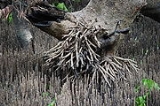
Aerial roots are roots above the ground. They are almost always
adventitiousAdventitious has various meanings in various disciplines and in general usage.Adventitious is from the Latin root advenire, meaning "to come or be superadded" and in correct English the meanings tend to have connections to accidental or casual occurrence...
. They are found in diverse plant species, including
epiphyteAn epiphyte is a plant that grows upon another plant non-parasitically or sometimes upon some other object , derives its moisture and nutrients from the air and rain and sometimes from debris accumulating around it, and is found in the temperate zone and in the...
s such as orchids, tropical coastal swamp trees such as
mangroveMangroves are various kinds of trees up to medium height and shrubs that grow in saline coastal sediment habitats in the tropics and subtropics – mainly between latitudes N and S...
s, the resourceful
banyanA banyan is a fig that starts its life as an epiphyte when its seeds germinate in the cracks and crevices on a host tree...
trees, the warm-temperate rainforest rātā (
Metrosideros robustaNorthern rātā , is a huge forest tree endemic to New Zealand. It grows up to 25 m or taller, and usually begins its life as a hemiepiphyte high in the branches of a mature forest tree; over centuries the young tree sends descending and girdling roots down and around the trunk of its host,...
) and pōhutukawa (
M. excelsa) trees of
New ZealandNew Zealand is an island country in the south-western Pacific Ocean comprising two main landmasses and numerous smaller islands. The country is situated some east of Australia across the Tasman Sea, and roughly south of the Pacific island nations of New Caledonia, Fiji, and Tonga...
and
vineA vine in the narrowest sense is the grapevine , but more generally it can refer to any plant with a growth habit of trailing or scandent, that is to say climbing, stems or runners...
s like Common Ivy (
Hedera helixHedera helix is a species of ivy native to most of Europe and western Asia. It is labeled as an invasive species in a number of areas where it has been introduced.-Description:...
) and irritating
poison ivyToxicodendron radicans, better known as poison ivy , is a poisonous North American plant that is well known for its production of urushiol, a clear liquid compound found within the sap of the plant that causes an itching rash in most people who touch it...
(
Toxicodendron radicans).
Types of aerial roots
This plant organ that is found in so many diverse plant families has different specializations that suit the plant habitat. In general growth form, they can be technically classed as
negatively gravitropicGravitropism is a turning or growth movement by a plant or fungus in response to gravity. Charles Darwin was one of the first to scientifically document that roots show positive gravitropism and stems show negative gravitropism. That is, roots grow in the direction of gravitational pull and stems...
(grows up and away from the ground) or
positively gravitropic (grows down toward the ground).
Aerial roots as supports
Non-parasitic
ivyIvy, plural ivies is a genus of 12–15 species of evergreen climbing or ground-creeping woody plants in the family Araliaceae, native to western, central and southern Europe, Macaronesia, northwestern Africa and across central-southern Asia east to Japan and Taiwan.-Description:On level ground they...
are vines that use their aerial roots to cling to host plants, rocks, or houses. Prop roots form on aerial stems and grow down into the soil to brace the plant, e.g.
maizeMaize known in many English-speaking countries as corn or mielie/mealie, is a grain domesticated by indigenous peoples in Mesoamerica in prehistoric times. The leafy stalk produces ears which contain seeds called kernels. Though technically a grain, maize kernels are used in cooking as a vegetable...
and screw pines (
PandanusPandanus is a genus of monocots with about 600 known species. They are numerous palmlike dioecious trees and shrubs native of the Old World tropics and subtropics. They are classified in the order Pandanales, family Pandanaceae.-Overview:...
species).
Stranglers
The
BanyanA banyan is a fig that starts its life as an epiphyte when its seeds germinate in the cracks and crevices on a host tree...
tree (
FicusFicus is a genus of about 850 species of woody trees, shrubs, vines, epiphytes, and hemiepiphyte in the family Moraceae. Collectively known as fig trees or figs, they are native throughout the tropics with a few species extending into the semi-warm temperate zone. The Common Fig Ficus is a genus of...
sp.) is an example of a
strangler figStrangler fig is the common name for a number of tropical and subtropical plant species, including some banyans and unrelated vines, including among many other species:* Ficus aurea, also known as the Florida Strangler Fig...
that begins life as an
epiphyteAn epiphyte is a plant that grows upon another plant non-parasitically or sometimes upon some other object , derives its moisture and nutrients from the air and rain and sometimes from debris accumulating around it, and is found in the temperate zone and in the...
in the crown of another tree. Its roots grow down and around the stem of the host, their growth accelerating once the ground has been reached. neck after time, the roots coalesce to form a pseudotrunk, eventually strangling and killing the host. Another strangler that begins life as an epiphyte is the
Moreton Bay FigFicus macrophylla, commonly known as the Moreton Bay Fig, is a large evergreen banyan tree of the Moraceae family that is a native of most of the eastern coast of Australia, from the Atherton Tableland in the north to the Illawarra in New South Wales, and Lord Howe Island. Its common name is...
(
Ficus macrophylla) of tropical and subtropical eastern Australia, which has powerfully descending aerial roots. In the subtropical to warm-temperate rainforests of northern New Zealand,
Metrosideros robustaNorthern rātā , is a huge forest tree endemic to New Zealand. It grows up to 25 m or taller, and usually begins its life as a hemiepiphyte high in the branches of a mature forest tree; over centuries the young tree sends descending and girdling roots down and around the trunk of its host,...
, the rātā tree, sends down aerial roots down several sides of the trunk of the host. From these descending roots, horizontal roots grow out to girdle the trunk and fuse with the descending roots. Eventually the host tree dies, leaving as its only trace a hollow core in the massive pseudotrunk of the rātā.
Pneumatophores
See also Cypress kneeIn the biology of trees, a cypress knee is a distinctive structure in a root of a cypress tree of any of various species of the subfamily Taxodioideae. Their function is unknown, but they are generally seen in swamps...
These specialized aerial roots enable plants to breathe air in habitats that have waterlogged soil. The roots may grow down from the stem, or up from typical roots. Some botanists classify these as
aerating roots rather than
aerial roots, if they come up from soil. The surface of these roots are covered with
lenticelA lenticel is an airy aggregation of cells within the structural surfaces of the stems, roots, and other parts of vascular plants. It functions as a pore, providing a medium for the direct exchange of gasses between the internal tissues and atmosphere, thereby bypassing the periderm, which would...
s which take up air into spongy tissue which in turn uses
osmoticOsmosis is the movement of solvent molecules through a selectively permeable membrane into a region of higher solute concentration, aiming to equalize the solute concentrations on the two sides...
pathways to spread oxygen throughout the plant as needed.
Black mangroveAvicennia germinans, commonly known as the black mangrove, is a species of flowering plant in the acanthus family, Acanthaceae.A. germinans grows in tropical and subtropical regions of the Americas, on both Atlantic and Pacific coasts, and on the Atlantic coast of tropical Africa, where it thrives...
is differentiated from other mangrove species by its pneumatophores.
Fishermen in some areas of
Southeast AsiaSoutheast Asia, South-East Asia, South East Asia or Southeastern Asia is a subregion of Asia, consisting of the countries that are geographically south of China, east of India, west of New Guinea and north of Australia. The region lies on the intersection of geological plates, with heavy seismic...
make corks for
fishing netA fishing net or fishnet is a net that is used for fishing. Fishing nets are meshes usually formed by knotting a relatively thin thread. Modern nets are usually made of artificial polyamides like nylon, although nets of organic polyamides such as wool or silk thread were common until recently and...
s by shaping the pneumatophores of
Sonneratia caseolarisSonneratia caseolaris, also known as Mangrove Apple or Crabapple Mangrove , is a species of plant in the Lythraceae family.This tree is a type of mangrove growing up to 20 m in height and with a trunk reaching a maximum diameter of 50 cm...
into small floats.
Haustorial roots
These roots are found in
parasitic plantA parasitic plant is one that derives some or all of its sustenance from another plant. About 4,100 species in approximately 19 families of flowering plants are known. Parasitic plants have a modified root, the haustorium, that penetrates the host plant and connects to the xylem, phloem, or...
s, where aerial roots become cemented to the host plant via a sticky attachment disc before intruding into the tissues of the host.
MistletoeMistletoe is the common name for obligate hemi-parasitic plants in several families in the order Santalales. The plants in question grow attached to and within the branches of a tree or shrub.-Mistletoe in the genus Viscum:...
is a good example of this.
Propagative roots
Adventitious roots usually develop from plantlet nodes formed via horizontal, aboveground stems, termed
stolonIn biology, stolons are horizontal connections between organisms. They may be part of the organism, or of its skeleton; typically, animal stolons are external skeletons.-In botany:...
s, e.g. strawberry runners and
spider plantChlorophytum is a genus of about 200-220 species of evergreen perennial flowering plants in family Asparagaceae, subfamily Agavoideae, native to the tropical and subtropical regions of Africa and Asia....
.
Some leaves develop adventitious buds, which then form adventitious roots, e.g. piggyback plant (
Tolmiea menziesii) and mother-of-thousands (
Kalanchoe daigremontianaKalanchoe daigremontiana syn. Bryophyllum daigremontianum also called Devil's Backbone, Alligator Plant, Mexican Hat Plant or Mother of Thousands is a succulent plant native to Madagascar. This plant is distinguished by its ability to propagate via vegetative propagation...
). The adventitious plantlets then drop off the parent plant and develop as separate
cloneCloning in biology is the process of producing similar populations of genetically identical individuals that occurs in nature when organisms such as bacteria, insects or plants reproduce asexually. Cloning in biotechnology refers to processes used to create copies of DNA fragments , cells , or...
s of the parent.