

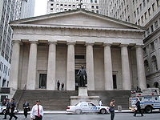
Federal Hall

Encyclopedia
Federal Hall, built in 1700 as New York's City Hall, later served as the first capitol building of the United States of America under the Constitution, and was the site of George Washington
's inauguration
as the first President of the United States
. It was also where the United States Bill of Rights
was introduced in the First Congress. The building was demolished in 1812.
Federal Hall National Memorial on Wall Street
was built in 1842 as the New York Customs House, on the site of the old Federal Hall. It later served as a sub-Treasury building and is now operated by the National Park Service
as a museum commemorating the historic events that happened there.
, an American newspaper publisher, was arrested for committing libel against the British royal governor and was imprisoned and tried there. His acquittal on the grounds that the material he had printed was true established the freedom of the press
as it was later defined in the Bill of Rights
.
In October 1765, delegates from nine of the 13 colonies met as the Stamp Act Congress
in response to the levying of the Stamp Act
by the Parliament of Great Britain
. Drawn together for the first time in organized opposition to British policy, the attendees drafted a message to King George III
, the House of Lords
, and the House of Commons
, claiming entitlement to the same rights as the residents of Britain and protesting the colonies' "taxation without representation".
After the American Revolution
, the City Hall served as the meeting place for the Congress
of the United States under the Articles of Confederation
, from 1785 until 1789. Acts adopted here included the Northwest Ordinance
, which set up what would later become the states of Ohio
, Indiana
, Illinois
, Michigan
and Wisconsin
, but more fundamentally prohibited slavery
in these future states.
In 1788 the building was remodeled and enlarged under the direction of Pierre Charles L'Enfant
, who was later selected by President George Washington
to design the capital city
on the Potomac River
. This was the first example of Federal Style architecture
in the United States. It was renamed Federal Hall when it became the first Capitol of the United States under the Constitution
in 1789. The 1st United States Congress
met there on March 4, 1789, to establish the new federal government, and the first thing they did was count the votes that elected George Washington as the first President of the United States
. He was inaugurated on the balcony of the building on April 30, 1789.
Many of the most important legislative actions in the United States occurred with the 1st Congress at Federal Hall. Foremost was adoption of the Bill of Rights to the U.S. Constitution; twelve amendments to the Constitution were initially drafted, ten were agreed upon, and on September 25, 1789, the United States Bill of Rights
was adopted in Federal Hall, establishing the freedoms claimed by the Stamp Act Congress
on the same site 24 years earlier. Also, the Judiciary Act of 1789
was enacted in the building which set up the United States federal court system which is still in use today.
In 1812 the old New York City Hall, known as Federal Hall, was torn down for US$
400 worth of scrap. Part of the original railing and balcony floor where Washington was inaugurated are on display in the monument.
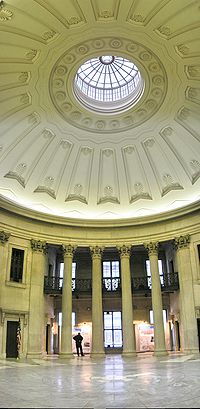 In 1790, the United States capital was moved to Philadelphia and what had been Federal Hall once again housed the New York City government until 1812, when the building was razed. The current structure, one of the best surviving examples of classical architecture
in New York, was built as the country's first Customs House, opening in 1842. In 1862, Customs moved to 55 Wall Street and the building served as one of six United States Sub-Treasury locations. Millions of dollars of gold
and silver
were kept in the basement vaults until the Federal Reserve Bank
replaced the Sub-Treasury system in 1920.
Two prominent American ideals are reflected in the building's architecture: The Doric
columns of the facade, designed by Ithiel Town
and Alexander Jackson Davis
, resemble those of the Parthenon
and serve as a tribute to Greek
democracy; the domed ceiling inside, designed by John Frazee
, echoes the Pantheon
and the economic might of the Romans
.
The current structure is often overshadowed among downtown landmarks by the New York Stock Exchange
, which is located diagonally across Wall and Nassau Streets
, but the site is one of the most important in the history of the United States and, particularly, the foundation of the United States Government and its democratic
institutions.
The current building is well known for John Quincy Adams Ward
's 1882 bronze
statue of George Washington
on its front steps, marking the approximate site where he was inaugurated
as President
in the former structure.
In 1920, a bomb was detonated across the street from Federal Hall at 23 Wall Street
, in what became known as the Wall Street bombing
. 38 people were killed and 400 injured, and 23 Wall was visibly damaged, but Federal Hall received no damage. A famous photograph of the event shows the destruction and effects of the bombing, but also shows the statue of Washington standing stoically in the face of chaos.
on August 11, 1955. As with all historic areas administered by the National Park Service
, the memorial was listed on the National Register of Historic Places
on October 15, 1966.
Federal Hall was designated a landmark by the New York City Landmarks Preservation Commission
on .
The National Park Services operates Federal Hall as a museum. The museum closed on December 3, 2004 for extensive renovations and reopened in the fall of 2006. Normally its exhibit galleries are open free to the public daily, except national holidays, and guided tours of the site are offered throughout the day. Exhibits include:
On September 6, 2002, approximately 300 members of the United States Congress
traveled from Washington, D.C.
to New York to convene in Federal Hall as a symbolic show of support for the City, still recovering from the September 11, 2001 attacks
. Just four blocks from Ground Zero
, the meeting was the first by Congress in New York since 1790.
In 2006, Federal Hall National Memorial reopened after a brief closure and a $16 million renovation, mostly to its foundation, after cracks threatening the structure were greatly aggravated by the collapse of the World Trade Center Twin Towers.
As a national memorial, the site is open free to the public from 9-5 on weekdays. It has tourist information about the New York Harbor Area's federal monuments and parks, and a New York City tourism information center. The gift shop has colonial and early American items for sale.
It was reported on June 8, 2008, that New York City Mayor Michael Bloomberg
and ABC News
invited 2008 United States presidential candidates John McCain
and Barack Obama
to a town hall forum at Federal Hall. Both candidates declined the offer "because they do not want it limited to one television network
."
inauguration, where he is depicted on the balcony of Federal Hall taking the oath of office. The second issue was released in 1957, the 200th anniversary of Alexander Hamilton's birth. This issue depicts Alexander Hamilton
and a full view of Federal Hall.
George Washington
George Washington was the dominant military and political leader of the new United States of America from 1775 to 1799. He led the American victory over Great Britain in the American Revolutionary War as commander-in-chief of the Continental Army from 1775 to 1783, and presided over the writing of...
's inauguration
First inauguration of George Washington
The first inauguration of George Washington as the first President of the United States took place on April 30, 1789.The inauguration marked the commencement of the first four-year term of George Washington as President and John Adams as Vice President...
as the first President of the United States
President of the United States
The President of the United States of America is the head of state and head of government of the United States. The president leads the executive branch of the federal government and is the commander-in-chief of the United States Armed Forces....
. It was also where the United States Bill of Rights
United States Bill of Rights
The Bill of Rights is the collective name for the first ten amendments to the United States Constitution. These limitations serve to protect the natural rights of liberty and property. They guarantee a number of personal freedoms, limit the government's power in judicial and other proceedings, and...
was introduced in the First Congress. The building was demolished in 1812.
Federal Hall National Memorial on Wall Street
Wall Street
Wall Street refers to the financial district of New York City, named after and centered on the eight-block-long street running from Broadway to South Street on the East River in Lower Manhattan. Over time, the term has become a metonym for the financial markets of the United States as a whole, or...
was built in 1842 as the New York Customs House, on the site of the old Federal Hall. It later served as a sub-Treasury building and is now operated by the National Park Service
National Park Service
The National Park Service is the U.S. federal agency that manages all national parks, many national monuments, and other conservation and historical properties with various title designations...
as a museum commemorating the historic events that happened there.
Historic building
The original structure on the site was built as New York's City Hall in 1700. In 1735, John Peter ZengerJohn Peter Zenger
John Peter Zenger was a German-American printer, publisher, editor, and journalist in New York City. He was a defendant in a landmark legal case in American jurisprudence that determined that truth was a defense against charges of libel and "laid the foundation for American press freedom."-...
, an American newspaper publisher, was arrested for committing libel against the British royal governor and was imprisoned and tried there. His acquittal on the grounds that the material he had printed was true established the freedom of the press
Freedom of the press
Freedom of the press or freedom of the media is the freedom of communication and expression through vehicles including various electronic media and published materials...
as it was later defined in the Bill of Rights
United States Bill of Rights
The Bill of Rights is the collective name for the first ten amendments to the United States Constitution. These limitations serve to protect the natural rights of liberty and property. They guarantee a number of personal freedoms, limit the government's power in judicial and other proceedings, and...
.
In October 1765, delegates from nine of the 13 colonies met as the Stamp Act Congress
Stamp Act Congress
The Stamp Act Congress was a meeting on October 19, 1765 in New York City of representatives from some of the British colonies of North America. They discussed and acted upon the Stamp Act recently passed by the governing Parliament of Great Britain overseas, which did not include any...
in response to the levying of the Stamp Act
Stamp Act 1765
The Stamp Act 1765 was a direct tax imposed by the British Parliament specifically on the colonies of British America. The act required that many printed materials in the colonies be produced on stamped paper produced in London, carrying an embossed revenue stamp...
by the Parliament of Great Britain
Parliament of Great Britain
The Parliament of Great Britain was formed in 1707 following the ratification of the Acts of Union by both the Parliament of England and Parliament of Scotland...
. Drawn together for the first time in organized opposition to British policy, the attendees drafted a message to King George III
George III of the United Kingdom
George III was King of Great Britain and King of Ireland from 25 October 1760 until the union of these two countries on 1 January 1801, after which he was King of the United Kingdom of Great Britain and Ireland until his death...
, the House of Lords
House of Lords
The House of Lords is the upper house of the Parliament of the United Kingdom. Like the House of Commons, it meets in the Palace of Westminster....
, and the House of Commons
British House of Commons
The House of Commons is the lower house of the Parliament of the United Kingdom, which also comprises the Sovereign and the House of Lords . Both Commons and Lords meet in the Palace of Westminster. The Commons is a democratically elected body, consisting of 650 members , who are known as Members...
, claiming entitlement to the same rights as the residents of Britain and protesting the colonies' "taxation without representation".
After the American Revolution
American Revolution
The American Revolution was the political upheaval during the last half of the 18th century in which thirteen colonies in North America joined together to break free from the British Empire, combining to become the United States of America...
, the City Hall served as the meeting place for the Congress
Congress of the Confederation
The Congress of the Confederation or the United States in Congress Assembled was the governing body of the United States of America that existed from March 1, 1781, to March 4, 1789. It comprised delegates appointed by the legislatures of the states. It was the immediate successor to the Second...
of the United States under the Articles of Confederation
Articles of Confederation
The Articles of Confederation, formally the Articles of Confederation and Perpetual Union, was an agreement among the 13 founding states that legally established the United States of America as a confederation of sovereign states and served as its first constitution...
, from 1785 until 1789. Acts adopted here included the Northwest Ordinance
Northwest Ordinance
The Northwest Ordinance was an act of the Congress of the Confederation of the United States, passed July 13, 1787...
, which set up what would later become the states of Ohio
Ohio
Ohio is a Midwestern state in the United States. The 34th largest state by area in the U.S.,it is the 7th‑most populous with over 11.5 million residents, containing several major American cities and seven metropolitan areas with populations of 500,000 or more.The state's capital is Columbus...
, Indiana
Indiana
Indiana is a US state, admitted to the United States as the 19th on December 11, 1816. It is located in the Midwestern United States and Great Lakes Region. With 6,483,802 residents, the state is ranked 15th in population and 16th in population density. Indiana is ranked 38th in land area and is...
, Illinois
Illinois
Illinois is the fifth-most populous state of the United States of America, and is often noted for being a microcosm of the entire country. With Chicago in the northeast, small industrial cities and great agricultural productivity in central and northern Illinois, and natural resources like coal,...
, Michigan
Michigan
Michigan is a U.S. state located in the Great Lakes Region of the United States of America. The name Michigan is the French form of the Ojibwa word mishigamaa, meaning "large water" or "large lake"....
and Wisconsin
Wisconsin
Wisconsin is a U.S. state located in the north-central United States and is part of the Midwest. It is bordered by Minnesota to the west, Iowa to the southwest, Illinois to the south, Lake Michigan to the east, Michigan to the northeast, and Lake Superior to the north. Wisconsin's capital is...
, but more fundamentally prohibited slavery
Slavery
Slavery is a system under which people are treated as property to be bought and sold, and are forced to work. Slaves can be held against their will from the time of their capture, purchase or birth, and deprived of the right to leave, to refuse to work, or to demand compensation...
in these future states.
In 1788 the building was remodeled and enlarged under the direction of Pierre Charles L'Enfant
Pierre Charles L'Enfant
Pierre Charles L'Enfant was a French-born American architect and civil engineer best known for designing the layout of the streets of Washington, D.C..-Early life:...
, who was later selected by President George Washington
George Washington
George Washington was the dominant military and political leader of the new United States of America from 1775 to 1799. He led the American victory over Great Britain in the American Revolutionary War as commander-in-chief of the Continental Army from 1775 to 1783, and presided over the writing of...
to design the capital city
Capital City
Capital City was a television show produced by Euston Films which focused on the lives of investment bankers in London living and working on the corporate trading floor for the fictional international bank Shane-Longman....
on the Potomac River
Potomac River
The Potomac River flows into the Chesapeake Bay, located along the mid-Atlantic coast of the United States. The river is approximately long, with a drainage area of about 14,700 square miles...
. This was the first example of Federal Style architecture
Federal architecture
Federal-style architecture is the name for the classicizing architecture built in the United States between c. 1780 and 1830, and particularly from 1785 to 1815. This style shares its name with its era, the Federal Period. The name Federal style is also used in association with furniture design...
in the United States. It was renamed Federal Hall when it became the first Capitol of the United States under the Constitution
United States Constitution
The Constitution of the United States is the supreme law of the United States of America. It is the framework for the organization of the United States government and for the relationship of the federal government with the states, citizens, and all people within the United States.The first three...
in 1789. The 1st United States Congress
1st United States Congress
-House of Representatives:During this congress, five House seats were added for North Carolina and one House seat was added for Rhode Island when they ratified the Constitution.-Senate:* President: John Adams * President pro tempore: John Langdon...
met there on March 4, 1789, to establish the new federal government, and the first thing they did was count the votes that elected George Washington as the first President of the United States
President of the United States
The President of the United States of America is the head of state and head of government of the United States. The president leads the executive branch of the federal government and is the commander-in-chief of the United States Armed Forces....
. He was inaugurated on the balcony of the building on April 30, 1789.
Many of the most important legislative actions in the United States occurred with the 1st Congress at Federal Hall. Foremost was adoption of the Bill of Rights to the U.S. Constitution; twelve amendments to the Constitution were initially drafted, ten were agreed upon, and on September 25, 1789, the United States Bill of Rights
United States Bill of Rights
The Bill of Rights is the collective name for the first ten amendments to the United States Constitution. These limitations serve to protect the natural rights of liberty and property. They guarantee a number of personal freedoms, limit the government's power in judicial and other proceedings, and...
was adopted in Federal Hall, establishing the freedoms claimed by the Stamp Act Congress
Stamp Act Congress
The Stamp Act Congress was a meeting on October 19, 1765 in New York City of representatives from some of the British colonies of North America. They discussed and acted upon the Stamp Act recently passed by the governing Parliament of Great Britain overseas, which did not include any...
on the same site 24 years earlier. Also, the Judiciary Act of 1789
Judiciary Act of 1789
The United States Judiciary Act of 1789 was a landmark statute adopted on September 24, 1789 in the first session of the First United States Congress establishing the U.S. federal judiciary...
was enacted in the building which set up the United States federal court system which is still in use today.
In 1812 the old New York City Hall, known as Federal Hall, was torn down for US$
United States dollar
The United States dollar , also referred to as the American dollar, is the official currency of the United States of America. It is divided into 100 smaller units called cents or pennies....
400 worth of scrap. Part of the original railing and balcony floor where Washington was inaugurated are on display in the monument.
Customs House and Shrine
Classical architecture
Classical architecture is a mode of architecture employing vocabulary derived in part from the Greek and Roman architecture of classical antiquity, enriched by classicizing architectural practice in Europe since the Renaissance...
in New York, was built as the country's first Customs House, opening in 1842. In 1862, Customs moved to 55 Wall Street and the building served as one of six United States Sub-Treasury locations. Millions of dollars of gold
Gold
Gold is a chemical element with the symbol Au and an atomic number of 79. Gold is a dense, soft, shiny, malleable and ductile metal. Pure gold has a bright yellow color and luster traditionally considered attractive, which it maintains without oxidizing in air or water. Chemically, gold is a...
and silver
Silver
Silver is a metallic chemical element with the chemical symbol Ag and atomic number 47. A soft, white, lustrous transition metal, it has the highest electrical conductivity of any element and the highest thermal conductivity of any metal...
were kept in the basement vaults until the Federal Reserve Bank
Federal Reserve Bank
The twelve Federal Reserve Banks form a major part of the Federal Reserve System, the central banking system of the United States. The twelve federal reserve banks together divide the nation into twelve Federal Reserve Districts, the twelve banking districts created by the Federal Reserve Act of...
replaced the Sub-Treasury system in 1920.
Two prominent American ideals are reflected in the building's architecture: The Doric
Doric order
The Doric order was one of the three orders or organizational systems of ancient Greek or classical architecture; the other two canonical orders were the Ionic and the Corinthian.-History:...
columns of the facade, designed by Ithiel Town
Ithiel Town
Ithiel Town was a prominent American architect and civil engineer. One of the first generation of professional architects in the United States, Town made significant contributions to American architecture in the first half of the 19th century. He was high-strung, sophisticated, generous,...
and Alexander Jackson Davis
Alexander Jackson Davis
Alexander Jackson Davis, or A. J. Davis , was one of the most successful and influential American architects of his generation, in particular his association with the Gothic Revival style....
, resemble those of the Parthenon
Parthenon
The Parthenon is a temple on the Athenian Acropolis, Greece, dedicated to the Greek goddess Athena, whom the people of Athens considered their virgin patron. Its construction began in 447 BC when the Athenian Empire was at the height of its power. It was completed in 438 BC, although...
and serve as a tribute to Greek
Greece
Greece , officially the Hellenic Republic , and historically Hellas or the Republic of Greece in English, is a country in southeastern Europe....
democracy; the domed ceiling inside, designed by John Frazee
John Frazee
John Frazee is an artist from New York City, New York. Frazee's work as a painter and sculptor is displayed around the world. He is also known for a science humor story he wrote in OMNI magazine, the Buttered cat paradox.-Education and career:...
, echoes the Pantheon
Pantheon, Rome
The Pantheon ,Rarely Pantheum. This appears in Pliny's Natural History in describing this edifice: Agrippae Pantheum decoravit Diogenes Atheniensis; in columnis templi eius Caryatides probantur inter pauca operum, sicut in fastigio posita signa, sed propter altitudinem loci minus celebrata.from ,...
and the economic might of the Romans
Ancient Rome
Ancient Rome was a thriving civilization that grew on the Italian Peninsula as early as the 8th century BC. Located along the Mediterranean Sea and centered on the city of Rome, it expanded to one of the largest empires in the ancient world....
.
The current structure is often overshadowed among downtown landmarks by the New York Stock Exchange
New York Stock Exchange
The New York Stock Exchange is a stock exchange located at 11 Wall Street in Lower Manhattan, New York City, USA. It is by far the world's largest stock exchange by market capitalization of its listed companies at 13.39 trillion as of Dec 2010...
, which is located diagonally across Wall and Nassau Streets
Nassau Street (Manhattan)
Nassau Street is a street in the Financial District of the New York City borough of Manhattan, located near Pace University and New York City Hall. It starts at Wall Street and runs north to Frankfort Street at the foot of the Brooklyn Bridge, lying one block east of Broadway and east of Park Row...
, but the site is one of the most important in the history of the United States and, particularly, the foundation of the United States Government and its democratic
Democracy
Democracy is generally defined as a form of government in which all adult citizens have an equal say in the decisions that affect their lives. Ideally, this includes equal participation in the proposal, development and passage of legislation into law...
institutions.
The current building is well known for John Quincy Adams Ward
John Quincy Adams Ward
John Quincy Adams Ward was an American sculptor, who is most familiar for his over-lifesize standing statue of George Washington on the steps of Federal Hall on Wall Street.-Early years:...
's 1882 bronze
Bronze
Bronze is a metal alloy consisting primarily of copper, usually with tin as the main additive. It is hard and brittle, and it was particularly significant in antiquity, so much so that the Bronze Age was named after the metal...
statue of George Washington
George Washington
George Washington was the dominant military and political leader of the new United States of America from 1775 to 1799. He led the American victory over Great Britain in the American Revolutionary War as commander-in-chief of the Continental Army from 1775 to 1783, and presided over the writing of...
on its front steps, marking the approximate site where he was inaugurated
Inauguration
An inauguration is a formal ceremony to mark the beginning of a leader's term of office. An example is the ceremony in which the President of the United States officially takes the oath of office....
as President
President of the United States
The President of the United States of America is the head of state and head of government of the United States. The president leads the executive branch of the federal government and is the commander-in-chief of the United States Armed Forces....
in the former structure.
In 1920, a bomb was detonated across the street from Federal Hall at 23 Wall Street
23 Wall Street
23 Wall Street or "The Corner" is an office building formerly owned by J.P. Morgan & Co. located at the southeast corner of Wall Street and Broad Street, in the heart of New York City's Financial District....
, in what became known as the Wall Street bombing
Wall Street bombing
The Wall Street bombing occurred at 12:01 p.m. on Thursday, September 16, 1920, in the Financial District of New York City. The blast killed 38 and seriously injured 143...
. 38 people were killed and 400 injured, and 23 Wall was visibly damaged, but Federal Hall received no damage. A famous photograph of the event shows the destruction and effects of the bombing, but also shows the statue of Washington standing stoically in the face of chaos.
Federal Hall National Memorial
The building was designated as Federal Hall Memorial National Historic Site on May 26, 1939, and redesignated a national memorialNational Memorial
National Memorial is a designation in the United States for a protected area that memorializes a historic person or event. National memorials are authorized by the United States Congress...
on August 11, 1955. As with all historic areas administered by the National Park Service
National Park Service
The National Park Service is the U.S. federal agency that manages all national parks, many national monuments, and other conservation and historical properties with various title designations...
, the memorial was listed on the National Register of Historic Places
National Register of Historic Places
The National Register of Historic Places is the United States government's official list of districts, sites, buildings, structures, and objects deemed worthy of preservation...
on October 15, 1966.
Federal Hall was designated a landmark by the New York City Landmarks Preservation Commission
New York City Landmarks Preservation Commission
The New York City Landmarks Preservation Commission is the New York City agency charged with administering the city's Landmarks Preservation Law. The Commission was created in April 1965 by Mayor Robert F. Wagner following the destruction of Pennsylvania Station the previous year to make way for...
on .
The National Park Services operates Federal Hall as a museum. The museum closed on December 3, 2004 for extensive renovations and reopened in the fall of 2006. Normally its exhibit galleries are open free to the public daily, except national holidays, and guided tours of the site are offered throughout the day. Exhibits include:
- George Washington’s Inauguration Gallery - Including the BibleBibleThe Bible refers to any one of the collections of the primary religious texts of Judaism and Christianity. There is no common version of the Bible, as the individual books , their contents and their order vary among denominations...
used to swear his oath of officeOath of officeAn oath of office is an oath or affirmation a person takes before undertaking the duties of an office, usually a position in government or within a religious body, although such oaths are sometimes required of officers of other organizations...
. - Freedom of the Press - The imprisonment and trial of John Peter ZengerJohn Peter ZengerJohn Peter Zenger was a German-American printer, publisher, editor, and journalist in New York City. He was a defendant in a landmark legal case in American jurisprudence that determined that truth was a defense against charges of libel and "laid the foundation for American press freedom."-...
. - Journey to Federal Hall - An 8-minute video about the history of Federal Hall.
- New York: An American Capital - Preview exhibit created by the National Archives and Records AdministrationNational Archives and Records AdministrationThe National Archives and Records Administration is an independent agency of the United States government charged with preserving and documenting government and historical records and with increasing public access to those documents, which comprise the National Archives...
.
On September 6, 2002, approximately 300 members of the United States Congress
United States Congress
The United States Congress is the bicameral legislature of the federal government of the United States, consisting of the Senate and the House of Representatives. The Congress meets in the United States Capitol in Washington, D.C....
traveled from Washington, D.C.
Washington, D.C.
Washington, D.C., formally the District of Columbia and commonly referred to as Washington, "the District", or simply D.C., is the capital of the United States. On July 16, 1790, the United States Congress approved the creation of a permanent national capital as permitted by the U.S. Constitution....
to New York to convene in Federal Hall as a symbolic show of support for the City, still recovering from the September 11, 2001 attacks
September 11, 2001 attacks
The September 11 attacks The September 11 attacks The September 11 attacks (also referred to as September 11, September 11th or 9/119/11 is pronounced "nine eleven". The slash is not part of the pronunciation...
. Just four blocks from Ground Zero
World Trade Center site
The World Trade Center site , also known as "Ground Zero" after the September 11 attacks, sits on in Lower Manhattan in New York City...
, the meeting was the first by Congress in New York since 1790.
In 2006, Federal Hall National Memorial reopened after a brief closure and a $16 million renovation, mostly to its foundation, after cracks threatening the structure were greatly aggravated by the collapse of the World Trade Center Twin Towers.
As a national memorial, the site is open free to the public from 9-5 on weekdays. It has tourist information about the New York Harbor Area's federal monuments and parks, and a New York City tourism information center. The gift shop has colonial and early American items for sale.
It was reported on June 8, 2008, that New York City Mayor Michael Bloomberg
Michael Bloomberg
Michael Rubens Bloomberg is the current Mayor of New York City. With a net worth of $19.5 billion in 2011, he is also the 12th-richest person in the United States...
and ABC News
ABC News
ABC News is the news gathering and broadcasting division of American broadcast television network ABC, a subsidiary of The Walt Disney Company...
invited 2008 United States presidential candidates John McCain
John McCain
John Sidney McCain III is the senior United States Senator from Arizona. He was the Republican nominee for president in the 2008 United States election....
and Barack Obama
Barack Obama
Barack Hussein Obama II is the 44th and current President of the United States. He is the first African American to hold the office. Obama previously served as a United States Senator from Illinois, from January 2005 until he resigned following his victory in the 2008 presidential election.Born in...
to a town hall forum at Federal Hall. Both candidates declined the offer "because they do not want it limited to one television network
Television network
A television network is a telecommunications network for distribution of television program content, whereby a central operation provides programming to many television stations or pay TV providers. Until the mid-1980s, television programming in most countries of the world was dominated by a small...
."
Federal Hall on U.S. postage
Engraved renditions of Federal Hall appear twice on U.S. postage stamps. The first stamp showing Federal Hall was issued on April 30, 1939, the 150th anniversary of President Washington'sU.S. Presidents on U.S. postage stamps
For more than 160 years the one subject that has appeared most frequently on the face of U.S. Postage stamps is that of American Presidents. When the U.S. Post Office released its first two postage stamps in 1847, George Washington, along with Benjamin Franklin, were the two subjects depicted on...
inauguration, where he is depicted on the balcony of Federal Hall taking the oath of office. The second issue was released in 1957, the 200th anniversary of Alexander Hamilton's birth. This issue depicts Alexander Hamilton
Alexander Hamilton
Alexander Hamilton was a Founding Father, soldier, economist, political philosopher, one of America's first constitutional lawyers and the first United States Secretary of the Treasury...
and a full view of Federal Hall.
External links
- Official NPS website: Federal Hall National Memorial
- National Parks of NY Harbor Conservancy: Federal Hall Visitor Information
- Library of Congress - The New Capital City
- U. S. Custom House, 28 Wall Street, New York, New York, NY, Historic American Buildings SurveyHistoric American Buildings SurveyThe Historic American Buildings Survey , Historic American Engineering Record , and Historic American Landscapes Survey are programs of the National Park Service established for the purpose of documenting historic places. Records consists of measured drawings, archival photographs, and written...
- Engraving: Federal Hall, The Seat of Congress
- Lithograph: A View of the Federal Hall, 1797
- CNN - Symbolic site for Congress to meet, 9/5/2002
- U.S. Senate - Farewell to New York
- Model of Federal Hall National Monument for Google Sketchup and Google EarthGoogle EarthGoogle Earth is a virtual globe, map and geographical information program that was originally called EarthViewer 3D, and was created by Keyhole, Inc, a Central Intelligence Agency funded company acquired by Google in 2004 . It maps the Earth by the superimposition of images obtained from satellite...
- Three dimensional rendering of Federal Hall (without plugin; in English, Spanish, German)