


Sibylline oracles

Encyclopedia
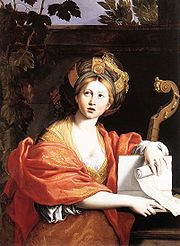
- This article is about the Sibylline Oracles. For the books, see Sibylline BooksSibylline BooksThe Sibylline Books or Libri Sibyllini were a collection of oracular utterances, set out in Greek hexameters, purchased from a sibyl by the last king of Rome, Tarquinius Superbus, and consulted at momentous crises through the history of the Republic and the Empire...
.
The Sibylline Oracles (sometimes called the "pseudo-Sibylline Oracles") are a collection of oracular utterances written in Greek hexameters
Dactylic hexameter
Dactylic hexameter is a form of meter in poetry or a rhythmic scheme. It is traditionally associated with the quantitative meter of classical epic poetry in both Greek and Latin, and was consequently considered to be the Grand Style of classical poetry...
ascribed to the Sibyl
Sibyl
The word Sibyl comes from the Greek word σίβυλλα sibylla, meaning prophetess. The earliest oracular seeresses known as the sibyls of antiquity, "who admittedly are known only through legend" prophesied at certain holy sites, under the divine influence of a deity, originally— at Delphi and...
s, prophetesses who uttered divine revelations in a frenzied state. Fourteen books and eight fragments of Sibylline Oracles survive. These are not considered to be identical to the original Sibylline Books
Sibylline Books
The Sibylline Books or Libri Sibyllini were a collection of oracular utterances, set out in Greek hexameters, purchased from a sibyl by the last king of Rome, Tarquinius Superbus, and consulted at momentous crises through the history of the Republic and the Empire...
of Roman mythology
Roman mythology
Roman mythology is the body of traditional stories pertaining to ancient Rome's legendary origins and religious system, as represented in the literature and visual arts of the Romans...
, which have been lost, but a collection of utterances that were composed or edited under various circumstances, between perhaps the middle of the 2nd century BC and the 5th century AD.
The Sibylline Oracles are a valuable source for information about Classical mythology and early first millennium Gnostic, Jewish
Hellenistic Judaism
Hellenistic Judaism was a movement which existed in the Jewish diaspora that sought to establish a Hebraic-Jewish religious tradition within the culture and language of Hellenism...
and Christian
Early Christianity
Early Christianity is generally considered as Christianity before 325. The New Testament's Book of Acts and Epistle to the Galatians records that the first Christian community was centered in Jerusalem and its leaders included James, Peter and John....
beliefs. Some apocalyptic
Apocalypse
An Apocalypse is a disclosure of something hidden from the majority of mankind in an era dominated by falsehood and misconception, i.e. the veil to be lifted. The Apocalypse of John is the Book of Revelation, the last book of the New Testament...
passages scattered throughout seem to adumbrate themes of John's Book of Revelation
Book of Revelation
The Book of Revelation is the final book of the New Testament. The title came into usage from the first word of the book in Koine Greek: apokalupsis, meaning "unveiling" or "revelation"...
and other Apocalyptic literature
Apocalyptic literature
Apocalyptic literature is a genre of prophetical writing that developed in post-Exilic Jewish culture and was popular among millennialist early Christians....
. In places the oracles have also undergone extensive editing, re-writing, and redaction, as they came to be exploited in wider circles.
One passage has an acrostic
Acrostic
An acrostic is a poem or other form of writing in which the first letter, syllable or word of each line, paragraph or other recurring feature in the text spells out a word or a message. As a form of constrained writing, an acrostic can be used as a mnemonic device to aid memory retrieval. A famous...
, spelling out a Christian code-phrase with the first letters of successive lines.
Introduction
The Sibylline Oracles in their existing form are a chaotic medley. They consist of 12 books (or 14) of various authorship, date, and religious conception. The final arrangement, thought to be due to an unknown editor of the 6th century (Alexandre), does not determine identity of authorship, time, or religious belief; many of the books are merely arbitrary groupings of unrelated fragments.These oracles were anonymous in origin and as such were apt to modification and enlargement at pleasure by Hellenistic Jews and by Christians for missionary purposes. So common was the invention of such oracles in early Christian times that Celsus
Celsus
Celsus was a 2nd century Greek philosopher and opponent of Early Christianity. He is known for his literary work, The True Word , written about by Origen. This work, c. 177 is the earliest known comprehensive attack on Christianity.According to Origen, Celsus was the author of an...
called Christians Σιβυλλισται (sibyl-mongers or believers in sibyls). The preservation of the entire collection that has come down to us is due to Christian writers.
Sources for the Sibylline texts
The oldest of the surviving Sibylline oracles seem to be books 3-5, which were composed partly by Jews in AlexandriaAlexandria
Alexandria is the second-largest city of Egypt, with a population of 4.1 million, extending about along the coast of the Mediterranean Sea in the north central part of the country; it is also the largest city lying directly on the Mediterranean coast. It is Egypt's largest seaport, serving...
. The third oracle seems to have been composed in the reign of Ptolemy VI Philometor. Books 1-2 may have been written by Christians, though again there may have been a Jewish original that was adapted to Christian purposes.
All the oracles seem to have undergone later revision, enrichment, and adaptation by editors and authors of different religions, who added similar texts, all in the interests of their respective religions. The Sibylline oracles are therefore a pastiche
Pastiche
A pastiche is a literary or other artistic genre or technique that is a "hodge-podge" or imitation. The word is also a linguistic term used to describe an early stage in the development of a pidgin language.-Hodge-podge:...
of Greek and Roman pagan
Paganism
Paganism is a blanket term, typically used to refer to non-Abrahamic, indigenous polytheistic religious traditions....
mythology
Mythology
The term mythology can refer either to the study of myths, or to a body or collection of myths. As examples, comparative mythology is the study of connections between myths from different cultures, whereas Greek mythology is the body of myths from ancient Greece...
, employing motifs of Homer
Homer
In the Western classical tradition Homer , is the author of the Iliad and the Odyssey, and is revered as the greatest ancient Greek epic poet. These epics lie at the beginning of the Western canon of literature, and have had an enormous influence on the history of literature.When he lived is...
and Hesiod
Hesiod
Hesiod was a Greek oral poet generally thought by scholars to have been active between 750 and 650 BC, around the same time as Homer. His is the first European poetry in which the poet regards himself as a topic, an individual with a distinctive role to play. Ancient authors credited him and...
; Judeo-Christian legends such as the Garden of Eden
Garden of Eden
The Garden of Eden is in the Bible's Book of Genesis as being the place where the first man, Adam, and his wife, Eve, lived after they were created by God. Literally, the Bible speaks about a garden in Eden...
, Noah
Noah
Noah was, according to the Hebrew Bible, the tenth and last of the antediluvian Patriarchs. The biblical story of Noah is contained in chapters 6–9 of the book of Genesis, where he saves his family and representatives of all animals from the flood by constructing an ark...
and the Tower of Babel
Tower of Babel
The Tower of Babel , according to the Book of Genesis, was an enormous tower built in the plain of Shinar .According to the biblical account, a united humanity of the generations following the Great Flood, speaking a single language and migrating from the east, came to the land of Shinar, where...
; Gnostic and early Christian homilies
Homily
A homily is a commentary that follows a reading of scripture. In Catholic, Anglican, Lutheran, and Eastern Orthodox Churches, a homily is usually given during Mass at the end of the Liturgy of the Word...
and eschatological
Eschatology
Eschatology is a part of theology, philosophy, and futurology concerned with what are believed to be the final events in history, or the ultimate destiny of humanity, commonly referred to as the end of the world or the World to Come...
writings; thinly veiled references to historical figures such as Alexander the Great and Cleopatra
Cleopatra VII of Egypt
Cleopatra VII Philopator was the last pharaoh of Ancient Egypt.She was a member of the Ptolemaic dynasty, a family of Greek origin that ruled Egypt after Alexander the Great's death during the Hellenistic period...
, as well as many allusions to the events of the later Roman Empire, often portraying Rome in a negative light.
Some have suggested that the surviving texts may include some fragments or remnants of the Sibylline Books
Sibylline Books
The Sibylline Books or Libri Sibyllini were a collection of oracular utterances, set out in Greek hexameters, purchased from a sibyl by the last king of Rome, Tarquinius Superbus, and consulted at momentous crises through the history of the Republic and the Empire...
with a legendary provenance from the Cumaean Sibyl
Cumaean Sibyl
The ageless Cumaean Sibyl was the priestess presiding over the Apollonian oracle at Cumae, a Greek colony located near Naples, Italy.The word sibyl comes from the ancient Greek word sibylla, meaning prophetess. There were many Sibyls in different locations throughout the ancient world...
, which had been kept in temples in Rome. The original oracular books, kept in Rome, were accidentally destroyed in a fire in 83 BC, which resulted in an attempt in 76 BC to recollect them when the Roman senate sent envoys throughout the world to discover copies. This official copy existed until at least AD 405, but little is known of their contents.
That use of the Sibylline Oracles was not always exclusive to Christians is shown by an extract from Book III concerning the Tower of Babel
Tower of Babel
The Tower of Babel , according to the Book of Genesis, was an enormous tower built in the plain of Shinar .According to the biblical account, a united humanity of the generations following the Great Flood, speaking a single language and migrating from the east, came to the land of Shinar, where...
as quoted by the Jewish historian Flavius Josephus, in the late 1st century AD.
The Christian apologist Athenagoras of Athens
Athenagoras of Athens
Athenagoras was a Father of the Church, a Proto-orthodox Christian apologist who lived during the second half of the 2nd century of whom little is known for certain, besides that he was Athenian , a philosopher, and a convert to Christianity. In his writings he styles himself as "Athenagoras, the...
, writing A Plea for the Christians to Marcus Aurelius in ca. AD 176, quoted the same section of the extant Oracles verbatim, in the midst of a lengthy series of classical and pagan references including Homer
Homer
In the Western classical tradition Homer , is the author of the Iliad and the Odyssey, and is revered as the greatest ancient Greek epic poet. These epics lie at the beginning of the Western canon of literature, and have had an enormous influence on the history of literature.When he lived is...
and Hesiod
Hesiod
Hesiod was a Greek oral poet generally thought by scholars to have been active between 750 and 650 BC, around the same time as Homer. His is the first European poetry in which the poet regards himself as a topic, an individual with a distinctive role to play. Ancient authors credited him and...
, and stated several times that all these works should already be familiar to the Roman Emperor.
The sibyl
Sibyl
The word Sibyl comes from the Greek word σίβυλλα sibylla, meaning prophetess. The earliest oracular seeresses known as the sibyls of antiquity, "who admittedly are known only through legend" prophesied at certain holy sites, under the divine influence of a deity, originally— at Delphi and...
s themselves, and the so-called Sibylline oracles, were often referred to by other early Church fathers; Theophilus
Theophilus of Antioch
Theophilus, Patriarch of Antioch, succeeded Eros c. 169, and was succeeded by Maximus I c.183, according to Henry Fynes Clinton, but these dates are only approximations...
, Bishop of Antioch (ca. 180), Clement of Alexandria
Clement of Alexandria
Titus Flavius Clemens , known as Clement of Alexandria , was a Christian theologian and the head of the noted Catechetical School of Alexandria. Clement is best remembered as the teacher of Origen...
(ca. 200), Lactantius
Lactantius
Lucius Caecilius Firmianus Lactantius was an early Christian author who became an advisor to the first Christian Roman emperor, Constantine I, guiding his religious policy as it developed, and tutor to his son.-Biography:...
(ca. 305), and Augustine
Augustine of Hippo
Augustine of Hippo , also known as Augustine, St. Augustine, St. Austin, St. Augoustinos, Blessed Augustine, or St. Augustine the Blessed, was Bishop of Hippo Regius . He was a Latin-speaking philosopher and theologian who lived in the Roman Africa Province...
(ca. 400), all knew various versions of the pseudo-Sibylline collections, quoted them or referred to them in paraphrase, and were unreluctant to Christianize them, by as simple means as inserting "Son of God" into a passage, as Lactantius:
- "The Erythraean SibylErythraean SibylThe Erythraean Sibyl was the prophetess of classical antiquity presiding over the Apollonian oracle at Erythrae, a town in Ionia opposite Chios, which was built by Neleus, the son of Codrus....
" in the beginning of her song, which she commenced by the help of the Most High God, proclaims the Son of God as leader and commander of all in these verses:
-
- All-nourishing Creator, who in all
- Sweet breath implanted, and made God the guide of all."
Some fragmentary verses that do not appear in the collections that survive are only known because they were quoted by a Church Father. Justin Martyr
Justin Martyr
Justin Martyr, also known as just Saint Justin , was an early Christian apologist. Most of his works are lost, but two apologies and a dialogue survive. He is considered a saint by the Roman Catholic Church and the Eastern Orthodox Church....
(ca. 150), if he is truly the author of the Hortatory Address to the Greeks, gives such a circumstantial account of the Cumaean sibyl that the Address is quoted here at the Cumaean sibyl
Cumaean Sibyl
The ageless Cumaean Sibyl was the priestess presiding over the Apollonian oracle at Cumae, a Greek colony located near Naples, Italy.The word sibyl comes from the ancient Greek word sibylla, meaning prophetess. There were many Sibyls in different locations throughout the ancient world...
's entry. The Catholic Encyclopedia
Catholic Encyclopedia
The Catholic Encyclopedia, also referred to as the Old Catholic Encyclopedia and the Original Catholic Encyclopedia, is an English-language encyclopedia published in the United States. The first volume appeared in March 1907 and the last three volumes appeared in 1912, followed by a master index...
states, "Through the decline and disappearance of paganism, however, interest in them gradually diminished and they ceased to be widely read or circulated, though they were known and used during the Middle Ages
Middle Ages
The Middle Ages is a periodization of European history from the 5th century to the 15th century. The Middle Ages follows the fall of the Western Roman Empire in 476 and precedes the Early Modern Era. It is the middle period of a three-period division of Western history: Classic, Medieval and Modern...
in both the East and the West." Thus, a student may find echoes of their imagery and style in much early medieval literature.
These books, in spite of their pagan content, have sometimes been described as part of the Pseudepigrapha. They do not appear in the canonical lists of any Church.
History of the texts
Large collections of these Jewish and Christian oracles are still in existence. When they were recovered in the 16th century, their initial publication caused a sensation among scholars. In 1545 Xystus Betuleius (Sixt BirckSixt Birck
Sixt Birck, as Xystus Betuleius was a German humanist of Augsburg, "a notable German scholar of the New Learning".At the end of his schooling in Augsburg the Protestant Reformation began...
of Augsburg
Augsburg
Augsburg is a city in the south-west of Bavaria, Germany. It is a university town and home of the Regierungsbezirk Schwaben and the Bezirk Schwaben. Augsburg is an urban district and home to the institutions of the Landkreis Augsburg. It is, as of 2008, the third-largest city in Bavaria with a...
) published at Basel
Basel
Basel or Basle In the national languages of Switzerland the city is also known as Bâle , Basilea and Basilea is Switzerland's third most populous city with about 166,000 inhabitants. Located where the Swiss, French and German borders meet, Basel also has suburbs in France and Germany...
an edition of eight books of oracles with a preface dating from perhaps the 6th century AD, and the next year a version set in Latin verse appeared. Better manuscripts were used by Johannes Cocceius
Johannes Cocceius
Johannes Cocceius , Dutch theologian, was born at Bremen.-Life:After studying at Hamburg and the University of Franeker, where Sixtinus Amama was one of his teachers, he became in 1630 professor of biblical philology at the Gymnasium illustre in his native town...
(Johannes Koch), whose edition appeared at Paris in 1599. The next edition was that in Andrea Gallandi
Andrea Gallandi
Andrea Gallandi was an Italian Oratorian and patristic scholar. He was descended from an ancient French family.-Life:...
's Bibliotheca Veterum Patrum (Venice, 1765, 1788). In 1817 Angelo Mai
Angelo Mai
Angelo Mai was an Italian Cardinal and philologist. He won a European reputation for publishing for the first time a series of previously unknown ancient texts. These he was able to discover and publish, first while in charge of the Biblioteca Ambrosiana in Milan and then in the same role at the...
edited a further book, from a manuscript in the Biblioteca Ambrosiana
Biblioteca Ambrosiana
The Biblioteca Ambrosiana is a historic library in Milan, Italy, also housing the Pinacoteca Ambrosiana, the Ambrosian art gallery. Named after Ambrose, the patron saint of Milan, it was founded by Cardinal Federico Borromeo , whose agents scoured Western Europe and even Greece and Syria for books...
at Milan
Milan
Milan is the second-largest city in Italy and the capital city of the region of Lombardy and of the province of Milan. The city proper has a population of about 1.3 million, while its urban area, roughly coinciding with its administrative province and the bordering Province of Monza and Brianza ,...
(Codex Ambrosianus) and later he discovered four more books, in the Vatican Library
Vatican Library
The Vatican Library is the library of the Holy See, currently located in Vatican City. It is one of the oldest libraries in the world and contains one of the most significant collections of historical texts. Formally established in 1475, though in fact much older, it has 75,000 codices from...
, none of which were continuations of the eight previously printed, but an independent collection. These are numbered XI to XIV in later editions. Several fragments of oracles taken from the works of Theophilus and Lactantius, printed in the later editions, show that even more Sibylline oracles formerly existed. In the course of the 19th century, better texts also became available for the parts previously published.
Contents
The so-called Sibylline oracles are couched in classical hexameterHexameter
Hexameter is a metrical line of verse consisting of six feet. It was the standard epic metre in classical Greek and Latin literature, such as in the Iliad and Aeneid. Its use in other genres of composition include Horace's satires, and Ovid's Metamorphoses. According to Greek mythology, hexameter...
verses. The contents are of the most varied character and for the most part contain references to peoples, kingdoms, cities, rulers, temples, etc. It is futile to attempt to read any order into their plan or any connected theme. The Catholic Encyclopedia suggests that
- "their present arrangement represents the caprice of different owners or collectors who brought them together from various sources... Though there are occasionally verses which are truly poetical and sublime, the general character of the Sibylline Oracles is mediocre. The order in which the books are enumerated does not represent their relative antiquity, nor has the most searching criticism been able accurately to determine how much is Christian and how much Jewish."
- "Book IV is generally considered to embody the oldest portions of the oracles, and while many of the older critics saw in it elements which were considered to be Christian, it is now looked on as completely Jewish. Book V has given rise to many divergent opinions, some claiming it as Jewish, others as the work of a Christian Jew, and others as being largely interpolated by a Christian. It contains so little that can be considered Christian that it can safely be set down as Jewish. Books VI and VII are admittedly of Christian origin. Some authors (Mendelssohn, Alexandre, Geffcken) describe Book VI as an heretical hymn, but this contention has no evidence in its favour. It dates most probably from the third century. Books I and II are regarded as a Christian revision of a Jewish original. Book VIII offers peculiar difficulties; the first 216 verses are most likely the work of a second century Jew, while the latter part (verses 217-500) beginning with an acrostic on the symbolical Christian word Icthus is undoubtedly Christian, and dates most probably from the third century. In the form in which they are now found the other four books are probably the work of Christian authors. Books XII and XIII are from the same pen, XII being a revision of a Jewish original. Book XI might have been written either by a Christian or a Jew in the third century, and Book XIV of the same doubtful provenence dates from the fourth century. The general conclusion is that Books VI, VII, and XIII and the latter part of Book VIII are wholly Christian. Books I, II, XI, XII, XIII, and XIV received their present form from a Christian. The peculiar Christian circle in which these compositions originated cannot be determined, neither can it be asserted what motive prompted their composition except as a means of Christian propaganda."
See also
- Alexander PolyhistorAlexander PolyhistorLucius Cornelius Alexander Polyhistor was a Greek scholar who was enslaved by the Romans during the Mithridatic War and taken to Rome as a tutor. After his release, he continued to live in Italy as a Roman citizen...
- Hebrew SibylHebrew SibylThe Hebrew Sibyl is identified as the author of the Sibylline oracles. Pausanias, 2nd century AD, used her name as Sabbe. Other oracles identify her as a pagan daughter-in-law of Noah.- External links :* *...
- Jewish eschatologyJewish eschatologyJewish eschatology is concerned with the Jewish Messiah, afterlife, and the revival of the dead. Eschatology, generically, is the area of theology and philosophy concerned with the final events in the history of the world, the ultimate destiny of humanity, and related concepts.-The Messiah:The...
- Vaticinia ex eventu describes the phenomenon of pretended oracles written after the event.
- Wives aboard the ArkWives aboard the ArkAlthough the Book of Genesis in the Bible does not give any further information about the four women it says were aboard Noah's Ark during the Flood, there exist substantial extra-Biblical traditions regarding these women and their names.-Book of Jubilees:...
External links
- Milton S. Terry, "The Sibylline Oracles" (complete text, at Elfinspell)
- Milton S. Terry, "The sibylline oracles": only those fragments that are quoted in Patristic writings, annotated and set in context, including the long preface of the (6th century?) editor
- The Sibylline oracles, Books III-V, Translated by the Rev. H. N. Bate, M.A., 1918 (a searchable facsimile at the University of Georgia Libraries; DjVuDjVuDjVu is a computer file format designed primarily to store scanned documents, especially those containing a combination of text, line drawings, and photographs. It uses technologies such as image layer separation of text and background/images, progressive loading, arithmetic coding, and lossy...
& layered PDF format) - The Sibylline Oracles. Translated from Greek into Blank English Verse. New Edition Revised after the Text of Ruch. (1899) Translated by Milton S. Terry. Digital Facsimile. (PDF)