

Archaeology of Israel

Encyclopedia
Archaeology
Archaeology, or archeology , is the study of human society, primarily through the recovery and analysis of the material culture and environmental data that they have left behind, which includes artifacts, architecture, biofacts and cultural landscapes...
of Israel
Israel
The State of Israel is a parliamentary republic located in the Middle East, along the eastern shore of the Mediterranean Sea...
, stretching from prehistory through three millennia of documented history. The ancient Land of Israel
Land of Israel
The Land of Israel is the Biblical name for the territory roughly corresponding to the area encompassed by the Southern Levant, also known as Canaan and Palestine, Promised Land and Holy Land. The belief that the area is a God-given homeland of the Jewish people is based on the narrative of the...
was a geographical bridge between the political and cultural centers of Mesopotamia
Mesopotamia
Mesopotamia is a toponym for the area of the Tigris–Euphrates river system, largely corresponding to modern-day Iraq, northeastern Syria, southeastern Turkey and southwestern Iran.Widely considered to be the cradle of civilization, Bronze Age Mesopotamia included Sumer and the...
and Egypt
Egypt
Egypt , officially the Arab Republic of Egypt, Arabic: , is a country mainly in North Africa, with the Sinai Peninsula forming a land bridge in Southwest Asia. Egypt is thus a transcontinental country, and a major power in Africa, the Mediterranean Basin, the Middle East and the Muslim world...
. Despite the importance of the country to three major religions, serious archaeological research only began in the 15th century. The first major work on the antiquities of Israel was Adrian Reland's Palestina ex monumentis veteribus, published in 1709. Edward Robinson
Edward Robinson (scholar)
Edward Robinson was an American biblical scholar, known as the “Father of Biblical Geography.” He has been referred to as the “founder of modern Palestinology.” -Biography:...
, an American theologian who visited the country in 1838, published the first topographical studies. A Frenchman, Louis Felicien de Saucy, embarked on the first "modern" excavations in 1850.
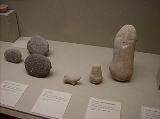
Neolithic period
The Neolithic period appears to have begun when the peoples of the Natufian cultureNatufian culture
The Natufian culture was a Mesolithic culture that existed from 12,500 to 9,500 BC in the Levant, a region in the Eastern Mediterranean. It was unusual in that it was sedentary, or semi-sedentary, before the introduction of agriculture...
, which spread across present-day Syria
Syria
Syria , officially the Syrian Arab Republic , is a country in Western Asia, bordering Lebanon and the Mediterranean Sea to the West, Turkey to the north, Iraq to the east, Jordan to the south, and Israel to the southwest....
, Israel
Israel
The State of Israel is a parliamentary republic located in the Middle East, along the eastern shore of the Mediterranean Sea...
and Lebanon
Lebanon
Lebanon , officially the Republic of LebanonRepublic of Lebanon is the most common term used by Lebanese government agencies. The term Lebanese Republic, a literal translation of the official Arabic and French names that is not used in today's world. Arabic is the most common language spoken among...
, began to practice agriculture. This Neolithic Revolution
Neolithic Revolution
The Neolithic Revolution was the first agricultural revolution. It was the transition from hunting and gathering to agriculture and settlement. Archaeological data indicates that various forms of plants and animal domestication evolved independently in 6 separate locations worldwide circa...
has been linked to the cold period known as the Younger Dryas
Younger Dryas
The Younger Dryas stadial, also referred to as the Big Freeze, was a geologically brief period of cold climatic conditions and drought between approximately 12.8 and 11.5 ka BP, or 12,800 and 11,500 years before present...
. This agriculture in the Levant
Levant
The Levant or ) is the geographic region and culture zone of the "eastern Mediterranean littoral between Anatolia and Egypt" . The Levant includes most of modern Lebanon, Syria, Jordan, Israel, the Palestinian territories, and sometimes parts of Turkey and Iraq, and corresponds roughly to the...
is the earliest known to have been practiced. The Neolithic period in this region is dated 8500-4300 BCE and the Chalcolithic 4300-3300 BCE. Natufian sites in Israel include Ain Mallaha
Ain Mallaha
Ain Mallaha, also known as Eynan, was a Natufian settlement built and settled circa 10,000–8,000 BCE. The settlement is an example of hunter-gatherer sedentism, a crucial step in the transition from foraging to farming.- The Village :...
, el-Wad, Ein Gev, Hayonim cave
Hayonim Cave
HaYonim Cave is a cave located in a limestone bluff about 250 meters above modern sea level, in the Upper Galilee, Israel. The site had substantial occupation during the Middle Paleolithic Mousterian period, from 250,000 years ago to 100,000 years ago, and later, during the Natufian period around...
and Nahal Oren
Nahal Oren
Nahal Oren is an archeological site in a cave 10 kilometers south of Haifa, Israel, which was first excavated in 1941. Kebaran and Natufian Pre-Pottery A and B industries were found. -Domestication of Gazelles and Goats:...
.
Bronze Age
The Bronze Age is the period 3300-1200 BCE when objects made of bronzeBronze
Bronze is a metal alloy consisting primarily of copper, usually with tin as the main additive. It is hard and brittle, and it was particularly significant in antiquity, so much so that the Bronze Age was named after the metal...
were in use. Many writers have linked the history of the Levant from the Bronze Age onwards to events described in the Bible
Bible
The Bible refers to any one of the collections of the primary religious texts of Judaism and Christianity. There is no common version of the Bible, as the individual books , their contents and their order vary among denominations...
. The Bronze Age and Iron Age together are sometimes called the "Biblical period". The periods of the Bronze Age include the following:
- Early Bronze Age I (EB I) 3330-3050 BCE
- Early Bronze Age II-III (EB II-III) 3050-2300 BCE
- Early Bronze Age IV/Middle Bronze Age I (EB IV/MB I) 2300-2000 BCE
- Middle Bronze Age IIA (MB IIA) 2000-1750 BCE
- Middle Bronze Age IIB (MB IIB) 1800-1550 BCE
- Late Bronze Age I-II (LB I-II) 1550-1200 BCE
The Late Bronze Age is characterized by individual city-states, which from time to time were dominated by Egypt
Egypt
Egypt , officially the Arab Republic of Egypt, Arabic: , is a country mainly in North Africa, with the Sinai Peninsula forming a land bridge in Southwest Asia. Egypt is thus a transcontinental country, and a major power in Africa, the Mediterranean Basin, the Middle East and the Muslim world...
until the last invasion by Merenptah in 1207 BCE. The Amarna Letters
Amarna letters
The Amarna letters are an archive of correspondence on clay tablets, mostly diplomatic, between the Egyptian administration and its representatives in Canaan and Amurru during the New Kingdom...
are an example of a specific period during the Late Bronze Age when the vassal kings of the Levant corresponded with their overlords in Egypt.
Iron Age/Israelite period
The Iron Age in the Levant begins in about 1200 BCE when iron tools came into use. It is also known as the IsraeliteIsraelite
According to the Bible the Israelites were a Hebrew-speaking people of the Ancient Near East who inhabited the Land of Canaan during the monarchic period .The word "Israelite" derives from the Biblical Hebrew ישראל...
period. This period marks the weakening of regional empires and the strengthening of local powers such as the Kingdom of Israel (Samaria), Kingdom of Judah
Kingdom of Judah
The Kingdom of Judah was a Jewish state established in the Southern Levant during the Iron Age. It is often referred to as the "Southern Kingdom" to distinguish it from the northern Kingdom of Israel....
and the Philistine city-states. Much of the spiritual (although not necessarily chronological/historical) content of this period is described in the Hebrew Bible
Hebrew Bible
The Hebrew Bible is a term used by biblical scholars outside of Judaism to refer to the Tanakh , a canonical collection of Jewish texts, and the common textual antecedent of the several canonical editions of the Christian Old Testament...
/Old Testament
Old Testament
The Old Testament, of which Christians hold different views, is a Christian term for the religious writings of ancient Israel held sacred and inspired by Christians which overlaps with the 24-book canon of the Masoretic Text of Judaism...
. Later in the period, the Assyria
Assyria
Assyria was a Semitic Akkadian kingdom, extant as a nation state from the mid–23rd century BC to 608 BC centred on the Upper Tigris river, in northern Mesopotamia , that came to rule regional empires a number of times through history. It was named for its original capital, the ancient city of Assur...
n and Babylonian empires put an end to the Kingdoms of Israel and Judah, culminating in the destruction of the First Temple by the Babylonians in 586 BCE.
The Israelite period is characterized by large numbers of urban dwellings and a new local culture. The rich and diverse archaeological findings attest to strong international links and trade relations. The abundance of writings found indicate a broad distribution of knowledge among common people of ancient Israel and not just scribes, a unique phenomenon in the ancient world.
In this period both the archaeological evidence and the narrative evidence from the Bible become richer and much writing has attempted to make links between them. A chronology includes:
- Iron Age I (IA I) 1200-1000 BCE
- Iron Age IIA (IA IIA) 1000-925 BCE
- Iron Age IIB-C (IA IIB-C) 925-586 BCE
- Iron Age III 586-539 BCE (Neo-Babylonian period)
The traditional view, personified in such archaeologists as Albright
William F. Albright
William Foxwell Albright was an American archaeologist, biblical scholar, philologist and expert on ceramics. From the early twentieth century until his death, he was the dean of biblical archaeologists and the universally acknowledged founder of the Biblical archaeology movement...
and Wright, faithfully accepted the biblical events as history, but has since been questioned by "Biblical minimalists" such as Niels Peter Lemche
Niels Peter Lemche
Niels Peter Lemche is a biblical scholar at the University of Copenhagen.-Biblical minimalism:Lemche is closely identified with the movement known as biblical minimalism, and "has assumed the role of philosophical and methodological spokesperson" for the movement.In common with the general trend...
, Thomas L. Thompson
Thomas L. Thompson
Thomas L. Thompson is a biblical theologian associated with the movement known as the Copenhagen School. He was professor of theology at the University of Copenhagen from 1993–2009, lives in Denmark and is now a Danish citizen.-Background:Thompson obtained a B.A...
and Philip R. Davies
Philip R. Davies
Philip R. Davies is a biblical scholar with interests in Early Judaism, History of Ancient Israel, and the Dead Sea Scrolls. Davies has been labeled a biblical minimalist and associated with the Copenhagen School...
. Israel Finkelstein
Israel Finkelstein
Israel Finkelstein is an Israeli archaeologist and academic. He is currently the Jacob M. Alkow Professor of the Archaeology of Israel in the Bronze Age and Iron Ages at Tel Aviv University and is also the co-director of excavations at Megiddo in northern Israel...
suggests that the empire of David and Solomon
United Monarchy
According to Biblical tradition, the united Kingdom of Israel was a kingdom that existed in the Land of Israel, a period referred to by scholars as the United Monarchy. Biblical historians date the kingdom from c. 1020 BCE to c...
(United Monarchy) never existed and Judah was not in a position to support an extended state until the start of the 8th century. Finklestein accepts the existence of King David and Solomon but doubts their chronology
Chronology
Chronology is the science of arranging events in their order of occurrence in time, such as the use of a timeline or sequence of events. It is also "the determination of the actual temporal sequence of past events".Chronology is part of periodization...
, significance and influence as described in the Bible. Despite an on-going debate, the prevailing view is that the Israelite Period corresponds (through its artifacts) with major biblical events and figures. Without claiming that everything in the Bible is historically accurate, non-supernatural
Supernatural
The supernatural or is that which is not subject to the laws of nature, or more figuratively, that which is said to exist above and beyond nature...
story elements appear to correspond with physical artifacts and other archaeological findings. The Hebrew kingdoms of David and Solomon are mentioned in inscriptions traced to non-Hebrew cultural origin, such as the Tel Dan Stele
Tel Dan Stele
The Tel Dan Stele is a stele discovered in 1993/94 during excavations at Tel Dan in northern Israel. Its author was a king of Damascus, Hazael or one of his sons, and it contains an Aramaic inscription commemorating victories over local ancient peoples including "Israel" and the "House of...
and possibly the Mesha Stele
Mesha Stele
The Mesha Stele is a black basalt stone bearing an inscription by the 9th century BC ruler Mesha of Moab in Jordan....
, which mention Hebrew kings as regional adversaries.
In July 2008, Israeli archaeologist Yossi Garfinkel
Yosef Garfinkel
Yosef Garfinkel is a professor of Prehistoric Archaeology and of Archaeology of the Biblical Period at the Hebrew University of Jerusalem.-Biography:...
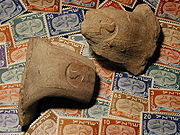
discovered the oldest known Hebrew inscription. A 3,000-year-old pottery shard bearing five lines of faded characters were found at Khirbet Qeiyafa
Khirbet Qeiyafa
Khirbet Qeiyafa is the site of an ancient city overlooking the Elah Valley. The ruins of the fortress were uncovered in 2007, near the Israeli city of Beit Shemesh, 20 miles from Jerusalem. It covers nearly six acres and is encircled by a 700-meter long city wall constructed of stones weighing...
, the ruins of an ancient town south-west of Jerusalem. Garfinkel noted that the find suggests Biblical accounts of the ancient Israelite kingdom of David could have been based on written texts.
Persian period
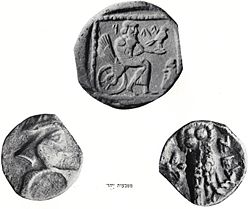
Cyrus the Great
Cyrus II of Persia , commonly known as Cyrus the Great, also known as Cyrus the Elder, was the founder of the Achaemenid Empire. Under his rule, the empire embraced all the previous civilized states of the ancient Near East, expanded vastly and eventually conquered most of Southwest Asia and much...
conquered the Babylonian Empire by 539 BCE and incorporated the entire area into the Persian Empire
Achaemenid Empire
The Achaemenid Empire , sometimes known as First Persian Empire and/or Persian Empire, was founded in the 6th century BCE by Cyrus the Great who overthrew the Median confederation...
. Cyrus organized the empire into provincial administrations called satrap
Satrap
Satrap was the name given to the governors of the provinces of the ancient Median and Achaemenid Empires and in several of their successors, such as the Sassanid Empire and the Hellenistic empires....
ies. The administrators of these provinces, called satraps, had considerable independence from the emperor. The Jews were allowed to return to the regions that the Babylonians had exiled them from, in which they established a small autonomy, Yehud Medinata
Yehud Medinata
Yehud Medinata or simply Yehud, was an Achaeminid autonomous province covering Judea and parts of Samaria, located south to Eber-Nari...
, under Persian protection. The Persian period is dated from 539 to 333 BCE.
The exiled Jews who returned to their traditional homeland encountered the Jews that had remained, surrounded by a much larger non-Jewish majority. One group of note (that exists up until this day) were the Samaritans, who adhered to most features of the Jewish rite and claimed to be descendants of the Assyrian Jews. For various reasons (at least some of which seem to be political) the returning exiles did not recognize the Samaritans as Jews. The return of the exiles from Babylon reinforced the Jewish population, which gradually became more dominant.
Hellenistic period
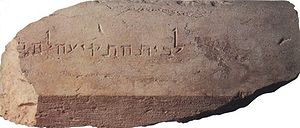
Wars of the Diadochi
The Wars of the Diadochi were a series of conflicts fought between Alexander the Great's generals over the rule of his empire between 322 and 275 BC.-Background:...
, following which the competing Ptolemaic
Ptolemaic Egypt
Ptolemaic Egypt began when Ptolemy I Soter invaded Egypt and declared himself Pharaoh of Egypt in 305 BC and ended with the death of queen Cleopatra VII of Egypt and the Roman conquest in 30 BC. The Ptolemaic Kingdom was a powerful Hellenistic state, extending from southern Syria in the east, to...
and Seleucid Empire
Seleucid Empire
The Seleucid Empire was a Greek-Macedonian state that was created out of the eastern conquests of Alexander the Great. At the height of its power, it included central Anatolia, the Levant, Mesopotamia, Persia, today's Turkmenistan, Pamir and parts of Pakistan.The Seleucid Empire was a major centre...
s occupied various portions of the eastern Mediterranean. The Jewish population was divided into Hellenists
Hellenization
Hellenization is a term used to describe the spread of ancient Greek culture, and, to a lesser extent, language. It is mainly used to describe the spread of Hellenistic civilization during the Hellenistic period following the campaigns of Alexander the Great of Macedon...
, who supported the adoption of Greek culture, and those who believed in keeping to the traditions of the past, which eventually led to the Maccabean revolt of the 2nd century BCE and subsequent Hasmonean
Hasmonean
The Hasmonean dynasty , was the ruling dynasty of Judea and surrounding regions during classical antiquity. Between c. 140 and c. 116 BCE, the dynasty ruled semi-autonomously from the Seleucids in the region of Judea...
rule. The Hellenistic period is thus dated 333-165 BCE and the Hasmonean
Hasmonean
The Hasmonean dynasty , was the ruling dynasty of Judea and surrounding regions during classical antiquity. Between c. 140 and c. 116 BCE, the dynasty ruled semi-autonomously from the Seleucids in the region of Judea...
period dated 165-63 BCE.
Roman period
The RomanRoman Empire
The Roman Empire was the post-Republican period of the ancient Roman civilization, characterised by an autocratic form of government and large territorial holdings in Europe and around the Mediterranean....
period covers the dates 63 BCE to 330 CE, from Pompey the Great's incorporation of the region into the Roman Republic
Roman Republic
The Roman Republic was the period of the ancient Roman civilization where the government operated as a republic. It began with the overthrow of the Roman monarchy, traditionally dated around 508 BC, and its replacement by a government headed by two consuls, elected annually by the citizens and...
until Rome's adoption of Christianity
Christianity
Christianity is a monotheistic religion based on the life and teachings of Jesus as presented in canonical gospels and other New Testament writings...
as the imperial religion. The Roman period itself features several stages:
- Early Roman period (including the HerodianHerod the GreatHerod , also known as Herod the Great , was a Roman client king of Judea. His epithet of "the Great" is widely disputed as he is described as "a madman who murdered his own family and a great many rabbis." He is also known for his colossal building projects in Jerusalem and elsewhere, including his...
period) 63 BCE to 70 CE - Middle Roman period: 70-135CE (Jewish-Roman warsJewish-Roman warsThe Jewish–Roman wars were a series of large-scale revolts by the Jews of Iudaea Province and Eastern Mediterranean against the Roman Empire. Some sources use the term to refer only to the First Jewish–Roman War and Bar Kokhba revolt...
period); 135-200CE (Mishnaic period) - Late Roman period 200-330CE (Talmudic period)
The end of the middle Roman period marks the end of the predominantly Jewish culture of Judea
Judea
Judea or Judæa was the name of the mountainous southern part of the historic Land of Israel from the 8th century BCE to the 2nd century CE, when Roman Judea was renamed Syria Palaestina following the Jewish Bar Kokhba revolt.-Etymology:The...
, but also the beginning of Rabbinic Judaism
Rabbinic Judaism
Rabbinic Judaism or Rabbinism has been the mainstream form of Judaism since the 6th century CE, after the codification of the Talmud...
through Rabbi Yochanan Ben Zakai in the city of Yavne
Yavne
Yavne is a city in the Central District of Israel. According to the Israel Central Bureau of Statistics , at the end of 2009 the city had a population of 33,000.-History:...
. Therefore, the late Roman period is also called the Yavne Period.
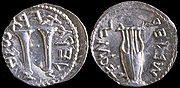
- MasadaMasadaMasada is the name for a site of ancient palaces and fortifications in the South District of Israel, on top of an isolated rock plateau, or horst, on the eastern edge of the Judean Desert, overlooking the Dead Sea. Masada is best known for the violence that occurred there in the first century CE...
- HerodiumHerodiumHerodium or Herodion is a volcano-like hill with a truncated cone located south of Jerusalem, near the city of Bethlehem in the West Bank. Herod the Great built a fortress and palace on the top of Herodium, and may have been buried there...
- Caesarea Maritima
Byzantine period
The ByzantineByzantine
Byzantine usually refers to the Roman Empire during the Middle Ages.Byzantine may also refer to:* A citizen of the Byzantine Empire, or native Greek during the Middle Ages...
period is dated 330-638 CE, from Rome's adoption of Christianity to the Muslim conquest of Palestine.
Findings from the Byzantine period include:
- Byzantine-period church in Jerusalem hills
- Byzantine-period street in Jerusalem
- 1,400 year-old wine press
Subsequent history
From 638 CE, the region became part of the Arab Muslim world, under the CaliphateCaliphate
The term caliphate, "dominion of a caliph " , refers to the first system of government established in Islam and represented the political unity of the Muslim Ummah...
. During the Crusades
Crusades
The Crusades were a series of religious wars, blessed by the Pope and the Catholic Church with the main goal of restoring Christian access to the holy places in and near Jerusalem...
, Christian
Christian
A Christian is a person who adheres to Christianity, an Abrahamic, monotheistic religion based on the life and teachings of Jesus of Nazareth as recorded in the Canonical gospels and the letters of the New Testament...
kingdoms were established, but then the area fell under the sway of the Ottoman Empire
Ottoman Empire
The Ottoman EmpireIt was usually referred to as the "Ottoman Empire", the "Turkish Empire", the "Ottoman Caliphate" or more commonly "Turkey" by its contemporaries...
. One of the pioneers of archaeological research in Jerusalem while it was still part of the Ottoman Empire was Captain Charles Warren
Charles Warren
General Sir Charles Warren, GCMG, KCB, FRS was an officer in the British Royal Engineers. He was one of the earliest European archaeologists of Biblical Holy Land, and particularly of Temple Mount...
who in 1867 led an expedition there on secondment to the Palestine Exploration Fund
Palestine Exploration Fund
The Palestine Exploration Fund is a British society often simply known as the PEF. It was founded in 1865 and is still functioning today. Its initial object was to carry out surveys of the topography and ethnography of Ottoman Palestine with a remit that fell somewhere between an expeditionary...
, particularly contributing to the discovery of cavities under the Temple Mount
Temple Mount
The Temple Mount, known in Hebrew as , and in Arabic as the Haram Ash-Sharif , is one of the most important religious sites in the Old City of Jerusalem. It has been used as a religious site for thousands of years...
, on of which bears his name, the Warren's Shaft
Warren's Shaft
Warren's Shaft is an archaeological feature in Jerusalem discovered in 1867 by British engineer Sir Charles Warren . It runs from within the old city to a spot near the Gihon Spring, and after its 19th century discovery was thought to have been the centrepiece of the city's early water supply...
. After the First World War, the United Kingdom
United Kingdom
The United Kingdom of Great Britain and Northern IrelandIn the United Kingdom and Dependencies, other languages have been officially recognised as legitimate autochthonous languages under the European Charter for Regional or Minority Languages...
was given a mandate over the Palestine
Mandate Palestine
Mandate Palestine existed while the British Mandate for Palestine, which formally began in September 1923 and terminated in May 1948, was in effect...
by the League of Nations
League of Nations
The League of Nations was an intergovernmental organization founded as a result of the Paris Peace Conference that ended the First World War. It was the first permanent international organization whose principal mission was to maintain world peace...
. The State of Israel was established in 1948.
Ashkelon
Archaeological excavation in AshkelonAshkelon
Ashkelon is a coastal city in the South District of Israel on the Mediterranean coast, south of Tel Aviv, and north of the border with the Gaza Strip. The ancient seaport of Ashkelon dates back to the Neolithic Age...
began in 1985, led by Lawrence Stager
Lawrence Stager
Lawrence E. "Larry" Stager is Dorot Professor of the Archaeology of Israel in the Department of Near Eastern Languages and Civilizations at Harvard University and is Director of the Harvard Semitic Museum...
The site contains 50 feet (15.2 m) of accumulated rubble from successive Canaanite, Philistine, Phoenician, Persian, Hellenistic, Roman, Byzantine, Islamic, and Crusader occupation. Major findings include shaft graves of pre-Phoenician Canaanites, a Bronze Age vault
Vault (architecture)
A Vault is an architectural term for an arched form used to provide a space with a ceiling or roof. The parts of a vault exert lateral thrust that require a counter resistance. When vaults are built underground, the ground gives all the resistance required...
and ramparts, and a silvered bronze statuette of a bull calf
Bull (mythology)
The worship of the Sacred Bull throughout the ancient world is most familiar to the Western world in the biblical episode of the idol of the Golden Calf. The Golden Calf after being made by the Hebrew people in the wilderness of Sinai, were rejected and destroyed by Moses and his tribe after his...
, assumed to be of the Canaanite period.
Beit Alfa
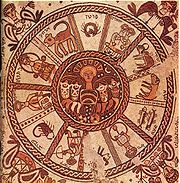
Beit Alfa Synagogue
The Beit Alfa Synagogue is an ancient Byzantine-era synagogue located in Heftziba, at the foot of Mount Gilboa in northern Israel. It was constructed in the 6th century CE and is famous for its mosaic floor which was uncovered in 1928.-Dimensions:...
is the site of an ancient Byzantine-era synagogue
Beit Alfa Synagogue
The Beit Alfa Synagogue is an ancient Byzantine-era synagogue located in Heftziba, at the foot of Mount Gilboa in northern Israel. It was constructed in the 6th century CE and is famous for its mosaic floor which was uncovered in 1928.-Dimensions:...
, constructed in the fifth century CE, with a three-paneled mosaic floor. An Aramaic
Aramaic language
Aramaic is a group of languages belonging to the Afroasiatic language phylum. The name of the language is based on the name of Aram, an ancient region in central Syria. Within this family, Aramaic belongs to the Semitic family, and more specifically, is a part of the Northwest Semitic subfamily,...
inscription states that the mosaic was made at the time of Justin (apparently Justin I
Justin I
Justin I was Byzantine Emperor from 518 to 527. He rose through the ranks of the army and ultimately became its Emperor, in spite of the fact he was illiterate and almost 70 years old at the time of accession...
), who ruled from 518 to 527 CE. The mosaic is one of the most important discovered in Israel. Each of its three panels depicts a scene - the Holy Ark
Ark (synagogue)
The Torah ark or ark in a synagogue is known in Hebrew as the Aron Kodesh by the Ashkenazim and as the Hekhál amongst most Sefardim. It is generally a receptacle, or ornamental closet, which contains each synagogue's Torah scrolls...
, the zodiac
Zodiac
In astronomy, the zodiac is a circle of twelve 30° divisions of celestial longitude which are centred upon the ecliptic: the apparent path of the Sun across the celestial sphere over the course of the year...
, and the story of the sacrifice of Isaac
Isaac
Isaac as described in the Hebrew Bible, was the only son Abraham had with his wife Sarah, and was the father of Jacob and Esau. Isaac was one of the three patriarchs of the Israelites...
. The zodiac has the names of the twelve signs in Hebrew. In the center is Helios
Helios
Helios was the personification of the Sun in Greek mythology. Homer often calls him simply Titan or Hyperion, while Hesiod and the Homeric Hymn separate him as a son of the Titans Hyperion and Theia or Euryphaessa and brother of the goddesses Selene, the moon, and Eos, the dawn...
, the sun god, being whisked away in his chariot
Chariot
The chariot is a type of horse carriage used in both peace and war as the chief vehicle of many ancient peoples. Ox carts, proto-chariots, were built by the Proto-Indo-Europeans and also built in Mesopotamia as early as 3000 BC. The original horse chariot was a fast, light, open, two wheeled...
by four galloping horses. The four women in the corners of the mosaic represent the four season
Season
A season is a division of the year, marked by changes in weather, ecology, and hours of daylight.Seasons result from the yearly revolution of the Earth around the Sun and the tilt of the Earth's axis relative to the plane of revolution...
s.
Carmel Caves
Misliya Cave, southwest of Mt. Carmel, has been excavated by teams of anthropologists and archaeologists from the Archaeology Department of the University of HaifaUniversity of Haifa
The University of Haifa is a university in Haifa, Israel.The University of Haifa was founded in 1963 by Haifa mayor Abba Hushi, to operate under the academic auspices of the Hebrew University of Jerusalem....
and Tel Aviv University
Tel Aviv University
Tel Aviv University is a public university located in Ramat Aviv, Tel Aviv, Israel. With nearly 30,000 students, TAU is Israel's largest university.-History:...
since 2001. In 2007, they unearthed artifacts indicative of what could be the earliest known prehistoric man. The teams uncovered hand-held stone tools and blades as well as animal bones, dating to 250,000 years ago, at the time of the Mousterian
Mousterian
Mousterian is a name given by archaeologists to a style of predominantly flint tools associated primarily with Homo neanderthalensis and dating to the Middle Paleolithic, the middle part of the Old Stone Age.-Naming:...
culture of Neanderthals in Europe.
Beth She'arim
Beth She'arim is an archaeological site of a Jewish town and necropolisNecropolis
A necropolis is a large cemetery or burial ground, usually including structural tombs. The word comes from the Greek νεκρόπολις - nekropolis, literally meaning "city of the dead"...
, near the town of Kiryat Tiv'on, 20 km east of Haifa
Haifa
Haifa is the largest city in northern Israel, and the third-largest city in the country, with a population of over 268,000. Another 300,000 people live in towns directly adjacent to the city including the cities of the Krayot, as well as, Tirat Carmel, Daliyat al-Karmel and Nesher...
in the southern foothills of the Lower Galilee. Beth She'arim was excavated by Benjamin Mazar
Benjamin Mazar
Benjamin Mazar was a pioneering Israeli historian, recognized as the "dean" of biblical archaeologists. He shared the national passion for the archaeology of Israel that also attracts considerable international interest due to the region's biblical links...
and Nahman Avigad
Nahman Avigad
Dr. Nahman Avigad , born in Zawalow, Galicia , was an Israeli archaeologist.-Biography:...
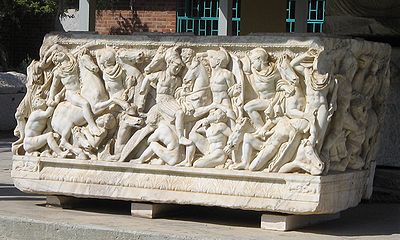
in the 1930s and 1950s. Most of the remains date from the 2nd to 4th century CE and include the remains of a large number of individuals buried in the more than twenty catacombs of the necropolis. Together with the images on walls and sarcophagi
Sarcophagus
A sarcophagus is a funeral receptacle for a corpse, most commonly carved or cut from stone. The word "sarcophagus" comes from the Greek σαρξ sarx meaning "flesh", and φαγειν phagein meaning "to eat", hence sarkophagus means "flesh-eating"; from the phrase lithos sarkophagos...
, the inscriptions show that this was a Jewish necropolis.
Gezer
Tel GezerGezer
Gezer was a Canaanite city-state and biblical town in ancient Israel. Tel Gezer , an archaeological site midway between Jerusalem and Tel Aviv, is now an Israeli national park....
is a strategically located archaeological site which sits on the western flank of the Shephelah
Shephelah
The Shephelah is a designation usually applied to the region in south-central Israel of 10-15 km of low hills between the central Mount Hebron and the coastal plains of Philistia within the area of the Judea, at an altitude of 120-450 metres above sea level. The area is fertile, and a temperate...
, overlooking the coastal plain of Israel, near the junction between Via Maris
Via Maris
Via Maris is the modern name for an ancient trade route, dating from the early Bronze Age, linking Egypt with the northern empires of Syria, Anatolia and Mesopotamia — modern day Iran, Iraq, Turkey and Syria....
and the trunk road leading to Jerusalem. The tel
Tell
A tell or tel, is a type of archaeological mound created by human occupation and abandonment of a geographical site over many centuries. A classic tell looks like a low, truncated cone with a flat top and sloping sides.-Archaeology:A tell is a hill created by different civilizations living and...
consists of two mounds with a saddle between them, spanning roughly 30 acres (121,405.8 m²). A dozen inscribed boundary stones found in the vicinity verify the identification of the mound as Gezer, making it the first positively identified Biblical city. Gezer is mentioned in several ancient sources, including the Hebrew Bible
Hebrew Bible
The Hebrew Bible is a term used by biblical scholars outside of Judaism to refer to the Tanakh , a canonical collection of Jewish texts, and the common textual antecedent of the several canonical editions of the Christian Old Testament...
and the Amarna letters
Amarna letters
The Amarna letters are an archive of correspondence on clay tablets, mostly diplomatic, between the Egyptian administration and its representatives in Canaan and Amurru during the New Kingdom...
. The biblical references describe it as one of Solomon's royal store cities. Gezer was excavated by R.A.S. Macalister in 1902 and 1907. Major findings include a soft limestone
Limestone
Limestone is a sedimentary rock composed largely of the minerals calcite and aragonite, which are different crystal forms of calcium carbonate . Many limestones are composed from skeletal fragments of marine organisms such as coral or foraminifera....
tablet, named the Gezer calendar
Gezer calendar
The Gezer calendar is a tablet of soft limestone inscription, dating to the 10th century BCE. Scholars are divided as to whether the script and language are Phoenician or paleo-Hebrew, which were linguistically very similar in this period....
, which describes the agricultural chores associated with each month of the year. The calendar is written in paleo-Hebrew script
Paleo-Hebrew alphabet
The Paleo-Hebrew alphabet , is an abjad offshoot of the ancient Semitic alphabet, identical to the Phoenician alphabet. At the very least it dates to the 10th century BCE...
, and is one of the oldest known examples of Hebrew writing, dating to the 10th century BCE. Also found was a six-chambered gate similar to those found at Hazor and Megiddo, and ten monumental megaliths.
Mamshit
MamshitMamshit
Mamshit is the Nabataean city of Memphis. In the Nabataean period, Mamshit was an important station on Incense Road, running from the Idumean Mountains, through the Arabah and Ma'ale Akrabim, and on to Beer-Sheva or to Hebron and Jerusalem. The city covers and is the smallest but best restored...
, the Nabatean city of Memphis (also known as Kurnub in Arabic), was declared a world heritage site by UNESCO on June 2005. The archaeological excavation at Mamshit uncovered the largest hoard of coins ever found in Israel : 10500 silver coins in a bronze jar, dating to the 3rd century CE. Among the Nabatean cities found in the Negev (Avdat
Avdat
Avdat , also known as Ovdat or Obodat was the most important historic city on the Incense Route after Petra between the 7th and the 1st centuries BCE. It was inhabited by Nabataeans, Romans and Byzantines. It was a seasonal camping ground for Nabataean caravans travelling along the early Petra -...
, Haluza
Haluza
Haluza , also known as Halasa, Chellous , al-Khalasa and Elusa, is a city in the Negev, Israel, that was once part of the Nabataean Incense Route. Due to this historic importance, UNESCO have granted four cities in the Negev the joint status of a World Heritage Site; Haluza is one of these, the...
, Shivta
Shivta
Shivta or Sobota or Subeitah or Subaytah , is an archaeological site in the Negev Desert of Israel, east of Nitzana. It is close to the Israeli Artillery Corps main training facility....
) Mamshit is the smallest (10 acres), but the best preserved and restored. Entire streets have survived intact, and numerous Nabatean buildings with open rooms, courtyards, and terraces have been restored. Most of the buildings were built in the late Nabatean period, in the 2nd century CE, after the Nabatean kingdom was annexed to Rome in 106 CE.
Old Acre
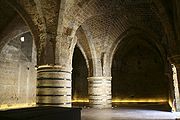
Acre, Israel
Acre , is a city in the Western Galilee region of northern Israel at the northern extremity of Haifa Bay. Acre is one of the oldest continuously inhabited sites in the country....
's Old City has been the site of extensive archaeological excavation since the 1990s. The major find has been an underground passageway leading to a 13th century fortress of the Knights Templar
Knights Templar
The Poor Fellow-Soldiers of Christ and of the Temple of Solomon , commonly known as the Knights Templar, the Order of the Temple or simply as Templars, were among the most famous of the Western Christian military orders...
. The excavated remains of the Crusader town, dating from 1104 to 1291 CE, are well preserved, and are on display above and below the current street level.
Tel Rehov
Tel RehovRehov
Rehov , meaning "broad", "wide place", was an important Bronze and Iron Age city located at Tel Rehov , an archaeological site in the Jordan Valley, Israel, approximately 5 km south of Beit She'an and 3 km west of the Jordan River...
is an important Bronze and Iron Age archaeological site approximately five kilometers south of Beit She'an and three kilometers west of the Jordan River. The site represents one of the largest ancient city mounds in Israel, its surface area comprising 120,000 m² in size, divided into an "Upper City" (40,000 m²) and a "Lower City" (80,000 m²). Archaeological excavations have been conducted at Rehov since 1997, under the directorship of Amihai Mazar. The first eight seasons of excavations revealed successive occupational layers from the Late Bronze Age and Iron Age I (12th - 11th centuries BCE). The Iron Age II levels of the site have emerged as a vitally important component in the current debate regarding the chronology of the United Monarchy
United Monarchy
According to Biblical tradition, the united Kingdom of Israel was a kingdom that existed in the Land of Israel, a period referred to by scholars as the United Monarchy. Biblical historians date the kingdom from c. 1020 BCE to c...
of Israel. In September 2007, 30 intact beehives dated to the mid-10th century BCE to the early 9th century BCE were found. The beehives are evidence of an advanced honey-producing beekeeping (apiculture) industry 3000 years ago in the city, then thought to have a population of about 2000. The beehives, made of straw and unbaked clay, were found in orderly rows of 100 hives. Organic material (wheat found next to the beehives) was dated using carbon-14 radiocarbon dating at the University of Groningen
University of Groningen
The University of Groningen , located in the city of Groningen, was founded in 1614. It is one of the oldest universities in the Netherlands as well as one of its largest. Since its inception more than 100,000 students have graduated...
in the Netherlands. Also found alongside the hives was an altar decorated with fertility figurines.
Tel Be'er Sheva
A UNESCO World Heritage site since 2005, Tel Be'er ShevaTel Be'er Sheva
Tel Be'er Sheva is an archeological site in southern Israel believed to be the remains of the biblical town of Beersheba. It lies to the east of the modern city of Beersheba and to the east of the Bedouin town of Tel Sheva.-Biblical Beersheba:...
is an archaeological site in southern Israel, believed to be the remains of the biblical town of Be'er Sheva. Archaeological finds indicate that the site was inhabited from the Chalcolithic period, around 4000 BCE, to the 16th century CE. This was probably due to the abundance of underground water
Aquifer
An aquifer is a wet underground layer of water-bearing permeable rock or unconsolidated materials from which groundwater can be usefully extracted using a water well. The study of water flow in aquifers and the characterization of aquifers is called hydrogeology...
, as evidenced by the numerous wells in the area. Excavated by Yohanan Aharoni and Ze'ev Herzog of Tel Aviv University, the settlement itself is dated to the early Israelite period. Probably populated in the 12th century BCE, the first fortified settlement dates to 1000 BCE. The city was likely destroyed by Sennacherib
Sennacherib
Sennacherib |Sîn]] has replaced brothers for me"; Aramaic: ) was the son of Sargon II, whom he succeeded on the throne of Assyria .-Rise to power:...
in 700 BCE, and after a habitation hiatus of three hundred years, there is evidence of remains from the Persian, Hellenistic, Roman and Early Arab periods. Major finds include an elaborate water system and a huge cistern
Cistern
A cistern is a waterproof receptacle for holding liquids, usually water. Cisterns are often built to catch and store rainwater. Cisterns are distinguished from wells by their waterproof linings...
carved out of the rock beneath the town, and a large horned altar
Altar
An altar is any structure upon which offerings such as sacrifices are made for religious purposes. Altars are usually found at shrines, and they can be located in temples, churches and other places of worship...
which was reconstructed using several well-dressed stones found in secondary use in the walls of a later building. The altar attests to the existence of a temple or cult
Cult
The word cult in current popular usage usually refers to a group whose beliefs or practices are considered abnormal or bizarre. The word originally denoted a system of ritual practices...
center in the city which was probably dismantled during the reforms of King Hezekiah.
Tel Megiddo
A UNESCO World Heritage site since 2005, Tel Megiddo comprises twenty-six stratified layers of the ruins of ancient cities in a strategic location at the head of a pass through the Carmel Ridge, which overlooks the Valley of Jezreel from the west. Megiddo has been excavated three times. The first excavations were carried out between 1903 and 1905 and a second expedition was carried out in 1925. During these excavation it was discovered that there were twenty levels of habitation, and many of the remains uncovered are preserved at the Rockefeller MuseumRockefeller Museum
The Rockefeller Museum, formerly the Palestine Archaeological Museum, is an archaeological museum located in East Jerusalem that houses a large collection of artifacts unearthed in the excavations conducted in Ottoman Palestine beginning in the late 19th century.The museum is under the management...
in Jerusalem and the Oriental Institute of the University of Chicago
University of Chicago
The University of Chicago is a private research university in Chicago, Illinois, USA. It was founded by the American Baptist Education Society with a donation from oil magnate and philanthropist John D. Rockefeller and incorporated in 1890...
. Yigael Yadin conducted a few small excavations in the 1960s. Since 1994, Megiddo been the subject of biannual excavation campaigns conducted by The Megiddo Expedition of Tel Aviv University, directed by Israel Finkelstein and David Ussishkin
David Ussishkin
David Ussishkin is an Israeli archaeologist. Now retired as Professor of Archaeology at Tel Aviv University, Ussishkin has directed and co-directed important excavations at a variety of sites, including Lachish, Jezreel and Megiddo....
, together with a consortium of international universities. A major find from digs conducted between 1927 and 1934 were the Megiddo Stables – two tripartite structures measuring 21 meters by 11 meters, believed to have been ancient stables capable of housing nearly 500 horses.
Beit She'arim
Beit She'arimBeit She'arim National Park
Beit She'arim , also known as Beth She'arim or Besara , literally The Strangers House, is the archeological site of a Jewish town and a large number of ancient rock-cut Jewish tombs...
is an archaeological site of a Jewish town and necropolis
Necropolis
A necropolis is a large cemetery or burial ground, usually including structural tombs. The word comes from the Greek νεκρόπολις - nekropolis, literally meaning "city of the dead"...
, near the town of Kiryat Tiv'on, 20 km east of Haifa
Haifa
Haifa is the largest city in northern Israel, and the third-largest city in the country, with a population of over 268,000. Another 300,000 people live in towns directly adjacent to the city including the cities of the Krayot, as well as, Tirat Carmel, Daliyat al-Karmel and Nesher...
in the southern foothills of the Lower Galilee. Beth She'arim was excavated by Benjamin Mazar
Benjamin Mazar
Benjamin Mazar was a pioneering Israeli historian, recognized as the "dean" of biblical archaeologists. He shared the national passion for the archaeology of Israel that also attracts considerable international interest due to the region's biblical links...
and Nahman Avigad
Nahman Avigad
Dr. Nahman Avigad , born in Zawalow, Galicia , was an Israeli archaeologist.-Biography:...
in the 1930s and 1950s. Most of the remains date from the 2nd to 4th century CE and include the remains of a large number of individuals buried in the more than twenty catacombs of the necropolis. Together with the images on walls and sarcophagi
Sarcophagus
A sarcophagus is a funeral receptacle for a corpse, most commonly carved or cut from stone. The word "sarcophagus" comes from the Greek σαρξ sarx meaning "flesh", and φαγειν phagein meaning "to eat", hence sarkophagus means "flesh-eating"; from the phrase lithos sarkophagos...
, the inscriptions show that this was a Jewish necropolis.
Gath
Tell es-SafiTell es-Safi
Gath, Gat, or Geth , often referred to as Gath of the Philistines, was one of the five Philistine city-states, established in northwestern Philistia. According to the Bible, the king of the city was Achish, in the times of Saul, David, and Solomon. It is not certain whether this refers to two or...
/Gath is one of the largest pre-Classical
Classical antiquity
Classical antiquity is a broad term for a long period of cultural history centered on the Mediterranean Sea, comprising the interlocking civilizations of ancient Greece and ancient Rome, collectively known as the Greco-Roman world...
sites in Israel, situated approximately halfway between Jerusalem and Ashkelon
Ashkelon
Ashkelon is a coastal city in the South District of Israel on the Mediterranean coast, south of Tel Aviv, and north of the border with the Gaza Strip. The ancient seaport of Ashkelon dates back to the Neolithic Age...
, on the border between coastal plain and the Judean foothils (Shephelah
Shephelah
The Shephelah is a designation usually applied to the region in south-central Israel of 10-15 km of low hills between the central Mount Hebron and the coastal plains of Philistia within the area of the Judea, at an altitude of 120-450 metres above sea level. The area is fertile, and a temperate...
). The site was settled from Prehistoric thru Modern times, and was of particular importance during the Bronze and Iron Ages, and during the Crusader period. The site is identified as Canaanite and Philistine Gath, and during the Iron Age was one of the five main cities (the Pentapolis
Pentapolis
A pentapolis, from the Greek words , "five" and , "city" is a geographic and/or institutional grouping of five cities...
) of the Philistines
Philistines
Philistines , Pleshet or Peleset, were a people who occupied the southern coast of Canaan at the beginning of the Iron Age . According to the Bible, they ruled the five city-states of Gaza, Askelon, Ashdod, Ekron and Gath, from the Wadi Gaza in the south to the Yarqon River in the north, but with...
. The site was excavated briefly in 1899 by the British archaeologists Frederick Jones Bliss
Frederick Jones Bliss
Frederick Jones Bliss was an American archaeologist. After training under Flinders Petrie in Egypt, Bliss became involved with the Palestine Exploration Fund working in the field of Biblical archaeology at the site of Tell el-Hesi between 1894 and 1897, while cuncurrently leading an expedition...
and Robert Alexander Stewart Macalister
Robert Alexander Stewart Macalister
Robert Alexander Stewart Macalister was an Irish archaeologist.Macalister was born in Dublin, Ireland and studied at Cambridge University. Although his earliest interest was in the archaeology of Ireland, he soon developed a strong interest in biblical archaeology. Along with Frederick J...
, and since 1996, by a team from Bar-Ilan University
Bar-Ilan University
Bar-Ilan University is a university in Ramat Gan of the Tel Aviv District, Israel.Established in 1955, Bar Ilan is now Israel's second-largest academic institution. It has nearly 26,800 students and 1,350 faculty members...
directed by Aren Maeir
Aren Maeir
Aren Maeir is a professor at Bar Ilan University and director of the Tell es-Safi/Gath Archaeological Project . Born in 1958 in Rochester, New York, USA, he moved to Israel in 1969 and has lived there since...
. Among the noteworthy finds from the ongoing excavations are the impressive late 9th cent. BCE destruction level (Stratum A3), apparently evidence of the destruction of Gath by Hazael
Hazael
Hazael was a court official and later an Aramean king who is mentioned in the Bible. Under his reign, Aram-Damascus became an empire that ruled over large parts of Syria and Palestine....
of Aram
Aram (Biblical region)
Aram is the name of a region mentioned in the Bible located in central Syria, including where the city of Aleppo now stands.-Etymology:The etymology is uncertain. One standard explanation is an original meaning of "highlands"...
(see II Kings 12:18), a unique siege
Siege
A siege is a military blockade of a city or fortress with the intent of conquering by attrition or assault. The term derives from sedere, Latin for "to sit". Generally speaking, siege warfare is a form of constant, low intensity conflict characterized by one party holding a strong, static...
system relating to this event that surrounds the site (the earliest known siege system in the world), a 10th/9th cent. BCE inscription written in archaic alphabetic script, mentioning two names of Indo-European
Indo-European
Indo-European may refer to:* Indo-European languages** Aryan race, a 19th century and early 20th century term for those peoples who are the native speakers of Indo-European languages...
nature, somewhat reminiscent of the etymological origins of the name Goliath, and a large stone altar with two "horns" from the 9th cent. BCE destruction level - which while very similar to the biblical description of the altar in the Tabernacle
Tabernacle
The Tabernacle , according to the Hebrew Torah/Old Testament, was the portable dwelling place for the divine presence from the time of the Exodus from Egypt through the conquering of the land of Canaan. Built to specifications revealed by God to Moses at Mount Sinai, it accompanied the Israelites...
(in Exodus 30), has only two horns (as opposed to four in other known examples), perhaps indicating a unique type of Philistine altar, perhaps influenced from Cypriot
Cyprus
Cyprus , officially the Republic of Cyprus , is a Eurasian island country, member of the European Union, in the Eastern Mediterranean, east of Greece, south of Turkey, west of Syria and north of Egypt. It is the third largest island in the Mediterranean Sea.The earliest known human activity on the...
, and perhaps Minoan
Minoan civilization
The Minoan civilization was a Bronze Age civilization that arose on the island of Crete and flourished from approximately the 27th century BC to the 15th century BC. It was rediscovered at the beginning of the 20th century through the work of the British archaeologist Arthur Evans...
, culture.
Gezer
Tel GezerGezer
Gezer was a Canaanite city-state and biblical town in ancient Israel. Tel Gezer , an archaeological site midway between Jerusalem and Tel Aviv, is now an Israeli national park....
is a strategically located archaeological site which sits on the western flank of the Shephelah
Shephelah
The Shephelah is a designation usually applied to the region in south-central Israel of 10-15 km of low hills between the central Mount Hebron and the coastal plains of Philistia within the area of the Judea, at an altitude of 120-450 metres above sea level. The area is fertile, and a temperate...
, overlooking the coastal plain of Israel, near the junction between Via Maris
Via Maris
Via Maris is the modern name for an ancient trade route, dating from the early Bronze Age, linking Egypt with the northern empires of Syria, Anatolia and Mesopotamia — modern day Iran, Iraq, Turkey and Syria....
and the trunk road leading to Jerusalem. The tel
Tell
A tell or tel, is a type of archaeological mound created by human occupation and abandonment of a geographical site over many centuries. A classic tell looks like a low, truncated cone with a flat top and sloping sides.-Archaeology:A tell is a hill created by different civilizations living and...
consists of two mounds with a saddle between them, spanning roughly 30 acres (121,405.8 m²). A dozen inscribed boundary stones found in the vicinity verify the identification of the mound as Gezer, making it the first positively identified Biblical city. Gezer is mentioned in several ancient sources, including the Hebrew Bible
Hebrew Bible
The Hebrew Bible is a term used by biblical scholars outside of Judaism to refer to the Tanakh , a canonical collection of Jewish texts, and the common textual antecedent of the several canonical editions of the Christian Old Testament...
and the Amarna letters
Amarna letters
The Amarna letters are an archive of correspondence on clay tablets, mostly diplomatic, between the Egyptian administration and its representatives in Canaan and Amurru during the New Kingdom...
. The biblical references describe it as one of Solomon's royal store cities. Gezer was excavated by R.A.S. Macalister in 1902 and 1907. Major findings include a soft limestone
Limestone
Limestone is a sedimentary rock composed largely of the minerals calcite and aragonite, which are different crystal forms of calcium carbonate . Many limestones are composed from skeletal fragments of marine organisms such as coral or foraminifera....
tablet, named the Gezer calendar
Gezer calendar
The Gezer calendar is a tablet of soft limestone inscription, dating to the 10th century BCE. Scholars are divided as to whether the script and language are Phoenician or paleo-Hebrew, which were linguistically very similar in this period....
, which describes the agricultural chores associated with each month of the year. The calendar is written in paleo-Hebrew script
Paleo-Hebrew alphabet
The Paleo-Hebrew alphabet , is an abjad offshoot of the ancient Semitic alphabet, identical to the Phoenician alphabet. At the very least it dates to the 10th century BCE...
, and is one of the oldest known examples of Hebrew writing, dating to the 10th century BCE. Also found was a six-chambered gate similar to those found at Hazor and Megiddo, and ten monumental megaliths.
Masada
A UNESCO World Heritage Site since 2001, MasadaMasada
Masada is the name for a site of ancient palaces and fortifications in the South District of Israel, on top of an isolated rock plateau, or horst, on the eastern edge of the Judean Desert, overlooking the Dead Sea. Masada is best known for the violence that occurred there in the first century CE...
is the site of ancient palaces and fortifications in the South District of Israel on top of an isolated rock plateau, or large mesa
Mesa
A mesa or table mountain is an elevated area of land with a flat top and sides that are usually steep cliffs. It takes its name from its characteristic table-top shape....
, on the eastern edge of the Judean Desert overlooking the Dead Sea. According to Josephus
Josephus
Titus Flavius Josephus , also called Joseph ben Matityahu , was a 1st-century Romano-Jewish historian and hagiographer of priestly and royal ancestry who recorded Jewish history, with special emphasis on the 1st century AD and the First Jewish–Roman War, which resulted in the Destruction of...
, a 1st-century Jewish-Roman historian, Herod the Great
Herod the Great
Herod , also known as Herod the Great , was a Roman client king of Judea. His epithet of "the Great" is widely disputed as he is described as "a madman who murdered his own family and a great many rabbis." He is also known for his colossal building projects in Jerusalem and elsewhere, including his...
fortified Masada between 37 and 31 BCE as a refuge for himself in the event of a revolt. Josephus also writes that in 66 CE, at the beginning of the First Jewish-Roman War against the Roman Empire, a group of Judaic extremist rebels called the Sicarii
Sicarii
Sicarii is a term applied, in the decades immediately preceding the destruction of Jerusalem in 70 AD, to an extremist splinter group of the Jewish Zealots, who attempted to expel the Romans and their partisans from Judea using concealed daggers .-History:The Sicarii used...
took Masada from the Roman garrison stationed there. The site of Masada was identified in 1842 and extensively excavated between 1963 and 1965 by an expedition led by Israeli archaeologist Yigael Yadin. Due to the remoteness from human habitation and the arid environment, the site has remained largely untouched by humans or nature during the past two millennia. Many of the ancient buildings have been restored, as have the wall-paintings of Herod's two main palaces, and the Roman-style bathhouses that he built. A synagogue thought to have been used by the Jewish rebels has also been identified and restored. Inside the synagogue, an ostracon
Ostracon
An ostracon is a piece of pottery , usually broken off from a vase or other earthenware vessel. In archaeology, ostraca may contain scratched-in words or other forms of writing which may give clues as to the time when the piece was in use...
bearing the inscription me'aser kohen ("tithe for the priest") was found, as were fragments of two scrolls. Also found were eleven small ostraca, each bearing a single name. One reads "ben Yair" and could be short for Eleazar ben Yair, the commander of the fortress. Excavations also uncovered the remains of 28 skeletons. Carbon dating of textiles found in the cave indicate they are contemporaneous with the period of the Revolt. The remnants of a Byzantine church dating from the 5th and 6th centuries CE, have also been excavated on the top of Masada.
Tel Arad
Tel AradTel Arad
Tel Arad or 'old' Arad is located west of the Dead Sea, about 10 km west of modern Arad in an area surrounded by mountain ridges which is known as the Arad Plain. The site is divided into a lower city and an upper hill which holds the only ever discovered 'House of Yahweh' in the land of...
is located west of the Dead Sea
Dead Sea
The Dead Sea , also called the Salt Sea, is a salt lake bordering Jordan to the east and Israel and the West Bank to the west. Its surface and shores are below sea level, the lowest elevation on the Earth's surface. The Dead Sea is deep, the deepest hypersaline lake in the world...
, about ten kilometers west of modern Arad. Excavations at the site conducted by Israeli archaeologist Yohanan Aharoni
Yohanan Aharoni
Yohanan Aharoni , was an Israeli archaeologist and historical geographer, chairman of the Department of Near East Studies and chairman of the Institute of Archeology at Tel-Aviv University.-Life:...
in 1962 have unearthed an extensive early Bronze Age settlement that was completely deserted and destroyed by 2700 BCE. The site was then apparently deserted until a new settlement was founded on the southeastern ridge of the ancient city during the Iron Age II. The major find was a garrison-town known as 'The Citadel', constructed in the time of King David and Solomon. A Judean temple, the earliest ever to be discovered in an excavation, dates back to the mid-10th century BCE. An inscription found on the site by Aharoni mentions a 'House of Yahweh', which William G. Dever
William G. Dever
William G. Dever is an American archaeologist, specialising in the history of Israel and the Near East in Biblical times. He was Professor of Near Eastern Archaeology and Anthropology at the University of Arizona in Tucson from 1975 to 2002...
suggests may have referred to the temple at Arad or the temple at Jerusalem. However, the temple was probably demolished around 700 CE, which is before the date of the inscription.
Tel Dan
Tel Dan, previously named Tell el-Qadi, is a mound where a city once stood, located at the northern tip of modern-day Israel. Finds at the site date back to the Neolithic era circa 4500 BCE, and include 0.8 meter wide walls and pottery shards. The most important find is the Tel Dan SteleTel Dan Stele
The Tel Dan Stele is a stele discovered in 1993/94 during excavations at Tel Dan in northern Israel. Its author was a king of Damascus, Hazael or one of his sons, and it contains an Aramaic inscription commemorating victories over local ancient peoples including "Israel" and the "House of...
, a black basalt stele
Stele
A stele , also stela , is a stone or wooden slab, generally taller than it is wide, erected for funerals or commemorative purposes, most usually decorated with the names and titles of the deceased or living — inscribed, carved in relief , or painted onto the slab...
, whose fragments were discovered in 1993 and 1994. The stele was erected by an Aramaean king and contains an Aramaic inscription to commemorate his victory over the ancient Hebrews. It has generated much excitement because the inscription includes the letters 'ביתדוד', Hebrew for "house of David
Davidic line
The Davidic line refers to the tracing of lineage to the King David referred to in the Hebrew Bible, as well as the New Testament...
". Proponents of that reading argue that it is the first time that the name "David" has been recognized at any archaeological site, lending evidence for the Bible account of David's kingdom. Others read the Hebrew letters 'דוד' as "beloved," "uncle" "kettle," or "a god named Dod," (all of which are possible readings of vowel-less Hebrew), and argue this is not a reference to Biblical David.
Tel Hazor
A UNESCO World Heritage site since 2005, Tel Hazor has been excavated repeatedly since 1955. Findings include an ancient Canaanite city, which experienced a catastrophic fire in the sometime in the 13th century BCE. The date and causes of the violent destruction of Canaanite Hazor have been an important issue ever since the first excavations of the site. One school of thought, represented by Yigael Yadin, Yohanan Aharoni and Amnon Ben-Tor, dates the destruction to the later half of the 13th century, tying it to biblical descriptions in Joshua which hold the Israelites responsible for the event. The second school of thought, represented by Olga Tufnell, Kathleen KenyonKathleen Kenyon
Dame Kathleen Mary Kenyon , was a leading archaeologist of Neolithic culture in the Fertile Crescent. She is best known for her excavations in Jericho in 1952-1958.-Early life:...
, P. Beck, Moshe Kochavi and Israel Finkelstein
Israel Finkelstein
Israel Finkelstein is an Israeli archaeologist and academic. He is currently the Jacob M. Alkow Professor of the Archaeology of Israel in the Bronze Age and Iron Ages at Tel Aviv University and is also the co-director of excavations at Megiddo in northern Israel...
, tends to support an earlier date in the first half of the 13th century, in which case there is no necessary connection between the destruction of Hazor and the process of settlement by Israelite Tribes in Cannan. Other findings at the site include a distinctive six chambered gate dating to the Early Iron Age, as well as pottery and administrative buildings dating to either the 10th century and King Solomon or, on a lowered chronology, to the Omrides of the 9th century.
Tzippori
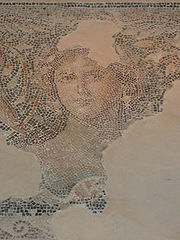
Tzippori
Tzippori , also known as Sepphoris, Dioceserea and Saffuriya is located in the central Galilee region, north-northwest of Nazareth, in modern-day Israel...
, in the central Galilee region, six kilometers north-northwest of Nazareth
Nazareth
Nazareth is the largest city in the North District of Israel. Known as "the Arab capital of Israel," the population is made up predominantly of Palestinian Arab citizens of Israel...
, have uncovered a rich and diverse historical and architectural legacy that includes Assyrian, Hellenistic, Judean, Babylonian, Roman, Byzantine, Islamic, Crusader, Arabic and Ottoman influences. The site is especially rich in mosaics belonging to different periods. Major findings include the remains of a 6th century synagogue, evidence of an interesting fusion of Jewish and pagan beliefs. A Roman villa, considered the centerpiece of the discoveries, which dates to the year 200 CE, was destroyed in the Galilee earthquake of 363
Galilee earthquake of 363
The Galilee earthquake of 363 was a severe earthquake that shook the Galilee and nearby regions in 363 CE.-Impact:* Tzippori was severely damaged.* Nabratein and the Nabratein synagogue were destroyed....
CE. The mosaic floor was discovered in August 1987 during an expedition led by Eric and Carol Meyers, of Duke University
Duke University
Duke University is a private research university located in Durham, North Carolina, United States. Founded by Methodists and Quakers in the present day town of Trinity in 1838, the school moved to Durham in 1892. In 1924, tobacco industrialist James B...
digging with Ehud Netzer, a locally trained archaeologist from the Hebrew University of Jerusalem. It depicts Dionysus
Dionysus
Dionysus was the god of the grape harvest, winemaking and wine, of ritual madness and ecstasy in Greek mythology. His name in Linear B tablets shows he was worshipped from c. 1500—1100 BC by Mycenean Greeks: other traces of Dionysian-type cult have been found in ancient Minoan Crete...
, the god of wine, socializing with Pan
Pan (mythology)
Pan , in Greek religion and mythology, is the god of the wild, shepherds and flocks, nature, of mountain wilds, hunting and rustic music, as well as the companion of the nymphs. His name originates within the Greek language, from the word paein , meaning "to pasture." He has the hindquarters, legs,...
and Hercules
Hercules
Hercules is the Roman name for Greek demigod Heracles, son of Zeus , and the mortal Alcmene...
in several of the 15 panels. In its center is a life-like image of a young lady, possibly Venus
Venus
Venus is the second planet from the Sun, orbiting it every 224.7 Earth days. The planet is named after Venus, the Roman goddess of love and beauty. After the Moon, it is the brightest natural object in the night sky, reaching an apparent magnitude of −4.6, bright enough to cast shadows...
, which has been named "The Mona Lisa of the Galilee." Additional finds include a Roman theater on the northern slope of the hill, and the remains of a 5th century public building, with a large and intricate mosaic floor.
Gesher Bnot Ya'akov
Bnot Ya'akov BridgeBnot Ya'akov Bridge
Bnot Ya'akov Bridge is a bridge across the Jordan River on Highway 91, straddling the border between Israel proper and the Israeli-occupied portion of the Golan Heights...
is a 780,000-year-old site on the banks of the Jordan river in northern Israel currently excavated by Naama Goren-Inbar of the Hebrew University of Jerusalem
Hebrew University of Jerusalem
The Hebrew University of Jerusalem ; ; abbreviated HUJI) is Israel's second-oldest university, after the Technion – Israel Institute of Technology. The Hebrew University has three campuses in Jerusalem and one in Rehovot. The world's largest Jewish studies library is located on its Edmond J...
. First discovered in the 1930s, Bnot Ya'akov had been the site of several excavations that provided archaeologists with crucial information about how and when Homo erectus
Homo erectus
Homo erectus is an extinct species of hominid that lived from the end of the Pliocene epoch to the later Pleistocene, about . The species originated in Africa and spread as far as India, China and Java. There is still disagreement on the subject of the classification, ancestry, and progeny of H...
moved out of Africa
Africa
Africa is the world's second largest and second most populous continent, after Asia. At about 30.2 million km² including adjacent islands, it covers 6% of the Earth's total surface area and 20.4% of the total land area...
, most likely through the Levantine corridor
Levantine corridor
The Levantine corridor is the relatively narrow strip between the Mediterranean Sea to the northwest and deserts to the southeast and connects Africa into Eurasia. This corridor is a land route of migrations of animals between Eurasia and Africa. In particular, it is believed that early hominids...
that includes Israel. "One of the rarest prehistoric sites in the world," it featured a remarkable level of organic preservation that archaeologists had not encountered at any other contemporary site in Europe
Europe
Europe is, by convention, one of the world's seven continents. Comprising the westernmost peninsula of Eurasia, Europe is generally 'divided' from Asia to its east by the watershed divides of the Ural and Caucasus Mountains, the Ural River, the Caspian and Black Seas, and the waterways connecting...
or Asia
Asia
Asia is the world's largest and most populous continent, located primarily in the eastern and northern hemispheres. It covers 8.7% of the Earth's total surface area and with approximately 3.879 billion people, it hosts 60% of the world's current human population...
. In 2000, the Israel Antiquities Authority
Israel Antiquities Authority
The Israel Antiquities Authority is an independent Israeli governmental authority responsible for enforcing the 1978 Law of Antiquities. The IAA regulates excavation and conservation, and promotes research...
(IAA) charged the Sea of Galilee
Sea of Galilee
The Sea of Galilee, also Kinneret, Lake of Gennesaret, or Lake Tiberias , is the largest freshwater lake in Israel, and it is approximately in circumference, about long, and wide. The lake has a total area of , and a maximum depth of approximately 43 m...
Drainage Authority (KDA) with causing "serious and irreversible damage" to the site. While the KDA had procured permission from the IAA to work in a limited area to alleviate the regular flooding of farmland in the adjacent Hula Valley under the supervision of an IAA inspector, bulldozers entered the site at night, damaging fossil
Fossil
Fossils are the preserved remains or traces of animals , plants, and other organisms from the remote past...
remains, manmade stone artifacts
Artifact (archaeology)
An artifact or artefact is "something made or given shape by man, such as a tool or a work of art, esp an object of archaeological interest"...
, and organic material.
Ain Mallaha
Ain MallahaAin Mallaha
Ain Mallaha, also known as Eynan, was a Natufian settlement built and settled circa 10,000–8,000 BCE. The settlement is an example of hunter-gatherer sedentism, a crucial step in the transition from foraging to farming.- The Village :...
, a Natufian village, colonized in three phases 12,000 to 9600 BCE, contains the earliest known archaeological evidence of dog domestication: the burial of a human being with a dog.
Politicisation of archaeology
Archaeological research and preservation efforts have been exploited by both Palestinians and Israelis for partisan ends. Rather than attempting to understand "the natural process of demolitionDemolition
Demolition is the tearing-down of buildings and other structures, the opposite of construction. Demolition contrasts with deconstruction, which involves taking a building apart while carefully preserving valuable elements for re-use....
, eradication, rebuilding, evasion, and ideological reinterpretation that has permitted ancient rulers and modern groups to claim exclusive possession," archaeologists have instead become active participants in the battle over partisan memory, with the result that archaeology, a seemingly objective science, has exacerbated the ongoing nationalist
Nationalism
Nationalism is a political ideology that involves a strong identification of a group of individuals with a political entity defined in national terms, i.e. a nation. In the 'modernist' image of the nation, it is nationalism that creates national identity. There are various definitions for what...
dispute. Silberman concludes: "The digging continues. Claims and counterclaims about exclusive historical 'ownership' weave together the random acts of violence of bifurcated collective memory." Adam and Moodley conclude their investigation into this issue by writing that, "Both sides remain prisoners of their mythologized past."
As an example of this process, an archaeological tunnel running the length of the western side of the Temple Mount
Temple Mount
The Temple Mount, known in Hebrew as , and in Arabic as the Haram Ash-Sharif , is one of the most important religious sites in the Old City of Jerusalem. It has been used as a religious site for thousands of years...
, as it is known to Jews, or the Haram al-Sharif, as it is known to Muslim
Islam
Islam . The most common are and . : Arabic pronunciation varies regionally. The first vowel ranges from ~~. The second vowel ranges from ~~~...
s, became a serious point of contestation in 1996. The tunnel had been in place for about a dozen years, but open conflict broke out after the government of Benjamin Netanyahu
Benjamin Netanyahu
Benjamin "Bibi" Netanyahu is the current Prime Minister of Israel. He serves also as the Chairman of the Likud Party, as a Knesset member, as the Health Minister of Israel, as the Pensioner Affairs Minister of Israel and as the Economic Strategy Minister of Israel.Netanyahu is the first and, to...
decided to open a new entrance to the tunnel from the Via Dolorosa
Via Dolorosa
The Via Dolorosa is a street, in two parts, within the Old City of Jerusalem, held to be the path that Jesus walked, carrying his cross, on the way to his crucifixion. The current route has been established since the 18th century, replacing various earlier versions...
in the Muslim quarter of the Old City. Palestinians and the Islamic Waqf
Waqf
A waqf also spelled wakf formally known as wakf-alal-aulad is an inalienable religious endowment in Islamic law, typically denoting a building or plot of land for Muslim religious or charitable purposes. The donated assets are held by a charitable trust...
authorities were outraged that the decision was taken without prior consultation. They claimed that the work threatened the foundations of the compound and those of houses in the Muslim quarter and that it was actually aimed at tunnelling under the holy compound complex to find remains of Solomon's Temple
Solomon's Temple
Solomon's Temple, also known as the First Temple, was the main temple in ancient Jerusalem, on the Temple Mount , before its destruction by Nebuchadnezzar II after the Siege of Jerusalem of 587 BCE....
, similar to previous attempts undertaken by Jews in the 1980s. As a result, rioting broke out in Jerusalem and spread to the West Bank, leading to the deaths of 86 Palestinians and 15 Israeli soldiers.
Damage to sites
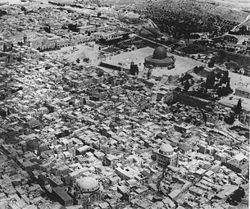
United Nations
The United Nations is an international organization whose stated aims are facilitating cooperation in international law, international security, economic development, social progress, human rights, and achievement of world peace...
, Yosef Tekoa, Israel's representative to the UN, protested Jordan's "policy of wanton vandalism, desecration and violation," in which all the synagogues in the Old City apart from one were blown up or used as stables. In the ancient historic Jewish graveyard on the Mount of Olives
Mount of Olives
The Mount of Olives is a mountain ridge in East Jerusalem with three peaks running from north to south. The highest, at-Tur, rises to 818 meters . It is named for the olive groves that once covered its slopes...
, tens of thousands of tombstones, some dating from as early as 1 BCE, were torn out, broken or used as flagstones, steps and building materials in Jordanian military installations. Large areas of the cemetery were levelled and turned into parking lots and gas stations.
The Old City of Jerusalem and its walls were added to the List of World Heritage in Danger in 1982, after it was nominated for inclusion by Jordan
Jordan
Jordan , officially the Hashemite Kingdom of Jordan , Al-Mamlaka al-Urduniyya al-Hashemiyya) is a kingdom on the East Bank of the River Jordan. The country borders Saudi Arabia to the east and south-east, Iraq to the north-east, Syria to the north and the West Bank and Israel to the west, sharing...
. Noting the "severe destruction followed by a rapid urbanization," UNESCO determined that the site met "the criteria proposed for the inscription of properties on the List of World Heritage in Danger as they apply to both 'ascertained danger' and 'potential danger'."
Work carried out by the Islamic Waqf since the late 1990s to convert two ancient underground structures into a large new mosque on the Temple Mount damaged archaeological artifacts in that area of Solomon's Stables
Solomon's Stables
Solomon's Stables or Marwani Mosque is an underground mosque some 600 square yards beneath al-Aqsa Mosque in Jerusalem...
and the Huldah Gates
Huldah Gates
The Huldah Gates are the two sets of now-blocked gates in the Southern Wall of the Temple Mount, situated in Jerusalem's Old City. The western set is a double arched gate , and the eastern is a triple arched gate...
. From October 1999 to January 2000, the Waqf authorities in Jerusalem opened an emergency exit to the newly renovated underground mosque, in the process digging a pit measuring 18000 square feet (1,672 m²) and 36 feet (11 m) deep. The Israel Antiquities Authority
Israel Antiquities Authority
The Israel Antiquities Authority is an independent Israeli governmental authority responsible for enforcing the 1978 Law of Antiquities. The IAA regulates excavation and conservation, and promotes research...
(IAA) expressed concern over the damage sustained to Muslim-period structures within the compound as a result of the digging. Jon Seligman, a Jerusalem District
Jerusalem District
The Jerusalem District is one of six administrative districts of Israel. The district capital is Jerusalem. The Jerusalem District has a land area of 652 km². The population of 910,300 is 67.8% Jewish and 30.6% Arab...
archaeologist told Archaeology magazine that, "It was clear to the IAA that an emergency exit [at the Marwani Mosque] was necessary, but in the best situation, salvage archaeology would have been performed first." Seligman also said that the lack of archaeological supervision "has meant a great loss to all of humanity. It was an archaeological crime."
Artifacts from the First Temple Period (ca. 960-586 BC) were destroyed when the thousands of tons of ancient fill from the site were dumped in the Kidron Valley
Kidron Valley
The Kidron Valley is the valley on the eastern side of The Old City of Jerusalem which features significantly in the Bible...
and Jerusalem's municipal garbage dump, making it impossible to conduct archaeological examination. The Waqf was accused of trying to destroy evidence of Jewish remains. Eilat Mazar said the actions of the Waqf were linked to routine denials of the existence of the Jerusalem Temples by senior officials of the Palestinian Authority, who "want to turn the whole of the Temple Mount into a mosque for Muslims only. They don't care about the artifacts or heritage of the site."
See also
- Near Eastern archaeologyNear Eastern archaeologyNear Eastern Archaeology is a regional branch of the wider, global discipline of Archaeology...
- Biblical archaeologyBiblical archaeologyFor the movement associated with William F. Albright and also known as biblical archaeology, see Biblical archaeology school. For the interpretation of biblical archaeology in relation to biblical historicity, see The Bible and history....
- Temple Mount Antiquities Salvage OperationTemple Mount Antiquities Salvage OperationThe Temple Mount Antiquities Salvage Operation is an archaeological project begun in 2005 dedicated to recovering archaeological artifacts from 300 truckloads of topsoil removed from the Temple Mount by the waqf during the construction of the underground el-Marwani Mosque from 1996-1999...
- List of artifacts significant to the Bible
- Excavations at the Temple MountExcavations at the Temple MountSeveral excavations at the Temple Mount have taken place. The first archaeological excavations at the site was by the British Royal Engineers in the 1870s....
- History of the Southern Levant
- History of PalestineHistory of PalestineThe Southern Levant is the southern portion of the geographical region bordering the Mediterranean between Egypt and Mesopotamia . A narrow definition would take in roughly the same area as the modern states of Israel, the West Bank, the Gaza Strip, and Jordan, while a wider definition would...
- History of IsraelHistory of IsraelThe State of Israel declared independence on May 14, 1948 after almost two millennia of Jewish dispersal and persecution around the Mediterranean. From the late 19th century the Zionist movement worked towards the goal of recreating a homeland for the Jewish people...
External links
- Israel Antiquities Authority (IAA) (English homepage)
- 'Producing National identity: Israeli Archaeology museums'. http://www.stateofnature.org/producingNationalIdentity.html
- University of Pennsylvania Museum of Archaeology and Anthropology (Canaan & Ancient Israel Exhibit)
- Israel Exploration Society
- Israel archaeological sites photos
- Nova special, The Bible's Buried Secrets
- Late Bronze Age II as a period of decline, unrest, disaster, and migration
- Early Israel in Canaan
- In the Roman Period Galilee, the vast majority of inhabitants were Jews. They got along sometimes and also fought
- IAA maps of ongoing excavations in Israel
- Israel Ministry of Foreign Affairs - An index of archaeological sites in Israel