


Nahum

Encyclopedia
Minor prophet
Minor prophets is a book of the Hebrew Bible, so named because it contains twelve shorter prophetic works. In Christian Bibles the twelve are presented as individual books...
whose prophecy is recorded in the Hebrew Bible
Hebrew Bible
The Hebrew Bible is a term used by biblical scholars outside of Judaism to refer to the Tanakh , a canonical collection of Jewish texts, and the common textual antecedent of the several canonical editions of the Christian Old Testament...
. His book
Book of Nahum
The book of Nahum is the seventh book of the 12 minor prophets of the Hebrew Bible. It is attributed to the prophet Nahum, and was probably written in Jerusalem in the 8th century BC.-Background:...
comes in chronological order between Micah
Book of Micah
The Book of Micah is one of fifteen prophetic books in the Hebrew bible/Old Testament, and the sixth of the twelve minor prophets. It records the sayings of Mikayahu, meaning "Who is like Yahweh?", an 8th century prophet from the village of Moresheth in Judah...
and Habakkuk
Habakkuk
Habakkuk , also spelled Habacuc, was a prophet in the Hebrew Bible. The etymology of the name of Habakkuk is not clear. The name is possibly related to the Akkadian khabbaququ, the name of a fragrant plant, or the Hebrew root חבק, meaning "embrace"...
in the Bible
Bible
The Bible refers to any one of the collections of the primary religious texts of Judaism and Christianity. There is no common version of the Bible, as the individual books , their contents and their order vary among denominations...
. He wrote about the end of the Assyrian Empire, and its capital city, Nineveh
Nineveh
Nineveh was an ancient Assyrian city on the eastern bank of the Tigris River, and capital of the Neo Assyrian Empire. Its ruins are across the river from the modern-day major city of Mosul, in the Ninawa Governorate of Iraq....
, in a vivid poetic style.
Little is known about Nahum’s personal history. His name means "comforter," and he was from the town of Alqosh, (Nah
Book of Nahum
The book of Nahum is the seventh book of the 12 minor prophets of the Hebrew Bible. It is attributed to the prophet Nahum, and was probably written in Jerusalem in the 8th century BC.-Background:...
1:1) which scholars have attempted to identify with several cities, including the modern `Alqush
Alqosh
Alqōsh or Alqūsh is one of the most famous Assyrian towns of the mainly East Syrian rite in Iraq. It is located north of Mosul. The name Alqosh is derived from an Akkadian name Eil-Kushtu, where "Eil" means God and "Kushtu" means righteousness or power...
of Assyria
Assyria
Assyria was a Semitic Akkadian kingdom, extant as a nation state from the mid–23rd century BC to 608 BC centred on the Upper Tigris river, in northern Mesopotamia , that came to rule regional empires a number of times through history. It was named for its original capital, the ancient city of Assur...
and Capharnaum
Capernaum
Capernaum was a fishing village in the time of the Hasmoneans. Located on the northern shore of the Sea of Galilee. It had a population of about 1,500. Archaeological excavations have revealed two ancient synagogues built one over the other...
of northern Galilee
Galilee
Galilee , is a large region in northern Israel which overlaps with much of the administrative North District of the country. Traditionally divided into Upper Galilee , Lower Galilee , and Western Galilee , extending from Dan to the north, at the base of Mount Hermon, along Mount Lebanon to the...
. He was a very nationalistic Hebrew however and lived amongst the Elkoshites in peace. His writings could be taken as prophecy or as history. One account suggests that his writings are a prophecy written in about 615 BC, just before the downfall of Assyria, while another account suggests that he wrote this passage as liturgy just after its downfall in 612 BC.
Current status
The tomb of Nahum is supposedly inside the synagogue at AlqoshAlqosh
Alqōsh or Alqūsh is one of the most famous Assyrian towns of the mainly East Syrian rite in Iraq. It is located north of Mosul. The name Alqosh is derived from an Akkadian name Eil-Kushtu, where "Eil" means God and "Kushtu" means righteousness or power...
, although there are other places outside Iraq that lay claim also to being the original “Elkosh” from which Nahum hailed. Alquosh was abandoned by its Jewish population in 1948, when they were expelled, and the synagogue that purportedly houses the tomb is in a poor structural state, to the extent that the tomb itself is in danger of destruction. The tomb underwent basic repairs in 1796. When all Jews were compelled to flee Alqosh in 1948, the iron keys to the tomb were handed to a Chaldean
Chaldean Christians
Chaldean Christians are ethnic Assyrian adherents of the Chaldean Catholic Church, most of whom entered communion with the Catholic Church from the Church of the East, which was already Catholic, but most wanted to stray away from the Catholic Church, causing the split in the 17th and 18th...
man by the name of Sami Jajouhana. Few Jews visit the historic site, yet Jajouhana continues to keep the promise he made with his Jewish friends, and looks after the tomb. A team of US/UK construction engineers, led by Huw Thomas, is currently planning ways to save the building and the tomb. Money has been allocated for proposed renovation in 2008. In secular sources, Ninaveh is first mentioned in the Code of Hammurabi(2200 B.C). Hammurabi calls himself the king who made the name of the goddess Ishthar famous in the temple of Ishthar in Ninaveh.
Liturgical commemoration
The Prophet Nahum is venerated as a saintSaint
A saint is a holy person. In various religions, saints are people who are believed to have exceptional holiness.In Christian usage, "saint" refers to any believer who is "in Christ", and in whom Christ dwells, whether in heaven or in earth...
in Eastern Christianity
Eastern Christianity
Eastern Christianity comprises the Christian traditions and churches that developed in the Balkans, Eastern Europe, Asia Minor, the Middle East, Northeastern Africa, India and parts of the Far East over several centuries of religious antiquity. The term is generally used in Western Christianity to...
. On the Eastern Orthodox
Eastern Orthodox Church
The Orthodox Church, officially called the Orthodox Catholic Church and commonly referred to as the Eastern Orthodox Church, is the second largest Christian denomination in the world, with an estimated 300 million adherents mainly in the countries of Belarus, Bulgaria, Cyprus, Georgia, Greece,...
liturgical calendar
Eastern Orthodox liturgical calendar
The Eastern Orthodox liturgical calendar describes and dictates the rhythm of the life of the Eastern Orthodox Church. Associated with each date are passages of Holy Scripture, Saints and events for commemoration, and many times special rules for fasting or feasting that correspond to the day of...
, his feast day is December 1
December 1 (Eastern Orthodox liturgics)
Nov 30 - Eastern Orthodox Church calendar - Dec 2All fixed commemorations below celebrated on December 14 by Old Calendarists-Saints:* Prophet Nahum * St...
(for those churches which follow the traditional Julian Calendar
Julian calendar
The Julian calendar began in 45 BC as a reform of the Roman calendar by Julius Caesar. It was chosen after consultation with the astronomer Sosigenes of Alexandria and was probably designed to approximate the tropical year .The Julian calendar has a regular year of 365 days divided into 12 months...
, December 1 currently falls on December 14 of the modern Gregorian Calendar
Gregorian calendar
The Gregorian calendar, also known as the Western calendar, or Christian calendar, is the internationally accepted civil calendar. It was introduced by Pope Gregory XIII, after whom the calendar was named, by a decree signed on 24 February 1582, a papal bull known by its opening words Inter...
). He is commemorated with the other minor prophet
Prophet
In religion, a prophet, from the Greek word προφήτης profitis meaning "foreteller", is an individual who is claimed to have been contacted by the supernatural or the divine, and serves as an intermediary with humanity, delivering this newfound knowledge from the supernatural entity to other people...
s in the Calendar of saints
Calendar of Saints (Armenian Apostolic Church)
-January:* 1 Third Day of the Fast of the Nativity* 2 Fourth Day of the Fast of the Nativity* 3 Fifth Day of the Fast of the Nativity* 4 Sixth Day of the Fast of the Nativity* 5 Eve of the Nativity and Theophany of our Lord Jesus Christ...
of the Armenian Apostolic Church
Armenian Apostolic Church
The Armenian Apostolic Church is the world's oldest National Church, is part of Oriental Orthodoxy, and is one of the most ancient Christian communities. Armenia was the first country to adopt Christianity as its official religion in 301 AD, in establishing this church...
on July 31.
External links
- Nahum article from The Catholic Encyclopedia
- Renovation - Al Qush Synagogue and the Tomb of Nahum
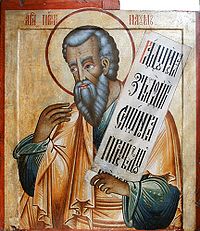
- Prophet Nahum Orthodox iconIconAn icon is a religious work of art, most commonly a painting, from Eastern Christianity and in certain Eastern Catholic churches...
and synaxarion