


Canton of Berne

Encyclopedia
The Canton of Bern is the second largest of the 26 Swiss
cantons
by both surface area and population. Located in west-central Switzerland, it borders the Canton of Jura
and the Canton of Solothurn
to the north. To the west lie the Canton of Neuchâtel
, the Canton of Fribourg
and Vaud
. To the south lies the Valais
. East of the canton of Bern lie the cantons of Uri
, Nidwalden
, Obwalden
, Lucerne
and Aargau
.
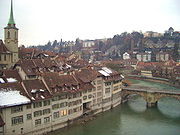
The canton of Bern is bilingual and has a population (as of ) of . , the population included 119,930 (or 12.45%) foreigners. The cantonal capital, also the federal capital of Switzerland, is Bern.
region; Schnurenloch near Oberwil
, Ranggiloch above Boltigen
and Chilchlihöhle above Erlenbach
. These caves were used at various times during the last ice age. The first open-air settlement in the area is an upper paleolithic
settlement at Moosbühl in Moosseedorf. During the warmer climate of the mesolithic
period, increasing forest cover restricted the movement of hunters, fishers and gatherers. Their temporary settlements were built along lake and marsh edges, which remained free of trees due to fluctuations in water level. Important mesolithic sites in the Canton are at Pieterlenmoos and Burgäschisee lake along with alpine valleys at Diemtig and Simmental. During the neolithic
period, there were a number of settlements on the shores of Lake Biel
, the Toteisbecken (Lobsigensee, Moossee, Burgäschisee and Inkwilersee) and along rivers (Aare, Zihl). Several of these sites are part of the Prehistoric Pile dwellings around the Alps
, a UNESCO
World Heritage Site.
One of the best explored neolithic sites is at Twann
(now Twann-Tüscherz
). In the Twannbach delta there were about 25 Cortaillod culture
and Horgen culture
villages that existed between 3800 and 2950 BC. One of the oldest examples of bread from Switzerland, a sourdough
from 3560-3530 BC, came from one of these villages.
Simple copper objects were already in use in the 4th millennium BC, including a copper pin from Lattrigen from 3170 BC and a knife blade from Twann. Shortly before 2000 BC bronze
production entered the area and brought about a surge in development. Settlements began to spread into the pre-Alpine and Alpine areas. The area between Lake Thun
and the Niedersimmental were densely settled. Archeological finds include scattered items along mountain passes, a fortified hilltop settlements at Spiezberg, Cholis Grind by Saanen and at Pintel by Wimmis, along with cemeteries at Thun-Allmendingen, Einigen and Hilterfingen. Late Bronze Age
(ca. 1000-800 BC) settlements along Lake Biel
(Mörigen, Vinelz) have yielded up a wealth of items.
(Hallstatt culture
from 800-450 BC) changes in climate forced them to abandon settlements along many waterways and in the valley floors and move to the plateaus and hills. With increased trade contacts across the Alps, the cultural influence of the Mediterranean grew in the area. Evidence of this trade include a hydria
which was discovered in Grächwil. Burial rituals and social classes became more developed during this time. The so-called princely graves became more common, many of the burial mounds were over 30 m (98.4 ft) in diameter and 4 m (13.1 ft) high and richly outfitted with grave goods. In a grave mound in Bützberg the first burial in the mound was followed by several later burials. Often, several grave mounds combined to become a necropolis, such as at Grossaffoltern, Ins, Bannwil, Langenthal and Bützberg. Most of the knowledge about the Hallstatt culture in the Canton comes from graves. The only discovered settlement is around Blanche Church in La Neuveville
.
The grave good show that iron was forged into swords, daggers, spearheads, knives and wagon accessories. Gold, which was probably collected from river sand, was made into diadems, rings and pendants. Thin bronze arm, leg and neck plates with geometric designs were often buried, especially in the graves at Allenlüften in Mühleberg, at Ins and at Bützberg. The jewelry that was buried included bracelets and rings which were also made of jet
and lignite
coal. At Münchringen, the grave pottery was both shaped by hand or thrown on a potter's wheel, and was painted with multi-colored ornamentation.
The transition to the late Iron Age or La Tène
period (450-1st Century BC) is indicated by a sudden change of style in the metalworking and ceramic industries. Numerous graves (from unknown settlements) along with the two oppida at Bern-Engehalbinsel and Jensberg by Studen
mark the population centers during the late Iron Age. Gold coins (from Melchnau
) along with silver and bronze coins first start to appear in this same era. A sword with Greek characters
that said Korisios was found at the Port site. At the oppidum at Bern-Engehalbinsel, there were studios for glass and ceramic production and iron working achieved a high level of skill, along with craftsmen who worked in wood, leather and goldsmithing. There was a nearby place of worship in the Bremgarten wood, and cemeteries at Münsingen
and Bern-Engehalbinsel.
victory at Bibracte
in 58 BC, the Helvetii
were forced to return to their homes as foederati
of the Romans. Under increasing Roman influence, the local economy and trade flourished. The main settlements lay on the foot of the Jura Mountains
and the Central Plateau. The existing roads were expanded, especially the Aventicum
-Vindonissa
and the Petinesca
-Augusta Raurica
roads. A fourth alpine pass, the Rawil
was added to the traditional three; the Grimsel
, Brunig
and Susten
passes. In the Bernese Jura the Mont Raimeux
and Pierre Pertuis
passes opened.
Under the romans, many of the old fortified places were expanded and refortified. The old Helvetii oppidum at the Engehalbinsel became a Roman vicus
, which was probably known as Brenodor or Brenodurum. At the foot of the Jens mountain, the fort Petinesca was built to guard the roads over the Jura Mountains. This was reinforced in the late-roman era (368-369 AD) by a fortified bridge over the Thielle/Zihl
river between Aegerten and Brügg.
A number of roman villas were built around the Canton. At Oberwichtrach
both the main building (pars urbana) and the industrial section (pars rustica) of a Roman villa have been discovered. The villas at Münsingen, Toffen
and Herzogenbuchsee
have rich mosaic
s that are still partly visible.
The religious practices of the local population merged with roman beliefs and the Canton of Bern is home to a number of unique cult centers. They include the larger than life statues of gods (including enthroned Jupiter) at Petinesca, Engehalbinsel and Thun-Allmendingen and a number of inscriptions. At the beginning of the 5th Century AD, Rome withdrew its troops from the Rhine garrisons, but allowed the Burgundians
to settle on Helvetii lands in 443 AD.
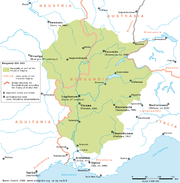 East of the Aare river, the transition from the Gallo-Roman dominated population to a Germanic
population in the Early Middle Ages
happened relatively peacefully. One exception was the Battle of Wangen in 610, but elsewhere it generally was a slow process of cultural infiltration. By the 7th century, the Alamanni
c settlers had already taken most of the good locations southeast of the Aare and they began moving up the Aare to the regions of Lake Thun and Lake Brienz
. All areas west of the Aare river belonged to the romanised Burgundian kingdom, which became part of the Merovingian
Frankish
kingdom in the 534. During the Carolingian era
, the political structure of the Franks had spread into parts of what became Switzerland. In 762/778 the County of Aargau was founded, followed in 861 by the County of Oberaargau and in 965 the County of Bargen. The Treaty of Verdun
in 843 put the border between Central and Eastern Frankish Empires at the Aare, and divided the Aare region in half. The population west of the Aare generally spoke a Romance language, while those to the east spoke a Germanic language. The region between the Saane and Aare rivers became the language border.
Christianity spread slowly into the Aare valley. The dioceses of Lausanne
, Basel, Sion, Chur
and Constance
were all established before the new faith made inroads into the valley. The Aare valley was bordered by three dioceses; Lausanne, Constance and Basel. However, the first christian missionaries came into the valley from Alsace
and other western areas. In 630 the Abbey of Luxeuil established the Abbey of Moutier-Grandval along the old transit route through the Pierre Pertuis Pass. By the 9th or 10th Century, this Abbey had property and influence all the way to Lake Biel and into the Balsthal valley. The first monastic cells of what would become the Abbey of Saint-Imier
was also founded in 600. In the Seeland and Aare valleys, wooden churches were first built during the Merovingian period. The current churches in Kirchlindach, Oberwil bei Buren and Bleibach were all built above the ruins of these early churches. About 30 churches in the Bern and Solothurn portions of the Aare valley were created over ruins of Roman villas and subsequent burial grounds in the 7th Century (including Meikirch and Oberbipp). In Mett, the church was built over a 5th century mausoleum, which was built over a 4th century tomb. In 700, six sarcophagi were buried on St. Peter's Island
next to a Roman temple complex. A wooden monastery was built over the complex in the 8th-9th century.
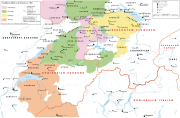 During the 10th century, the Aare valley came fully under the Second Kingdom of Burgundy. Under King Rudolph I
and his son Rudolph II
Burgundy's influence reached across most of modern Switzerland. They established royal courts at Bümpliz, Münsingen, Uetendorf, Wimmis, Kirchberg and Utzenstorf to allow them to govern the Aare valley. Later, the Aare valley moved toward closer ties with the Holy Roman Empire
during the Ottonian and Salian
dynasties.
The succession dispute following the death of Rudolph III
in 1032 allowed the Salian kings to acquire the Kingdom of Upper Burgundy and with it the Aare valley. As a part of the Holy Roman Empire, the valley was involved when the Investiture Controversy
broke out in 1056. In 1077, the Regent of Burgundy, Count Rudolf of Rheinfelden, declared himself as an anti-king against King Henry IV
. The Bishops of Basel and Lausanne remained loyal to King Henry IV, and took the Rheinfelden lands in Oberaargau and the upper Aare valley. After Rudolf's death in 1090, his lands went to his son, Berchtold II of Zähringen. He and his son, Berchtold III, tried to use these lands to expand their power. In 1127 the Zähringens were appointed Rector or delegate of the king in Burgundy. Their hopes for a new, independent Burgundy were dashed in 1156, and the last Zähringen count, Berchtold V, embarked on a program of city founding. The cities of Burgdorf, Murten
, Thun
and Bern were all founded by Berchtold V. When he died without an heir, the Zähringen lands went to the House of Kyburg
, while the offices and fiefs reverted to the empire.
During the High Middle Ages
both the Aare valley and the Bernese Oberland
were divided into a number of small counties, each with their own baron
. Nobles from the Holy Roman Empire began to marry into the local noble families and a number of the Zähringen Ministerialis
families (unfree knights in the service of a feudal overlord) moved into the Oberland. The nobles also began to found monasteries to spread their power into the Oberland. During the period between 1070 and 1150, at least ten large monasteries were founded by local nobles. These include; the Cluniac
Priory
of Rüeggisberg
(Lords of Rümligen in 1072), Münchenwiler (Wiler family in 1080), St. Peter's Island
(Count of Hochburgund-Mâcon in the late 11th century), Hettiswil (1107), Röthenbach im Emmental (Lords of Rümligen or Signau), the Benedictine
monastery at St. Johannsen
in Erlach (Fenis family in 1100), Trub (Lords of Lützelflüh before 1130) and Rüegsau (possibly also the Lords of Lützelflüh in first half of the 12th century), the Augustinian Collegiate church
in Interlaken (Oberhofen family in 1130) and the Cistercian monastery Frienisberg (Count Saugern around 1130). However, in 1191 the Oberland Barons revolted against Berchtold V of Zähringen and many of the Oberland barons were killed in the battle of Grindelwald.
During the 13th Century a number of the cities near Bern were granted the city right and appointed mayors and city councils. Bern became an imperial city. During the mid-13th Century, the Empire's presence weakened in the Aare valley, forcing the local nobles to find allies to protect themselves. Bern entered into a number of treaties with its neighbors in the 13th Century. In 1274, the Emperor Rudolph I of Habsburg
, confirmed Bern's imperial immediacy. However, in 1285 he imposed an imperial tax which drove the city to support Rudolph's enemies. Although it withstood two sieges by the Emperor in 1288, after the defeat at Schosshalde in 1289 it had to pay taxes and a penalty.
In 1298 Bernese forces won a victory at Oberwangen in Köniz
against the County of Savoy
and the Habsburg Austrian nobility. In 1300, the city acquired the four surrounding parish
es of Bolligen, Vechigen, Stettlen and Muri, destroyed the threatening castles of Bremgarten and Belp and gave the Baron of Montenach Bernese citizenship. After the victory of Louis IV of Bavaria
over the Habsburg Frederick the Fair in the battle of Mühldorf (Bavaria) in 1322, Bern entered an alliance with the anti-Habsburg Swiss Forest Cantons in 1323.
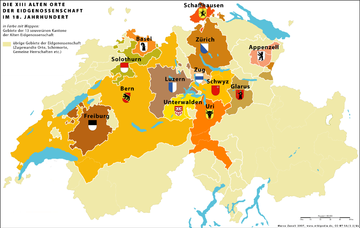 The area of the canton of Bern consists of lands acquired by the city of Bern mostly between the 14th and the 16th century, both by conquest and purchase. Acquired districts include (with dates of acquisition):
In 1322, the brothers Eberhard II of Neu-Kyburg and Hartmann II of Neu-Kyburg started fighting with each other over who would inherit the family's lands around Thun. The fighting led to the "fratricide
at Thun Castle
" where Eberhard killed his brother Hartmann. To avoid punishment by his Habsburg overlords, Eberhard fled to Bern. In the following year, he sold the town of Thun
, its castle and the land surrounding Thun to Bern. Bern then granted the land back to Eberhard as a fief. Bern's support of Eberhard, their resulting expansion into the Oberland and their alliance with the Forest Cantons brought the city into conflict with the Habsburgs during the 14th Century. The Gümmenenkrieg in 1333 between Bern and Fribourg
over rights and influence in the Sense/Singine area ended without resolving anything.
In 1334, Bern fought with the Barons of Weissenburg and occupied Wimmis
and Unspunnen
. Bern's victory allowed them to bring the Oberhasli
region and Weissenburg under their control. Bern's continued expansion was at the expense of the feudal lords in the surrounding lands. In 1339 the Habsburgs, Kyburgs and Fribourg, marched against Bern with 17,000 men and besieged the border town of Laupen. To raise the siege, Bern raised a force of 6,000, consisting of Bernese, supported by the Forest Cantons, and other allies (Simmental
, Weissenbur and Oberhasli). The allied Bernese forces were victorious at the Battle of Laupen
and Bern drew closer to the Swiss Forest Cantons. It entered into a permanent or eternal alliance with Uri, Schwyz and Unterwalden in 1353. This date is usually considered the date of Bern's entrance into the Swiss Confederation, however the alliance only indirectly tied Bern to Zurich and Lucerne.
In 1358 the cash-strapped Count Peter II of Aarberg pawned the County of Aarberg
to Bern. However, in 1367 he sold it, with out repaying Bern, to his cousin Rudolf IV of Nidau. After Rudolf's death (1375) Bern acquired clear right to the Aarberg lands from the other heirs.
Throughout the 14th Century, Bern entered into alliances and treaties with many of its neighbors, including members of the Swiss Confederation
. Bern entered into a series of agreements with Biel/Bienne
, which led to a conflict with Biel's ruler, the Prince-Bishop of Basel in 1367-68. The bishop marched south and destroyed Biel along with a number of towns in the southern Jura Mountains
. During the Gugler war
in 1375, there were several battles between Bernese troops and English mercenaries under Enguerrand de Coucy.
By the 1370's, the Kyburgs (which still held Thun as a fief for Bern) were deeply in debt to Bern. On 11 November 1382, Rudolf II of Neu-Kyburg made an unsuccessful raid on Solothurn
. The ensuing conflict with the Old Swiss Confederacy
(known as the Burgdorferkrieg or Kyburgerkrieg) allowed Bern to move against the Habsburgs in Aargau. After the Bernese laid siege to Burgdorf, Neu-Kyburg was forced to concede an unfavourable peace. Bern bought Thun and Burgdorf, the most important cities of Neu-Kyburg, and their remaining towns passed to Bern and Solothurn by 1408. The last of the Neu-Kyburgs, Berchtold, died destitute in Bern in 1417.
In 1386, the Austrians
under Leopold of Habsburg
invaded eastern Switzerland. When they besieged the city of Sempach
, troops from Zurich, Lucerne and the Forest Cantons marched out and defeated the Austrians at the Battle of Sempach
. While Bern was not involved at Sempach they used the Austrian weakness to march into the Oberland in 1386, followed by the Seeland
(the region south of the Jura Mountains containing the Morat (Murten)
, Neuchâtel and Bienne (Biel) lakes) in 1388 and the Aargau
in 1389. In the peace agreement of 1389 Bern got Unterseen
and the Upper Simme valley (Simmental
) from the Habsburgs. In the same year, Fribourg accepted Berns acquisition of the Iselgaus, ie the area between Lake Biel and the Seeland. Over the next several decades Bern continued to expand to the determent of the Habsburgs and Fribourg. They acquired the following towns: 1391 Simmenegg, 1399 Signau
, 1400 Frutigen
, 1407 Wangen
, 1408 Trachselwald
and Huttwil
, 1412 Oltigen and in 1413 (together with Solothurn) Bipp and Bechburg.
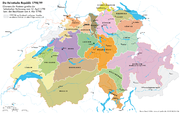 In 1798, with the establishment of the Helvetic Republic
, Bern was divided, the canton of Oberland
with Thun
as its capital and the canton of Léman
with Lausanne
as its capital detached from the rump canton.
With the constitution of Malmaison of 29 May 1801, Bern regained the Bernese Oberland.
with Biel/Bienne
from the bishopric of Basel
, while the canton of Léman became the canton of Vaud and remained separate from Bern.
Bern still remained the largest canton of the confederacy from 1815 to 1979, when parts of the Bernese Jura broke away to form the canton of Jura
.
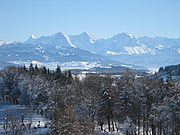 The canton of Bern is mainly drained by the River Aare and its tributaries. The area of the canton is commonly divided into six regions. The most populated area is the Bernese Mittelland
on the plateau north of the Alps, with the capital city of Bern. The northmost part of the canton is the Bernese Jura
bordering the Canton of Jura
. The Bernese Oberland
is the mountainous region which lies in the south of the canton.
The area of the canton is 5959 square kilometre. Of this area, 6.4 % is occupied with houses, businesses or roads. 43.3% of the canton is agricultural land, and 31.0% is forested. Less than 19.3% is considered non-productive, which includes glaciers, cliffs and lakes.
. The classic Swiss cheese with holes Emmentaler comes from this region's forests and pastures, of hilly and low mountainous countryside in the 1000 to 2000 m (3,280.8 to 6,561.7 ft) m range.
), concentrated around Lake Biel
, Neuchâtel
, and Murten
, which rises from the plain up to the northernmost Swiss mountain chain of the Jura
. This area has more relaxed geography, although still some lower mountains and some waterfalls, and large lakes.

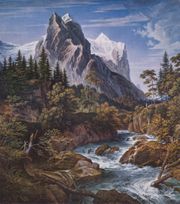
The Bernese Oberland constitute the north side of the Bernese Alps
and the west side of the Urner Alps
within the canton of Bern. The highest mountain in the Bernese Alps is the Finsteraarhorn
at 4274 metres (14,022.3 ft), but the best known mountains are Eiger
, Mönch
, and Jungfrau
.
The well known hiking and ski resorts in the eastern Oberland are located around Interlaken
and the Jungfrau, such as car-free Mürren
and Wengen
in the Lauterbrunnen
valley, and Grindelwald
. Further east, in the Haslital
are the Aareschlucht and the town of Meiringen
, famous for the fateful scene of Sherlock Holmes
's 'death' at the hands of Professor Moriarty
on the nearby Reichenbach Falls
. In the Western Bernese Oberland there are many other resorts and small villages catering to visitors. These are accessed from the lake town of Thun
, and the most notable of them are Kandersteg
with the Oeschinensee and Adelboden
. Further west is the Simmental
with Lenk
and Zweisimmen
and the Saanenland with the famous resorts Gstaad
and Saanen
.
The whole area is very mountainous, with steep cliffs, many glaciers, and countless waterfalls. It is renowned for its scenic beauty and the charm of the small Swiss villages that dot the area. As a result of this, tourism
is one of the main sources of income in the Bernese Oberland. The region also has an extensive train network as well as many cable car
s and funicular
s, with the highest train station in Europe at the Jungfraujoch
and the longest gondola cableway
in the world from Grindelwald to the Männlichen
.
Mountains in the canton of Bern include:
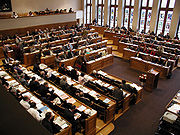 The Grand Council of Bern
( / ) is the parliament
of the canton of Bern. It consists of 160 representatives elected by proportional representation
for four-year terms of office. The French-speaking part of the canton, the Bernese Jura
, has 12 seats guaranteed and 3 seats are guaranteed for the French-speaking minority of the bilingual district of Biel/Bienne.
The Executive Council of Bern
( / ) is the government
of the canton of Bern. This seven-member collegial body is elected by the people for a period of four years. The cantonal constitution reserves one seat in the Executive Council for a French-speaking citizen from the Bernese Jura.
The canton has a two-tiered court system, consisting of district courts and a cantonal Supreme Court . There is also an administrative court as well as other specialised courts and judicial boards.
(22 districts, with 84% of the population) and French
(three districts, 7.6%) are spoken. The German-speaking majority speaks Bernese German
, a Swiss German
dialect. French-speakers live in the western and northern part of the canton. Both German and French are spoken in the bilingual city of Biel/Bienne
. In the government and administration, both languages are official languages of equal standing.
 Most Bernese are Protestant , and most Protestants belong to the Swiss Reformed Church
, which is officially recognised as a state church
, although it is autonomous in its governance and is organised along democratic principles. The canton is also home to a great number of small Evangelical
Christian denominations unaffiliated with the state church. Bernese evangelical groups are mostly found in the Emmental
and Berner Oberland, where they have a long tradition; several contemporary American religious groups, such as the Amish
and Mennonites, were founded or co-founded by Bernese emigrants to the United States. Two small Evangelical political parties are represented in the Bernese cantonal parliament
.
Bern features substantial Roman Catholic (16%) and Christian Catholic
minorities. These churches also have state church status, and the small Jewish community is similarly recognised by law. As everywhere in Switzerland, there are also significant religious communities of immigrant
s, including Sikh
s (who have a prominent Gurdwara
, or temple, in Langenthal
), Mormons
(who have built the Bern Switzerland Temple
) and Muslim
s. As of 2006, the plans to expand a backyard mosque in Langenthal with a symbolic minaret
have, as elsewhere in Switzerland, caused a public stir due to vocal opposition from local conservative and evangelical leaders.
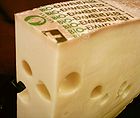 Tourism is the main source of income in the Bernese Oberland. Other important sectors are agriculture (especially cattle breeding), cheese making, and hydroelectric power generation. The Bernese cheese Emmentaler is known around the world. In the Bernese Midlands the lands are more fertile. Agriculture is of great importance, but this part of the canton is also the most industrialized. Small and middle-sized businesses are important employers in this part of the canton of Bern. There is a nuclear power plant at Mühleberg
.
The area around Lake Biel is renowned for its wine
production. The 3 French-speaking districts of the Bernese Jura and the bilingual district of Biel/Bienne
are renowned for their watch industry and its mechanical industry (high precision machine tools, automation and machining).
Switzerland
Switzerland name of one of the Swiss cantons. ; ; ; or ), in its full name the Swiss Confederation , is a federal republic consisting of 26 cantons, with Bern as the seat of the federal authorities. The country is situated in Western Europe,Or Central Europe depending on the definition....
cantons
Cantons of Switzerland
The 26 cantons of Switzerland are the member states of the federal state of Switzerland. Each canton was a fully sovereign state with its own borders, army and currency from the Treaty of Westphalia until the establishment of the Swiss federal state in 1848...
by both surface area and population. Located in west-central Switzerland, it borders the Canton of Jura
Canton of Jura
The Republic and Canton of the Jura , also known as the Canton of Jura or Canton Jura, is one of the cantons of Switzerland. It is the newest of the 26 Swiss cantons, located in the northwestern part of Switzerland. The capital is Delémont...
and the Canton of Solothurn
Canton of Solothurn
Solothurn is a canton of Switzerland. It is located in the northwest of Switzerland. The capital is Solothurn.-History:The territory of the canton comprises land acquired by the capital...
to the north. To the west lie the Canton of Neuchâtel
Canton of Neuchâtel
Neuchâtel is a canton of French speaking western Switzerland. In 2007, its population was 169,782 of which 39,654 were foreigners. The capital is Neuchâtel.-History:...
, the Canton of Fribourg
Canton of Fribourg
The Canton of Fribourg is a canton of Switzerland. It is located in the west of the country. The capital of the canton is Fribourg. The name Fribourg is French, whereas is the German name for both the canton and the town.-History:...
and Vaud
Vaud
Vaud is one of the 26 cantons of Switzerland and is located in Romandy, the French-speaking southwestern part of the country. The capital is Lausanne. The name of the Canton in Switzerland's other languages are Vaud in Italian , Waadt in German , and Vad in Romansh.-History:Along the lakes,...
. To the south lies the Valais
Valais
The Valais is one of the 26 cantons of Switzerland in the southwestern part of the country, around the valley of the Rhône from its headwaters to Lake Geneva, separating the Pennine Alps from the Bernese Alps. The canton is one of the drier parts of Switzerland in its central Rhône valley...
. East of the canton of Bern lie the cantons of Uri
Canton of Uri
Uri is one of the 26 cantons of Switzerland and a founding member of the Swiss Confederation. It is located in Central Switzerland. The canton's territory covers the valley of the Reuss River between Lake Lucerne and the St. Gotthard Pass. German is the primary language spoken in Uri...
, Nidwalden
Nidwalden
Nidwalden is a canton of Switzerland. It is located in the centre of Switzerland. The population is 40,287 of which 4,046 are foreigners. The capital is Stans.-History:...
, Obwalden
Obwalden
Obwalden is a canton of Switzerland. It is located in the centre of Switzerland. The population is 33,997 of which 4,043 are foreigners. Its capital is Sarnen. The canton contains the geographical centre of Switzerland.-History:...
, Lucerne
Canton of Lucerne
Lucerne is a canton of Switzerland. It is located in the centre of Switzerland. The population of the canton is . , the population included 57,268 foreigners, or about 15.8% of the total population. The cantonal capital is Lucerne.-History:...
and Aargau
Aargau
Aargau is one of the more northerly cantons of Switzerland. It comprises the lower course of the river Aare, which is why the canton is called Aar-gau .-History:...
.
The canton of Bern is bilingual and has a population (as of ) of . , the population included 119,930 (or 12.45%) foreigners. The cantonal capital, also the federal capital of Switzerland, is Bern.
History
Bern joined the Swiss Confederation in 1353 and was between 1803 and 1814 one of the six direcorial cantons of the Napoleonic Swiss Confederation.Early Prehistory
The earliest traces a human presence in the area of the modern Canton is found in three caves in the SimmentalSimmental
Simmental is an alpine valley in the Bernese Oberland of Switzerland. It expands from Lenk to Boltigen, in a more or less South-North direction , and from there to the valley exit at Wimmis near Spiez it takes a West-East orientation . It comprises the municipalities of Lenk, St...
region; Schnurenloch near Oberwil
Oberwil im Simmental
Oberwil im Simmental is a municipality in the Frutigen-Niedersimmental administrative district in the canton of Bern in Switzerland.-Geography:...
, Ranggiloch above Boltigen
Boltigen
Boltigen is a municipality in the Obersimmental-Saanen administrative district in the canton of Bern in Switzerland.Boltigen is a mixed community, with traits both of a burgese community and a village community. Beside it, there is also a reformed evangelical Church community...
and Chilchlihöhle above Erlenbach
Erlenbach im Simmental
Erlenbach im Simmental is a municipality in the district of Niedersimmental in the canton of Bern in Switzerland.-Geography:Erlenbach im Simmental has an area, , of . Of this area, or 50.5% is used for agricultural purposes, while or 37.9% is forested...
. These caves were used at various times during the last ice age. The first open-air settlement in the area is an upper paleolithic
Paleolithic
The Paleolithic Age, Era or Period, is a prehistoric period of human history distinguished by the development of the most primitive stone tools discovered , and covers roughly 99% of human technological prehistory...
settlement at Moosbühl in Moosseedorf. During the warmer climate of the mesolithic
Mesolithic
The Mesolithic is an archaeological concept used to refer to certain groups of archaeological cultures defined as falling between the Paleolithic and the Neolithic....
period, increasing forest cover restricted the movement of hunters, fishers and gatherers. Their temporary settlements were built along lake and marsh edges, which remained free of trees due to fluctuations in water level. Important mesolithic sites in the Canton are at Pieterlenmoos and Burgäschisee lake along with alpine valleys at Diemtig and Simmental. During the neolithic
Neolithic
The Neolithic Age, Era, or Period, or New Stone Age, was a period in the development of human technology, beginning about 9500 BC in some parts of the Middle East, and later in other parts of the world. It is traditionally considered as the last part of the Stone Age...
period, there were a number of settlements on the shores of Lake Biel
Lake Biel
Lake Biel or Lake Bienne is a lake in the west of Switzerland. Together with Lake Morat and Lake Neuchâtel, it is one of the three large lakes in the Jura region of Switzerland. It lies approximately at , at the language boundary between German & French speaking areas.The lake is 15 km long and up...
, the Toteisbecken (Lobsigensee, Moossee, Burgäschisee and Inkwilersee) and along rivers (Aare, Zihl). Several of these sites are part of the Prehistoric Pile dwellings around the Alps
Prehistoric Pile dwellings around the Alps
Prehistoric Pile dwellings around the Alps is a series of prehistoric pile-dwelling settlements in and around the Alps built from around 5000 to 500 B.C. on the edges of lakes, rivers or wetlands...
, a UNESCO
UNESCO
The United Nations Educational, Scientific and Cultural Organization is a specialized agency of the United Nations...
World Heritage Site.
One of the best explored neolithic sites is at Twann
Twann
Twann was a municipality in the district of Nidau in the canton of Bern in Switzerland. On 1 January 2010 the municipalities of Tüscherz-Alfermée and Twann merged into the municipality of Twann-Tüscherz.-Geography:...
(now Twann-Tüscherz
Twann-Tüscherz
Twann-Tüscherz is a municipality in the Biel/Bienne administrative district in the canton of Bern in Switzerland. On 1 January 2010 the municipalities of Tüscherz-Alfermée and Twann merged into the municipality of Twann-Tüscherz.-World heritage site:...
). In the Twannbach delta there were about 25 Cortaillod culture
Cortaillod culture
The Cortaillod culture is one of several archaeologically defined cultures belonging to the Neolithic period of Switzerland. The Cortaillod Culture in the west of the region is contemporary with the Pfyn Culture...
and Horgen culture
Horgen culture
The Horgen culture is one of several archaeological cultures belonging to the Neolithic period of Switzerland. The Horgen culture may derive from the Pfyn culture and early Horgen pottery is similar to the earlier Cortaillod culture pottery of Twann, Switzerland...
villages that existed between 3800 and 2950 BC. One of the oldest examples of bread from Switzerland, a sourdough
Sourdough
Sourdough is a dough containing a Lactobacillus culture, usually in symbiotic combination with yeasts. It is one of two principal means of biological leavening in bread baking, along with the use of cultivated forms of yeast . It is of particular importance in baking rye-based breads, where yeast...
from 3560-3530 BC, came from one of these villages.
Simple copper objects were already in use in the 4th millennium BC, including a copper pin from Lattrigen from 3170 BC and a knife blade from Twann. Shortly before 2000 BC bronze
Bronze
Bronze is a metal alloy consisting primarily of copper, usually with tin as the main additive. It is hard and brittle, and it was particularly significant in antiquity, so much so that the Bronze Age was named after the metal...
production entered the area and brought about a surge in development. Settlements began to spread into the pre-Alpine and Alpine areas. The area between Lake Thun
Lake Thun
Lake Thun is an Alpine lake in the Bernese Oberland in Switzerland. It took its name from the city of Thun, on its northern shore.Lake Thun's approximately 2,500 km² large catchment area frequently causes local flooding after heavy rainfalls...
and the Niedersimmental were densely settled. Archeological finds include scattered items along mountain passes, a fortified hilltop settlements at Spiezberg, Cholis Grind by Saanen and at Pintel by Wimmis, along with cemeteries at Thun-Allmendingen, Einigen and Hilterfingen. Late Bronze Age
Bronze Age
The Bronze Age is a period characterized by the use of copper and its alloy bronze as the chief hard materials in the manufacture of some implements and weapons. Chronologically, it stands between the Stone Age and Iron Age...
(ca. 1000-800 BC) settlements along Lake Biel
Lake Biel
Lake Biel or Lake Bienne is a lake in the west of Switzerland. Together with Lake Morat and Lake Neuchâtel, it is one of the three large lakes in the Jura region of Switzerland. It lies approximately at , at the language boundary between German & French speaking areas.The lake is 15 km long and up...
(Mörigen, Vinelz) have yielded up a wealth of items.
Iron Age
During the early Iron AgeIron Age
The Iron Age is the archaeological period generally occurring after the Bronze Age, marked by the prevalent use of iron. The early period of the age is characterized by the widespread use of iron or steel. The adoption of such material coincided with other changes in society, including differing...
(Hallstatt culture
Hallstatt culture
The Hallstatt culture was the predominant Central European culture from the 8th to 6th centuries BC , developing out of the Urnfield culture of the 12th century BC and followed in much of Central Europe by the La Tène culture.By the 6th century BC, the Hallstatt culture extended for some...
from 800-450 BC) changes in climate forced them to abandon settlements along many waterways and in the valley floors and move to the plateaus and hills. With increased trade contacts across the Alps, the cultural influence of the Mediterranean grew in the area. Evidence of this trade include a hydria
Hydria
A hydria is a type of Greek pottery used for carrying water. The hydria has three handles. Two horizontal handles on either side of the body of the pot were used for lifting and carrying the pot. The third handle, a vertical one, located in the center of the other two handles, was used when...
which was discovered in Grächwil. Burial rituals and social classes became more developed during this time. The so-called princely graves became more common, many of the burial mounds were over 30 m (98.4 ft) in diameter and 4 m (13.1 ft) high and richly outfitted with grave goods. In a grave mound in Bützberg the first burial in the mound was followed by several later burials. Often, several grave mounds combined to become a necropolis, such as at Grossaffoltern, Ins, Bannwil, Langenthal and Bützberg. Most of the knowledge about the Hallstatt culture in the Canton comes from graves. The only discovered settlement is around Blanche Church in La Neuveville
La Neuveville
La Neuveville is a municipality in the Jura bernois administrative district in the canton of Bern in Switzerland, located in the French-speaking Bernese Jura .-Geography:...
.
The grave good show that iron was forged into swords, daggers, spearheads, knives and wagon accessories. Gold, which was probably collected from river sand, was made into diadems, rings and pendants. Thin bronze arm, leg and neck plates with geometric designs were often buried, especially in the graves at Allenlüften in Mühleberg, at Ins and at Bützberg. The jewelry that was buried included bracelets and rings which were also made of jet
Jet (lignite)
Jet is a geological material and is considered to be a minor gemstone. Jet is not considered a true mineral, but rather a mineraloid as it has an organic origin, being derived from decaying wood under extreme pressure....
and lignite
Lignite
Lignite, often referred to as brown coal, or Rosebud coal by Northern Pacific Railroad,is a soft brown fuel with characteristics that put it somewhere between coal and peat...
coal. At Münchringen, the grave pottery was both shaped by hand or thrown on a potter's wheel, and was painted with multi-colored ornamentation.
The transition to the late Iron Age or La Tène
La Tène culture
The La Tène culture was a European Iron Age culture named after the archaeological site of La Tène on the north side of Lake Neuchâtel in Switzerland, where a rich cache of artifacts was discovered by Hansli Kopp in 1857....
period (450-1st Century BC) is indicated by a sudden change of style in the metalworking and ceramic industries. Numerous graves (from unknown settlements) along with the two oppida at Bern-Engehalbinsel and Jensberg by Studen
Studen
Studen is a municipality in the Seeland administrative district in the canton of Bern in Switzerland.-Geography:Studen has an area of . Of this area, 43% is used for agricultural purposes, while 19.6% is forested...
mark the population centers during the late Iron Age. Gold coins (from Melchnau
Melchnau
Melchnau is a municipality in the Oberaargau administrative district in the canton of Bern in Switzerland.-History:Melchnau celebrated its 900th anniversary in 2000. The earliest written evidence for the town dates from about 1100....
) along with silver and bronze coins first start to appear in this same era. A sword with Greek characters
Greek alphabet
The Greek alphabet is the script that has been used to write the Greek language since at least 730 BC . The alphabet in its classical and modern form consists of 24 letters ordered in sequence from alpha to omega...
that said Korisios was found at the Port site. At the oppidum at Bern-Engehalbinsel, there were studios for glass and ceramic production and iron working achieved a high level of skill, along with craftsmen who worked in wood, leather and goldsmithing. There was a nearby place of worship in the Bremgarten wood, and cemeteries at Münsingen
Münsingen
Münsingen is a municipality in the Bern-Mittelland administrative district in the canton of Bern in Switzerland.The village lies on the River Aar between the cities of Bern and Thun.-Geography:...
and Bern-Engehalbinsel.
Roman era
After the RomanSwitzerland in the Roman era
The history of Switzerland in the Roman era encompasses the roughly six centuries during which the territory of modern Switzerland was a part of the Roman Republic and Empire...
victory at Bibracte
Battle of Bibracte
The Battle of Bibracte was fought between the Helvetii and six Roman legions, under the command of Gaius Julius Caesar. It was the second major battle of the Gallic Wars....
in 58 BC, the Helvetii
Helvetii
The Helvetii were a Celtic tribe or tribal confederation occupying most of the Swiss plateau at the time of their contact with the Roman Republic in the 1st century BC...
were forced to return to their homes as foederati
Foederati
Foederatus is a Latin term whose definition and usage drifted in the time between the early Roman Republic and the end of the Western Roman Empire...
of the Romans. Under increasing Roman influence, the local economy and trade flourished. The main settlements lay on the foot of the Jura Mountains
Jura mountains
The Jura Mountains are a small mountain range located north of the Alps, separating the Rhine and Rhone rivers and forming part of the watershed of each...
and the Central Plateau. The existing roads were expanded, especially the Aventicum
Aventicum
Aventicum was the largest town and capital of Roman Switzerland . Its remains are beside the modern town of Avenches....
-Vindonissa
Vindonissa
Vindonissa was a Roman legion camp at modern Windisch, Switzerland. It was probably established in 15 AD. In an expansion around 30, thermal baths were added....
and the Petinesca
Petinesca
Petinesca is an archeological site on the territory of Studen, a community of the Canton of Bern, in Switzerland, where Celtic and Roman vestiges were found.-Celtic and Roman vestiges:...
-Augusta Raurica
Augusta Raurica
Augusta Raurica is a Roman archaeological site and an open-air museum in Switzerland. Located on the south bank of the Rhine river about 20 km east of Basel near the villages of Augst and Kaiseraugst, it is the oldest known Roman colony on the Rhine....
roads. A fourth alpine pass, the Rawil
Rawil Pass
The Rawil Pass is a high mountain pass across the western Bernese Alps, connecting Lenk in the canton of Berne in Switzerland and Anzère or Crans Montana in the canton of Valais....
was added to the traditional three; the Grimsel
Grimsel Pass
Grimsel Pass is a Swiss high mountain pass.-Position:It connects the valley of the Rhone River in the canton of Valais and the Haslital in the canton of Bern....
, Brunig
Brünig Pass
Brünig Pass connects the Bernese Oberland and central Switzerland, linking Meiringen in the canton of Bern and Lungern in the canton of Obwalden.Rail services are provided by the Zentralbahn between Luzern and Interlaken.-See also:...
and Susten
Susten Pass
Susten Pass is a mountain pass in the Swiss Alps. The pass road, built from 1938–1945, connects Innertkirchen in the canton of Bern with Wassen in the canton of Uri...
passes. In the Bernese Jura the Mont Raimeux
Mont Raimeux
Mont Raimeux is the highest mountain in the Swiss canton of Jura. It lies in the Jura Mountains on the border between the cantons of Berne and Jura.-References:*...
and Pierre Pertuis
Col de Pierre Pertuis
Col de Pierre Pertuis is a mountain pass in the Jura Mountains in the canton of Berne in Switzerland.It connects Sonceboz and Tavannes.The name of the pass comes from the Latin: Petra pertusa, meaning broken rock...
passes opened.
Under the romans, many of the old fortified places were expanded and refortified. The old Helvetii oppidum at the Engehalbinsel became a Roman vicus
Vicus
Vicus may refer to:*Vicus , plural vici, a neighborhood or local administrative unit of ancient Rome**Vicus Tuscus in Rome**Vicus Jugarius, leading into the Roman Forum** Gensis in Moesia Superior...
, which was probably known as Brenodor or Brenodurum. At the foot of the Jens mountain, the fort Petinesca was built to guard the roads over the Jura Mountains. This was reinforced in the late-roman era (368-369 AD) by a fortified bridge over the Thielle/Zihl
Thielle
The River La Thielle is a tributary to the Aare River, in the Swiss Seeland."La Thielle" results of the merging of the river Orbe and river Talent, Northeast of the little city of Orbe in the Swiss Canton of Vaud...
river between Aegerten and Brügg.
A number of roman villas were built around the Canton. At Oberwichtrach
Wichtrach
Wichtrach is a municipality in the Bern-Mittelland administrative district in the canton of Bern in Switzerland.-History:Wichtrach was created on January 1, 2004 by uniting of the independent municipalities of Niederwichtrach and Oberwichtrach. The parish church of Oberwichtrach was first...
both the main building (pars urbana) and the industrial section (pars rustica) of a Roman villa have been discovered. The villas at Münsingen, Toffen
Toffen
Toffen is a municipality in the Bern-Mittelland administrative district in the canton of Bern in Switzerland. It lies approximately 10 km south of the city of Bern.The palace situated there, Schloss Toffen, is a heritage site of national significance....
and Herzogenbuchsee
Herzogenbuchsee
Herzogenbuchsee is a municipality in the Oberaargau administrative district in the canton of Bern in Switzerland.The population is 6,646 , counting the villages in the Oberaargau. The traditional name was Buchsi.- History :...
have rich mosaic
Mosaic
Mosaic is the art of creating images with an assemblage of small pieces of colored glass, stone, or other materials. It may be a technique of decorative art, an aspect of interior decoration, or of cultural and spiritual significance as in a cathedral...
s that are still partly visible.
The religious practices of the local population merged with roman beliefs and the Canton of Bern is home to a number of unique cult centers. They include the larger than life statues of gods (including enthroned Jupiter) at Petinesca, Engehalbinsel and Thun-Allmendingen and a number of inscriptions. At the beginning of the 5th Century AD, Rome withdrew its troops from the Rhine garrisons, but allowed the Burgundians
Burgundians
The Burgundians were an East Germanic tribe which may have emigrated from mainland Scandinavia to the island of Bornholm, whose old form in Old Norse still was Burgundarholmr , and from there to mainland Europe...
to settle on Helvetii lands in 443 AD.
Early Middle Age
Germanic peoples
The Germanic peoples are an Indo-European ethno-linguistic group of Northern European origin, identified by their use of the Indo-European Germanic languages which diversified out of Proto-Germanic during the Pre-Roman Iron Age.Originating about 1800 BCE from the Corded Ware Culture on the North...
population in the Early Middle Ages
Early Middle Ages
The Early Middle Ages was the period of European history lasting from the 5th century to approximately 1000. The Early Middle Ages followed the decline of the Western Roman Empire and preceded the High Middle Ages...
happened relatively peacefully. One exception was the Battle of Wangen in 610, but elsewhere it generally was a slow process of cultural infiltration. By the 7th century, the Alamanni
Alamanni
The Alamanni, Allemanni, or Alemanni were originally an alliance of Germanic tribes located around the upper Rhine river . One of the earliest references to them is the cognomen Alamannicus assumed by Roman Emperor Caracalla, who ruled the Roman Empire from 211 to 217 and claimed thereby to be...
c settlers had already taken most of the good locations southeast of the Aare and they began moving up the Aare to the regions of Lake Thun and Lake Brienz
Lake Brienz
Lake Brienz is a lake just north of the Alps, in the Canton of Berne in Switzerland. The lake took its name from the village Brienz on its northern shore. Interlaken and the villages Matten and Unterseen lie to the south west of the lake. The shores are steep, and there is almost no shallow water...
. All areas west of the Aare river belonged to the romanised Burgundian kingdom, which became part of the Merovingian
Merovingian dynasty
The Merovingians were a Salian Frankish dynasty that came to rule the Franks in a region largely corresponding to ancient Gaul from the middle of the 5th century. Their politics involved frequent civil warfare among branches of the family...
Frankish
Franks
The Franks were a confederation of Germanic tribes first attested in the third century AD as living north and east of the Lower Rhine River. From the third to fifth centuries some Franks raided Roman territory while other Franks joined the Roman troops in Gaul. Only the Salian Franks formed a...
kingdom in the 534. During the Carolingian era
Carolingian Empire
Carolingian Empire is a historiographical term which has been used to refer to the realm of the Franks under the Carolingian dynasty in the Early Middle Ages. This dynasty is seen as the founders of France and Germany, and its beginning date is based on the crowning of Charlemagne, or Charles the...
, the political structure of the Franks had spread into parts of what became Switzerland. In 762/778 the County of Aargau was founded, followed in 861 by the County of Oberaargau and in 965 the County of Bargen. The Treaty of Verdun
Treaty of Verdun
The Treaty of Verdun was a treaty between the three surviving sons of Louis the Pious, the son and successor of Charlemagne, which divided the Carolingian Empire into three kingdoms...
in 843 put the border between Central and Eastern Frankish Empires at the Aare, and divided the Aare region in half. The population west of the Aare generally spoke a Romance language, while those to the east spoke a Germanic language. The region between the Saane and Aare rivers became the language border.
Christianity spread slowly into the Aare valley. The dioceses of Lausanne
Bishop of Lausanne
The Bishop of Lausanne was a Prince-Bishop of the Holy Roman Empire and the Ordinary of the diocese of Lausanne, Switzerland .Bern secularized the bishopric in 1536....
, Basel, Sion, Chur
Bishop of Chur
The Bishop of Chur is the Ordinary of the Roman Catholic Diocese of Chur, Grisons, Switzerland .-History:...
and Constance
Bishopric of Constance
The Bishopric of Constance was a diocese of the Roman Catholic Church and ecclesiastical state of the Holy Roman Empire that existed from about 585 until 1821. Its seat was Konstanz at the western end of Lake Constance in the south-west corner of Germany...
were all established before the new faith made inroads into the valley. The Aare valley was bordered by three dioceses; Lausanne, Constance and Basel. However, the first christian missionaries came into the valley from Alsace
Alsace
Alsace is the fifth-smallest of the 27 regions of France in land area , and the smallest in metropolitan France. It is also the seventh-most densely populated region in France and third most densely populated region in metropolitan France, with ca. 220 inhabitants per km²...
and other western areas. In 630 the Abbey of Luxeuil established the Abbey of Moutier-Grandval along the old transit route through the Pierre Pertuis Pass. By the 9th or 10th Century, this Abbey had property and influence all the way to Lake Biel and into the Balsthal valley. The first monastic cells of what would become the Abbey of Saint-Imier
Saint-Imier
Saint-Imier is a municipality in the Jura bernois administrative district in the canton of Bern in Switzerland. It is located in the French-speaking Bernese Jura .Observatoire Astronomique de Mont-Soleil is located above the village....
was also founded in 600. In the Seeland and Aare valleys, wooden churches were first built during the Merovingian period. The current churches in Kirchlindach, Oberwil bei Buren and Bleibach were all built above the ruins of these early churches. About 30 churches in the Bern and Solothurn portions of the Aare valley were created over ruins of Roman villas and subsequent burial grounds in the 7th Century (including Meikirch and Oberbipp). In Mett, the church was built over a 5th century mausoleum, which was built over a 4th century tomb. In 700, six sarcophagi were buried on St. Peter's Island
St. Petersinsel
St. Petersinsel or Île de St-Pierre is a peninsula situated in Lake Biel in the canton of Bern, Switzerland. It was formed in the last Ice Age , when the Rhône Glacier reached as far as the Jura mountains...
next to a Roman temple complex. A wooden monastery was built over the complex in the 8th-9th century.
Middle Ages
Rudolph I of Burgundy
Rudolph I was King of Burgundy from his election in 888 until his death.Rudolph belonged to the elder Welf family and was the son of Conrad, Count of Auxerre, from whom he inherited the lay abbacy of St Maurice en Valais, making him the most powerful magnate in Upper Burgundy - present-day...
and his son Rudolph II
Rudolph II of Burgundy
Rudolph II was king of Upper Burgundy , Lower Burgundy , and Italy . He was the son of Rudolph I, king of Upper Burgundy, and it is presumed that his mother was his father's known wife, Guilla of Provence...
Burgundy's influence reached across most of modern Switzerland. They established royal courts at Bümpliz, Münsingen, Uetendorf, Wimmis, Kirchberg and Utzenstorf to allow them to govern the Aare valley. Later, the Aare valley moved toward closer ties with the Holy Roman Empire
Holy Roman Empire
The Holy Roman Empire was a realm that existed from 962 to 1806 in Central Europe.It was ruled by the Holy Roman Emperor. Its character changed during the Middle Ages and the Early Modern period, when the power of the emperor gradually weakened in favour of the princes...
during the Ottonian and Salian
Salian dynasty
The Salian dynasty was a dynasty in the High Middle Ages of four German Kings , also known as the Frankish dynasty after the family's origin and role as dukes of Franconia...
dynasties.
The succession dispute following the death of Rudolph III
Rudolph III of Burgundy
Rudolf III of Burgundy was the last King of an independent Burgundy. He was the son of Conrad, King of Burgundy, and Matilda of France...
in 1032 allowed the Salian kings to acquire the Kingdom of Upper Burgundy and with it the Aare valley. As a part of the Holy Roman Empire, the valley was involved when the Investiture Controversy
Investiture Controversy
The Investiture Controversy or Investiture Contest was the most significant conflict between Church and state in medieval Europe. In the 11th and 12th centuries, a series of Popes challenged the authority of European monarchies over control of appointments, or investitures, of church officials such...
broke out in 1056. In 1077, the Regent of Burgundy, Count Rudolf of Rheinfelden, declared himself as an anti-king against King Henry IV
Henry IV, Holy Roman Emperor
Henry IV was King of the Romans from 1056 and Holy Roman Emperor from 1084 until his forced abdication in 1105. He was the third emperor of the Salian dynasty and one of the most powerful and important figures of the 11th century...
. The Bishops of Basel and Lausanne remained loyal to King Henry IV, and took the Rheinfelden lands in Oberaargau and the upper Aare valley. After Rudolf's death in 1090, his lands went to his son, Berchtold II of Zähringen. He and his son, Berchtold III, tried to use these lands to expand their power. In 1127 the Zähringens were appointed Rector or delegate of the king in Burgundy. Their hopes for a new, independent Burgundy were dashed in 1156, and the last Zähringen count, Berchtold V, embarked on a program of city founding. The cities of Burgdorf, Murten
Murten
Murten is a municipality in the See district of the canton of Fribourg in Switzerland.It is located on the southern shores of Lake Morat. Morat is situated between Bern and Lausanne and is the capital of the Lake District of the canton of Fribourg....
, Thun
Thun
Thun is a municipality in the administrative district of Thun in the canton of Bern in Switzerland with about 42,136 inhabitants , as of 1 January 2006....
and Bern were all founded by Berchtold V. When he died without an heir, the Zähringen lands went to the House of Kyburg
House of Kyburg
The House of Kyburg was family of Grafen or counts from Zürich in Switzerland. The family was one of the three most powerful noble families in the Swiss plateau beside the Habsburg and the House of Savoy during the 11th and 12th Centuries...
, while the offices and fiefs reverted to the empire.
During the High Middle Ages
High Middle Ages
The High Middle Ages was the period of European history around the 11th, 12th, and 13th centuries . The High Middle Ages were preceded by the Early Middle Ages and followed by the Late Middle Ages, which by convention end around 1500....
both the Aare valley and the Bernese Oberland
Bernese Oberland
The Bernese Oberland is the higher part of the canton of Bern, Switzerland, in the southern end of the canton: The area around Lake Thun and Lake Brienz, and the valleys of the Bernese Alps .The flag of the Bernese Oberland consists of a black eagle in a gold field The Bernese Oberland (Bernese...
were divided into a number of small counties, each with their own baron
Baron
Baron is a title of nobility. The word baron comes from Old French baron, itself from Old High German and Latin baro meaning " man, warrior"; it merged with cognate Old English beorn meaning "nobleman"...
. Nobles from the Holy Roman Empire began to marry into the local noble families and a number of the Zähringen Ministerialis
Ministerialis
Ministerialis ; a post-classical Latin word, used in English, meaning originally servitor, agent, in a broad range of senses...
families (unfree knights in the service of a feudal overlord) moved into the Oberland. The nobles also began to found monasteries to spread their power into the Oberland. During the period between 1070 and 1150, at least ten large monasteries were founded by local nobles. These include; the Cluniac
Cluny Abbey
Cluny Abbey is a Benedictine monastery in Cluny, Saône-et-Loire, France. It was built in the Romanesque style, with three churches built in succession from the 10th to the early 12th centuries....
Priory
Priory
A priory is a house of men or women under religious vows that is headed by a prior or prioress. Priories may be houses of mendicant friars or religious sisters , or monasteries of monks or nuns .The Benedictines and their offshoots , the Premonstratensians, and the...
of Rüeggisberg
Rüeggisberg Priory
Rüeggisberg Priory was a Cluniac priory in the municipality of Rüeggisberg, Canton of Bern, Switzerland.The original foundation of uncertain date, made by Lütold of Rümligen, was turned into the first Cluniac house in the German-speaking world by Cuno of Siegburg and Ulrich of Zell in about 1072,...
(Lords of Rümligen in 1072), Münchenwiler (Wiler family in 1080), St. Peter's Island
St. Petersinsel
St. Petersinsel or Île de St-Pierre is a peninsula situated in Lake Biel in the canton of Bern, Switzerland. It was formed in the last Ice Age , when the Rhône Glacier reached as far as the Jura mountains...
(Count of Hochburgund-Mâcon in the late 11th century), Hettiswil (1107), Röthenbach im Emmental (Lords of Rümligen or Signau), the Benedictine
Benedictine
Benedictine refers to the spirituality and consecrated life in accordance with the Rule of St Benedict, written by Benedict of Nursia in the sixth century for the cenobitic communities he founded in central Italy. The most notable of these is Monte Cassino, the first monastery founded by Benedict...
monastery at St. Johannsen
Erlach Abbey
Erlach Abbey, also known as St. Johannsen Abbey , was a Benedictine monastery in Gals, Canton of Bern, Switzerland....
in Erlach (Fenis family in 1100), Trub (Lords of Lützelflüh before 1130) and Rüegsau (possibly also the Lords of Lützelflüh in first half of the 12th century), the Augustinian Collegiate church
Collegiate church
In Christianity, a collegiate church is a church where the daily office of worship is maintained by a college of canons; a non-monastic, or "secular" community of clergy, organised as a self-governing corporate body, which may be presided over by a dean or provost...
in Interlaken (Oberhofen family in 1130) and the Cistercian monastery Frienisberg (Count Saugern around 1130). However, in 1191 the Oberland Barons revolted against Berchtold V of Zähringen and many of the Oberland barons were killed in the battle of Grindelwald.
During the 13th Century a number of the cities near Bern were granted the city right and appointed mayors and city councils. Bern became an imperial city. During the mid-13th Century, the Empire's presence weakened in the Aare valley, forcing the local nobles to find allies to protect themselves. Bern entered into a number of treaties with its neighbors in the 13th Century. In 1274, the Emperor Rudolph I of Habsburg
Rudolph I of Germany
Rudolph I was King of the Romans from 1273 until his death. He played a vital role in raising the Habsburg dynasty to a leading position among the Imperial feudal dynasties...
, confirmed Bern's imperial immediacy. However, in 1285 he imposed an imperial tax which drove the city to support Rudolph's enemies. Although it withstood two sieges by the Emperor in 1288, after the defeat at Schosshalde in 1289 it had to pay taxes and a penalty.
In 1298 Bernese forces won a victory at Oberwangen in Köniz
Köniz
Köniz is a municipality in the Bern-Mittelland administrative district in the canton of Bern in Switzerland. With a population of 38,793 inhabitants , the municipality is one of the 15 most populous cities in Switzerland.- History :...
against the County of Savoy
County of Savoy
The Counts of Savoy emerged, along with the free communes of Switzerland, from the collapse of the Burgundian Kingdom of Arles in the 11th century....
and the Habsburg Austrian nobility. In 1300, the city acquired the four surrounding parish
Parish
A parish is a territorial unit historically under the pastoral care and clerical jurisdiction of one parish priest, who might be assisted in his pastoral duties by a curate or curates - also priests but not the parish priest - from a more or less central parish church with its associated organization...
es of Bolligen, Vechigen, Stettlen and Muri, destroyed the threatening castles of Bremgarten and Belp and gave the Baron of Montenach Bernese citizenship. After the victory of Louis IV of Bavaria
Louis IV, Holy Roman Emperor
Louis IV , called the Bavarian, of the house of Wittelsbach, was the King of Germany from 1314, the King of Italy from 1327 and the Holy Roman Emperor from 1328....
over the Habsburg Frederick the Fair in the battle of Mühldorf (Bavaria) in 1322, Bern entered an alliance with the anti-Habsburg Swiss Forest Cantons in 1323.
Old Swiss Confederacy
- Laupen (1324)
- Hasli and Meiringen (1334)
- Aarberg (1375)
- Thun and Burgdorf (1384)
- Unterseen and the Upper Simme valley (1386)
- FrutigenFrutigenFrutigen is a municipality in the Bernese Oberland in the canton of Bern in Switzerland. It is the capital of the Frutigen-Niedersimmental administrative district.-History:...
, etc. (1400) - AargauAargauAargau is one of the more northerly cantons of Switzerland. It comprises the lower course of the river Aare, which is why the canton is called Aar-gau .-History:...
(1415) - Lower Simme valley (1439–1449)
- AigleAigleAigle is the capital of the district of Aigle in the canton of Vaud in Switzerland. The town has a population of 8,100 people.The name of this municipality in French means eagle.-Geography:...
and GrandsonGrandson, SwitzerlandGrandson is a municipality in the district of Jura-Nord Vaudois in the canton of Vaud in Switzerland.During the Burgundian Wars, Charles the Bold was defeated near here in the Battle of Grandson on 2 March 1476.-History:...
(1475) - Interlaken, with Grindelwald, LauterbrunnenLauterbrunnenLauterbrunnen is a municipality in the Interlaken-Oberhasli administrative district in the canton of Bern in Switzerland.The municipality lies in the Lauterbrunnen Valley and comprises the villages Lauterbrunnen, Wengen, Mürren, Gimmelwald, Stechelberg and Isenfluh...
and BrienzBrienzBrienz is a municipality in the Interlaken-Oberhasli administrative district in the canton of Bern in Switzerland.The village lies on the north bank of Lake Brienz in the Bernese Oberland at the foot of the Brienzer Rothorn mountain.-History:...
(1528, all the suppression of the Austin Canons of Interlaken) - VaudVaudVaud is one of the 26 cantons of Switzerland and is located in Romandy, the French-speaking southwestern part of the country. The capital is Lausanne. The name of the Canton in Switzerland's other languages are Vaud in Italian , Waadt in German , and Vad in Romansh.-History:Along the lakes,...
(1536) - SaanenSaanenSaanen is a municipality in the canton of Bern in Switzerland. It is the capital of the Obersimmental-Saanen administrative district.-Geography:Saanen has an area of . Of this area, 52.8% is used for agricultural purposes, while 33.6% is forested...
or Gessenay (1555) - the Pays d'En-Haut including Château-d'ŒxChâteau-d'ŒxChâteau-d'Œx is a municipality in the canton of Vaud in Switzerland. It is in the district of Riviera-Pays-d'Enhaut.-Prehistoric settlements:...
(1555) - Köniz (1729).
In 1322, the brothers Eberhard II of Neu-Kyburg and Hartmann II of Neu-Kyburg started fighting with each other over who would inherit the family's lands around Thun. The fighting led to the "fratricide
Fratricide
Fratricide is the act of a person killing his or her brother....
at Thun Castle
Thun Castle
Thun Castle is a castle in the municipality of Thun of the Canton of Bern in Switzerland. It is a Swiss heritage site of national significance.-References:...
" where Eberhard killed his brother Hartmann. To avoid punishment by his Habsburg overlords, Eberhard fled to Bern. In the following year, he sold the town of Thun
Thun
Thun is a municipality in the administrative district of Thun in the canton of Bern in Switzerland with about 42,136 inhabitants , as of 1 January 2006....
, its castle and the land surrounding Thun to Bern. Bern then granted the land back to Eberhard as a fief. Bern's support of Eberhard, their resulting expansion into the Oberland and their alliance with the Forest Cantons brought the city into conflict with the Habsburgs during the 14th Century. The Gümmenenkrieg in 1333 between Bern and Fribourg
Fribourg
Fribourg is the capital of the Swiss canton of Fribourg and the district of Sarine. It is located on both sides of the river Saane/Sarine, on the Swiss plateau, and is an important economic, administrative and educational center on the cultural border between German and French Switzerland...
over rights and influence in the Sense/Singine area ended without resolving anything.
In 1334, Bern fought with the Barons of Weissenburg and occupied Wimmis
Wimmis
Wimmis is a municipality in the Frutigen-Niedersimmental administrative district in the canton of Bern in Switzerland.-Geography:Wimmis has an area of . Of this area, 30.1% is used for agricultural purposes, while 45.8% is forested...
and Unspunnen
Unspunnen Castle
Unspunnen Castle is a castle, now in ruins, located in the Bernese highlands of Switzerland. The castle, likely constructed in the early 12th century, overlooks the city of Interlaken, and is a short distance from the village of Wilderswil....
. Bern's victory allowed them to bring the Oberhasli
Oberhasli
Oberhasli may refer to:* Oberhasli, a historical region in the Bernese Oberland in the canton of Berne, Switzerland* Oberhasli District, a former district* Oberhasli , a breed of goat named after the Bernese district...
region and Weissenburg under their control. Bern's continued expansion was at the expense of the feudal lords in the surrounding lands. In 1339 the Habsburgs, Kyburgs and Fribourg, marched against Bern with 17,000 men and besieged the border town of Laupen. To raise the siege, Bern raised a force of 6,000, consisting of Bernese, supported by the Forest Cantons, and other allies (Simmental
Simmental
Simmental is an alpine valley in the Bernese Oberland of Switzerland. It expands from Lenk to Boltigen, in a more or less South-North direction , and from there to the valley exit at Wimmis near Spiez it takes a West-East orientation . It comprises the municipalities of Lenk, St...
, Weissenbur and Oberhasli). The allied Bernese forces were victorious at the Battle of Laupen
Battle of Laupen
The Battle of Laupen in 1339 was fought between the Bern and its allies on one side, and Freiburg together with feudal landholders from the County of Burgundy and Habsburg territories on the other. Bern was victorious, consolidating its position in the region...
and Bern drew closer to the Swiss Forest Cantons. It entered into a permanent or eternal alliance with Uri, Schwyz and Unterwalden in 1353. This date is usually considered the date of Bern's entrance into the Swiss Confederation, however the alliance only indirectly tied Bern to Zurich and Lucerne.
In 1358 the cash-strapped Count Peter II of Aarberg pawned the County of Aarberg
Aarberg
Aarberg is a municipality in the Seeland administrative district in the canton of Bern in Switzerland.Aarberg lies 20 kilometers from Bern above the Aar River...
to Bern. However, in 1367 he sold it, with out repaying Bern, to his cousin Rudolf IV of Nidau. After Rudolf's death (1375) Bern acquired clear right to the Aarberg lands from the other heirs.
Throughout the 14th Century, Bern entered into alliances and treaties with many of its neighbors, including members of the Swiss Confederation
Old Swiss Confederacy
The Old Swiss Confederacy was the precursor of modern-day Switzerland....
. Bern entered into a series of agreements with Biel/Bienne
Biel/Bienne
Biel/Bienne is a city in the district of the Biel/Bienne administrative district in the canton of Bern in Switzerland.It is located on the language boundary and is throughout bilingual. Biel is the German name for the town, Bienne its French counterpart. The town is often referred to in both...
, which led to a conflict with Biel's ruler, the Prince-Bishop of Basel in 1367-68. The bishop marched south and destroyed Biel along with a number of towns in the southern Jura Mountains
Jura mountains
The Jura Mountains are a small mountain range located north of the Alps, separating the Rhine and Rhone rivers and forming part of the watershed of each...
. During the Gugler war
Gugler
The Gugler were a body of mostly English and French knights who as mercenaries invaded Alsace and the Swiss plateau under the leadership of Enguerrand VII de Coucy during the Gugler War of 1375.-Origin of the term:...
in 1375, there were several battles between Bernese troops and English mercenaries under Enguerrand de Coucy.
By the 1370's, the Kyburgs (which still held Thun as a fief for Bern) were deeply in debt to Bern. On 11 November 1382, Rudolf II of Neu-Kyburg made an unsuccessful raid on Solothurn
Solothurn
The city of Solothurn is the capital of the Canton of Solothurn in Switzerland. The city also comprises the only municipality of the district of the same name.-Pre-roman settlement:...
. The ensuing conflict with the Old Swiss Confederacy
Old Swiss Confederacy
The Old Swiss Confederacy was the precursor of modern-day Switzerland....
(known as the Burgdorferkrieg or Kyburgerkrieg) allowed Bern to move against the Habsburgs in Aargau. After the Bernese laid siege to Burgdorf, Neu-Kyburg was forced to concede an unfavourable peace. Bern bought Thun and Burgdorf, the most important cities of Neu-Kyburg, and their remaining towns passed to Bern and Solothurn by 1408. The last of the Neu-Kyburgs, Berchtold, died destitute in Bern in 1417.
In 1386, the Austrians
Archduchy of Austria
The Archduchy of Austria , one of the most important states within the Holy Roman Empire, was the nucleus of the Habsburg Monarchy and the predecessor of the Austrian Empire...
under Leopold of Habsburg
Leopold III, Duke of Austria
Duke Leopold III of Austria from the Habsburg family, was Duke of Austria from 1365 to 1379, and Duke of Styria and Carinthia in 1365–1386.-Life:...
invaded eastern Switzerland. When they besieged the city of Sempach
Sempach
Sempach is a municipality in the district of Sursee in the canton of Lucerne in Switzerland.-History:It has retained some traces of its medieval appearance, especially the main gateway, beneath a watch tower, and reached by a bridge over the old moat.About half an hour distant to the north-east, on...
, troops from Zurich, Lucerne and the Forest Cantons marched out and defeated the Austrians at the Battle of Sempach
Battle of Sempach
An armistice was agreed upon on 12 October, followed by a peace agreement valid for one year, beginning on 14 January 1387.The battle was a severe blow to Austrian interests in the region, and allowed for the further growth of the Old Swiss Confederacy....
. While Bern was not involved at Sempach they used the Austrian weakness to march into the Oberland in 1386, followed by the Seeland
Seeland (Switzerland)
Seeland is a region in Switzerland, at the foot of the first mountain range of the Jura Mountains containing the 3 lakes of Morat , Neuchâtel and Bienne . In previous aeras, it was the floodplain of the Aare and is thus swampy. After the huge hydrological works Jura water correction, the area...
(the region south of the Jura Mountains containing the Morat (Murten)
Lake Murten
Lake Morat is a lake located in the cantons of Fribourg and Vaud in the west of Switzerland. It is named after the small town of Murten/Morat on its southern shore...
, Neuchâtel and Bienne (Biel) lakes) in 1388 and the Aargau
Aargau
Aargau is one of the more northerly cantons of Switzerland. It comprises the lower course of the river Aare, which is why the canton is called Aar-gau .-History:...
in 1389. In the peace agreement of 1389 Bern got Unterseen
Unterseen
Unterseen is a municipality in the Interlaken-Oberhasli administrative district in the canton of Bern in Switzerland.It is the highest town on the Aare, in the Bödeli watershed, between Lake Thun and Lake Brienz...
and the Upper Simme valley (Simmental
Simmental
Simmental is an alpine valley in the Bernese Oberland of Switzerland. It expands from Lenk to Boltigen, in a more or less South-North direction , and from there to the valley exit at Wimmis near Spiez it takes a West-East orientation . It comprises the municipalities of Lenk, St...
) from the Habsburgs. In the same year, Fribourg accepted Berns acquisition of the Iselgaus, ie the area between Lake Biel and the Seeland. Over the next several decades Bern continued to expand to the determent of the Habsburgs and Fribourg. They acquired the following towns: 1391 Simmenegg, 1399 Signau
Signau
Signau is a municipality in the administrative district of Emmental in the canton of Bern in Switzerland.-Geography:Signau lies in the Emmental....
, 1400 Frutigen
Frutigen
Frutigen is a municipality in the Bernese Oberland in the canton of Bern in Switzerland. It is the capital of the Frutigen-Niedersimmental administrative district.-History:...
, 1407 Wangen
Wangen an der Aare
Wangen an der Aare is a municipality in the Oberaargau administrative district in the canton of Bern in Switzerland.This small town lies between Olten and Solothurn in rural surroundings on the Aare, a major river of the west-central lowland region of Switzerland, the Mittelland. An ancient wooden...
, 1408 Trachselwald
Trachselwald
Trachselwald is a municipality in the administrative district of Emmental in the Swiss canton of Bern.- History :The name of this municipality means "Drechsler-Wald" and was first mentioned in 1131...
and Huttwil
Huttwil
Huttwil is a municipality in the Oberaargau administrative district in the Swiss canton of Bern.-History:Huttwil is first mentioned in the 9th Century as Huttiwilare.During the Swiss peasant war of 1653, Huttwil was a center of the rebellion...
, 1412 Oltigen and in 1413 (together with Solothurn) Bipp and Bechburg.
Napoleonic period
Helvetic Republic
In Swiss history, the Helvetic Republic represented an early attempt to impose a central authority over Switzerland, which until then consisted mainly of self-governing cantons united by a loose military alliance, and conquered territories such as Vaud...
, Bern was divided, the canton of Oberland
Canton of Oberland
Oberland was the name of a canton of the Helvetic Republic , corresponding to the area of the Bernese Oberland, with its capital at Thun....
with Thun
Thun
Thun is a municipality in the administrative district of Thun in the canton of Bern in Switzerland with about 42,136 inhabitants , as of 1 January 2006....
as its capital and the canton of Léman
Canton of Léman
Léman was the name of a canton of the Helvetic Republic from 1798 to 1803, corresponding to the territory of modern Vaud. As a former subject territory of Bern, Vaud had been independent for only four months in 1798 as the Lemanic Republic before it was incorporated in the centralist Helvetic...
with Lausanne
Lausanne
Lausanne is a city in Romandy, the French-speaking part of Switzerland, and is the capital of the canton of Vaud. The seat of the district of Lausanne, the city is situated on the shores of Lake Geneva . It faces the French town of Évian-les-Bains, with the Jura mountains to its north-west...
as its capital detached from the rump canton.
With the constitution of Malmaison of 29 May 1801, Bern regained the Bernese Oberland.
Modern history
With the Restoration of 1815, Bern acquired the Bernese JuraBernese Jura
Bernese Jura is the name for the French-speaking area of the Swiss canton of Bern, and from 2010 one of five administrative divisions of the canton....
with Biel/Bienne
Biel/Bienne
Biel/Bienne is a city in the district of the Biel/Bienne administrative district in the canton of Bern in Switzerland.It is located on the language boundary and is throughout bilingual. Biel is the German name for the town, Bienne its French counterpart. The town is often referred to in both...
from the bishopric of Basel
Bishopric of Basel
The Diocese of Basel is a Roman Catholic diocese in Switzerland .Historically, the bishops of Basel were also secular rulers of the Prince-Bishopric of Basel ....
, while the canton of Léman became the canton of Vaud and remained separate from Bern.
Bern still remained the largest canton of the confederacy from 1815 to 1979, when parts of the Bernese Jura broke away to form the canton of Jura
Canton of Jura
The Republic and Canton of the Jura , also known as the Canton of Jura or Canton Jura, is one of the cantons of Switzerland. It is the newest of the 26 Swiss cantons, located in the northwestern part of Switzerland. The capital is Delémont...
.
Geography
Bernese Mittelland
The Bernese Mittelland is the part of the canton of Berne situated in the Swiss Plateau. Beginning in 2010, it is one of the canton's five administrative divisions....
on the plateau north of the Alps, with the capital city of Bern. The northmost part of the canton is the Bernese Jura
Bernese Jura
Bernese Jura is the name for the French-speaking area of the Swiss canton of Bern, and from 2010 one of five administrative divisions of the canton....
bordering the Canton of Jura
Canton of Jura
The Republic and Canton of the Jura , also known as the Canton of Jura or Canton Jura, is one of the cantons of Switzerland. It is the newest of the 26 Swiss cantons, located in the northwestern part of Switzerland. The capital is Delémont...
. The Bernese Oberland
Bernese Oberland
The Bernese Oberland is the higher part of the canton of Bern, Switzerland, in the southern end of the canton: The area around Lake Thun and Lake Brienz, and the valleys of the Bernese Alps .The flag of the Bernese Oberland consists of a black eagle in a gold field The Bernese Oberland (Bernese...
is the mountainous region which lies in the south of the canton.
The area of the canton is 5959 square kilometre. Of this area, 6.4 % is occupied with houses, businesses or roads. 43.3% of the canton is agricultural land, and 31.0% is forested. Less than 19.3% is considered non-productive, which includes glaciers, cliffs and lakes.
Bernese Mittelland
The Bernese Mittelland (Bernese Midlands) is made up of the valley of the rivers Aare, the river Emme, some of the foothills of the Bernese Alps, as well as the plain around the capital Bern, and has many small farms and hilly forested regions with small to mid-sized towns scattered throughout. It is perhaps best known by foreigners and visitors for the EmmentalEmmental
For the cheese made in the region, see Emmental .The Emmental is a region in west central Switzerland, forming part of the canton of Bern. It is a hilly landscape comprising the basins of the Emme and Ilfis rivers. The region is mostly devoted to farming, particularly dairy farming...
. The classic Swiss cheese with holes Emmentaler comes from this region's forests and pastures, of hilly and low mountainous countryside in the 1000 to 2000 m (3,280.8 to 6,561.7 ft) m range.
Three Lakes Region and Bernese Jura
In the north of the canton lies the predominantly French speaking Three Lakes Region (SeelandSeeland (Switzerland)
Seeland is a region in Switzerland, at the foot of the first mountain range of the Jura Mountains containing the 3 lakes of Morat , Neuchâtel and Bienne . In previous aeras, it was the floodplain of the Aare and is thus swampy. After the huge hydrological works Jura water correction, the area...
), concentrated around Lake Biel
Lake Biel
Lake Biel or Lake Bienne is a lake in the west of Switzerland. Together with Lake Morat and Lake Neuchâtel, it is one of the three large lakes in the Jura region of Switzerland. It lies approximately at , at the language boundary between German & French speaking areas.The lake is 15 km long and up...
, Neuchâtel
Lake Neuchâtel
Lake Neuchâtel is a lake in Romandy, Switzerland . The lake lies mainly in the canton of Neuchâtel, but is also shared by the cantons of Vaud, of Fribourg, and of Bern....
, and Murten
Lake Murten
Lake Morat is a lake located in the cantons of Fribourg and Vaud in the west of Switzerland. It is named after the small town of Murten/Morat on its southern shore...
, which rises from the plain up to the northernmost Swiss mountain chain of the Jura
Jura mountains
The Jura Mountains are a small mountain range located north of the Alps, separating the Rhine and Rhone rivers and forming part of the watershed of each...
. This area has more relaxed geography, although still some lower mountains and some waterfalls, and large lakes.
Bernese Oberland
The Bernese Oberland constitute the north side of the Bernese Alps
Bernese Alps
The Bernese Alps are a group of mountain ranges in the western part of the Alps, in Switzerland. Although the name suggests that they are located in the Bernese Oberland region of the canton of Bern, portions of the Bernese Alps are in the adjacent cantons of Valais, Lucerne, Obwalden, Fribourg and...
and the west side of the Urner Alps
Urner Alps
The Urner Alps are a mountain range in central Switzerland in the western part of the Alps. They extend into the cantons of Obwalden, Valais, Lucerne, Bern, Uri and Nidwalden and are bordered by the Bernese Alps to the west, the Lepontine Alps to the south and the Glarus Alps to the east.The Urner...
within the canton of Bern. The highest mountain in the Bernese Alps is the Finsteraarhorn
Finsteraarhorn
The Finsteraarhorn is the highest mountain in the Bernese Alps and the highest mountain in the canton of Berne. It is also the highest summit in the Alps lying outside the main chain, or watershed. The Finsteraarhorn is the ninth highest and third most prominent peak in the Alps...
at 4274 metres (14,022.3 ft), but the best known mountains are Eiger
Eiger
The Eiger is a mountain in the Bernese Alps in Switzerland. It is the easternmost peak of a ridge crest that extends across the Mönch to the Jungfrau at 4,158 m...
, Mönch
Mönch
The Mönch is a mountain in the Bernese Alps, in Switzerland. Together with the Eiger and the Jungfrau it forms a highly recognisable group of mountains visible from far away....
, and Jungfrau
Jungfrau
The Jungfrau is one of the main summits in the Bernese Alps, situated between the cantons of Valais and Bern in Switzerland...
.
The well known hiking and ski resorts in the eastern Oberland are located around Interlaken
Interlaken
Interlaken is a municipality in the Interlaken-Oberhasli administrative district in the Canton of Bern in Switzerland, a well-known tourist destination in the Bernese Oberland.-History:...
and the Jungfrau, such as car-free Mürren
Mürren
Mürren is a traditional Walser mountain village in Bernese Oberland, Switzerland, at an elevation of 1,650 m above sea level and unreachable by public road....
and Wengen
Wengen
Wengen may refer to:*Wengen, a village and winter resort in Switzerland*La Val, a commune in South Tyrol, Italy with the German name "Wengen"*in Germany:**Wengen , a village in the municipality of Nennslingen in Mittelfranken...
in the Lauterbrunnen
Lauterbrunnen
Lauterbrunnen is a municipality in the Interlaken-Oberhasli administrative district in the canton of Bern in Switzerland.The municipality lies in the Lauterbrunnen Valley and comprises the villages Lauterbrunnen, Wengen, Mürren, Gimmelwald, Stechelberg and Isenfluh...
valley, and Grindelwald
Grindelwald
Grindelwald is a municipality in the Interlaken-Oberhasli administrative district in the canton of Bern in Switzerland. The village is located at above sea level in the Bernese Alps.-Winter sports:...
. Further east, in the Haslital
Haslital
The Hasli region is a historical Landvogtei or Talschaft in the Bernese Oberland, Switzerland, bordering on the cantons of Obwalden, Uri and Wallis...
are the Aareschlucht and the town of Meiringen
Meiringen
-References:...
, famous for the fateful scene of Sherlock Holmes
Sherlock Holmes
Sherlock Holmes is a fictional detective created by Scottish author and physician Sir Arthur Conan Doyle. The fantastic London-based "consulting detective", Holmes is famous for his astute logical reasoning, his ability to take almost any disguise, and his use of forensic science skills to solve...
's 'death' at the hands of Professor Moriarty
Professor Moriarty
Professor James Moriarty is a fictional character and the archenemy of the detective Sherlock Holmes in the fiction of Sir Arthur Conan Doyle. Moriarty is a criminal mastermind, described by Holmes as the "Napoleon of Crime". Doyle lifted the phrase from a real Scotland Yard inspector who was...
on the nearby Reichenbach Falls
Reichenbach Falls
The Reichenbach Falls are a series of waterfalls on the River Aar near Meiringen in Bern canton in central Switzerland. They have a total drop of 250 m . At 90 m , the Upper Reichenbach Falls is one of the highest cataracts in the Alps...
. In the Western Bernese Oberland there are many other resorts and small villages catering to visitors. These are accessed from the lake town of Thun
Thun
Thun is a municipality in the administrative district of Thun in the canton of Bern in Switzerland with about 42,136 inhabitants , as of 1 January 2006....
, and the most notable of them are Kandersteg
Kandersteg
Kandersteg is a municipality in the Frutigen-Niedersimmental administrative district in the canton of Bern in Switzerland. It is located along the valley of the River Kander, west of the Jungfrau massif. It is noted for its spectacular mountain scenery and sylvan alpine landscapes. Tourism is a...
with the Oeschinensee and Adelboden
Adelboden
Adelboden is a municipality in the Frutigen-Niedersimmental administrative district in the Bernese Oberland in Switzerland.-Geography:Adelboden lies in the west of the Berner Oberland, at the end of the valley of the Engstlige river, which flows in Frutigen into the Kander river.Adelboden is a...
. Further west is the Simmental
Simmental
Simmental is an alpine valley in the Bernese Oberland of Switzerland. It expands from Lenk to Boltigen, in a more or less South-North direction , and from there to the valley exit at Wimmis near Spiez it takes a West-East orientation . It comprises the municipalities of Lenk, St...
with Lenk
Lenk
Lenk may refer to:Places:* Lenk im Simmental, a municipality in the district of Obersimmental in the canton of Bern in SwitzerlandPeople:* Arthur Lenk, an Israeli diplomat* Maria Lenk, a Brazilian swimmer...
and Zweisimmen
Zweisimmen
Zweisimmen is a municipality in the Obersimmental-Saanen administrative district in the canton of Bern in Switzerland.-Geography:Zweisimmen has an area of . Of this area, 56.2% is used for agricultural purposes, while 32.9% is forested...
and the Saanenland with the famous resorts Gstaad
Gstaad
Gstaad is a village in the German-speaking section of the Canton of Berne in southwestern Switzerland. Part of the municipality of Saanen, Gstaad is known as one of the most exclusive ski resorts in the world....
and Saanen
Saanen
Saanen is a municipality in the canton of Bern in Switzerland. It is the capital of the Obersimmental-Saanen administrative district.-Geography:Saanen has an area of . Of this area, 52.8% is used for agricultural purposes, while 33.6% is forested...
.
The whole area is very mountainous, with steep cliffs, many glaciers, and countless waterfalls. It is renowned for its scenic beauty and the charm of the small Swiss villages that dot the area. As a result of this, tourism
Tourism
Tourism is travel for recreational, leisure or business purposes. The World Tourism Organization defines tourists as people "traveling to and staying in places outside their usual environment for not more than one consecutive year for leisure, business and other purposes".Tourism has become a...
is one of the main sources of income in the Bernese Oberland. The region also has an extensive train network as well as many cable car
Cable car
A cable car is any of a variety of transportation systems relying on cables to pull vehicles along or lower them at a steady rate, or a vehicle on these systems.-Aerial lift:Aerial lifts where the vehicle is suspended in the air from a cable:...
s and funicular
Funicular
A funicular, also known as an inclined plane or cliff railway, is a cable railway in which a cable attached to a pair of tram-like vehicles on rails moves them up and down a steep slope; the ascending and descending vehicles counterbalance each other.-Operation:The basic principle of funicular...
s, with the highest train station in Europe at the Jungfraujoch
Jungfraujoch
The Jungfraujoch is a col or saddle between the Mönch and the Jungfrau in the Bernese Alps on the boundary between the cantons of Bern and Valais, inside the Jungfrau-Aletsch Protected Area....
and the longest gondola cableway
Gondelbahn Grindelwald-Männlichen
The Gondelbahn Grindelwald-Männlichen is a gondola cable car linking Grindelwald with Männlichen. It is the third longest passenger-carrying gondola lift in the world.-History:*1977 Company was founded....
in the world from Grindelwald to the Männlichen
Männlichen
The Männlichen is a 2,343 metre mountain in the Swiss Alps located within the Canton of Berne.It can be reached from Wengen by the Luftseilbahn Wengen-Männlichen cable-car, or from Grindelwald using the Gondelbahn Grindelwald-Männlichen gondola. It then takes 15 minutes to walk to the summit...
.
Mountains in the canton of Bern include:
|
Government
Grand Council of Bern
The Grand Council is the parliament of the Swiss canton of Bern.It consists of 160 members elected by proportional representation for a four-year term of office...
( / ) is the parliament
Parliament
A parliament is a legislature, especially in those countries whose system of government is based on the Westminster system modeled after that of the United Kingdom. The name is derived from the French , the action of parler : a parlement is a discussion. The term came to mean a meeting at which...
of the canton of Bern. It consists of 160 representatives elected by proportional representation
Proportional representation
Proportional representation is a concept in voting systems used to elect an assembly or council. PR means that the number of seats won by a party or group of candidates is proportionate to the number of votes received. For example, under a PR voting system if 30% of voters support a particular...
for four-year terms of office. The French-speaking part of the canton, the Bernese Jura
Bernese Jura
Bernese Jura is the name for the French-speaking area of the Swiss canton of Bern, and from 2010 one of five administrative divisions of the canton....
, has 12 seats guaranteed and 3 seats are guaranteed for the French-speaking minority of the bilingual district of Biel/Bienne.
The Executive Council of Bern
Executive Council of Bern
The Executive Council is the executive of the Swiss canton of Bern.This seven-member collegial body is elected by the people for a period of four years. The cantonal constitution reserves one seat in the Executive Council for a French-speaking citizen from the Bernese Jura...
( / ) is the government
Executive (government)
Executive branch of Government is the part of government that has sole authority and responsibility for the daily administration of the state bureaucracy. The division of power into separate branches of government is central to the idea of the separation of powers.In many countries, the term...
of the canton of Bern. This seven-member collegial body is elected by the people for a period of four years. The cantonal constitution reserves one seat in the Executive Council for a French-speaking citizen from the Bernese Jura.
The canton has a two-tiered court system, consisting of district courts and a cantonal Supreme Court . There is also an administrative court as well as other specialised courts and judicial boards.
Political subdivisions
On 1 January 2010, the 26 districts (Amtsbezirke) were combined into 10 new districts (Verwaltungskreise):- Bern-Mittelland with capital OstermundigenOstermundigenOstermundigen is a municipality in the Bern-Mittelland administrative district in the canton of Bern in Switzerland.The city is the birthplace of screen legend, Ursula Andress.-Geography:...
, made up of all or part of the former districts of Bern, FraubrunnenFraubrunnen (district)Fraubrunnen District was one of the 26 administrative districts in the canton of Bern, Switzerland. Its capital was the municipality of Fraubrunnen. The district has an area of 124 km² and consists of 27 municipalities:...
, KonolfingenKonolfingen (district)Konolfingen District was a district in the canton of Bern, Switzerland. The district capital was the municipality of Konolfingen. The district consisted of 29 municipalities in an area of 214 km².*CH-3112 Allmendingen bei Bern*CH-3508 Arni bei Biglen...
, LaupenLaupen (district)Laupen District was one of the 26 administrative districts in the canton of Bern, Switzerland. Its capital was the municipality of Laupen. The district had an area of 88 km² and consisted of 11 municipalities:...
, SchwarzenburgSchwarzenburg (district)Schwarzenburg District was one of the 26 administrative districts in the Canton of Bern, Switzerland. Its capital was the town of Schwarzenburg, located in the municipality of Wahlern. The district had an area of 157 km² and consisted of 4 municipalities:...
and SeftigenSeftigen (district)Seftigen District was one of the 26 administrative districts in the Canton of Bern, Switzerland. Its capital was the municipality of Seftigen. The district had an area of 189 km² and consisted of 25 municipalities:-References:... - Biel/Bienne with capital Biel/BienneBiel/BienneBiel/Bienne is a city in the district of the Biel/Bienne administrative district in the canton of Bern in Switzerland.It is located on the language boundary and is throughout bilingual. Biel is the German name for the town, Bienne its French counterpart. The town is often referred to in both...
, made up of all of the former district of BielBiel (district)Biel/Bienne District was a district in the canton of Bern in Switzerland with its seat Biel/Bienne. It was bi-lingual and included two municipalities in an area of 25 km²:...
and about half of the former district of NidauNidau (district)Nidau District was one of the 26 administrative districts in the canton of Bern, Switzerland. Its capital was the municipality of Nidau. Although the district is officially German speaking, a small French speaking minority lives in the area. The district has an area of 113 km² and consisted of 25... - Emmental with capital Langnau im EmmentalLangnau im Emmental-Sport:Langnau is the home of the SCL Tigers, who plays in the Swiss National League A. They play their home games at the Ilfis Stadium.- External links :* * *...
, made up of all or part of the former districts of BurgdorfBurgdorf (district)Burgdorf District was a district in the canton of Bern in Switzerland with its seat at Burgdorf Castle in Burgdorf. It included 24 cities and towns in an area of :-External links :...
, SignauSignau (district)Signau District was a district in Switzerland in the canton of Bern with its seat Signau. It included nine municipalities in an area of 320 km²:- External links :* -References:...
and TrachselwaldTrachselwald (district)Trachselwald District was a district in the canton of Bern, Switzerland. Its governor's seat was in Trachselwald Castle in Trachselwald. It consisted of 10 municipalities within an area of 191 km².- External links :- References :... - Frutigen-Niedersimmental with capital FrutigenFrutigenFrutigen is a municipality in the Bernese Oberland in the canton of Bern in Switzerland. It is the capital of the Frutigen-Niedersimmental administrative district.-History:...
, made up of all or part of the former districts of FrutigenFrutigen (district)Frutigen District was a district in the canton of Bern in Switzerland with its seat at Frutigen. It included seven municipalities in an area of 490 km²:-References:This article is based on a translation of an article from the German Wikipedia....
and NiedersimmentalNiedersimmental (district)Niedersimmental District was one of the 26 administrative districts in the canton of Bern, Switzerland. Its capital was the municipality of Wimmis. The district had an area of 319 km² and consisted of 9 municipalities:-References:... - Interlaken-Oberhasli with capital InterlakenInterlakenInterlaken is a municipality in the Interlaken-Oberhasli administrative district in the Canton of Bern in Switzerland, a well-known tourist destination in the Bernese Oberland.-History:...
, made up of all or part of the former districts of InterlakenInterlaken (district)Interlaken District in the canton of Bern with administrative capital Interlaken comprised 23 municipalities over 724 km²:*CH-3803 Beatenberg*CH-3806 Bönigen*CH-3855 Brienz*CH-3856 Brienzwiler*CH-3707 Därligen*CH-3818 Grindelwald...
and Oberhasli - Jura bernois with capital CourtelaryCourtelaryCourtelary is a municipality of the French-speaking Bernese Jura, in the canton of Bern in Switzerland. The town is the capital of the Jura bernois administrative district.-Geography:...
, made up of all or part of the former districts of CourtelaryCourtelary (district)Courtelary District was located in Switzerland and was one of the 3 French-speaking districts of the Bernese Jura. The district was located in the canton of Bern with the seat being Courtelary. It had a population of about 22'224 in 2004....
, MoutierMoutier (district)Moutier District was one of the 3 French-speaking districts of the Bernese Jura in the canton of Bern with the seat being Moutier. It had a population of about 23'098 in 2004.-References:...
and La NeuvevilleLa Neuveville (district)La Neuveville District was one of the 3 French-speaking districts of the Bernese Jura in the canton of Bern with the seat being La Neuveville. It had a population of about 6,083 in 2004.-References:... - Oberaargau with capital Wangen an der AareWangen an der AareWangen an der Aare is a municipality in the Oberaargau administrative district in the canton of Bern in Switzerland.This small town lies between Olten and Solothurn in rural surroundings on the Aare, a major river of the west-central lowland region of Switzerland, the Mittelland. An ancient wooden...
, made up of all or part of the former districts of AarwangenAarwangen (district)Aarwangen District was a district in the northeast corner of the canton of Bern in Switzerland, with its seat at Aarwangen.It was surrounded by the canton of Solothurn on the north, the canton of Aargau on the northeast, the canton of Lucerne on the east, the district of Trachselwald on the south,...
and WangenWangen (district)Wangen District was one of the 26 administrative districts in the canton of Bern, Switzerland. Its capital was the municipality of Wangen an der Aare... - Obersimmental-Saanen with capital SaanenSaanenSaanen is a municipality in the canton of Bern in Switzerland. It is the capital of the Obersimmental-Saanen administrative district.-Geography:Saanen has an area of . Of this area, 52.8% is used for agricultural purposes, while 33.6% is forested...
, made up of all of the former districts of ObersimmentalObersimmental (district)Obersimmental District was one of the 26 administrative districts in the Canton of Bern, Switzerland. Its capital was Blankenburg in the municipality of Zweisimmen. The district had an area of 334 km² and consisted of 4 municipalities:-References:...
and SaanenSaanen (district)Saanen District was one of the 26 administrative districts in the canton of Bern, Switzerland. Its capital was the municipality of Saanen. The district had an area of 241 km² and consisted of 3 municipalities:-References:... - Seeland with capital AarbergAarbergAarberg is a municipality in the Seeland administrative district in the canton of Bern in Switzerland.Aarberg lies 20 kilometers from Bern above the Aar River...
, made up of all or part of the former districts of AarbergAarberg (district)The Aarberg District was an administrative district of the canton of Bern, Switzerland. Its capital was the town of Aarberg. The district contained 12 municipalities covering an area of :*CH-3270 Aarberg*CH-3282 Bargen*CH-3257 Grossaffoltern...
, BürenBüren (district)Büren District was a district in the canton of Bern in Switzerland, with its capital at Büren an der Aare. It contained 14 municipalities in an area of 88 km²:- External links :...
, ErlachErlach (district)Erlach District was one of the 26 administrative districts in the canton of Bern, Switzerland. Its capital was Erlach. The district had an area of 96 km² and consists of 12 municipalities:-External links:* Official website...
and NidauNidau (district)Nidau District was one of the 26 administrative districts in the canton of Bern, Switzerland. Its capital was the municipality of Nidau. Although the district is officially German speaking, a small French speaking minority lives in the area. The district has an area of 113 km² and consisted of 25... - Thun with capital ThunThunThun is a municipality in the administrative district of Thun in the canton of Bern in Switzerland with about 42,136 inhabitants , as of 1 January 2006....
, made up of all of the former district of ThunThun (district)Thun District was one of the 25 administrative districts in the canton of Bern, Switzerland. Its capital was the municipality of Thun. The district had an area of 285 km² and consists of 27 municipalities:-References:...
Demographics
The canton of Bern is bilingual: Both GermanGerman language
German is a West Germanic language, related to and classified alongside English and Dutch. With an estimated 90 – 98 million native speakers, German is one of the world's major languages and is the most widely-spoken first language in the European Union....
(22 districts, with 84% of the population) and French
French language
French is a Romance language spoken as a first language in France, the Romandy region in Switzerland, Wallonia and Brussels in Belgium, Monaco, the regions of Quebec and Acadia in Canada, and by various communities elsewhere. Second-language speakers of French are distributed throughout many parts...
(three districts, 7.6%) are spoken. The German-speaking majority speaks Bernese German
Bernese German
Bernese German is the dialect of High Alemannic German spoken in the Swiss plateau part of the canton of Bern and in some neighbouring regions.- Varieties :There is a lot of regional variation within Bernese German dialects...
, a Swiss German
Swiss German
Swiss German is any of the Alemannic dialects spoken in Switzerland and in some Alpine communities in Northern Italy. Occasionally, the Alemannic dialects spoken in other countries are grouped together with Swiss German as well, especially the dialects of Liechtenstein and Austrian Vorarlberg...
dialect. French-speakers live in the western and northern part of the canton. Both German and French are spoken in the bilingual city of Biel/Bienne
Biel/Bienne
Biel/Bienne is a city in the district of the Biel/Bienne administrative district in the canton of Bern in Switzerland.It is located on the language boundary and is throughout bilingual. Biel is the German name for the town, Bienne its French counterpart. The town is often referred to in both...
. In the government and administration, both languages are official languages of equal standing.
Religion
Swiss Reformed Church
The Reformed branch of Protestantism in Switzerland was started in Zürich by Huldrych Zwingli and spread within a few years to Basel , Bern , St...
, which is officially recognised as a state church
State church
State churches are organizational bodies within a Christian denomination which are given official status or operated by a state.State churches are not necessarily national churches in the ethnic sense of the term, but the two concepts may overlap in the case of a nation state where the state...
, although it is autonomous in its governance and is organised along democratic principles. The canton is also home to a great number of small Evangelical
Evangelicalism
Evangelicalism is a Protestant Christian movement which began in Great Britain in the 1730s and gained popularity in the United States during the series of Great Awakenings of the 18th and 19th century.Its key commitments are:...
Christian denominations unaffiliated with the state church. Bernese evangelical groups are mostly found in the Emmental
Emmental
For the cheese made in the region, see Emmental .The Emmental is a region in west central Switzerland, forming part of the canton of Bern. It is a hilly landscape comprising the basins of the Emme and Ilfis rivers. The region is mostly devoted to farming, particularly dairy farming...
and Berner Oberland, where they have a long tradition; several contemporary American religious groups, such as the Amish
Amish
The Amish , sometimes referred to as Amish Mennonites, are a group of Christian church fellowships that form a subgroup of the Mennonite churches...
and Mennonites, were founded or co-founded by Bernese emigrants to the United States. Two small Evangelical political parties are represented in the Bernese cantonal parliament
Grand Council of Bern
The Grand Council is the parliament of the Swiss canton of Bern.It consists of 160 members elected by proportional representation for a four-year term of office...
.
Bern features substantial Roman Catholic (16%) and Christian Catholic
Christian Catholic Church of Switzerland
The Christian Catholic Church of Switzerland is the Swiss member church of the Union of Utrecht, also known as Old Catholic Church, originally founded by the jansenists, with a later influx of discontented Catholics following their disappointment with the First Vatican Council. It has 14,000...
minorities. These churches also have state church status, and the small Jewish community is similarly recognised by law. As everywhere in Switzerland, there are also significant religious communities of immigrant
Immigration
Immigration is the act of foreigners passing or coming into a country for the purpose of permanent residence...
s, including Sikh
Sikh
A Sikh is a follower of Sikhism. It primarily originated in the 15th century in the Punjab region of South Asia. The term "Sikh" has its origin in Sanskrit term शिष्य , meaning "disciple, student" or शिक्ष , meaning "instruction"...
s (who have a prominent Gurdwara
Gurdwara
A Gurdwara , meaning the Gateway to the Guru, is the place of worship for Sikhs, the followers of Sikhism. A Gurdwara can be identified from a distance by tall flagpoles bearing the Nishan Sahib ....
, or temple, in Langenthal
Langenthal, Switzerland
Langenthal is a municipality in the district of Oberaargau in the canton of Bern in Switzerland. On 1 January 2010 the municipality of Untersteckholz merged into the Langenthal....
), Mormons
Mormons
The Mormons are a religious and cultural group related to Mormonism, a religion started by Joseph Smith during the American Second Great Awakening. A vast majority of Mormons are members of The Church of Jesus Christ of Latter-day Saints while a minority are members of other independent churches....
(who have built the Bern Switzerland Temple
Bern Switzerland Temple
The Bern Switzerland Temple is a temple of The Church of Jesus Christ of Latter-day Saints . Though the building is located in Münchenbuchsee, its postal address is assigned to the neighboring municipality of Zollikofen...
) and Muslim
Muslim
A Muslim, also spelled Moslem, is an adherent of Islam, a monotheistic, Abrahamic religion based on the Quran, which Muslims consider the verbatim word of God as revealed to prophet Muhammad. "Muslim" is the Arabic term for "submitter" .Muslims believe that God is one and incomparable...
s. As of 2006, the plans to expand a backyard mosque in Langenthal with a symbolic minaret
Minaret
A minaret مناره , sometimes مئذنه) is a distinctive architectural feature of Islamic mosques, generally a tall spire with an onion-shaped or conical crown, usually either free standing or taller than any associated support structure. The basic form of a minaret includes a base, shaft, and gallery....
have, as elsewhere in Switzerland, caused a public stir due to vocal opposition from local conservative and evangelical leaders.
Economy
Mühleberg
Mühleberg is a municipality in the Bern-Mittelland administrative district in the canton of Bern in Switzerland.-Geography:Mühleberg has an area of . Of this area, 53.6% is used for agricultural purposes, while 32.9% is forested...
.
The area around Lake Biel is renowned for its wine
Wine
Wine is an alcoholic beverage, made of fermented fruit juice, usually from grapes. The natural chemical balance of grapes lets them ferment without the addition of sugars, acids, enzymes, or other nutrients. Grape wine is produced by fermenting crushed grapes using various types of yeast. Yeast...
production. The 3 French-speaking districts of the Bernese Jura and the bilingual district of Biel/Bienne
Biel/Bienne
Biel/Bienne is a city in the district of the Biel/Bienne administrative district in the canton of Bern in Switzerland.It is located on the language boundary and is throughout bilingual. Biel is the German name for the town, Bienne its French counterpart. The town is often referred to in both...
are renowned for their watch industry and its mechanical industry (high precision machine tools, automation and machining).
See also
- Canton of Bern castles and fortresses
- Berner ZeitungBerner ZeitungBerner Zeitung is a regional newspaper in the canton of Berne, Switzerland. With a distribution of 165,700 , it is number four of the daily newspapers in Switzerland and the leading newspaper in the Canton of Berne...
- Der BundDer BundDer Bund is a daily German-language newspaper published in Bern, Switzerland. Established in 1850 and associated with the cause of liberalism, it was among the leading quality newspapers in Switzerland for much of the 19th and 20th centuries. In economic distress since the 1980s, its circulation...
- Bieler TagblattBieler TagblattBieler Tagblatt is a daily newspaper published in Biel/Bienne, Switzerland by Gassmann AG. With a distribution of 28,745, its estimated readership is 67,000 ....