


Old Swiss Confederacy

Encyclopedia
The Old Swiss Confederacy (Modern German
: ; historically , after the Reformation also , "Republic of the Swiss
") was the precursor of modern-day Switzerland
.
It was a loose confederation
of largely independent small states called cantons
which formed during the 14th century. From a nucleus in what is now Central Switzerland
, the confederacy expanded
to include the cities of Zürich
and Berne
by the mid 14th-century, forming a rare union of rural and urban communes
, all of which had the status of imperial immediacy within the Holy Roman Empire
.
This confederation of eight cantons (Acht Orte) persisted for more than a century, enjoying great political and military successes, culminating in the Burgundy Wars in the 1470s, which established it as a power holding its own in the complicated political landscape dominated by France
and the Habsburgs
. These successes resulted in the accession of more confederates, increasing the number of cantons to thirteen by 1513 (Dreizehn Orte).
The confederacy pledged neutrality in 1515, and again in 1647 under the threat of the Thirty Years' War
, even though many Swiss served privately as mercenaries
in the Italian Wars
and throughout the Early Modern period.
After the Swabian War
of 1499, the confederacy was a de-facto independent state throughout the early modern period
, although still nominally part of the Holy Roman Empire
until 1648. However, the Swiss Reformation divided the confederates in a Reformed and a Catholic party, resulting in numerous internal conflicts during the 16th to 18th centuries, and as a result the federal diet or Tagsatzung
was often paralyzed by hostilities between the two factions.
The Swiss Confederacy finally fell to the invasion by the French Revolutionary Army
in 1798, after which it was transformed it into the short-lived Helvetic Republic
.
, alongside the term Ancien Régime, a retronym
distinguishing the pre-Napoleonic from the restored confederation.
Contemporarily, the confederacy was simply known as Eidgenossenschaft (Eydtgnoschafft) or "oath fellowship" in reference to the treaties between the individual cantons. This term was first used in the Pfaffenbrief
of 1370.
The territories of the confederacy came to be referred to collectively as Schweiz or Schweizerland (in contemporary spelling Schwytzerland, whence English Switzerland) beginning in the mid-16th century.
From that time, the Confederacy came to be seen as a single state, and was also called the Swiss Republic (Republic der Schweitzer, République des Suisses, Republica Helvetiorum, so by Josias Simmler
1576), after the fashion of styling individual urban cantons as Republics
(Republic of Zürich. Republic of Berne, Republic of Basel).
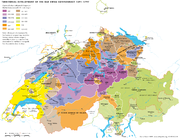
Traditionally, the foundation of the Confederacy is marked by the Rütlischwur
, dated to 1307 by Aegidius Tschudi
, or by the Pact of Brunnen
of 1315.
Since 1889, the Federal Charter of 1291
among the rural communes
of Uri
, Schwyz
, and Unterwalden
been popularly considered the founding document of the confederacy.
, Zürich
, and Berne
. This rare union of rural and urban communes
, all of which had the status of imperial immediacy within the Holy Roman Empire
, was caused by them all being under pressure by the Habsburg
dukes and kings, who once had ruled much of these lands. In several battles against Habsburg armies, the Swiss remained victorious and even conquered the rural areas of Glarus
and Zug
, which subsequently became independent members of the confederacy.
From 1353 to 1481, this federation of eight cantons
, known in German as the Acht Orte (Eight Places), consolidated its position. The individual members, especially the cities, enlarged their territories at the cost of the local counts in the neighbourhood, mostly by buying the judicial rights, but sometimes also by force. The Eidgenossenschaft as a whole expanded through military conquests. The Aargau
was conquered in 1415, the Thurgau
in 1460. Both times, the Swiss profited from a weakness of the Habsburg dukes. In the south, Uri
led a military territorial expansion that would—after many setbacks—by 1515 lead to the conquest of the Ticino
.
None of these territories became members of the confederacy, though; instead, they had a status as condominiums
, regions administered commonly by several cantons.
At the same time, the eight cantons gradually increased their influence on neighbouring cities and regions through additional alliances. Not the Eidgenossenschaft as a whole, but several (or only one) individual cantons concluded pacts with Fribourg
, Appenzell
, Schaffhausen
, the abbot and the city of St. Gallen
, Biel, Rottweil
, Mulhouse
, and others. These allies, called the Zugewandte Orte, became closely associated to the confederacy, but were not accepted as full members.
The Burgundy Wars prompted a further enlargement of the union with new members. Fribourg
and Solothurn
were accepted into the confederacy in 1481. In the Swabian War
against emperor Maximilian I, Holy Roman Emperor
, the Swiss again remained victorious and were exempted from the imperial legislation. The previously associated cities of Basel
and Schaffhausen
joined the confederacy as a direct result of that conflict. Appenzell
followed in 1513 as the 13th member. This federation of thirteen cantons (Dreizehn Orte) constituted the Old Swiss Confederacy until its demise in 1798.
The military expansion of the confederacy was stopped by the loss of the Swiss in the battle of Marignano
in 1515. Only Berne and Fribourg were still able to conquer the Vaud
in 1536, which mostly became part of the canton of Berne
, with only a small part coming under the rule of Fribourg.
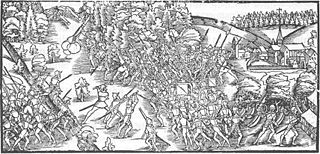 The Reformation in Switzerland
led to a confession
al division amongst the cantons. Zürich, Berne, Basel, Schaffhausen, as well as the associates Biel, Mulhouse, Neuchâtel, Geneva, and the city of St. Gallen became Protestant, the other members of the confederation and the Valais
remained Catholic
. In Glarus, Appenzell, in the Grisons, and in most condominium
s both religions coexisted; Appenzell split in 1597 into a Catholic Appenzell Inner Rhodes and a Protestant Appenzell Outer Rhodes.
The confessional division led to civil war — the wars of Kappel
— and separate alliances with foreign powers of the Catholic and Protestant factions, but the confederacy as a whole continued to exist. A common foreign policy was blocked, though, by the stand-off of the two equally strong camps. In the Thirty Years' War
, the deep religious disagreements among the cantons kept the confederacy neutral and spared it from all belligerent devastations. At the Peace of Westphalia
, the Swiss delegation was granted formal recognition of the confederacy as an independent state, separate from the Holy Roman Empire
.
in the city cantons during the Ancien Régime of Switzerland led to various local popular revolts
. Only the uprising in 1653, during the post-war depression after the Thirty Years' War, escalated to the general Swiss peasant war
in the territories of Lucerne, Berne, Basel, Solothurn, and in the Aargau. The revolt was put down by force with the help of the other cantons.
The religious differences were increasingly accentuated by an ever-growing economic discrepancy. The Catholic and predominantly rural central Swiss cantons were surrounded by Protestant cantons with increasingly commercial economies. The politically dominant cantons were Zürich and Berne, both Protestant, but, in the common agencies of the confederation, the Catholic cantons had the upper hand since the second war of Kappel, in 1531. An attempt in 1655, led by Zürich, to restructure the federation was blocked by a Catholic opposition, which led to the first war of Villmergen in 1656, which the Catholic party won, cementing the status quo. But the problems remained unsolved and erupted again in 1712 in the second war of Villmergen. This time, the Protestant cantons won, and thenceforth dominated the federation. A true reform, however, was not possible: the individual interests of the thirteen members were too diverse and the absolutist cantonal governments resisted all attempts at centralisation or at introducing a federation-wide administration or a modern bureaucracy. The foreign politics remained fragmented.
, at the invitation of the Republican faction in Vaud
, led by Frédéric-César de La Harpe
. The invasion proceeded largely peacefully, since the Swiss people failed to respond to the calls of their politicians to take up arms, and the collapse of the Confederacy was not so much due to external pressure than to the internal division between sovereign cantons and subject territories.
The Helvetic Republic
was proclaimed on 12 April 1798 as "one and indivisible", abolishing all cantonal sovereignty and feudal rights, reducing the cantons to the status of mere administrative districts. But this system was unstable, as there was federalist opposition not only among the urban elite but also in the rural cantons, and the government of the Helvetic Republic soon collapsed in its turn as a result of the Stecklikrieg
. A federalist compromise solution
was attempted, but the latent conflict between federalist elites and republican subjects persisted until the formation of the modern federal state
in 1848.
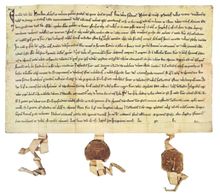
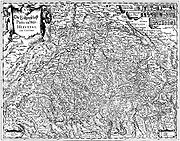
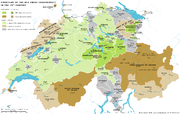 Initially, the Eidgenossenschaft was not united by one single pact, but rather by a whole set of overlapping pacts and separate bilateral treaties between various members, with only minimum liabilities. The parties generally agreed to preserve the peace in their territories, help each other in military endeavours, and defined some arbitration in case of disputes. Only slowly did the members begin to understand the federation itself as a unifying entity. In the Pfaffenbrief
, a treaty of 1370 among six of the eight members (Glarus and Berne did not participate) that forbade feud
s and that denied clerical courts any jurisdiction over the confederacy, the cantons referred for the first time to themselves using the singular term Eidgenossenschaft. The first treaty uniting all of the then eight members of the confederacy became the Sempacherbrief of 1393. This treaty was concluded after the important victories over the Habsburg
s at Sempach
and Näfels
(1386 and 1388) and declared that no member was to unilaterally begin a war without the consent of the other cantons. Subsequently, a kind of federal diet
, the Tagsatzung
, developed in the 15th century.
Other pacts and renewals or modernizations of earlier alliances between some of the members reinforced the confederacy. Yet the individual interests of the cantons clashed in the Old Zürich War
(1436 – 1450), which was caused by a territorial conflict among Zürich and the central Swiss cantons over the succession of the Count of Toggenburg. Zürich even entered an alliance with the Habsburg dukes, but finally re-joined the confederacy. The confederation had grown into a political alliance so close that it no longer tolerated separatist tendencies of its members.
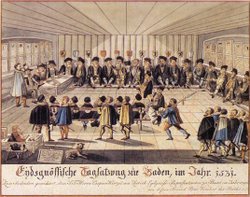 The Tagsatzung served as the council of the confederation and typically met several times a year. Each canton delegated two representatives; including the associate states, who, however, had no vote. Initially, the canton where the delegates met chaired the gathering, but in the 16th century, Zürich permanently assumed the chair (Vorort), and Baden
became the sessional seat. The Tagsatzung dealt with all inter-cantonal affairs and also served as the final arbitral court to settle disputes between member states, or to decide on sanctions against dissenting members. It also organized and oversaw the administration of the condominiums; the reeves were delegated for two years, each time by a different canton.
An important unifying treaty of the Old Swiss Confederacy was the Stanser Verkommnis
of 1481. Conflicts between the rural and the urban cantons and disagreements about the repartition of the bounty of the Burgundian Wars
had led to several skirmishes. The city states of Fribourg and Solothurn wanted to join the confederacy, but were met with distrust by the central Swiss rural cantons. The compromise of the Tagsatzung in the Stanser Verkommnis restored order and accounted for the rural cantons' complaints; Fribourg and Solothurn were accepted into the federation. While the treaty also restricted the freedom of assembly (many skirmishes were caused by unauthorised expeditions of groups of soldiers from the Burgundian Wars), it also reinforced the agreements amongst the cantons of the earlier Sempacherbrief and Pfaffenbrief.
The civil war during the Reformation
brought about a stalemate. The victorious Catholic cantons could block any decisions of the council, but due to their geographic and economic situation could not overcome the Protestant cantons. Both factions began to hold separate councils, but still met at a common Tagsatzung, even though this common council remained effectively blocked by the disagreements of the two factions until 1712, when the Protestant cantons reversed the situation after their victory in the second war of Villmergen. The Catholic cantons were excluded from the administration of the condominiums in the Aargau, the Thurgau, and the Rhine valley; in their place, Berne became a co-sovereign of these regions.
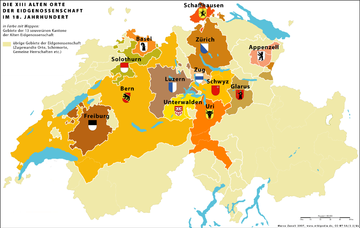
 The confederation expanded in several stages: first to the Eight Cantons (Acht Orte), then in 1481 to ten, in 1501 to twelve, and finally to thirteen cantons (Dreizehn Orte).
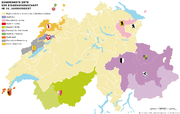 Associates
(Zugewandte Orte) were close allies of the Old Swiss Confederacy, connected to the union by alliance treaties with all or some of the individual members of the confederacy.
s were common subject territories under the administration of several cantons. They were governed by reeves
(Vögte) delegated for two years, each time from another of the responsible cantons. Berne initially did not participate in the administration of some of the eastern condominiums, as it had no part in their conquest and its interests were focused more on the western border. In 1712, Berne replaced the Catholic cantons in the administration of the Freie Ämter
("Free Districts"), the Thurgau
, the Rhine valley, and Sargans
, and furthermore the Catholic cantons were excluded from the administration of the County of Baden.
(Vogteien) were generally referred to as "transmontane bailiwicks" .
In 1440, Uri
conquered the Leventina Valley from the Visconti
, dukes of Milan
. Some of this territory had previously been annexed between 1403 and 1422. Further territories were acquired in 1500; see History of Ticino for further details.
Three bailiwicks, all now in the Ticino
, were condominiums of the Forest cantons of Uri, Schwyz and Nidwalden:
Four other Ticinese bailiwicks were condominiums of the Zwölf Orte (the original 13 cantons, minus Appenzell) from 1512:
Another three bailiwicks were condominiums of the Zwölf Orte from 1512, but were lost from the Confederacy three years later and are all now comuni of Lombardy
:
German language
German is a West Germanic language, related to and classified alongside English and Dutch. With an estimated 90 – 98 million native speakers, German is one of the world's major languages and is the most widely-spoken first language in the European Union....
: ; historically , after the Reformation also , "Republic of the Swiss
Swiss (people)
The Swiss are citizens or natives of Switzerland. The demonym derives from the toponym of Schwyz and has been in widespread use to refer to the Old Swiss Confederacy since the 16th century....
") was the precursor of modern-day Switzerland
Switzerland
Switzerland name of one of the Swiss cantons. ; ; ; or ), in its full name the Swiss Confederation , is a federal republic consisting of 26 cantons, with Bern as the seat of the federal authorities. The country is situated in Western Europe,Or Central Europe depending on the definition....
.
It was a loose confederation
Confederation
A confederation in modern political terms is a permanent union of political units for common action in relation to other units. Usually created by treaty but often later adopting a common constitution, confederations tend to be established for dealing with critical issues such as defense, foreign...
of largely independent small states called cantons
Cantons of Switzerland
The 26 cantons of Switzerland are the member states of the federal state of Switzerland. Each canton was a fully sovereign state with its own borders, army and currency from the Treaty of Westphalia until the establishment of the Swiss federal state in 1848...
which formed during the 14th century. From a nucleus in what is now Central Switzerland
Central Switzerland
Central Switzerland is the region of the Alpine foothills geographically the heart and historically the origin of Switzerland, with the cantons of Uri, Schwyz, Obwalden, Nidwalden, Lucerne and Zug....
, the confederacy expanded
Growth of the Old Swiss Confederacy
The growth of the Old Swiss Confederacy began as an alliance between the communities of the valleys in the Central Alps to facilitate the management of common interests such as free trade and to ensure the peace along the important trade routes through the mountains...
to include the cities of Zürich
Zürich
Zurich is the largest city in Switzerland and the capital of the canton of Zurich. It is located in central Switzerland at the northwestern tip of Lake Zurich...
and Berne
Berne
The city of Bern or Berne is the Bundesstadt of Switzerland, and, with a population of , the fourth most populous city in Switzerland. The Bern agglomeration, which includes 43 municipalities, has a population of 349,000. The metropolitan area had a population of 660,000 in 2000...
by the mid 14th-century, forming a rare union of rural and urban communes
Medieval commune
Medieval communes in the European Middle Ages had sworn allegiances of mutual defense among the citizens of a town or city. They took many forms, and varied widely in organization and makeup. Communes are first recorded in the late 11th and early 12th centuries, thereafter becoming a widespread...
, all of which had the status of imperial immediacy within the Holy Roman Empire
Holy Roman Empire
The Holy Roman Empire was a realm that existed from 962 to 1806 in Central Europe.It was ruled by the Holy Roman Emperor. Its character changed during the Middle Ages and the Early Modern period, when the power of the emperor gradually weakened in favour of the princes...
.
This confederation of eight cantons (Acht Orte) persisted for more than a century, enjoying great political and military successes, culminating in the Burgundy Wars in the 1470s, which established it as a power holding its own in the complicated political landscape dominated by France
Early Modern France
Kingdom of France is the early modern period of French history from the end of the 15th century to the end of the 18th century...
and the Habsburgs
Habsburg Monarchy
The Habsburg Monarchy covered the territories ruled by the junior Austrian branch of the House of Habsburg , and then by the successor House of Habsburg-Lorraine , between 1526 and 1867/1918. The Imperial capital was Vienna, except from 1583 to 1611, when it was moved to Prague...
. These successes resulted in the accession of more confederates, increasing the number of cantons to thirteen by 1513 (Dreizehn Orte).
The confederacy pledged neutrality in 1515, and again in 1647 under the threat of the Thirty Years' War
Thirty Years' War
The Thirty Years' War was fought primarily in what is now Germany, and at various points involved most countries in Europe. It was one of the most destructive conflicts in European history....
, even though many Swiss served privately as mercenaries
Swiss mercenaries
Swiss mercenaries were notable for their service in foreign armies, especially the armies of the Kings of France, throughout the Early Modern period of European history, from the Later Middle Ages into the Age of the European Enlightenment...
in the Italian Wars
Italian Wars
The Italian Wars, often referred to as the Great Italian Wars or the Great Wars of Italy and sometimes as the Habsburg–Valois Wars, were a series of conflicts from 1494 to 1559 that involved, at various times, most of the city-states of Italy, the Papal States, most of the major states of Western...
and throughout the Early Modern period.
After the Swabian War
Swabian War
The Swabian War of 1499 was the last major armed conflict between the Old Swiss Confederacy and the House of Habsburg...
of 1499, the confederacy was a de-facto independent state throughout the early modern period
Early modern period
In history, the early modern period of modern history follows the late Middle Ages. Although the chronological limits of the period are open to debate, the timeframe spans the period after the late portion of the Middle Ages through the beginning of the Age of Revolutions...
, although still nominally part of the Holy Roman Empire
Early Modern Switzerland
The early modern history of the Old Swiss Confederacy , lasting from formal independence in 1648 to the French invasion of 1798 came to be referred as Ancien Régime retrospectively, in post-Napoleonic Switzerland.The early modern period was characterized by an increasingly...
until 1648. However, the Swiss Reformation divided the confederates in a Reformed and a Catholic party, resulting in numerous internal conflicts during the 16th to 18th centuries, and as a result the federal diet or Tagsatzung
Tagsatzung
The Swiss Tagsatzung was the legislative and executive council of the Swiss confederacy from the beginnings until the formation of the Swiss federal state in 1848. It was a meeting of delegates of the individual cantons...
was often paralyzed by hostilities between the two factions.
The Swiss Confederacy finally fell to the invasion by the French Revolutionary Army
French Revolutionary Army
The French Revolutionary Army is the term used to refer to the military of France during the period between the fall of the ancien regime under Louis XVI in 1792 and the formation of the First French Empire under Napoleon Bonaparte in 1804. These armies were characterised by their revolutionary...
in 1798, after which it was transformed it into the short-lived Helvetic Republic
Helvetic Republic
In Swiss history, the Helvetic Republic represented an early attempt to impose a central authority over Switzerland, which until then consisted mainly of self-governing cantons united by a loose military alliance, and conquered territories such as Vaud...
.
Name
The specification "Old" was introduced in retrospect, after the end of the Napoleonic eraNapoleonic Era
The Napoleonic Era is a period in the history of France and Europe. It is generally classified as including the fourth and final stage of the French Revolution, the first being the National Assembly, the second being the Legislative Assembly, and the third being the Directory...
, alongside the term Ancien Régime, a retronym
Retronym
A retronym is a type of neologism that provides a new name for an object or concept to differentiate the original form or version of it from a more recent form or version. The original name is most often augmented with an adjective to account for later developments of the object or concept itself...
distinguishing the pre-Napoleonic from the restored confederation.
Contemporarily, the confederacy was simply known as Eidgenossenschaft (Eydtgnoschafft) or "oath fellowship" in reference to the treaties between the individual cantons. This term was first used in the Pfaffenbrief
Pfaffenbrief
The Pfaffenbrief is a contract dated to October 7, 1370, between six states of the Old Swiss Confederacy, Zürich, Lucerne, Zug, Uri, Schwyz and Unterwalden ....
of 1370.
The territories of the confederacy came to be referred to collectively as Schweiz or Schweizerland (in contemporary spelling Schwytzerland, whence English Switzerland) beginning in the mid-16th century.
From that time, the Confederacy came to be seen as a single state, and was also called the Swiss Republic (Republic der Schweitzer, République des Suisses, Republica Helvetiorum, so by Josias Simmler
Josias Simmler
Josias Simmler , was a Swiss theologian and classicist, author of the first book relating solely to the Alps.-Life:...
1576), after the fashion of styling individual urban cantons as Republics
Classical republicanism
Classical republicanism is a form of republicanism developed in the Renaissance inspired by the governmental forms and writings of classical antiquity. The earliest examples of the school were classical writers such as Aristotle, Polybius, and Cicero...
(Republic of Zürich. Republic of Berne, Republic of Basel).
History
Foundation
The nucleus of the Old Swiss Confederacy was an alliance between the communities of the valleys in the Central Alps to facilitate the management of common interests such as free trade and to ensure the peace along the important trade routes through the mountains.Traditionally, the foundation of the Confederacy is marked by the Rütlischwur
Rütlischwur
The Rütlischwur is a legendary oath of the Old Swiss Confederacy, taken on the Rütli, a meadow above Lake Lucerne near Seelisberg. The oath is notably featured in the Wilhelm Tell drama of 1804 by Friedrich Schiller.-Early accounts:...
, dated to 1307 by Aegidius Tschudi
Aegidius Tschudi
Aegidius Tschudi was an eminent member of the Tschudi family, of Glarus, Switzerland....
, or by the Pact of Brunnen
Pact of Brunnen
The pact of Brunnen is a historical treaty between the cantons ofUri, Schwyz, Unterwalden, concluded in Brunnen SZ on 9 December 1315....
of 1315.
Since 1889, the Federal Charter of 1291
Federal Charter of 1291
The Federal Charter or Letter of Alliance documents the Eternal Alliance or League Of The Three Forest Cantons , the union of three cantons in what is now central Switzerland. It is dated in early August, 1291 and initiates the current August 1 national Swiss holiday. This agreement cites a...
among the rural communes
Medieval commune
Medieval communes in the European Middle Ages had sworn allegiances of mutual defense among the citizens of a town or city. They took many forms, and varied widely in organization and makeup. Communes are first recorded in the late 11th and early 12th centuries, thereafter becoming a widespread...
of Uri
Canton of Uri
Uri is one of the 26 cantons of Switzerland and a founding member of the Swiss Confederation. It is located in Central Switzerland. The canton's territory covers the valley of the Reuss River between Lake Lucerne and the St. Gotthard Pass. German is the primary language spoken in Uri...
, Schwyz
Canton of Schwyz
Schwyz is a canton in central Switzerland between the Alps in the south, Lake Lucerne in the east and Lake Zurich in the north, centered around and named after the town of Schwyz....
, and Unterwalden
Unterwalden
Unterwalden is the old name of a forest-canton of the Old Swiss Confederacy in central Switzerland, south of Lake Lucerne, consisting of two valleys or Talschaften, now organized as two half-cantons, an upper part, Obwalden, and a lower part, Nidwalden.Unterwalden was one of the three participants...
been popularly considered the founding document of the confederacy.
Growth of the federation
This initial pact was gradually augmented with additional pacts with the cities of LucerneLucerne
Lucerne is a city in north-central Switzerland, in the German-speaking portion of that country. Lucerne is the capital of the Canton of Lucerne and the capital of the district of the same name. With a population of about 76,200 people, Lucerne is the most populous city in Central Switzerland, and...
, Zürich
Zürich
Zurich is the largest city in Switzerland and the capital of the canton of Zurich. It is located in central Switzerland at the northwestern tip of Lake Zurich...
, and Berne
Berne
The city of Bern or Berne is the Bundesstadt of Switzerland, and, with a population of , the fourth most populous city in Switzerland. The Bern agglomeration, which includes 43 municipalities, has a population of 349,000. The metropolitan area had a population of 660,000 in 2000...
. This rare union of rural and urban communes
Medieval commune
Medieval communes in the European Middle Ages had sworn allegiances of mutual defense among the citizens of a town or city. They took many forms, and varied widely in organization and makeup. Communes are first recorded in the late 11th and early 12th centuries, thereafter becoming a widespread...
, all of which had the status of imperial immediacy within the Holy Roman Empire
Holy Roman Empire
The Holy Roman Empire was a realm that existed from 962 to 1806 in Central Europe.It was ruled by the Holy Roman Emperor. Its character changed during the Middle Ages and the Early Modern period, when the power of the emperor gradually weakened in favour of the princes...
, was caused by them all being under pressure by the Habsburg
Habsburg
The House of Habsburg , also found as Hapsburg, and also known as House of Austria is one of the most important royal houses of Europe and is best known for being an origin of all of the formally elected Holy Roman Emperors between 1438 and 1740, as well as rulers of the Austrian Empire and...
dukes and kings, who once had ruled much of these lands. In several battles against Habsburg armies, the Swiss remained victorious and even conquered the rural areas of Glarus
Glarus
Glarus is the capital of the Canton of Glarus in Switzerland. Glarus municipality since 1 January 2011 incorporates the former municipalities of Ennenda, Netstal and Riedern....
and Zug
Zug
Zug , is a German-speaking city in Switzerland. The name ‘Zug’ originates from fishing vocabulary; in the Middle Ages it referred to the right to ‘pull up’ fishing nets and hence to the right to fish.The city of Zug is located in the Canton of Zug and is its capital...
, which subsequently became independent members of the confederacy.
From 1353 to 1481, this federation of eight cantons
Cantons of Switzerland
The 26 cantons of Switzerland are the member states of the federal state of Switzerland. Each canton was a fully sovereign state with its own borders, army and currency from the Treaty of Westphalia until the establishment of the Swiss federal state in 1848...
, known in German as the Acht Orte (Eight Places), consolidated its position. The individual members, especially the cities, enlarged their territories at the cost of the local counts in the neighbourhood, mostly by buying the judicial rights, but sometimes also by force. The Eidgenossenschaft as a whole expanded through military conquests. The Aargau
Aargau
Aargau is one of the more northerly cantons of Switzerland. It comprises the lower course of the river Aare, which is why the canton is called Aar-gau .-History:...
was conquered in 1415, the Thurgau
Thurgau
Thurgau is a northeast canton of Switzerland. The population, , is . In 2007, there were a total of 47,390 who were resident foreigners. The capital is Frauenfeld.-History:...
in 1460. Both times, the Swiss profited from a weakness of the Habsburg dukes. In the south, Uri
Canton of Uri
Uri is one of the 26 cantons of Switzerland and a founding member of the Swiss Confederation. It is located in Central Switzerland. The canton's territory covers the valley of the Reuss River between Lake Lucerne and the St. Gotthard Pass. German is the primary language spoken in Uri...
led a military territorial expansion that would—after many setbacks—by 1515 lead to the conquest of the Ticino
Ticino
Canton Ticino or Ticino is the southernmost canton of Switzerland. Named after the Ticino river, it is the only canton in which Italian is the sole official language...
.
None of these territories became members of the confederacy, though; instead, they had a status as condominiums
Condominium (international law)
In international law, a condominium is a political territory in or over which two or more sovereign powers formally agree to share equally dominium and exercise their rights jointly, without dividing it up into 'national' zones.Although a condominium has always been...
, regions administered commonly by several cantons.
At the same time, the eight cantons gradually increased their influence on neighbouring cities and regions through additional alliances. Not the Eidgenossenschaft as a whole, but several (or only one) individual cantons concluded pacts with Fribourg
Fribourg
Fribourg is the capital of the Swiss canton of Fribourg and the district of Sarine. It is located on both sides of the river Saane/Sarine, on the Swiss plateau, and is an important economic, administrative and educational center on the cultural border between German and French Switzerland...
, Appenzell
Appenzell
Appenzell is a region and historical canton in the northeast of Switzerland, entirely surrounded by the Canton of St. Gallen....
, Schaffhausen
Schaffhausen
Schaffhausen is a city in northern Switzerland and the capital of the canton of the same name; it has an estimated population of 34,587 ....
, the abbot and the city of St. Gallen
St. Gallen
St. Gallen is the capital of the canton of St. Gallen in Switzerland. It evolved from the hermitage of Saint Gall, founded in the 7th century. Today, it is a large urban agglomeration and represents the center of eastern Switzerland. The town mainly relies on the service sector for its economic...
, Biel, Rottweil
Rottweil
Rottweil is a town in the south west of Germany and is the oldest town in the federal state of Baden-Württemberg.Located between the Black Forest and the Swabian Alb hills, Rottweil has about 25,000 inhabitants...
, Mulhouse
Mulhouse
Mulhouse |mill]] hamlet) is a city and commune in eastern France, close to the Swiss and German borders. With a population of 110,514 and 278,206 inhabitants in the metropolitan area in 2006, it is the largest city in the Haut-Rhin département, and the second largest in the Alsace region after...
, and others. These allies, called the Zugewandte Orte, became closely associated to the confederacy, but were not accepted as full members.
The Burgundy Wars prompted a further enlargement of the union with new members. Fribourg
Fribourg
Fribourg is the capital of the Swiss canton of Fribourg and the district of Sarine. It is located on both sides of the river Saane/Sarine, on the Swiss plateau, and is an important economic, administrative and educational center on the cultural border between German and French Switzerland...
and Solothurn
Solothurn
The city of Solothurn is the capital of the Canton of Solothurn in Switzerland. The city also comprises the only municipality of the district of the same name.-Pre-roman settlement:...
were accepted into the confederacy in 1481. In the Swabian War
Swabian War
The Swabian War of 1499 was the last major armed conflict between the Old Swiss Confederacy and the House of Habsburg...
against emperor Maximilian I, Holy Roman Emperor
Maximilian I, Holy Roman Emperor
Maximilian I , the son of Frederick III, Holy Roman Emperor and Eleanor of Portugal, was King of the Romans from 1486 and Holy Roman Emperor from 1493 until his death, though he was never in fact crowned by the Pope, the journey to Rome always being too risky...
, the Swiss again remained victorious and were exempted from the imperial legislation. The previously associated cities of Basel
Basel
Basel or Basle In the national languages of Switzerland the city is also known as Bâle , Basilea and Basilea is Switzerland's third most populous city with about 166,000 inhabitants. Located where the Swiss, French and German borders meet, Basel also has suburbs in France and Germany...
and Schaffhausen
Schaffhausen
Schaffhausen is a city in northern Switzerland and the capital of the canton of the same name; it has an estimated population of 34,587 ....
joined the confederacy as a direct result of that conflict. Appenzell
Appenzell
Appenzell is a region and historical canton in the northeast of Switzerland, entirely surrounded by the Canton of St. Gallen....
followed in 1513 as the 13th member. This federation of thirteen cantons (Dreizehn Orte) constituted the Old Swiss Confederacy until its demise in 1798.
The military expansion of the confederacy was stopped by the loss of the Swiss in the battle of Marignano
Battle of Marignano
The Battle of Marignano was fought during the phase of the Italian Wars called the War of the League of Cambrai, between France and the Old Swiss Confederacy. It took place on September 13 and 15, 1515, near the town today called Melegnano, 16 km southeast of Milan...
in 1515. Only Berne and Fribourg were still able to conquer the Vaud
Vaud
Vaud is one of the 26 cantons of Switzerland and is located in Romandy, the French-speaking southwestern part of the country. The capital is Lausanne. The name of the Canton in Switzerland's other languages are Vaud in Italian , Waadt in German , and Vad in Romansh.-History:Along the lakes,...
in 1536, which mostly became part of the canton of Berne
Canton of Berne
The Canton of Bern is the second largest of the 26 Swiss cantons by both surface area and population. Located in west-central Switzerland, it borders the Canton of Jura and the Canton of Solothurn to the north. To the west lie the Canton of Neuchâtel, the Canton of Fribourg and Vaud. To the south...
, with only a small part coming under the rule of Fribourg.
Reformation
Reformation in Switzerland
The Protestant Reformation in Switzerland was promoted initially by Huldrych Zwingli, who gained the support of the magistrate and population of Zürich in the 1520s. It led to significant changes in civil life and state matters in Zürich and spread to several other cantons of the Old Swiss...
led to a confession
Confession
This article is for the religious practice of confessing one's sins.Confession is the acknowledgment of sin or wrongs...
al division amongst the cantons. Zürich, Berne, Basel, Schaffhausen, as well as the associates Biel, Mulhouse, Neuchâtel, Geneva, and the city of St. Gallen became Protestant, the other members of the confederation and the Valais
Valais
The Valais is one of the 26 cantons of Switzerland in the southwestern part of the country, around the valley of the Rhône from its headwaters to Lake Geneva, separating the Pennine Alps from the Bernese Alps. The canton is one of the drier parts of Switzerland in its central Rhône valley...
remained Catholic
Catholic
The word catholic comes from the Greek phrase , meaning "on the whole," "according to the whole" or "in general", and is a combination of the Greek words meaning "about" and meaning "whole"...
. In Glarus, Appenzell, in the Grisons, and in most condominium
Condominium (international law)
In international law, a condominium is a political territory in or over which two or more sovereign powers formally agree to share equally dominium and exercise their rights jointly, without dividing it up into 'national' zones.Although a condominium has always been...
s both religions coexisted; Appenzell split in 1597 into a Catholic Appenzell Inner Rhodes and a Protestant Appenzell Outer Rhodes.
The confessional division led to civil war — the wars of Kappel
Wars of Kappel
The wars of Kappel were two armed conflicts fought near Kappel am Albis between the Protestant and the Roman Catholic cantons of the Old Swiss Confederacy during the reformation in Switzerland.*First war of Kappel...
— and separate alliances with foreign powers of the Catholic and Protestant factions, but the confederacy as a whole continued to exist. A common foreign policy was blocked, though, by the stand-off of the two equally strong camps. In the Thirty Years' War
Thirty Years' War
The Thirty Years' War was fought primarily in what is now Germany, and at various points involved most countries in Europe. It was one of the most destructive conflicts in European history....
, the deep religious disagreements among the cantons kept the confederacy neutral and spared it from all belligerent devastations. At the Peace of Westphalia
Peace of Westphalia
The Peace of Westphalia was a series of peace treaties signed between May and October of 1648 in Osnabrück and Münster. These treaties ended the Thirty Years' War in the Holy Roman Empire, and the Eighty Years' War between Spain and the Dutch Republic, with Spain formally recognizing the...
, the Swiss delegation was granted formal recognition of the confederacy as an independent state, separate from the Holy Roman Empire
Holy Roman Empire
The Holy Roman Empire was a realm that existed from 962 to 1806 in Central Europe.It was ruled by the Holy Roman Emperor. Its character changed during the Middle Ages and the Early Modern period, when the power of the emperor gradually weakened in favour of the princes...
.
Early modern period
Growing social differences and an increasing absolutismAbsolutism (European history)
Absolutism or The Age of Absolutism is a historiographical term used to describe a form of monarchical power that is unrestrained by all other institutions, such as churches, legislatures, or social elites...
in the city cantons during the Ancien Régime of Switzerland led to various local popular revolts
Popular revolt in late medieval Europe
Popular revolts in late medieval Europe were uprisings and rebellions by peasants in the countryside, or the bourgeois in towns, against nobles, abbots and kings during the upheavals of the 14th through early 16th centuries, part of a larger "Crisis of the Late Middle Ages"...
. Only the uprising in 1653, during the post-war depression after the Thirty Years' War, escalated to the general Swiss peasant war
Swiss peasant war of 1653
The Swiss peasant war of 1653 was a popular revolt in the Old Swiss Confederacy at the time of the Ancien Régime. A devaluation of Bernese money caused a tax revolt that spread from the Entlebuch valley in the Canton of Lucerne to the Emmental valley in the Canton of Bern and then to the cantons of...
in the territories of Lucerne, Berne, Basel, Solothurn, and in the Aargau. The revolt was put down by force with the help of the other cantons.
The religious differences were increasingly accentuated by an ever-growing economic discrepancy. The Catholic and predominantly rural central Swiss cantons were surrounded by Protestant cantons with increasingly commercial economies. The politically dominant cantons were Zürich and Berne, both Protestant, but, in the common agencies of the confederation, the Catholic cantons had the upper hand since the second war of Kappel, in 1531. An attempt in 1655, led by Zürich, to restructure the federation was blocked by a Catholic opposition, which led to the first war of Villmergen in 1656, which the Catholic party won, cementing the status quo. But the problems remained unsolved and erupted again in 1712 in the second war of Villmergen. This time, the Protestant cantons won, and thenceforth dominated the federation. A true reform, however, was not possible: the individual interests of the thirteen members were too diverse and the absolutist cantonal governments resisted all attempts at centralisation or at introducing a federation-wide administration or a modern bureaucracy. The foreign politics remained fragmented.
Collapse
In 1798, the confederacy was invaded by the French Revolutionary ArmyFrench Revolutionary Army
The French Revolutionary Army is the term used to refer to the military of France during the period between the fall of the ancien regime under Louis XVI in 1792 and the formation of the First French Empire under Napoleon Bonaparte in 1804. These armies were characterised by their revolutionary...
, at the invitation of the Republican faction in Vaud
Vaud
Vaud is one of the 26 cantons of Switzerland and is located in Romandy, the French-speaking southwestern part of the country. The capital is Lausanne. The name of the Canton in Switzerland's other languages are Vaud in Italian , Waadt in German , and Vad in Romansh.-History:Along the lakes,...
, led by Frédéric-César de La Harpe
Frédéric-César de La Harpe
Frédéric-César de La Harpe was a Swiss political leader and Vaudois patriot, who played a leading role in the creation of the Helvetic Republic.-Biography:...
. The invasion proceeded largely peacefully, since the Swiss people failed to respond to the calls of their politicians to take up arms, and the collapse of the Confederacy was not so much due to external pressure than to the internal division between sovereign cantons and subject territories.
The Helvetic Republic
Helvetic Republic
In Swiss history, the Helvetic Republic represented an early attempt to impose a central authority over Switzerland, which until then consisted mainly of self-governing cantons united by a loose military alliance, and conquered territories such as Vaud...
was proclaimed on 12 April 1798 as "one and indivisible", abolishing all cantonal sovereignty and feudal rights, reducing the cantons to the status of mere administrative districts. But this system was unstable, as there was federalist opposition not only among the urban elite but also in the rural cantons, and the government of the Helvetic Republic soon collapsed in its turn as a result of the Stecklikrieg
Stecklikrieg
The Stecklikrieg of 1802 resulted in the collapse of the Helvetic Republic, the renewed French occupation of Switzerland and ultimately the Act of Mediation dictated by Napoleon on 10 March 1803....
. A federalist compromise solution
Act of Mediation
The Act of Mediation was issued by Napoleon Bonaparte on 19 February 1803 establishing the Swiss Confederation. The act also abolished the previous Helvetic Republic, which had existed since the invasion of Switzerland by French troops in 1798. After the withdrawal of French troops in July 1802,...
was attempted, but the latent conflict between federalist elites and republican subjects persisted until the formation of the modern federal state
Switzerland as a federal state
The rise of Switzerland as a federal state began on September 12, 1848, with the creation of a federal constitution, which was created in response to a 27-day civil war in Switzerland, the Sonderbundskrieg...
in 1848.
Structure of the federation
Pfaffenbrief
The Pfaffenbrief is a contract dated to October 7, 1370, between six states of the Old Swiss Confederacy, Zürich, Lucerne, Zug, Uri, Schwyz and Unterwalden ....
, a treaty of 1370 among six of the eight members (Glarus and Berne did not participate) that forbade feud
Feud
A feud , referred to in more extreme cases as a blood feud, vendetta, faida, or private war, is a long-running argument or fight between parties—often groups of people, especially families or clans. Feuds begin because one party perceives itself to have been attacked, insulted or wronged by another...
s and that denied clerical courts any jurisdiction over the confederacy, the cantons referred for the first time to themselves using the singular term Eidgenossenschaft. The first treaty uniting all of the then eight members of the confederacy became the Sempacherbrief of 1393. This treaty was concluded after the important victories over the Habsburg
Habsburg
The House of Habsburg , also found as Hapsburg, and also known as House of Austria is one of the most important royal houses of Europe and is best known for being an origin of all of the formally elected Holy Roman Emperors between 1438 and 1740, as well as rulers of the Austrian Empire and...
s at Sempach
Battle of Sempach
An armistice was agreed upon on 12 October, followed by a peace agreement valid for one year, beginning on 14 January 1387.The battle was a severe blow to Austrian interests in the region, and allowed for the further growth of the Old Swiss Confederacy....
and Näfels
Battle of Näfels
The Battle of Näfels was fought on 9 April 1388 between Glarus with their allies, the Old Swiss Confederation, and the Habsburgs. It was a decisive Glarner victory despite being outnumbered sixteen to one.-History:...
(1386 and 1388) and declared that no member was to unilaterally begin a war without the consent of the other cantons. Subsequently, a kind of federal diet
Diet (assembly)
In politics, a diet is a formal deliberative assembly. The term is mainly used historically for the Imperial Diet, the general assembly of the Imperial Estates of the Holy Roman Empire, and for the legislative bodies of certain countries.-Etymology:...
, the Tagsatzung
Tagsatzung
The Swiss Tagsatzung was the legislative and executive council of the Swiss confederacy from the beginnings until the formation of the Swiss federal state in 1848. It was a meeting of delegates of the individual cantons...
, developed in the 15th century.
Other pacts and renewals or modernizations of earlier alliances between some of the members reinforced the confederacy. Yet the individual interests of the cantons clashed in the Old Zürich War
Old Zürich War
The Old Zürich War , 1440–46, was a conflict between the canton of Zürich and the other seven cantons of the Old Swiss Confederacy over the succession to the Count of Toggenburg....
(1436 – 1450), which was caused by a territorial conflict among Zürich and the central Swiss cantons over the succession of the Count of Toggenburg. Zürich even entered an alliance with the Habsburg dukes, but finally re-joined the confederacy. The confederation had grown into a political alliance so close that it no longer tolerated separatist tendencies of its members.
Baden, Switzerland
Baden is a municipality in the Swiss canton of Aargau, on the west bank of the river Limmat, located in the Limmat Valley , northwest of Zürich. It is the seat of the district of Baden...
became the sessional seat. The Tagsatzung dealt with all inter-cantonal affairs and also served as the final arbitral court to settle disputes between member states, or to decide on sanctions against dissenting members. It also organized and oversaw the administration of the condominiums; the reeves were delegated for two years, each time by a different canton.
An important unifying treaty of the Old Swiss Confederacy was the Stanser Verkommnis
Stanser Verkommnis
In the Stanser Verkommnis of 1481 the Tagsatzung solved the latent conflict between the rural and urban cantons of the Old Swiss Confederacy, averting the breaking of the Confederacy, and triggering its further expansion from 8 to 13 members until 1513.The tensions between the cantons had arisen...
of 1481. Conflicts between the rural and the urban cantons and disagreements about the repartition of the bounty of the Burgundian Wars
Burgundian Wars
The Burgundian Wars were a conflict between the Dukes of Burgundy and the Kings of France, later involving the Old Swiss Confederacy, which would play a decisive role. Open war broke out in 1474, and in the following years the Duke of Burgundy, Charles the Bold, was defeated three times on the...
had led to several skirmishes. The city states of Fribourg and Solothurn wanted to join the confederacy, but were met with distrust by the central Swiss rural cantons. The compromise of the Tagsatzung in the Stanser Verkommnis restored order and accounted for the rural cantons' complaints; Fribourg and Solothurn were accepted into the federation. While the treaty also restricted the freedom of assembly (many skirmishes were caused by unauthorised expeditions of groups of soldiers from the Burgundian Wars), it also reinforced the agreements amongst the cantons of the earlier Sempacherbrief and Pfaffenbrief.
The civil war during the Reformation
Reformation in Switzerland
The Protestant Reformation in Switzerland was promoted initially by Huldrych Zwingli, who gained the support of the magistrate and population of Zürich in the 1520s. It led to significant changes in civil life and state matters in Zürich and spread to several other cantons of the Old Swiss...
brought about a stalemate. The victorious Catholic cantons could block any decisions of the council, but due to their geographic and economic situation could not overcome the Protestant cantons. Both factions began to hold separate councils, but still met at a common Tagsatzung, even though this common council remained effectively blocked by the disagreements of the two factions until 1712, when the Protestant cantons reversed the situation after their victory in the second war of Villmergen. The Catholic cantons were excluded from the administration of the condominiums in the Aargau, the Thurgau, and the Rhine valley; in their place, Berne became a co-sovereign of these regions.
Cantons
- Founding cantons (Urkantone):
-
 UriCanton of UriUri is one of the 26 cantons of Switzerland and a founding member of the Swiss Confederation. It is located in Central Switzerland. The canton's territory covers the valley of the Reuss River between Lake Lucerne and the St. Gotthard Pass. German is the primary language spoken in Uri...
, founding canton named in the Federal Charter of 1291Federal Charter of 1291The Federal Charter or Letter of Alliance documents the Eternal Alliance or League Of The Three Forest Cantons , the union of three cantons in what is now central Switzerland. It is dated in early August, 1291 and initiates the current August 1 national Swiss holiday. This agreement cites a... -
 SchwyzCanton of SchwyzSchwyz is a canton in central Switzerland between the Alps in the south, Lake Lucerne in the east and Lake Zurich in the north, centered around and named after the town of Schwyz....
, founding canton named in the Federal Charter of 1291 -
 UnterwaldenUnterwaldenUnterwalden is the old name of a forest-canton of the Old Swiss Confederacy in central Switzerland, south of Lake Lucerne, consisting of two valleys or Talschaften, now organized as two half-cantons, an upper part, Obwalden, and a lower part, Nidwalden.Unterwalden was one of the three participants...
, founding canton named in the Federal Charter of 1291
-
- 14th century: expansion to the Achtörtige Eidgenossenschaft following the battles of MorgartenBattle of MorgartenThe Battle of Morgarten occurred on November 15, 1315, when a Swiss Confederation force of 1,500 infantry archers ambushed a group of Austrian soldiers of the Holy Roman Empire near the Morgarten Pass...
and LaupenBattle of LaupenThe Battle of Laupen in 1339 was fought between the Bern and its allies on one side, and Freiburg together with feudal landholders from the County of Burgundy and Habsburg territories on the other. Bern was victorious, consolidating its position in the region...
:-
 LucerneCanton of LucerneLucerne is a canton of Switzerland. It is located in the centre of Switzerland. The population of the canton is . , the population included 57,268 foreigners, or about 15.8% of the total population. The cantonal capital is Lucerne.-History:...
, city canton, since 1332 -
 ZürichCanton of ZürichThe Canton of Zurich has a population of . The canton is located in the northeast of Switzerland and the city of Zurich is its capital. The official language is German, but people speak the local Swiss German dialect called Züritüütsch...
, city canton, since 1351 -
 GlarusCanton of GlarusThe Canton of Glarus is a canton in east central Switzerland. The capital is Glarus.The population speaks a variety of Alemannic German.The majority of the population identifies as Christian, about evenly split between the Protestant and Catholic confessions.-History:According to legend, the...
, rural canton, since 1352 -
 ZugCanton of ZugThe Canton of Zug is one of the 26 cantons of Switzerland. It is located in central Switzerland and its capital is Zug. With 239 km² the canton is one of the smallest of the cantons in terms of area. It is not subdivided into districts.- History :The earlier history of the canton is...
, city canton, since 1352 -
 Berne, city canton, since 1353; associate since 1323
-
- 15th century: expansion to the Zehnörtige Eidgenossenschaft following the Burgundian WarsBurgundian WarsThe Burgundian Wars were a conflict between the Dukes of Burgundy and the Kings of France, later involving the Old Swiss Confederacy, which would play a decisive role. Open war broke out in 1474, and in the following years the Duke of Burgundy, Charles the Bold, was defeated three times on the...
:-
 FribourgCanton of FribourgThe Canton of Fribourg is a canton of Switzerland. It is located in the west of the country. The capital of the canton is Fribourg. The name Fribourg is French, whereas is the German name for both the canton and the town.-History:...
, city canton, since 1481; associate since 1454 -
 SolothurnCanton of SolothurnSolothurn is a canton of Switzerland. It is located in the northwest of Switzerland. The capital is Solothurn.-History:The territory of the canton comprises land acquired by the capital...
, city canton, since 1481; associate since 1353
-
- 16th century: expansion to the Dreizehnörtige Eidgenossenschaft following the Swabian WarSwabian WarThe Swabian War of 1499 was the last major armed conflict between the Old Swiss Confederacy and the House of Habsburg...
:-
 Basel, city canton, since 1501
 -
 SchaffhausenCanton of SchaffhausenThe Canton of is a canton of Switzerland. The principal city and capital of the canton is Schaffhausen.- History:Schaffhausen was a city-state in the Middle Ages, documented to have struck its own coins starting in 1045. It was then known as Villa Scafhusun. Around 1049 Count Eberhard von...
, city canton, since 1501; associate since 1454 -
 Appenzell, rural canton, since 1513; associate since 1411
-
Associates
Associated state
An associated state is the minor partner in a formal, free relationship between a political territory with a degree of statehood and a nation, for which no other specific term, such as protectorate, is adopted...
(Zugewandte Orte) were close allies of the Old Swiss Confederacy, connected to the union by alliance treaties with all or some of the individual members of the confederacy.
Closest associates
Three of the associates were known as :-
 Biel — 1344–82 treaties with Fribourg, Berne and Solothurn. Nominally, Biel was subject to the Bishopric of BaselBishopric of BaselThe Diocese of Basel is a Roman Catholic diocese in Switzerland .Historically, the bishops of Basel were also secular rulers of the Prince-Bishopric of Basel ....
. -
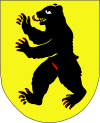 Imperial Abbey of St. GallAbbey of St. GallThe Abbey of Saint Gall is a religious complex in the city of St. Gallen in present-day Switzerland. The Carolingian-era Abbey has existed since 719 and became an independent principality during the 13th century, and was for many centuries one of the chief Benedictine abbeys in Europe. It was...
en — 1451 treaty with Schwyz, Lucerne, Zürich and Glarus, renewed in 1479 and 1490. The abbey was simultaneously a protectorate. -
 Imperial CityFree Imperial CityIn the Holy Roman Empire, a free imperial city was a city formally ruled by the emperor only — as opposed to the majority of cities in the Empire, which were governed by one of the many princes of the Empire, such as dukes or prince-bishops...
of St. GallenSt. GallenSt. Gallen is the capital of the canton of St. Gallen in Switzerland. It evolved from the hermitage of Saint Gall, founded in the 7th century. Today, it is a large urban agglomeration and represents the center of eastern Switzerland. The town mainly relies on the service sector for its economic...
— 1454 treaty with Schwyz, Lucerne, Zürich, Glarus, Zug and Berne.
Eternal associates
Two federations were known as :-
 Sieben Zenden, an independent federation in the ValaisValaisThe Valais is one of the 26 cantons of Switzerland in the southwestern part of the country, around the valley of the Rhône from its headwaters to Lake Geneva, separating the Pennine Alps from the Bernese Alps. The canton is one of the drier parts of Switzerland in its central Rhône valley...
— Became a Zugewandter Ort in 1416 through an alliance with Uri, Unterwalden and Lucerne, followed by a treaty with Berne in 1446. -
 Three LeaguesThree LeaguesThe Three Leagues was the alliance of 1471 of the League of God's House, the League of the Ten Jurisdictions and the Grey League, leading eventually to the formation of the Swiss canton of Graubünden. Most of the lands of Graubünden were part of the Roman province Raetia in 15 BC...
were independent federations on the territory of the Grisons and became an associates of the Old Swiss Confederacy in 1497/98 through the events of the Swabian WarSwabian WarThe Swabian War of 1499 was the last major armed conflict between the Old Swiss Confederacy and the House of Habsburg...
. The Three Leagues together concluded an alliance pact with Berne in 1602.-
 Grey LeagueGrey LeagueThe Grey League , sometimes called Oberbund, formed in 1395 in the Vorderrhein and Hinterrhein valleys, Raetia. The name Grey League is derived from the homespun grey clothes worn by the people. The league became part of the canton of Graubünden. The Grey League allied itself to the two other...
, who had been allied with Glarus, Uri and Obwalden through pacts from 1400, 1407 and 1419, entered an alliance with seven of the old eight cantons (the Acht Orte without Berne) in 1497 -
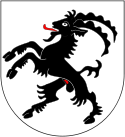 League of God's HouseLeague of God's HouseThe League of God's House was formed in what is now Switzerland on January 29, 1367 to resist the rising power of the Bishopric of Chur and the House of Habsburg. The League allied with the Grey League and the League of the Ten Jurisdictions in 1471 to form the Three Leagues...
(Gotteshausbund) followed suit a year later. -
 League of the Ten JurisdictionsLeague of the Ten JurisdictionsThe League of the Ten Jurisdictions was the last of the Three Leagues founded during the Middle Ages in what is now Canton Graubünden of Switzerland. The League was created in the County of Toggenburg after the counts of Toggenburg died out. The League initially existed to resist the power of the...
, the third of the leagues, entered an alliance with Zürich and Glarus in 1590.
-
Protestant associates
There were two :-
 Imperial City of MulhouseMulhouseMulhouse |mill]] hamlet) is a city and commune in eastern France, close to the Swiss and German borders. With a population of 110,514 and 278,206 inhabitants in the metropolitan area in 2006, it is the largest city in the Haut-Rhin département, and the second largest in the Alsace region after...
— Concluded a first treaty with some cantons in 1466 and became an associate in 1515 through a treaty with all 13 members of the Confederacy, remaining so until events of the French Revolutionary WarsFrench Revolutionary WarsThe French Revolutionary Wars were a series of major conflicts, from 1792 until 1802, fought between the French Revolutionary government and several European states...
in 1797. -
 Imperial City of GenevaGenevaGeneva In the national languages of Switzerland the city is known as Genf , Ginevra and Genevra is the second-most-populous city in Switzerland and is the most populous city of Romandie, the French-speaking part of Switzerland...
— 1536 treaty with Berne and a 1584 treaty with Zürich and Berne.
Remaining associates
-
 County of Neuchâtel — 1406 and 1526 treaties with Berne and Solothurn, 1495 treaty with Fribourg and 1501 treaty with Lucerne.
 -
 Imperial ValleyImperial ValleyThe Imperial Valley is an agricultural area of Southern California's Imperial County. It is located in southeastern Southern California, centered around the city of El Centro. Locally, the terms "Imperial Valley" and "Imperial County" are used synonymously. The Valley is bordered between the...
of Urseren — 1317 treaty with Uri; annexed by Uri in 1410. -
 WeggisWeggisWeggis is a municipality in the district of Lucerne in the canton of Lucerne in Switzerland.It forms part of the northern shore of Lake Lucerne. The official language is German.-History:In about 800 the monastery of Pfäfers acquired the court of Wattawis...
— 1332–1380 by treaties with Uri, Schwyz, Unterwalden and Lucerne; annexed by Lucerne in 1480. -
 MurtenMurtenMurten is a municipality in the See district of the canton of Fribourg in Switzerland.It is located on the southern shores of Lake Morat. Morat is situated between Bern and Lausanne and is the capital of the Lake District of the canton of Fribourg....
— from 1353 by treaty with Berne; became a confederal condominium in 1475. -
 PayernePayernePayerne is a municipality in the Swiss canton of Vaud. It was the seat of the district of Payerne, and is now part of the district of Broye-Vully....
— from 1353 by treaty with Berne; annexed by Berne in 1536. - Vogtei of Bellinzona — from 1407 by treaty with Uri and Obwalden; became a confederal condominium from 1419–22.
-
 County of SargansCounty of SargansThe County of Sargans was a state of the Holy Roman Empire. From 1458 until the French Revolutionary War in 1798, Sargans became a condominium of the Old Swiss Confederacy, administered jointly by the cantons of Uri, Schwyz, Unterwalden, Lucerne, Zürich, Glarus and Zug.-History:In 1396, the counts...
— from 1437 by treaty with Glarus and Schwyz; became a confederal condominium in 1483. -
 Barony of Sax-Forstegg — from 1458 by treaty with Zürich; annexed by Zürich in 1615
 -
 Stein am RheinStein am RheinStein am Rhein is a municipality in the canton of Schaffhausen in Switzerland.The town has a well-preserved medieval centre, retaining the ancient street plan. The site of the city wall, and the city gates are preserved, though the former city wall now consists of houses...
— from 1459 by treaty with Zürich and Schaffhausen; annexed by Zürich in 1484. -
 County of Gruyère — had been allied with Fribourg and Berne since the early 14th century, becoming a full associate of the Confederation in 1548. When the counts fell bankrupt in 1555, the country was partitioned in twain:
- Lower Gruyère — from 1475 by treaty with Fribourg
- Upper Gruyère — from 1403 by treaty with Berne; annexed by Berne in 1555:
-
 Imperial ValleyImperial ValleyThe Imperial Valley is an agricultural area of Southern California's Imperial County. It is located in southeastern Southern California, centered around the city of El Centro. Locally, the terms "Imperial Valley" and "Imperial County" are used synonymously. The Valley is bordered between the...
of SaanenSaanenSaanen is a municipality in the canton of Bern in Switzerland. It is the capital of the Obersimmental-Saanen administrative district.-Geography:Saanen has an area of . Of this area, 52.8% is used for agricultural purposes, while 33.6% is forested... - Imperial ValleyImperial ValleyThe Imperial Valley is an agricultural area of Southern California's Imperial County. It is located in southeastern Southern California, centered around the city of El Centro. Locally, the terms "Imperial Valley" and "Imperial County" are used synonymously. The Valley is bordered between the...
of Château-d'ŒxChâteau-d'ŒxChâteau-d'Œx is a municipality in the canton of Vaud in Switzerland. It is in the district of Riviera-Pays-d'Enhaut.-Prehistoric settlements:...
-
-
 County of Werdenberg — from 1493 by treaty with Lucerne; annexed by Glarus in 1517.
 -
 Imperial City of RottweilRottweilRottweil is a town in the south west of Germany and is the oldest town in the federal state of Baden-Württemberg.Located between the Black Forest and the Swabian Alb hills, Rottweil has about 25,000 inhabitants...
— from 1519–1632 through a treaty with all 13 members; a first treaty on military cooperation had already been concluded in 1463. In 1632, the treaty was renewed with Lucerne, Uri, Schwyz, Unterwalden, Zug, Solothurn and Fribourg. -
 Bishopric of BaselBishopric of BaselThe Diocese of Basel is a Roman Catholic diocese in Switzerland .Historically, the bishops of Basel were also secular rulers of the Prince-Bishopric of Basel ....
— 1579–1735 by treaty with Lucerne, Uri, Schwyz, Unterwalden, Zug, Solothurn and Fribourg.
Condominiums
CondominiumCondominium (international law)
In international law, a condominium is a political territory in or over which two or more sovereign powers formally agree to share equally dominium and exercise their rights jointly, without dividing it up into 'national' zones.Although a condominium has always been...
s were common subject territories under the administration of several cantons. They were governed by reeves
Vogt (Switzerland)
thumb|left|[[Franz Rudolf Frisching]], [[bailiff]] in the [[Vallemaggia |Vallemaggia]] in 1770, in the uniform of an officer of the [[Bernese]] Huntsmen Corps with his [[Berner Laufhund]], painted by [[Jean Preudhomme]] in 1785...
(Vögte) delegated for two years, each time from another of the responsible cantons. Berne initially did not participate in the administration of some of the eastern condominiums, as it had no part in their conquest and its interests were focused more on the western border. In 1712, Berne replaced the Catholic cantons in the administration of the Freie Ämter
Freie Ämter
The Freiamt or Freie Ämter is a region in Switzerland and is located in the southeast of Canton of Aargau. It comprises the area between the Lindenberg and Heitersberg and from the terminal moraine at Othmarsingen to Reuss river in Dietwil. Today the area of the Bremgarten and Muri Districts are...
("Free Districts"), the Thurgau
Thurgau
Thurgau is a northeast canton of Switzerland. The population, , is . In 2007, there were a total of 47,390 who were resident foreigners. The capital is Frauenfeld.-History:...
, the Rhine valley, and Sargans
Sargans
Sargans is a municipality in the Wahlkreis of Sarganserland in the canton of St. Gallen in Switzerland.Sargans is known for its castle, which dates from before the founding of the Swiss Confederation in 1291...
, and furthermore the Catholic cantons were excluded from the administration of the County of Baden.
German bailiwicks
The "German bailiwicks" were generally governed by the Acht Orte apart from Berne until 1712, when Berne joined the sovereign powers:-
 Freie ÄmterFreie ÄmterThe Freiamt or Freie Ämter is a region in Switzerland and is located in the southeast of Canton of Aargau. It comprises the area between the Lindenberg and Heitersberg and from the terminal moraine at Othmarsingen to Reuss river in Dietwil. Today the area of the Bremgarten and Muri Districts are...
— conquered 1415 and partitioned in 1712:- Upper Freiamt was governed by the Acht Orte;
- Lower Freiamt was governed by Zürich, Berne and Glarus alone.
-
 County of Baden — conquered 1415; from 1712 governed by Zürich, Berne and Glarus.
 - County of SargansCounty of SargansThe County of Sargans was a state of the Holy Roman Empire. From 1458 until the French Revolutionary War in 1798, Sargans became a condominium of the Old Swiss Confederacy, administered jointly by the cantons of Uri, Schwyz, Unterwalden, Lucerne, Zürich, Glarus and Zug.-History:In 1396, the counts...
— from 1460/83 -
 Landgraviate of Thurgau — from 1460
 -
 Vogtei of Rheintal — from 1490, Acht Orte minus Berne, plus the Imperial Abbey of St Gall. Appenzell added in 1500; Berne added in 1712.
Italian bailiwicks
Several bailiwicksVogt (Switzerland)
thumb|left|[[Franz Rudolf Frisching]], [[bailiff]] in the [[Vallemaggia |Vallemaggia]] in 1770, in the uniform of an officer of the [[Bernese]] Huntsmen Corps with his [[Berner Laufhund]], painted by [[Jean Preudhomme]] in 1785...
(Vogteien) were generally referred to as "transmontane bailiwicks" .
In 1440, Uri
Canton of Uri
Uri is one of the 26 cantons of Switzerland and a founding member of the Swiss Confederation. It is located in Central Switzerland. The canton's territory covers the valley of the Reuss River between Lake Lucerne and the St. Gotthard Pass. German is the primary language spoken in Uri...
conquered the Leventina Valley from the Visconti
House of Visconti
Visconti is the family name of two important Italian noble dynasties of the Middle Ages. There are two distinct Visconti families: The first one in the Republic of Pisa in the mid twelfth century who achieved prominence first in Pisa, then in Sardinia where they became rulers of Gallura...
, dukes of Milan
Milan
Milan is the second-largest city in Italy and the capital city of the region of Lombardy and of the province of Milan. The city proper has a population of about 1.3 million, while its urban area, roughly coinciding with its administrative province and the bordering Province of Monza and Brianza ,...
. Some of this territory had previously been annexed between 1403 and 1422. Further territories were acquired in 1500; see History of Ticino for further details.
Three bailiwicks, all now in the Ticino
Ticino
Canton Ticino or Ticino is the southernmost canton of Switzerland. Named after the Ticino river, it is the only canton in which Italian is the sole official language...
, were condominiums of the Forest cantons of Uri, Schwyz and Nidwalden:
-
 Vogtei of Blenio — 1477–80 and from 1495
 -
 Vogtei of Rivera — 1403–22 and from 1495
 - Vogtei of Bellinzona — from 1500
Four other Ticinese bailiwicks were condominiums of the Zwölf Orte (the original 13 cantons, minus Appenzell) from 1512:
-
 Landvogtei of Valmaggia
 -
 Landvogtei of Lugano
 -
 Landvogtei of Locarno
 -
 Landvogtei of Mendrisio
Another three bailiwicks were condominiums of the Zwölf Orte from 1512, but were lost from the Confederacy three years later and are all now comuni of Lombardy
Lombardy
Lombardy is one of the 20 regions of Italy. The capital is Milan. One-sixth of Italy's population lives in Lombardy and about one fifth of Italy's GDP is produced in this region, making it the most populous and richest region in the country and one of the richest in the whole of Europe...
:
- Travaglia
- Cuvio
- EschentalOssolaThe Ossola is an area of Italy situated to the north of Lago Maggiore. It lies within the Province of Verbano-Cusio-Ossola. Its principal river is the Toce, and its most important town Domodossola....
(now Ossola)
Vogteien of Bern and Fribourg
-
 County of Grasburg / SchwarzenburgSchwarzenburgSchwarzenburg is a municipality in the district of Bern-Mittelland in the canton of Bern in Switzerland. It was created on 1 January 2011 through the merger of the municipalities of Wahlern and Albligen.-References:...
— from 1423 - MurtenMurtenMurten is a municipality in the See district of the canton of Fribourg in Switzerland.It is located on the southern shores of Lake Morat. Morat is situated between Bern and Lausanne and is the capital of the Lake District of the canton of Fribourg....
— from 1475 -
 GrandsonGrandson, SwitzerlandGrandson is a municipality in the district of Jura-Nord Vaudois in the canton of Vaud in Switzerland.During the Burgundian Wars, Charles the Bold was defeated near here in the Battle of Grandson on 2 March 1476.-History:...
— from 1475 -
 OrbeOrbeOrbe is a municipality in the Swiss canton of Vaud. It was the seat of the former district of Orbe and is now part of the district of Jura-Nord Vaudois.-History:Orbe is first mentioned about 280 as Urba. In 1179 it was mentioned as versus Orbam....
and EchallensEchallensEchallens is a municipality in the district of Gros-de-Vaud in the canton of Vaud in Switzerland.-History:The territory of the municipality was already settled very early. There are remains of a Bronze Age foundry....
— from 1475
Vogteien of Glarus and Schwyz
-
 County of Uznach — from 1437
 -
 , Lordship of Windegg / Gaster — from 1438
 -
 Lordship of Hohensax / GamsGamsGams is a municipality in the Wahlkreis of Werdenberg in the canton of St. Gallen in Switzerland.-History:Gams is first mentioned in 835 as Campesias. In 1210 it was mentioned as Chames, in 1236 as Gamps. Until the Middle Ages it was a Romansh village and was known in Romansh as...
— from 1497
Condominiums with third-parties
- Lordship of Tessenberg — from 1388, condominium between BerneBerneThe city of Bern or Berne is the Bundesstadt of Switzerland, and, with a population of , the fourth most populous city in Switzerland. The Bern agglomeration, which includes 43 municipalities, has a population of 349,000. The metropolitan area had a population of 660,000 in 2000...
and Bishopric of BaselBishopric of BaselThe Diocese of Basel is a Roman Catholic diocese in Switzerland .Historically, the bishops of Basel were also secular rulers of the Prince-Bishopric of Basel ....
Protectorates
-
 Bellelay AbbeyBellelay AbbeyBellelay Abbey is a former Premonstratensian monastery in the Bernese Jura in Switzerland, now a psychiatric clinic.-History:According to the legend, the monastery was founded in 1136 by Siginand, prior of the abbey of Moutier-Grandval, who got lost in the deep forest of the High Jura while hunting...
— protectorate of Bern, Biel and Solothurn from 1414; nominally under the jurisdiction of the Bishopric of BaselBishopric of BaselThe Diocese of Basel is a Roman Catholic diocese in Switzerland .Historically, the bishops of Basel were also secular rulers of the Prince-Bishopric of Basel .... - Einsiedeln AbbeyEinsiedeln AbbeyEinsiedeln Abbey is a Benedictine monastery in the town of Einsiedeln in the Canton of Schwyz, Switzerland. The abbey is dedicated to Our Lady of the Hermits, the title being derived from the circumstances of its foundation, from which the name Einsiedeln is also said to have originated...
— protectorate of Schwyz from 1357 -
 Engelberg AbbeyEngelberg AbbeyEngelberg Abbey is a Benedictine monastery in Engelberg, Canton of Obwalden, Switzerland. It was formerly in the Diocese of Constance, but now in the Diocese of Chur...
— protectorate of Lucerne, Uri, Schwyz and Unterwalden from 1425 -
 ErguelErguelErguël is an ancient seigniory of the Roman Catholic Diocese of Basel, and under protectorate of Biel/Bienne, under military jurisdiction from 1335, in the now so called valley of St.-Imier, in the now Bernese Jura, Switzerland...
— protectorate of Biel/BienneBiel/BienneBiel/Bienne is a city in the district of the Biel/Bienne administrative district in the canton of Bern in Switzerland.It is located on the language boundary and is throughout bilingual. Biel is the German name for the town, Bienne its French counterpart. The town is often referred to in both...
under military jurisdiction from 1335; also subject to the Bishopric of Basel - Imperial Abbey of St. GallAbbey of St. GallThe Abbey of Saint Gall is a religious complex in the city of St. Gallen in present-day Switzerland. The Carolingian-era Abbey has existed since 719 and became an independent principality during the 13th century, and was for many centuries one of the chief Benedictine abbeys in Europe. It was...
en — protectorate of Schwyz, Lucerne, Zürich and Glarus from 1451; the abbey was simultaneously a Zugewandter Ort. -
 Republic of Gersau, an independent village — allied with Schwyz since 1332; Lucerne, Uri and Unterwalden were also protecting powers.
 -
 Moutier-Grandval Abbey — protectorate of Berne from 1486; the abbey was also subject to the Bishopric of Basel and, until 1797, the Holy Roman EmpireHoly Roman EmpireThe Holy Roman Empire was a realm that existed from 962 to 1806 in Central Europe.It was ruled by the Holy Roman Emperor. Its character changed during the Middle Ages and the Early Modern period, when the power of the emperor gradually weakened in favour of the princes...
 -
 La NeuvevilleLa NeuvevilleLa Neuveville is a municipality in the Jura bernois administrative district in the canton of Bern in Switzerland, located in the French-speaking Bernese Jura .-Geography:...
— protectorate of Berne from 1388; also subject to the Bishopric of Basel. -
 Pfäfers AbbeyPfäfers AbbeyPfäfers Abbey , also known as St. Pirminsberg from its position on a mountain, was a Benedictine monastery in Pfäfers near Bad Ragaz, in the canton of St...
— protectorate of the Acht Orte minus Berne from 1460; annexed to the County of SargansCounty of SargansThe County of Sargans was a state of the Holy Roman Empire. From 1458 until the French Revolutionary War in 1798, Sargans became a condominium of the Old Swiss Confederacy, administered jointly by the cantons of Uri, Schwyz, Unterwalden, Lucerne, Zürich, Glarus and Zug.-History:In 1396, the counts...
in 1483 -
 RapperswilRapperswilRapperswil-Jona is a municipality in the Wahlkreis of See-Gaster in the canton of St. Gallen in Switzerland.Besides Rapperswil and Jona, which were separate municipalities until 2006, the municipality includes Bollingen, Busskirch, Curtiberg, Kempraten-Lenggis, Wagen, and Wurmsbach.-Today:On...
— protectorate of Uri, Schwyz, Unterwalden and Glarus from 1464; of Zürich, Berne and Glarus from 1712 -
 County of Toggenburg — protectorate of Schwyz and Glarus from 1436; of Zürich and Berne from 1718. The county was simultaneously subject to St Gallen Abbey.
Separate subjects
Some territories were separate subjects of cantons or associates, :of Uri
-
 Valley of Leventina (1403, 1439)
 - Valley of Urseren (1440)
of Schwyz
-
 KüssnachtKüssnachtKüssnacht am Rigi is a district and municipality in the canton of Schwyz in Switzerland, consisting of three villages: Küssnacht, Immensee and Merlischachen...
(1402) -
 Einsiedeln AbbeyEinsiedeln AbbeyEinsiedeln Abbey is a Benedictine monastery in the town of Einsiedeln in the Canton of Schwyz, Switzerland. The abbey is dedicated to Our Lady of the Hermits, the title being derived from the circumstances of its foundation, from which the name Einsiedeln is also said to have originated...
(1397 / 1424) -
 MarchMarch (district)March District is a district in Canton of Schwyz, Switzerland. The coat of arms of the district is gules, an annulet sable — a black ring on a red background...
(1405 / 36) -
 HöfeHöfe (district)Höfe District is a district of the canton of Schwyz, Switzerland. The coat of arms of the Höfe is per pale: gules, two lions rampant sinister or; and or, three lions passant gules. It has a population of ....
(1440)
of Glarus
- County of Werdenberg (1485 / 1517); annexed to Lucerne in 1485; to Glarus in 1517
of the Republic of Valais
-
 St-Maurice (1475 / 77)
 -
 MontheyMontheyMonthey is the capital of the district of Monthey in the canton of Valais in Switzerland.- History :The castle in the town center was built in 950 on a hill, the first houses of Monthey surrounded it. Monthey is first mentioned in 1215 as Montez At the 13th century, the counts of Savoy owned the...
(1536) - Nendaz-HérémanceNendazNendaz is a municipality in the district of Conthey in the canton of Valais in Switzerland.-History:Nendaz is first mentioned in 984 as Nenda. It was also known under its German name Neind though that name is no longer used.-Geography:...
(1475 / 77) - Port Valais/VionnazPort-ValaisPort-Valais is a municipality of the district of Monthey in the French-speaking part of the canton of Valais in Switzerland.-History:Port-Valais is first mentioned in 1180 as ad porvalesium. The municipality was formerly known by its German name Portwallis, however, that name is no longer...
- LötschentalLötschentalThe Lötschental is the largest valley on the northern side of the Rhône valley in the canton of Valais in Switzerland. It lies in the Bernese Alps, with the river Lonza running down the length of the valley from its source within the Langgletscher....
(15th century); the five upper Zenden
of the Three Leagues
-
 BormioBormioBormio is a town and comune located in the province of Sondrio, Lombardy region of the Alps in northern Italy. It has a population of 4,200...
(1512) - Chiavenna (1512)
- ValtellinaValtellinaValtellina or the Valtelline valley ; is a valley in the Lombardy region of northern Italy, bordering Switzerland. Today it is known for its skiing, its hot spring spas, its cheeses and its wines...
(1512) - Drei Pleven (1512–26)
-
 MaienfeldMaienfeldMaienfeld is a municipality in the district of Landquart in the Swiss canton of Graubünden. It is a tourist destination in the Alps, both because of the local wine and because it was the setting of the story Heidi.- History :...
(Bündner Herrschaft) (1509–1790); simultaneously a member of the League of the Ten JurisdictionsLeague of the Ten JurisdictionsThe League of the Ten Jurisdictions was the last of the Three Leagues founded during the Middle Ages in what is now Canton Graubünden of Switzerland. The League was created in the County of Toggenburg after the counts of Toggenburg died out. The League initially existed to resist the power of the...
.
Further reading
- Aubert, J.-F.: Petite histoire constitutionnelle de la Suisse, 2nd ed.; Francke Editions, Bern, 1974.
- Peyer, H.C.: Verfassungsgeschichte der alten Schweiz, Schulthess Polygraphischer Verlag, Zürich 1978. ISBN 3-7255-1880-7.