


Sourdough

Encyclopedia
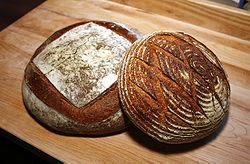
Dough
Dough is a paste made out of any cereals or leguminous crops by mixing flour with a small amount of water and/or other liquid. This process is a precursor to making a wide variety of foodstuffs, particularly breads and bread-based items , flatbreads, noodles, pastry, and similar items)...
containing a Lactobacillus
Lactobacillus
Lactobacillus is a genus of Gram-positive facultative anaerobic or microaerophilic rod-shaped bacteria. They are a major part of the lactic acid bacteria group, named as such because most of its members convert lactose and other sugars to lactic acid. They are common and usually benign...
culture, usually in symbiotic combination with yeasts. It is one of two principal means of biological leavening in bread baking, along with the use of cultivated forms of yeast (Saccharomyces
Saccharomyces
Saccharomyces is a genus in the kingdom of fungi that includes many species of yeast. Saccharomyces is from Greek σάκχαρ and μύκης and means sugar fungus. Many members of this genus are considered very important in food production. One example is Saccharomyces cerevisiae, which is used in making...
). It is of particular importance in baking rye
Rye
Rye is a grass grown extensively as a grain and as a forage crop. It is a member of the wheat tribe and is closely related to barley and wheat. Rye grain is used for flour, rye bread, rye beer, some whiskeys, some vodkas, and animal fodder...
-based breads, where yeast does not produce comparable results. In comparison with yeast-based breads, it produces a distinctively tangy or sour taste, mainly because of the lactic acid
Lactic acid
Lactic acid, also known as milk acid, is a chemical compound that plays a role in various biochemical processes and was first isolated in 1780 by the Swedish chemist Carl Wilhelm Scheele. Lactic acid is a carboxylic acid with the chemical formula C3H6O3...
produced by the lactobacilli; the actual medium, known as "starter
Bread starter
A pre-ferment is a fermentation starter used in bread making, and is referred to as an indirect method. It may also be called mother dough....
" or levain, is essentially an ancestral form of pre-ferment. In English-speaking countries, where wheat-based breads predominate, sourdough is no longer the standard method for bread leavening. It was gradually replaced, first by the use of barm
Barm
Barm cake is type of bun with flour on top. It has a characteristically strong flavour that comes from the traditional barm leaven made from a natural leaven with the addition of hops. However, the Barm Cake is more likely made from commercial yeast today....
from beer
Beer
Beer is the world's most widely consumed andprobably oldest alcoholic beverage; it is the third most popular drink overall, after water and tea. It is produced by the brewing and fermentation of sugars, mainly derived from malted cereal grains, most commonly malted barley and malted wheat...
making, then, after the confirmation of germ theory by Louis Pasteur
Louis Pasteur
Louis Pasteur was a French chemist and microbiologist born in Dole. He is remembered for his remarkable breakthroughs in the causes and preventions of diseases. His discoveries reduced mortality from puerperal fever, and he created the first vaccine for rabies and anthrax. His experiments...
, by cultured yeasts. However, some form of natural leaven is still used by many specialty bakeries.
Sourdough starter is traditionally made with a small amount of old dough, preferably saved from a prior batch. This is traditionally called mother dough or chef
Chef (baking)
A chef is type of bread starter. It is a piece of dough taken from a previous batch used to inoculate a new dough with yeasts and Lactobacilli. The term chef is French. It may also be called chief or head....
: in more modern usage, seed sour. First generation starter or spontaneous seed may be created by storing new dough in a warm place and allowing sufficient time for it to sour. This small amount of old-dough starter contains the culture, and its weight is increased by additions of new dough and mixing or kneading followed by rest or leavening periods. A small amount of the resulting dough is then saved to use as starter sour for the next batch. As long as this starter culture is fed flour and water weekly, it can stay at room temperature indefinitely.
Sourdough bread is made by combining the increased amount of starter with another new-dough addition, along with any other desired ingredients to make the final dough. The starter comprises about 20 to 25 percent of the final dough, though particular formulas vary and that ratio may be higher. This final dough may be divided and shaped, then allowed to rise, followed by baking.
It is not uncommon for a baker's starter dough to have years of history, from many hundreds of previous batches. As a result, each bakery's sourdough has a distinct taste. The combination of starter processes, refreshment ratios and rest times, culture and air temperature, humidity, and elevation also makes each batch of sourdough different.
Biology and chemistry of sourdough
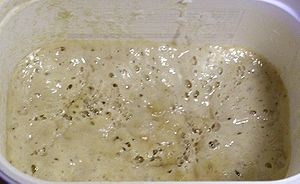
Bread starter
A pre-ferment is a fermentation starter used in bread making, and is referred to as an indirect method. It may also be called mother dough....
is a stable symbiotic culture of bacteria
Bacteria
Bacteria are a large domain of prokaryotic microorganisms. Typically a few micrometres in length, bacteria have a wide range of shapes, ranging from spheres to rods and spirals...
and yeast
Yeast
Yeasts are eukaryotic micro-organisms classified in the kingdom Fungi, with 1,500 species currently described estimated to be only 1% of all fungal species. Most reproduce asexually by mitosis, and many do so by an asymmetric division process called budding...
present in a mixture of flour
Flour
Flour is a powder which is made by grinding cereal grains, other seeds or roots . It is the main ingredient of bread, which is a staple food for many cultures, making the availability of adequate supplies of flour a major economic and political issue at various times throughout history...
and water
Water
Water is a chemical substance with the chemical formula H2O. A water molecule contains one oxygen and two hydrogen atoms connected by covalent bonds. Water is a liquid at ambient conditions, but it often co-exists on Earth with its solid state, ice, and gaseous state . Water also exists in a...
. The yeasts Candida milleri
Candida milleri
Candida milleri is a species of yeast in the genus Candida. It is used, along with the bacterium Lactobacillus sanfranciscensis, in the production of sourdough bread.-See also:*Candida *Sourdough*Lactobacillus sanfranciscensis...
or Saccharomyces exiguus usually populate sourdough cultures symbiotically with Lactobacillus sanfranciscensis
Lactobacillus sanfranciscensis
Lactobacillus sanfranciscensis is a species of lactic acid bacteria that helps give San Francisco sourdough bread its characteristic taste....
. Lactobacillus sanfranciscensis was named for its discovery in San Francisco sourdough starters.
Often a starter will consist of basic items such as: water, bread flour, rye
Rye
Rye is a grass grown extensively as a grain and as a forage crop. It is a member of the wheat tribe and is closely related to barley and wheat. Rye grain is used for flour, rye bread, rye beer, some whiskeys, some vodkas, and animal fodder...
flour, and a sourdough starter which can be purchased at certain grocery stores. Once the starter is made, water and flour must be added in time increments over a period of days. Depending on the locale of the bakery and the type of bread being made, the starter can be either a relatively fluid batter or a stiffer dough. Firm starters (such as the Flemish Desem
Desem
Desem is a type of sourdough starter made from Whole Wheat, Spelt of other flours and water, inoculated by wild yeasts and bacteria, traditionally used in Belgium to make healthy, nutrient rich bread. The starter is grown in a bed of flour at cool temperatures until it reaches sufficient maturity...
starter) are often more resource-intensive, traditionally being buried in a large container of flour to prevent drying out.
A fresh culture begins with a mixture of flour and water. Fresh flour naturally contains a wide variety of yeast and bacterial spores. When wheat flour contacts water, naturally occurring amylase
Amylase
Amylase is an enzyme that catalyses the breakdown of starch into sugars. Amylase is present in human saliva, where it begins the chemical process of digestion. Food that contains much starch but little sugar, such as rice and potato, taste slightly sweet as they are chewed because amylase turns...
enzymes break down the starch into disaccharides (sucrose
Sucrose
Sucrose is the organic compound commonly known as table sugar and sometimes called saccharose. A white, odorless, crystalline powder with a sweet taste, it is best known for its role in human nutrition. The molecule is a disaccharide composed of glucose and fructose with the molecular formula...
and maltose
Maltose
Maltose , or malt sugar, is a disaccharide formed from two units of glucose joined with an αbond, formed from a condensation reaction. The isomer "isomaltose" has two glucose molecules linked through an α bond. Maltose is the second member of an important biochemical series of glucose chains....
); maltase
Maltase
Maltase is an enzyme that breaks down the disaccharide maltose. Maltase is an enzyme that catalyzes the hydrolysis of the disaccharide maltose to the simple sugar glucose. This enzyme is found in plants, bacteria, and yeast. Then there is what is called Acid maltase deficiency...
converts these sugars into glucose
Glucose
Glucose is a simple sugar and an important carbohydrate in biology. Cells use it as the primary source of energy and a metabolic intermediate...
and fructose
Fructose
Fructose, or fruit sugar, is a simple monosaccharide found in many plants. It is one of the three dietary monosaccharides, along with glucose and galactose, that are absorbed directly into the bloodstream during digestion. Fructose was discovered by French chemist Augustin-Pierre Dubrunfaut in 1847...
that yeast can metabolize. The lactobacteria feed mostly on the metabolism products from the yeast. The mixture develops a balanced, symbiotic culture after repeated feedings.
There are several ways to increase the chances of creating a stable culture. Unbleached, unbromated flour
Potassium bromate
Potassium bromate , is a bromate of potassium and takes the form of white crystals or powder.-Uses in baking:Potassium bromate is typically used as a flour improver , strengthening the dough and allowing higher rising. It is an oxidizing agent, and under the right conditions, will be completely...
contains more microorganisms than more processed flours. Bran
Bran
Bran is the hard outer layer of grain and consists of combined aleurone and pericarp. Along with germ, it is an integral part of whole grains, and is often produced as a by-product of milling in the production of refined grains. When bran is removed from grains, the grains lose a portion of their...
-containing (wholemeal) flour provides the greatest variety of organisms and additional minerals, though some cultures use an initial mixture of white flour and rye flour or "seed" the culture using unwashed organic grapes (for the wild yeasts on their skins). Using water from boiled potatoes also increases the leavening power of the bacteria, by providing additional starch. Some bakers recommend un-chlorinated water for feeding cultures. Adding a small quantity of diastatic malt provides maltase and simple sugars to support the yeasts initially.
The flour-water mixture can also be inoculated from a previously maintained culture. The culture is stable because of its ability to prevent colonization by other yeasts and bacteria as a result of its acid
Acid
An acid is a substance which reacts with a base. Commonly, acids can be identified as tasting sour, reacting with metals such as calcium, and bases like sodium carbonate. Aqueous acids have a pH of less than 7, where an acid of lower pH is typically stronger, and turn blue litmus paper red...
ity and other anti-bacterial agents. As a result, many sourdough bread varieties tend to be relatively resistant to spoilage and mold.
The yeast and bacteria in the culture will cause a wheat
Wheat
Wheat is a cereal grain, originally from the Levant region of the Near East, but now cultivated worldwide. In 2007 world production of wheat was 607 million tons, making it the third most-produced cereal after maize and rice...
-based dough, whose gluten
Gluten
Gluten is a protein composite found in foods processed from wheat and related grain species, including barley and rye...
has been developed sufficiently to retain gas, to leaven or rise. Obtaining a satisfactory rise from sourdough, however, is more difficult than with packaged yeast, because the lactobacteria almost always outnumber the yeasts by a factor of between 100:1 and 1000:1, and the acidity of the bacteria inhibit the yeasts' gas production. The acidic conditions, along with the fact that the bacteria also produce enzymes which break down proteins, result in weaker gluten, and a denser finished product.
San Francisco sourdough is generally the same as a Type I sourdough. Type I sourdoughs have a pH range of 3.8 to 4.5 and are fermented in a temperature range of 20 to; Saccharomyces exiguus leavens the dough, Lactobacillus sanfranciscensis and L. pontis highlight a lactic-acid bacterial flora that includes L. fermentum, L. fructivorans, L. brevis, and L. paralimentarius. In Type II sourdoughs Saccharomyces cerevisiae
Saccharomyces cerevisiae
Saccharomyces cerevisiae is a species of yeast. It is perhaps the most useful yeast, having been instrumental to baking and brewing since ancient times. It is believed that it was originally isolated from the skin of grapes...
leavens the dough, L. pontis and L. panis highlight the flora. These sourdoughs have a pH less than 3.5 and are fermented within a temperature range of 30 to for several days without feedings which reduces the flora's activity. This process was adopted by some in industry, in part, due to simplification of the multiple-step build typical of Type I traditional sourdoughs. A primary-culture levain is prepared from a salted wheat-rye dough, the process takes about 54 hours at 27 °C (80.6 °F) to build to a pH range of 4.4 to 4.6.
Preparing sourdough products
Sourdough starter can be used in two different manners. Traditionally, a certain amount of sourdough starter (20 to 25 percent on average, depending on the water content of the starter) is mixed into the bread dough, and the bread is kneaded and allowed to rise as normal. The process is largely similar to using a pure strain of baker's yeastBaker's yeast
Baker's yeast is the common name for the strains of yeast commonly used as a leavening agent in baking bread and bakery products, where it converts the fermentable sugars present in the dough into carbon dioxide and ethanol...
, although some care must be taken since the rise time of most sourdough starters is usually somewhat longer than the average for typical baker's yeasts. (As a result, many sourdough starters are unsuitable for use in a bread machine
Bread machine
A bread making machine or bread maker is a home appliance for baking bread. It consists of a bread pan with a paddle mounted in the center of a small special-purpose oven, with a control panel...
.) When using a particularly liquid starter with a high concentration of lactobacillus or acetic acid bacteria
Acetic acid bacteria
Acetic acid bacteria are bacteria that derive their energy from the oxidation of ethanol to acetic acid during fermentation. They are Gram-negative, aerobic, rod-shaped bacteria. Not to be confused with the genus Acetobacterium which are anaerobic homoacetogenic facultative autotrophs and can...
, the large amount of lactic and acetic acids produced needs to be managed carefully, since the acid can break down the gluten in the bread dough; this becomes less of a concern in a stiffer starter, where the yeast usually predominates.
The other manner of using sourdough starter is common for making quick bread
Quick bread
Quick bread is an American term used to denote a type of bread which is leavened with leavening agents other than yeast. Quick breads includes many cakes, brownies and cookies, as well as banana bread, beer bread, cornbread, biscuits, muffins, pancakes, scones, and soda bread.-History::"Quick...
s or foods like pancake
Pancake
A pancake is a thin, flat, round cake prepared from a batter, and cooked on a hot griddle or frying pan. Most pancakes are quick breads; some use a yeast-raised or fermented batter. Most pancakes are cooked one side on a griddle and flipped partway through to cook the other side...
s. It involves using baking soda (and sometimes baking powder
Baking powder
Baking powder is a dry chemical leavening agent used to increase the volume and lighten the texture of baked goods such as muffins, cakes, scones and American-style biscuits. Baking powder works by releasing carbon dioxide gas into a batter or dough through an acid-base reaction, causing bubbles in...
) to neutralize some or all of the acid in the starter, with the acid-base reaction generating carbon dioxide
Carbon dioxide
Carbon dioxide is a naturally occurring chemical compound composed of two oxygen atoms covalently bonded to a single carbon atom...
to provide lift to the dough or batter in a manner very similar to Irish soda bread. This technique is particularly common in kitchens where the starter is intentionally kept off-balance, with a substantially high acid level, and is particularly associated with areas such as Alaska.
History of sourdough
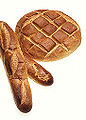
Ancient Egyptian cuisine
The cuisine of ancient Egypt covers a span of over three thousand years, but still retained many consistent traits until well into Greco-Roman times...
times around 1500 BC and was likely the first form of leavening available to bakers. Sourdough remained the usual form of leavening down into the European Middle Ages
Middle Ages
The Middle Ages is a periodization of European history from the 5th century to the 15th century. The Middle Ages follows the fall of the Western Roman Empire in 476 and precedes the Early Modern Era. It is the middle period of a three-period division of Western history: Classic, Medieval and Modern...
until being replaced by barm
Barm
Barm cake is type of bun with flour on top. It has a characteristically strong flavour that comes from the traditional barm leaven made from a natural leaven with the addition of hops. However, the Barm Cake is more likely made from commercial yeast today....
from the beer brewing process, and then later purpose-cultured yeast.
Bread made from 100 percent rye flour, which is very popular in the northern half of Europe
Europe
Europe is, by convention, one of the world's seven continents. Comprising the westernmost peninsula of Eurasia, Europe is generally 'divided' from Asia to its east by the watershed divides of the Ural and Caucasus Mountains, the Ural River, the Caspian and Black Seas, and the waterways connecting...
, is usually leavened with sourdough. Baker's yeast is not useful as a leavening agent
Leavening agent
A leavening agent is any one of a number of substances used in doughs and batters that cause a foaming action which lightens and softens the finished product...
for rye bread
Rye bread
Rye bread is a type of bread made with various percentages of flour from rye grain. It can be light or dark in color, depending on the type of flour used and the addition of coloring agents, and is typically denser than bread made from wheat flour...
, as rye does not contain enough gluten
Gluten
Gluten is a protein composite found in foods processed from wheat and related grain species, including barley and rye...
. The structure of rye bread is based primarily on the starch
Starch
Starch or amylum is a carbohydrate consisting of a large number of glucose units joined together by glycosidic bonds. This polysaccharide is produced by all green plants as an energy store...
in the flour, as well as other carbohydrates known as pentosans; however, rye amylase
Amylase
Amylase is an enzyme that catalyses the breakdown of starch into sugars. Amylase is present in human saliva, where it begins the chemical process of digestion. Food that contains much starch but little sugar, such as rice and potato, taste slightly sweet as they are chewed because amylase turns...
is active at substantially higher temperatures than wheat amylase, causing the structure of the bread to disintegrate as the starches are broken down during cooking. The lowered pH
PH
In chemistry, pH is a measure of the acidity or basicity of an aqueous solution. Pure water is said to be neutral, with a pH close to 7.0 at . Solutions with a pH less than 7 are said to be acidic and solutions with a pH greater than 7 are basic or alkaline...
of a sourdough starter therefore inactivates the amylases when heat cannot, allowing the carbohydrates in the bread to gel and set properly. In the southern part of Europe, where baguette
Baguette
A baguette is "a long thin loaf of French bread" that is commonly made from basic lean dough...
and even panettone
Panettone
thumb|200px|right|A non-traditionally shaped panettone loaf.Panettone is a type of sweet bread loaf originally from Milan , usually prepared and enjoyed for Christmas and New Year in Italy, Malta, Brazil, Germany and Switzerland, and is one of the symbols of the city of Milan. Maltese nationals are...
were originally made with wheat flour and rye flour, sourdough has become less common in recent times; it has been replaced by the faster growing baker's yeast, sometimes supplemented with longer fermentation rests to allow for some bacterial activity to build flavor.
Sourdough was the main bread made in Northern California
Northern California
Northern California is the northern portion of the U.S. state of California. The San Francisco Bay Area , and Sacramento as well as its metropolitan area are the main population centers...
during the California Gold Rush
California Gold Rush
The California Gold Rush began on January 24, 1848, when gold was found by James W. Marshall at Sutter's Mill in Coloma, California. The first to hear confirmed information of the gold rush were the people in Oregon, the Sandwich Islands , and Latin America, who were the first to start flocking to...
, and it remains a part of the culture of San Francisco
San Francisco, California
San Francisco , officially the City and County of San Francisco, is the financial, cultural, and transportation center of the San Francisco Bay Area, a region of 7.15 million people which includes San Jose and Oakland...
today. The bread became so common that "sourdough" became a general nickname for the gold prospectors. The nickname remains in "Sourdough Sam
Sourdough Sam
Sourdough Sam is a mascot for the NFL's San Francisco 49ers. According to his official biography, he has six nicknames: Sam, Sammy, Samster, Sammiester, Samarama, and Samalamadingdong. He wears jersey #49....
", the mascot
Mascot
The term mascot – defined as a term for any person, animal, or object thought to bring luck – colloquially includes anything used to represent a group with a common public identity, such as a school, professional sports team, society, military unit, or brand name...
of the San Francisco 49ers
San Francisco 49ers
The San Francisco 49ers are a professional American football team based in San Francisco, California, playing in the West Division of the National Football Conference in the National Football League . The team was founded in 1946 as a charter member of the All-America Football Conference and...
. A 'Sourdough' is also a nickname used in the North (Yukon/Alaska) for someone who has spent an entire winter north of the Arctic Circle and refers to their tradition of protecting their Sourdough during the coldest months by keeping it close to their body.
The sourdough tradition was carried into Alaska
Alaska
Alaska is the largest state in the United States by area. It is situated in the northwest extremity of the North American continent, with Canada to the east, the Arctic Ocean to the north, and the Pacific Ocean to the west and south, with Russia further west across the Bering Strait...
and the western Canadian territories during the Klondike Gold Rush
Klondike Gold Rush
The Klondike Gold Rush, also called the Yukon Gold Rush, the Alaska Gold Rush and the Last Great Gold Rush, was an attempt by an estimated 100,000 people to travel to the Klondike region the Yukon in north-western Canada between 1897 and 1899 in the hope of successfully prospecting for gold...
. Conventional leavenings such as yeast and baking soda were much less reliable in the conditions faced by the prospectors. Experienced miners and other settlers frequently carried a pouch of starter either around their neck or on a belt; these were fiercely guarded to keep from freezing. Ironically, freezing does not kill a sourdough starter; excessive heat does. Old hands came to be called "sourdoughs", a term that is still applied to any Alaskan old-timer.
San Francisco sourdough is the most famous sourdough bread made in the U.S. today. In contrast to sourdough production in other areas of the country, the San Francisco variety has remained in continuous production since 1849, with some bakeries (e.g., Boudin Bakery
Boudin Bakery
Boudin Bakery is a bakery based in San Francisco, California, known for its sourdough bread...
among others) able to trace their starters back to California's Gold Rush period. It is a white bread characterized by a pronounced sourness (not all varieties are as sour as San Francisco sourdough), so much so that the dominant strain of lactobacillus in sourdough starters was named Lactobacillus sanfranciscensis. Sourdough also became popular because of its ability to combine well with seafoods and soups such as cioppino
Cioppino
Cioppino is a fish stew originating in San Francisco. Despite being considered an Italian dish, it is unknown in Italy, and it is only slightly comparable with various regional fish soups and stews of Italian cuisine...
, clam chowder, and chili.
Sourdough has not enjoyed the popularity it once had since bread became mass-produced. However, many restaurant chains, such as Cracker Barrel
Cracker Barrel
Cracker Barrel Old Country Store, Inc. is an American chain of combined restaurant and gift stores with a Southern country theme. The company was founded by Dan Evins in 1969 and its first store was located in Lebanon, Tennessee, where the company is now headquartered...
, keep it as a menu staple. Manufacturers make up for the lack of yeast and bacterial culture by introducing into their dough an artificially-made mix known as bread improver
Bread improver
Bread improver has been a common ingredient in bread since the early 1950s, and is used to speed up bread production.- History :Before the 1950s, bread had been made virtually the same way since it was first discovered. Using sourdoughs, and sponge and dough methods, bread would take up to a day to...
.
Sourdough breads
Aside from what might be called plain sourdough bread, there are a number of other breads that use similar starters and techniques. Amish Friendship BreadAmish Friendship Bread
Amish Friendship Bread is a type of bread or cake made from a sourdough starter that is often shared in a manner similar to a chain letter. The starter is a substitute for baking yeast and can be used to make many kinds of yeast-based breads, shared with friends, or frozen for future use...
uses a sourdough starter that includes sugar
Sugar
Sugar is a class of edible crystalline carbohydrates, mainly sucrose, lactose, and fructose, characterized by a sweet flavor.Sucrose in its refined form primarily comes from sugar cane and sugar beet...
and milk
Milk
Milk is a white liquid produced by the mammary glands of mammals. It is the primary source of nutrition for young mammals before they are able to digest other types of food. Early-lactation milk contains colostrum, which carries the mother's antibodies to the baby and can reduce the risk of many...
. However, it is further leavened with baking powder
Baking powder
Baking powder is a dry chemical leavening agent used to increase the volume and lighten the texture of baked goods such as muffins, cakes, scones and American-style biscuits. Baking powder works by releasing carbon dioxide gas into a batter or dough through an acid-base reaction, causing bubbles in...
and baking soda, making it more of a quick bread. A real Amish sourdough starter for bread is fed with sugar and potato flakes every 3-5 days. The German Pumpernickel
Pumpernickel
Pumpernickel is a type of very heavy, slightly sweet rye bread traditionally made with coarsely ground rye. It is often made with a combination of rye flour and whole rye berries. It has been long associated with the Westphalia region of Germany. The first written mention of the black bread of...
is traditionally made from a sourdough starter, although modern pumpernickel loaves often use commercial yeasts, sometimes spiked with citric acid
Citric acid
Citric acid is a weak organic acid. It is a natural preservative/conservative and is also used to add an acidic, or sour, taste to foods and soft drinks...
or lactic acid
Lactic acid
Lactic acid, also known as milk acid, is a chemical compound that plays a role in various biochemical processes and was first isolated in 1780 by the Swedish chemist Carl Wilhelm Scheele. Lactic acid is a carboxylic acid with the chemical formula C3H6O3...
to inactivate the amylase
Amylase
Amylase is an enzyme that catalyses the breakdown of starch into sugars. Amylase is present in human saliva, where it begins the chemical process of digestion. Food that contains much starch but little sugar, such as rice and potato, taste slightly sweet as they are chewed because amylase turns...
s in the rye flour. Also, the Flemish Desem
Desem
Desem is a type of sourdough starter made from Whole Wheat, Spelt of other flours and water, inoculated by wild yeasts and bacteria, traditionally used in Belgium to make healthy, nutrient rich bread. The starter is grown in a bed of flour at cool temperatures until it reaches sufficient maturity...
bread is a popular form of whole-wheat sourdough, though cultured in a much less liquid medium.
Other recipes use starters that are not truly natural leavens. The Italian Biga
Biga (bread baking)
Biga is a type of pre-ferment used in Italian baking. Many popular Italian breads, including ciabatta, are made using a biga. Using a biga adds complexity to the bread's flavour and is often used in breads which need a light, open texture with holes...
and French Poolish add sourdough-like flavors to breads by allowing the yeast a lengthy half-day or longer fermentation. Unlike a true sourdough, these recipes usually start with commercial yeast, and cultivation of lactobacillus bacteria is generally an incidental effect.
Whole wheat sourdough flatbreads are traditionally eaten in Azerbaijan
Azerbaijan
Azerbaijan , officially the Republic of Azerbaijan is the largest country in the Caucasus region of Eurasia. Located at the crossroads of Western Asia and Eastern Europe, it is bounded by the Caspian Sea to the east, Russia to the north, Georgia to the northwest, Armenia to the west, and Iran to...
.
See also
- Salt rising breadSalt rising breadSalt rising bread is bread in which the main rising agent is a bacterium Clostridium perfringens, which leavens the bread along with lactobacillus and other wild microbes, as opposed to mainly yeast or baking soda. It is thought that the salt used in the starter is used to suppress yeast growth...
- Klondike Gold RushKlondike Gold RushThe Klondike Gold Rush, also called the Yukon Gold Rush, the Alaska Gold Rush and the Last Great Gold Rush, was an attempt by an estimated 100,000 people to travel to the Klondike region the Yukon in north-western Canada between 1897 and 1899 in the hope of successfully prospecting for gold...
where sourdough was a word for an experienced miner - History of California breadHistory of California breadThe history of California bread as a prominent factor in the field of bread baking dates from the days of the Gold Rush and the development of sourdough bread in San Francisco, and includes the development of artisan bakeries in the 1980s, which strongly influenced what has been called the "Bread...
External links
- Modeling of Growth of Lactobacillus sanfranciscensis and Candida milleri... from Applied and Environmental Microbiology, July 1998, by Gänzle et al., Universität Hohenheim