

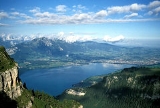
Lake Thun

Encyclopedia
Lake Thun is an Alpine
lake
in the Bernese Oberland
in Switzerland
. It took its name from the city of Thun
, on its northern shore.
Lake Thun's approximately 2,500 km² large catchment area frequently causes local flooding after heavy rainfalls. This occurs because the river Aar , which drains Lake Thun, has only limited capacity to handle the excess runoff
.
The lake is fed by water from Lake Brienz
to the south east, which lies 6 metres higher than Lake Thun, and various streams in the Oberland, including the Kander (only since 1714). Lake Thun was created after the last ice age
and was originally part of Lake Brienz. The historic combined lake is called Wendelsee by geologists and historians.
Fishing is important enough to keep a handful of professional fishers employed. In 2001 the total catch was 53,000 kg. Since 1835 passenger ships have operated on the lake. There are ten passenger ships in total, operated by the local railway company BLS Lötschbergbahn.
Following World War II and up until 1964, the Swiss Government disposed of unused munitions into Lake Thun. The quantity of munitions dumped is reported to be from 3,000 to more than 9,020 tons.
Swiss Alps
The Swiss Alps are the portion of the Alps mountain range that lies within Switzerland. Because of their central position within the entire Alpine range, they are also known as the Central Alps....
lake
Lake
A lake is a body of relatively still fresh or salt water of considerable size, localized in a basin, that is surrounded by land. Lakes are inland and not part of the ocean and therefore are distinct from lagoons, and are larger and deeper than ponds. Lakes can be contrasted with rivers or streams,...
in the Bernese Oberland
Bernese Oberland
The Bernese Oberland is the higher part of the canton of Bern, Switzerland, in the southern end of the canton: The area around Lake Thun and Lake Brienz, and the valleys of the Bernese Alps .The flag of the Bernese Oberland consists of a black eagle in a gold field The Bernese Oberland (Bernese...
in Switzerland
Switzerland
Switzerland name of one of the Swiss cantons. ; ; ; or ), in its full name the Swiss Confederation , is a federal republic consisting of 26 cantons, with Bern as the seat of the federal authorities. The country is situated in Western Europe,Or Central Europe depending on the definition....
. It took its name from the city of Thun
Thun
Thun is a municipality in the administrative district of Thun in the canton of Bern in Switzerland with about 42,136 inhabitants , as of 1 January 2006....
, on its northern shore.
Lake Thun's approximately 2,500 km² large catchment area frequently causes local flooding after heavy rainfalls. This occurs because the river Aar , which drains Lake Thun, has only limited capacity to handle the excess runoff
Surface runoff
Surface runoff is the water flow that occurs when soil is infiltrated to full capacity and excess water from rain, meltwater, or other sources flows over the land. This is a major component of the water cycle. Runoff that occurs on surfaces before reaching a channel is also called a nonpoint source...
.
The lake is fed by water from Lake Brienz
Lake Brienz
Lake Brienz is a lake just north of the Alps, in the Canton of Berne in Switzerland. The lake took its name from the village Brienz on its northern shore. Interlaken and the villages Matten and Unterseen lie to the south west of the lake. The shores are steep, and there is almost no shallow water...
to the south east, which lies 6 metres higher than Lake Thun, and various streams in the Oberland, including the Kander (only since 1714). Lake Thun was created after the last ice age
Ice age
An ice age or, more precisely, glacial age, is a generic geological period of long-term reduction in the temperature of the Earth's surface and atmosphere, resulting in the presence or expansion of continental ice sheets, polar ice sheets and alpine glaciers...
and was originally part of Lake Brienz. The historic combined lake is called Wendelsee by geologists and historians.
Fishing is important enough to keep a handful of professional fishers employed. In 2001 the total catch was 53,000 kg. Since 1835 passenger ships have operated on the lake. There are ten passenger ships in total, operated by the local railway company BLS Lötschbergbahn.
Following World War II and up until 1964, the Swiss Government disposed of unused munitions into Lake Thun. The quantity of munitions dumped is reported to be from 3,000 to more than 9,020 tons.
External links
- Lake Thun Tourism Portal
- Hochwasserschutz Thunersee - water regulation scheme at Thun
- Hydrological data for Lake Thun at SpiezSpiezSpiez is a city in the Frutigen-Niedersimmental administrative district in the canton of Bern in Switzerland.-Geography:Spiez has an area of . Of this area, 38.5% is used for agricultural purposes, while 29.1% is forested...
- historic and current data: waterlevels