


Calvary

Encyclopedia
- For alternative meanings, see: Calvary (disambiguation)Calvary (disambiguation)Calvary is the site in Jerusalem where Jesus is said to have been crucified.* Calvary, Wisconsin, United StatesCalvary may also refer to:* Calvary , a type of public crucifix with figures...
, Mount Calvary (disambiguation)Mount Calvary (disambiguation)Mount Calvary refers to:* Calvary, the place where Jesus was crucified* Mount Calvary, Wisconsin* Mount Calvary Cemetery , a Roman Catholic cemetery in Dubuque, Iowa...
, and Golgotha (disambiguation)Golgotha (disambiguation)Golgotha may refer to:* Golgotha, or Calvary, the hill on which Jesus was crucified** Golgotha , a French film about the death of Jesus Christ...
.
Calvary or Golgotha (ˈɡɒlɡəθə) was the site, outside of ancient Jerusalem
Jerusalem in Christianity
For Christians, Jerusalem's place in the ministry of Jesus and the Apostolic Age gives it great importance, in addition to its place in the Old Testament, the Hebrew Bible.-Jerusalem in the New Testament and early Christianity:...
’s early first century walls, at which the crucifixion of Jesus
Crucifixion of Jesus
The crucifixion of Jesus and his ensuing death is an event that occurred during the 1st century AD. Jesus, who Christians believe is the Son of God as well as the Messiah, was arrested, tried, and sentenced by Pontius Pilate to be scourged, and finally executed on a cross...
is said to have occurred. Calvary and Golgotha are the English
English language
English is a West Germanic language that arose in the Anglo-Saxon kingdoms of England and spread into what was to become south-east Scotland under the influence of the Anglian medieval kingdom of Northumbria...
names for the site used in Western Christianity
Western Christianity
Western Christianity is a term used to include the Latin Rite of the Catholic Church and groups historically derivative thereof, including the churches of the Anglican and Protestant traditions, which share common attributes that can be traced back to their medieval heritage...
. Golgotha is the Greek transcription given by the New Testament
New Testament
The New Testament is the second major division of the Christian biblical canon, the first such division being the much longer Old Testament....
, of an Aramaic
Aramaic language
Aramaic is a group of languages belonging to the Afroasiatic language phylum. The name of the language is based on the name of Aram, an ancient region in central Syria. Within this family, Aramaic belongs to the Semitic family, and more specifically, is a part of the Northwest Semitic subfamily,...
title, which has traditionally been presumed to be Gûlgaltâ (but see below for an alternative); the Bible
Bible
The Bible refers to any one of the collections of the primary religious texts of Judaism and Christianity. There is no common version of the Bible, as the individual books , their contents and their order vary among denominations...
gloss
Gloss
A gloss is a brief notation of the meaning of a word or wording in a text. It may be in the language of the text, or in the reader's language if that is different....
es it as place of [the] skull — Κρανίου Τόπος (Kraniou Topos) in Greek
Greek language
Greek is an independent branch of the Indo-European family of languages. Native to the southern Balkans, it has the longest documented history of any Indo-European language, spanning 34 centuries of written records. Its writing system has been the Greek alphabet for the majority of its history;...
, and Calvariae Locus in Latin
Latin
Latin is an Italic language originally spoken in Latium and Ancient Rome. It, along with most European languages, is a descendant of the ancient Proto-Indo-European language. Although it is considered a dead language, a number of scholars and members of the Christian clergy speak it fluently, and...
, from which we get Calvary.
Biblical references and etymology
- Origen Against Marcion Book II (259 C.E.)OrigenOrigen , or Origen Adamantius, 184/5–253/4, was an early Christian Alexandrian scholar and theologian, and one of the most distinguished writers of the early Church. As early as the fourth century, his orthodoxy was suspect, in part because he believed in the pre-existence of souls...
: A spot there is called Golgotha, - of old the fathers' earlier tongue thus called its name, "The skull-pan of a head".
Since the 6th century it has been referred to as the location of a mountain, and as a small hill since 333. The Gospels describe it as a place near enough to the city that those coming in and out could read the inscription 'Jesus of Nazareth - King of the Jews'
. When the King James Version was written, the translators used an anglicised version — Calvary — of the Latin
Latin
Latin is an Italic language originally spoken in Latium and Ancient Rome. It, along with most European languages, is a descendant of the ancient Proto-Indo-European language. Although it is considered a dead language, a number of scholars and members of the Christian clergy speak it fluently, and...
gloss from the Vulgate
Vulgate
The Vulgate is a late 4th-century Latin translation of the Bible. It was largely the work of St. Jerome, who was commissioned by Pope Damasus I in 382 to make a revision of the old Latin translations...
(Calvariæ), to refer to Golgotha in the Gospel of Luke
Gospel of Luke
The Gospel According to Luke , commonly shortened to the Gospel of Luke or simply Luke, is the third and longest of the four canonical Gospels. This synoptic gospel is an account of the life and ministry of Jesus of Nazareth. It details his story from the events of his birth to his Ascension.The...
, rather than translate it; subsequent uses of Calvary stem from this single translation decision. The location itself is mentioned in all four canonical Gospels
Biblical canon
A biblical canon, or canon of scripture, is a list of books considered to be authoritative as scripture by a particular religious community. The term itself was first coined by Christians, but the idea is found in Jewish sources. The internal wording of the text can also be specified, for example...
:
- MarkGospel of MarkThe Gospel According to Mark , commonly shortened to the Gospel of Mark or simply Mark, is the second book of the New Testament. This canonical account of the life of Jesus of Nazareth is one of the three synoptic gospels. It was thought to be an epitome, which accounts for its place as the second...
: And they brought him to the place called Gol'gotha (which means the place of a skull).
- MatthewGospel of MatthewThe Gospel According to Matthew is one of the four canonical gospels, one of the three synoptic gospels, and the first book of the New Testament. It tells of the life, ministry, death, and resurrection of Jesus of Nazareth...
: And when they came to a place called Gol'gotha (which means the place of a skull).
- LukeGospel of LukeThe Gospel According to Luke , commonly shortened to the Gospel of Luke or simply Luke, is the third and longest of the four canonical Gospels. This synoptic gospel is an account of the life and ministry of Jesus of Nazareth. It details his story from the events of his birth to his Ascension.The...
: And when they came to the place which is called The Skull, there they crucified him, and the criminals, one on the right and one on the left.
- JohnGospel of JohnThe Gospel According to John , commonly referred to as the Gospel of John or simply John, and often referred to in New Testament scholarship as the Fourth Gospel, is an account of the public ministry of Jesus...
: So they took Jesus, and he went out, bearing his own cross, to the place called the place of a skull, which is called in Hebrew Gol'gotha.
The “place of a skull” etymology is based on the Hebrew verbal root g-l-l, from which the Hebrew word for skull, (gulggolet), is derived. A number of alternative explanations have been given for the name. It has been suggested that the Aramaic name is actually Gol Goatha, meaning mount of execution, possibly the same location as the Goatha mentioned in a Book of Jeremiah
Book of Jeremiah
The Book of Jeremiah is the second of the Latter Prophets in the Hebrew Bible, following the book of Isaiah and preceding Ezekiel and the Book of the Twelve....
passage, describing the geography of Jerusalem An alternative explanation is that the location was a place of public execution, and the name refers to abandoned skulls that would be found there, or that the location was near a cemetery, and the name refers to the bones buried there.
In some Christian and Jewish traditions, the name Golgotha refers to the location of the skull of Adam
Adam and Eve
Adam and Eve were, according to the Genesis creation narratives, the first human couple to inhabit Earth, created by YHWH, the God of the ancient Hebrews...
. A common version states that Shem
Shem
Shem was one of the sons of Noah in the Hebrew Bible as well as in Islamic literature. He is most popularly regarded as the eldest son, though some traditions regard him as the second son. Genesis 10:21 refers to relative ages of Shem and his brother Japheth, but with sufficient ambiguity in each...
and Melchizedek
Melchizedek
Melchizedek or Malki Tzedek translated as "my king righteous") is a king and priest mentioned during the Abram narrative in the 14th chapter of the Book of Genesis....
traveled to the resting place of Noah's Ark
Noah's Ark
Noah's Ark is a vessel appearing in the Book of Genesis and the Quran . These narratives describe the construction of the ark by Noah at God's command to save himself, his family, and the world's animals from the worldwide deluge of the Great Flood.In the narrative of the ark, God sees the...
, retrieved the body of Adam from it, and were led by Angels to Golgotha — described as a skull-shaped hill at the centre of the Earth, where also the serpent's head had been crushed following the Fall of man. This tradition appears in numerous older sources, including the Kitab al-Magall
Clementine literature
Clementine literature is the name given to the religious romance which purports to contain a record made by one Clement of discourses...
, the Conflict of Adam and Eve with Satan
Conflict of Adam and Eve with Satan
The Conflict of Adam and Eve with Satan is a Christian pseudepigraphical work found in Ge'ez, translated from an Arabic original and thought to date from the 5th or 6th century AD....
, the Cave of Treasures
Cave of Treasures
The Cave of Treasures, sometimes referred to simply as The Treasure, is a book of the New Testament apocrypha.-Origin:This text is attributed to Ephrem Syrus, who was born at Nisibis soon after AD 306 and died in 373, but it is now generally believed that its current form is 6th century or...
, and the writings of Patriarch Eutychius of Alexandria
Patriarch Eutychius of Alexandria
Eutychius or Sa'id ibn Batriq or Bitriq was the Greek Orthodox Patriarch of Alexandria. He is known for being one of the first Christian Egyptian writers to use the Arabic language...
. It is also suggested that the location's landscape resembled the shape of a skull, and gained its name for that reason.
Traditional location
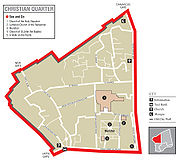
Helena of Constantinople
Saint Helena also known as Saint Helen, Helena Augusta or Helena of Constantinople was the consort of Emperor Constantius, and the mother of Emperor Constantine I...
, the mother of Constantine I
Constantine I
Constantine the Great , also known as Constantine I or Saint Constantine, was Roman Emperor from 306 to 337. Well known for being the first Roman emperor to convert to Christianity, Constantine and co-Emperor Licinius issued the Edict of Milan in 313, which proclaimed religious tolerance of all...
, in 325. A few yards nearby, Helena also identified the location of the Tomb of Jesus
Tomb of Jesus
Several places have been proposed as the tomb of Jesus, the place where Jesus Christ was buried:*Church of the Holy Sepulchre, Jerusalem, accepted by many Christians and scholars as built on ground on which Jesus was crucified and buried...
and claimed to have discovered the True Cross
True Cross
The True Cross is the name for physical remnants which, by a Christian tradition, are believed to be from the cross upon which Jesus was crucified.According to post-Nicene historians, Socrates Scholasticus and others, the Empress Helena The True Cross is the name for physical remnants which, by a...
; her son, Constantine, then built the Church of the Holy Sepulchre
Church of the Holy Sepulchre
The Church of the Holy Sepulchre, also called the Church of the Resurrection by Eastern Christians, is a church within the walled Old City of Jerusalem. It is a few steps away from the Muristan....
around the whole site. In 333, the Pilgrim of Bordeaux
Itinerarium Burdigalense
The Itinerarium Burdigalense is the oldest known Christian itinerarium, written by an anonymous pilgrim from Burdigala...
, entering from the east described the result:
In Nazénie Garibian de Vartavan's doctoral thesis, now published as La Jérusalem Nouvelle et les premiers sanctuaires chrétiens de l’Arménie. Méthode pour l’étude de l’église comme temple de Dieu, she concluded, through multiple arguments (mainly theological and archaeological), that the true site of Golgotha was precisely at the vertical of the now buried Constantinian basilica's altar and away from where the traditional rock of Golgotha is situated. The plans published in the book indicate the location of the Golgotha within a precision of less than two meters, below the circular passage situated a metre away from where the blood stained shirt of Christ was traditionally recovered and immediately before the stairs leading down to "St. Helena's Chapel" (the above mentioned mother of Emperor Constantine), alternatively called "St. Vartan's Chapel".
The temple to Aphrodite
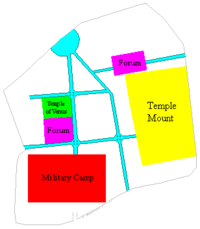
Temple
A temple is a structure reserved for religious or spiritual activities, such as prayer and sacrifice, or analogous rites. A templum constituted a sacred precinct as defined by a priest, or augur. It has the same root as the word "template," a plan in preparation of the building that was marked out...
to Aphrodite
Aphrodite
Aphrodite is the Greek goddess of love, beauty, pleasure, and procreation.Her Roman equivalent is the goddess .Historically, her cult in Greece was imported from, or influenced by, the cult of Astarte in Phoenicia....
. Constantine's construction took over most of the site of the earlier temple enclosure, and the Rotunda and cloister
Cloister
A cloister is a rectangular open space surrounded by covered walks or open galleries, with open arcades on the inner side, running along the walls of buildings and forming a quadrangle or garth...
(which was replaced after the 12th century by the present Catholicon
Katholikon
A Katholikon or Catholicon is the major temple of a monastery, or diocese in the Eastern Orthodox Church. The name derives from the fact that it is the largest temple where all gather together to celebrate the major feast days of the liturgical year. At other times, the smaller temples or...
and Calvary chapel) roughly overlap with the temple building itself; the basilica
Basilica
The Latin word basilica , was originally used to describe a Roman public building, usually located in the forum of a Roman town. Public basilicas began to appear in Hellenistic cities in the 2nd century BC.The term was also applied to buildings used for religious purposes...
church which Constantine built over the remainder of the enclosure was destroyed at the turn of the 11th century, and has not been replaced. Christian tradition
Sacred Tradition
Sacred Tradition or Holy Tradition is a theological term used in some Christian traditions, primarily in the Roman Catholic, Anglican, Eastern Orthodox and Oriental Orthodox traditions, to refer to the fundamental basis of church authority....
justifies this re-use by claiming that the location had originally been a Christian place of veneration, but that Hadrian had deliberately buried these Christian sites and built his own temple on top, on account of his alleged hatred for Christianity. There is certainly evidence that just 30 years after Hadrian's temple
Aelia Capitolina
Aelia Capitolina was a city built by the emperor Hadrian, and occupied by a Roman colony, on the site of Jerusalem, which was in ruins since 70 AD, leading in part to the Bar Kokhba revolt of 132–136.-Politics:...
had been built, Christians associated it with the site of Golgotha; Melito of Sardis
Melito of Sardis
Melito of Sardis was the bishop of Sardis near Smyrna in western Anatolia, and a great authority in Early Christianity: Jerome, speaking of the Old Testament canon established by Melito, quotes Tertullian to the effect that he was esteemed a prophet by many of the faithful...
, a late 2nd century bishop in the region, described the location as in the middle of the street, in the middle of the city, which matches the position of Hadrian's temple within the late 2nd century city.
However, Hadrian's temple had actually been located there simply because it was the junction of the main north-south road
Cardo
The cardo was a north-south oriented street in Roman cities, military camps, and coloniae. The cardo, an integral component of city planning, was lined with shops and vendors, and served as a hub of economic life. The main cardo was called cardo maximus.Most Roman cities also had a Decumanus...
(which is now the Suq Khan-ez-Zeit, etc.) with one of the two main east-west roads
Decumanus Maximus
In Roman city planning, a decumanus was an east-west-oriented road in a Roman city, castra , or colonia. The main decumanus was the Decumanus Maximus, which normally connected the Porta Praetoria to the Porta Decumana .This name comes from the fact that the via decumana or decimana In Roman city...
(which is now the Via Dolorosa
Via Dolorosa
The Via Dolorosa is a street, in two parts, within the Old City of Jerusalem, held to be the path that Jesus walked, carrying his cross, on the way to his crucifixion. The current route has been established since the 18th century, replacing various earlier versions...
), and directly adjacent to the forum
Forum (Roman)
A forum was a public square in a Roman municipium, or any civitas, reserved primarily for the vending of goods; i.e., a marketplace, along with the buildings used for shops and the stoas used for open stalls...
(which is now the location of the (smaller) Muristan
Muristan
The Muristan is a complex of streets and shops in the Christian Quarter of the Old City of Jerusalem...
); the forum itself had been placed, as is traditional in Roman towns, at the junction of the main north-south road with the (other) main east-west road (which is now El-Bazar/David Street). The temple and forum together took up the entire space between the two main east-west roads (a few above-ground remains of the east end of the temple precinct still survive in the Russia
Russia
Russia or , officially known as both Russia and the Russian Federation , is a country in northern Eurasia. It is a federal semi-presidential republic, comprising 83 federal subjects...
n Mission in Exile).
Questions of the location in relation to the city walls
The New Testament describes the crucifixion site, Golgotha, as being "near the city" (John 19:20), and "outside the city wall" (Heb. 13:12). The traditionally identified location is in the heart of Hadrian's city, well within Jerusalem's Old City WallsJerusalem's Old City walls
The Old City is a walled area within the modern city of Jerusalem. Until 1860, when the Jewish neighborhood, Mishkenot Sha'ananim, was established, this area constituted the entire city of Jerusalem...
; there has therefore been some questioning of the legitimacy of the traditional identification on these grounds. Some defenders of this tradition have responded by citing Jewish history of the wall, that the city had been much narrower in Jesus' time, with the site then having been outside the walls; since Herod Agrippa (41–44) is recorded by history as extending the city to the north (beyond the present northern walls), the required repositioning of the western wall is traditionally attributed to him as well. In 2003, Professor Sir Henry Chadwick (former Dean of Christ Church, Oxford
Christ Church, Oxford
Christ Church or house of Christ, and thus sometimes known as The House), is one of the largest constituent colleges of the University of Oxford in England...
) argued that when Hadrian's builders replanned the old city, they "incidentally confirm[ed] the bringing of Golgotha inside a new town wall."
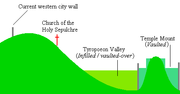
Temple Mount
The Temple Mount, known in Hebrew as , and in Arabic as the Haram Ash-Sharif , is one of the most important religious sites in the Old City of Jerusalem. It has been used as a religious site for thousands of years...
would make the city inside the wall quite thin; essentially for the traditional site to have been outside the wall, the city would have had to be limited to the lower parts of the Tyropoeon Valley
Tyropoeon Valley
Tyropoeon Valley is the name given by Josephus the historian to the valley or rugged ravine, in the Old City of Jerusalem, which in ancient times separated Mount Moriah from Mount Zion and emptied into the valley of Hinnom...
, rather than including the defensively advantageous western hill. Since these geographic considerations imply that not including the hill within the walls would be willfully making the city prone to attack from it, some scholars, including the late 19th century surveyors of the Palestine Exploration Fund
Palestine Exploration Fund
The Palestine Exploration Fund is a British society often simply known as the PEF. It was founded in 1865 and is still functioning today. Its initial object was to carry out surveys of the topography and ethnography of Ottoman Palestine with a remit that fell somewhere between an expeditionary...
, consider it unlikely that a wall would ever have been built which would cut the hill off from the city in the valley; archaeological evidence for the existence an earlier city wall in such a location has never been found.
In another viewpoint, in 2007 Dan Bahat, the former City Archaeologist of Jerusalem and Professor of Land of Israel Studies at Bar-Ilan University
Bar-Ilan University
Bar-Ilan University is a university in Ramat Gan of the Tel Aviv District, Israel.Established in 1955, Bar Ilan is now Israel's second-largest academic institution. It has nearly 26,800 students and 1,350 faculty members...
, stated that "Six graves from the first century were found on the area of the Church of the Holy Sepulchre. That means, this place [was] outside of the city, without any doubt…". The dating of the tombs is based on the fact that they are in the kokh
Kokhim
Kokh is a type of tomb complex characterized by a series of long narrow shafts, in which the deceased were placed for burial, radiating from a central chamber...
style, which was common in 1st century; however, the kokh style of tomb was also common in the 2nd and 3rd centuries BC.
The rockface
During 1973–1978 restoration works, and excavations, inside the Church of the Holy Sepulchre, and under the nearby MuristanMuristan
The Muristan is a complex of streets and shops in the Christian Quarter of the Old City of Jerusalem...
, it was found that the area was originally a quarry, from which white Meleke limestone
Limestone
Limestone is a sedimentary rock composed largely of the minerals calcite and aragonite, which are different crystal forms of calcium carbonate . Many limestones are composed from skeletal fragments of marine organisms such as coral or foraminifera....
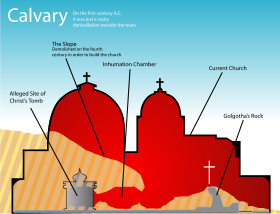
was struck; surviving parts of the quarry, to the north-east of the chapel of St. Helena, are now accessible from within the chapel (by permission). Inside the church is a rock, about 7 m long by 3 m wide by 4.8 m high, that is traditionally believed to be all that now remains visible of Golgotha; the design of the church means that the Calvary Chapel contains the upper foot or so of the rock, while the remainder is in the chapel beneath it (known as the tomb of Adam). Virgilio Corbo
Virgilio Canio Corbo
Born: 1918Dead: December 6, 1991,A Franciscan Friar and professor of archaeology at the Studium Biblicum Franciscanum in Jerusalem. Remembered for the excavations of many religious sites:* the Shepherds' field near Bethlehem...
, a Franciscan
Franciscan
Most Franciscans are members of Roman Catholic religious orders founded by Saint Francis of Assisi. Besides Roman Catholic communities, there are also Old Catholic, Anglican, Lutheran, ecumenical and Non-denominational Franciscan communities....
priest and archaeologist, present at the excavations, suggested that from the city the little hill (which still exists) could have looked like a skull.
During a 1986 repair to the floor of the Calvary Chapel, by the art historian George Lavas and architect Theo Mitropoulos, a round slot of 11.5 cm diameter was discovered in the rock, partly open on one side (Lavas attributes the open side to accidental damage during his repairs); although the dating of the slot is uncertain, and could date to Hadrian's temple of Aphrodite, Lavas suggested that it could have been the site of the crucifixion, as it would be strong enough to hold in place a wooden trunk of up to 2.5 m height (among other things). The same restoration work also revealed a crack running across the surface of the rock, which continues down to the Chapel of Adam; the crack is thought by archaeologists to have been a result of the quarry workmen encountering a flaw in the rock.
Jerome
Saint Jerome was a Roman Christian priest, confessor, theologian and historian, and who became a Doctor of the Church. He was the son of Eusebius, of the city of Stridon, which was on the border of Dalmatia and Pannonia...
. Some archaeologists have been suggested that prior to Hadrian's use, the rock outcrop had been a nefesh - a Jewish funeral monument, equivalent to the stele
Stele
A stele , also stela , is a stone or wooden slab, generally taller than it is wide, erected for funerals or commemorative purposes, most usually decorated with the names and titles of the deceased or living — inscribed, carved in relief , or painted onto the slab...
.
Pilgrimages to Constantine's Church
The Itinerarium BurdigalenseItinerarium Burdigalense
The Itinerarium Burdigalense is the oldest known Christian itinerarium, written by an anonymous pilgrim from Burdigala...
speaks of Golgotha in 333: "... On the left hand is the little hill of Golgotha where the Lord was crucified. About a stone's throw from thence is a vault (crypta) wherein His body was laid, and rose again on the third day. There, at present, by the command of the Emperor Constantine, has been built a basilica, that is to say, a church of wondrous beauty," Cyril of Jerusalem
Cyril of Jerusalem
Cyril of Jerusalem was a distinguished theologian of the early Church . He is venerated as a saint by the Roman Catholic Church, the Eastern Orthodox Church, and the Anglican Communion. In 1883, Cyril was declared a Doctor of the Church by Pope Leo XIII...
, a distinguished theologian of the early Church, and eyewitness to the early days of Constantine's edifice, speaks of Golgotha in eight separate passages, sometimes as near to the church in which he and his listeners were assembled: "Golgotha, the holy hill standing above us here, bears witness to our sight: the Holy Sepulchre bears witness, and the stone which lies there to this day." And just in such a way the pilgrim Egeria often reported in 383: "… the church, built by Constantine, which is situated in Golgotha …", and also bishop Eucherius of Lyon
Eucherius of Lyon
Saint Eucherius, bishop of Lyon, was a high-born and high-ranking ecclesiastic in the Christian Church of Gaul. He is remembered for his letters advocating extreme self-abnegation. Henry Wace ranked him "except perhaps St. Irenaeus the most distinguished occupant of that see".On the death of his...
wrote to the island presbyter Faustus in 440: "Golgotha is in the middle between the Anastasis and the Martyrium, the place of the Lord's passion, in which still appears that rock which once endured the very cross on which the Lord was.", and Breviarius de Hierosolyma reports in 530: "From there (the middle of the basilica), you enter into Golgotha, where there is a large court. Here the Lord was crucified. All around that hill, there are silver screens." (See also: Eusebius
Eusebius of Caesarea
Eusebius of Caesarea also called Eusebius Pamphili, was a Roman historian, exegete and Christian polemicist. He became the Bishop of Caesarea in Palestine about the year 314. Together with Pamphilus, he was a scholar of the Biblical canon...
in 338).
Alternative locations
In 1882–83, Major-General Charles George GordonCharles George Gordon
Major-General Charles George Gordon, CB , known as "Chinese" Gordon, Gordon Pasha, and Gordon of Khartoum, was a British army officer and administrator....
proposed a different location. The location, which some Protestants call the Garden Tomb
Garden Tomb
The Garden Tomb , located in Jerusalem, outside the city walls and close to the Damascus Gate, is a rock-cut tomb considered by some to be the site of the burial and resurrection of Jesus, and to be adjacent to Golgotha, in contradistinction to the traditional site for these—the Church of the Holy...
, is beneath a cliff which contains two large sunken holes, which Gordon regarded as resembling the eyes of a skull; he and a few others before him believed that the skull-like appearance would have caused the location to be known as Golgotha.
The Garden Tomb contains several ancient burial places, although pottery and archaeological findings in the area have been dated to the 7th century BC, so the site would have been abandoned by the 1st century. Eusebius comments that Golgotha was in his day (the 4th century) pointed out north of Mount Zion. Although the hill currently referred to as Mount Zion
Mount Zion
Mount Zion is a place name for a site in Jerusalem, the location of which has shifted several times in history. According to the Hebrew Bible's Book of Samuel, it was the site of the Jebusite fortress called the "stronghold of Zion" that was conquered by King David, becoming his palace in the City...
is indeed south of the traditional site for Golgotha, it has only had that name since the Middle Ages, and previously 'Mount Zion' referred to the Temple Mount
Temple Mount
The Temple Mount, known in Hebrew as , and in Arabic as the Haram Ash-Sharif , is one of the most important religious sites in the Old City of Jerusalem. It has been used as a religious site for thousands of years...
itself. The Garden Tomb is north of both.
Another alternate location has been proposed by Rodger Dusatko, a missionary in Germany. He claims that the location is just outside the Lion's gate.
He has written a book about the correlation between the crucifixion of Jesus and the sacrifice of the Red Heifer (400 pages - http://www.dusatko.de/redheifer.pdf). In this book he describes in detail the view of the priest who sacrificed the Red Heifer. It is mentioned in Num 19,4 that he must look towards the entrance of the temple as he sprinkles the blood. In his book, Rodger Dusatko claims that this view went directly over the place on Golgotha where Jesus was crucified. He has also written a small summary on the location of Golgotha.
All of his works, both the books as well as the pictures, may be distributed freely as stated at http://www.dusatko.de/books.aspx
Other uses of the name
- The name CalvaryCalvary (sculpture)A calvary is a type of monumental public crucifix, sometimes encased in an open shrine, most commonly found across northern France from Brittany east and through Belgium and equally familiar as wayside structures provided with minimal sheltering roofs in Italy and Spain...
often refers to sculptures or pictures representing the scene of the crucifixionCrucifixionCrucifixion is an ancient method of painful execution in which the condemned person is tied or nailed to a large wooden cross and left to hang until dead...
of Jesus, or a small wayside shrine incorporating such a picture. It also can be used to describe larger, more monumentlike constructions, essentially artificial hills often built by devotees, especially a tradition in BrittanyBrittanyBrittany is a cultural and administrative region in the north-west of France. Previously a kingdom and then a duchy, Brittany was united to the Kingdom of France in 1532 as a province. Brittany has also been referred to as Less, Lesser or Little Britain...
in France of large stone monuments. - Churches in various Christian denominations have been named Calvary. The name is also sometimes given to cemeteries, especially those associated with the Roman Catholic ChurchRoman Catholic ChurchThe Catholic Church, also known as the Roman Catholic Church, is the world's largest Christian church, with over a billion members. Led by the Pope, it defines its mission as spreading the gospel of Jesus Christ, administering the sacraments and exercising charity...
. - Two Catholic religious orders have been dedicated to Mount Calvary. Several places worldwide have been named after it; including the town Kalvarija in LithuaniaLithuaniaLithuania , officially the Republic of Lithuania is a country in Northern Europe, the biggest of the three Baltic states. It is situated along the southeastern shore of the Baltic Sea, whereby to the west lie Sweden and Denmark...
and towns Góra KalwariaGóra KalwariaGóra Kalwaria is a town on the Vistula River in the Mazovian Voivodship, Poland, about 25 km southeast of Warsaw. It has a population of about 11,000 . The town has significance for both Catholic Christians and Hasidic Jews...
and Kalwaria ZebrzydowskaKalwaria ZebrzydowskaKalwaria Zebrzydowska is a town in southern Poland with 4,429 inhabitants . It is situated in the Lesser Poland Voivodeship ; previously it was in the Bielsko-Biała Voivodeship ....
in Poland. - In the 18th and early 19th centuries at Oxford and Cambridge universities the rooms of the heads of colleges and halls were nicknamed golgotha. Apart from the obvious pun on the place of skulls (i.e. heads), this was also due to the punishments that students received in these rooms.
- In the Eastern Orthodox Church, a Golgotha is a representation (iconIconAn icon is a religious work of art, most commonly a painting, from Eastern Christianity and in certain Eastern Catholic churches...
) of the crucified Jesus, often with the TheotokosTheotokosTheotokos is the Greek title of Mary, the mother of Jesus used especially in the Eastern Orthodox, Oriental Orthodox, and Eastern Catholic Churches. Its literal English translations include God-bearer and the one who gives birth to God. Less literal translations include Mother of God...
(Mother of God) and John the Beloved Disciple standing to either side. This is used during Holy Week, especially during the MatinsMatinsMatins is the early morning or night prayer service in the Roman Catholic, Anglican, Lutheran and Eastern Orthodox liturgies of the canonical hours. The term is also used in some Protestant denominations to describe morning services.The name "Matins" originally referred to the morning office also...
of Great Friday (Good Friday). During the rest of the year, it may stand in the naveNaveIn Romanesque and Gothic Christian abbey, cathedral basilica and church architecture, the nave is the central approach to the high altar, the main body of the church. "Nave" was probably suggested by the keel shape of its vaulting...
of the church, off to one side, and will be the place where Pannikhidas (memorial services) will be chanted.