

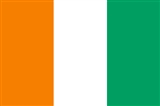
Côte d'Ivoire

Encyclopedia
The Republic of Côte d'Ivoire (kot diˈvwaʁ) or Ivory Coast is a country in West Africa
. It has an area of 322462 square kilometres (124,503.3 sq mi), and borders the countries Liberia
, Guinea
, Mali
, Burkina Faso
and Ghana
; its southern boundary is along the Gulf of Guinea
. The country's population was 15,366,672 in 1998 and was estimated to be 20,617,068 in 2009. Côte d'Ivoire's first national census in 1975 counted 6.7 million inhabitants.
Prior to its colonization by Europeans, Côte d'Ivoire was home to several states, including Gyaaman
, the Kong Empire
, and Baoulé
. There were two Anyi
kingdoms, Indénié and Sanwi
, which attempted to retain their separate identity through the French colonial period and after Côte d'Ivoire's independence. An 1843–1844 treaty made a "protectorate
" of France and in 1893, it became a French colony as part of the European scramble for Africa
.
Côte d'Ivoire became independent on 7 August 1960. From 1960 to 1993, the country was led by . It maintained close political and economic association with its West African neighbours, while at the same time maintaining close ties to the West, especially to France. Since the end of Houphouët-Boigny's rule, Côte d'Ivoire has experienced one , in 1999, and a civil war, which broke out in 2002. A political agreement between the government and the rebels brought a return to peace. Côte d'Ivoire is a republic with a strong executive power invested in the President. Its de jure
capital is Yamoussoukro
and the biggest city is the port city of Abidjan
. The country is divided into 19 regions
and 81 departments
. It is a member of the Organisation of Islamic Cooperation, African Union
, La Francophonie
, Latin Union
, Economic Community of West African States
and South Atlantic Peace and Cooperation Zone
.
The official language
is French, although many of the local languages are widely used, including Baoulé
, Dioula
, Dan
, Anyin
and Cebaara Senufo
. The main religions are Islam, Christianity (primarily Roman Catholic
) and various indigenous religion
s.
Through production of coffee and cocoa, the country was an economic powerhouse during the 1960s and 1970s in West Africa. However, Côte d'Ivoire went through an economic crisis in the 1980s, leading to the country's period of political and social turmoil. The 21st century Ivoirian economy is largely market-based and relies heavily on agriculture, with smallholder cash crop production being dominant.
Despite the Ivorian government's request, the English translation "Ivory Coast" (sometimes "the Ivory Coast") is still frequently used in English. The BBC
usually uses "Ivory Coast" both in news reports and on its page about the country. The Guardian
newspaper's Style Guide says: "Ivory Coast, not 'The Ivory Coast' or ''; its nationals are Ivorians." ABC News (USA), The Times
, The New York Times
, and the South African Broadcasting Corporation
all use "Ivory Coast" either exclusively or predominantly.
Many governments use "" for diplomatic reasons, as do their outlets, such as the Chinese CCTV News. The English country name registered with the United Nations
and used by ISO 3166
is "Côte d'Ivoire". Other organizations that use "Côte d'Ivoire" include FIFA
and the IOC
(referring to their national football
and Olympic teams in international games and in official broadcasts), The Economist
newsmagazine, Encyclopædia Britannica
, and National Geographic Society
.
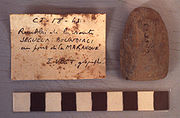 The first human presence in has been difficult to determine because human remains have not been well-preserved in the country's humid climate. However, the presence of newly found weapon and tool fragments (specifically, polished axes cut through shale
and remnants of cooking and fishing) has been interpreted as a possible indication of a large human presence during the Upper Paleolithic
period (15,000 to 10,000 BC), or at the minimum, the Neolithic
period.
The earliest known inhabitants of have left traces scattered throughout the territory. Historians believe that they were all either displaced or absorbed by the ancestors of the present indigenous inhabitants, who migrated south into the area before the 16th century. Such groups included the Ehotilé (Aboisso
), Kotrowou (Fresco), Zéhiri (Grand Lahou
), Ega and Diès (Divo
).
) traders, who, from early Roman times, conducted a caravan
trade across the Sahara
in salt, slaves, gold, and other goods. The southern terminals of the trans-Saharan trade
routes were located on the edge of the desert, and from there supplemental trade extended as far south as the edge of the rain forest. The more important terminals—Djenné
, Gao
, and Timbuctu—grew into major commercial centres around which the great Sudanic empires developed.
By controlling the trade routes with their powerful military forces, these empires were able to dominate neighbouring states. The Sudanic empires also became centres of Islamic education
. Islam had been introduced in the western Sudan (today's Mali) by Muslim Berber traders from North Africa; it spread rapidly after the conversion of many important rulers. From the eleventh century, by which time the rulers of the Sudanic empires had embraced Islam, it spread south into the northern areas of contemporary Côte d'Ivoire.
The Ghana empire
, the earliest of the Sudanic empires, flourished in present-day eastern Mauritania from the fourth to the thirteenth century. At the peak of its power in the eleventh century, its realms extended from the Atlantic Ocean to Timbuctu. After the decline of Ghana, the Mali Empire
grew into a powerful Muslim state, which reached its apogee in the early part of the fourteenth century. The territory of the Mali Empire in Côte d'Ivoire was limited to the north-west corner around Odienné
.
Its slow decline starting at the end of the fourteenth century followed internal discord and revolts by vassal states, one of which, Songhai
, flourished as an empire between the fourteenth and sixteenth centuries. Songhai was also weakened by internal discord, which led to factional warfare. This discord spurred most of the migrations of peoples southward toward the forest belt. The dense rain forest, covering the southern half of the country, created barriers to the large-scale political organizations that had arisen in the north. Inhabitants lived in villages or clusters of villages; their contacts with the outside world were filtered through long-distance traders. Villagers subsisted on agriculture and hunting.
was established by the Juula in the early eighteenth century in the north-central region inhabited by the Sénoufo, who had fled Islamization
under the Mali Empire
. Although Kong became a prosperous center of agriculture, trade, and crafts, ethnic diversity and religious discord gradually weakened the kingdom. The city of Kong was destroyed in 1895 by Samori Ture.
The Abron
kingdom of Gyaaman
was established in the seventeenth century by an Akan
group, the Abron, who had fled the developing Ashanti confederation
of Asanteman in what is present-day Ghana. From their settlement south of Bondoukou
, the Abron gradually extended their hegemony over the Dyula people in Bondoukou, who were recent émigrés from the market city of Begho. Bondoukou developed into a major centre of commerce and Islam. The kingdom's Quranic scholars attracted students from all parts of West Africa. In the mid-seventeenth century in east-central Côte d'Ivoire, other Akan groups' fleeing the Asante established a Baoulé
kingdom at Sakasso and two Agni
kingdoms, Indénié and Sanwi.
The Baoulé, like the Ashanti, developed a highly centralized political and administrative structure under three successive rulers. It finally split into smaller chiefdoms. Despite the breakup of their kingdom, the Baoulé strongly resisted French subjugation. The descendants of the rulers of the Agni kingdoms tried to retain their separate identity long after Côte d'Ivoire's independence; as late as 1969, the Sanwi attempted to break away from Côte d'Ivoire and form an independent kingdom. Michael Jackson
visited Krinjabo, the capital of Sanwi, in 1992 and met with the king. The current King of Sanwi is Nana Amon Ndoufou V (since 2002).
The earliest recorded European voyage to West Africa was made by the Portuguese and took place in 1482. The first West African French settlement, Saint Louis, was founded in the mid-seventeenth century in Senegal while, at about the same time, the Dutch ceded to the French a settlement at Goree Island
off Dakar
. A French mission
was established in 1637 Assinie
near the border with the Gold Coast
(now Ghana).
Assinie's survival was precarious, however. It was not until the mid-nineteenth century that the French were firmly established in Côte d'Ivoire. In 1843–1844, French admiral Bouët-Willaumez
signed treaties with the kings of the Grand Bassam and Assinie regions, placing their territories under a French protectorate
. French explorers
, missionaries, trading companies, and soldiers gradually extended the area under French control inland from the lagoon region. Pacification was not accomplished until 1915.
Activity along the coast stimulated European interest in the interior, especially along the two great rivers, the Senegal
and the Niger
. Concerted French exploration of West Africa began in the mid-nineteenth century but moved slowly, based more on individual initiative than on government policy. In the 1840s, the French concluded a series of treaties with local West African rulers that enabled the French to build fortified posts along the Gulf of Guinea to serve as permanent trading centres.
The first posts in Côte d'Ivoire included one at Assinie and another at Grand Bassam, which became the colony's first capital. The treaties provided for French sovereignty within the posts, and for trading privileges in exchange for fees or coutume
s paid annually to the local rulers for the use of the land. The arrangement was not entirely satisfactory to the French, because trade was limited and misunderstandings over treaty obligations often arose. Nevertheless, the French government maintained the treaties, hoping to expand trade.
France also wanted to maintain a presence in the region to stem the increasing influence of the British along the Gulf of Guinea coast. The French built naval bases to keep out non-French traders and began a systematic conquest of the interior. (They accomplished this only after a long war in the 1890s against Mandinka
forces, mostly from Gambia. Guerrilla warfare
by the Baoulé and other eastern groups continued until 1917).
The defeat of France in the Franco-Prussian War
in 1871 and the subsequent annexation by Germany of the French province of Alsace Lorraine caused the French government to abandon its colonial ambitions and withdraw its military garrisons from its French West African trading posts, leaving them in the care of resident merchants. The trading post at Grand Bassam in Côte d'Ivoire was left in the care of a shipper from Marseille
, Arthur Verdier
, who in 1878 was named Resident
of the Establishment of Côte d'Ivoire.
In 1886, to support its claims of effective occupation, France again assumed direct control of its West African coastal trading posts and embarked on an accelerated program of exploration in the interior. In 1887 Lieutenant Louis Gustave Binger
began a two-year journey that traversed parts of Côte d'Ivoire's interior. By the end of the journey, he had concluded four treaties establishing French protectorates in Côte d'Ivoire. Also in 1887, Verdier's agent, Marcel Treich-Laplène
, negotiated five additional agreements that extended French influence from the headwaters of the Niger River Basin through Côte d'Ivoire.
(present-day Mali) to Côte d'Ivoire for economic and administrative reasons.
France's main goal was to stimulate the production of exports. Coffee, cocoa and palm oil crops were soon planted along the coast. stood out as the only West African country with a sizeable population of settlers; elsewhere in West and Central Africa, the French and British were largely bureaucrats. As a result, French citizens owned one third of the cocoa, coffee and banana plantation
s and adopted a forced-labour system.
Throughout the early years of French rule, French military contingents were sent inland to establish new posts. The African population resisted French penetration and settlement. Among those offering greatest resistance was Samori Ture, who in the 1880s and 1890s was establishing the Wassoulou Empire
, which extended over large parts of present-day Guinea, Mali, Burkina Faso, and Côte d'Ivoire. Samori Ture's large, well-equipped army, which could manufacture and repair its own firearm
s, attracted strong support throughout the region. The French responded to Samori Ture's expansion of regional control with military pressure. French campaigns against Samori Ture, which were met with fierce resistance, intensified in the mid-1890s until he was captured in 1898.
France's imposition of a head tax in 1900 to support the colony in a public works
program, provoked a number of revolts. Ivoirians viewed the tax as a violation of the terms of the protectorate treaties, because they thought that France was demanding the equivalent of a coutume
from the local kings, rather than the reverse. Much of the population, especially in the interior, considered the tax a humiliating symbol of submission.
From 1904 to 1958, Côte d'Ivoire was a constituent unit of the Federation of French West Africa. It was a colony and an overseas territory under the Third Republic
. Until the period following World War II
, governmental affairs in French West Africa were administered from Paris. France's policy in West Africa was reflected mainly in its philosophy of "association", meaning that all Africans in Côte d'Ivoire were officially French "subjects", but without rights to representation in Africa or France.
French colonial policy incorporated concepts of assimilation
and association. Based on an assumption of the superiority of French culture over all others, in practice the assimilation policy meant extension of the French language, institutions, laws, and customs in the colonies. The policy of association also affirmed the superiority of the French in the colonies, but it entailed different institutions and systems of laws for the colonizer and the colonized. Under this policy, the Africans in Côte d'Ivoire were allowed to preserve their own customs insofar as they were compatible with French interests.
An indigenous elite
trained in French administrative practice formed an intermediary group between the French and the Africans. Assimilation was practiced in Côte d'Ivoire to the extent that after 1930, a small number of Westernized Ivoirians were granted the right to apply for French citizenship. Most Ivoirians, however, were classified as French subjects and were governed under the principle of association. As subjects of France, they had no political rights. They were drafted for work in mines, on plantations, as porters, and on public projects as part of their tax responsibility. They were expected to serve in the military and were subject to the indigénat
, a separate system of law.
In World War II, the Vichy regime remained in control until 1943, when members of Gen. Charles de Gaulle
's provisional government assumed control of all French West Africa. The Brazzaville Conference of 1944
, the first Constituent Assembly of the Fourth Republic
in 1946, and France's gratitude for African loyalty during World War II led to far-reaching governmental reforms in 1946. French citizenship was granted to all African "subjects," the right to organize politically was recognized, and various forms of forced labour were abolished.
Until 1958, governors appointed in Paris administered the colony of Côte d'Ivoire, using a system of direct, centralized administration that left little room for Ivoirian participation in policy making. Whereas British colonial administration adopted divide-and-rule policies elsewhere, applying ideas of assimilation only to the educated elite, the French were interested in ensuring that the small but influential elite was sufficiently satisfied with the status quo to refrain from any anti-French sentiment. Although strongly opposed to the practices of association, educated Ivoirians believed that they would achieve equality with their French peers through assimilation rather than through complete independence from France, a change that would eliminate the enormous economic advantages of remaining a French possession. But, after the assimilation doctrine was implemented entirely through the postwar reforms, Ivoirian leaders realized that even assimilation implied the superiority of the French over the Ivoirians, and that discrimination and political inequality would end only with independence.
A turning point in relations with France was reached with the 1956 Overseas Reform Act (Loi Cadre
), which transferred a number of powers from Paris to elected territorial governments in French West Africa
and also removed remaining voting inequalities. In 1958, became an autonomous member of the French Community (which replaced the French Union
).
At the time of 's independence (1960), the country was easily French West Africa
's most prosperous, contributing over 40% of the region's total exports. When became the first president, his government gave farmers good prices for their products to further stimulate production. This was further boosted by a significant immigration of workers from surrounding countries. Coffee production increased significantly, catapulting into third place in world output (behind Brazil and Colombia). By 1979, the country was the world's leading producer of cocoa.
It also became Africa's leading exporter of pineapples and palm oil
. French technicians contributed to the 'Ivoirian miracle'. In other African nations, the people drove out the Europeans following independence; but in , they poured in. The French community grew from only 30,000 prior to independence to 60,000 in 1980, most of them teachers, managers and advisors. For 20 years, the economy maintained an annual growth rate of nearly 10%—the highest of Africa's non-oil-exporting countries.
, who would be the president of Côte d'Ivoire in 2000, had to flee as he incurred the ire of Houphouët-Boigny when Gbagbo founded the Front Populair Ivoirien. Houphouët-Boigny banked on his broad appeal to the population who continually elected him. He was also criticized for his emphasis on developing large scale projects. Many felt the millions of dollars spent transforming his home village, Yamoussoukro
, into the new capital that it became, were wasted; others support his vision to develop a centre for peace, education and religion in the heart of the country. But in the early 1980s, the world recession and a local drought sent shock waves through the Ivoirian economy. Due to the overcutting of timber and collapsing sugar prices, the country's external debt increased threefold. Crime rose dramatically in Abidjan.
In 1990, hundreds of civil servants went on strike, joined by students protesting institutional corruption. The unrest forced the government to support multi-party democracy. Houphouët-Boigny became increasingly feeble and died in 1993. He favoured as his successor.
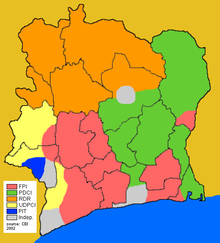 Unlike , who was very careful in avoiding any ethnic conflict and left access to administrative positions open to immigrants from neighbouring countries, emphasized the concept of "Ivority" to exclude his rival Alassane Ouattara
, who had two northern Ivorian parents, from running for future presidential election. As people originating from foreign countries are a large part of the Ivoirian population, this policy excluded many people from Ivoirian nationality, and the relationship between various ethnic groups became strained.
, putting General in power. fled into exile in France. The new leadership reduced crime and corruption, and the generals pressed for austerity and openly campaigned in the streets for a less wasteful society.
vied with , but it was peaceful. The lead-up to the election was marked by military and civil unrest. Following a public uprising that resulted in around 180 deaths, was swiftly replaced by Gbagbo. Alassane Ouattara
was disqualified by the country's Supreme Court, due to his alleged nationality. The existing and later reformed constitution [under ] did not allow non-citizens to run for presidency. This sparked violent protests in which his supporters, mainly from the country's north, battled riot police in the capital, Yamoussoukro.
What exactly happened that night is disputed. The government claimed that former president had led a coup attempt, and state TV showed pictures of his dead body in the street; counter-claims stated that he and fifteen others had been murdered at his home and his body had been moved to the streets to incriminate him. Alassane Ouattara took refuge in the French embassy; his home had burned down.
President Gbagbo cut short his trip to Italy and on his return stated, in a television address, that some of the rebels were hiding in the shanty towns where foreign migrant workers lived. Gendarmes and vigilantes bulldozed and burned homes by the thousands, attacking the residents.
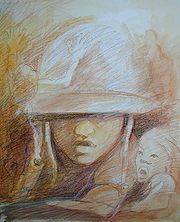 An early ceasefire with the rebels, which had the backing of much of the northern populace, proved short-lived, and fighting over the prime cocoa-growing areas resumed. France sent in troops to maintain the cease-fire boundaries, and militias, including warlords and fighters from Liberia and Sierra Leone, took advantage of the crisis to seize parts of the west.
Though UN peacekeepers were deployed to maintain a Zone of Confidence, relations between Gbagbo and the opposition continued to deteriorate.
Early in November 2004, after the peace agreement had effectively collapsed following the rebels' refusal to disarm, Gbagbo ordered airstrikes against the rebels. During one of these airstrikes in Bouaké
, on 6 November 2004, French soldiers were hit and nine were killed; the Ivorian government has said it was a mistake, but the French have claimed it was deliberate. They responded by destroying most Ivoirian military aircraft (2 Su-25 planes and 5 helicopters), and violent retaliatory riots against the French broke out in Abidjan.
Gbagbo's original mandate as president expired on 30 October 2005, but due to the lack of disarmament it was deemed impossible to hold an election, and therefore his term in office was extended for a maximum of one year, according to a plan worked out by the African Union
; this plan was endorsed by the United Nations Security Council
. With the late October deadline approaching in 2006, it was regarded as very unlikely that the election would be held by that point, and the opposition and the rebels rejected the possibility of another term extension for Gbagbo. The UN Security Council endorsed another one-year extension of Gbagbo's term on 1 November 2006; however, the resolution provided for the strengthening of Prime Minister Charles Konan Banny
's powers. Gbagbo said the next day that elements of the resolution deemed to be constitutional violations would not be applied.
A peace accord between the government and the rebels, or New Forces
, was signed on 4 March 2007, and subsequently Guillaume Soro
, leader of the New Forces, became prime minister. These events have been seen by some observers as substantially strengthening Gbagbo's position.
. The ruling FPI contested the results before the Constitutional Council, charging massive fraud in the northern departments controlled by the rebels of the Forces Nouvelles de Côte d'Ivoire
(FNCI). These charges were contradicted by international observers. The report of the results led to severe tension and violent incidents. The Constitutional Council, which consists of Gbagbo supporters, declared the results of seven northern departments unlawful and that Gbagbo had won the elections with 51% of the vote (instead of Ouattara winning with 54%, as reported by the Electoral Commission). After the inauguration of Gbagbo, Ouattara, recognized as the winner by most countries and the United Nations, organized an alternative inauguration. These events raised fears of a resurgence of the civil war; thousands of refugees have fled the country. The African Union
sent Thabo Mbeki
, former President of South Africa, to mediate the conflict. The UN Security Council adopted a common resolution recognising Alassane Ouattara as winner of the elections, based on the position of ECOWAS (Economic Community of West Africa States). ECOWAS suspended Côte d'Ivoire from all its decision-making bodies while the African Union also suspended the country's membership.
and to the Second Ivorian Civil War
. After months of unsuccessful negotiations and sporadic violence, the crisis entered a critical stage as Ouattara's forces seized control of most of the country, with Gbagbo entrenched in Abidjan
, the country's largest city. International organizations reported numerous instances of human rights violations by both sides. In the city of Duékoué, hundreds of people were estimated to have been killed, predominantly by advancing pro-Ouattara militias. In nearby Blolequin, dozens of people were killed, reportedly by retreating Liberian militias who had been hired by pro-Gbagbo forces. UN and French forces took military action against Gbagbo. Gbagbo was taken into custody after a raid into his residence on 11 April. It was initially thought he was captured by French forces, however Ouattara's envoy to the UN claimed it was their forces who captured him, and the French deny any involvement in his arrest.
The regions are further divided into 81 departments
.
(295,500), the fourth most populous city. Abidjan
, with a population of 3,310,500, is the largest city and serves as the commercial and banking center of as well as the de facto capital. It is also the most populous city in French-speaking Western Africa.
; Abidjan
, however, remains the administrative center. Most countries maintain their embassies in Abidjan, although some (including the United Kingdom) have closed their missions because of the continuing violence and attacks on Europeans. The Ivoirian population continues to suffer because of an ongoing civil war (See the History section above). International human rights organizations have noted problems with the treatment of captive non-combatants by both sides and the re-emergence of child slavery among workers in cocoa production.
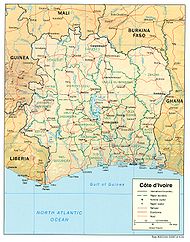 Although most of the fighting ended by late 2004, the country remained split in two, with the north controlled by the New Forces (FN). A new presidential election was expected to be held in October 2005, and an agreement was reached among the rival parties in March 2007 to proceed with this, but it continued to be postponed until November 2010 due to delays in its preparation.
Elections were finally held in 2010. The first round of elections were held peacefully, and widely hailed as free and fair. Runoffs were held 28 November 2010, after being delayed one week from the original date of 21 November. Laurent Gbagbo
as president ran against former Prime Minister Alassane Ouattara
.
On 2 December, the Electoral Commission declared that Ouattara had won the election by a margin off 54% to 46%. In response, the Gbagbo-aligned Constitutional Council rejected the declaration, and the government announced that country's borders had been sealed. An Ivorian military spokesman said, "The air, land and sea border of the country are closed to all movement of people and goods."
. It borders Liberia
and Guinea
in the west, Mali
and Burkina Faso
in the north, Ghana
in the east, and the Gulf of Guinea
(Atlantic Ocean) in the south. The country lies between latitudes 4°
and 11°N
, and longitudes 2°
and 9°W
.
The maintenance of close ties to France since independence in 1960, diversification of agriculture for export, and encouragement of foreign investment, have been factors in the economic growth of . In recent years has been subject to greater competition and falling prices in the global marketplace for its primary agricultural crops: coffee and cocoa. That, compounded with high internal corruption, makes life difficult for the grower and those exporting into foreign markets.
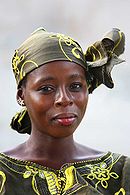 Ethnic groups: Akan
42.1%, Voltaiques or Gur
17.6%, Northern Mandes 16.5%, Krous 11%, Southern Mandes 10%, other 2.8% (includes 30,000 Lebanese and 45,000 French) (2004). 77% of the population are considered Ivoirians. They represent several different peoples and language groups. An estimated 65 languages are spoken in the country. One of the most common is Dyula
, which acts as a trade language as well as a language commonly spoken by the Muslim population.
French, the official language, is taught in schools and serves as a lingua franca
in the country.
The native born population is roughly split into three groups of Muslim, Christian (primarily Roman Catholic) and animist. Since Côte d'Ivoire has established itself as one of the most successful West African nations, about 20% of the population (about 3.4 million) consists of workers from neighbouring Liberia, Burkina Faso and Guinea.
4% of the population is of non-African ancestry. Many are French, Lebanese, Vietnamese and Spanish citizens, as well as Protestant missionaries from the United States and Canada. In November 2004, around 10,000 French and other foreign nationals evacuated Côte d'Ivoire due to attacks from pro-government youth militias. Aside from French nationals, there are native-born descendants of French settlers who arrived during the country's colonial period.
) and Christianity (mostly Roman Catholic) being the major religions. Muslims dominate the north, while Christians dominate the south. In 2008, 38.6% of Côte d'Ivoire was Muslim, followed by 32.8% Christian, 11.9% practicing indigenous religions and 16.7% with no religion. Côte d'Ivoire's capital, Yamoussoukro, is also home to the largest church building in the world, the Basilica of Our Lady of Peace of Yamoussoukro
.
at birth was 41 for males in 2004; for females it was 47. Infant mortality
was 118 of 1000 live births. There are 12 physicians per 100,000 people. About a quarter of the population lives below the international poverty line of US$1.25 a day.
The majority of students in secondary education are male. At the end of secondary education, students can sit the Baccalauréat examination. The country has universities in Abidjan (Université de Cocody
) and Bouaké, (Université de Bouaké).
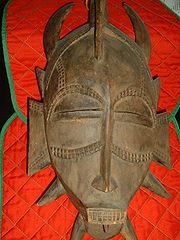
. Talking drums are also common, especially among the Appolo, and polyrhythm
s, another African characteristic, are found throughout Côte d'Ivoire and are especially common in the southwest.
Popular music genres from Côte d'Ivoire include zoblazo
, zouglou
and Coupé-Décalé
.
The Côte d'Ivoire football team has played in the World Cup twice, in Germany 2006 and in South Africa 2010. The national Rugby team played at the Rugby World Cup in South Africa in 1995.
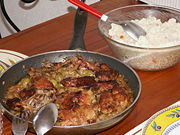 The traditional cuisine of Côte d'Ivoire is very similar to that of neighboring countries in west Africa in its reliance on grains and tuber
s. Cassava and plantain
s are significant parts of Ivorian cuisine. A type of corn paste called “Aitiu” is used to prepare corn balls, and peanut
s are widely used in many dishes. Attiéké is a popular side dish in Côte d'Ivoire made with grated cassava
and is a vegetable-based couscous
. A common street-vended food is aloko
, which is ripe banana fried in palm oil
, spiced with steamed onions and chili and eaten alone or with grilled fish. Chicken is commonly consumed, and has a unique flavor due to its lean, low-fat mass in this region. Seafood includes tuna
, sardine
s, shrimp
and bonito
, which are similar to tuna. Mafé is a common dish consisting of meat in a peanut sauce
. Slow-simmered stew
s with various ingredients are another common food staple in Côte d'Ivoire. "Kedjenou" is a dish consisting of chicken and vegetables that are slow-cooked in a sealed pot with little or no added liquid, which concentrates the flavors of the chicken and vegetables and tenderizes the chicken. It's usually cooked in a pottery jar called a canary, over a slight fire, or cooked in an oven. "Bangui" is a local palm wine.
Ivorians have a particular kind of small, open-air restaurant called a maquis, which is unique to the region. Maquis normally feature braised chicken and fish covered in onions and tomatoes, served with attiéké, or kedjenou, a chicken dish made with vegetables and a mild sauce.
General information
News
Tourism
Other
West Africa
West Africa or Western Africa is the westernmost region of the African continent. Geopolitically, the UN definition of Western Africa includes the following 16 countries and an area of approximately 5 million square km:-Flags of West Africa:...
. It has an area of 322462 square kilometres (124,503.3 sq mi), and borders the countries Liberia
Liberia
Liberia , officially the Republic of Liberia, is a country in West Africa. It is bordered by Sierra Leone on the west, Guinea on the north and Côte d'Ivoire on the east. Liberia's coastline is composed of mostly mangrove forests while the more sparsely populated inland consists of forests that open...
, Guinea
Guinea
Guinea , officially the Republic of Guinea , is a country in West Africa. Formerly known as French Guinea , it is today sometimes called Guinea-Conakry to distinguish it from its neighbour Guinea-Bissau. Guinea is divided into eight administrative regions and subdivided into thirty-three prefectures...
, Mali
Mali
Mali , officially the Republic of Mali , is a landlocked country in Western Africa. Mali borders Algeria on the north, Niger on the east, Burkina Faso and the Côte d'Ivoire on the south, Guinea on the south-west, and Senegal and Mauritania on the west. Its size is just over 1,240,000 km² with...
, Burkina Faso
Burkina Faso
Burkina Faso – also known by its short-form name Burkina – is a landlocked country in west Africa. It is surrounded by six countries: Mali to the north, Niger to the east, Benin to the southeast, Togo and Ghana to the south, and Côte d'Ivoire to the southwest.Its size is with an estimated...
and Ghana
Ghana
Ghana , officially the Republic of Ghana, is a country located in West Africa. It is bordered by Côte d'Ivoire to the west, Burkina Faso to the north, Togo to the east, and the Gulf of Guinea to the south...
; its southern boundary is along the Gulf of Guinea
Gulf of Guinea
The Gulf of Guinea is the northeasternmost part of the tropical Atlantic Ocean between Cape Lopez in Gabon, north and west to Cape Palmas in Liberia. The intersection of the Equator and Prime Meridian is in the gulf....
. The country's population was 15,366,672 in 1998 and was estimated to be 20,617,068 in 2009. Côte d'Ivoire's first national census in 1975 counted 6.7 million inhabitants.
Prior to its colonization by Europeans, Côte d'Ivoire was home to several states, including Gyaaman
Gyaaman
Gyaman also spelled Jamang was a medieval African state of the Akan people, located in what is now Ghana and Côte d'Ivoire. Gyaman was founded by the Abron, a branch of the Akan, in the late 15th century...
, the Kong Empire
Kong Empire
The Kong Empire , also known as the Wattara Empire or Ouattara Empire for its founder, was a pre-colonial African Muslim state centered in north eastern Cote d'Ivoire that also encompassed much of present-day Burkina Faso.-Early Period:...
, and Baoulé
Baoulé
The Baoulé are an Akan people and one of the largest groups in the Ivory Coast. The Baoulé are farmers who live in the eastern side of Côte d'Ivoire . The Baoule people are represented by religion, art, festivals, and equal society . There are more than sixty-five different Akan-speaking ethnic...
. There were two Anyi
Anyi people
The Anyi people are an ethnic group in southeast Côte d'Ivoire and Ghana.. They are an Akan people who speak the Anyi language.-History:...
kingdoms, Indénié and Sanwi
Kingdom of Sanwi
Kingdom of Sanwi is a traditional kingdom located in the south-east corner of the Republic of Côte d'Ivoire in west Africa. It was established in about 1740 by Anyi migrants from Ghana. In 1843 the kingdom became a protectorate of France...
, which attempted to retain their separate identity through the French colonial period and after Côte d'Ivoire's independence. An 1843–1844 treaty made a "protectorate
Protectorate
In history, the term protectorate has two different meanings. In its earliest inception, which has been adopted by modern international law, it is an autonomous territory that is protected diplomatically or militarily against third parties by a stronger state or entity...
" of France and in 1893, it became a French colony as part of the European scramble for Africa
Scramble for Africa
The Scramble for Africa, also known as the Race for Africa or Partition of Africa was a process of invasion, occupation, colonization and annexation of African territory by European powers during the New Imperialism period, between 1881 and World War I in 1914...
.
Côte d'Ivoire became independent on 7 August 1960. From 1960 to 1993, the country was led by . It maintained close political and economic association with its West African neighbours, while at the same time maintaining close ties to the West, especially to France. Since the end of Houphouët-Boigny's rule, Côte d'Ivoire has experienced one , in 1999, and a civil war, which broke out in 2002. A political agreement between the government and the rebels brought a return to peace. Côte d'Ivoire is a republic with a strong executive power invested in the President. Its de jure
De jure
De jure is an expression that means "concerning law", as contrasted with de facto, which means "concerning fact".De jure = 'Legally', De facto = 'In fact'....
capital is Yamoussoukro
Yamoussoukro
The District of Yamoussoukro is the official political capital and administrative capital city of Côte d'Ivoire, while the economic capital of the country is Abidjan. As of 2010, it was estimated to have 242,744 inhabitants...
and the biggest city is the port city of Abidjan
Abidjan
Abidjan is the economic and former official capital of Côte d'Ivoire, while the current capital is Yamoussoukro. it was the largest city in the nation and the third-largest French-speaking city in the world, after Paris, and Kinshasa but before Montreal...
. The country is divided into 19 regions
Regions of Côte d'Ivoire
||Côte d'Ivoire is divided into nineteen regions :The regions are further divided into 81 departments.-External links:...
and 81 departments
Departments of Côte d'Ivoire
The regions of Côte d'Ivoire are divided into 81 departments .A 1978 law created 27 self governing Communes in Cote 'Ivoire , alongside Sous-Prefectures, dividing each of the Departments. The Commune, , is administered by a Municipal Council, presided over by a Mayor...
. It is a member of the Organisation of Islamic Cooperation, African Union
African Union
The African Union is a union consisting of 54 African states. The only all-African state not in the AU is Morocco. Established on 9 July 2002, the AU was formed as a successor to the Organisation of African Unity...
, La Francophonie
La Francophonie
Francophonie is an international organization of politics and governments with French as the mother or customary language, where a significant proportion of people are francophones , or where there is a notable affiliation with the French language or culture.Formally known as the Organisation...
, Latin Union
Latin Union
The Latin Union is an international organization of nations that use Romance languages, with the aim of protecting, projecting, and promoting the common cultural heritage and unifying identities of the Latin, and Latin-influenced, world. It was created in 1954 in Madrid, Spain, and has existed as a...
, Economic Community of West African States
Economic Community of West African States
The Economic Community of West African States is a regional group of fifteen West African countries. Founded on 28 May 1975, with the signing of the Treaty of Lagos, its mission is to promote economic integration across the region....
and South Atlantic Peace and Cooperation Zone
South Atlantic Peace and Cooperation Zone
The South Atlantic Peace and Cooperation Zone was created in 1986 through a UN resolution on Brazil's initiative, with the aim of promoting regional cooperation and the maintenance of peace and security in the region...
.
The official language
Official language
An official language is a language that is given a special legal status in a particular country, state, or other jurisdiction. Typically a nation's official language will be the one used in that nation's courts, parliament and administration. However, official status can also be used to give a...
is French, although many of the local languages are widely used, including Baoulé
Baoulé language
Baoulé is a Central Tano language spoken in Ivory Coast.The Baoule are an Akan people of the central region of Ivory Coast. Baoule-speaking areas include Bouaké, Yamoussoukro, Bouaflé, Béoumi, Sakassou, Toumodi, Dimbokro, M'Bahiakro, Tiassalé....
, Dioula
Dioula language
Jula is a Mande language spoken in Burkina Faso, Côte d'Ivoire and Mali. It is one of the Manding languages, and is most closely related to Bambara, being mutually intelligible with Bambara as well as Malinke. It is a trade language in West Africa and is spoken by millions of people, either as a...
, Dan
Dan language
Dan is a Mande language spoken primarily in Côte d'Ivoire and Liberia . There is also a population of about 800 speakers in Guinea. Dan is a tonal language, with three main tones and two glide/contour tones....
, Anyin
Anyin language
The Anyin language is spoken principally in Côte d'Ivoire and in Ghana. It is an Akan language member of the Kwa branch of the Niger–Congo family of languages...
and Cebaara Senufo
Senari languages
The Senari languages form a central dialect cluster of the Senufo languages. They are spoken in northern Côte d'Ivoire, southern Mali and southwest Burkina Faso by more than a million Senufo. Four varieties can be distinguished, Cebaara, Nyarafolo, Senara and Syenara, all with several dialects...
. The main religions are Islam, Christianity (primarily Roman Catholic
Roman Catholicism in Côte d'Ivoire
The Catholic Church in Côte d'Ivoire is part of the worldwide Catholic Church, under the spiritual leadership of the Pope and curia in Rome. Roman Catholicism arrived in Côte d'Ivoire through the arrival of French settlers....
) and various indigenous religion
Indigenous religion
Indigenous religion refers to those religions which are native to indigenous peoples around the world. They are one of the three broad divisions into which religions are categorised, along with world religions and new religious movements. The majority of the world's many thousands of religions fit...
s.
Through production of coffee and cocoa, the country was an economic powerhouse during the 1960s and 1970s in West Africa. However, Côte d'Ivoire went through an economic crisis in the 1980s, leading to the country's period of political and social turmoil. The 21st century Ivoirian economy is largely market-based and relies heavily on agriculture, with smallholder cash crop production being dominant.
Name
The region, and then the country, was originally known in English as "Ivory Coast". In October 1985, the government officially changed the name of the country to .Despite the Ivorian government's request, the English translation "Ivory Coast" (sometimes "the Ivory Coast") is still frequently used in English. The BBC
BBC
The British Broadcasting Corporation is a British public service broadcaster. Its headquarters is at Broadcasting House in the City of Westminster, London. It is the largest broadcaster in the world, with about 23,000 staff...
usually uses "Ivory Coast" both in news reports and on its page about the country. The Guardian
The Guardian
The Guardian, formerly known as The Manchester Guardian , is a British national daily newspaper in the Berliner format...
newspaper's Style Guide says: "Ivory Coast, not 'The Ivory Coast' or ''; its nationals are Ivorians." ABC News (USA), The Times
The Times
The Times is a British daily national newspaper, first published in London in 1785 under the title The Daily Universal Register . The Times and its sister paper The Sunday Times are published by Times Newspapers Limited, a subsidiary since 1981 of News International...
, The New York Times
The New York Times
The New York Times is an American daily newspaper founded and continuously published in New York City since 1851. The New York Times has won 106 Pulitzer Prizes, the most of any news organization...
, and the South African Broadcasting Corporation
South African Broadcasting Corporation
The South African Broadcasting Corporation is the state-owned broadcaster in South Africa and provides 18 radio stations as well as 3 television broadcasts to the general public.-Early years:Radio broadcasting began in South Africa in 1923...
all use "Ivory Coast" either exclusively or predominantly.
Many governments use "" for diplomatic reasons, as do their outlets, such as the Chinese CCTV News. The English country name registered with the United Nations
United Nations member states
There are 193 United Nations member states, and each of them is a member of the United Nations General Assembly.The criteria for admission of new members are set out in the United Nations Charter, Chapter II, Article 4, as follows:...
and used by ISO 3166
ISO 3166
ISO 3166 is a standard published by the International Organization for Standardization . It defines codes for the names of countries, dependent territories, special areas of geographical interest, and their principal subdivisions . The official name of the standard is Codes for the representation...
is "Côte d'Ivoire". Other organizations that use "Côte d'Ivoire" include FIFA
FIFA
The Fédération Internationale de Football Association , commonly known by the acronym FIFA , is the international governing body of :association football, futsal and beach football. Its headquarters are located in Zurich, Switzerland, and its president is Sepp Blatter, who is in his fourth...
and the IOC
International Olympic Committee
The International Olympic Committee is an international corporation based in Lausanne, Switzerland, created by Pierre de Coubertin on 23 June 1894 with Demetrios Vikelas as its first president...
(referring to their national football
Côte d'Ivoire national football team
The Côte d'Ivoire National Football Team or Ivory Coast National Football Team, nicknamed Les Éléphants , represents Côte d'Ivoire in international football and is controlled by the Fédération Ivoirienne de Football...
and Olympic teams in international games and in official broadcasts), The Economist
The Economist
The Economist is an English-language weekly news and international affairs publication owned by The Economist Newspaper Ltd. and edited in offices in the City of Westminster, London, England. Continuous publication began under founder James Wilson in September 1843...
newsmagazine, Encyclopædia Britannica
Encyclopædia Britannica
The Encyclopædia Britannica , published by Encyclopædia Britannica, Inc., is a general knowledge English-language encyclopaedia that is available in print, as a DVD, and on the Internet. It is written and continuously updated by about 100 full-time editors and more than 4,000 expert...
, and National Geographic Society
National Geographic Society
The National Geographic Society , headquartered in Washington, D.C. in the United States, is one of the largest non-profit scientific and educational institutions in the world. Its interests include geography, archaeology and natural science, the promotion of environmental and historical...
.
Land migration
Shale
Shale is a fine-grained, clastic sedimentary rock composed of mud that is a mix of flakes of clay minerals and tiny fragments of other minerals, especially quartz and calcite. The ratio of clay to other minerals is variable. Shale is characterized by breaks along thin laminae or parallel layering...
and remnants of cooking and fishing) has been interpreted as a possible indication of a large human presence during the Upper Paleolithic
Upper Paleolithic
The Upper Paleolithic is the third and last subdivision of the Paleolithic or Old Stone Age as it is understood in Europe, Africa and Asia. Very broadly it dates to between 40,000 and 10,000 years ago, roughly coinciding with the appearance of behavioral modernity and before the advent of...
period (15,000 to 10,000 BC), or at the minimum, the Neolithic
Neolithic
The Neolithic Age, Era, or Period, or New Stone Age, was a period in the development of human technology, beginning about 9500 BC in some parts of the Middle East, and later in other parts of the world. It is traditionally considered as the last part of the Stone Age...
period.
The earliest known inhabitants of have left traces scattered throughout the territory. Historians believe that they were all either displaced or absorbed by the ancestors of the present indigenous inhabitants, who migrated south into the area before the 16th century. Such groups included the Ehotilé (Aboisso
Aboisso
Abiosso is the main town of Aboisso Department of Côte d'Ivoire, located in the Sud-Comoé Region. The city's population is primarily composed of the Anyi Sanwi ethnic group, a branch of the Akan people. Once part of the Krindjabo kingdom, the city also served as a staging point for Marcel...
), Kotrowou (Fresco), Zéhiri (Grand Lahou
Grand Lahou
Grand Lahou is a town in Grand Lahou Department of Côte d'Ivoire in Lagunes Region.The town of Grand Lahou is situated where the Bandama River meets the Gulf of Guinea. It was occupied by the British, Germans and Dutch before the French developed it as a trading port from 1890...
), Ega and Diès (Divo
Divo, Côte d'Ivoire
Divo is a town in Divo Department of Côte d'Ivoire. Divo Department is part of Sud-Bandama Region. The town is served by Divo Airport.-References:...
).
Pre-Islamic and Islamic periods
The first recorded history is found in the chronicles of North African (BerberBerber people
Berbers are the indigenous peoples of North Africa west of the Nile Valley. They are continuously distributed from the Atlantic to the Siwa oasis, in Egypt, and from the Mediterranean to the Niger River. Historically they spoke the Berber language or varieties of it, which together form a branch...
) traders, who, from early Roman times, conducted a caravan
Caravan (travellers)
A caravan is a group of people traveling together, often on a trade expedition. Caravans were used mainly in desert areas and throughout the Silk Road, where traveling in groups aided in defence against bandits as well as helped to improve economies of scale in trade.In historical times, caravans...
trade across the Sahara
Sahara
The Sahara is the world's second largest desert, after Antarctica. At over , it covers most of Northern Africa, making it almost as large as Europe or the United States. The Sahara stretches from the Red Sea, including parts of the Mediterranean coasts, to the outskirts of the Atlantic Ocean...
in salt, slaves, gold, and other goods. The southern terminals of the trans-Saharan trade
Trans-Saharan trade
Trans-Saharan trade requires travel across the Sahara to reach sub-Saharan Africa. While existing from prehistoric times, the peak of trade extended from the 8th century until the late 16th century.- Increasing desertification and economic incentive :...
routes were located on the edge of the desert, and from there supplemental trade extended as far south as the edge of the rain forest. The more important terminals—Djenné
Djenné
Djenné is an Urban Commune and town in the Inland Niger Delta region of central Mali. In the 2009 census the commune had a population of 32,944. Administratively it is part of the Mopti Region....
, Gao
Gao
Gao is a town in eastern Mali on the River Niger lying ESE of Timbuktu. Situated on the left bank of the river at the junction with the Tilemsi valley, it is the capital of the Gao Region and had a population of 86,663 in 2009....
, and Timbuctu—grew into major commercial centres around which the great Sudanic empires developed.
By controlling the trade routes with their powerful military forces, these empires were able to dominate neighbouring states. The Sudanic empires also became centres of Islamic education
Islamic studies
In a Muslim context, Islamic studies can be an umbrella term for all virtually all of academia, both originally researched and as defined by the Islamization of knowledge...
. Islam had been introduced in the western Sudan (today's Mali) by Muslim Berber traders from North Africa; it spread rapidly after the conversion of many important rulers. From the eleventh century, by which time the rulers of the Sudanic empires had embraced Islam, it spread south into the northern areas of contemporary Côte d'Ivoire.
The Ghana empire
Ghana Empire
The Ghana Empire or Wagadou Empire was located in what is now southeastern Mauritania, and Western Mali. Complex societies had existed in the region since about 1500 BCE, and around Ghana's core region since about 300 CE...
, the earliest of the Sudanic empires, flourished in present-day eastern Mauritania from the fourth to the thirteenth century. At the peak of its power in the eleventh century, its realms extended from the Atlantic Ocean to Timbuctu. After the decline of Ghana, the Mali Empire
Mali Empire
The Mali Empire or Mandingo Empire or Manden Kurufa was a West African empire of the Mandinka from c. 1230 to c. 1600. The empire was founded by Sundiata Keita and became renowned for the wealth of its rulers, especially Mansa Musa I...
grew into a powerful Muslim state, which reached its apogee in the early part of the fourteenth century. The territory of the Mali Empire in Côte d'Ivoire was limited to the north-west corner around Odienné
Odienné
Odienné is the chief town of Odienné Department of Côte d'Ivoire, lying in the northwestern part of the country. West of Odienné is the Deng Kele Massif. The town of Odienné was founded by Malinké people under Vakaba Tourié . Later, Samory Touré founded a support base in the town. Features of...
.
Its slow decline starting at the end of the fourteenth century followed internal discord and revolts by vassal states, one of which, Songhai
Songhai Empire
The Songhai Empire, also known as the Songhay Empire, was a state located in western Africa. From the early 15th to the late 16th century, Songhai was one of the largest Islamic empires in history. This empire bore the same name as its leading ethnic group, the Songhai. Its capital was the city...
, flourished as an empire between the fourteenth and sixteenth centuries. Songhai was also weakened by internal discord, which led to factional warfare. This discord spurred most of the migrations of peoples southward toward the forest belt. The dense rain forest, covering the southern half of the country, created barriers to the large-scale political organizations that had arisen in the north. Inhabitants lived in villages or clusters of villages; their contacts with the outside world were filtered through long-distance traders. Villagers subsisted on agriculture and hunting.
Pre-European era
Five important states flourished in Côte d'Ivoire in the pre-European era. The Muslim Kong EmpireKong Empire
The Kong Empire , also known as the Wattara Empire or Ouattara Empire for its founder, was a pre-colonial African Muslim state centered in north eastern Cote d'Ivoire that also encompassed much of present-day Burkina Faso.-Early Period:...
was established by the Juula in the early eighteenth century in the north-central region inhabited by the Sénoufo, who had fled Islamization
Islamization
Islamization or Islamification has been used to describe the process of a society's conversion to the religion of Islam...
under the Mali Empire
Mali Empire
The Mali Empire or Mandingo Empire or Manden Kurufa was a West African empire of the Mandinka from c. 1230 to c. 1600. The empire was founded by Sundiata Keita and became renowned for the wealth of its rulers, especially Mansa Musa I...
. Although Kong became a prosperous center of agriculture, trade, and crafts, ethnic diversity and religious discord gradually weakened the kingdom. The city of Kong was destroyed in 1895 by Samori Ture.
The Abron
Abron
The Abron or Bono are an Akan people of West Africa. They speak the Abron language.In the late sixteenth century, the Abron founded the Gyaaman kingdom as extension of Bono state in what is now Ghana and Côte d'Ivoire.-References:...
kingdom of Gyaaman
Gyaaman
Gyaman also spelled Jamang was a medieval African state of the Akan people, located in what is now Ghana and Côte d'Ivoire. Gyaman was founded by the Abron, a branch of the Akan, in the late 15th century...
was established in the seventeenth century by an Akan
Akan people
The Akan people are an ethnic group found predominately in Ghana and The Ivory Coast. Akans are the majority in both of these countries and overall have a population of over 20 million people.The Akan speak Kwa languages-Origin and ethnogenesis:...
group, the Abron, who had fled the developing Ashanti confederation
Confederation
A confederation in modern political terms is a permanent union of political units for common action in relation to other units. Usually created by treaty but often later adopting a common constitution, confederations tend to be established for dealing with critical issues such as defense, foreign...
of Asanteman in what is present-day Ghana. From their settlement south of Bondoukou
Bondoukou
Bondoukou is a town in Bondoukou Department of Côte d'Ivoire, located in the Zanzan Region, 420 km Northeast of Abidjan...
, the Abron gradually extended their hegemony over the Dyula people in Bondoukou, who were recent émigrés from the market city of Begho. Bondoukou developed into a major centre of commerce and Islam. The kingdom's Quranic scholars attracted students from all parts of West Africa. In the mid-seventeenth century in east-central Côte d'Ivoire, other Akan groups' fleeing the Asante established a Baoulé
Baoulé
The Baoulé are an Akan people and one of the largest groups in the Ivory Coast. The Baoulé are farmers who live in the eastern side of Côte d'Ivoire . The Baoule people are represented by religion, art, festivals, and equal society . There are more than sixty-five different Akan-speaking ethnic...
kingdom at Sakasso and two Agni
Anyi people
The Anyi people are an ethnic group in southeast Côte d'Ivoire and Ghana.. They are an Akan people who speak the Anyi language.-History:...
kingdoms, Indénié and Sanwi.
The Baoulé, like the Ashanti, developed a highly centralized political and administrative structure under three successive rulers. It finally split into smaller chiefdoms. Despite the breakup of their kingdom, the Baoulé strongly resisted French subjugation. The descendants of the rulers of the Agni kingdoms tried to retain their separate identity long after Côte d'Ivoire's independence; as late as 1969, the Sanwi attempted to break away from Côte d'Ivoire and form an independent kingdom. Michael Jackson
Michael Jackson
Michael Joseph Jackson was an American recording artist, entertainer, and businessman. Referred to as the King of Pop, or by his initials MJ, Jackson is recognized as the most successful entertainer of all time by Guinness World Records...
visited Krinjabo, the capital of Sanwi, in 1992 and met with the king. The current King of Sanwi is Nana Amon Ndoufou V (since 2002).
Establishment of French rule
Compared to neighbouring Ghana, Côte d'Ivoire suffered little from the slave trade, as European slaving and merchant ships preferred other areas along the coast with better harbours.The earliest recorded European voyage to West Africa was made by the Portuguese and took place in 1482. The first West African French settlement, Saint Louis, was founded in the mid-seventeenth century in Senegal while, at about the same time, the Dutch ceded to the French a settlement at Goree Island
Gorée
Île de Gorée Île de Gorée Île de Gorée (i.e. "Gorée Island"; is one of the 19 communes d'arrondissement (i.e. "commune of arrondissement") of the city of Dakar, Senegal. It is a island located at sea from the main harbor of Dakar ....
off Dakar
Dakar
Dakar is the capital city and largest city of Senegal. It is located on the Cap-Vert Peninsula on the Atlantic coast and is the westernmost city on the African mainland...
. A French mission
Missionary
A missionary is a member of a religious group sent into an area to do evangelism or ministries of service, such as education, literacy, social justice, health care and economic development. The word "mission" originates from 1598 when the Jesuits sent members abroad, derived from the Latin...
was established in 1637 Assinie
Assinie
Assinie is a resort town in Côte d'Ivoire, 80 km East of Abidjan on the coast of the Gulf of Guinea....
near the border with the Gold Coast
Gold Coast (British colony)
The Gold Coast was a British colony on the Gulf of Guinea in west Africa that became the independent nation of Ghana in 1957.-Overview:The first Europeans to arrive at the coast were the Portuguese in 1471. They encountered a variety of African kingdoms, some of which controlled substantial...
(now Ghana).
Assinie's survival was precarious, however. It was not until the mid-nineteenth century that the French were firmly established in Côte d'Ivoire. In 1843–1844, French admiral Bouët-Willaumez
Louis Edouard Bouët-Willaumez
Louis Edouard Bouët-Willaumez was a French admiral.He was born Louis Edouard Bouët, the son of a businessman in Maison-Lafitte, near Paris...
signed treaties with the kings of the Grand Bassam and Assinie regions, placing their territories under a French protectorate
Protectorate
In history, the term protectorate has two different meanings. In its earliest inception, which has been adopted by modern international law, it is an autonomous territory that is protected diplomatically or militarily against third parties by a stronger state or entity...
. French explorers
Exploration
Exploration is the act of searching or traveling around a terrain for the purpose of discovery of resources or information. Exploration occurs in all non-sessile animal species, including humans...
, missionaries, trading companies, and soldiers gradually extended the area under French control inland from the lagoon region. Pacification was not accomplished until 1915.
Activity along the coast stimulated European interest in the interior, especially along the two great rivers, the Senegal
Sénégal River
The Sénégal River is a long river in West Africa that forms the border between Senegal and Mauritania.The Sénégal's headwaters are the Semefé and Bafing rivers which both originate in Guinea; they form a small part of the Guinean-Malian border before coming together at Bafoulabé in Mali...
and the Niger
Niger River
The Niger River is the principal river of western Africa, extending about . Its drainage basin is in area. Its source is in the Guinea Highlands in southeastern Guinea...
. Concerted French exploration of West Africa began in the mid-nineteenth century but moved slowly, based more on individual initiative than on government policy. In the 1840s, the French concluded a series of treaties with local West African rulers that enabled the French to build fortified posts along the Gulf of Guinea to serve as permanent trading centres.
The first posts in Côte d'Ivoire included one at Assinie and another at Grand Bassam, which became the colony's first capital. The treaties provided for French sovereignty within the posts, and for trading privileges in exchange for fees or coutume
Coutume
Coutumes are legal customs of France.During the Middle Ages and early modern period the French kings and their vassals constantly asserted the importance and, in effect, primacy of customary law, especially in the lands north and west of Paris. The area where the French customary law was in force...
s paid annually to the local rulers for the use of the land. The arrangement was not entirely satisfactory to the French, because trade was limited and misunderstandings over treaty obligations often arose. Nevertheless, the French government maintained the treaties, hoping to expand trade.
France also wanted to maintain a presence in the region to stem the increasing influence of the British along the Gulf of Guinea coast. The French built naval bases to keep out non-French traders and began a systematic conquest of the interior. (They accomplished this only after a long war in the 1890s against Mandinka
Mandinka people
The Mandinka, Malinke are one of the largest ethnic groups in West Africa with an estimated population of eleven million ....
forces, mostly from Gambia. Guerrilla warfare
Guerrilla warfare
Guerrilla warfare is a form of irregular warfare and refers to conflicts in which a small group of combatants including, but not limited to, armed civilians use military tactics, such as ambushes, sabotage, raids, the element of surprise, and extraordinary mobility to harass a larger and...
by the Baoulé and other eastern groups continued until 1917).
The defeat of France in the Franco-Prussian War
Franco-Prussian War
The Franco-Prussian War or Franco-German War, often referred to in France as the 1870 War was a conflict between the Second French Empire and the Kingdom of Prussia. Prussia was aided by the North German Confederation, of which it was a member, and the South German states of Baden, Württemberg and...
in 1871 and the subsequent annexation by Germany of the French province of Alsace Lorraine caused the French government to abandon its colonial ambitions and withdraw its military garrisons from its French West African trading posts, leaving them in the care of resident merchants. The trading post at Grand Bassam in Côte d'Ivoire was left in the care of a shipper from Marseille
Marseille
Marseille , known in antiquity as Massalia , is the second largest city in France, after Paris, with a population of 852,395 within its administrative limits on a land area of . The urban area of Marseille extends beyond the city limits with a population of over 1,420,000 on an area of...
, Arthur Verdier
Arthur Verdier
Arthur Verdier was a French mariner, shipowner, merchant and pioneer. From 1871 to 1889, he was the French resident in Grand-Bassam and Assinie, in present-day Côte d'Ivoire. He was an active participant in the development of this region....
, who in 1878 was named Resident
Resident (title)
A Resident, or in full Resident Minister, is a government official required to take up permanent residence in another country. A representative of his government, he officially has diplomatic functions which are often seen as a form of indirect rule....
of the Establishment of Côte d'Ivoire.
In 1886, to support its claims of effective occupation, France again assumed direct control of its West African coastal trading posts and embarked on an accelerated program of exploration in the interior. In 1887 Lieutenant Louis Gustave Binger
Louis Gustave Binger
Louis Gustave Binger was a French officer and explorer who claimed the Côte d'Ivoire for France.Binger was born at Strasbourg in the Bas-Rhin . In 1887 he travelled from Senegal up to the Niger River, arriving at Grand Bassam in 1889. During this expedition he discovered that the Mountains of Kong...
began a two-year journey that traversed parts of Côte d'Ivoire's interior. By the end of the journey, he had concluded four treaties establishing French protectorates in Côte d'Ivoire. Also in 1887, Verdier's agent, Marcel Treich-Laplène
Marcel Treich-Laplène
Marcel Treich-Laplene was the first explorer of Côte d'Ivoire and its first colonial administrator....
, negotiated five additional agreements that extended French influence from the headwaters of the Niger River Basin through Côte d'Ivoire.
French colonial era
By the end of the 1880s, France had established what passed for control over the coastal regions of Côte d'Ivoire, and in 1889 Britain recognized French sovereignty in the area. That same year, France named Treich-Laplène titular governor of the territory. In 1893 Côte d'Ivoire was made a French colony, and then Captain Binger was appointed governor. Agreements with Liberia in 1892 and with Britain in 1893 determined the eastern and western boundaries of the colony, but the northern boundary was not fixed until 1947 because of efforts by the French government to attach parts of Upper Volta (present-day Burkina Faso) and French SudanFrench Sudan
French Sudan was a colony in French West Africa that had two separate periods of existence, first from 1890 to 1899, then from 1920 to 1960, when the territory became the independent nation of Mali.-Colonial establishment:...
(present-day Mali) to Côte d'Ivoire for economic and administrative reasons.
France's main goal was to stimulate the production of exports. Coffee, cocoa and palm oil crops were soon planted along the coast. stood out as the only West African country with a sizeable population of settlers; elsewhere in West and Central Africa, the French and British were largely bureaucrats. As a result, French citizens owned one third of the cocoa, coffee and banana plantation
Plantation
A plantation is a long artificially established forest, farm or estate, where crops are grown for sale, often in distant markets rather than for local on-site consumption...
s and adopted a forced-labour system.
Throughout the early years of French rule, French military contingents were sent inland to establish new posts. The African population resisted French penetration and settlement. Among those offering greatest resistance was Samori Ture, who in the 1880s and 1890s was establishing the Wassoulou Empire
Wassoulou Empire
The Wassoulou Empire, sometimes referred to as the Mandinka Empire, was a short-lived empire of West Africa built from the conquests of Dyula ruler Samori Ture and destroyed by the French colonial army....
, which extended over large parts of present-day Guinea, Mali, Burkina Faso, and Côte d'Ivoire. Samori Ture's large, well-equipped army, which could manufacture and repair its own firearm
Firearm
A firearm is a weapon that launches one, or many, projectile at high velocity through confined burning of a propellant. This subsonic burning process is technically known as deflagration, as opposed to supersonic combustion known as a detonation. In older firearms, the propellant was typically...
s, attracted strong support throughout the region. The French responded to Samori Ture's expansion of regional control with military pressure. French campaigns against Samori Ture, which were met with fierce resistance, intensified in the mid-1890s until he was captured in 1898.
France's imposition of a head tax in 1900 to support the colony in a public works
Public works
Public works are a broad category of projects, financed and constructed by the government, for recreational, employment, and health and safety uses in the greater community...
program, provoked a number of revolts. Ivoirians viewed the tax as a violation of the terms of the protectorate treaties, because they thought that France was demanding the equivalent of a coutume
Coutume
Coutumes are legal customs of France.During the Middle Ages and early modern period the French kings and their vassals constantly asserted the importance and, in effect, primacy of customary law, especially in the lands north and west of Paris. The area where the French customary law was in force...
from the local kings, rather than the reverse. Much of the population, especially in the interior, considered the tax a humiliating symbol of submission.
From 1904 to 1958, Côte d'Ivoire was a constituent unit of the Federation of French West Africa. It was a colony and an overseas territory under the Third Republic
French Third Republic
The French Third Republic was the republican government of France from 1870, when the Second French Empire collapsed due to the French defeat in the Franco-Prussian War, to 1940, when France was overrun by Nazi Germany during World War II, resulting in the German and Italian occupations of France...
. Until the period following World War II
World War II
World War II, or the Second World War , was a global conflict lasting from 1939 to 1945, involving most of the world's nations—including all of the great powers—eventually forming two opposing military alliances: the Allies and the Axis...
, governmental affairs in French West Africa were administered from Paris. France's policy in West Africa was reflected mainly in its philosophy of "association", meaning that all Africans in Côte d'Ivoire were officially French "subjects", but without rights to representation in Africa or France.
French colonial policy incorporated concepts of assimilation
Cultural assimilation
Cultural assimilation is a socio-political response to demographic multi-ethnicity that supports or promotes the assimilation of ethnic minorities into the dominant culture. The term assimilation is often used with regard to immigrants and various ethnic groups who have settled in a new land. New...
and association. Based on an assumption of the superiority of French culture over all others, in practice the assimilation policy meant extension of the French language, institutions, laws, and customs in the colonies. The policy of association also affirmed the superiority of the French in the colonies, but it entailed different institutions and systems of laws for the colonizer and the colonized. Under this policy, the Africans in Côte d'Ivoire were allowed to preserve their own customs insofar as they were compatible with French interests.
An indigenous elite
Elite
Elite refers to an exceptional or privileged group that wields considerable power within its sphere of influence...
trained in French administrative practice formed an intermediary group between the French and the Africans. Assimilation was practiced in Côte d'Ivoire to the extent that after 1930, a small number of Westernized Ivoirians were granted the right to apply for French citizenship. Most Ivoirians, however, were classified as French subjects and were governed under the principle of association. As subjects of France, they had no political rights. They were drafted for work in mines, on plantations, as porters, and on public projects as part of their tax responsibility. They were expected to serve in the military and were subject to the indigénat
Indigénat
The Code de l'indigénat was a set of laws creating, in practice, an inferior legal status for natives of French Colonies from 1887 until 1944–1947. First put in place in Algeria, it was applied across the French Colonial Empire in 1887–1889...
, a separate system of law.
In World War II, the Vichy regime remained in control until 1943, when members of Gen. Charles de Gaulle
Charles de Gaulle
Charles André Joseph Marie de Gaulle was a French general and statesman who led the Free French Forces during World War II. He later founded the French Fifth Republic in 1958 and served as its first President from 1959 to 1969....
's provisional government assumed control of all French West Africa. The Brazzaville Conference of 1944
Brazzaville Conference of 1944
After the Fall of France during World War II, and the alignment of many West African French colonies with the Free French, Charles de Gaulle recognized the need to revise the relationship between France and its colonies in Africa...
, the first Constituent Assembly of the Fourth Republic
French Fourth Republic
The French Fourth Republic was the republican government of France between 1946 and 1958, governed by the fourth republican constitution. It was in many ways a revival of the Third Republic, which was in place before World War II, and suffered many of the same problems...
in 1946, and France's gratitude for African loyalty during World War II led to far-reaching governmental reforms in 1946. French citizenship was granted to all African "subjects," the right to organize politically was recognized, and various forms of forced labour were abolished.
Until 1958, governors appointed in Paris administered the colony of Côte d'Ivoire, using a system of direct, centralized administration that left little room for Ivoirian participation in policy making. Whereas British colonial administration adopted divide-and-rule policies elsewhere, applying ideas of assimilation only to the educated elite, the French were interested in ensuring that the small but influential elite was sufficiently satisfied with the status quo to refrain from any anti-French sentiment. Although strongly opposed to the practices of association, educated Ivoirians believed that they would achieve equality with their French peers through assimilation rather than through complete independence from France, a change that would eliminate the enormous economic advantages of remaining a French possession. But, after the assimilation doctrine was implemented entirely through the postwar reforms, Ivoirian leaders realized that even assimilation implied the superiority of the French over the Ivoirians, and that discrimination and political inequality would end only with independence.
Independence
The son of a chief, , was to become 's father of independence. In 1944 he formed the country's first agricultural trade union for African cocoa farmers like himself. Angered that colonial policy favoured French plantation owners, they united to recruit migrant workers for their own farms. soon rose to prominence and within a year was elected to the French Parliament in Paris. A year later the French abolished forced labour. established a strong relationship with the French government, expressing a belief that the country would benefit from it, which it did for many years. France appointed him as the first African to become a minister in a European government.A turning point in relations with France was reached with the 1956 Overseas Reform Act (Loi Cadre
Loi Cadre
The loi-cadre was a French legal reform passed by the French National Assembly on 23 June 1956. It marked a turning point in relations between France and its overseas empire...
), which transferred a number of powers from Paris to elected territorial governments in French West Africa
French West Africa
French West Africa was a federation of eight French colonial territories in Africa: Mauritania, Senegal, French Sudan , French Guinea , Côte d'Ivoire , Upper Volta , Dahomey and Niger...
and also removed remaining voting inequalities. In 1958, became an autonomous member of the French Community (which replaced the French Union
French Union
The French Union was a political entity created by the French Fourth Republic to replace the old French colonial system, the "French Empire" and to abolish its "indigenous" status.-History:...
).
At the time of 's independence (1960), the country was easily French West Africa
French West Africa
French West Africa was a federation of eight French colonial territories in Africa: Mauritania, Senegal, French Sudan , French Guinea , Côte d'Ivoire , Upper Volta , Dahomey and Niger...
's most prosperous, contributing over 40% of the region's total exports. When became the first president, his government gave farmers good prices for their products to further stimulate production. This was further boosted by a significant immigration of workers from surrounding countries. Coffee production increased significantly, catapulting into third place in world output (behind Brazil and Colombia). By 1979, the country was the world's leading producer of cocoa.
It also became Africa's leading exporter of pineapples and palm oil
Palm oil
Palm oil, coconut oil and palm kernel oil are edible plant oils derived from the fruits of palm trees. Palm oil is extracted from the pulp of the fruit of the oil palm Elaeis guineensis; palm kernel oil is derived from the kernel of the oil palm and coconut oil is derived from the kernel of the...
. French technicians contributed to the 'Ivoirian miracle'. In other African nations, the people drove out the Europeans following independence; but in , they poured in. The French community grew from only 30,000 prior to independence to 60,000 in 1980, most of them teachers, managers and advisors. For 20 years, the economy maintained an annual growth rate of nearly 10%—the highest of Africa's non-oil-exporting countries.
Houphouët-Boigny administration
Houphouët-Boigny's one-party rule was not amenable to political competition. Laurent GbagboLaurent Gbagbo
Laurent Koudou Gbagbo served as the fourth President of Côte d'Ivoire from 2000 until his arrest in April 2011. A historian by profession, he is also an amateur chemist and physicist....
, who would be the president of Côte d'Ivoire in 2000, had to flee as he incurred the ire of Houphouët-Boigny when Gbagbo founded the Front Populair Ivoirien. Houphouët-Boigny banked on his broad appeal to the population who continually elected him. He was also criticized for his emphasis on developing large scale projects. Many felt the millions of dollars spent transforming his home village, Yamoussoukro
Yamoussoukro
The District of Yamoussoukro is the official political capital and administrative capital city of Côte d'Ivoire, while the economic capital of the country is Abidjan. As of 2010, it was estimated to have 242,744 inhabitants...
, into the new capital that it became, were wasted; others support his vision to develop a centre for peace, education and religion in the heart of the country. But in the early 1980s, the world recession and a local drought sent shock waves through the Ivoirian economy. Due to the overcutting of timber and collapsing sugar prices, the country's external debt increased threefold. Crime rose dramatically in Abidjan.
In 1990, hundreds of civil servants went on strike, joined by students protesting institutional corruption. The unrest forced the government to support multi-party democracy. Houphouët-Boigny became increasingly feeble and died in 1993. He favoured as his successor.
administration
In October 1995, overwhelmingly won re-election against a fragmented and disorganised opposition. He tightened his hold over political life, jailing several hundred opposition supporters. In contrast, the economic outlook improved, at least superficially, with decreasing inflation and an attempt to remove foreign debt.Alassane Ouattara
Alassane Dramane Ouattara is an Ivorian politician who has been President of Côte d'Ivoire since 2011. An economist by profession, Ouattara worked for the International Monetary Fund and the Central Bank of West African States , and he was the Prime Minister of Côte d'Ivoire from November 1990 to...
, who had two northern Ivorian parents, from running for future presidential election. As people originating from foreign countries are a large part of the Ivoirian population, this policy excluded many people from Ivoirian nationality, and the relationship between various ethnic groups became strained.
1999 coup
Similarly, excluded many potential opponents from the army. In late 1999, a group of dissatisfied officers staged a military coup1999 Ivorian coup d'état
The 1999 Ivorian coup d'état took place on December 24, 1999. It was the first coup d'état since the independence of Côte d'Ivoire.- Background :...
, putting General in power. fled into exile in France. The new leadership reduced crime and corruption, and the generals pressed for austerity and openly campaigned in the streets for a less wasteful society.
Gbagbo administration
A presidential election was held in October 2000 in which Laurent GbagboLaurent Gbagbo
Laurent Koudou Gbagbo served as the fourth President of Côte d'Ivoire from 2000 until his arrest in April 2011. A historian by profession, he is also an amateur chemist and physicist....
vied with , but it was peaceful. The lead-up to the election was marked by military and civil unrest. Following a public uprising that resulted in around 180 deaths, was swiftly replaced by Gbagbo. Alassane Ouattara
Alassane Ouattara
Alassane Dramane Ouattara is an Ivorian politician who has been President of Côte d'Ivoire since 2011. An economist by profession, Ouattara worked for the International Monetary Fund and the Central Bank of West African States , and he was the Prime Minister of Côte d'Ivoire from November 1990 to...
was disqualified by the country's Supreme Court, due to his alleged nationality. The existing and later reformed constitution [under ] did not allow non-citizens to run for presidency. This sparked violent protests in which his supporters, mainly from the country's north, battled riot police in the capital, Yamoussoukro.
Ivorian Civil War
In the early hours of 19 September 2002, while the President was in Italy, there was an armed uprising. Troops who were to be demobilised mutinied, launching attacks in several cities. The battle for the main gendarmerie barracks in Abidjan lasted until mid-morning, but by lunchtime the government forces had secured the main city, Abidjan. They had lost control of the north of the country, and the rebel forces made their strong-hold in the northern city of Bouake. The rebels threatened to move on Abidjan again and France deployed troops from its base in the country to stop any rebel advance. The French said they were protecting their own citizens from danger, but their deployment also aided the government forces. It was not established as a fact that the French were helping either side but each side accused them of being on the opposite side. It is disputed as to whether the French actions improved or worsened the situation in the long term.What exactly happened that night is disputed. The government claimed that former president had led a coup attempt, and state TV showed pictures of his dead body in the street; counter-claims stated that he and fifteen others had been murdered at his home and his body had been moved to the streets to incriminate him. Alassane Ouattara took refuge in the French embassy; his home had burned down.
President Gbagbo cut short his trip to Italy and on his return stated, in a television address, that some of the rebels were hiding in the shanty towns where foreign migrant workers lived. Gendarmes and vigilantes bulldozed and burned homes by the thousands, attacking the residents.
2002 unity government
In January 2003, Gbagbo and rebel leaders signed accords creating a "government of national unity". Curfews were lifted and French troops patrolled the western border of the country. The unity government was unstable and the central problems remained with neither side achieving its goals. In March 2004, 120 people were killed in an opposition rally, and subsequent mob violence led to foreign nationals being evacuated. A later report concluded the killings were planned.Though UN peacekeepers were deployed to maintain a Zone of Confidence, relations between Gbagbo and the opposition continued to deteriorate.
Early in November 2004, after the peace agreement had effectively collapsed following the rebels' refusal to disarm, Gbagbo ordered airstrikes against the rebels. During one of these airstrikes in Bouaké
Bouaké
Bouaké is the second largest city in Côte d'Ivoire, with a population of 775,300 . It is the main urban settlement of the Bouaké Department with a population exceeding 1.2 million, in the Vallée du Bandama Region...
, on 6 November 2004, French soldiers were hit and nine were killed; the Ivorian government has said it was a mistake, but the French have claimed it was deliberate. They responded by destroying most Ivoirian military aircraft (2 Su-25 planes and 5 helicopters), and violent retaliatory riots against the French broke out in Abidjan.
Gbagbo's original mandate as president expired on 30 October 2005, but due to the lack of disarmament it was deemed impossible to hold an election, and therefore his term in office was extended for a maximum of one year, according to a plan worked out by the African Union
African Union
The African Union is a union consisting of 54 African states. The only all-African state not in the AU is Morocco. Established on 9 July 2002, the AU was formed as a successor to the Organisation of African Unity...
; this plan was endorsed by the United Nations Security Council
United Nations Security Council
The United Nations Security Council is one of the principal organs of the United Nations and is charged with the maintenance of international peace and security. Its powers, outlined in the United Nations Charter, include the establishment of peacekeeping operations, the establishment of...
. With the late October deadline approaching in 2006, it was regarded as very unlikely that the election would be held by that point, and the opposition and the rebels rejected the possibility of another term extension for Gbagbo. The UN Security Council endorsed another one-year extension of Gbagbo's term on 1 November 2006; however, the resolution provided for the strengthening of Prime Minister Charles Konan Banny
Charles Konan Banny
Charles Konan Banny was Prime Minister of Côte d'Ivoire from 7 December 2005 until 4 April 2007.Banny joined the Central Bank of West African States in 1976, holding various positions in the Bank over the years. In 1988 he became Special Advisor to the Governor of BCEAO...
's powers. Gbagbo said the next day that elements of the resolution deemed to be constitutional violations would not be applied.
A peace accord between the government and the rebels, or New Forces
Forces Nouvelles de Côte d'Ivoire
The Forces Nouvelles de Côte d'Ivoire is a political coalition that was formed in December 2002, in the wake of the first peace accords of the Ivorian Civil War.-Composition:FNCI includes these political parties:...
, was signed on 4 March 2007, and subsequently Guillaume Soro
Guillaume Soro
Guillaume Kigbafori Soro has served as the Prime Minister of Côte d'Ivoire since 4 April 2007...
, leader of the New Forces, became prime minister. These events have been seen by some observers as substantially strengthening Gbagbo's position.
2010 election
The presidential elections that should have been organized in 2005 were postponed until November 2010. The preliminary results announced by the Electoral Commission showed a loss for Gbagbo in favour of his rival, former prime minister Alassane OuattaraAlassane Ouattara
Alassane Dramane Ouattara is an Ivorian politician who has been President of Côte d'Ivoire since 2011. An economist by profession, Ouattara worked for the International Monetary Fund and the Central Bank of West African States , and he was the Prime Minister of Côte d'Ivoire from November 1990 to...
. The ruling FPI contested the results before the Constitutional Council, charging massive fraud in the northern departments controlled by the rebels of the Forces Nouvelles de Côte d'Ivoire
Forces Nouvelles de Côte d'Ivoire
The Forces Nouvelles de Côte d'Ivoire is a political coalition that was formed in December 2002, in the wake of the first peace accords of the Ivorian Civil War.-Composition:FNCI includes these political parties:...
(FNCI). These charges were contradicted by international observers. The report of the results led to severe tension and violent incidents. The Constitutional Council, which consists of Gbagbo supporters, declared the results of seven northern departments unlawful and that Gbagbo had won the elections with 51% of the vote (instead of Ouattara winning with 54%, as reported by the Electoral Commission). After the inauguration of Gbagbo, Ouattara, recognized as the winner by most countries and the United Nations, organized an alternative inauguration. These events raised fears of a resurgence of the civil war; thousands of refugees have fled the country. The African Union
African Union
The African Union is a union consisting of 54 African states. The only all-African state not in the AU is Morocco. Established on 9 July 2002, the AU was formed as a successor to the Organisation of African Unity...
sent Thabo Mbeki
Thabo Mbeki
Thabo Mvuyelwa Mbeki is a South African politician who served two terms as the second post-apartheid President of South Africa from 14 June 1999 to 24 September 2008. He is also the brother of Moeletsi Mbeki...
, former President of South Africa, to mediate the conflict. The UN Security Council adopted a common resolution recognising Alassane Ouattara as winner of the elections, based on the position of ECOWAS (Economic Community of West Africa States). ECOWAS suspended Côte d'Ivoire from all its decision-making bodies while the African Union also suspended the country's membership.
2011 Civil War
The presidential election led to the 2010–2011 Ivorian crisis2010–2011 Ivorian crisis
The 2010–11 Ivorian crisis was a political crisis in Côte d'Ivoire which began after Laurent Gbagbo, the President of Côte d'Ivoire since 2000, was proclaimed the winner of the Ivorian election of 2010, the first election in the country in 10 years...
and to the Second Ivorian Civil War
Second Ivorian Civil War
The Second Ivorian Civil War broke out in March 2011 when the crisis in Côte d'Ivoire escalated into full-scale military conflict between forces loyal to Laurent Gbagbo, the President of Côte d'Ivoire since 2000, and supporters of the internationally recognised president-elect Alassane Ouattara...
. After months of unsuccessful negotiations and sporadic violence, the crisis entered a critical stage as Ouattara's forces seized control of most of the country, with Gbagbo entrenched in Abidjan
Abidjan
Abidjan is the economic and former official capital of Côte d'Ivoire, while the current capital is Yamoussoukro. it was the largest city in the nation and the third-largest French-speaking city in the world, after Paris, and Kinshasa but before Montreal...
, the country's largest city. International organizations reported numerous instances of human rights violations by both sides. In the city of Duékoué, hundreds of people were estimated to have been killed, predominantly by advancing pro-Ouattara militias. In nearby Blolequin, dozens of people were killed, reportedly by retreating Liberian militias who had been hired by pro-Gbagbo forces. UN and French forces took military action against Gbagbo. Gbagbo was taken into custody after a raid into his residence on 11 April. It was initially thought he was captured by French forces, however Ouattara's envoy to the UN claimed it was their forces who captured him, and the French deny any involvement in his arrest.
Regions and departments
is divided into nineteen regions (régions):
|
The regions are further divided into 81 departments
Departments of Côte d'Ivoire
The regions of Côte d'Ivoire are divided into 81 departments .A 1978 law created 27 self governing Communes in Cote 'Ivoire , alongside Sous-Prefectures, dividing each of the Departments. The Commune, , is administered by a Municipal Council, presided over by a Mayor...
.
Population of major cities
The official capital of is YamoussoukroYamoussoukro
The District of Yamoussoukro is the official political capital and administrative capital city of Côte d'Ivoire, while the economic capital of the country is Abidjan. As of 2010, it was estimated to have 242,744 inhabitants...
(295,500), the fourth most populous city. Abidjan
Abidjan
Abidjan is the economic and former official capital of Côte d'Ivoire, while the current capital is Yamoussoukro. it was the largest city in the nation and the third-largest French-speaking city in the world, after Paris, and Kinshasa but before Montreal...
, with a population of 3,310,500, is the largest city and serves as the commercial and banking center of as well as the de facto capital. It is also the most populous city in French-speaking Western Africa.
| City | Population |
|---|---|
| Abidjan Abidjan Abidjan is the economic and former official capital of Côte d'Ivoire, while the current capital is Yamoussoukro. it was the largest city in the nation and the third-largest French-speaking city in the world, after Paris, and Kinshasa but before Montreal... |
3,310,500 |
| Bouaké Bouaké Bouaké is the second largest city in Côte d'Ivoire, with a population of 775,300 . It is the main urban settlement of the Bouaké Department with a population exceeding 1.2 million, in the Vallée du Bandama Region... |
775,300 |
| Daloa Daloa Daloa is a town in Daloa Department of Côte d'Ivoire, lying west of Yamoussoukro in Haut-Sassandra Region. It has a population of over 100,000. The town is a regional capital and an important trading centre, particularly for cocoa... |
489,100 |
| Yamoussoukro Yamoussoukro The District of Yamoussoukro is the official political capital and administrative capital city of Côte d'Ivoire, while the economic capital of the country is Abidjan. As of 2010, it was estimated to have 242,744 inhabitants... |
295,500 |
| Korhogo Korhogo Korhogo is a town in Korhogo Department in the north-central region of Côte d'Ivoire. It has a population of 174,000 . It produces and/or processes goods such as cotton, kapok, rice, millet, peanuts, corn, yams, sheep, goats and diamonds. The town was on an important pre-colonial trade route to... |
163,400 |
| San Pédro San Pédro San Pédro is a city in southwestern Côte d'Ivoire. It is the nation’s second largest port, the center of the San Pédro Department, and the capital of the Bas-Sassandra Region. It has a population of 131,800... |
151,600 |
| Divo Divo, Côte d'Ivoire Divo is a town in Divo Department of Côte d'Ivoire. Divo Department is part of Sud-Bandama Region. The town is served by Divo Airport.-References:... |
134,200 |
Politics
Since 1983, 's official capital has been YamoussoukroYamoussoukro
The District of Yamoussoukro is the official political capital and administrative capital city of Côte d'Ivoire, while the economic capital of the country is Abidjan. As of 2010, it was estimated to have 242,744 inhabitants...
; Abidjan
Abidjan
Abidjan is the economic and former official capital of Côte d'Ivoire, while the current capital is Yamoussoukro. it was the largest city in the nation and the third-largest French-speaking city in the world, after Paris, and Kinshasa but before Montreal...
, however, remains the administrative center. Most countries maintain their embassies in Abidjan, although some (including the United Kingdom) have closed their missions because of the continuing violence and attacks on Europeans. The Ivoirian population continues to suffer because of an ongoing civil war (See the History section above). International human rights organizations have noted problems with the treatment of captive non-combatants by both sides and the re-emergence of child slavery among workers in cocoa production.
Elections were finally held in 2010. The first round of elections were held peacefully, and widely hailed as free and fair. Runoffs were held 28 November 2010, after being delayed one week from the original date of 21 November. Laurent Gbagbo
Laurent Gbagbo
Laurent Koudou Gbagbo served as the fourth President of Côte d'Ivoire from 2000 until his arrest in April 2011. A historian by profession, he is also an amateur chemist and physicist....
as president ran against former Prime Minister Alassane Ouattara
Alassane Ouattara
Alassane Dramane Ouattara is an Ivorian politician who has been President of Côte d'Ivoire since 2011. An economist by profession, Ouattara worked for the International Monetary Fund and the Central Bank of West African States , and he was the Prime Minister of Côte d'Ivoire from November 1990 to...
.
On 2 December, the Electoral Commission declared that Ouattara had won the election by a margin off 54% to 46%. In response, the Gbagbo-aligned Constitutional Council rejected the declaration, and the government announced that country's borders had been sealed. An Ivorian military spokesman said, "The air, land and sea border of the country are closed to all movement of people and goods."
Geography
Côte d'Ivoire is a country of western sub-Saharan AfricaSub-Saharan Africa
Sub-Saharan Africa as a geographical term refers to the area of the African continent which lies south of the Sahara. A political definition of Sub-Saharan Africa, instead, covers all African countries which are fully or partially located south of the Sahara...
. It borders Liberia
Liberia
Liberia , officially the Republic of Liberia, is a country in West Africa. It is bordered by Sierra Leone on the west, Guinea on the north and Côte d'Ivoire on the east. Liberia's coastline is composed of mostly mangrove forests while the more sparsely populated inland consists of forests that open...
and Guinea
Guinea
Guinea , officially the Republic of Guinea , is a country in West Africa. Formerly known as French Guinea , it is today sometimes called Guinea-Conakry to distinguish it from its neighbour Guinea-Bissau. Guinea is divided into eight administrative regions and subdivided into thirty-three prefectures...
in the west, Mali
Mali
Mali , officially the Republic of Mali , is a landlocked country in Western Africa. Mali borders Algeria on the north, Niger on the east, Burkina Faso and the Côte d'Ivoire on the south, Guinea on the south-west, and Senegal and Mauritania on the west. Its size is just over 1,240,000 km² with...
and Burkina Faso
Burkina Faso
Burkina Faso – also known by its short-form name Burkina – is a landlocked country in west Africa. It is surrounded by six countries: Mali to the north, Niger to the east, Benin to the southeast, Togo and Ghana to the south, and Côte d'Ivoire to the southwest.Its size is with an estimated...
in the north, Ghana
Ghana
Ghana , officially the Republic of Ghana, is a country located in West Africa. It is bordered by Côte d'Ivoire to the west, Burkina Faso to the north, Togo to the east, and the Gulf of Guinea to the south...
in the east, and the Gulf of Guinea
Gulf of Guinea
The Gulf of Guinea is the northeasternmost part of the tropical Atlantic Ocean between Cape Lopez in Gabon, north and west to Cape Palmas in Liberia. The intersection of the Equator and Prime Meridian is in the gulf....
(Atlantic Ocean) in the south. The country lies between latitudes 4°
4th parallel north
The 4th parallel north is a circle of latitude that is 4 degrees north of the Earth's equatorial plane. It crosses the Atlantic Ocean, Africa, the Indian Ocean, Southeast Asia, the Pacific Ocean and South America....
and 11°N
11th parallel north
The 11th parallel north is a circle of latitude that is 11 degrees north of the Earth's equatorial plane. It crosses Africa, the Indian Ocean, South Asia, Southeast Asia, the Pacific Ocean, Central America, South America and the Atlantic Ocean....
, and longitudes 2°
2nd meridian west
The meridian 2° west of Greenwich is a line of longitude that extends from the North Pole across the Arctic Ocean, the Atlantic Ocean, Europe, Africa, the Southern Ocean, and Antarctica to the South Pole.-Geography:...
and 9°W
9th meridian west
The meridian 9° west of Greenwich is a line of longitude that extends from the North Pole across the Arctic Ocean, the Atlantic Ocean, Europe, Africa, the Southern Ocean, and Antarctica to the South Pole....
.
Economy
Côte d’Ivoire has for the region a relatively high income per capita (USD 960 in 2007) and plays a key role in transit trade for neighboring landlocked countries. The country is the largest economy in the West African Economic and Monetary Union, constituting 40 percent of the monetary union’s total GDP. The country is the world's largest exporter of cocoa, and the fourth largest exporter of goods in sub-Saharan Africa (following South Africa, Nigeria and Angola).The maintenance of close ties to France since independence in 1960, diversification of agriculture for export, and encouragement of foreign investment, have been factors in the economic growth of . In recent years has been subject to greater competition and falling prices in the global marketplace for its primary agricultural crops: coffee and cocoa. That, compounded with high internal corruption, makes life difficult for the grower and those exporting into foreign markets.
Demographics
Akan people
The Akan people are an ethnic group found predominately in Ghana and The Ivory Coast. Akans are the majority in both of these countries and overall have a population of over 20 million people.The Akan speak Kwa languages-Origin and ethnogenesis:...
42.1%, Voltaiques or Gur
Gur
-People:*Mordechai Gur , Israeli politician and the 10th Chief of Staff of the Israeli Defense Forces-Places:*A village in Tibet, see Gur, Tibet*Gur place name in ancient Israel near Megiddo*Guernsey, one of the Channel Islands-Other:...
17.6%, Northern Mandes 16.5%, Krous 11%, Southern Mandes 10%, other 2.8% (includes 30,000 Lebanese and 45,000 French) (2004). 77% of the population are considered Ivoirians. They represent several different peoples and language groups. An estimated 65 languages are spoken in the country. One of the most common is Dyula
Dioula language
Jula is a Mande language spoken in Burkina Faso, Côte d'Ivoire and Mali. It is one of the Manding languages, and is most closely related to Bambara, being mutually intelligible with Bambara as well as Malinke. It is a trade language in West Africa and is spoken by millions of people, either as a...
, which acts as a trade language as well as a language commonly spoken by the Muslim population.
French, the official language, is taught in schools and serves as a lingua franca
Lingua franca
A lingua franca is a language systematically used to make communication possible between people not sharing a mother tongue, in particular when it is a third language, distinct from both mother tongues.-Characteristics:"Lingua franca" is a functionally defined term, independent of the linguistic...
in the country.
The native born population is roughly split into three groups of Muslim, Christian (primarily Roman Catholic) and animist. Since Côte d'Ivoire has established itself as one of the most successful West African nations, about 20% of the population (about 3.4 million) consists of workers from neighbouring Liberia, Burkina Faso and Guinea.
4% of the population is of non-African ancestry. Many are French, Lebanese, Vietnamese and Spanish citizens, as well as Protestant missionaries from the United States and Canada. In November 2004, around 10,000 French and other foreign nationals evacuated Côte d'Ivoire due to attacks from pro-government youth militias. Aside from French nationals, there are native-born descendants of French settlers who arrived during the country's colonial period.
Religion
Religion in Côte d'Ivoire remains very heterogeneous, with Islam (almost all Sunni MuslimsSunni Islam
Sunni Islam is the largest branch of Islam. Sunni Muslims are referred to in Arabic as ʾAhl ūs-Sunnah wa āl-Ǧamāʿah or ʾAhl ūs-Sunnah for short; in English, they are known as Sunni Muslims, Sunnis or Sunnites....
) and Christianity (mostly Roman Catholic) being the major religions. Muslims dominate the north, while Christians dominate the south. In 2008, 38.6% of Côte d'Ivoire was Muslim, followed by 32.8% Christian, 11.9% practicing indigenous religions and 16.7% with no religion. Côte d'Ivoire's capital, Yamoussoukro, is also home to the largest church building in the world, the Basilica of Our Lady of Peace of Yamoussoukro
Basilica of Our Lady of Peace of Yamoussoukro
The Basilica of Our Lady of Peace of Yamoussoukro is a Roman Catholic minor basilica dedicated to Our Lady of Peace in Yamoussoukro, the administrative capital of Côte d'Ivoire . The basilica was constructed between 1985 and 1989 at a cost of $300 million...
.
Health
Life expectancyLife expectancy
Life expectancy is the expected number of years of life remaining at a given age. It is denoted by ex, which means the average number of subsequent years of life for someone now aged x, according to a particular mortality experience...
at birth was 41 for males in 2004; for females it was 47. Infant mortality
Infant mortality
Infant mortality is defined as the number of infant deaths per 1000 live births. Traditionally, the most common cause worldwide was dehydration from diarrhea. However, the spreading information about Oral Re-hydration Solution to mothers around the world has decreased the rate of children dying...
was 118 of 1000 live births. There are 12 physicians per 100,000 people. About a quarter of the population lives below the international poverty line of US$1.25 a day.
Education
A large part of the adult population, in particular women, are illiterate. Many children between 6 and 10 years are not enrolled in school.The majority of students in secondary education are male. At the end of secondary education, students can sit the Baccalauréat examination. The country has universities in Abidjan (Université de Cocody
Université de Cocody
The University of Cocody-Abidjan is a university in the Cocody section of Abidjan, Côte d'Ivoire. It is one of the elite universities in the country and region...
) and Bouaké, (Université de Bouaké).
Culture
Music
Each of the ethnic groups in Côte d'Ivoire has its own music genres, most showing strong vocal polyphonyPolyphony
In music, polyphony is a texture consisting of two or more independent melodic voices, as opposed to music with just one voice or music with one dominant melodic voice accompanied by chords ....
. Talking drums are also common, especially among the Appolo, and polyrhythm
Polyrhythm
Polyrhythm is the simultaneous sounding of two or more independent rhythms.Polyrhythm in general is a nonspecific term for the simultaneous occurrence of two or more conflicting rhythms, of which cross-rhythm is a specific and definable subset.—Novotney Polyrhythms can be distinguished from...
s, another African characteristic, are found throughout Côte d'Ivoire and are especially common in the southwest.
Popular music genres from Côte d'Ivoire include zoblazo
Zoblazo
Zoblazo is a musical style from Abidjan, Côte d'Ivoire, first created in the early 1990s. It is a cosmopolitan popular dance music with simple up-tempo rhythm and high tech instrumentation and contains a mixture of traditional dance rhythms from southern Côte d'Ivoire.Zoblazo's best known exponent...
, zouglou
Zouglou
Zouglou is a dance oriented style of music from the Côte d'Ivoire that first evolved in the 1990s out of the university crisis at the time. It started with students from the University of Abidjan...
and Coupé-Décalé
Coupé-Décalé
Coupé-Décalé is a type of popular dance music originating from Côte d'Ivoire and the Ivorian diaspora in Paris, France. Drawing heavily from Zouglou, Zouk, and Congolese rhythms, Coupé-Décalé is a very percussive style featuring African samples, deep bass, and repetitive, minimalist...
.
Sport
Côte d'Ivoire won an Olympic silver medal for men's 400-metre in 1984.The Côte d'Ivoire football team has played in the World Cup twice, in Germany 2006 and in South Africa 2010. The national Rugby team played at the Rugby World Cup in South Africa in 1995.
Cuisine
Tuber
Tubers are various types of modified plant structures that are enlarged to store nutrients. They are used by plants to survive the winter or dry months and provide energy and nutrients for regrowth during the next growing season and they are a means of asexual reproduction...
s. Cassava and plantain
Plantain
Plantain is the common name for herbaceous plants of the genus Musa. The fruit they produce is generally used for cooking, in contrast to the soft, sweet banana...
s are significant parts of Ivorian cuisine. A type of corn paste called “Aitiu” is used to prepare corn balls, and peanut
Peanut
The peanut, or groundnut , is a species in the legume or "bean" family , so it is not a nut. The peanut was probably first cultivated in the valleys of Peru. It is an annual herbaceous plant growing tall...
s are widely used in many dishes. Attiéké is a popular side dish in Côte d'Ivoire made with grated cassava
Cassava
Cassava , also called yuca or manioc, a woody shrub of the Euphorbiaceae native to South America, is extensively cultivated as an annual crop in tropical and subtropical regions for its edible starchy tuberous root, a major source of carbohydrates...
and is a vegetable-based couscous
Couscous
Couscous is a Berber dish of semolina traditionally served with a meat or vegetable stew spooned over it. Couscous is a staple food throughout Algeria, Morocco and Tunisia.-Etymology:...
. A common street-vended food is aloko
Aloko
Alloco is a Ivorian snack made from fried plantain. It is often served with chili pepper and onions. It is predominantly popular in the Ivory Coast and the surrounding African nations....
, which is ripe banana fried in palm oil
Palm oil
Palm oil, coconut oil and palm kernel oil are edible plant oils derived from the fruits of palm trees. Palm oil is extracted from the pulp of the fruit of the oil palm Elaeis guineensis; palm kernel oil is derived from the kernel of the oil palm and coconut oil is derived from the kernel of the...
, spiced with steamed onions and chili and eaten alone or with grilled fish. Chicken is commonly consumed, and has a unique flavor due to its lean, low-fat mass in this region. Seafood includes tuna
Tuna
Tuna is a salt water fish from the family Scombridae, mostly in the genus Thunnus. Tuna are fast swimmers, and some species are capable of speeds of . Unlike most fish, which have white flesh, the muscle tissue of tuna ranges from pink to dark red. The red coloration derives from myoglobin, an...
, sardine
Sardine
Sardines, or pilchards, are several types of small, oily fish related to herrings, family Clupeidae. Sardines are named after the Mediterranean island of Sardinia, around which they were once abundant....
s, shrimp
Shrimp
Shrimp are swimming, decapod crustaceans classified in the infraorder Caridea, found widely around the world in both fresh and salt water. Adult shrimp are filter feeding benthic animals living close to the bottom. They can live in schools and can swim rapidly backwards. Shrimp are an important...
and bonito
Bonito
Bonito is a name given to various species of medium-sized, predatory fish in the Scombridae family. First, bonito most commonly refers to species in the genus Sarda, including the Atlantic bonito and the Pacific bonito ; second, in Japanese cuisine, bonito refers to the skipjack tuna , which, in...
, which are similar to tuna. Mafé is a common dish consisting of meat in a peanut sauce
Peanut sauce
Peanut sauce, satay sauce, bumbu kacang, or sambal kacang is a sauce widely used in the cuisines of Indonesia, Malaysia, Thailand, Vietnam, China and Africa. It is also used, to a lesser extent, in European and Middle Eastern cuisine.-Ingredients:The main ingredient is ground roasted peanuts, for...
. Slow-simmered stew
Stew
A stew is a combination of solid food ingredients that have been cooked in liquid and served in the resultant gravy. Ingredients in a stew can include any combination of vegetables , meat, especially tougher meats suitable for slow-cooking, such as beef. Poultry, sausages, and seafood are also used...
s with various ingredients are another common food staple in Côte d'Ivoire. "Kedjenou" is a dish consisting of chicken and vegetables that are slow-cooked in a sealed pot with little or no added liquid, which concentrates the flavors of the chicken and vegetables and tenderizes the chicken. It's usually cooked in a pottery jar called a canary, over a slight fire, or cooked in an oven. "Bangui" is a local palm wine.
Ivorians have a particular kind of small, open-air restaurant called a maquis, which is unique to the region. Maquis normally feature braised chicken and fish covered in onions and tomatoes, served with attiéké, or kedjenou, a chicken dish made with vegetables and a mild sauce.
See also
- Art of Côte d'Ivoire
- Civil war in Côte d'IvoireCivil war in Côte d'IvoireThe Ivorian Civil War was a conflict in Côte d'Ivoire that began on 19 September 2002. Although most of the fighting ended by late 2004, the country remains split in two, with a rebel-held north and a government-held south. Hostility increased and raids on foreign troops and civilians rose...
- Communications in Côte d'IvoireCommunications in Côte d'IvoireTelephones - main lines in use:328,000 Telephones - mobile cellular: 4,000,000 )Telephone system:well-developed by African standards but operating well below capacitydomestic:...
- Foreign relations of Côte d'IvoireForeign relations of Côte d'IvoireThroughout the Cold War, Côte d'Ivoire's foreign policy was generally favorable toward the West. In particular, Félix Houphouët-Boigny kept relations with France that was among the closest between any African country and a former colonial power. The country became a member of the United Nations at...
- Ivoirian diplomatic missions
- Labor exploitation in the chocolate industry
- List of cities in Côte d'Ivoire
- List of Ivoirians
- List of writers from Côte d'Ivoire
- Military of Côte d'Ivoire
- Operation LicorneOperation LicorneOperation Unicorn is the name of the French Armed Forces's peacekeeping operation in support of the United Nations Operation in Côte d'Ivoire. The French forces have been stationed in the country since shortly after the outbreak of the Ivorian Civil War...
- Transport in Côte d'IvoireTransport in Côte d'Ivoire- Railways :As of 2004, the nation’s railway system consisted of a state-controlled 660 km section of a 1,146 km narrow gauge railroad that ran north from Abidjan through Bouaké and Ferkéssédougou to Ouagadougou, Burkina Faso.total:660 km...
Further reading
- Abbascia, D, Cote D'Ivoire (Ivory Coast) Election Crisis and Aftermath, (Nova Science Publishers Inc, 2011)
- Ajdehi, Laurent, Cote D'Ivoire--Africa: Two Battles To Win, (Outskirts Press, 2008)
- Erdman, Sarah, Nine Hills to Nambonkaha: Two Years in the Heart of an African Village, (Picador, 2004)
- Fischer, Ebehard, Guro: Masks, Performances, and Master Carvers in Ivory Coast, (Prestel, 2008)
- Hamer, Magali Chelpi-denYoungest Recruits: Pre-war, War and Post-war Experiences in Western Cote D'Ivoire, (Pallas Publications, 2009)
- Hamilton, Janice, Ivory Coast in Pictures, (Lerner Publications, 2005)
- Hellweg, Joseph, Hunting the Ethical State: The Benkadi Movement of Cote D'Ivoire, (University of Chicago Press, 2011)
- McGovern, Mike, Making War in Cote D'Ivoire, (C. Hurst & Co Publishers Ltd, 2011)
External links
Government Official Portal of the Government of Côte d'Ivoire Official Site of the Ivoirian President- Embassy of in Japan government information and links
- Embassy of in Scandinavia
- Consulate of in Los Angeles
- Chief of State and Cabinet Members
General information
- Ivory Coast country profile from BBC NewsBBC NewsBBC News is the department of the British Broadcasting Corporation responsible for the gathering and broadcasting of news and current affairs. The department is the world's largest broadcast news organisation and generates about 120 hours of radio and television output each day, as well as online...
- Côte d’Ivoire from the Encyclopaedia Britannica
- Cote d'Ivoire (Ivory Coast) from UCB Libraries GovPubs
News
- allAfrica – news headline links
- Abidjan.Net news forum links
Tourism
Other
- Cote D'Ivoire literature
- Map of
- Akwaba in Ivory Coast
- French intervention in Ivory Coast 2002–2003
- Crisis briefing on Ivory Coast's recovery from war from Reuters AlertNet
- Muslims target Catholic priests; Churches burned, more than 1,000 Christians slaughtered]|193 KiBKibibyteThe kibibyte is a multiple of the unit byte for quantities of digital information. The binary prefix kibi means 1024; therefore, 1 kibibyte is . The unit symbol for the kibibyte is KiB. The unit was established by the International Electrotechnical Commission in 1999 and has been accepted for use...
}}