

Burseraceae

Encyclopedia
Burseraceae is a moderate-sized family
of 17-18 genera
and about 540 species
of flowering plant
s. The actual numbers differ according to the time period in which a given source is written describing this family. The Burseraceae is also known as the Torchwood family, the frankincense
and myrrh
family, or simply the incense tree family. The family includes both tree
s and shrub
s, and is native to tropical regions of Africa
, Asia
and the Americas
.
Just as the family size (in terms of genera and species) differs according to the time period of the study, so too does its placement in the higher ranks. Nevertheless, the family is a genetically supported monophyletic group currently and frequently cited within the Sapindales
and is recognized as a sister group to the Anacardiaceae
. The Burseraceae members are characterized by the non-allergenic resin they produce in virtually all plant tissue and the distinctive smooth, yet flaking aromatic bark ,. The origins of the family can be traced to the Paleocene
(~65 Mya) when Beiselia mexicana first diverged in Mexico
. The subsequent divergences in the family lineage and migration of the species in the Eocene
(~53 Mya) from North America
have led to the current distributions of the species that are primarily associated with the tropics . Though the family likely originated in North America
, the greatest generic diversity presently is in the Southern Hemisphere
. Tabonuco (Dacryodes excelsa) and gumbo limbo (Bursera simaruba) represent the economic, ethnobotanical, and ecological significance of the Burseraceae in the Western Hemisphere
, while frankincense
(Boswellia carterii) and myrrh
(Commiphora abyssinica) represent the same in the Eastern Hemisphere
.
to the leaf veins . In fact, the synapomorphy
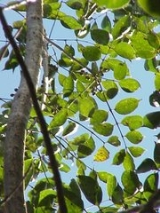
of the Burseraceae is the smooth yet peeling or flaking aromatic bark . The clear, non-allergenic resins may smell like almonds , but at least the most well known resins, frankincense and myrrh, have an odor that is distinct from almonds, smelling like incense. The leaves are generally alternate, spiral, and odd-pinnately compound with opposite, frequently long-petiolulate, entire to serrate, pinnately veined leaflet
s whose symmetry is distinctive in some genera . However, some members are known to have trifoliate or unifoliate leaves . The leaf and leaflet stalks and axis may be brown and scurfy, while the leaf base is swollen and may be concave adaxially . The family members tend to be without stipule
s . The determinate, axillary inflorescence
s carry small, radial, unisexual flowers . The plants tend to be dioecious
. The flowers may have 4-5 faintly connate but imbricate sepal
s with an equal number of distinct, imbricate petal
s . Also, the stamens, that may contain nectar discs, have distinct glabrous filaments that come in 1-2 whorls and in numbers equaling or twice the number of petals; the tricolporate pollen
is contained within 2 locule
s of the anthers that open longitudinally along slits . The gynoecium
contains 3-5 connate carpels, one style
, and one stigma that is head-like to lobed . Each locule of the superior ovary has 2 ovule
s with axile placentation that are anatropous to campylotropous . The 1-5 pitted fruit
is a drupe
that opens at maturity . The endosperm is usually lacking in the embryo .
and 600 species
; 20 genera and 500-600 species ; According to a pollen studies and molecular data, the family is split up into three tribe
s: Protieae, Bursereae, and Canarieae. The Protieae is composed of Protium (147 species and largest in this tribe), Crepidospermum, Garuga, and Tetragastris . The Bursereae, which is further split into subtribes Boswelliinae and Burserinae, contains Commiphora (nearly 200 species and largest in the family), Aucoumea, Beiselia, Boswellia, Bursera, and Triomma . Finally, the Canarieae is composed of Canarium (75 species and largest in this tribe), Dacryodes, Haplolobus, Pseudodacryodes, Rosselia, Santiria, Scutinanthe, and Trattinnickia . The morphology of the fruit, which is a drupe
, helps to distinguish between the three tribes . Though the groupings have slightly changed since the 1990s, Protieae is described as having a 2-5-parted drupe with either ‘free or adhering parts’ which are ‘not fused in the endocarp’ ; Bursereae is described as having a drupe with parts that are fused in the endocarp but an exocarp with dehiscing valves ; and the Canarieae as simply having a drupe with parts that are fused in the endocarp .
and subtribe (where applicable)
and Podoaceae . In the mid-19th century and early 20th century the family was placed in the Geraniales . Then by the mid- and late-20th century the family moved to the Rutales . Finally, in the late 20th century the family was and still is located within the Sapindales . Families that are consistently found in the same order as Burseraceae (except when it was in the Burserales) include Rutaceae
, Meliaceae
, and Simaroubaceae
. It is only in recent studies that Burseraceae and the Anacardiaceae
were seen as sister groups .
The Sapindales
are contained within the Malvids of the Rosid clade
within the Eudicotyledons . The order contains 9 to 15 families , 460 genera , and anywhere from 5,400 to 5,670 to 5,800 species . The nine currently recognized families include Aceraceae, Anacardiaceae, Burseraceae, Hippocastanaceae, Julianaceae, Meliaceae, Rutaceae, Sapindaceae, and Simaroubaceae. The Sapindales is a clade supported by DNA-based analyses on rbcL, atpB, and 18S sequences . Within the Sapindales are two clades that contain gum and resin: 1) the Rutaceae
-Meliaceae
-Simaroubaceae
clade; and 2) the Burseraceae-Anacardiaceae
clade . Therefore, the Burseraceae are not the only family with this characteristic. The synapomorphies of the Sapindales
include pinnately compound, alternate and spiral leaves that may be palmately compound, trifoliate, or unifoliate, and small 4-or 5-merous flowers having a characteristic nectar disk and imbricate petals and sepals . Some of these characteristics also occur in the Rosales
. However, the Sapindales
and Rutales may actually form a complex since many families jump between them. Indeed, rbcL sequence studies seem to indicate that a Sapindalean/Rutalean complex exists and may better represent the relationships of the families than the separate orders would . A study based on chloroplast
-encoded gene
rbcL reconstructed cladograms that include families within both the Sapindales
and Rutales. One such cladogram
indicated that the Sapindales are robust and that the Burseraceae (and Anacardiaceae) are within a single clade . This grouping seems to make sense as both the Burseraceae and Anacardiaceae have secretory canals in the phloem, resin canals in the leaves and are unique in the Sapindales for having biflavones in the leaf tissue . However, the two families have several distinguishing characteristics. The resin of the Burseraceae is non-allergenic and there are two ovules per carpel, whereas the resin of the Anacardiaceae can be allergenic or poisonous and there is one ovule per carpel . The Burseraceae-Anacardiaceae
clade is sister to a robust cluster of three other families, the Sapindaceae
-Aceraceae
-Hippocastanaceae
clade . The Rutaceae
-Meliaceae
-Simaroubaceae
clade is sister to the Burseraceae-Anacardiaceae
and Sapindaceae
-Aceraceae
-Hippocastanaceae
clade . The rbcL technique is supported and considered acceptable until other methods become better developed for the analysis .
, Meso- and South America
. The three tribes can be linked to a specific region of the world although this is not obligatory. For example, members of the tribe Protieae are generally found in South America, those of the Bursereae are found in Africa
and Mesoamerica
, while members of the Canarieae are found in Malaysia . However, each tribe has a representative genus that is present in all the tropical regions: Dacryodes (Canarieae), Protium (Protieae), and Commiphora (Bursereae) . The Burseraceae are found in a variety of habitats including hot, dry desert
and savannah
as well as in coastal mangrove
forest and rain forest habitats . One study found that the family originated in North America
during the Paleocene
(~65 Mya), when the earliest fossils of the Sapindales are found . During the Early to Middle Eocene (~53 Mya) family members dispersed to eastern Laurasia
(i.e. Europe and Asia) via the Boreotropical Land Bridge (BLB) and the continents in the Southern Hemisphere
, which is now the area of the greatest generic diversity of this family .
More specifically, the earliest diverging genus was Beiselia (of the Bursereae subtribe Boswelliinae) in either North America
, Mexico
, or the Caribbean
in the Paleocene
(~65 Mya). Similar results from other studies find that Beiselia mexicana, a native of Mexico
is basal to the remaining Burseraceae members. These results may indicate that the family originated in Mexico
. The next divergence was in the Early Eocene
(~53 Mya) when Burserinae (i.e. Commiphora) diverged and emigrated from North America
into Africa
, Madagascar
, and India
. Commiphora dispersed throughout Africa during the Middle Eocene (~44 Mya) and from Africa to Madagascar during the Oligocene (~30 Mya) via the Mozambique Channel Land Bridge; the spread to India was more recent (~5 Mya) . The Canarieae and Boswelliinae (subtribe of Bursereae) dispersed from western Laurasia
and spread eastward during the Eocene
; fossils of Canarium, for example, from the Czech Republic
date to the Late Oligocene
(23 Mya) . Finally, Protieae originated in North America
like the rest of the family, then migrated to Africa
and Asia
through the Tethys seaway in the Late Eocene
(~37 Mya), but then made its way back to South America
via long-distance dispersal . By the late Oligocene
(~23Mya) all three Burseraceae tribes were extant and dispersed throughout the Northern Hemisphere
.
The mechanism of seed dispersal via animal link vectors (endozoochoric dispersal) may explain how most Burseraceae members were able to expand their range so efficiently across the globe . Beiselia, Boswellia, and Triomma have dry fruits better suited for wind dispersal, but most Burseraceae members have fleshy, edible fruit that is eaten by many animal dispersers . The seeds may provide a high reward in fat (24-73%) and protein (2.7-25.9%) if digested, but many animals eat just the fleshy part of the fruit and either discard the endocarp right away or excrete it some time later . Some known Burseraceae fruit consumers include hornbills (Buceros bicornis, Ceratogyma atrata, C. cylindricus, Penelopides panini), oilbirds (Steatnoris caripensis), fruit pigeons, warblers, vireos, orioles, flycatchers, tanagers, woodpeckers, loeries, primates (Cercopithecus spp., Lophocebus albigena), lemurs (Varecia variegate subsp. Variegate), and sun bears (Helarctos malayanus) . There is also a possibility that the fruits may also have been water dispersed .
. Finally, the namesakes of the family Boswellia carterii (frankincense) and Commiphora abyssinica (myrrh) are important economically and medicinally in several parts of the world. Though this is a small subset of the large number of potentially important species, these four members exemplify the wide use and importance of the Burseraceae. The latter three are frequently cited in the literature for their renowned importance.
Commonly known as Tabonuco (or gommier, also candlewood), Dacryodes excelsa is a large dominant tree found in Puerto Rico
and other parts of the Caribbean
. The seeds of the tree are a source of food for birds. Like all members, the tree releases sap from the bark when wounded. The clear sap oozes from the tree and hardens to a white, aromatic waxy resin
that can be used to make candles and incense . Before the arrival of the Spaniards to Puerto Rico
, the native Taínos used the resin
to make torches. The wood itself is useful for construction, furniture, making boxes, small boats, and a variety of other wood-based products; the utility of the wood is comparable to that of mahogany
and birch
. In addition, species like Canarium littorale, Dacryodes costata, Santiria laevigata, and Santiria tomentosa
from Malaysia as well as Aucoumea kleineana and Canarium schweinfurthii from Africa also produce valuable wood for construction projects and carpentry .
The species in the Bursera (esp. the elephant tree) can be found primarily in Mexico
where they are used to make varnish
. The Maya
also used a Bursera sp. to make incense
. However, the Bursera may also be considered an ornamental genus and a common representative of the family in the United States, especially in Florida (B. simaruba) and the Southwest (B. odorata, B. microphylla) . Naked Indian (also known as gumbo limbo), or Bursera simaruba, in particular, is found in Florida
, Mexico
, the Caribbean
, Venezuela
, and Brazil
. The tree is also named the ‘tourist tree’ for its very distinctive flaking red bark; apparently, the tree occurs in tropical areas where many white tourists go on vacation . The resin from this tree can be used to make varnish and turpentine . In addition, the resin may also be used in the same form as tiger balm (containing Cinnamomum camphora of the Lauraceae
) to relieve sprains and muscle aches . The leaves containing hexane
can be used to make tea to relieve inflammation . The bark serves as an antidote to skin irritation caused by Metopium toxiferum (also known as poisonwood, Florida poison tree, and hog gum) of the Anacardiaceae. The gumbo limbo grows quickly and can be used to make a living fence especially out of cut limbs that are placed straight into the ground or for restoration projects as a pioneer species . The tree is highly tolerant of high intensity wind such as hurricane-force winds and is therefore planted in areas where hurricanes occur frequently like Florida and the Caribbean. The seeds of this species are also a source of food for birds.
Frankincense, or olibanum, (Boswellia carterii) and myrrh (Commiphora abyssinica) may readily be associated with the aromatic resins they produce. These resins are extracted via tapping, or cutting of the bark to make it release sap
. The liquid sap hardens and is gathered, sold as it is or further ground up and mixed with spices, seeds, and roots to make various odors for incense . The two species are native to parts of Northeast Africa (Somalia
, frankincense; Somalia and Ethiopia
, myrrh) and Arabia (Oman
and Yemen
, frankincense), but their distribution and utility spreads beyond these regions to India
and China
. The best frankincense is found in Oman and the incense is widely used in worship in India . The ancient Egyptians prized frankincense for the resin they used to make the characteristic dark eyeliner and myrrh as an embalming agent for deceased Pharaohs . At this time, myrrh was worth more than gold. These days, the resins from these trees are frequently used in Chinese herbal medicine and Indian Ayurvedic medicine to treat several ailments. Ingesting frankincense in small amounts usually in the form of a pill mixed with other ingredients promotes blood flow and the movement of the ‘qi
’ . Ingesting myrrh in a similar way also promotes blood flow and stimulates the stomach and digestion. It is also reportedly useful to treat diabetes, menopause, uterine tumors, amenorrhea (loss of menstruation or failure to menstruate), and dysmenorrhea (menstrual cramping) . Both frankincense (containing triterpene acids) and myrrh are used to relieve pain and inflammation as in arthritis and asthma .
Family (biology)
In biological classification, family is* a taxonomic rank. Other well-known ranks are life, domain, kingdom, phylum, class, order, genus, and species, with family fitting between order and genus. As for the other well-known ranks, there is the option of an immediately lower rank, indicated by the...
of 17-18 genera
Genus
In biology, a genus is a low-level taxonomic rank used in the biological classification of living and fossil organisms, which is an example of definition by genus and differentia...
and about 540 species
Species
In biology, a species is one of the basic units of biological classification and a taxonomic rank. A species is often defined as a group of organisms capable of interbreeding and producing fertile offspring. While in many cases this definition is adequate, more precise or differing measures are...
of flowering plant
Flowering plant
The flowering plants , also known as Angiospermae or Magnoliophyta, are the most diverse group of land plants. Angiosperms are seed-producing plants like the gymnosperms and can be distinguished from the gymnosperms by a series of synapomorphies...
s. The actual numbers differ according to the time period in which a given source is written describing this family. The Burseraceae is also known as the Torchwood family, the frankincense
Frankincense
Frankincense, also called olibanum , is an aromatic resin obtained from trees of the genus Boswellia, particularly Boswellia sacra, B. carteri, B. thurifera, B. frereana, and B. bhaw-dajiana...
and myrrh
Myrrh
Myrrh is the aromatic oleoresin of a number of small, thorny tree species of the genus Commiphora, which grow in dry, stony soil. An oleoresin is a natural blend of an essential oil and a resin. Myrrh resin is a natural gum....
family, or simply the incense tree family. The family includes both tree
Tree
A tree is a perennial woody plant. It is most often defined as a woody plant that has many secondary branches supported clear of the ground on a single main stem or trunk with clear apical dominance. A minimum height specification at maturity is cited by some authors, varying from 3 m to...
s and shrub
Shrub
A shrub or bush is distinguished from a tree by its multiple stems and shorter height, usually under 5–6 m tall. A large number of plants may become either shrubs or trees, depending on the growing conditions they experience...
s, and is native to tropical regions of Africa
Africa
Africa is the world's second largest and second most populous continent, after Asia. At about 30.2 million km² including adjacent islands, it covers 6% of the Earth's total surface area and 20.4% of the total land area...
, Asia
Asia
Asia is the world's largest and most populous continent, located primarily in the eastern and northern hemispheres. It covers 8.7% of the Earth's total surface area and with approximately 3.879 billion people, it hosts 60% of the world's current human population...
and the Americas
Americas
The Americas, or America , are lands in the Western hemisphere, also known as the New World. In English, the plural form the Americas is often used to refer to the landmasses of North America and South America with their associated islands and regions, while the singular form America is primarily...
.
Just as the family size (in terms of genera and species) differs according to the time period of the study, so too does its placement in the higher ranks. Nevertheless, the family is a genetically supported monophyletic group currently and frequently cited within the Sapindales
Sapindales
Sapindales is a botanical name for an order of flowering plants. Well-known members of Sapindales include citrus; maples, horse-chestnuts, lychees and rambutans; mangos and cashews; frankincense and myrrh; mahogany and neem....
and is recognized as a sister group to the Anacardiaceae
Anacardiaceae
Anacardiaceae are a family of flowering plants bearing fruits that are drupes and in some cases producing urushiol, an irritant. Anacardiaceae include numerous genera with several of economic importance. Notable plants in this family include cashew , mango, poison ivy, sumac, smoke tree, and marula...
. The Burseraceae members are characterized by the non-allergenic resin they produce in virtually all plant tissue and the distinctive smooth, yet flaking aromatic bark ,. The origins of the family can be traced to the Paleocene
Paleocene
The Paleocene or Palaeocene, the "early recent", is a geologic epoch that lasted from about . It is the first epoch of the Palaeogene Period in the modern Cenozoic Era...
(~65 Mya) when Beiselia mexicana first diverged in Mexico
Mexico
The United Mexican States , commonly known as Mexico , is a federal constitutional republic in North America. It is bordered on the north by the United States; on the south and west by the Pacific Ocean; on the southeast by Guatemala, Belize, and the Caribbean Sea; and on the east by the Gulf of...
. The subsequent divergences in the family lineage and migration of the species in the Eocene
Eocene
The Eocene Epoch, lasting from about 56 to 34 million years ago , is a major division of the geologic timescale and the second epoch of the Paleogene Period in the Cenozoic Era. The Eocene spans the time from the end of the Palaeocene Epoch to the beginning of the Oligocene Epoch. The start of the...
(~53 Mya) from North America
North America
North America is a continent wholly within the Northern Hemisphere and almost wholly within the Western Hemisphere. It is also considered a northern subcontinent of the Americas...
have led to the current distributions of the species that are primarily associated with the tropics . Though the family likely originated in North America
North America
North America is a continent wholly within the Northern Hemisphere and almost wholly within the Western Hemisphere. It is also considered a northern subcontinent of the Americas...
, the greatest generic diversity presently is in the Southern Hemisphere
Southern Hemisphere
The Southern Hemisphere is the part of Earth that lies south of the equator. The word hemisphere literally means 'half ball' or "half sphere"...
. Tabonuco (Dacryodes excelsa) and gumbo limbo (Bursera simaruba) represent the economic, ethnobotanical, and ecological significance of the Burseraceae in the Western Hemisphere
Western Hemisphere
The Western Hemisphere or western hemisphere is mainly used as a geographical term for the half of the Earth that lies west of the Prime Meridian and east of the Antimeridian , the other half being called the Eastern Hemisphere.In this sense, the western hemisphere consists of the western portions...
, while frankincense
Frankincense
Frankincense, also called olibanum , is an aromatic resin obtained from trees of the genus Boswellia, particularly Boswellia sacra, B. carteri, B. thurifera, B. frereana, and B. bhaw-dajiana...
(Boswellia carterii) and myrrh
Myrrh
Myrrh is the aromatic oleoresin of a number of small, thorny tree species of the genus Commiphora, which grow in dry, stony soil. An oleoresin is a natural blend of an essential oil and a resin. Myrrh resin is a natural gum....
(Commiphora abyssinica) represent the same in the Eastern Hemisphere
Eastern Hemisphere
The Eastern Hemisphere, also Eastern hemisphere or eastern hemisphere, is a geographical term for the half of the Earth that is east of the Prime Meridian and west of 180° longitude. It is also used to refer to Europe, Asia, Africa, and Australasia, vis-à-vis the Western Hemisphere, which includes...
.
Key characteristics
The Burseraceae trees or shrubs are characterized by resins (having triterpenoids and ethereal oils; that are present within the plant tissue from the vertical resin canals and ducts in the barkBark
Bark is the outermost layers of stems and roots of woody plants. Plants with bark include trees, woody vines and shrubs. Bark refers to all the tissues outside of the vascular cambium and is a nontechnical term. It overlays the wood and consists of the inner bark and the outer bark. The inner...
to the leaf veins . In fact, the synapomorphy
Synapomorphy
In cladistics, a synapomorphy or synapomorphic character is a trait that is shared by two or more taxa and their most recent common ancestor, whose ancestor in turn does not possess the trait. A synapomorphy is thus an apomorphy visible in multiple taxa, where the trait in question originates in...
of the Burseraceae is the smooth yet peeling or flaking aromatic bark . The clear, non-allergenic resins may smell like almonds , but at least the most well known resins, frankincense and myrrh, have an odor that is distinct from almonds, smelling like incense. The leaves are generally alternate, spiral, and odd-pinnately compound with opposite, frequently long-petiolulate, entire to serrate, pinnately veined leaflet
Leaflet
A leaflet in botany is a part of a compound leaf. A leaflet may resemble an entire leaf, but it is not borne on a stem as a leaf is, but rather on a vein of the whole leaf. Compound leaves are common in many plant families...
s whose symmetry is distinctive in some genera . However, some members are known to have trifoliate or unifoliate leaves . The leaf and leaflet stalks and axis may be brown and scurfy, while the leaf base is swollen and may be concave adaxially . The family members tend to be without stipule
Stipule
In botany, stipule is a term coined by Linnaeus which refers to outgrowths borne on either side of the base of a leafstalk...
s . The determinate, axillary inflorescence
Inflorescence
An inflorescence is a group or cluster of flowers arranged on a stem that is composed of a main branch or a complicated arrangement of branches. Strictly, it is the part of the shoot of seed plants where flowers are formed and which is accordingly modified...
s carry small, radial, unisexual flowers . The plants tend to be dioecious
Dioecious
Dioecy is the property of a group of biological organisms that have males and females, but not members that have organs of both sexes at the same time. I.e., those whose individual members can usually produce only one type of gamete; each individual organism is thus distinctly female or male...
. The flowers may have 4-5 faintly connate but imbricate sepal
Sepal
A sepal is a part of the flower of angiosperms . Collectively the sepals form the calyx, which is the outermost whorl of parts that form a flower. Usually green, sepals have the typical function of protecting the petals when the flower is in bud...
s with an equal number of distinct, imbricate petal
Petal
Petals are modified leaves that surround the reproductive parts of flowers. They often are brightly colored or unusually shaped to attract pollinators. Together, all of the petals of a flower are called a corolla. Petals are usually accompanied by another set of special leaves called sepals lying...
s . Also, the stamens, that may contain nectar discs, have distinct glabrous filaments that come in 1-2 whorls and in numbers equaling or twice the number of petals; the tricolporate pollen
Pollen
Pollen is a fine to coarse powder containing the microgametophytes of seed plants, which produce the male gametes . Pollen grains have a hard coat that protects the sperm cells during the process of their movement from the stamens to the pistil of flowering plants or from the male cone to the...
is contained within 2 locule
Locule
A locule is a small cavity or compartment within an organ or part of an organism ....
s of the anthers that open longitudinally along slits . The gynoecium
Gynoecium
Gynoecium is most commonly used as a collective term for all carpels in a flower. A carpel is the ovule and seed producing reproductive organ in flowering plants. Carpels are derived from ovule-bearing leaves which evolved to form a closed structure containing the ovules...
contains 3-5 connate carpels, one style
Gynoecium
Gynoecium is most commonly used as a collective term for all carpels in a flower. A carpel is the ovule and seed producing reproductive organ in flowering plants. Carpels are derived from ovule-bearing leaves which evolved to form a closed structure containing the ovules...
, and one stigma that is head-like to lobed . Each locule of the superior ovary has 2 ovule
Ovule
Ovule means "small egg". In seed plants, the ovule is the structure that gives rise to and contains the female reproductive cells. It consists of three parts: The integument forming its outer layer, the nucellus , and the megaspore-derived female gametophyte in its center...
s with axile placentation that are anatropous to campylotropous . The 1-5 pitted fruit
Fruit
In broad terms, a fruit is a structure of a plant that contains its seeds.The term has different meanings dependent on context. In non-technical usage, such as food preparation, fruit normally means the fleshy seed-associated structures of certain plants that are sweet and edible in the raw state,...
is a drupe
Drupe
In botany, a drupe is a fruit in which an outer fleshy part surrounds a shell of hardened endocarp with a seed inside. These fruits develop from a single carpel, and mostly from flowers with superior ovaries...
that opens at maturity . The endosperm is usually lacking in the embryo .
Tribes, subtribes, and genera
There is some discrepancy in the literature about the size of the Burseraceae. Records say that the family has 17 to 18 genera and 500 to 540 to 726 species . Other authors cite different numbers: 16-20 generaGenera
Genera is a commercial operating system and development environment for Lisp machines developed by Symbolics. It is essentially a fork of an earlier operating system originating on the MIT AI Lab's Lisp machines which Symbolics had used in common with LMI and Texas Instruments...
and 600 species
Species
In biology, a species is one of the basic units of biological classification and a taxonomic rank. A species is often defined as a group of organisms capable of interbreeding and producing fertile offspring. While in many cases this definition is adequate, more precise or differing measures are...
; 20 genera and 500-600 species ; According to a pollen studies and molecular data, the family is split up into three tribe
Tribe
A tribe, viewed historically or developmentally, consists of a social group existing before the development of, or outside of, states.Many anthropologists use the term tribal society to refer to societies organized largely on the basis of kinship, especially corporate descent groups .Some theorists...
s: Protieae, Bursereae, and Canarieae. The Protieae is composed of Protium (147 species and largest in this tribe), Crepidospermum, Garuga, and Tetragastris . The Bursereae, which is further split into subtribes Boswelliinae and Burserinae, contains Commiphora (nearly 200 species and largest in the family), Aucoumea, Beiselia, Boswellia, Bursera, and Triomma . Finally, the Canarieae is composed of Canarium (75 species and largest in this tribe), Dacryodes, Haplolobus, Pseudodacryodes, Rosselia, Santiria, Scutinanthe, and Trattinnickia . The morphology of the fruit, which is a drupe
Drupe
In botany, a drupe is a fruit in which an outer fleshy part surrounds a shell of hardened endocarp with a seed inside. These fruits develop from a single carpel, and mostly from flowers with superior ovaries...
, helps to distinguish between the three tribes . Though the groupings have slightly changed since the 1990s, Protieae is described as having a 2-5-parted drupe with either ‘free or adhering parts’ which are ‘not fused in the endocarp’ ; Bursereae is described as having a drupe with parts that are fused in the endocarp but an exocarp with dehiscing valves ; and the Canarieae as simply having a drupe with parts that are fused in the endocarp .
Taxonomy
This is a list of the 18 genera of the Burseraceae with placement in tribeTribe
A tribe, viewed historically or developmentally, consists of a social group existing before the development of, or outside of, states.Many anthropologists use the term tribal society to refer to societies organized largely on the basis of kinship, especially corporate descent groups .Some theorists...
and subtribe (where applicable)
Bursereae subtribe Burserinae
|
Bursereae subtribe Boswelliinae
|
Canarieae
|
Protieae
|
Order
According to the literature, the Burseraceae has not been lumped with other families nor split up into several others. However, it has jumped orders several times. For example, it seems that in the early 19th century the family was placed in the Burserales, with AnacardiaceaeAnacardiaceae
Anacardiaceae are a family of flowering plants bearing fruits that are drupes and in some cases producing urushiol, an irritant. Anacardiaceae include numerous genera with several of economic importance. Notable plants in this family include cashew , mango, poison ivy, sumac, smoke tree, and marula...
and Podoaceae . In the mid-19th century and early 20th century the family was placed in the Geraniales . Then by the mid- and late-20th century the family moved to the Rutales . Finally, in the late 20th century the family was and still is located within the Sapindales . Families that are consistently found in the same order as Burseraceae (except when it was in the Burserales) include Rutaceae
Rutaceae
Rutaceae, commonly known as the rue or citrus family, is a family of flowering plants, usually placed in the order Sapindales.Species of the family generally have flowers that divide into four or five parts, usually with strong scents...
, Meliaceae
Meliaceae
The Meliaceae, or the Mahogany family, is a flowering plant family of mostly trees and shrubs in the order Sapindales....
, and Simaroubaceae
Simaroubaceae
The Simaroubaceae is a small, mostly tropical, family in the order Sapindales. In recent decades it has been subject to much taxonomic debate, with several small families being split off...
. It is only in recent studies that Burseraceae and the Anacardiaceae
Anacardiaceae
Anacardiaceae are a family of flowering plants bearing fruits that are drupes and in some cases producing urushiol, an irritant. Anacardiaceae include numerous genera with several of economic importance. Notable plants in this family include cashew , mango, poison ivy, sumac, smoke tree, and marula...
were seen as sister groups .
The Sapindales
Sapindales
Sapindales is a botanical name for an order of flowering plants. Well-known members of Sapindales include citrus; maples, horse-chestnuts, lychees and rambutans; mangos and cashews; frankincense and myrrh; mahogany and neem....
are contained within the Malvids of the Rosid clade
Clade
A clade is a group consisting of a species and all its descendants. In the terms of biological systematics, a clade is a single "branch" on the "tree of life". The idea that such a "natural group" of organisms should be grouped together and given a taxonomic name is central to biological...
within the Eudicotyledons . The order contains 9 to 15 families , 460 genera , and anywhere from 5,400 to 5,670 to 5,800 species . The nine currently recognized families include Aceraceae, Anacardiaceae, Burseraceae, Hippocastanaceae, Julianaceae, Meliaceae, Rutaceae, Sapindaceae, and Simaroubaceae. The Sapindales is a clade supported by DNA-based analyses on rbcL, atpB, and 18S sequences . Within the Sapindales are two clades that contain gum and resin: 1) the Rutaceae
Rutaceae
Rutaceae, commonly known as the rue or citrus family, is a family of flowering plants, usually placed in the order Sapindales.Species of the family generally have flowers that divide into four or five parts, usually with strong scents...
-Meliaceae
Meliaceae
The Meliaceae, or the Mahogany family, is a flowering plant family of mostly trees and shrubs in the order Sapindales....
-Simaroubaceae
Simaroubaceae
The Simaroubaceae is a small, mostly tropical, family in the order Sapindales. In recent decades it has been subject to much taxonomic debate, with several small families being split off...
clade; and 2) the Burseraceae-Anacardiaceae
Anacardiaceae
Anacardiaceae are a family of flowering plants bearing fruits that are drupes and in some cases producing urushiol, an irritant. Anacardiaceae include numerous genera with several of economic importance. Notable plants in this family include cashew , mango, poison ivy, sumac, smoke tree, and marula...
clade . Therefore, the Burseraceae are not the only family with this characteristic. The synapomorphies of the Sapindales
Sapindales
Sapindales is a botanical name for an order of flowering plants. Well-known members of Sapindales include citrus; maples, horse-chestnuts, lychees and rambutans; mangos and cashews; frankincense and myrrh; mahogany and neem....
include pinnately compound, alternate and spiral leaves that may be palmately compound, trifoliate, or unifoliate, and small 4-or 5-merous flowers having a characteristic nectar disk and imbricate petals and sepals . Some of these characteristics also occur in the Rosales
Rosales
Rosales is an order of flowering plants. It is one of the four orders in the nitrogen fixing clade of the fabids and is sister to a clade consisting of Fagales and Cucurbitales. It contains about 7700 species, distributed into about 260 genera. Rosales comprises nine families, the type family...
. However, the Sapindales
Sapindales
Sapindales is a botanical name for an order of flowering plants. Well-known members of Sapindales include citrus; maples, horse-chestnuts, lychees and rambutans; mangos and cashews; frankincense and myrrh; mahogany and neem....
and Rutales may actually form a complex since many families jump between them. Indeed, rbcL sequence studies seem to indicate that a Sapindalean/Rutalean complex exists and may better represent the relationships of the families than the separate orders would . A study based on chloroplast
Chloroplast
Chloroplasts are organelles found in plant cells and other eukaryotic organisms that conduct photosynthesis. Chloroplasts capture light energy to conserve free energy in the form of ATP and reduce NADP to NADPH through a complex set of processes called photosynthesis.Chloroplasts are green...
-encoded gene
Gene
A gene is a molecular unit of heredity of a living organism. It is a name given to some stretches of DNA and RNA that code for a type of protein or for an RNA chain that has a function in the organism. Living beings depend on genes, as they specify all proteins and functional RNA chains...
rbcL reconstructed cladograms that include families within both the Sapindales
Sapindales
Sapindales is a botanical name for an order of flowering plants. Well-known members of Sapindales include citrus; maples, horse-chestnuts, lychees and rambutans; mangos and cashews; frankincense and myrrh; mahogany and neem....
and Rutales. One such cladogram
Cladogram
A cladogram is a diagram used in cladistics which shows ancestral relations between organisms, to represent the evolutionary tree of life. Although traditionally such cladograms were generated largely on the basis of morphological characters, DNA and RNA sequencing data and computational...
indicated that the Sapindales are robust and that the Burseraceae (and Anacardiaceae) are within a single clade . This grouping seems to make sense as both the Burseraceae and Anacardiaceae have secretory canals in the phloem, resin canals in the leaves and are unique in the Sapindales for having biflavones in the leaf tissue . However, the two families have several distinguishing characteristics. The resin of the Burseraceae is non-allergenic and there are two ovules per carpel, whereas the resin of the Anacardiaceae can be allergenic or poisonous and there is one ovule per carpel . The Burseraceae-Anacardiaceae
Anacardiaceae
Anacardiaceae are a family of flowering plants bearing fruits that are drupes and in some cases producing urushiol, an irritant. Anacardiaceae include numerous genera with several of economic importance. Notable plants in this family include cashew , mango, poison ivy, sumac, smoke tree, and marula...
clade is sister to a robust cluster of three other families, the Sapindaceae
Sapindaceae
Sapindaceae, also known as the soapberry family, is a family of flowering plants in the order Sapindales. There are about 140-150 genera with 1400-2000 species, including maple, horse chestnut and lychee....
-Aceraceae
Aceraceae
Aceraceae is a family of flowering plants also called the Maple Family. It contains two to four genera, depending upon the circumscription, of some 120 species of trees and shrubs. A common characteristic is that the leaves are opposite, and the fruit a schizocarp.The maples have long been known...
-Hippocastanaceae
Hippocastanaceae
thumb|230pxHippocastanaceae is the name given to a small group of trees and shrubs, when this group is treated as a family. Its most widespread genus is Aesculus . However, the American genus Billia and the Chinese genus Handeliodendron are also sometimes included in this family...
clade . The Rutaceae
Rutaceae
Rutaceae, commonly known as the rue or citrus family, is a family of flowering plants, usually placed in the order Sapindales.Species of the family generally have flowers that divide into four or five parts, usually with strong scents...
-Meliaceae
Meliaceae
The Meliaceae, or the Mahogany family, is a flowering plant family of mostly trees and shrubs in the order Sapindales....
-Simaroubaceae
Simaroubaceae
The Simaroubaceae is a small, mostly tropical, family in the order Sapindales. In recent decades it has been subject to much taxonomic debate, with several small families being split off...
clade is sister to the Burseraceae-Anacardiaceae
Anacardiaceae
Anacardiaceae are a family of flowering plants bearing fruits that are drupes and in some cases producing urushiol, an irritant. Anacardiaceae include numerous genera with several of economic importance. Notable plants in this family include cashew , mango, poison ivy, sumac, smoke tree, and marula...
and Sapindaceae
Sapindaceae
Sapindaceae, also known as the soapberry family, is a family of flowering plants in the order Sapindales. There are about 140-150 genera with 1400-2000 species, including maple, horse chestnut and lychee....
-Aceraceae
Aceraceae
Aceraceae is a family of flowering plants also called the Maple Family. It contains two to four genera, depending upon the circumscription, of some 120 species of trees and shrubs. A common characteristic is that the leaves are opposite, and the fruit a schizocarp.The maples have long been known...
-Hippocastanaceae
Hippocastanaceae
thumb|230pxHippocastanaceae is the name given to a small group of trees and shrubs, when this group is treated as a family. Its most widespread genus is Aesculus . However, the American genus Billia and the Chinese genus Handeliodendron are also sometimes included in this family...
clade . The rbcL technique is supported and considered acceptable until other methods become better developed for the analysis .
Biogeography
The Burseraceae are distributed throughout the world and primarily in the tropics, especially Malaysia, AfricaAfrica
Africa is the world's second largest and second most populous continent, after Asia. At about 30.2 million km² including adjacent islands, it covers 6% of the Earth's total surface area and 20.4% of the total land area...
, Meso- and South America
South America
South America is a continent situated in the Western Hemisphere, mostly in the Southern Hemisphere, with a relatively small portion in the Northern Hemisphere. The continent is also considered a subcontinent of the Americas. It is bordered on the west by the Pacific Ocean and on the north and east...
. The three tribes can be linked to a specific region of the world although this is not obligatory. For example, members of the tribe Protieae are generally found in South America, those of the Bursereae are found in Africa
Africa
Africa is the world's second largest and second most populous continent, after Asia. At about 30.2 million km² including adjacent islands, it covers 6% of the Earth's total surface area and 20.4% of the total land area...
and Mesoamerica
Mesoamerica
Mesoamerica is a region and culture area in the Americas, extending approximately from central Mexico to Belize, Guatemala, El Salvador, Honduras, Nicaragua, and Costa Rica, within which a number of pre-Columbian societies flourished before the Spanish colonization of the Americas in the 15th and...
, while members of the Canarieae are found in Malaysia . However, each tribe has a representative genus that is present in all the tropical regions: Dacryodes (Canarieae), Protium (Protieae), and Commiphora (Bursereae) . The Burseraceae are found in a variety of habitats including hot, dry desert
Desert
A desert is a landscape or region that receives an extremely low amount of precipitation, less than enough to support growth of most plants. Most deserts have an average annual precipitation of less than...
and savannah
Savannah
Savannah or savanna is a type of grassland.It can also mean:-People:* Savannah King, a Canadian freestyle swimmer* Savannah Outen, a singer who gained popularity on You Tube...
as well as in coastal mangrove
Mangrove
Mangroves are various kinds of trees up to medium height and shrubs that grow in saline coastal sediment habitats in the tropics and subtropics – mainly between latitudes N and S...
forest and rain forest habitats . One study found that the family originated in North America
North America
North America is a continent wholly within the Northern Hemisphere and almost wholly within the Western Hemisphere. It is also considered a northern subcontinent of the Americas...
during the Paleocene
Paleocene
The Paleocene or Palaeocene, the "early recent", is a geologic epoch that lasted from about . It is the first epoch of the Palaeogene Period in the modern Cenozoic Era...
(~65 Mya), when the earliest fossils of the Sapindales are found . During the Early to Middle Eocene (~53 Mya) family members dispersed to eastern Laurasia
Laurasia
In paleogeography, Laurasia was the northernmost of two supercontinents that formed part of the Pangaea supercontinent from approximately...
(i.e. Europe and Asia) via the Boreotropical Land Bridge (BLB) and the continents in the Southern Hemisphere
Southern Hemisphere
The Southern Hemisphere is the part of Earth that lies south of the equator. The word hemisphere literally means 'half ball' or "half sphere"...
, which is now the area of the greatest generic diversity of this family .
More specifically, the earliest diverging genus was Beiselia (of the Bursereae subtribe Boswelliinae) in either North America
North America
North America is a continent wholly within the Northern Hemisphere and almost wholly within the Western Hemisphere. It is also considered a northern subcontinent of the Americas...
, Mexico
Mexico
The United Mexican States , commonly known as Mexico , is a federal constitutional republic in North America. It is bordered on the north by the United States; on the south and west by the Pacific Ocean; on the southeast by Guatemala, Belize, and the Caribbean Sea; and on the east by the Gulf of...
, or the Caribbean
Caribbean
The Caribbean is a crescent-shaped group of islands more than 2,000 miles long separating the Gulf of Mexico and the Caribbean Sea, to the west and south, from the Atlantic Ocean, to the east and north...
in the Paleocene
Paleocene
The Paleocene or Palaeocene, the "early recent", is a geologic epoch that lasted from about . It is the first epoch of the Palaeogene Period in the modern Cenozoic Era...
(~65 Mya). Similar results from other studies find that Beiselia mexicana, a native of Mexico
Mexico
The United Mexican States , commonly known as Mexico , is a federal constitutional republic in North America. It is bordered on the north by the United States; on the south and west by the Pacific Ocean; on the southeast by Guatemala, Belize, and the Caribbean Sea; and on the east by the Gulf of...
is basal to the remaining Burseraceae members. These results may indicate that the family originated in Mexico
Mexico
The United Mexican States , commonly known as Mexico , is a federal constitutional republic in North America. It is bordered on the north by the United States; on the south and west by the Pacific Ocean; on the southeast by Guatemala, Belize, and the Caribbean Sea; and on the east by the Gulf of...
. The next divergence was in the Early Eocene
Eocene
The Eocene Epoch, lasting from about 56 to 34 million years ago , is a major division of the geologic timescale and the second epoch of the Paleogene Period in the Cenozoic Era. The Eocene spans the time from the end of the Palaeocene Epoch to the beginning of the Oligocene Epoch. The start of the...
(~53 Mya) when Burserinae (i.e. Commiphora) diverged and emigrated from North America
North America
North America is a continent wholly within the Northern Hemisphere and almost wholly within the Western Hemisphere. It is also considered a northern subcontinent of the Americas...
into Africa
Africa
Africa is the world's second largest and second most populous continent, after Asia. At about 30.2 million km² including adjacent islands, it covers 6% of the Earth's total surface area and 20.4% of the total land area...
, Madagascar
Madagascar
The Republic of Madagascar is an island country located in the Indian Ocean off the southeastern coast of Africa...
, and India
India
India , officially the Republic of India , is a country in South Asia. It is the seventh-largest country by geographical area, the second-most populous country with over 1.2 billion people, and the most populous democracy in the world...
. Commiphora dispersed throughout Africa during the Middle Eocene (~44 Mya) and from Africa to Madagascar during the Oligocene (~30 Mya) via the Mozambique Channel Land Bridge; the spread to India was more recent (~5 Mya) . The Canarieae and Boswelliinae (subtribe of Bursereae) dispersed from western Laurasia
Laurasia
In paleogeography, Laurasia was the northernmost of two supercontinents that formed part of the Pangaea supercontinent from approximately...
and spread eastward during the Eocene
Eocene
The Eocene Epoch, lasting from about 56 to 34 million years ago , is a major division of the geologic timescale and the second epoch of the Paleogene Period in the Cenozoic Era. The Eocene spans the time from the end of the Palaeocene Epoch to the beginning of the Oligocene Epoch. The start of the...
; fossils of Canarium, for example, from the Czech Republic
Czech Republic
The Czech Republic is a landlocked country in Central Europe. The country is bordered by Poland to the northeast, Slovakia to the east, Austria to the south, and Germany to the west and northwest....
date to the Late Oligocene
Oligocene
The Oligocene is a geologic epoch of the Paleogene Period and extends from about 34 million to 23 million years before the present . As with other older geologic periods, the rock beds that define the period are well identified but the exact dates of the start and end of the period are slightly...
(23 Mya) . Finally, Protieae originated in North America
North America
North America is a continent wholly within the Northern Hemisphere and almost wholly within the Western Hemisphere. It is also considered a northern subcontinent of the Americas...
like the rest of the family, then migrated to Africa
Africa
Africa is the world's second largest and second most populous continent, after Asia. At about 30.2 million km² including adjacent islands, it covers 6% of the Earth's total surface area and 20.4% of the total land area...
and Asia
Asia
Asia is the world's largest and most populous continent, located primarily in the eastern and northern hemispheres. It covers 8.7% of the Earth's total surface area and with approximately 3.879 billion people, it hosts 60% of the world's current human population...
through the Tethys seaway in the Late Eocene
Eocene
The Eocene Epoch, lasting from about 56 to 34 million years ago , is a major division of the geologic timescale and the second epoch of the Paleogene Period in the Cenozoic Era. The Eocene spans the time from the end of the Palaeocene Epoch to the beginning of the Oligocene Epoch. The start of the...
(~37 Mya), but then made its way back to South America
South America
South America is a continent situated in the Western Hemisphere, mostly in the Southern Hemisphere, with a relatively small portion in the Northern Hemisphere. The continent is also considered a subcontinent of the Americas. It is bordered on the west by the Pacific Ocean and on the north and east...
via long-distance dispersal . By the late Oligocene
Oligocene
The Oligocene is a geologic epoch of the Paleogene Period and extends from about 34 million to 23 million years before the present . As with other older geologic periods, the rock beds that define the period are well identified but the exact dates of the start and end of the period are slightly...
(~23Mya) all three Burseraceae tribes were extant and dispersed throughout the Northern Hemisphere
Northern Hemisphere
The Northern Hemisphere is the half of a planet that is north of its equator—the word hemisphere literally means “half sphere”. It is also that half of the celestial sphere north of the celestial equator...
.
The mechanism of seed dispersal via animal link vectors (endozoochoric dispersal) may explain how most Burseraceae members were able to expand their range so efficiently across the globe . Beiselia, Boswellia, and Triomma have dry fruits better suited for wind dispersal, but most Burseraceae members have fleshy, edible fruit that is eaten by many animal dispersers . The seeds may provide a high reward in fat (24-73%) and protein (2.7-25.9%) if digested, but many animals eat just the fleshy part of the fruit and either discard the endocarp right away or excrete it some time later . Some known Burseraceae fruit consumers include hornbills (Buceros bicornis, Ceratogyma atrata, C. cylindricus, Penelopides panini), oilbirds (Steatnoris caripensis), fruit pigeons, warblers, vireos, orioles, flycatchers, tanagers, woodpeckers, loeries, primates (Cercopithecus spp., Lophocebus albigena), lemurs (Varecia variegate subsp. Variegate), and sun bears (Helarctos malayanus) . There is also a possibility that the fruits may also have been water dispersed .
Economic significance and ethnobotanic uses
There are several representative species within the Burseraceae that typify the economic and ethnobotanic significance of the family. First, Dacryodes excelsa of the Canarieae is an important old-growth species found in the Caribbean. Second, Bursera simaruba of the Burserinae is a fast-growing ornamental that is one of a few representatives of the primarily tropical family in the United StatesUnited States
The United States of America is a federal constitutional republic comprising fifty states and a federal district...
. Finally, the namesakes of the family Boswellia carterii (frankincense) and Commiphora abyssinica (myrrh) are important economically and medicinally in several parts of the world. Though this is a small subset of the large number of potentially important species, these four members exemplify the wide use and importance of the Burseraceae. The latter three are frequently cited in the literature for their renowned importance.
Commonly known as Tabonuco (or gommier, also candlewood), Dacryodes excelsa is a large dominant tree found in Puerto Rico
Puerto Rico
Puerto Rico , officially the Commonwealth of Puerto Rico , is an unincorporated territory of the United States, located in the northeastern Caribbean, east of the Dominican Republic and west of both the United States Virgin Islands and the British Virgin Islands.Puerto Rico comprises an...
and other parts of the Caribbean
Caribbean
The Caribbean is a crescent-shaped group of islands more than 2,000 miles long separating the Gulf of Mexico and the Caribbean Sea, to the west and south, from the Atlantic Ocean, to the east and north...
. The seeds of the tree are a source of food for birds. Like all members, the tree releases sap from the bark when wounded. The clear sap oozes from the tree and hardens to a white, aromatic waxy resin
Resin
Resin in the most specific use of the term is a hydrocarbon secretion of many plants, particularly coniferous trees. Resins are valued for their chemical properties and associated uses, such as the production of varnishes, adhesives, and food glazing agents; as an important source of raw materials...
that can be used to make candles and incense . Before the arrival of the Spaniards to Puerto Rico
Puerto Rico
Puerto Rico , officially the Commonwealth of Puerto Rico , is an unincorporated territory of the United States, located in the northeastern Caribbean, east of the Dominican Republic and west of both the United States Virgin Islands and the British Virgin Islands.Puerto Rico comprises an...
, the native Taínos used the resin
Resin
Resin in the most specific use of the term is a hydrocarbon secretion of many plants, particularly coniferous trees. Resins are valued for their chemical properties and associated uses, such as the production of varnishes, adhesives, and food glazing agents; as an important source of raw materials...
to make torches. The wood itself is useful for construction, furniture, making boxes, small boats, and a variety of other wood-based products; the utility of the wood is comparable to that of mahogany
Mahogany
The name mahogany is used when referring to numerous varieties of dark-colored hardwood. It is a native American word originally used for the wood of the species Swietenia mahagoni, known as West Indian or Cuban mahogany....
and birch
Birch
Birch is a tree or shrub of the genus Betula , in the family Betulaceae, closely related to the beech/oak family, Fagaceae. The Betula genus contains 30–60 known taxa...
. In addition, species like Canarium littorale, Dacryodes costata, Santiria laevigata, and Santiria tomentosa
Santiria tomentosa
Santiria tomentosa is a species of plant in the Burseraceae family. It is found in Indonesia, Malaysia, the Philippines, and Singapore.-References:* World Conservation Monitoring Centre 1998. . Downloaded on 23 August 2007....
from Malaysia as well as Aucoumea kleineana and Canarium schweinfurthii from Africa also produce valuable wood for construction projects and carpentry .
The species in the Bursera (esp. the elephant tree) can be found primarily in Mexico
Mexico
The United Mexican States , commonly known as Mexico , is a federal constitutional republic in North America. It is bordered on the north by the United States; on the south and west by the Pacific Ocean; on the southeast by Guatemala, Belize, and the Caribbean Sea; and on the east by the Gulf of...
where they are used to make varnish
Varnish
Varnish is a transparent, hard, protective finish or film primarily used in wood finishing but also for other materials. Varnish is traditionally a combination of a drying oil, a resin, and a thinner or solvent. Varnish finishes are usually glossy but may be designed to produce satin or semi-gloss...
. The Maya
Maya civilization
The Maya is a Mesoamerican civilization, noted for the only known fully developed written language of the pre-Columbian Americas, as well as for its art, architecture, and mathematical and astronomical systems. Initially established during the Pre-Classic period The Maya is a Mesoamerican...
also used a Bursera sp. to make incense
Incense
Incense is composed of aromatic biotic materials, which release fragrant smoke when burned. The term "incense" refers to the substance itself, rather than to the odor that it produces. It is used in religious ceremonies, ritual purification, aromatherapy, meditation, for creating a mood, and for...
. However, the Bursera may also be considered an ornamental genus and a common representative of the family in the United States, especially in Florida (B. simaruba) and the Southwest (B. odorata, B. microphylla) . Naked Indian (also known as gumbo limbo), or Bursera simaruba, in particular, is found in Florida
Florida
Florida is a state in the southeastern United States, located on the nation's Atlantic and Gulf coasts. It is bordered to the west by the Gulf of Mexico, to the north by Alabama and Georgia and to the east by the Atlantic Ocean. With a population of 18,801,310 as measured by the 2010 census, it...
, Mexico
Mexico
The United Mexican States , commonly known as Mexico , is a federal constitutional republic in North America. It is bordered on the north by the United States; on the south and west by the Pacific Ocean; on the southeast by Guatemala, Belize, and the Caribbean Sea; and on the east by the Gulf of...
, the Caribbean
Caribbean
The Caribbean is a crescent-shaped group of islands more than 2,000 miles long separating the Gulf of Mexico and the Caribbean Sea, to the west and south, from the Atlantic Ocean, to the east and north...
, Venezuela
Venezuela
Venezuela , officially called the Bolivarian Republic of Venezuela , is a tropical country on the northern coast of South America. It borders Colombia to the west, Guyana to the east, and Brazil to the south...
, and Brazil
Brazil
Brazil , officially the Federative Republic of Brazil , is the largest country in South America. It is the world's fifth largest country, both by geographical area and by population with over 192 million people...
. The tree is also named the ‘tourist tree’ for its very distinctive flaking red bark; apparently, the tree occurs in tropical areas where many white tourists go on vacation . The resin from this tree can be used to make varnish and turpentine . In addition, the resin may also be used in the same form as tiger balm (containing Cinnamomum camphora of the Lauraceae
Lauraceae
The Lauraceae or Laurel family comprises a group of flowering plants included in the order Laurales. The family contains about 55 genera and over 3500, perhaps as many as 4000, species world-wide, mostly from warm or tropical regions, especially Southeast Asia and South America...
) to relieve sprains and muscle aches . The leaves containing hexane
Hexane
Hexane is a hydrocarbon with the chemical formula C6H14; that is, an alkane with six carbon atoms.The term may refer to any of four other structural isomers with that formula, or to a mixture of them. In the IUPAC nomenclature, however, hexane is the unbranched isomer ; the other four structures...
can be used to make tea to relieve inflammation . The bark serves as an antidote to skin irritation caused by Metopium toxiferum (also known as poisonwood, Florida poison tree, and hog gum) of the Anacardiaceae. The gumbo limbo grows quickly and can be used to make a living fence especially out of cut limbs that are placed straight into the ground or for restoration projects as a pioneer species . The tree is highly tolerant of high intensity wind such as hurricane-force winds and is therefore planted in areas where hurricanes occur frequently like Florida and the Caribbean. The seeds of this species are also a source of food for birds.
Frankincense, or olibanum, (Boswellia carterii) and myrrh (Commiphora abyssinica) may readily be associated with the aromatic resins they produce. These resins are extracted via tapping, or cutting of the bark to make it release sap
Sap
Sap may refer to:* Plant sap, the fluid transported in xylem cells or phloem sieve tube elements of a plant* Sap , a village in the Dunajská Streda District of Slovakia...
. The liquid sap hardens and is gathered, sold as it is or further ground up and mixed with spices, seeds, and roots to make various odors for incense . The two species are native to parts of Northeast Africa (Somalia
Somalia
Somalia , officially the Somali Republic and formerly known as the Somali Democratic Republic under Socialist rule, is a country located in the Horn of Africa. Since the outbreak of the Somali Civil War in 1991 there has been no central government control over most of the country's territory...
, frankincense; Somalia and Ethiopia
Ethiopia
Ethiopia , officially known as the Federal Democratic Republic of Ethiopia, is a country located in the Horn of Africa. It is the second-most populous nation in Africa, with over 82 million inhabitants, and the tenth-largest by area, occupying 1,100,000 km2...
, myrrh) and Arabia (Oman
Oman
Oman , officially called the Sultanate of Oman , is an Arab state in southwest Asia on the southeast coast of the Arabian Peninsula. It is bordered by the United Arab Emirates to the northwest, Saudi Arabia to the west, and Yemen to the southwest. The coast is formed by the Arabian Sea on the...
and Yemen
Yemen
The Republic of Yemen , commonly known as Yemen , is a country located in the Middle East, occupying the southwestern to southern end of the Arabian Peninsula. It is bordered by Saudi Arabia to the north, the Red Sea to the west, and Oman to the east....
, frankincense), but their distribution and utility spreads beyond these regions to India
India
India , officially the Republic of India , is a country in South Asia. It is the seventh-largest country by geographical area, the second-most populous country with over 1.2 billion people, and the most populous democracy in the world...
and China
China
Chinese civilization may refer to:* China for more general discussion of the country.* Chinese culture* Greater China, the transnational community of ethnic Chinese.* History of China* Sinosphere, the area historically affected by Chinese culture...
. The best frankincense is found in Oman and the incense is widely used in worship in India . The ancient Egyptians prized frankincense for the resin they used to make the characteristic dark eyeliner and myrrh as an embalming agent for deceased Pharaohs . At this time, myrrh was worth more than gold. These days, the resins from these trees are frequently used in Chinese herbal medicine and Indian Ayurvedic medicine to treat several ailments. Ingesting frankincense in small amounts usually in the form of a pill mixed with other ingredients promotes blood flow and the movement of the ‘qi
Qi
In traditional Chinese culture, qì is an active principle forming part of any living thing. Qi is frequently translated as life energy, lifeforce, or energy flow. Qi is the central underlying principle in traditional Chinese medicine and martial arts...
’ . Ingesting myrrh in a similar way also promotes blood flow and stimulates the stomach and digestion. It is also reportedly useful to treat diabetes, menopause, uterine tumors, amenorrhea (loss of menstruation or failure to menstruate), and dysmenorrhea (menstrual cramping) . Both frankincense (containing triterpene acids) and myrrh are used to relieve pain and inflammation as in arthritis and asthma .