

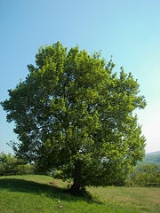
Aceraceae

Encyclopedia
Aceraceae is a family of flowering plant
s also called the Maple Family. It contains two to four genera, depending upon the circumscription, of some 120 species
of tree
s and shrub
s. A common characteristic is that the leaves are opposite
, and the fruit a schizocarp
.
The maples have long been known to be closely related to the family Sapindaceae
. Several taxonomists
(including the Angiosperm Phylogeny Group
) now include both the Aceraceae and the Hippocastanaceae
in the Sapindaceae. Recent research (Harrington et al. 2005) has shown that while both Aceraceae and Hippocastanaceae are monophyletic in themselves, their removal from Sapindaceae
sensu lato would leave Sapindaceae sensu stricto as a paraphyletic
group, particularly with reference to the genus Xanthoceras
.
Flowering plant
The flowering plants , also known as Angiospermae or Magnoliophyta, are the most diverse group of land plants. Angiosperms are seed-producing plants like the gymnosperms and can be distinguished from the gymnosperms by a series of synapomorphies...
s also called the Maple Family. It contains two to four genera, depending upon the circumscription, of some 120 species
Species
In biology, a species is one of the basic units of biological classification and a taxonomic rank. A species is often defined as a group of organisms capable of interbreeding and producing fertile offspring. While in many cases this definition is adequate, more precise or differing measures are...
of tree
Tree
A tree is a perennial woody plant. It is most often defined as a woody plant that has many secondary branches supported clear of the ground on a single main stem or trunk with clear apical dominance. A minimum height specification at maturity is cited by some authors, varying from 3 m to...
s and shrub
Shrub
A shrub or bush is distinguished from a tree by its multiple stems and shorter height, usually under 5–6 m tall. A large number of plants may become either shrubs or trees, depending on the growing conditions they experience...
s. A common characteristic is that the leaves are opposite
Phyllotaxis
In botany, phyllotaxis or phyllotaxy is the arrangement of leaves on a plant stem .- Pattern structure :...
, and the fruit a schizocarp
Schizocarp
A schizocarp is a dry fruit that develops from multiple carpels. When mature it splits up into mericarps. Mericarps are often 1-seeded as in, for example, Malva, Malvastrum, and Sida...
.
The maples have long been known to be closely related to the family Sapindaceae
Sapindaceae
Sapindaceae, also known as the soapberry family, is a family of flowering plants in the order Sapindales. There are about 140-150 genera with 1400-2000 species, including maple, horse chestnut and lychee....
. Several taxonomists
Taxonomy
Taxonomy is the science of identifying and naming species, and arranging them into a classification. The field of taxonomy, sometimes referred to as "biological taxonomy", revolves around the description and use of taxonomic units, known as taxa...
(including the Angiosperm Phylogeny Group
Angiosperm Phylogeny Group
The Angiosperm Phylogeny Group, or APG, refers to an informal international group of systematic botanists who came together to try to establish a consensus on the taxonomy of flowering plants that would reflect new knowledge about plant relationships discovered through phylogenetic studies., three...
) now include both the Aceraceae and the Hippocastanaceae
Hippocastanaceae
thumb|230pxHippocastanaceae is the name given to a small group of trees and shrubs, when this group is treated as a family. Its most widespread genus is Aesculus . However, the American genus Billia and the Chinese genus Handeliodendron are also sometimes included in this family...
in the Sapindaceae. Recent research (Harrington et al. 2005) has shown that while both Aceraceae and Hippocastanaceae are monophyletic in themselves, their removal from Sapindaceae
Sapindaceae
Sapindaceae, also known as the soapberry family, is a family of flowering plants in the order Sapindales. There are about 140-150 genera with 1400-2000 species, including maple, horse chestnut and lychee....
sensu lato would leave Sapindaceae sensu stricto as a paraphyletic
Paraphyly
A group of taxa is said to be paraphyletic if the group consists of all the descendants of a hypothetical closest common ancestor minus one or more monophyletic groups of descendants...
group, particularly with reference to the genus Xanthoceras
Xanthoceras
Xanthoceras sorbifolium , the sole species in the genus Xanthoceras, is a flowering plant in the family Sapindaceae, native to northern China in the provinces of Gansu, Hebei, Henan, Liaoning, Nei Monggol, Ningxia, Shaanxi, and Shandong.It is a large shrub or small tree growing to 8 m tall...
.