
All Topics  
Slow motion


   Email Print
   Bookmark   Link


Slow motion


Slow motion or slowmo is an effect in film-making whereby time
Time

Time is a component of the measurement used to sequence events, to compare the durations of events and the intervals between them, and to quantify the motions of objects....
 appears to be slowed down. It was invented by Austria
Austria

Austria , officially the Republic of Austria , is a landlocked country in Central Europe. It borders both Germany and the Czech Republic to the north, Slovakia and Hungary to the east, Slovenia and Italy to the south, and Switzerland and Liechtenstein to the west....
n August Musger. Typically this style is achieved when each film
Film

Film encompasses individual motion pictures, the field of film as an art form, and the film industry. Films are produced by recording images from the world with cameras, or by creating images using animation techniques or special effects....
 frame is captured at a rate much faster than it will be played back. When replayed at normal speed, time appears to be moving more slowly. The technical term for slow motion is overcranking which refers to the concept of cranking a handcranked camera at a faster rate than normal (i.e.


Discussion
Ask a question about 'Slow motion'
Start a new discussion about 'Slow motion'
Answer questions from other users
Full Discussion Forum


Recent Posts


Encyclopedia


Slow motion or slowmo is an effect in film-making whereby time
Time

Time is a component of the measurement used to sequence events, to compare the durations of events and the intervals between them, and to quantify the motions of objects....
 appears to be slowed down. It was invented by Austria
Austria

Austria , officially the Republic of Austria , is a landlocked country in Central Europe. It borders both Germany and the Czech Republic to the north, Slovakia and Hungary to the east, Slovenia and Italy to the south, and Switzerland and Liechtenstein to the west....
n August Musger. Typically this style is achieved when each film
Film

Film encompasses individual motion pictures, the field of film as an art form, and the film industry. Films are produced by recording images from the world with cameras, or by creating images using animation techniques or special effects....
 frame is captured at a rate much faster than it will be played back. When replayed at normal speed, time appears to be moving more slowly. The technical term for slow motion is overcranking which refers to the concept of cranking a handcranked camera at a faster rate than normal (i.e. faster than 24 frames per second). Slow motion can also be achieved by playing normally recorded footage at a slower speed. This technique is more often applied to video subjected to instant replay
Instant replay

Instant replay is a technology that allows broadcast of a previously occuring event using recorded video. This is most commonly used in sports; by on television to replay previous plays for the viewer, often from other angles than shown in the main broadcast, and also on video screens at live events....
, than to film. High-speed photography is a more sophisticated technique that uses specialized equipment to record fast phenomena, usually for scientific applications.

Slow motion is ubiquitous in modern filmmaking. It is used by diverse directors to achieve diverse effects. Some classic subjects of slow motion include:

  • Athletic activities of all kinds, to demonstrate skill and style.
  • To recapture a key moment in an athletic game, typically shown as a replay
    Replay

    Replay can refer to:*Replay , a replayed match in between two sport teams to decide in case of tie or conflict resulting from scoring, officiating, fouling or other factors...
    .
  • Natural phenomena, such as a drop of water hitting a glass.


Slow motion can also be used for artistic effect, to create a romantic or suspenseful aura or to stress a moment in time. Vsevolod Pudovkin
Vsevolod Pudovkin

Vsevolod Illarionovich Pudovkin was a Russia film director, screenwriter and actor who developed influential theories of Soviet montage theory....
, for instance, used slow motion in a suicide scene in The Deserter, in which a man jumping into a river seems sucked down by the slowly splashing waves. Another example is Face/Off
Face/Off

Face/Off is an Academy Award-nominated 1997 in film action film directed by John Woo, starring John Travolta and Nicolas Cage. The two both play an Federal Bureau of Investigation agent and a terrorist, sworn enemies who assume the physical appearance of the other....
, in which John Woo
John Woo

John Woo Yu-Sen is a critically acclaimed international China film director and film producer. Recognized for his stylized films of highly choreographed action sequences, Mexican standoffs, and use of slow-motion, Mr....
 used the same technique in the movements of a flock of flying pigeons. The Matrix
The Matrix

The Matrix is a science fiction film-action film written and directed by Wachowski brothers and starring Keanu Reeves, Laurence Fishburne, Carrie-Anne Moss, Joe Pantoliano, and Hugo Weaving....
 made a distinct success in applying the effect into action scenes through the use of multiple cameras, as well as mixing slow-motion with live action in other scenes. Japanese director
Film director

A film director, or filmmaker, is a person who directs the making of a film. A film director visualizes the Screenplay, controlling a film's artistic and dramatic aspects, while guiding the technical crew and actors in the fulfillment of his or her vision....
 Akira Kurosawa
Akira Kurosawa

was a prominent Japanese people filmmaker, film producer, screenwriter and film editing. His first credited film as director, , was released in 1943, his last as director, , in 1993....
 was a pioneer using this technique in his 1954 movie Seven Samurai. American director
Film director

A film director, or filmmaker, is a person who directs the making of a film. A film director visualizes the Screenplay, controlling a film's artistic and dramatic aspects, while guiding the technical crew and actors in the fulfillment of his or her vision....
 Sam Peckinpah
Sam Peckinpah

David Samuel "Sam" Peckinpah was an United States film director who achieved iconic status following the release of his 1969 Western epic The Wild Bunch....
 was another classic lover of the use of slow motion. The technique is especially associated with explosion
Explosion

An explosion is a sudden increase in volume and release of energy in an extreme manner, usually with the generation of high temperatures and the release of gases....
 effect shots and underwater footage.

The opposite of slow motion is fast motion. Cinematographer
Cinematographer

A cinematographer is one photography with a motion picture camera . The title is generally equivalent to director of photography , used to designate a chief over the camera and lighting film crews working on a film, responsible for achieving artistic and technical decisions related to the image....
s refer to fast motion as undercranking since it was originally achieved by cranking a handcranked camera slower than normal. It is often used for comic effect, time lapse
Time Lapse

Time Lapse is the tenth solo album by guitarist Steve Hackett, and his first live album. The album is drawn from live performances at the Savoy Theater in New York City and at Central TV Studios in Nottingham....
 or occasional stylistic effect.

The concept of slow motion may have existed before the invention of the motion picture: the Japan
Japan

Japan is an island country in East Asia. Located in the Pacific Ocean, it lies to the east of the Sea of Japan, People's Republic of China, North Korea, South Korea and Russia, stretching from the Sea of Okhotsk in the north to the East China Sea and Taiwan in the south....
ese theatrical form Noh
Noh

, or is a major form of classic Japanese musical drama that has been performed since the 14th century. Together with the closely-related Kyogen farce, it evolved from various popular, folk and aristocratic art forms, including Dengaku, Shirabyoshi, and Gagaku....
 employs very slow movements.

How slow motion works


There are two ways in which slow motion can be achieved in modern cinematography. Both involve a camera and a projector. A projector refers to a classical film projector in a movie theatre, but the same basic rules apply to a television screen and any other device that displays consecutive images at a constant frame rate.

Overcranking

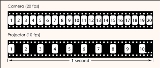
Overcrankingtimeline
Overcranking is a technique that achieves slow motion by photographing images at a faster rate than they will be projected. Normally great care is taken to ensure that the camera will record sequential images at the same rate that they will eventually be projected. When a faster camera speed is selected, the projection rate remains the same. The result is that photographed movement will appear to be slowed down. The change in speed of the onscreen image can be calculated by simply dividing the projection speed by the camera speed.

Most video cameras do not allow the operator to select a frame speed faster than the projection speed. For this reason, overcranking is sometimes referred to as film slow motion because it is most often achieved with film cameras. Digital overcranking is currently rare.

Time stretching

Digitalslowmotiontimeline
The second type of slow motion is achieved during post production. This is known as time-stretching or digital slow motion. This type of slow motion is achieved by inserting new frames in between frames that have actually been photographed. The effect is similar to overcranking as the actual motion occurs over a longer time.

Since the necessary frames were never photographed, new frames must be fabricated. Sometimes the new frames are simply repeats of the proceeding frames but more often they are created by interpolating between frames. (Often this interpolation
Interpolation

In the mathematics subfield of numerical analysis, interpolation is a method of constructing new data points within the range of a discrete set of known data points....
 is effectively a short dissolve
Dissolve (film)

In film editing, a dissolve is a gradual transition from one image to another. In film, this effect is created by controlled double exposure from frame to frame; transiting from the end of one clip to the beginning of another....
 between still frames). Many complicated algorithms exist that can track motion between frames and generate intermediate frames that appear natural and smooth. However it is understood that these methods can never achieve the clarity or smoothness of its overcranking counterpart.

Traditionally, frames were duplicated on an optical printer
Optical printer

An optical printer is a device consisting of one or more film projectors machine linked to a movie camera. It allows filmmakers to re-photograph one or more strips of film....
. True frame interpolation can only be done digitally.

Simple replication of the same frame twice is also sometimes called half-speed. This relatively primitive technique (as opposed to digital interpolation) is often visually detectable by the casual viewer. It was used in certain scenes in Tarzan, the Ape Man
Tarzan, the Ape Man

Tarzan, the Ape Man is a 1981 in film English language adventure film directed by John Derek. It stars Bo Derek, Richard Harris , John Phillip Law and Miles O'Keeffe....
, and critics pointed it out. Sometimes lighting limitations or editorial decisions can require it. A wide-angle shot of Roy Hobbs swinging the bat, in the climactic moments of The Natural
The Natural

The Natural is a 1952 novel about baseball written by Bernard Malamud. The book follows Roy Hobbs, a baseball prodigy whose career is sidetracked when he is shot by a crazed serial killer....
, was printed at half-speed in order to simulate slow-motion, and the closeup that immediately followed it was true overcranked slow-motion.

A VCR may have the option of slow motion playback, sometimes at various speeds; this can be applied to any normally recorded scene. It is similar to half-speed, and is not true slow-motion, but merely longer display of each frame.

In action films


Slow motion is used wildly in most action films.It's mostly used when a bullet is shot or when it hits it target to build up suspense.

In Broadcasting
Broadcasting

Broadcasting is distribution of Sound and/or video Signalling s which transmit programs to an audience. The audience may be the general public or a relatively large sub-audience, such as children or young adults....


Slow-motion is worldly used in sport broacasting. In instant replays, slow motion reviews are now commonly used to show in detail some action (photo finish
Photo finish

A photo finish occurs in a sporting Racing, when two competitors cross the finishing line at near the same time. As the naked eye may not be able to discriminate between which of the competitors crossed the line first, a strip photo, a series of rapidly triggered photographs, or a video taken at the finish line may be used for a more accura...
, Football (soccer) goal
Football pitch

A football pitch is the playing surface for the game of association football made of turf. Its dimensions and markings are defined by Law 1 of the Laws of the Game, "The Field of Play"....
, ...). Generally, they are made with video servers
Video server

A video server is a computer based device dedicated to delivering video online.Unlike PCs or Macs, both being multi-application devices, a video server is designed for one purpose; provisioning video, often for broadcasters....
 and special controllers.

See also

  • Motion picture terminology
    Motion picture terminology

    The film industry is built upon a large number of technologies and techniques, drawing upon photography, stagecraft, music, and many other disciplines....
  • High speed camera
    High speed camera

    A high speed camera is a device used for recording Slow motion playback films, or used for scientific study of transient phenomena.A normal Film is filmed and played back at 24 frames per second, while television uses 25 frame/s or 29.97 frame/s ....
  • Time-lapse
    Time-lapse

    Time-lapse photography is a cinematography technique whereby each film frame is captured at a rate much slower than it will be played back. When replayed at normal speed, time appears to be moving faster and thus lapsing....
  • Bullet time
    Bullet time

    Bullet Time refers to a digitally enhanced simulation of variable speed photography used in films, broadcast advertisements and personal computer games....
  • video server
    Video server

    A video server is a computer based device dedicated to delivering video online.Unlike PCs or Macs, both being multi-application devices, a video server is designed for one purpose; provisioning video, often for broadcasters....
  • Multicam(LSM)
    Multicam(LSM)

    The Multicam is a software developed by the Belgian company EVS Broadcast Equipment. Combined with its remote controller, it allows to control the Xt video server and offers high reactive live editing solutions like instant replays and slow-motion....

External links