
Home      Discussion      Topics      Dictionary      Almanac
Signup       Login
Air gun

Air gun

Overview
An air gun is a rifle
Rifle
A rifle is a firearm designed to be fired from the shoulder, with a barrel that has a helical groove or pattern of grooves cut into the barrel walls. The raised areas of the rifling are called "lands," which make contact with the projectile , imparting spin around an axis corresponding to the...

 (air rifle), pistol
Pistol
When distinguished as a subset of handguns, a pistol is a handgun with a chamber that is integral with the barrel, as opposed to a revolver, wherein the chamber is separate from the barrel as a revolving cylinder. Typically, pistols have an effective range of about 100 feet.-History:The pistol...

 (air pistol), or shotgun
Shotgun
A shotgun is a firearm that is usually designed to be fired from the shoulder, which uses the energy of a fixed shell to fire a number of small spherical pellets called shot, or a solid projectile called a slug...

 that fires projectile
Projectile
A projectile is any object projected into space by the exertion of a force. Although a thrown baseball is technically a projectile too, the term more commonly refers to a weapon....

s by means of compressed air
Pneumatics
Pneumatics is a branch of technology, which deals with the study and application of use of pressurized gas to effect mechanical motion.Pneumatic systems are extensively used in industry, where factories are commonly plumbed with compressed air or compressed inert gases...

 or other gas
Gas
Gas is one of the three classical states of matter . Near absolute zero, a substance exists as a solid. As heat is added to this substance it melts into a liquid at its melting point , boils into a gas at its boiling point, and if heated high enough would enter a plasma state in which the electrons...

, in contrast to a firearm
Firearm
A firearm is a weapon that launches one, or many, projectile at high velocity through confined burning of a propellant. This subsonic burning process is technically known as deflagration, as opposed to supersonic combustion known as a detonation. In older firearms, the propellant was typically...

, which burns a propellant. Most air guns use metallic projectiles as ammunition. Air guns that only use plastic projectiles are classified as airsoft guns.
Discussion
Ask a question about 'Air gun'
Start a new discussion about 'Air gun'
Answer questions from other users
Full Discussion Forum
 
Unanswered Questions
Encyclopedia
An air gun is a rifle
Rifle
A rifle is a firearm designed to be fired from the shoulder, with a barrel that has a helical groove or pattern of grooves cut into the barrel walls. The raised areas of the rifling are called "lands," which make contact with the projectile , imparting spin around an axis corresponding to the...

 (air rifle), pistol
Pistol
When distinguished as a subset of handguns, a pistol is a handgun with a chamber that is integral with the barrel, as opposed to a revolver, wherein the chamber is separate from the barrel as a revolving cylinder. Typically, pistols have an effective range of about 100 feet.-History:The pistol...

 (air pistol), or shotgun
Shotgun
A shotgun is a firearm that is usually designed to be fired from the shoulder, which uses the energy of a fixed shell to fire a number of small spherical pellets called shot, or a solid projectile called a slug...

 that fires projectile
Projectile
A projectile is any object projected into space by the exertion of a force. Although a thrown baseball is technically a projectile too, the term more commonly refers to a weapon....

s by means of compressed air
Pneumatics
Pneumatics is a branch of technology, which deals with the study and application of use of pressurized gas to effect mechanical motion.Pneumatic systems are extensively used in industry, where factories are commonly plumbed with compressed air or compressed inert gases...

 or other gas
Gas
Gas is one of the three classical states of matter . Near absolute zero, a substance exists as a solid. As heat is added to this substance it melts into a liquid at its melting point , boils into a gas at its boiling point, and if heated high enough would enter a plasma state in which the electrons...

, in contrast to a firearm
Firearm
A firearm is a weapon that launches one, or many, projectile at high velocity through confined burning of a propellant. This subsonic burning process is technically known as deflagration, as opposed to supersonic combustion known as a detonation. In older firearms, the propellant was typically...

, which burns a propellant. Most air guns use metallic projectiles as ammunition. Air guns that only use plastic projectiles are classified as airsoft guns.

History


Air guns represent the oldest pneumatic
Pneumatics
Pneumatics is a branch of technology, which deals with the study and application of use of pressurized gas to effect mechanical motion.Pneumatic systems are extensively used in industry, where factories are commonly plumbed with compressed air or compressed inert gases...

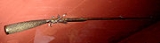
 technology. The oldest existing mechanical air gun, a bellows air gun dating back to about 1580, is in the Livrustkammaren
Livrustkammaren
The is a museum in the Royal Palace in Stockholm, Sweden. It contains many artefacts of Swedish military history and Swedish royalty. Seen from an international perspective, the Royal Armoury's collections are of world-class...

 Museum in Stockholm. This is the timeline most historians peg as the beginning of the modern air gun.

In the 17th century, air guns, in caliber
Caliber
In guns including firearms, caliber or calibre is the approximate internal diameter of the barrel in relation to the diameter of the projectile used in it....

s .30–.51, were used to hunt big game deer and wild boar. These air rifles were charged using a pump to fill an air reservoir and gave velocities from 650–1,000 feet per second. They were also used in warfare; the most famous example is the Girandoni Military Repeating Air rifle
Girandoni Air Rifle
The Girandoni Air Rifle was an airgun designed by Bartholomäus Girandoni circa 1779. The weapon was also known as the "Windbüchse", which means "wind rifle" in German.-History and Use:...

.

At that time, they had compelling advantages over the primitive firearms of the day. For example, air guns could be fired in wet weather and rain (unlike matchlock
Matchlock
The matchlock was the first mechanism, or "lock" invented to facilitate the firing of a hand-held firearm. This design removed the need to lower by hand a lit match into the weapon's flash pan and made it possible to have both hands free to keep a firm grip on the weapon at the moment of firing,...

 musket
Musket
A musket is a muzzle-loaded, smooth bore long gun, fired from the shoulder. Muskets were designed for use by infantry. A soldier armed with a musket had the designation musketman or musketeer....

s) and with greater rapidity than muzzle-loading
Muzzleloader
A muzzleloader is any firearm into which the projectile and usually the propellant charge is loaded from the muzzle of the gun . This is distinct from the more popular modern designs of breech-loading firearms...

 guns. Moreover, they were quieter than a firearm of similar caliber, had no muzzle flash, and were completely smokeless, thus not disclosing the shooter's position or obscuring his view. Black powder muskets of the 18th and 19th century produced huge volumes of dense smoke when fired, a disadvantage compared to air rifles.

Although some enthusiasts suggest air guns posed a serious alternative to powder weapons, that was never proved to be the case, as valve leaks and bursting reservoirs were known problems. Air guns also were delicate, and peasant-soldiers, many of whom had never seen any mechanical tools more complex than horse-drawn carriages, could not have operated or maintained them properly. Later improvements in valve designs and reservoir strength either came too late or were too complex for the few air gunsmiths of the day.

But in the hands of skilled soldiers, they gave the military a distinct advantage. France, Austria
Austria
Austria , officially the Republic of Austria , is a landlocked country of roughly 8.4 million people in Central Europe. It is bordered by the Czech Republic and Germany to the north, Slovakia and Hungary to the east, Slovenia and Italy to the south, and Switzerland and Liechtenstein to the...

, Japan
Japan
Japan is an island nation in East Asia. Located in the Pacific Ocean, it lies to the east of the Sea of Japan, China, North Korea, South Korea and Russia, stretching from the Sea of Okhotsk in the north to the East China Sea and Taiwan in the south...

 and other nations had special sniper
Sniper
A sniper is a marksman who shoots targets from concealed positions or distances exceeding the capabilities of regular personnel. Snipers typically have specialized training and distinct high-precision rifles....

 detachments using air rifles. The Austrian 1780 model was named Windbüchse (literally "wind rifle" in German). The gun was developed in 1778 or 1779 by the Tyrolese watchmaker, mechanic and gunsmith Bartholomäus Girandoni (1744–1799) and is sometimes referred to as the Girandoni Air Rifle
Girandoni Air Rifle
The Girandoni Air Rifle was an airgun designed by Bartholomäus Girandoni circa 1779. The weapon was also known as the "Windbüchse", which means "wind rifle" in German.-History and Use:...

 or Girandoni air gun in literature (the name is also spelled "Girandony," "Giradoni" or "Girardoni".) The Windbüchse was about 4 ft (1.2 m) long and weighed 10 pounds (4.5 kg), which was about the same size and mass as a conventional musket. The air reservoir was a removable, club-shaped butt
Stock (firearm)
A stock, also known as a buttstock or shoulder stock, is a part of a rifle or other firearm, to which the barrel and firing mechanism are attached, that is held against one's shoulder when firing the gun. Stocks are also found on crossbows though a crossbow stock is more properly referred to as a...

. The Windbüchse carried twenty-two .51 in (13 mm) lead balls in a tubular magazine. A skilled shooter could fire off one magazine in about thirty seconds, which was a fearsome rate of fire compared to a muzzle loader. A shot from this air gun could penetrate a one-inch wooden board at a hundred paces, an effect roughly equal to that of a modern 9 mm or .45 ACP
.45 ACP
The .45 ACP , also known as the .45 Auto by C.I.P., is a cartridge designed by John Browning in 1904, for use in his prototype Colt semi-automatic .45 pistol and eventually the M1911 pistol adopted by the United States Army in 1911.-Design and history:The U.S...

 caliber pistol.


Around 1820, the Japanese inventor Kunitomo Ikkansai
Kunitomo Ikkansai
was a Japanese gun manufacturer of the early 19th century, who, after having spent several months in Edo where he could get accustomed with Dutch wares, built Japan's first reflective telescope in 1831. It was of the Gregorian type....

 developed various manufacturing methods for guns, and also created an air gun based on the study of Western knowledge ("rangaku
Rangaku
Rangaku is a body of knowledge developed by Japan through its contacts with the Dutch enclave of Dejima, which allowed Japan to keep abreast of Western technology and medicine in the period when the country was closed to foreigners, 1641–1853, because of the Tokugawa shogunate’s policy of national...

") acquired from the Dutch
Netherlands
The Netherlands is a constituent country of the Kingdom of the Netherlands, located mainly in North-West Europe and with several islands in the Caribbean. Mainland Netherlands borders the North Sea to the north and west, Belgium to the south, and Germany to the east, and shares maritime borders...

 in Dejima
Dejima
was a small fan-shaped artificial island built in the bay of Nagasaki in 1634. This island, which was formed by digging a canal through a small peninsula, remained as the single place of direct trade and exchange between Japan and the outside world during the Edo period. Dejima was built to...

.

Air guns appear throughout other periods of history. The celebrated Lewis and Clark Expedition
Lewis and Clark Expedition
The Lewis and Clark Expedition, or ″Corps of Discovery Expedition" was the first transcontinental expedition to the Pacific Coast by the United States. Commissioned by President Thomas Jefferson and led by two Virginia-born veterans of Indian wars in the Ohio Valley, Meriwether Lewis and William...

 (1804) carried a reservoir air gun, later believed to be the Girandoni Military Repeating Air rifle
Girandoni Air Rifle
The Girandoni Air Rifle was an airgun designed by Bartholomäus Girandoni circa 1779. The weapon was also known as the "Windbüchse", which means "wind rifle" in German.-History and Use:...

 in Dr Robert Beeman's Collection. It held 22 .46 calibre round balls in a tubular magazine mounted on the side of the barrel
Gun barrel
A gun barrel is the tube, usually metal, through which a controlled explosion or rapid expansion of gases are released in order to propel a projectile out of the end at a high velocity....

. The butt stock served as the air reservoir and had a working pressure of 800 PSI. The rifle was said to be capable of 22 aimed shots in 1 minute. That air rifle is measured to have a rifled bore of .452" and a groove diameter 0.462".

During the 1890s, air rifles were used in Birmingham
Birmingham
Birmingham is a city and metropolitan borough in the West Midlands of England. It is the most populous British city outside the capital London, with a population of 1,036,900 , and lies at the heart of the West Midlands conurbation, the second most populous urban area in the United Kingdom with a...

, England, for competitive target shooting
Shooting sports
A shooting sport is a competitive sport involving tests of proficiency using various types of guns such as firearms and airguns . Hunting is also a shooting sport, and indeed shooting live pigeons was an Olympic event...

. Matches were held in public house
Public house
A public house, informally known as a pub, is a drinking establishment fundamental to the culture of Britain, Ireland, Australia and New Zealand. There are approximately 53,500 public houses in the United Kingdom. This number has been declining every year, so that nearly half of the smaller...

s, which sponsored shooting teams. Prizes, such as a leg of mutton for the winning team, were paid for by the losing team. The sport became so popular that in 1899, the National Smallbore Rifle Association
National Smallbore Rifle Association
The National Smallbore Rifle Association, The NSRA, is the national governing body for all Small-bore Rifle and Pistol Target Shooting in the United Kingdom, including Airgun and Match Crossbow Shooting....

 was created. During this time over 4,000 air rifle clubs and associations existed across Great Britain
Great Britain
Great Britain or Britain is an island situated to the northwest of Continental Europe. It is the ninth largest island in the world, and the largest European island, as well as the largest of the British Isles...

, many of them in Birmingham. During this time, the air gun was associated with poaching
Poaching
Poaching is the illegal taking of wild plants or animals contrary to local and international conservation and wildlife management laws. Violations of hunting laws and regulations are normally punishable by law and, collectively, such violations are known as poaching.It may be illegal and in...

 because it could deliver a shot without a significant report.

Today's modern air guns are typically low-powered because of safety concerns and legal restrictions. High-powered designs are still used for hunting
Hunting
Hunting is the practice of pursuing any living thing, usually wildlife, for food, recreation, or trade. In present-day use, the term refers to lawful hunting, as distinguished from poaching, which is the killing, trapping or capture of the hunted species contrary to applicable law...

. These air rifles can propel a pellet beyond 1100 ft/s (330 m/s), approximately the speed of sound
Speed of sound
The speed of sound is the distance travelled during a unit of time by a sound wave propagating through an elastic medium. In dry air at , the speed of sound is . This is , or about one kilometer in three seconds or approximately one mile in five seconds....

, and produce a noise similar to a .22 caliber rimfire rifle
.22 Long Rifle
The .22 Long Rifle rimfire cartridge is a long established variety of ammunition, and in terms of units sold is still by far the most common in the world today. The cartridge is often referred to simply as .22 LR and various rifles, pistols, revolvers, and even some smoothbore shotguns have...

. Using lead pellets, some current spring powered .177 pellet guns can break the sound barrier. Most low-powered air guns can be safely fired in a backyard or garden, and even indoors, with a proper backstop.

In some countries, air guns are still classified as firearms, and as such it may be illegal to discharge them in residential areas. Air guns can be highly accurate and are used in target shooting events
ISSF shooting events
The International Shooting Sport Federation recognizes several shooting events, some of which have Olympic status. They are divided into four disciplines: rifle, pistol, shotgun and running target....

 at the Olympic Games
Olympic Games
The Olympic Games is a major international event featuring summer and winter sports, in which thousands of athletes participate in a variety of competitions. The Olympic Games have come to be regarded as the world’s foremost sports competition where more than 200 nations participate...

, governed by the International Shooting Sport Federation
International Shooting Sport Federation
The International Shooting Sport Federation is an organization that governs international shooting sports. While far from the only such organization, it is the one that is a member of the International Olympic Committee and so it is in charge of the Olympic shooting events. Not all ISSF shooting...

 (ISSF), where they are shot at a range of 10 metres.

Use


Air guns are used for hunting
Hunting
Hunting is the practice of pursuing any living thing, usually wildlife, for food, recreation, or trade. In present-day use, the term refers to lawful hunting, as distinguished from poaching, which is the killing, trapping or capture of the hunted species contrary to applicable law...

, pest control
Pest control
Pest control refers to the regulation or management of a species defined as a pest, usually because it is perceived to be detrimental to a person's health, the ecology or the economy.-History:...

, recreational shooting
Shooting
Shooting is the act or process of firing rifles, shotguns or other projectile weapons such as bows or crossbows. Even the firing of artillery, rockets and missiles can be called shooting. A person who specializes in shooting is a marksman...

 (commonly known as plinking
Plinking
Plinking refers to informal target shooting done at non-traditional targets such as tin cans, glass bottles, and balloons filled with water. The term is an onomatopoeia of the sound a bullet or other projectile makes when hitting a tin can, or other similar target, referring to the sharp, metallic...

), and competitive sports, such as the Olympic
Shooting at the Summer Olympics
Shooting sports have been contested at every Summer Olympic Games since the birth of the modern Olympic movement at the 1896 Summer Olympics except at the 1904 & 1928 editions.-Men's:...

 10 m Air Rifle
10 m Air Rifle
10 metre air rifle is an International Shooting Sports Federation shooting event, shot over a distance of 10 metres from a standing position with a 4.5 mm calibre air rifle with a maximum weight of 5.5 kg...

 and 10 m Air Pistol
10 m Air Pistol
10 metre air pistol is an Olympic shooting event governed by the International Shooting Sport Federation . It is similar to 10 metre air rifle in that it is shot with 4.5 mm caliber air guns at a distance of 10 metres , and the programme consists of 60 shots within 105 minutes...

 events. Field Target
Field Target
Field Target is an outdoor air gun discipline originating in the United Kingdom, in the early 1980s, but gaining popularity worldwide.-UK Rules:...

 (FT) is a competitive form of target shooting in which the targets are knock-down metal silhouettes of animals, with a 'kill zone' cut out of the steel plate. Hunter Field Target
Hunter Field Target
Hunter field target is a target shooting sport derived from the air gun disciplines of field target shooting and hunting. Primarily an outdoor sport, shot with UK legal air rifles , a typical HFT course is made up of 30 lanes, with each lane consisting of a peg and a metal "knock down" target...

 (HFT) is a variation, using identical equipment, but with differing rules. The distances FT and HFT competitions are shot at range between 10 metres and 50 metres, with varying sizes of 'reducers' being used to increase or decrease the size of the kill zone. In the UK, competition power limits are set at the legal maximum for an unlicensed air rifle, i.e. 12 ft·lbf.

Legal issues


The legal definition of an air gun differs from country to country. There may be minimum ages for possession and sales of both air guns and ammunition may be restricted. Some areas may require permits and background checks similar to those required for firearms possession.

Air gun power sources


There are different methods of powering an air gun. These methods can be broadly divided into 3 groups: spring-piston, pneumatic, and CO2. These methods are used in both air rifles and air pistols.

Spring-piston


Spring-piston air guns are able to achieve muzzle velocities near or greater than the speed of sound
Speed of sound
The speed of sound is the distance travelled during a unit of time by a sound wave propagating through an elastic medium. In dry air at , the speed of sound is . This is , or about one kilometer in three seconds or approximately one mile in five seconds....

 from a single stroke of a cocking lever or the barrel itself. The difficulty of the cocking stroke is usually related to the power of the gun, with higher muzzle velocities requiring greater effort.

Spring-piston guns operate by means of a coiled steel spring
Spring (device)
A spring is an elastic object used to store mechanical energy. Springs are usually made out of spring steel. Small springs can be wound from pre-hardened stock, while larger ones are made from annealed steel and hardened after fabrication...

-loaded piston
Piston
A piston is a component of reciprocating engines, reciprocating pumps, gas compressors and pneumatic cylinders, among other similar mechanisms. It is the moving component that is contained by a cylinder and is made gas-tight by piston rings. In an engine, its purpose is to transfer force from...

 contained within a compression chamber, and separate from the barrel. Cocking the gun causes the piston assembly to compress the spring until a small hook on the rear of the piston engages the sear
Sear (firearm)
In a firearm, the sear is the part of the trigger mechanism which holds the hammer or striker back until the correct amount of pressure has been applied to the trigger; at which point the hammer or striker is released to discharge the weapon...

; pulling the trigger releases the sear and allows the spring to decompress, pushing the piston forward, thereby compressing the air in the chamber directly behind the pellet. Once the air pressure has risen enough to overcome any static friction and/or barrel restriction holding the pellet, the pellet moves forward, propelled by an expanding column of air. All this takes place in a fraction of a second, during which the air undergoes adiabatic heating to several hundred degrees and then cools as the air expands.

Spring-piston guns have a practical upper limit of 1250 ft/s (380 m/s) for .177 cal (4.5 mm) pellets. Higher velocities cause unstable pellet flight and loss of accuracy. This is due to the shock wave
Sonic boom
A sonic boom is the sound associated with the shock waves created by an object traveling through the air faster than the speed of sound. Sonic booms generate enormous amounts of sound energy, sounding much like an explosion...

 generated as the super sonic pellet contacts the air. Shortly after leaving the barrel, the pellet falls below the speed of sound and the shock wave overtakes the pellet, causing it to tumble. Drag increases rapidly as pellets are pushed past the speed of sound, so it is generally better to increase pellet weight to keep velocities subsonic in high-powered guns. Sonic crack from the pellet as it moves with supersonic speed also makes the shot louder sometimes making it possible to be mistaken for firearm discharge and drawing unwanted attention. Many shooters have found that velocities in the 800–900 ft/s (274.3 m/s) range offer an ideal balance between power and pellet stability.

Most spring piston guns are single-shot breech-loaders by nature, but multiple-shot guns have become more common in recent years. Spring guns are typically cocked by a mechanism requiring the gun to be hinged at the mid-point (called a break barrel), with the barrel serving as a cocking lever. Other systems that are used include side levers, under-barrel levers, and motorized cocking, powered by a rechargeable battery.

Spring guns, especially high-powered ones, have significant recoil resulting from the forward motion of the piston. Although this recoil is less than that of a cartridge firearm, it can make the gun difficult to shoot accurately as the recoil forces are well under way while the pellet is still traveling down the barrel. Most guns seem to respond well to a light, repeatable grip that allows the gun to vibrate the same way from shot to shot. This method is commonly referred to as the "artillery hold", in reference to the way large military artillery pieces like the M777 howitzer
M777 howitzer
The M777 howitzer is a towed 155 mm artillery piece, successor to the M198 howitzer in the United States Marine Corps and United States Army. The M777 is also used by the Canadian Army, and has been in action in Afghanistan since February 2006 along with the associated GPS-guided Excalibur...

 often recoil. Spring gun recoil also has a sharp forward component, caused by the piston as it hits the forward end of the chamber when the spring behind it reaches full expansion. This sudden forward acceleration helps to counteract the recoil, since the recoil and "forward recoil" forces happen within milliseconds of each other, but it is infamous for the loosening or breaking of lenses and reticles found in low- and medium-priced telescopic sight
Telescopic sight
A telescopic sight, commonly called a scope, is a sighting device that is based on an optical refracting telescope. They are equipped with some form of graphic image pattern mounted in an optically appropriate position in their optical system to give an accurate aiming point...

s. All mounted telescopic sights for air guns should be rated as such.

Spring guns can also suffer from spring vibrations that reduce accuracy. These vibrations can be controlled by adding features like close-fitting spring guides or by aftermarket tuning done by "air-gunsmiths" who specialize in air gun modifications. A common modification is the addition of viscous silicone grease to the spring, which both lubricates it and dampens vibration.

The better quality spring air guns can have very long service lives, being simple to maintain and repair. Because they deliver the same energy on each shot, their trajectory is consistent. Most Olympic
Olympic Games
The Olympic Games is a major international event featuring summer and winter sports, in which thousands of athletes participate in a variety of competitions. The Olympic Games have come to be regarded as the world’s foremost sports competition where more than 200 nations participate...

 air gun matches through the 1970s and into the 1980s were shot with spring-piston guns, often of the opposing-piston recoil-eliminating type. Beginning in the 1980s, guns powered by compressed, liquefied carbon dioxide began to dominate competition. Today, the guns used at the highest levels of competition are powered by compressed air stored at very high pressures of 2000 to 3000 lb/in² (14 to 21 MPa).

Gas Spring


Some makes of air rifle (e.g. Weihrauch, Theoben) incorporate a gas spring in some models instead of a mechanical spring. Pressurized air or nitrogen is held in a chamber built into the piston, and this air is further pressurized when the gun is cocked. It is, in effect, a gas spring
Gas spring
A gas spring is a type of spring that, unlike a typical metal spring, uses a compressed gas, contained in a cylinder and compressed by a piston, to exert a force. Gas springs are used in automobiles, where they are incorporated into the design of struts that support the weight of hatchback doors...

 commonly referred to as a "gas ram" or "gas strut". Gas spring units require higher precision to build, since they require a low friction sliding seal that can withstand the high pressures when cocked. Gas spring units are available as an upgrade for some popular models such as the Weirauch HW80, the Crosman 766C American Classic air rifle and the Arowsmith 876 Magnum rifle. The advantages of the gas spring include the facility to keep the rifle cocked and ready to fire for long periods of time without harming the mechanism. Also, since there is no spring (and therefore a reduction in moving mass during firing) there is less (although some say slightly sharper), recoil. There is also an elimination of the associated problems of long-term spring fatigue and a faster "lock time" (the time between pulling the trigger and the pellet being discharged). The improvement in lock time makes for better accuracy since there is less time for the gun to move off target. Finally, gas springs are practically maintenance free and last longer than conventional metal springs (research test ch1208); they are an order of magnitude more expensive when they do need replacement.

Pneumatic


Pneumatic air guns utilize pre-compressed air as the source of energy to propel the projectile. Single-stroke and multi-stroke guns utilize an on board pump to pressurize the air in their reservoir, Pre-charged Pneumatic guns' reservoirs are filled using either a high-pressure hand pump (often capable of attaining pressures of 30 MPa) or by decanting the necessary volume/pressure of air from a diving cylinder. Because of this design, having no significant movement of heavy mechanical parts during the firing cycle, the recoil produced is only the "true" recoil, equivalent to the equal and opposite reaction to the pellet and air volume's acceleration up the bore.

Multi-stroke


Multi-Stroke pneumatic air guns require 2–10 pumps of an on-board lever to store compressed air within the air gun. Variable power can be achieved through this process, as the user can adapt the power level for long, or short-range shooting. The design of higher quality and match-grade multi-stroke air rifles can propel a pellet to speeds in excess of 1000 feet per second (304.8 m/s).

For beginners and intermediates, multi-stroke air rifles have been a cost-effective choice as they are generally the cheapest form of air gun available. Several manufacturers make multi-stroke air guns including, to name a few, Sheridan, Benjamin, Daisy
Daisy Outdoor Products
Daisy is a company that makes and sells inexpensive BB guns and other air guns.-History:Daisy was started in 1882 as Plymouth Iron Windmill Company in Plymouth, Michigan. In 1886 the company started to give BB guns with purchases of windmills. The gun was so popular the company started to sell guns...

, and Crosman
Crosman
Crosman Corporation is a leading, worldwide designer, manufacturer and supplier of products for the shooting sports. The company has a long standing presence in airgun design and a proud tradition of producing high quality pellet and BB air rifles and pistols...

. Modified multi-pump guns, with stronger pump linkages and improved valves, can produce muzzle energies in excess of 30 foot-pounds (40.7 J).

Single-stroke


As the name implies, one motion of the cocking lever is all that is needed to compress the air for propulsion. The single-pump system is usually found in target rifles and pistols, where the higher muzzle energy of a multi-stroke pumping system is not required. Single-stroke pneumatic rifles dominated the national and international ISSF 10 metre air rifle shooting events
ISSF shooting events
The International Shooting Sport Federation recognizes several shooting events, some of which have Olympic status. They are divided into four disciplines: rifle, pistol, shotgun and running target....

 from the 1970s up to the 1990s.

Pre-charged pneumatic (PCP)


Pre-charged pneumatic (PCP) air guns are usually filled by decanting from an air reservoir, such as a diving cylinder
Diving cylinder
A diving cylinder, scuba tank or diving tank is a gas cylinder used to store and transport high pressure breathing gas as a component of a scuba set. It provides gas to the scuba diver through the demand valve of a diving regulator....

 or by charging directly with a hand pump. Because of the need for cylinders or charging systems, PCP guns have higher initial costs but very low operating costs compared to CO2 guns. These guns are often used for hunting purposes in countries with restrictive firearms laws. A distinction is sometimes made between true PCP guns and high pressure air (HPA) guns. The distinction being that true PCP guns are an integrated high pressure design while an HPA application is an adaptation of a high pressure, regulated air supply to function with components not designed for high pressure—e.g. CO2 guns. The RWS/Hammerli 850 is a CO2 designed gun, which is often adapted to HPA.

PCP guns have very low recoil and can fire as many as 500 shots per charge. The ready supply of air has allowed the development of semi-automatic PCP air guns. PCP guns are very popular in the UK and Europe because of their accuracy and ease of shooting. They are widely utilized in ISSF 10 metre air pistol and rifle shooting events
ISSF shooting events
The International Shooting Sport Federation recognizes several shooting events, some of which have Olympic status. They are divided into four disciplines: rifle, pistol, shotgun and running target....

 and the sport of Field Target
Field Target
Field Target is an outdoor air gun discipline originating in the United Kingdom, in the early 1980s, but gaining popularity worldwide.-UK Rules:...

 shooting, and fitted with telescopic sight
Telescopic sight
A telescopic sight, commonly called a scope, is a sighting device that is based on an optical refracting telescope. They are equipped with some form of graphic image pattern mounted in an optically appropriate position in their optical system to give an accurate aiming point...

s.

Earlier hand pumps for charging carried with them problems of fatigue (both human and mechanical), temperature warping, and condensation. None of those is beneficial to good shooting or the longevity of the rifle. Modern hand pumps have built-in air filtration systems and have overcome many of these problems. Using scuba-quality air decanted from a scuba cylinder
Diving cylinder
A diving cylinder, scuba tank or diving tank is a gas cylinder used to store and transport high pressure breathing gas as a component of a scuba set. It provides gas to the scuba diver through the demand valve of a diving regulator....

 also provides a clean, dry, high-pressure air supply that is consistent and available at low cost.

During the typical PCP's discharge cycle, the hammer of the rifle is released by the sear to strike the valve. The hammer may move rearwards or forwards, unlike firearms where the hammer almost always moves forward. Prior to being struck by the hammer, the valve is held closed by a spring and the pressure of the air in the reservoir. The pressure of the spring is constant, and the pressure of the air decreases with each successive shot. As a result, when the reservoir pressure is at its peak, the valve opens less fully and closes faster than when the reservoir pressure is lower, resulting in a similar total volume of air flowing past the valve with each shot. This results in a degree of self-regulation that gives a greater consistency of velocity from shot to shot than would otherwise be expected. A well-designed PCP will display good self-regulation properties, meaning good shot to shot consistency over a range of pressures as the air reservoir is diminished.

More expensive PCP rifles and pistols are often pressure regulated, i.e. the firing valve operates within a secondary chamber separated from the main air reservoir by the regulator body. The regulator maintains pressure within this secondary chamber at a set pressure lower than the main reservoir's. This occurs until the main reservoir's pressure is diminished to the set pressure, after which the PCP behaves in an unregulated manner. Thus shot to shot consistency is maintained for longer than in an unregulated rifle, at the expense of efficiency, shots per fill and often at a lower velocity.

CO2


Most CO2 guns (e.g. Beretta Elite II
Beretta Elite II
The Beretta Elite II is an air pistol manufactured by Umarex and distributed in the United States by Umarex USA. It has only a few similarities to the Beretta 92G Elite II, but it does have its good features. It is made of polymer, but it has a steel magazine, trigger, magazine release button, and ...

) use a disposable cylinder, a powerlet
Powerlet
A Powerlet cartridge is a small disposable metal container holding of liquid CO2 and often a small quantity of oil, used as a power source for certain air guns, paintball markers, and a few airsoft guns...

, that is purchased often pre-filled with 12 grams of pressurized carbon dioxide
Carbon dioxide
Carbon dioxide is a naturally occurring chemical compound composed of two oxygen atoms covalently bonded to a single carbon atom...

, although some, usually more expensive models, use larger refillable CO2 reservoirs like those typically used with paintball marker
Paintball marker
A paintball marker, also known as a paintball gun, is the main piece of equipment in the sport of paintball. Markers use an expanding gas, such as carbon dioxide or compressed air, to propel paintballs through the barrel. Some paintball players refer to the piece of equipment as a "marker" rather...

s.

Carbon dioxide-powered guns have two significant advantages over pre-charged pneumatic air guns:
(1.) A simpler system for compact storage of energy—a small volume of liquid converts to a large volume of pressurized gas.
(2.) No pressure regulator. Within a temperature range tolerable to humans there is little need to regulate the inherently suitable pressure for low-to-moderate-power air guns. The vapor pressure is dependent only on temperature, not tank size, as long as some liquid CO2 remains in the reservoir.

These two advantages allow CO2 guns to be constructed more simply than guns using a pressurized air reservoir. Some CO2-powered guns have detachable or fixed reservoirs that are loaded with pressurized gas from a larger cylinder. Most CO2 powered guns use the standard 12 gram Powerlet disposable cylinder invented by Crosman. Recently, the same company introduced a new 88 gram disposable AirSource cylinder that is used in some of their guns.

On the other hand, liquefied CO2 must be purchased, which introduces an element of cost that does not factor with a PCP gun/hand pump combination using "free" air, or is at least considerably lower when refilling from a diver's tank.

Furthermore, the pressure of gaseous CO2 at ordinary ambient temperatures is only around 850–1000 psi (6 to 7 MPa), which is only a third of the safe working pressure of a typical full PCP reservoir (20 MPa or 2900 psi or more). The effect of this is that generally speaking CO2 guns are lower powered and less efficient than PCP guns, which is why CO2 guns are usually pistols or semi-target type rifles, with few guns (none of commercial note) reaching even the 12 ft·lbf (16.2 joules) licence-free energy limit for air rifles imposed in the UK.

CO2 guns, like compressed air guns, offer power for repeated shots in a compact package without the need for complex cocking or filling mechanisms. The ability to store power for repeated shots also means that repeating arms are possible. There are many replica revolvers and semi-automatic pistols on the market that use CO2 power. These guns are popular for training, as the guns and ammunition are inexpensive, safe to use, and no specialized facilities are needed for safety. In addition, they can be purchased and owned in areas where firearms possession is either strictly controlled, or banned outright.

Most CO2 powered guns are relatively inexpensive, although there are still a few precision target guns on the market that use CO2.

The CO2 system has been used in experimental non-lethal law enforcement weapons, where high power delivery systems launch rubber batons or bean bags out of a gas-powered launcher, much like a non-lethal shotgun system (but at lower velocities, thus being safer).

Safety


For safety, CO2 containers must be kept at temperatures below 120 °F (49 °C) ; at temperatures above this level, the pressure begins to increase very rapidly, and can cause the container to fail. CO2 containers with diameters at or above two inches (50 mm) have a pressure release "rupture" mechanism to release the contents over a certain pressure level and avoid explosion because of high temperature. These disks are generally calibrated to a minimum pressure corresponding to the 120 °F (48.9 °C) level at 100% of the rated CO2 capacity. Elevated temperatures, even those below the critical temperature, can cause increased leaking through seals.

Operating considerations

  • Re-filling Forcing more carbon dioxide gas into a reservoir of liquid and gas CO2 while maintaining a constant temperature would not raise the pressure but merely convert the additional gas into liquid. By chilling the vessel to be filled, the lower vapor pressure will pull CO2 from the source container. While the pressure in the reservoir is generally dependent only on the temperature, if the bottle is too full, that changes. The expansion of the liquid CO2 will take up all the space in the bottle, preventing evaporation. At this point, the pressure increase with temperature becomes dangerously high.
  • Cooling Each time the gun is fired there is rapid evaporation of liquid to gas, which is an endothermic
    Endothermic
    In thermodynamics, the word endothermic describes a process or reaction in which the system absorbs energy from the surroundings in the form of heat. Its etymology stems from the prefix endo- and the Greek word thermasi,...

     process in which the pressure drops until enough ambient heat is absorbed to restore the pressure. When shooting at a rate faster than the cylinder can absorb heat from the environment to counter the cooling of the evaporating liquid, the pressure will drop, and the velocity is likely to drop as well in a non-regulated gun.

Calibers


The most common air gun caliber
Caliber
In guns including firearms, caliber or calibre is the approximate internal diameter of the barrel in relation to the diameter of the projectile used in it....

s are:
  • .177 (4.5 mm): the most common caliber, also used in ISSF shooting events
    ISSF shooting events
    The International Shooting Sport Federation recognizes several shooting events, some of which have Olympic status. They are divided into four disciplines: rifle, pistol, shotgun and running target....

     at the Olympic Games, it has the flattest trajectory of all the calibers for a given energy level, making accuracy simpler. As well as its very effective targetry use, this caliber can be effectively used to hunt small quarry or vermin.
  • .20 (5.0 mm): found in some European air guns and those manufactured by the American
    United States
    The United States of America is a federal constitutional republic comprising fifty states and a federal district...

     air gun manufacturer Sheridan. This is generally considered to be a "compromise caliber", having a flatter trajectory similar to the .177 but more energy retention. .20" pellets tend to be of a similar weight to .22" pellets, but with an elongated profile, resulting in a higher Ballistic Coefficient
    Ballistic coefficient
    In ballistics, the ballistic coefficient of a body is a measure of its ability to overcome air resistance in flight. It is inversely proportional to the negative acceleration—a high number indicates a low negative acceleration. BC is a function of mass, diameter, and drag coefficient...

     (BC) than either .177 or .22 pellets.
  • .22 (5.5 mm & 5.6 mm): the most common caliber for hunting small game, as it delivers large amounts of energy on impact (more so than the smaller calibers).
  • .25 (6.35 mm): the largest commonly available caliber. This caliber is renowned for its impact, having the most energy retention of all calibers. It does have a highly parabolic trajectory at low energy levels and is thus more suited for higher powered rifles.
  • .357 Found in new crosman PCP airguns. These are expensive as compared to others but do have slightly higher stopping power.


Custom air gun manufacturers regularly produce air rifles in common muzzle loading
Muzzleloader
A muzzleloader is any firearm into which the projectile and usually the propellant charge is loaded from the muzzle of the gun . This is distinct from the more popular modern designs of breech-loading firearms...

 calibers, such as .45 (11.43 mm), .50 (12.7 mm), .58 (14.5 mm); some recently built custom air guns are even larger, 20 mm (0.79") or .87 (22.1 mm).

Ammunition


Pellet


The most popular ammunition used in rifled air guns is the lead diabolo pellet. This waisted projectile is hollowed at the base and available in a variety of head styles. The diabolo pellet is designed to be drag stabilized, though is not as stable as some other shapes in the transonic region (272–408 m/s ~ 893–1340 ft/s). Pellets are also manufactured from tin, or a combination of materials such as steel-tipped plastic.

Most air guns are .177 (4.5 mm) or .22 (5.5 mm / 5.6 mm), and are designed for target practice, small game hunting and field target shooting. Cost per round is less than $0.02 (US) for Olympic-quality ammunition, and far less for cheaper grades. Though less common, .20 and .25 caliber
Caliber
In guns including firearms, caliber or calibre is the approximate internal diameter of the barrel in relation to the diameter of the projectile used in it....

 (5.0 mm and 6.4 mm) guns also exist and are used predominantly for hunting.

BB


The BB was once the most common air gun ammunition in the USA. A BB is a small ball, typically made of steel with a copper or zinc plating, of 4.5 mm/.177" diameter. Lead "Round Balls" are manufactured in numerous calibers too; these are often 4.5 mm/.177" diameter and designed for use in .177 caliber rifled
Rifling
Rifling is the process of making helical grooves in the barrel of a gun or firearm, which imparts a spin to a projectile around its long axis...

 guns normally used for shooting pellets. Steel BBs can be acceptably accurate at short distances when fired from properly designed BB gun
BB gun
BB guns are a type of air gun designed to shoot projectiles named BBs after the birdshot pellet of approximately the same size. These projectiles are usually spherical but can also be pointed; those are usually used for bird hunting. Modern day BB guns usually have a smoothbore barrel, with a bore...

s with smoothbore
Smoothbore
A smoothbore weapon is one which has a barrel without rifling. Smoothbores range from handheld firearms to powerful tank guns and large artillery mortars.-History of firearms and rifling:...

 barrels.

Due to the hardness of the steel, they can not "take" to rifled barrels, which is why they are undersized (4.4 against 4.5 mm) to allow them to be used in .177" rifled barrels, which when used in this configuration can in effect be considered smoothbore
Smoothbore
A smoothbore weapon is one which has a barrel without rifling. Smoothbores range from handheld firearms to powerful tank guns and large artillery mortars.-History of firearms and rifling:...

, but with a poorer gas-seal. Were they 4.5 mm diameter, they would jam in the bore. Therefore BB's lack the spin stabilization required for long-range accuracy, and usage in any but the cheapest rifled guns is discouraged.

Typically BBs are used for indoor practice, casual outdoor plinking, training children, or for air gun enthusiasts who like to practice, but cannot afford high-powered air gun systems that use pellets. Some shotgunners use sightless BB rifles to train in instinctive shooting. Similar guns were also used briefly by the United States Army in a Vietnam-era instinctive shooting program called "Quick Kill" (Time magazine, Friday, July 14, 1967).

See also

  • List of air guns
  • Air gun laws
    Air gun laws
    -Legal issues:While in some countries air guns are not subject to any specific regulation, in most there are laws - but they differ widely.Each jurisdiction has its own definition of what constitutes an air gun; secondly there are often different classes of air guns defined—based on bore,...

  • Airsoft guns
  • BB gun
    BB gun
    BB guns are a type of air gun designed to shoot projectiles named BBs after the birdshot pellet of approximately the same size. These projectiles are usually spherical but can also be pointed; those are usually used for bird hunting. Modern day BB guns usually have a smoothbore barrel, with a bore...

  • Blowgun
    Blowgun
    "Blowpipe" and "blow tube" redirect here. For other uses of the terms, see GlassblowingA blowgun is a simple weapon consisting of a small tube for firing light projectiles, or darts....

  • Field Target
    Field Target
    Field Target is an outdoor air gun discipline originating in the United Kingdom, in the early 1980s, but gaining popularity worldwide.-UK Rules:...

  • Girandoni Air Rifle
    Girandoni Air Rifle
    The Girandoni Air Rifle was an airgun designed by Bartholomäus Girandoni circa 1779. The weapon was also known as the "Windbüchse", which means "wind rifle" in German.-History and Use:...

  • Gun safety
    Gun safety
    Gun safety is a collection of rules and recommendations that can be applied when handling firearms. The purpose of gun safety is to eliminate or minimize the risks of unintentional death, injury or damage caused by improper handling of firearms....

  • Gun Quarter
  • Hunter Field Target
    Hunter Field Target
    Hunter field target is a target shooting sport derived from the air gun disciplines of field target shooting and hunting. Primarily an outdoor sport, shot with UK legal air rifles , a typical HFT course is made up of 30 lanes, with each lane consisting of a peg and a metal "knock down" target...

  • Marksmanship
  • Pellet
    Pellet (air gun)
    An air gun pellet is, for the most part, a non-spherical projectile designed to be fired from an air gun. But this is not always the case.Pellets differ from bullets used in firearms because of the pressures encountered; firearms operate at pressures of thousands of atmospheres, while airguns...


Manufacturer
  • J. G. Anschütz
  • BSA
    Birmingham Small Arms Company
    This article is not about Gamo subsidiary BSA Guns Limited of Armoury Road, Small Heath, Birmingham B11 2PP or BSA Company or its successors....

  • Česká Zbrojovka Uherský Brod
    Ceská Zbrojovka Uhersky Brod
    Česká zbrojovka a.s. Uherský Brod is a Czech firearms manufacturer.-History:CZUB was established in 1936 as a branch of the Česká zbrojovka armament firm in the small Moravian town of Uherský Brod in Czechoslovakia, now in the Czech Republic....

  • Crosman
    Crosman
    Crosman Corporation is a leading, worldwide designer, manufacturer and supplier of products for the shooting sports. The company has a long standing presence in airgun design and a proud tradition of producing high quality pellet and BB air rifles and pistols...

  • Daisy Outdoor Products
    Daisy Outdoor Products
    Daisy is a company that makes and sells inexpensive BB guns and other air guns.-History:Daisy was started in 1882 as Plymouth Iron Windmill Company in Plymouth, Michigan. In 1886 the company started to give BB guns with purchases of windmills. The gun was so popular the company started to sell guns...

  • DIANA Mayer & Grammelspacher
    DIANA Mayer & Grammelspacher
    DIANA Mayer & Grammelspacher is a German air gun manufacturer based in Rastatt. It was founded in 1890 by Jakob Mayer and Josef Grammelspacher....

  • Feinwerkbau
    Feinwerkbau
    Feinwerkbau , often abbreviated FWB, is a German manufacturer of firearms . It is aimed mainly at competitive ISSF shooting events, including some contested at the Olympic Games as governed by the International Shooting Sport Federation .The company currently offers three distinct product lines:...

  • Gamo
  • Steyr Sportwaffen GmbH
    Steyr Sportwaffen GmbH
    Steyr Sportwaffen GmbH is an Austrian manufacturer of air guns aimed mostly at competitive ISSF shooting events events such as 10 m Air Pistol and 10 m Air Rifle contested at the Olympic Games as governed by the International Shooting Sport Federation .The company was formed as an offshoot of...

  • Umarex
    Umarex
    Umarex Sportwaffen GmbH & Co. KG is a manufacturer of air guns , tear-gas and signal pistols, paintball markers under the RAM brand and airsoft guns, based in Arnsberg, Germany...

  • Walther
  • Webley & Scott
    Webley and Scott
    Webley & Scott is an arms manufacturer based in Birmingham, England. Webley produced handguns and long guns from 1834 to 1979, when the company ceased to manufacture firearms and instead focused on producing air pistols and air rifles...

  • Weihrauch
    Weihrauch
    Weihrauch & Weihrauch GmbH & Co. KG is a German manufacturer of target and sporting air rifles and air pistols. The company also manufactures a small range of cartridge rifles and pistols. In North America they are often distributed under the "Beeman" brand name...


External links