

Internal ballistics

Encyclopedia
Internal ballistics, a subfield of ballistics
, is the study of a projectile
's behavior from the time its propellant
's igniter is initiated until it exits the gun barrel
. The study of internal ballistics is important to designer
s and users of firearms of all types, from small-bore Olympic
rifle
s and pistol
s, to high-tech artillery
.
s, which were simple closed tubes. There was a small aperture, the "touchhole", drilled in the closed end of the tube, leading to the main powder charge. This hole was filled with finely ground powder, which was then ignited with a hot ember
or torch
. With the advent of hand-held firearms, this became an undesirable way of firing a gun. Holding a burning stick while trying to pour a charge of black powder carefully down a barrel is dangerous, and trying to hold the gun with one hand while simultaneously aiming at the target and looking for the touchhole makes it very difficult to fire accurately.
made of plant fibers that were soaked in a solution of nitrates, charcoal
, and sulfur
, and dried. This "slow-match" was ignited before the gun
was needed, and it would slowly burn, keeping a hot ember at the burning end. After the gun was loaded and the touchhole primed with powder, the burning tip of the match was positioned so that the lock would bring it into contact with the touchhole. To fire the gun, it was aimed and the trigger pulled. This brought the match down to the touchhole, igniting the powder. With careful attention the slow-burning match could be kept burning for long periods of time, and the use of the lock mechanism made fairly accurate fire possible.
steel
wheel
which rubbed against a piece of iron pyrite, similar to a modern lighter
. A key was used to wind the wheel and put the spring under tension. Once tensioned, the wheel was held in place by a trigger. When the trigger was pulled, the serrated edge of the steel rubbed against the pyrite, generating sparks
. These sparks were directed into a pan, called the "flash pan
", filled with loose powder which led into the touchhole. The flashpan usually was protected by a spring-loaded cover that would slide out of the way when the trigger was pulled, exposing the powder to the sparks. The wheel-lock was a major innovation
— since it did not rely on burning material as a source of heat
, it could be kept ready for extended periods of time. The covered flashpan also provided some ability to withstand bad weather. Wind, rain, and wet weather would render a matchlock useless, but a wheel-lock that was loaded and waterproofed with a bit of grease
around the flashpan could be fired under most conditions.
rather than iron pyrite. The flint was held in a spring-loaded arm, called the "cock" from the resemblance of its motion to a pecking chicken. The cock rotated through approximately a 90 degree arc, and was held in the tensioned, or "cocked" position by a trigger. Usually, flintlocks could lock the cock in two positions. The "half-cock" position held the cock halfway back, and used a deep notch
, so that pulling the trigger would not release the cock. Half-cock was a safety position, used when loading, storing or carrying a loaded flintlock. The "full-cock" position held the cock all the way back, and was the position from which the gun was fired. The L-shaped "frizzen" was the other half of the flintlock's ignition system. It served as both a flashpan cover and a steel striking surface for the flint. The frizzen was hinged and spring-loaded so that it would lock in the open or closed position. When closed, the striking surface was positioned so that the flint would strike at the proper angle to generate a spark. The striking flint would also open the frizzen
, exposing the flashpan to the spark. The flintlock mechanism was simpler and stronger than the wheel-lock, and the flint and steel provided a good, reliable source of ignition. The flintlock remained in military service for over 200 years, and flintlocks are still made today for historical re-enactments and muzzle-loading target competition, and for hunters who enjoy the additional challenge that the flintlock provides.
in 1807 but needed further refinements before it was gradually accepted in the 1820s to 1830s. By the middle of the 19th century the percussion or caplock system was well established. It was adopted by both sides in the American Civil War
, as it was simpler and more reliable than the flintlock. The main reason the caplock was so quickly adopted was its similarity to the flintlock and the ease of converting older arms to use percussion-cap ignition; usually the same lock and barrel could be used with minor changes. The flashpan and frizzen were removed and replaced by a small, hollow horizontal cylinder (drum) screwed into the bored-out and tapped flash hole and carrying a "nipple" over which the cap could be fitted. A "hammer" which also had half-cock (for loading and applying the cap) and full-cock positions replaced the cock. When released by pulling the trigger, the hammer would strike the cap, crushing it against the nipple. The percussion cap
was a thin metal cup that contained a small quantity of pressure-sensitive explosive. When crushed, the explosive would detonate, sending a stream of hot gas
down through a hole in the nipple and into the touchhole of the gun to ignite the powder charge. In the process of firing, the cap generally split open and would fall off when the hammer was moved to half-cock position for loading. The caplock system worked well, and is still the preferred method of ignition for hunters and recreational shooters who use muzzle
-loading arms.
and manufacturing
techniques all came together in the 19th century to create an entirely new class of firearm — the cartridge arm. Flintlock and caplock shooters had long carried their ammunition
in paper
cartridge
s, which served to hold a measured charge of powder and a bullet
in one convenient package; the paper also served to seal the bullet in the bore. Still, the source of ignition was handled separately from the cartridge. With the advent of chemical primers, it was not long before several systems were invented with many different ways of combining bullet, powder, and primer into a single package which could be loaded quickly from the breech
of the firearm. This greatly streamlined the reloading procedure and paved the way for semi- and fully automatic firearms.
This big leap forward came at a price. It introduced an extra component into each round – the cartridge case - which had to be removed before the gun could be reloaded. While a flintlock, for example, is immediately ready to be reloaded once it has been fired, adopting brass cartridge cases brought in the problems of extraction and ejection. The mechanism of a modern gun not only must load and fire the piece, but also must remove the spent case, which may require just as many moving parts. Probably most malfunctions
involve this process, either through failure to extract a case properly from the chamber or by allowing it to jam the action. Nineteenth-century inventors were reluctant to accept this added complication and experimented with a variety of self-consuming cartridges
before acknowledging that the advantages of brass cases far outweighed their one drawback.
The three systems of self-contained metallic cartridge ignition which have survived the test of time are the rimfire, the Berdan centerfire primer, and the Boxer centerfire primer.
case with a hollow bulge, or rim, around the back end. This rim is filled during manufacture with an impact-sensitive primer. In the wet state, the primer is stable; a pellet of wet primer is placed in the shell and simply spun out to the full extremes of the rim. (For more on the exact process and one set of chemical compounds that have been used successfully, see , a 1932 Remington Arms patent by James E. Burns.) In the dry state, the primer within the rim becomes impact-sensitive. When the rim is then crushed by the hammer or firing pin, the primer detonates and ignites the powder charge. Rimfire cartridges are single-use and normally cannot be reloaded. Also, since the rim must be thin enough to be easily crushed, the peak pressure possible in the case is limited by the strength of this thin rim. Rimfire cartridges originally were available in caliber
s up to .44, the latter used in the famous Henry and 1866 Winchester lever-action repeating rifles, but all but the small .22 caliber rounds eventually died out. The .22 Long Rifle
, also fired in pistol
s, is the most popular recreational caliber today because it is inexpensive and quiet and has very low recoil
. The most inexpensive brands can be bought for less than US$0.02 per round in cartons of 500, and even the precision Olympic
class ammunition
is around US$0.20 per round.
While the rimfire priming method is limited due to the thin cases required, it has enjoyed a few resurgences recently. First was Winchester's .22 Magnum Rimfire, or .22 WMR
, in the 1950s, followed in 1970 by Remington's short-lived 5mm Rimfire
, based on Winchester's magnum case. In 2002 Hornady
introduced a new .17 caliber cartridge based on the .22 WMR, the .17 HMR
. The .17 HMR is essentially a .22 WMR cartridge necked down to accept a .17-caliber bullet, and is used as a flat-shooting, light-duty varmint round. The .17 HMR was followed a year later by Hornady's .17 Mach 2, or .17 HM2
, which is based on a slightly lengthened and necked-down .22 Long Rifle cartridge. Both of the .17 caliber rimfires have had widespread support from firearms makers, and while the high-tech, high-velocity .17 caliber jacketed bullets make the .17 Rimfire
cartridges quite a bit more expensive than the .22 caliber versions, they are excellent for shorter-range shooting and still far less expensive than comparable centerfire cartridges.
crushes this explosive between the cup and an anvil to produce hot gas and a shower of incandescent particles to ignite the powder charge. Berdan and Boxer cartridge primers are both considered "centerfire". Various priming mixtures have been used in different sized primers to effect prompt ignition of the powder charge. Particles with relatively high heat capacity
are required to promptly ignite smokeless powder
deterrent coatings. Some priming explosives decompose into incandescent solids or liquids. Inert ingredients may be heated into incandescent sparks when the explosive decomposes into gas. Cartridges for military use require stable priming formulations so war reserves of small-arms ammunition will dependably function after years of storage.
Modern Gatling-type miniguns and aircraft cannon use electrical-primed ammunition due to the high rates of fire they achieve. The mechanical system of firing the primers cannot operate reliably at these extreme speeds, which reach 1,500 to 6,000 rounds per minute. These weapons have electric motors that rotate multiple barrels. As each barrel comes to the firing position, the primer passes an electrode that initiates the explosive train to the propellant, firing the cartridge.
(Black powder) is a finely ground, pressed and granulated mechanical mixture of sulfur
, charcoal
, and potassium nitrate
or sodium nitrate
. It can be produced in a range of grain sizes. The size and shape of the grains can increase or decrease the relative surface area
, and change the burning rate significantly. The burning rate of black powder is relatively insensitive to pressure, meaning it will burn quickly even without confinement, making it also suitable for use as a low explosive. However, it is a very poor explosive compared to modern high explosives because it has a very slow decomposition rate, and therefore a very low brisance
. It is not, in the strictest sense of the term, an explosive, but a "deflagrant", as it does not detonate but decomposes by deflagration
due to its subsonic mechanism of flame-front propagation.
or "guncotton" is formed by the action of nitric acid
on cellulose
fibers. It is a highly combustible fibrous material that deflagrates
rapidly when heat is applied. It also burns very cleanly, burning almost entirely to gaseous components at high temperature
s with little smoke or solid residue. The burning rate of nitrocellulose is dependent upon the pressure — a pile of uncontained nitrocellulose will burn slowly, with a high, bright flame
, but when placed in a high-strength, sealed container, the same material will burn very quickly, bursting the container.
Gelatin
ised nitrocellulose is a plastic
, which can be formed into many shapes of gun propellants such as cylinders, tubes, balls, and flakes. The size and shape of the propellant grains can increase or decrease the relative surface area
, and change the burn rate significantly. Additives and coatings can be added to the propellant to further modify the burn rate. Normally, very fast powders are used for light-bullet or low-velocity pistol
s and shotgun
s, medium-rate powders for magnum pistols and light rifle
rounds, and slow powders for large-bore heavy rifle rounds. These are known as Single-base propellants.
In artillery
, Ballistite
or Cordite
has been used in the form of rods, tubes, slotted-tube, perforated-cylinder or multi-tubular; the geometry being chosen to provide the required burning characteristics. (Round balls or rods, for example, are "degressive-burning" because their production of gas decreases with their surface area as the balls or rods burn smaller; thin flakes are "neutral-burning," since they burn on their flat surfaces until the flake is completely consumed. The longitudally perforated or multi-perforated cylinders used in large, long-barreled rifles or cannon are "progressive-burning;" the burning surface increases as the inside diameter of the holes enlarges, giving sustained burning and a long, continuous push on the projectile to produce higher velocity without increasing the peak pressure unduly. Progressive-burning powder compensates somewhat for the pressure drop as the projectile accelerates down the bore and increases the volume behind it.)
". In a caseless cartridge, the propellant is cast as a single solid grain, with the priming compound placed in a hollow at the base, and the bullet attached to the front. Since the single propellant grain is so large (most smokeless powders have grain sizes around 1 mm, but a caseless grain will be perhaps 7 mm diameter and 15 mm long), the relative burn rate must be much higher. To reach this rate of burning, caseless propellants often use moderated explosives, such as RDX
. (Caseless ammunition might be considered a return to the mid-19th century, since the first practical cartridge repeater, the "Volcanic" pistol, used a charge of black powder in a cavity in the bullet base. This weapon was the direct ancestor of the Henry and Winchester rifles, though they switched to metal-cased ammunition. Some early rifles and revolvers also used combustible-paper cartridges, but they required a separate ignition system.) The major advantages of a successful caseless round would be elimination of the need to extract and eject the spent cartridge case, permitting higher rates of fire and a simpler mechanism, and also reduced ammunition weight by eliminating the weight (and cost) of the brass or steel case.
While there is at least one experimental military rifle (the H&K G11), and one commercial rifle (the Voere VEC-91
), that use caseless rounds, they are meeting little success. One other commercial rifle was the Daisy VL rifle made by the Daisy Air Rifle Co. and chambered for .22 caliber caseless ammunition that was ignited by a hot blast of compressed air from the lever used to compress a strong spring like for an air rifle. The caseless ammunition is of course not reloadable, since there is no casing left after firing the bullet, and the exposed propellant makes the rounds less rugged. Also, the case in a standard cartridge serves as a seal, keeping gas from escaping the breech
. Caseless arms must use a more complex self-sealing breech, which increases the design and manufacturing complexity. Another unpleasant problem, common to all rapid-firing arms but particularly problematic for those firing caseless rounds, is the problem of rounds "cooking off
". This problem is caused by residual heat from the chamber heating the round in the chamber to the point where it ignites, causing an unintentional discharge.
Belt-fed machine guns or magazine-fed submachine guns designed for high volumes of fire usually fire from an open bolt, with the round not chambered until the trigger is pulled, and so there is no chance for the round to cook off before the operator is ready. Such weapons could use caseless ammunition effectively. Open-bolt designs are generally undesirable for anything but belt-fed machine guns and pistol-cartridge submachine guns; the mass of the bolt moving forward causes the gun to lurch in reaction, which significantly reduces the accuracy of the gun. Since one of the motivating factors for the use of caseless rounds is to increase the rate of fire to the degree that several shots can be fired to the same point of aim, anything that reduces the accuracy of those first shots would be counterproductive. Cased ammunition serves as a heat sink, to carry heat away from the chamber after firing; the hot case carries away much of the heat before it can transfer to the chamber walls, and the new case absorbs heat from the chamber, reducing the risk of cook-off.
is the percentage
of the space in the cartridge case that is filled with powder. In general, loads close to 100% density (or even loads where seating the bullet in the case, compresses the powder) ignite and burn more consistently than lower-density loads. In cartridges surviving from the black-powder era (examples being .45 Colt
, .45-70 Government), the case is much larger than is needed to hold the maximum charge of high-density smokeless powder. This extra room allows the powder to shift in the case, piling up near the front or back of the case and potentially causing significant variations in burning rate, as powder near the rear of the case will ignite rapidly but powder near the front of the case will ignite later. This change has less impact with fast powders. Such high-capacity, low-density cartridges generally deliver best accuracy with the fastest appropriate powder, although this keeps the total energy low due to the sharp high-pressure peak.
Magnum pistol cartridges reverse this power/accuracy tradeoff by using lower-density, slower-burning powders that give high load density and a broad pressure curve. The downside is the increased recoil and muzzle blast from the high powder mass, and high muzzle pressure. The advantage is that the magnum pistol rounds can generate accuracy comparable to a good hunting rifle, and energy sufficient to take medium game at ranges out to 100 yards (100 m) and beyond.
Most rifle cartridges have a high load density with the appropriate powders. Rifle cartridges tend to be bottlenecked, with a wide base narrowing down to a smaller diameter, to hold a light, high-velocity bullet. These cases are designed to hold a large charge of low-density powder, for an even broader pressure curve than a magnum pistol cartridge. These cases require the use of a long rifle barrel to extract their full efficiency, although they are also chambered in rifle-like pistols (single-shot or bolt-action) with barrels of 10 to 15 inches (25 to 38 cm).
One unusual phenomenon occurs when dense, low-volume powders are used in large-capacity rifle cases. Small charges of powder, unless held tightly near the rear of the case by wadding
, can apparently detonate
when ignited, sometimes causing catastrophic failure of the firearm. The mechanism of this phenomenon is not well known, and generally it is not encountered except when loading low recoil or low-velocity subsonic
rounds for rifles. These rounds generally have velocities of under 1100 ft/s (320 m/s), and are used for indoor shooting, in conjunction with a suppressor or for pest control
, where the power and muzzle blast of a full-power round is not needed or desired.
. The large diameter allowed a short, stable bullet with high weight, and the maximum practical bore volume
to extract the most energy possible in a given length barrel. There were a few cartridges that had long, shallow tapers, but these were generally an attempt to use an existing cartridge to fire a smaller bullet with a higher velocity and lower recoil. With the advent of smokeless powder
s, it was possible to generate far higher velocities by using a slow smokeless powder in a large volume case, pushing a small, light bullet. The odd, highly tapered 8 mm Lebel
, made by necking down an older 11 mm black powder cartridge, was introduced in 1886, and it was soon followed by the 7.92 x 57 mm Mauser and 7 x 57 mm Mauser
military rounds, and the commercial .30-30 Winchester
, all of which were new designs built to use smokeless powder. All of these have a distinct shoulder that closely resembles modern cartridges, and with the exception of the Lebel they are still chambered in modern firearms even though the cartridges are over a century old.
cartridges, it appears the ideal might be a case approaching spherical inside. Target and varmint hunting rounds require the greatest accuracy, so their cases tend to be short, fat, and nearly untapered with sharp shoulders on the case. Short, fat cases also allow short-action weapons to be made lighter and stronger for the same level of performance. The trade-off for this performance is fat rounds which take up more space in a magazine
, sharp shoulders that do not feed as easily out of a magazine, and less reliable extraction of the spent round. For these reasons, when reliable feeding is more important than accuracy, such as with military rifles, longer cases with shallower shoulder angles are favored. There has been a long-term trend however, even among military weapons, towards shorter, fatter cases. The current 7.62 x 51 mm NATO case replacing the longer .30-06 Springfield
is a good example, as is the new 6.5 Grendel
cartridge designed to increase the performance of the AR-15
family of rifles and carbines.
, especially in cartridges with fast powders. The friction
, holding the bullet in the case, determines how soon after ignition the bullet moves, and since the motion
of the bullet increases the volume and drops the pressure, a difference in friction can change the slope of the pressure curve. In general, a tight fit is desired, to the extent of crimping
the bullet into the case. In straight-walled rimless cases, such as the .45 ACP, an aggressive crimp is not possible, since the case is held in the chamber by the mouth of the case, but sizing the case to allow a tight interference fit
with the bullet, can give the desired result.
begins to melt, and deposit in the bore
. This lead build-up constricts the bore, increasing the pressure and decreasing the accuracy of subsequent rounds, and is difficult to scrub out without damaging the bore. Rounds, used at velocities up to 1500 ft/s (457.2 m/s), can use wax
lubricant
s on the bullet to reduce lead build-up. At velocities over 1500 ft/s (457.2 m/s), nearly all bullets are jacketed in copper
, or a similar alloy
that is soft enough not to wear on the barrel, but melts at a high enough temperature to reduce build-up in the bore. Copper build-up does begin to occur in rounds that exceed 2500 ft/s (762 m/s), and a common solution is to impregnate the surface of the bullet with molybdenum disulfide
lubricant
. This reduces copper build-up in the bore, and results in better long-term accuracy.
is on the order of tens of thousands of gravities, so even a projectile as light as 40 grains (2.6 g), can provide hundreds of pounds-force (over 1000 newtons) of resistance, due to inertia
. Changes in bullet mass, therefore, have a huge impact on the pressure curves of smokeless powder cartridges, unlike black powder cartridges. The loading or reloading of smokeless cartridges thus requires high-precision equipment, and carefully measured tables of load data for given cartridges, powders, and bullet weights.
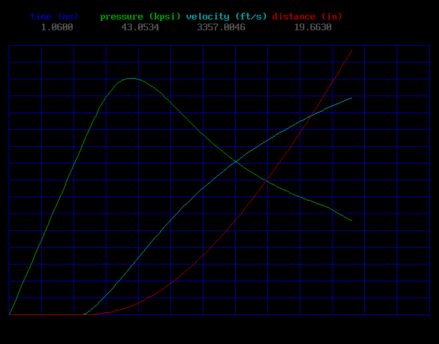 Energy is imparted to the bullet in a firearm by the pressure of the gases produced by the burning gunpowder. While it seems to casual observers that a higher peak pressures should produce higher velocities, that is not always the case, since measures of peak pressure capture only a small fraction of the time the bullet is accelerating. To achieve maximum performance, the entire duration of the bullet's travel through the barrel must be considered.
There are hundreds of powders in existence because powders must be carefully matched to the case volume, case dimensions, bullet dimensions, bullet weight, barrel length, and special bullet features such as moly coating or driving bands. For example, long, heavy bullets are required to be seated so deep in the case that they displace powder, while at the same time requiring a slower powder which gives their greater mass more time to move down the barrel. If the bullet is banded or coated with a lubricant like moly, faster powders can be used as the bullet moves faster due to decreased friction with the barrel. All of these variables must be accommodated within the maximum pressure levels set for the platform. Finding the optimum combination is largely a trial and error process, and may take years to complete. New cartridges with significantly new internal ballistics often bring forth new powders engineered to maximize performance; examples of this are Accurate Arms 2230, designed for use in the .223 Remington
, and #9, designed for use in magnum pistol cartridges.
This pattern of buring by external surfaces is known as Piobert's Law.
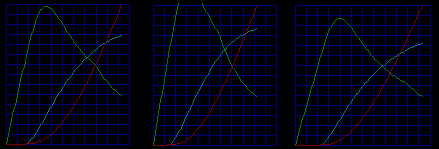 Using powder that is too fast creates a destructive pressure spike that usually has a very short duration. Using powder that is too slow produces poor energy and leaves a lot of unburned powder.
is defined as a force
exerted over a distance
; for example, the work required to lift a one-pound weight, one foot against the pull of gravity defines a foot-pound of energy (One joule
is equal to the energy used to move a body over a distance of one meter using one newton of force). If we were to modify the graph to reflect force (the pressure exerted on the bullet multiplied by its area) as a function of distance, the area under that curve would be the total energy imparted to the bullet. From this, it can be seen that the way to increase the energy of the bullet is to increase the area under that curve, either by raising the average pressure, or increasing the distance, the bullet travels under pressure (in other words, lengthen the barrel).
occurs earlier, and with the slower powder, it occurs later. Propellant that is unburned when the bullet reaches the muzzle is wasted — it adds no energy to the bullet, but it does add to the recoil and muzzle blast. For maximum power, the powder should burn until the bullet is just short of the muzzle.
Since smokeless powders burn, not detonate, the reaction can only take place on the surface of the powder. Smokeless powders come in a variety of shapes, which serve to determine how fast they burn, and also how the burn rate changes as the powder burns. The simplest shape is a ball powder, which is in the form of round or slightly flattened spheres. Ball powder has a comparatively small surface-area-to-volume ratio, so it burns comparatively slowly, and as it burns, its surface area decreases. This means as the powder burns, the burn rate slows down.
To some degree, this can be offset by the use of a retardant
coating on the surface of the powder, which slows the initial burn rate and flattens out the rate of change. Ball powders are generally formulated as slow pistol powders, or fast rifle powders.
Flake powders are in the form of flat, round flakes which have a relatively high surface-area-to-volume ratio. Flake powders have a nearly constant rate of burn, and are usually formulated as fast pistol or shotgun
powders. The last common shape is an extruded powder, which is in the form of a cylinder, sometimes hollow. Extruded powders generally have a lower ratio of nitroglycerin to nitrocellulose, and are often progressive burning — that is, they burn at a faster rate as they burn. Extruded powders are generally medium to slow rifle powders.
pressure (in this case, the muzzle pressure). Any remaining pressure at the muzzle or at the end of the engine's power stroke represents lost energy.
To extract the maximum amount of energy, then, the swept volume is maximized. This can be done in one of two ways — increasing the length of the barrel or increasing the diameter of the projectile. Increasing the barrel length will increase the swept volume linearly, while increasing the diameter will increase the swept volume as the square of the diameter. Since barrel length is limited by practical concerns to about arm's length for a rifle and much shorter for a handgun, increasing bore diameter is the normal way to increase the efficiency of a cartridge. The limit to bore diameter is generally the sectional density
of the projectile (see external ballistics
). Larger-diameter bullets of the same weight have much more drag
, and so they lose energy more quickly after exiting the barrel. In general, most handguns use bullets between .355 (9 mm) and .45 (11.5 mm) caliber, while most rifles generally range from .223 (5.56 mm) to .32 (8 mm) caliber. There are many exceptions, of course, but bullets in the given ranges provide the best general-purpose performance. Handgun
s use the larger-diameter bullets for greater efficiency in short barrels, and tolerate the long-range velocity loss since handguns are seldom used for long-range shooting. Handguns designed for long-range shooting are generally closer to shortened rifles than to other handguns.
, using 40 grains (2.6 g) of powder and a 40 grain (2.6 g) bullet), the powder charge can make for the majority of the recoil force.
There is a solution to the recoil issue, though it is not without cost. A muzzle brake
or recoil compensator is a device which redirects the powder gas at the muzzle, usually up and back. This acts like a rocket, pushing the muzzle down and forward. The forward push helps negate the feel of the projectile recoil by pulling the firearm forwards. The downward push, on the other hand, helps counteract the rotation imparted by the fact that most firearms have the barrel mounted above the center of gravity
. Overt combat guns, large-bore high-powered rifles, long-range handguns chambered for rifle ammunition, and action-shooting handguns designed for accurate rapid fire, all benefit from muzzle brakes.
The high-powered firearms use the muzzle brake mainly for recoil reduction, which reduces the battering of the shooter by the severe recoil. The action-shooting handguns redirect all the energy up to counteract the rotation of the recoil, and make following shots faster by leaving the gun on target. The disadvantage of the muzzle brake is a longer, heavier barrel, and a large increase in sound levels and flash behind the muzzle of the rifle. Shooting firearms without muzzle brakes and without hearing protection can eventually damage the operator's hearing; however, shooting rifles with muzzle brakes - with or without hearing protection - causes permanent ear damage. (See muzzle brake
for more on the disadvantages of muzzle brakes.)
Powder-to-projectile-weight ratio also touches on the subject of efficiency. In the case of the .22-250 Remington, more energy goes into propelling the powder gas than goes into propelling the bullet. The .22-250 pays for this by requiring a large case, with lots of powder, all for a fairly small gain in velocity and energy over other .22 caliber cartridges.
Another system, polygonal rifling
, gives the bore a polygonal cross section. Polygonal rifling is not very common, used by only a few Europe
an manufacturers as well as the American gun manufacturer Kahr Arms. The companies that use polygonal rifling claim greater accuracy, lower friction, and less lead and/or copper buildup in the barrel. Traditional land and groove rifling is used in most competition firearms, however, so the advantages of polygonal rifling are unproven.
There are three common ways of rifling a barrel, and one emerging technology:
The purpose of the barrel is to provide a consistent seal
, allowing the bullet to accelerate to a consistent velocity. It must also impart the right spin, and release the bullet consistently, perfectly concentric
to the bore. The residual pressure in the bore must be released symmetrically, so that no side of the bullet receives any more or less push than the rest. The muzzle of the barrel is the most critical part, since that is the part that controls the release of the bullet. Some rimfires and airguns actually have a slight constriction
, called a choke
, in the barrel at the muzzle. This guarantees that the bullet is held securely just before release.
To keep a good seal, the bore must be a very precise, constant diameter, or have a slight decrease in diameter from breech to muzzle. Any increase in bore diameter will allow the bullet to shift. This can cause gas to leak past the bullet, affecting the velocity, or cause the bullet to tip, so that it is no longer perfectly coaxial
with the bore. High quality barrels are lapped
to remove any constrictions in the bore which will cause a change in diameter.
A lapping process known as "fire lapping
" uses a lead "slug" that is slightly larger than the bore and covered in fine abrasive
compound
to cut out the constrictions. The slug is passed from breech to muzzle, so that as it encounters constrictions, it cuts them away, and does no cutting on areas that are larger than the constriction. Many passes are made, and as the bore becomes more uniform, finer grades of abrasive compound are used. The final result is a barrel that is mirror-smooth, and with a consistent or slightly tapering bore. The hand-lapping technique uses a wooden or soft metal rod to pull or push the slug through the bore, while the newer fire-lapping technique uses specially loaded, low-power cartridges to push abrasive-covered soft-lead bullets down the barrel.
Another issue that has an effect on the barrel's hold on the bullet is the rifling. When the bullet is fired, it is forced into the rifling, which cuts or "engrave
s" the surface of the bullet. If the rifling is a constant twist, then the rifling rides in the grooves engraved in the bullet, and everything is secure and sealed. If the rifling has a decreasing twist, then the changing angle of the rifling in the engraved grooves of the bullet causes the rifling to become narrower than the grooves. This allows gas to blow by, and loosens the hold of the bullet on the barrel. An increasing twist, however, will make the rifling become wider than the grooves in the bullet, maintaining the seal. When a rifled-barrel blank
is selected for a gun, careful measurement of the inevitable variations in manufacture can determine if the rifling twist varies, and put the higher-twist end at the muzzle.
The muzzle of the barrel is the last thing to touch the bullet before it goes into ballistic flight, and as such has the greatest potential to disrupt the bullet's flight. The muzzle must allow the gas to escape the barrel symmetrically; any asymmetry
will cause an uneven pressure on the base of the bullet, which will disrupt its flight. The muzzle end of the barrel is called the "crown", and it is usually either bevel
ed or recessed to protect it from bumps or scratches that might affect accuracy. A sign of a good crown will be a symmetric, star-shaped pattern on the muzzle end of the barrel, formed by soot
deposited, as the powder gases escape the barrel. If the star is uneven, then it is a sign of an uneven crown, and an inaccurate barrel.
Before the barrel can release the bullet in a consistent manner, it must grip the bullet in a consistent manner. The part of the barrel between where the bullet exits the cartridge, and engages the rifling, is called the "throat", and the length of the throat is the freebore. In some firearms, the freebore is all but nonexistent — the act of chambering the cartridge forces the bullet into the rifling. This is common in low-powered rimfire target rifles. The placement of the bullet in the rifling ensures that the transition between cartridge and rifling is quick and stable. The downside is that the cartridge is firmly held in place, and attempting to extract the unfired round can be difficult, to the point of even pulling the bullet from the cartridge in extreme cases.
With high-powered cartridges, there is an additional disadvantage to a short freebore. A significant amount of force is required to engrave the bullet, and this additional resistance can raise the pressure in the chamber by quite a bit. To mitigate this effect, higher-powered rifles tend to have more freebore, so that the bullet is allowed to gain some momentum, and the chamber pressure is allowed to drop slightly, before the bullet engages the rifling. The downside is that the bullet hits the rifling when already moving, and any slight misalignment can cause the bullet to tip as it engages the rifling. This will, in turn, mean that the bullet does not exit the barrel coaxially. The amount of freebore is a function of both the barrel and the cartridge. The manufacturer or gunsmith who cuts the chamber will determine the amount of space between the cartridge case mouth and the rifling. Setting the bullet further forward or back in the cartridge can decrease or increase the amount of freebore, but only within a small range. Careful testing by the ammunition loader can optimize the amount of freebore to maximize accuracy, while keeping the peak pressure within limits.
The throat in a revolver is part of the cylinder, and like any other chamber, the throat should be sized so that it is concentric to the chamber and very slightly over the bullet diameter. At the end of the throat, however, things change. First, the throat in a revolver is at least as long as the maximum overall length of the cartridge; if otherwise the cylinder cannot revolve. The next step is the cylinder gap, the space between the cylinder and barrel. This must be wide enough to allow free rotation of the cylinder even when it becomes fouled with powder residue, but not so large that excess gas can be released. The next step is the forcing cone. The forcing cone is where the bullet is guided from the cylinder into the bore of the barrel. It should be concentric with the bore, and deep enough to force the bullet into the bore without significant deformation. Unlike rifles, where the threaded portion of the barrel is in the chamber, revolver barrels threads surround the breech end of the bore, and it is possible that the bore will be compressed when the barrel is screwed into the frame. Cutting a longer forcing cone can relieve this "choke" point, as can lapping of the barrel after it is fitted to the frame.[41][42][43]
A consistent lockup is important to keep all these parts in line, and revolvers are prone to abuse that can damage these parts, adversely affecting the accuracy and even safety of the revolver. This lockup consists of two parts, the crane to frame lockup, and the cylinder bolt to cylinder lockup. Many swing-out cylinder revolvers only support the cylinder securely at the rear, and flipping the cylinder open and closed can bend the crane and prevent the cylinder from lining up parallel to the bore. The cylinder bolt, which engages the bottom of the cylinder through a slot in the frame, should provide a relatively tight lockup, and not drag the cylinder during rotation or pop loose when the hammer is cocked at a reasonable speed. Fanning a revolver can batter the cylinder bolt and prevent a solid lockup.[43]
Ballistics
Ballistics is the science of mechanics that deals with the flight, behavior, and effects of projectiles, especially bullets, gravity bombs, rockets, or the like; the science or art of designing and accelerating projectiles so as to achieve a desired performance.A ballistic body is a body which is...
, is the study of a projectile
Projectile
A projectile is any object projected into space by the exertion of a force. Although a thrown baseball is technically a projectile too, the term more commonly refers to a weapon....
's behavior from the time its propellant
Propellant
A propellant is a material that produces pressurized gas that:* can be directed through a nozzle, thereby producing thrust ;...
's igniter is initiated until it exits the gun barrel
Gun barrel
A gun barrel is the tube, usually metal, through which a controlled explosion or rapid expansion of gases are released in order to propel a projectile out of the end at a high velocity....
. The study of internal ballistics is important to designer
Designer
A designer is a person who designs. More formally, a designer is an agent that "specifies the structural properties of a design object". In practice, anyone who creates tangible or intangible objects, such as consumer products, processes, laws, games and graphics, is referred to as a...
s and users of firearms of all types, from small-bore Olympic
Olympic Games
The Olympic Games is a major international event featuring summer and winter sports, in which thousands of athletes participate in a variety of competitions. The Olympic Games have come to be regarded as the world’s foremost sports competition where more than 200 nations participate...
rifle
Rifle
A rifle is a firearm designed to be fired from the shoulder, with a barrel that has a helical groove or pattern of grooves cut into the barrel walls. The raised areas of the rifling are called "lands," which make contact with the projectile , imparting spin around an axis corresponding to the...
s and pistol
Pistol
When distinguished as a subset of handguns, a pistol is a handgun with a chamber that is integral with the barrel, as opposed to a revolver, wherein the chamber is separate from the barrel as a revolving cylinder. Typically, pistols have an effective range of about 100 feet.-History:The pistol...
s, to high-tech artillery
Artillery
Originally applied to any group of infantry primarily armed with projectile weapons, artillery has over time become limited in meaning to refer only to those engines of war that operate by projection of munitions far beyond the range of effect of personal weapons...
.
Priming methods
The first step to firing a firearm of any sort is igniting the propellant. The earliest firearms were cannonCannon
A cannon is any piece of artillery that uses gunpowder or other usually explosive-based propellents to launch a projectile. Cannon vary in caliber, range, mobility, rate of fire, angle of fire, and firepower; different forms of cannon combine and balance these attributes in varying degrees,...
s, which were simple closed tubes. There was a small aperture, the "touchhole", drilled in the closed end of the tube, leading to the main powder charge. This hole was filled with finely ground powder, which was then ignited with a hot ember
Ember
Embers are the glowing, hot coals made of greatly heated wood, coal, or other carbon-based material that remain after, or sometimes precede a fire. Embers can glow very hot, sometimes as hot as the fire which created them...
or torch
Torch
A torch is a fire source, usually a rod-shaped piece of wood with a rag soaked in pitch and/or some other flammable material wrapped around one end. Torches were often supported in sconces by brackets high up on walls, to throw light over corridors in stone structures such as castles or crypts...
. With the advent of hand-held firearms, this became an undesirable way of firing a gun. Holding a burning stick while trying to pour a charge of black powder carefully down a barrel is dangerous, and trying to hold the gun with one hand while simultaneously aiming at the target and looking for the touchhole makes it very difficult to fire accurately.
Matchlock
The first attempt to make the process of firing a small arm easier was the "matchlock". The matchlock incorporated a "lock" (so called because of its resemblance to door locks of the day) that was actuated by a trigger, originally called a "tricker." The lock was a simple lever which pivoted when pulled, and lowered the match down to the touchhole. The match was a slow burning fuseFuse (explosives)
In an explosive, pyrotechnic device or military munition, a fuse is the part of the device that initiates function. In common usage, the word fuse is used indiscriminately...
made of plant fibers that were soaked in a solution of nitrates, charcoal
Charcoal
Charcoal is the dark grey residue consisting of carbon, and any remaining ash, obtained by removing water and other volatile constituents from animal and vegetation substances. Charcoal is usually produced by slow pyrolysis, the heating of wood or other substances in the absence of oxygen...
, and sulfur
Sulfur
Sulfur or sulphur is the chemical element with atomic number 16. In the periodic table it is represented by the symbol S. It is an abundant, multivalent non-metal. Under normal conditions, sulfur atoms form cyclic octatomic molecules with chemical formula S8. Elemental sulfur is a bright yellow...
, and dried. This "slow-match" was ignited before the gun
Gun
A gun is a muzzle or breech-loaded projectile-firing weapon. There are various definitions depending on the nation and branch of service. A "gun" may be distinguished from other firearms in being a crew-served weapon such as a howitzer or mortar, as opposed to a small arm like a rifle or pistol,...
was needed, and it would slowly burn, keeping a hot ember at the burning end. After the gun was loaded and the touchhole primed with powder, the burning tip of the match was positioned so that the lock would bring it into contact with the touchhole. To fire the gun, it was aimed and the trigger pulled. This brought the match down to the touchhole, igniting the powder. With careful attention the slow-burning match could be kept burning for long periods of time, and the use of the lock mechanism made fairly accurate fire possible.
Wheel-lock
The next revolution in ignition technology was the "wheel-lock". It used a spring-loaded, serratedSerration
Serration generally refers to a saw-like appearance or a row of sharp or tooth-like projections. A serrated cutting edge has many small points of contact with the material being cut. By having less contact area than a smooth blade or other edge, the applied force at each point of contact is...
steel
Steel
Steel is an alloy that consists mostly of iron and has a carbon content between 0.2% and 2.1% by weight, depending on the grade. Carbon is the most common alloying material for iron, but various other alloying elements are used, such as manganese, chromium, vanadium, and tungsten...
wheel
Wheel
A wheel is a device that allows heavy objects to be moved easily through rotating on an axle through its center, facilitating movement or transportation while supporting a load, or performing labor in machines. Common examples found in transport applications. A wheel, together with an axle,...
which rubbed against a piece of iron pyrite, similar to a modern lighter
Lighter
A lighter is a portable device used to generate a flame. It consists of a metal or plastic container filled with a flammable fluid or pressurized liquid gas, a means of ignition, and some provision for extinguishing the flame.- History :...
. A key was used to wind the wheel and put the spring under tension. Once tensioned, the wheel was held in place by a trigger. When the trigger was pulled, the serrated edge of the steel rubbed against the pyrite, generating sparks
Ember
Embers are the glowing, hot coals made of greatly heated wood, coal, or other carbon-based material that remain after, or sometimes precede a fire. Embers can glow very hot, sometimes as hot as the fire which created them...
. These sparks were directed into a pan, called the "flash pan
Flash pan
The flash pan or priming pan is a small receptacle for priming powder, found next to the touch hole on muzzleloading guns. Flash pans are found on gonnes, matchlocks, wheellocks, snaplocks, snaphances, and flintlocks....
", filled with loose powder which led into the touchhole. The flashpan usually was protected by a spring-loaded cover that would slide out of the way when the trigger was pulled, exposing the powder to the sparks. The wheel-lock was a major innovation
Innovation
Innovation is the creation of better or more effective products, processes, technologies, or ideas that are accepted by markets, governments, and society...
— since it did not rely on burning material as a source of heat
Heat
In physics and thermodynamics, heat is energy transferred from one body, region, or thermodynamic system to another due to thermal contact or thermal radiation when the systems are at different temperatures. It is often described as one of the fundamental processes of energy transfer between...
, it could be kept ready for extended periods of time. The covered flashpan also provided some ability to withstand bad weather. Wind, rain, and wet weather would render a matchlock useless, but a wheel-lock that was loaded and waterproofed with a bit of grease
Grease (lubricant)
The term grease is used to describe semisolid lubricants. Although the word grease is also used to describe rendered fat of animals, in the context of lubrication, grease typically applies to a material consisting of a soap emulsified with mineral or vegetable oil...
around the flashpan could be fired under most conditions.
Flintlock
The wheel-lock enjoyed only a brief period of popularity before being superseded by a simpler, more robust design. The "flintlock", like the wheel-lock, used a flashpan and a spark to ignite the powder. As the name implies, the flintlock used flintFlint
Flint is a hard, sedimentary cryptocrystalline form of the mineral quartz, categorized as a variety of chert. It occurs chiefly as nodules and masses in sedimentary rocks, such as chalks and limestones. Inside the nodule, flint is usually dark grey, black, green, white, or brown in colour, and...
rather than iron pyrite. The flint was held in a spring-loaded arm, called the "cock" from the resemblance of its motion to a pecking chicken. The cock rotated through approximately a 90 degree arc, and was held in the tensioned, or "cocked" position by a trigger. Usually, flintlocks could lock the cock in two positions. The "half-cock" position held the cock halfway back, and used a deep notch
Notch
Notch may refer to:* The nock of an arrow* Notch , a Hip hop, R&B, reggae, dancehall and reggaeton artist* Notch signaling pathway, a cell signaling system present in most multicellular organisms...
, so that pulling the trigger would not release the cock. Half-cock was a safety position, used when loading, storing or carrying a loaded flintlock. The "full-cock" position held the cock all the way back, and was the position from which the gun was fired. The L-shaped "frizzen" was the other half of the flintlock's ignition system. It served as both a flashpan cover and a steel striking surface for the flint. The frizzen was hinged and spring-loaded so that it would lock in the open or closed position. When closed, the striking surface was positioned so that the flint would strike at the proper angle to generate a spark. The striking flint would also open the frizzen
Frizzen
The frizzen, historically called the steel, is an "L" shaped piece of steel hinged at the rear used in flintlock firearms. It is positioned over the flash pan so as to enclose a small priming charge of black powder next to the flash hole that is drilled through the barrel into where the main...
, exposing the flashpan to the spark. The flintlock mechanism was simpler and stronger than the wheel-lock, and the flint and steel provided a good, reliable source of ignition. The flintlock remained in military service for over 200 years, and flintlocks are still made today for historical re-enactments and muzzle-loading target competition, and for hunters who enjoy the additional challenge that the flintlock provides.
Caplock
The next major leap in ignition technology was the invention of the chemical primer, or "cap", and the mechanism which used it, called the "caplock". Percussion ignition was invented by Scottish clergyman Rev. Alexander John ForsythAlexander John Forsyth
Alexander John Forsyth was a Scottish Presbyterian clergyman who invented the percussion ignition.Gunsmiths like Joseph Manton invented more reliable forms of ignition, like the tube lock in 1814...
in 1807 but needed further refinements before it was gradually accepted in the 1820s to 1830s. By the middle of the 19th century the percussion or caplock system was well established. It was adopted by both sides in the American Civil War
American Civil War
The American Civil War was a civil war fought in the United States of America. In response to the election of Abraham Lincoln as President of the United States, 11 southern slave states declared their secession from the United States and formed the Confederate States of America ; the other 25...
, as it was simpler and more reliable than the flintlock. The main reason the caplock was so quickly adopted was its similarity to the flintlock and the ease of converting older arms to use percussion-cap ignition; usually the same lock and barrel could be used with minor changes. The flashpan and frizzen were removed and replaced by a small, hollow horizontal cylinder (drum) screwed into the bored-out and tapped flash hole and carrying a "nipple" over which the cap could be fitted. A "hammer" which also had half-cock (for loading and applying the cap) and full-cock positions replaced the cock. When released by pulling the trigger, the hammer would strike the cap, crushing it against the nipple. The percussion cap
Percussion cap
The percussion cap, introduced around 1830, was the crucial invention that enabled muzzleloading firearms to fire reliably in any weather.Before this development, firearms used flintlock ignition systems which produced flint-on-steel sparks to ignite a pan of priming powder and thereby fire the...
was a thin metal cup that contained a small quantity of pressure-sensitive explosive. When crushed, the explosive would detonate, sending a stream of hot gas
Gas
Gas is one of the three classical states of matter . Near absolute zero, a substance exists as a solid. As heat is added to this substance it melts into a liquid at its melting point , boils into a gas at its boiling point, and if heated high enough would enter a plasma state in which the electrons...
down through a hole in the nipple and into the touchhole of the gun to ignite the powder charge. In the process of firing, the cap generally split open and would fall off when the hammer was moved to half-cock position for loading. The caplock system worked well, and is still the preferred method of ignition for hunters and recreational shooters who use muzzle
Muzzle
A muzzle may be:* the snout of an animal* Muzzle , a device that covers an animal's snout* Muzzle , the mouth of a firearm* Muzzle , a song on The Smashing Pumpkins album Mellon Collie and the Infinite Sadness...
-loading arms.
Internal priming
Chemical primers, advanced metallurgyMetallurgy
Metallurgy is a domain of materials science that studies the physical and chemical behavior of metallic elements, their intermetallic compounds, and their mixtures, which are called alloys. It is also the technology of metals: the way in which science is applied to their practical use...
and manufacturing
Manufacturing
Manufacturing is the use of machines, tools and labor to produce goods for use or sale. The term may refer to a range of human activity, from handicraft to high tech, but is most commonly applied to industrial production, in which raw materials are transformed into finished goods on a large scale...
techniques all came together in the 19th century to create an entirely new class of firearm — the cartridge arm. Flintlock and caplock shooters had long carried their ammunition
Ammunition
Ammunition is a generic term derived from the French language la munition which embraced all material used for war , but which in time came to refer specifically to gunpowder and artillery. The collective term for all types of ammunition is munitions...
in paper
Paper
Paper is a thin material mainly used for writing upon, printing upon, drawing or for packaging. It is produced by pressing together moist fibers, typically cellulose pulp derived from wood, rags or grasses, and drying them into flexible sheets....
cartridge
Cartridge (firearms)
A cartridge, also called a round, packages the bullet, gunpowder and primer into a single metallic case precisely made to fit the firing chamber of a firearm. The primer is a small charge of impact-sensitive chemical that may be located at the center of the case head or at its rim . Electrically...
s, which served to hold a measured charge of powder and a bullet
Bullet
A bullet is a projectile propelled by a firearm, sling, or air gun. Bullets do not normally contain explosives, but damage the intended target by impact and penetration...
in one convenient package; the paper also served to seal the bullet in the bore. Still, the source of ignition was handled separately from the cartridge. With the advent of chemical primers, it was not long before several systems were invented with many different ways of combining bullet, powder, and primer into a single package which could be loaded quickly from the breech
Breech-loading weapon
A breech-loading weapon is a firearm in which the cartridge or shell is inserted or loaded into a chamber integral to the rear portion of a barrel....
of the firearm. This greatly streamlined the reloading procedure and paved the way for semi- and fully automatic firearms.
This big leap forward came at a price. It introduced an extra component into each round – the cartridge case - which had to be removed before the gun could be reloaded. While a flintlock, for example, is immediately ready to be reloaded once it has been fired, adopting brass cartridge cases brought in the problems of extraction and ejection. The mechanism of a modern gun not only must load and fire the piece, but also must remove the spent case, which may require just as many moving parts. Probably most malfunctions
Firearm malfunction
A firearm malfunction is the partial or complete failure of a firearm to operate as intended. Malfunctions range from temporary and relatively safe situations, such as a casing that didn't eject, to potentially dangerous occurrences that may permanently damage the gun and cause injury or death...
involve this process, either through failure to extract a case properly from the chamber or by allowing it to jam the action. Nineteenth-century inventors were reluctant to accept this added complication and experimented with a variety of self-consuming cartridges
Paper cartridge
Paper cartridge refers to one of various types of small arms ammunition used before the advent of the metallic cartridge. These cartridges consisted of a paper cylinder or cone containing the bullet, gunpowder, and, in some cases, a primer or a lubricating and anti-fouling agent...
before acknowledging that the advantages of brass cases far outweighed their one drawback.
The three systems of self-contained metallic cartridge ignition which have survived the test of time are the rimfire, the Berdan centerfire primer, and the Boxer centerfire primer.
Rimfire
Rimfire cartridges use a thin brassBrass
Brass is an alloy of copper and zinc; the proportions of zinc and copper can be varied to create a range of brasses with varying properties.In comparison, bronze is principally an alloy of copper and tin...
case with a hollow bulge, or rim, around the back end. This rim is filled during manufacture with an impact-sensitive primer. In the wet state, the primer is stable; a pellet of wet primer is placed in the shell and simply spun out to the full extremes of the rim. (For more on the exact process and one set of chemical compounds that have been used successfully, see , a 1932 Remington Arms patent by James E. Burns.) In the dry state, the primer within the rim becomes impact-sensitive. When the rim is then crushed by the hammer or firing pin, the primer detonates and ignites the powder charge. Rimfire cartridges are single-use and normally cannot be reloaded. Also, since the rim must be thin enough to be easily crushed, the peak pressure possible in the case is limited by the strength of this thin rim. Rimfire cartridges originally were available in caliber
Caliber
In guns including firearms, caliber or calibre is the approximate internal diameter of the barrel in relation to the diameter of the projectile used in it....
s up to .44, the latter used in the famous Henry and 1866 Winchester lever-action repeating rifles, but all but the small .22 caliber rounds eventually died out. The .22 Long Rifle
.22 Long Rifle
The .22 Long Rifle rimfire cartridge is a long established variety of ammunition, and in terms of units sold is still by far the most common in the world today. The cartridge is often referred to simply as .22 LR and various rifles, pistols, revolvers, and even some smoothbore shotguns have...
, also fired in pistol
Pistol
When distinguished as a subset of handguns, a pistol is a handgun with a chamber that is integral with the barrel, as opposed to a revolver, wherein the chamber is separate from the barrel as a revolving cylinder. Typically, pistols have an effective range of about 100 feet.-History:The pistol...
s, is the most popular recreational caliber today because it is inexpensive and quiet and has very low recoil
Recoil
Recoil is the backward momentum of a gun when it is discharged. In technical terms, the recoil caused by the gun exactly balances the forward momentum of the projectile and exhaust gasses, according to Newton's third law...
. The most inexpensive brands can be bought for less than US$0.02 per round in cartons of 500, and even the precision Olympic
Olympic Games
The Olympic Games is a major international event featuring summer and winter sports, in which thousands of athletes participate in a variety of competitions. The Olympic Games have come to be regarded as the world’s foremost sports competition where more than 200 nations participate...
class ammunition
Ammunition
Ammunition is a generic term derived from the French language la munition which embraced all material used for war , but which in time came to refer specifically to gunpowder and artillery. The collective term for all types of ammunition is munitions...
is around US$0.20 per round.
While the rimfire priming method is limited due to the thin cases required, it has enjoyed a few resurgences recently. First was Winchester's .22 Magnum Rimfire, or .22 WMR
.22 WMR
The .22 Winchester Magnum Rimfire, more commonly called .22 WMR, .22 Magnum, or simply .22 Mag, is a rimfire rifle cartridge...
, in the 1950s, followed in 1970 by Remington's short-lived 5mm Rimfire
5 mm Remington Rimfire Magnum
The 5 mm Remington Rimfire Magnum is an obsolete bottlenecked rimfire cartridge introduced by Remington Arms Company in 1970. Remington chambered it in a pair of bolt-action rifles, the Model 591 and Model 592, but the round never became very popular, and the rifles were discontinued in 1974....
, based on Winchester's magnum case. In 2002 Hornady
Hornady
Hornady Manufacturing Company is an American manufacturer of ammunition and handloading components, based in Grand Island, Nebraska.The company was founded by Joyce Hornady in 1949 and is currently run by his son Steve Hornady who took over after his father's death in a plane crash in 1981.Hornady...
introduced a new .17 caliber cartridge based on the .22 WMR, the .17 HMR
.17 HMR
.17 Hornady Magnum Rimfire, commonly known as the .17 HMR, is a rimfire rifle cartridge developed by the ammunition company Hornady in 2002. It descended from the .22 Magnum by necking down the .22 Magnum case to take a .17 caliber bullet, and it is more costly to shoot than traditional .22...
. The .17 HMR is essentially a .22 WMR cartridge necked down to accept a .17-caliber bullet, and is used as a flat-shooting, light-duty varmint round. The .17 HMR was followed a year later by Hornady's .17 Mach 2, or .17 HM2
.17 HM2
The .17 Hornady Mach 2, or .17 HM2, is a rimfire cartridge introduced in 2004 by the ammunition manufacturer Hornady, following the successful launch in 2002 of the .17 HMR...
, which is based on a slightly lengthened and necked-down .22 Long Rifle cartridge. Both of the .17 caliber rimfires have had widespread support from firearms makers, and while the high-tech, high-velocity .17 caliber jacketed bullets make the .17 Rimfire
.17 Rimfire
.17 Rimfire may refer to a number of different cartridges or firearms that use them. The cartridges all use rimfire cases and fire .17 inch bullets...
cartridges quite a bit more expensive than the .22 caliber versions, they are excellent for shorter-range shooting and still far less expensive than comparable centerfire cartridges.
Pinfire
A pinfire firearm cartridge is an obsolete type of brass cartridge in which the priming compound is ignited by striking a small pin which protrudes radially from just above the base of the cartridge. Invented by Casimir Lefaucheaux in 1828 but not patented until 1835, it was one of the earliest practical designs of metallic cartridge. However, the protruding pin was vulnerable to damage, displacement and accidental ignition. Moreover, the pin had to be positioned carefully in a small notch when loading, making the pinfire's use in repeating or self-loading weapons impossible. The pinfire survives today only in a few very small blank cartridges designed as noisemakers and in novelty miniature guns.Peripheral primer
This unique system, much like a refined combination of the pinfire and rimfire, uses a firing pin that strikes a ring of priming compound in the center of the cartridge as described in . Despite its being successful, only experimental batches of the cartridge were made. The primary advantage is that it is struck from the side, which allows the operating system of the firearm to be moved forward allowing a more compact action. No commercial weapons used the system, however.Centerfire
The identifying feature of centerfire ammunition is the primer -- a metal cup containing primary explosive inserted into a recess in the center of the base of the cartridge. The firearm firing pinFiring pin
A firing pin or striker is part of the firing mechanism used in a firearm or explosive device e.g. an M14 landmine or bomb fuze. Firing pins may take many forms, though the types used in landmines, bombs, grenade fuzes or other single-use devices generally have a sharpened point...
crushes this explosive between the cup and an anvil to produce hot gas and a shower of incandescent particles to ignite the powder charge. Berdan and Boxer cartridge primers are both considered "centerfire". Various priming mixtures have been used in different sized primers to effect prompt ignition of the powder charge. Particles with relatively high heat capacity
Heat capacity
Heat capacity , or thermal capacity, is the measurable physical quantity that characterizes the amount of heat required to change a substance's temperature by a given amount...
are required to promptly ignite smokeless powder
Smokeless powder
Smokeless powder is the name given to a number of propellants used in firearms and artillery which produce negligible smoke when fired, unlike the older gunpowder which they replaced...
deterrent coatings. Some priming explosives decompose into incandescent solids or liquids. Inert ingredients may be heated into incandescent sparks when the explosive decomposes into gas. Cartridges for military use require stable priming formulations so war reserves of small-arms ammunition will dependably function after years of storage.
Electrical
A very small but growing number of civilian and military arms are switching to electrical triggers. These use an electrical charge, powered by a battery, to detonate the primer and decrease the time between pulling the trigger and ignition of the charge. The control circuitry attendant with electrical triggers also offers opportunities for biometric safety locks, remote trigger mountings, and remote or computer-controlled operation of the weapon.Modern Gatling-type miniguns and aircraft cannon use electrical-primed ammunition due to the high rates of fire they achieve. The mechanical system of firing the primers cannot operate reliably at these extreme speeds, which reach 1,500 to 6,000 rounds per minute. These weapons have electric motors that rotate multiple barrels. As each barrel comes to the firing position, the primer passes an electrode that initiates the explosive train to the propellant, firing the cartridge.
Black powder
GunpowderGunpowder
Gunpowder, also known since in the late 19th century as black powder, was the first chemical explosive and the only one known until the mid 1800s. It is a mixture of sulfur, charcoal, and potassium nitrate - with the sulfur and charcoal acting as fuels, while the saltpeter works as an oxidizer...
(Black powder) is a finely ground, pressed and granulated mechanical mixture of sulfur
Sulfur
Sulfur or sulphur is the chemical element with atomic number 16. In the periodic table it is represented by the symbol S. It is an abundant, multivalent non-metal. Under normal conditions, sulfur atoms form cyclic octatomic molecules with chemical formula S8. Elemental sulfur is a bright yellow...
, charcoal
Charcoal
Charcoal is the dark grey residue consisting of carbon, and any remaining ash, obtained by removing water and other volatile constituents from animal and vegetation substances. Charcoal is usually produced by slow pyrolysis, the heating of wood or other substances in the absence of oxygen...
, and potassium nitrate
Potassium nitrate
Potassium nitrate is a chemical compound with the formula KNO3. It is an ionic salt of potassium ions K+ and nitrate ions NO3−.It occurs as a mineral niter and is a natural solid source of nitrogen. Its common names include saltpetre , from medieval Latin sal petræ: "stone salt" or possibly "Salt...
or sodium nitrate
Sodium nitrate
Sodium nitrate is the chemical compound with the formula NaNO3. This salt, also known as Chile saltpeter or Peru saltpeter to distinguish it from ordinary saltpeter, potassium nitrate, is a white solid which is very soluble in water...
. It can be produced in a range of grain sizes. The size and shape of the grains can increase or decrease the relative surface area
Surface area
Surface area is the measure of how much exposed area a solid object has, expressed in square units. Mathematical description of the surface area is considerably more involved than the definition of arc length of a curve. For polyhedra the surface area is the sum of the areas of its faces...
, and change the burning rate significantly. The burning rate of black powder is relatively insensitive to pressure, meaning it will burn quickly even without confinement, making it also suitable for use as a low explosive. However, it is a very poor explosive compared to modern high explosives because it has a very slow decomposition rate, and therefore a very low brisance
Brisance
Brisance is the shattering capability of an explosive. It is a measure of the rapidity with which an explosive develops its maximum pressure. The term originates from the French verb "briser", which means to break or shatter...
. It is not, in the strictest sense of the term, an explosive, but a "deflagrant", as it does not detonate but decomposes by deflagration
Deflagration
Deflagration is a term describing subsonic combustion that usually propagates through thermal conductivity; hot burning material heats the next layer of cold material and ignites it. Most "fire" found in daily life, from flames to explosions, is deflagration...
due to its subsonic mechanism of flame-front propagation.
Nitrocellulose (single-base propellants)
NitrocelluloseNitrocellulose
Nitrocellulose is a highly flammable compound formed by nitrating cellulose through exposure to nitric acid or another powerful nitrating agent. When used as a propellant or low-order explosive, it is also known as guncotton...
or "guncotton" is formed by the action of nitric acid
Nitric acid
Nitric acid , also known as aqua fortis and spirit of nitre, is a highly corrosive and toxic strong acid.Colorless when pure, older samples tend to acquire a yellow cast due to the accumulation of oxides of nitrogen. If the solution contains more than 86% nitric acid, it is referred to as fuming...
on cellulose
Cellulose
Cellulose is an organic compound with the formula , a polysaccharide consisting of a linear chain of several hundred to over ten thousand β linked D-glucose units....
fibers. It is a highly combustible fibrous material that deflagrates
Deflagration
Deflagration is a term describing subsonic combustion that usually propagates through thermal conductivity; hot burning material heats the next layer of cold material and ignites it. Most "fire" found in daily life, from flames to explosions, is deflagration...
rapidly when heat is applied. It also burns very cleanly, burning almost entirely to gaseous components at high temperature
Temperature
Temperature is a physical property of matter that quantitatively expresses the common notions of hot and cold. Objects of low temperature are cold, while various degrees of higher temperatures are referred to as warm or hot...
s with little smoke or solid residue. The burning rate of nitrocellulose is dependent upon the pressure — a pile of uncontained nitrocellulose will burn slowly, with a high, bright flame
Flame
A flame is the visible , gaseous part of a fire. It is caused by a highly exothermic reaction taking place in a thin zone...
, but when placed in a high-strength, sealed container, the same material will burn very quickly, bursting the container.
Gelatin
Gelatin
Gelatin is a translucent, colorless, brittle , flavorless solid substance, derived from the collagen inside animals' skin and bones. It is commonly used as a gelling agent in food, pharmaceuticals, photography, and cosmetic manufacturing. Substances containing gelatin or functioning in a similar...
ised nitrocellulose is a plastic
Plastic
A plastic material is any of a wide range of synthetic or semi-synthetic organic solids used in the manufacture of industrial products. Plastics are typically polymers of high molecular mass, and may contain other substances to improve performance and/or reduce production costs...
, which can be formed into many shapes of gun propellants such as cylinders, tubes, balls, and flakes. The size and shape of the propellant grains can increase or decrease the relative surface area
Surface area
Surface area is the measure of how much exposed area a solid object has, expressed in square units. Mathematical description of the surface area is considerably more involved than the definition of arc length of a curve. For polyhedra the surface area is the sum of the areas of its faces...
, and change the burn rate significantly. Additives and coatings can be added to the propellant to further modify the burn rate. Normally, very fast powders are used for light-bullet or low-velocity pistol
Pistol
When distinguished as a subset of handguns, a pistol is a handgun with a chamber that is integral with the barrel, as opposed to a revolver, wherein the chamber is separate from the barrel as a revolving cylinder. Typically, pistols have an effective range of about 100 feet.-History:The pistol...
s and shotgun
Shotgun
A shotgun is a firearm that is usually designed to be fired from the shoulder, which uses the energy of a fixed shell to fire a number of small spherical pellets called shot, or a solid projectile called a slug...
s, medium-rate powders for magnum pistols and light rifle
Rifle
A rifle is a firearm designed to be fired from the shoulder, with a barrel that has a helical groove or pattern of grooves cut into the barrel walls. The raised areas of the rifling are called "lands," which make contact with the projectile , imparting spin around an axis corresponding to the...
rounds, and slow powders for large-bore heavy rifle rounds. These are known as Single-base propellants.
Double-base propellants
To further increase the energy of smokeless powder, nitroglycerin can be added in amounts up to 50%. These powders are called "double-base powders", since both their main components actively produce energy, and they have similar basic physical properties to single-base powders. The nitrocellulose serves to desensitize the highly unstable nitroglycerin, preventing it from detonating as a high explosive, and the nitroglycerin gelatinises the nitrocellulose and greatly increases the energy density of the resulting powder. Double-base powders burn faster than single-base powders of the same shape, though not as cleanly, and in general the higher the nitroglycerin content of a powder, the faster the burn rate.In artillery
Artillery
Originally applied to any group of infantry primarily armed with projectile weapons, artillery has over time become limited in meaning to refer only to those engines of war that operate by projection of munitions far beyond the range of effect of personal weapons...
, Ballistite
Ballistite
Ballistite is a smokeless propellant made from two high explosives, nitrocellulose and nitroglycerine. It was developed and patented by Alfred Nobel in the late 19th century.-The development of smokeless powders:...
or Cordite
Cordite
Cordite is a family of smokeless propellants developed and produced in the United Kingdom from 1889 to replace gunpowder as a military propellant. Like gunpowder, cordite is classified as a low explosive because of its slow burning rates and consequently low brisance...
has been used in the form of rods, tubes, slotted-tube, perforated-cylinder or multi-tubular; the geometry being chosen to provide the required burning characteristics. (Round balls or rods, for example, are "degressive-burning" because their production of gas decreases with their surface area as the balls or rods burn smaller; thin flakes are "neutral-burning," since they burn on their flat surfaces until the flake is completely consumed. The longitudally perforated or multi-perforated cylinders used in large, long-barreled rifles or cannon are "progressive-burning;" the burning surface increases as the inside diameter of the holes enlarges, giving sustained burning and a long, continuous push on the projectile to produce higher velocity without increasing the peak pressure unduly. Progressive-burning powder compensates somewhat for the pressure drop as the projectile accelerates down the bore and increases the volume behind it.)
Solid propellants (caseless ammunition)
A recent topic of research has been in the realm of "caseless ammunitionCaseless ammunition
Caseless ammunition is a type of small arms ammunition that eliminates the cartridge case that typically holds the primer, propellant, and projectile together as a unit...
". In a caseless cartridge, the propellant is cast as a single solid grain, with the priming compound placed in a hollow at the base, and the bullet attached to the front. Since the single propellant grain is so large (most smokeless powders have grain sizes around 1 mm, but a caseless grain will be perhaps 7 mm diameter and 15 mm long), the relative burn rate must be much higher. To reach this rate of burning, caseless propellants often use moderated explosives, such as RDX
RDX
RDX, an initialism for Research Department Explosive, is an explosive nitroamine widely used in military and industrial applications. It was developed as an explosive which was more powerful than TNT, and it saw wide use in WWII. RDX is also known as cyclonite, hexogen , and T4...
. (Caseless ammunition might be considered a return to the mid-19th century, since the first practical cartridge repeater, the "Volcanic" pistol, used a charge of black powder in a cavity in the bullet base. This weapon was the direct ancestor of the Henry and Winchester rifles, though they switched to metal-cased ammunition. Some early rifles and revolvers also used combustible-paper cartridges, but they required a separate ignition system.) The major advantages of a successful caseless round would be elimination of the need to extract and eject the spent cartridge case, permitting higher rates of fire and a simpler mechanism, and also reduced ammunition weight by eliminating the weight (and cost) of the brass or steel case.
While there is at least one experimental military rifle (the H&K G11), and one commercial rifle (the Voere VEC-91
Voere VEC-91
The Voere VEC-91, made by Voere, is the first commercial sporting rifle to combine caseless ammunition and electronic firing. Depending upon its chambering, it fires a 5.7 mm or 6 mm projectile at speeds of up to 930 meters per second . When chambered for 5.7 mm it has a 5 round magazine, and it...
), that use caseless rounds, they are meeting little success. One other commercial rifle was the Daisy VL rifle made by the Daisy Air Rifle Co. and chambered for .22 caliber caseless ammunition that was ignited by a hot blast of compressed air from the lever used to compress a strong spring like for an air rifle. The caseless ammunition is of course not reloadable, since there is no casing left after firing the bullet, and the exposed propellant makes the rounds less rugged. Also, the case in a standard cartridge serves as a seal, keeping gas from escaping the breech
Breech-loading weapon
A breech-loading weapon is a firearm in which the cartridge or shell is inserted or loaded into a chamber integral to the rear portion of a barrel....
. Caseless arms must use a more complex self-sealing breech, which increases the design and manufacturing complexity. Another unpleasant problem, common to all rapid-firing arms but particularly problematic for those firing caseless rounds, is the problem of rounds "cooking off
Cooking off
Cooking off refers to ammunition exploding prematurely due to heat in the surrounding environment. It can also refer to a technique used when throwing grenades to achieve a controlled, predictable explosion....
". This problem is caused by residual heat from the chamber heating the round in the chamber to the point where it ignites, causing an unintentional discharge.
Belt-fed machine guns or magazine-fed submachine guns designed for high volumes of fire usually fire from an open bolt, with the round not chambered until the trigger is pulled, and so there is no chance for the round to cook off before the operator is ready. Such weapons could use caseless ammunition effectively. Open-bolt designs are generally undesirable for anything but belt-fed machine guns and pistol-cartridge submachine guns; the mass of the bolt moving forward causes the gun to lurch in reaction, which significantly reduces the accuracy of the gun. Since one of the motivating factors for the use of caseless rounds is to increase the rate of fire to the degree that several shots can be fired to the same point of aim, anything that reduces the accuracy of those first shots would be counterproductive. Cased ammunition serves as a heat sink, to carry heat away from the chamber after firing; the hot case carries away much of the heat before it can transfer to the chamber walls, and the new case absorbs heat from the chamber, reducing the risk of cook-off.
Load density and consistency
Load densityDensity
The mass density or density of a material is defined as its mass per unit volume. The symbol most often used for density is ρ . In some cases , density is also defined as its weight per unit volume; although, this quantity is more properly called specific weight...
is the percentage
Percentage
In mathematics, a percentage is a way of expressing a number as a fraction of 100 . It is often denoted using the percent sign, “%”, or the abbreviation “pct”. For example, 45% is equal to 45/100, or 0.45.Percentages are used to express how large/small one quantity is, relative to another quantity...
of the space in the cartridge case that is filled with powder. In general, loads close to 100% density (or even loads where seating the bullet in the case, compresses the powder) ignite and burn more consistently than lower-density loads. In cartridges surviving from the black-powder era (examples being .45 Colt
.45 Colt
The .45 Colt cartridge is a handgun cartridge dating to 1872. It began as a black powder revolver round developed for the Colt Single Action Army revolver, but is offered as a magnum level handgun hunting round in modern usage. This cartridge was adopted by the U.S. Army in 1873 and served as the...
, .45-70 Government), the case is much larger than is needed to hold the maximum charge of high-density smokeless powder. This extra room allows the powder to shift in the case, piling up near the front or back of the case and potentially causing significant variations in burning rate, as powder near the rear of the case will ignite rapidly but powder near the front of the case will ignite later. This change has less impact with fast powders. Such high-capacity, low-density cartridges generally deliver best accuracy with the fastest appropriate powder, although this keeps the total energy low due to the sharp high-pressure peak.
Magnum pistol cartridges reverse this power/accuracy tradeoff by using lower-density, slower-burning powders that give high load density and a broad pressure curve. The downside is the increased recoil and muzzle blast from the high powder mass, and high muzzle pressure. The advantage is that the magnum pistol rounds can generate accuracy comparable to a good hunting rifle, and energy sufficient to take medium game at ranges out to 100 yards (100 m) and beyond.
Most rifle cartridges have a high load density with the appropriate powders. Rifle cartridges tend to be bottlenecked, with a wide base narrowing down to a smaller diameter, to hold a light, high-velocity bullet. These cases are designed to hold a large charge of low-density powder, for an even broader pressure curve than a magnum pistol cartridge. These cases require the use of a long rifle barrel to extract their full efficiency, although they are also chambered in rifle-like pistols (single-shot or bolt-action) with barrels of 10 to 15 inches (25 to 38 cm).
One unusual phenomenon occurs when dense, low-volume powders are used in large-capacity rifle cases. Small charges of powder, unless held tightly near the rear of the case by wadding
Wadding
Wadding is a disc of material used in guns to seal gas behind a projectile or to separate powder from shot.Wadding can be crucial to a gun's efficiency, since any gas that leaks past a projectile as it is being fired is wasted. A harder or more carefully designed item which serves this purpose is...
, can apparently detonate
Detonation
Detonation involves a supersonic exothermic front accelerating through a medium that eventually drives a shock front propagating directly in front of it. Detonations are observed in both conventional solid and liquid explosives, as well as in reactive gases...
when ignited, sometimes causing catastrophic failure of the firearm. The mechanism of this phenomenon is not well known, and generally it is not encountered except when loading low recoil or low-velocity subsonic
Speed of sound
The speed of sound is the distance travelled during a unit of time by a sound wave propagating through an elastic medium. In dry air at , the speed of sound is . This is , or about one kilometer in three seconds or approximately one mile in five seconds....
rounds for rifles. These rounds generally have velocities of under 1100 ft/s (320 m/s), and are used for indoor shooting, in conjunction with a suppressor or for pest control
Pest control
Pest control refers to the regulation or management of a species defined as a pest, usually because it is perceived to be detrimental to a person's health, the ecology or the economy.-History:...
, where the power and muzzle blast of a full-power round is not needed or desired.
Straight vs bottleneck
Straight walled cases were the standard from the beginnings of cartridge arms. With the low burning speed of black powder, the best efficiency was achieved with large, heavy bullets, so the bullet was the largest practical diameterDiameter
In geometry, a diameter of a circle is any straight line segment that passes through the center of the circle and whose endpoints are on the circle. The diameters are the longest chords of the circle...
. The large diameter allowed a short, stable bullet with high weight, and the maximum practical bore volume
Volume
Volume is the quantity of three-dimensional space enclosed by some closed boundary, for example, the space that a substance or shape occupies or contains....
to extract the most energy possible in a given length barrel. There were a few cartridges that had long, shallow tapers, but these were generally an attempt to use an existing cartridge to fire a smaller bullet with a higher velocity and lower recoil. With the advent of smokeless powder
Smokeless powder
Smokeless powder is the name given to a number of propellants used in firearms and artillery which produce negligible smoke when fired, unlike the older gunpowder which they replaced...
s, it was possible to generate far higher velocities by using a slow smokeless powder in a large volume case, pushing a small, light bullet. The odd, highly tapered 8 mm Lebel
8 mm Lebel
The 8×50mmR French rifle cartridge was the first smokeless gunpowder cartridge to be made and adopted by any country. It was introduced by France in 1886. Formed by necking down the 11 mm Gras black powder cartridge, the smokeless 8 mm Lebel cartridge started a revolution in military rifle...
, made by necking down an older 11 mm black powder cartridge, was introduced in 1886, and it was soon followed by the 7.92 x 57 mm Mauser and 7 x 57 mm Mauser
7 x 57 mm Mauser
The 7×57mm cartridge, also known as the 7 mm Mauser, 7×57mm Mauser, 7 mm Spanish Mauser in the USA and .275 Rigby in the United Kingdom, was developed by Paul Mauser of the Mauser company in 1892 and adopted as a military cartridge by Spain in 1893. It was subsequently adopted by several...
military rounds, and the commercial .30-30 Winchester
.30-30 Winchester
The .30-30 Winchester/.30 Winchester Center Fire/7.62×51mmR cartridge was first marketed in early 1895 for the Winchester Model 1894 lever-action rifle. The .30-30 , as it is most commonly known, was the USA's first small-bore, sporting rifle cartridge designed for smokeless powder. The .30-30 is...
, all of which were new designs built to use smokeless powder. All of these have a distinct shoulder that closely resembles modern cartridges, and with the exception of the Lebel they are still chambered in modern firearms even though the cartridges are over a century old.
Aspect ratio and consistency
When selecting a rifle cartridge for maximum accuracy, a short, fat cartridge with very little case taper will generally yield higher efficiency and more consistent velocity than a long, thin cartridge with a lot of case taper (part of the reason for a bottle-necked design). Given current trends towards shorter and fatter cases, such as the new Winchester Super Short MagnumWinchester Super Short Magnum
Winchester Super Short Magnum, or WSSM is a line of rebated rim bottlenecked centerfire short magnum cartridges introduced by the U.S. Repeating Arms Company...
cartridges, it appears the ideal might be a case approaching spherical inside. Target and varmint hunting rounds require the greatest accuracy, so their cases tend to be short, fat, and nearly untapered with sharp shoulders on the case. Short, fat cases also allow short-action weapons to be made lighter and stronger for the same level of performance. The trade-off for this performance is fat rounds which take up more space in a magazine
Magazine
Magazines, periodicals, glossies or serials are publications, generally published on a regular schedule, containing a variety of articles. They are generally financed by advertising, by a purchase price, by pre-paid magazine subscriptions, or all three...
, sharp shoulders that do not feed as easily out of a magazine, and less reliable extraction of the spent round. For these reasons, when reliable feeding is more important than accuracy, such as with military rifles, longer cases with shallower shoulder angles are favored. There has been a long-term trend however, even among military weapons, towards shorter, fatter cases. The current 7.62 x 51 mm NATO case replacing the longer .30-06 Springfield
.30-06 Springfield
The .30-06 Springfield cartridge or 7.62×63mm in metric notation, was introduced to the United States Army in 1906 and standardized, and was in use until the 1960s and early 1970s. It replaced the .30-03, 6 mm Lee Navy, and .30 US Army...
is a good example, as is the new 6.5 Grendel
6.5 Grendel
The 6.5 Grendel is a proprietary intermediate cartridge developed in 2002 by Arne Brennan . This cartridge is an improved version of the PPC cartridge family designed by Dr. Lou Palmisano and Ferris Pindell in 1974. The first 6.5mm member of the PPC cartridge family was created in 1984 by Dr...
cartridge designed to increase the performance of the AR-15
AR-15
The AR-15 is a lightweight, 5.56 mm, air-cooled, gas-operated, magazine-fed semi-automatic rifle, with a rotating-lock bolt, actuated by direct impingement gas operation. It is manufactured with the extensive use of aluminum alloys and synthetic materials....
family of rifles and carbines.
Static friction and ignition
Since the burning rate of smokeless powder varies directly with the pressure, the initial pressure buildup has a significant effect on the final velocityVelocity
In physics, velocity is speed in a given direction. Speed describes only how fast an object is moving, whereas velocity gives both the speed and direction of the object's motion. To have a constant velocity, an object must have a constant speed and motion in a constant direction. Constant ...
, especially in cartridges with fast powders. The friction
Friction
Friction is the force resisting the relative motion of solid surfaces, fluid layers, and/or material elements sliding against each other. There are several types of friction:...
, holding the bullet in the case, determines how soon after ignition the bullet moves, and since the motion
Motion (physics)
In physics, motion is a change in position of an object with respect to time. Change in action is the result of an unbalanced force. Motion is typically described in terms of velocity, acceleration, displacement and time . An object's velocity cannot change unless it is acted upon by a force, as...
of the bullet increases the volume and drops the pressure, a difference in friction can change the slope of the pressure curve. In general, a tight fit is desired, to the extent of crimping
Crimp (joining)
Crimping is joining two pieces of metal or other malleable material by deforming one or both of them to hold the other. The bend or deformity is called the crimp.- Uses :...
the bullet into the case. In straight-walled rimless cases, such as the .45 ACP, an aggressive crimp is not possible, since the case is held in the chamber by the mouth of the case, but sizing the case to allow a tight interference fit
Interference fit
An interference fit, also known as a press fit or friction fit, is a fastening between two parts which is achieved by friction after the parts are pushed together, rather than by any other means of fastening...
with the bullet, can give the desired result.
Kinetic friction
The bullet must tightly fit the bore to seal the high pressure of the burning gun powder. This tight fit generates a large quantity of friction. The friction of the bullet in the bore does have a slight impact on the final velocity, but that is generally not much of a concern. Of greater concern is the heat that is generated due to the friction. At velocities of about 1000 ft/s (304.8 m/s), leadLead
Lead is a main-group element in the carbon group with the symbol Pb and atomic number 82. Lead is a soft, malleable poor metal. It is also counted as one of the heavy metals. Metallic lead has a bluish-white color after being freshly cut, but it soon tarnishes to a dull grayish color when exposed...
begins to melt, and deposit in the bore
Gauge (bore diameter)
The gauge of a firearm is a unit of measurement used to express the diameter of the barrel. Gauge is determined from the weight of a solid sphere of lead that will fit the bore of the firearm, and is expressed as the multiplicative inverse of the sphere's weight as a fraction of a pound . Thus...
. This lead build-up constricts the bore, increasing the pressure and decreasing the accuracy of subsequent rounds, and is difficult to scrub out without damaging the bore. Rounds, used at velocities up to 1500 ft/s (457.2 m/s), can use wax
Wax
thumb|right|[[Cetyl palmitate]], a typical wax ester.Wax refers to a class of chemical compounds that are plastic near ambient temperatures. Characteristically, they melt above 45 °C to give a low viscosity liquid. Waxes are insoluble in water but soluble in organic, nonpolar solvents...
lubricant
Lubricant
A lubricant is a substance introduced to reduce friction between moving surfaces. It may also have the function of transporting foreign particles and of distributing heat...
s on the bullet to reduce lead build-up. At velocities over 1500 ft/s (457.2 m/s), nearly all bullets are jacketed in copper
Copper
Copper is a chemical element with the symbol Cu and atomic number 29. It is a ductile metal with very high thermal and electrical conductivity. Pure copper is soft and malleable; an exposed surface has a reddish-orange tarnish...
, or a similar alloy
Alloy
An alloy is a mixture or metallic solid solution composed of two or more elements. Complete solid solution alloys give single solid phase microstructure, while partial solutions give two or more phases that may or may not be homogeneous in distribution, depending on thermal history...
that is soft enough not to wear on the barrel, but melts at a high enough temperature to reduce build-up in the bore. Copper build-up does begin to occur in rounds that exceed 2500 ft/s (762 m/s), and a common solution is to impregnate the surface of the bullet with molybdenum disulfide
Molybdenum disulfide
Molybdenum disulfide is the inorganic compound with the formula MoS2. This black crystalline sulfide of molybdenum occurs as the mineral molybdenite. It is the principal ore from which molybdenum metal is extracted. The natural amorphous form is known as the rarer mineral jordisite. MoS2 is less...
lubricant
Lubricant
A lubricant is a substance introduced to reduce friction between moving surfaces. It may also have the function of transporting foreign particles and of distributing heat...
. This reduces copper build-up in the bore, and results in better long-term accuracy.
The role of inertia
In the first few inches (centimeters) of travel down the bore, the bullet reaches a significant percentage of its final velocity, even for high-capacity rifles, with slow burning powder. The accelerationAcceleration
In physics, acceleration is the rate of change of velocity with time. In one dimension, acceleration is the rate at which something speeds up or slows down. However, since velocity is a vector, acceleration describes the rate of change of both the magnitude and the direction of velocity. ...
is on the order of tens of thousands of gravities, so even a projectile as light as 40 grains (2.6 g), can provide hundreds of pounds-force (over 1000 newtons) of resistance, due to inertia
Inertia
Inertia is the resistance of any physical object to a change in its state of motion or rest, or the tendency of an object to resist any change in its motion. It is proportional to an object's mass. The principle of inertia is one of the fundamental principles of classical physics which are used to...
. Changes in bullet mass, therefore, have a huge impact on the pressure curves of smokeless powder cartridges, unlike black powder cartridges. The loading or reloading of smokeless cartridges thus requires high-precision equipment, and carefully measured tables of load data for given cartridges, powders, and bullet weights.
Pressure
There are hundreds of powders in existence because powders must be carefully matched to the case volume, case dimensions, bullet dimensions, bullet weight, barrel length, and special bullet features such as moly coating or driving bands. For example, long, heavy bullets are required to be seated so deep in the case that they displace powder, while at the same time requiring a slower powder which gives their greater mass more time to move down the barrel. If the bullet is banded or coated with a lubricant like moly, faster powders can be used as the bullet moves faster due to decreased friction with the barrel. All of these variables must be accommodated within the maximum pressure levels set for the platform. Finding the optimum combination is largely a trial and error process, and may take years to complete. New cartridges with significantly new internal ballistics often bring forth new powders engineered to maximize performance; examples of this are Accurate Arms 2230, designed for use in the .223 Remington
.223 Remington
The .223 Remington is a sporting cartridge with almost the same external dimensions as the 5.56×45mm NATO military cartridge. The name is commonly pronounced either two-two-three or two-twenty-three. It is loaded with a diameter, jacketed bullet, with weights ranging from , though the most common...
, and #9, designed for use in magnum pistol cartridges.
Piobert's Law
Propellant burns by consuming the outer surface of each grain of the charge. Thus, the larger the surface of the propellant's grains exposed to burn - the faster the release of gasses to the chamber and the higher the pressure buildup.This pattern of buring by external surfaces is known as Piobert's Law.
Pressure vs distance traveled
Peak vs area
EnergyEnergy
In physics, energy is an indirectly observed quantity. It is often understood as the ability a physical system has to do work on other physical systems...
is defined as a force
Force
In physics, a force is any influence that causes an object to undergo a change in speed, a change in direction, or a change in shape. In other words, a force is that which can cause an object with mass to change its velocity , i.e., to accelerate, or which can cause a flexible object to deform...
exerted over a distance
Distance
Distance is a numerical description of how far apart objects are. In physics or everyday discussion, distance may refer to a physical length, or an estimation based on other criteria . In mathematics, a distance function or metric is a generalization of the concept of physical distance...
; for example, the work required to lift a one-pound weight, one foot against the pull of gravity defines a foot-pound of energy (One joule
Joule
The joule ; symbol J) is a derived unit of energy or work in the International System of Units. It is equal to the energy expended in applying a force of one newton through a distance of one metre , or in passing an electric current of one ampere through a resistance of one ohm for one second...
is equal to the energy used to move a body over a distance of one meter using one newton of force). If we were to modify the graph to reflect force (the pressure exerted on the bullet multiplied by its area) as a function of distance, the area under that curve would be the total energy imparted to the bullet. From this, it can be seen that the way to increase the energy of the bullet is to increase the area under that curve, either by raising the average pressure, or increasing the distance, the bullet travels under pressure (in other words, lengthen the barrel).
Propellant burnout
Another issue to consider, when choosing a powder burn rate, is the time the powder takes to completely burn vs. the time the bullet spends in the barrel. Since the burn rate of nitrocellulose-based powders increases with increasing pressure, this can be a very difficult interaction to guess, and requires careful testing with gradual changes. Looking carefully at the left graph, there is a change in the curve, at about 0.8 ms. This is the point at which the powder is completely burned, and no new gas is created. With a faster powder, burnoutBurnout
Burnout or burn-out may refer to:*Burnout , a psychological term for a syndrome characterized by long-term exhaustion and diminished interest, especially in one's career*Burnout , when a vehicle's tires are spun so they smoke...
occurs earlier, and with the slower powder, it occurs later. Propellant that is unburned when the bullet reaches the muzzle is wasted — it adds no energy to the bullet, but it does add to the recoil and muzzle blast. For maximum power, the powder should burn until the bullet is just short of the muzzle.
Since smokeless powders burn, not detonate, the reaction can only take place on the surface of the powder. Smokeless powders come in a variety of shapes, which serve to determine how fast they burn, and also how the burn rate changes as the powder burns. The simplest shape is a ball powder, which is in the form of round or slightly flattened spheres. Ball powder has a comparatively small surface-area-to-volume ratio, so it burns comparatively slowly, and as it burns, its surface area decreases. This means as the powder burns, the burn rate slows down.
To some degree, this can be offset by the use of a retardant
Fire retardant
A fire retardant is a substance other than water that reduces flammability of fuels or delays their combustion. This typically refers to chemical retardants but may also include substances that work by physical action, such as cooling the fuels; examples of these include fire-fighting foams and...
coating on the surface of the powder, which slows the initial burn rate and flattens out the rate of change. Ball powders are generally formulated as slow pistol powders, or fast rifle powders.
Flake powders are in the form of flat, round flakes which have a relatively high surface-area-to-volume ratio. Flake powders have a nearly constant rate of burn, and are usually formulated as fast pistol or shotgun
Shotgun
A shotgun is a firearm that is usually designed to be fired from the shoulder, which uses the energy of a fixed shell to fire a number of small spherical pellets called shot, or a solid projectile called a slug...
powders. The last common shape is an extruded powder, which is in the form of a cylinder, sometimes hollow. Extruded powders generally have a lower ratio of nitroglycerin to nitrocellulose, and are often progressive burning — that is, they burn at a faster rate as they burn. Extruded powders are generally medium to slow rifle powders.
Muzzle pressure concerns
From the pressure graphs, it can be seen that the residual pressure in the barrel as the bullet exits is quite high, in this case over 16 kpsi / 110000 kPa. / 1100 bar. While lengthening the barrel or reducing the amount of propellant gas will reduce this pressure, that often is not possible due to issues of firearm size and minimum required energy. Short-range target guns usually are chambered for .22 Long Rifle or .22 Short, which have very tiny powder capacities and little residual pressure. When higher energies are required for long-range shooting, hunting or anti-personnel use, high muzzle pressures are a necessary evil. With these high muzzle pressures come increased flash and noise from the muzzle blast, and, due to the large powder charges used, higher recoil. Recoil includes the reaction caused not just by the bullet, but also by the powder mass (the residual gases acting as a rocket exhaust.)Bore diameter and energy transfer
A firearm, in many ways, is like a piston engine on the power stroke. There is a certain amount of high-pressure gas available, and energy is extracted from it by making the gas move a piston — in this case, the projectile is the piston. The swept volume of the piston determines how much energy can be extracted from the given gas. The more volume that is swept by the piston, the lower is the exhaustExhaust gas
Exhaust gas or flue gas is emitted as a result of the combustion of fuels such as natural gas, gasoline/petrol, diesel fuel, fuel oil or coal. According to the type of engine, it is discharged into the atmosphere through an exhaust pipe, flue gas stack or propelling nozzle.It often disperses...
pressure (in this case, the muzzle pressure). Any remaining pressure at the muzzle or at the end of the engine's power stroke represents lost energy.
To extract the maximum amount of energy, then, the swept volume is maximized. This can be done in one of two ways — increasing the length of the barrel or increasing the diameter of the projectile. Increasing the barrel length will increase the swept volume linearly, while increasing the diameter will increase the swept volume as the square of the diameter. Since barrel length is limited by practical concerns to about arm's length for a rifle and much shorter for a handgun, increasing bore diameter is the normal way to increase the efficiency of a cartridge. The limit to bore diameter is generally the sectional density
Sectional density
Sectional density is the ratio of an object's mass to its cross-sectional area. It conveys how well an object's mass is distributed to overcome resistance. For illustration, a needle can penetrate a target medium with less force than a coin of the same mass...
of the projectile (see external ballistics
External ballistics
External ballistics is the part of the science of ballistics that deals with the behaviour of a non-powered projectile in flight. External ballistics is frequently associated with firearms, and deals with the behaviour of the bullet after it exits the barrel and before it hits the target.-Forces...
). Larger-diameter bullets of the same weight have much more drag
Drag (physics)
In fluid dynamics, drag refers to forces which act on a solid object in the direction of the relative fluid flow velocity...
, and so they lose energy more quickly after exiting the barrel. In general, most handguns use bullets between .355 (9 mm) and .45 (11.5 mm) caliber, while most rifles generally range from .223 (5.56 mm) to .32 (8 mm) caliber. There are many exceptions, of course, but bullets in the given ranges provide the best general-purpose performance. Handgun
Handgun
A handgun is a firearm designed to be held and operated by one hand. This characteristic differentiates handguns as a general class of firearms from long guns such as rifles and shotguns ....
s use the larger-diameter bullets for greater efficiency in short barrels, and tolerate the long-range velocity loss since handguns are seldom used for long-range shooting. Handguns designed for long-range shooting are generally closer to shortened rifles than to other handguns.
Ratio of propellant to projectile mass
Another issue, when choosing or developing a cartridge, is the issue of recoil. The recoil is not just the reaction from the projectile being launched, but also from the powder gas, which will exit the barrel with a velocity even higher than that of the bullet. For handgun cartridges, with large bullets and small powder charges (a 9x19 mm, for example, might use 5 grains (320 mg) of powder, and a 115 grain (7.5 g) bullet), this is not a significant force; for a rifle cartridge (a .22-250 Remington.22-250 Remington
The .22-250 Remington is a very high-velocity , short action, .22 caliber rifle cartridge primarily used for varmint hunting and small game hunting, though it finds occasional use on deer. This cartridge is also sometimes known as the 22 Varminter or the 22 Wotkyns Original Swift...
, using 40 grains (2.6 g) of powder and a 40 grain (2.6 g) bullet), the powder charge can make for the majority of the recoil force.
There is a solution to the recoil issue, though it is not without cost. A muzzle brake
Muzzle brake
Muzzle brakes and recoil compensators are devices that are fitted to the muzzle of a firearm or cannon to redirect propellant gases with the effect of countering both recoil of the gun and unwanted rising of the barrel during rapid fire...
or recoil compensator is a device which redirects the powder gas at the muzzle, usually up and back. This acts like a rocket, pushing the muzzle down and forward. The forward push helps negate the feel of the projectile recoil by pulling the firearm forwards. The downward push, on the other hand, helps counteract the rotation imparted by the fact that most firearms have the barrel mounted above the center of gravity
Center of gravity
In physics, a center of gravity of a material body is a point that may be used for a summary description of gravitational interactions. In a uniform gravitational field, the center of mass serves as the center of gravity...
. Overt combat guns, large-bore high-powered rifles, long-range handguns chambered for rifle ammunition, and action-shooting handguns designed for accurate rapid fire, all benefit from muzzle brakes.
The high-powered firearms use the muzzle brake mainly for recoil reduction, which reduces the battering of the shooter by the severe recoil. The action-shooting handguns redirect all the energy up to counteract the rotation of the recoil, and make following shots faster by leaving the gun on target. The disadvantage of the muzzle brake is a longer, heavier barrel, and a large increase in sound levels and flash behind the muzzle of the rifle. Shooting firearms without muzzle brakes and without hearing protection can eventually damage the operator's hearing; however, shooting rifles with muzzle brakes - with or without hearing protection - causes permanent ear damage. (See muzzle brake
Muzzle brake
Muzzle brakes and recoil compensators are devices that are fitted to the muzzle of a firearm or cannon to redirect propellant gases with the effect of countering both recoil of the gun and unwanted rising of the barrel during rapid fire...
for more on the disadvantages of muzzle brakes.)
Powder-to-projectile-weight ratio also touches on the subject of efficiency. In the case of the .22-250 Remington, more energy goes into propelling the powder gas than goes into propelling the bullet. The .22-250 pays for this by requiring a large case, with lots of powder, all for a fairly small gain in velocity and energy over other .22 caliber cartridges.
Accuracy and bore characteristics
Nearly all small bore firearms, with the exception of shotguns, have rifled barrels. The rifling imparts a spin on the bullet, which keeps it from tumbling in flight. The rifling is usually in the form of sharp edged grooves cut as helices along the axis of the bore, anywhere from 2 to 16 in number. The areas between the grooves are known as lands.Another system, polygonal rifling
Polygonal rifling
Polygonal rifling is a type of gun barrel rifling where the traditional lands and grooves are replaced by "hills and valleys" in a rounded polygonal pattern, usually a hexagon or octagon....
, gives the bore a polygonal cross section. Polygonal rifling is not very common, used by only a few Europe
Europe
Europe is, by convention, one of the world's seven continents. Comprising the westernmost peninsula of Eurasia, Europe is generally 'divided' from Asia to its east by the watershed divides of the Ural and Caucasus Mountains, the Ural River, the Caspian and Black Seas, and the waterways connecting...
an manufacturers as well as the American gun manufacturer Kahr Arms. The companies that use polygonal rifling claim greater accuracy, lower friction, and less lead and/or copper buildup in the barrel. Traditional land and groove rifling is used in most competition firearms, however, so the advantages of polygonal rifling are unproven.
There are three common ways of rifling a barrel, and one emerging technology:
- The most basic is to use a single point cutter, drawn down the bore by a machine that carefully controls the rotation of the cutting head relative to the barrel. This is the slowest process, but as it requires the simplest equipment, it is often used by custom gunsmithGunsmithA gunsmith is a person who repairs, modifies, designs, or builds firearms. This occupation is different from an armorer. The armorer primarily maintains weapons and limited repairs involving parts replacement and possibly work involving accurization...
s, and can result in superbly accurate barrels. - The next method is button rifling. This method uses a dieDie (manufacturing)A die is a specialized tool used in manufacturing industries to cut or shape material using a press. Like molds, dies are generally customized to the item they are used to create...
with a negative image of the rifling cut on it. This die is drawn down the barrel while carefully rotated, and it swages the inside of the barrel. This "cuts" all the grooves at once (it does not really cut metal), and so is faster than cut rifling. Detractors claim that the process leaves considerable residual stressResidual stressResidual stresses are stresses that remain after the original cause of the stresses has been removed. They remain along a cross section of the component, even without the external cause. Residual stresses occur for a variety of reasons, including inelastic deformations and heat treatment...
in the barrel, but world records have been set with button-rifled barrels, so again there is no clear advantage. - The last common method used is hammer forgingForgeA forge is a hearth used for forging. The term "forge" can also refer to the workplace of a smith or a blacksmith, although the term smithy is then more commonly used.The basic smithy contains a forge, also known as a hearth, for heating metals...
. In this process, a slightly oversized, bored barrel is placed around a mandrelMandrelA mandrel is one of the following:* an object used to shape machined work.* a tool component that grips or clamps materials to be machined.* a tool component that can be used to grip other moving tool components.- Variants :...
that contains a negative image of the entire length of the rifled barrel. The barrel and mandrel are rotated and hammered by power hammers, which forms the inside of the barrel all at once. This is the fastest (and in the long run, cheapest) method of making a barrel, but the equipment is prohibitively expensive for all but the largest gun makers. Hammer-forged barrels are strictly mass-produced, so they are generally not capable of top accuracy as produced, but with some careful hand work, they can be made to shoot far better than most shooters are capable of. - A new technique being applied to barrel manufacture is electrical machining, in the form of Electrical discharge machiningElectrical discharge machiningElectric discharge machining , sometimes colloquially also referred to as spark machining, spark eroding, burning, die sinking or wire erosion, is a manufacturing process whereby a desired shape is obtained using electrical discharges...
(EDM) or Electro chemical machiningElectro chemical machiningElectrochemical machining is a method of removing metal by an electrochemical process. It is normally used for mass production and is used for working extremely hard materials or materials that are difficult to machine using conventional methods. Its use is limited to electrically conductive...
(ECM). These processes use electricity to erode away material, a process produces a highly consistent diameter and very smooth finish, with less stress than other rifling methods. EDM is very costly and primarily used in large bore, long barrel cannonCannonA cannon is any piece of artillery that uses gunpowder or other usually explosive-based propellents to launch a projectile. Cannon vary in caliber, range, mobility, rate of fire, angle of fire, and firepower; different forms of cannon combine and balance these attributes in varying degrees,...
, where traditional methods are very difficult, while ECM is used by some smaller barrel makers.
The purpose of the barrel is to provide a consistent seal
Seal (mechanical)
A mechanical seal is a device which helps join systems or mechanisms together by preventing leakage , containing pressure, or excluding contamination...
, allowing the bullet to accelerate to a consistent velocity. It must also impart the right spin, and release the bullet consistently, perfectly concentric
Concentric
Concentric objects share the same center, axis or origin with one inside the other. Circles, tubes, cylindrical shafts, disks, and spheres may be concentric to one another...
to the bore. The residual pressure in the bore must be released symmetrically, so that no side of the bullet receives any more or less push than the rest. The muzzle of the barrel is the most critical part, since that is the part that controls the release of the bullet. Some rimfires and airguns actually have a slight constriction
Constriction
Constriction is a method used by various snake species to kill their prey. Although some species of venomous and mildly-venomous snakes do use constriction to subdue their prey, most snakes which use constriction lack venom. The snake initially strikes at its prey and holds on, pulling the prey...
, called a choke
Choke
Choke may refer to:* Choking, obstruction of airflow into the lungs** Choke , a condition in horses in which the esophagus is blocked** Choking game, a schoolyard game involving deprivation of oxygen to the brain...
, in the barrel at the muzzle. This guarantees that the bullet is held securely just before release.
To keep a good seal, the bore must be a very precise, constant diameter, or have a slight decrease in diameter from breech to muzzle. Any increase in bore diameter will allow the bullet to shift. This can cause gas to leak past the bullet, affecting the velocity, or cause the bullet to tip, so that it is no longer perfectly coaxial
Coaxial
In geometry, coaxial means that two or more forms share a common axis; it is the three-dimensional linear analogue of concentric.Coaxial cable, as a common example, has a wire conductor in the centre a circumferential outer conductor and an insulating medium called the dielectric separating...
with the bore. High quality barrels are lapped
Lapping
Lapping is a machining operation, in which two surfaces are rubbed together with an abrasive between them, by hand movement or by way of a machine.This can take two forms...
to remove any constrictions in the bore which will cause a change in diameter.
A lapping process known as "fire lapping
Lapping
Lapping is a machining operation, in which two surfaces are rubbed together with an abrasive between them, by hand movement or by way of a machine.This can take two forms...
" uses a lead "slug" that is slightly larger than the bore and covered in fine abrasive
Abrasive
An abrasive is a material, often a mineral, that is used to shape or finish a workpiece through rubbing which leads to part of the workpiece being worn away...
compound
Chemical compound
A chemical compound is a pure chemical substance consisting of two or more different chemical elements that can be separated into simpler substances by chemical reactions. Chemical compounds have a unique and defined chemical structure; they consist of a fixed ratio of atoms that are held together...
to cut out the constrictions. The slug is passed from breech to muzzle, so that as it encounters constrictions, it cuts them away, and does no cutting on areas that are larger than the constriction. Many passes are made, and as the bore becomes more uniform, finer grades of abrasive compound are used. The final result is a barrel that is mirror-smooth, and with a consistent or slightly tapering bore. The hand-lapping technique uses a wooden or soft metal rod to pull or push the slug through the bore, while the newer fire-lapping technique uses specially loaded, low-power cartridges to push abrasive-covered soft-lead bullets down the barrel.
Another issue that has an effect on the barrel's hold on the bullet is the rifling. When the bullet is fired, it is forced into the rifling, which cuts or "engrave
Engraving
Engraving is the practice of incising a design on to a hard, usually flat surface, by cutting grooves into it. The result may be a decorated object in itself, as when silver, gold, steel, or glass are engraved, or may provide an intaglio printing plate, of copper or another metal, for printing...
s" the surface of the bullet. If the rifling is a constant twist, then the rifling rides in the grooves engraved in the bullet, and everything is secure and sealed. If the rifling has a decreasing twist, then the changing angle of the rifling in the engraved grooves of the bullet causes the rifling to become narrower than the grooves. This allows gas to blow by, and loosens the hold of the bullet on the barrel. An increasing twist, however, will make the rifling become wider than the grooves in the bullet, maintaining the seal. When a rifled-barrel blank
Blank
Blank may refer to:*Blank, a space where there is nothing at all.*Blank , a thick, shaped stone biface of suitable size and configuration for refining into a stone tool...
is selected for a gun, careful measurement of the inevitable variations in manufacture can determine if the rifling twist varies, and put the higher-twist end at the muzzle.
The muzzle of the barrel is the last thing to touch the bullet before it goes into ballistic flight, and as such has the greatest potential to disrupt the bullet's flight. The muzzle must allow the gas to escape the barrel symmetrically; any asymmetry
Asymmetry
Asymmetry is the absence of, or a violation of, symmetry.-In organisms:Due to how cells divide in organisms, asymmetry in organisms is fairly usual in at least one dimension, with biological symmetry also being common in at least one dimension....
will cause an uneven pressure on the base of the bullet, which will disrupt its flight. The muzzle end of the barrel is called the "crown", and it is usually either bevel
Bevel
A beveled edge refers to an edge of a structure that is not perpendicular to the faces of the piece. The words bevel and chamfer overlap in usage; in general usage they are often interchanged, while in technical usage they may sometimes be differentiated as shown in the image at right.-Cutting...
ed or recessed to protect it from bumps or scratches that might affect accuracy. A sign of a good crown will be a symmetric, star-shaped pattern on the muzzle end of the barrel, formed by soot
Soot
Soot is a general term that refers to impure carbon particles resulting from the incomplete combustion of a hydrocarbon. It is more properly restricted to the product of the gas-phase combustion process but is commonly extended to include the residual pyrolyzed fuel particles such as cenospheres,...
deposited, as the powder gases escape the barrel. If the star is uneven, then it is a sign of an uneven crown, and an inaccurate barrel.
Before the barrel can release the bullet in a consistent manner, it must grip the bullet in a consistent manner. The part of the barrel between where the bullet exits the cartridge, and engages the rifling, is called the "throat", and the length of the throat is the freebore. In some firearms, the freebore is all but nonexistent — the act of chambering the cartridge forces the bullet into the rifling. This is common in low-powered rimfire target rifles. The placement of the bullet in the rifling ensures that the transition between cartridge and rifling is quick and stable. The downside is that the cartridge is firmly held in place, and attempting to extract the unfired round can be difficult, to the point of even pulling the bullet from the cartridge in extreme cases.
With high-powered cartridges, there is an additional disadvantage to a short freebore. A significant amount of force is required to engrave the bullet, and this additional resistance can raise the pressure in the chamber by quite a bit. To mitigate this effect, higher-powered rifles tend to have more freebore, so that the bullet is allowed to gain some momentum, and the chamber pressure is allowed to drop slightly, before the bullet engages the rifling. The downside is that the bullet hits the rifling when already moving, and any slight misalignment can cause the bullet to tip as it engages the rifling. This will, in turn, mean that the bullet does not exit the barrel coaxially. The amount of freebore is a function of both the barrel and the cartridge. The manufacturer or gunsmith who cuts the chamber will determine the amount of space between the cartridge case mouth and the rifling. Setting the bullet further forward or back in the cartridge can decrease or increase the amount of freebore, but only within a small range. Careful testing by the ammunition loader can optimize the amount of freebore to maximize accuracy, while keeping the peak pressure within limits.
Revolver-specific issues
The defining characteristic of a revolver is the revolving cylinder, separate from the barrel, that contains the chambers. Revolvers typically have 5 to 9 chambers, and the first issue is ensuring consistency among the chambers, because if they aren't consistent then the point of impact will vary from chamber to chamber. The chambers must also align consistently with the barrel, so the bullet enters the barrel the same way from each chamber.[41]The throat in a revolver is part of the cylinder, and like any other chamber, the throat should be sized so that it is concentric to the chamber and very slightly over the bullet diameter. At the end of the throat, however, things change. First, the throat in a revolver is at least as long as the maximum overall length of the cartridge; if otherwise the cylinder cannot revolve. The next step is the cylinder gap, the space between the cylinder and barrel. This must be wide enough to allow free rotation of the cylinder even when it becomes fouled with powder residue, but not so large that excess gas can be released. The next step is the forcing cone. The forcing cone is where the bullet is guided from the cylinder into the bore of the barrel. It should be concentric with the bore, and deep enough to force the bullet into the bore without significant deformation. Unlike rifles, where the threaded portion of the barrel is in the chamber, revolver barrels threads surround the breech end of the bore, and it is possible that the bore will be compressed when the barrel is screwed into the frame. Cutting a longer forcing cone can relieve this "choke" point, as can lapping of the barrel after it is fitted to the frame.[41][42][43]
A consistent lockup is important to keep all these parts in line, and revolvers are prone to abuse that can damage these parts, adversely affecting the accuracy and even safety of the revolver. This lockup consists of two parts, the crane to frame lockup, and the cylinder bolt to cylinder lockup. Many swing-out cylinder revolvers only support the cylinder securely at the rear, and flipping the cylinder open and closed can bend the crane and prevent the cylinder from lining up parallel to the bore. The cylinder bolt, which engages the bottom of the cylinder through a slot in the frame, should provide a relatively tight lockup, and not drag the cylinder during rotation or pop loose when the hammer is cocked at a reasonable speed. Fanning a revolver can batter the cylinder bolt and prevent a solid lockup.[43]
See also
- External ballisticsExternal ballisticsExternal ballistics is the part of the science of ballistics that deals with the behaviour of a non-powered projectile in flight. External ballistics is frequently associated with firearms, and deals with the behaviour of the bullet after it exits the barrel and before it hits the target.-Forces...
- Percussion capPercussion capThe percussion cap, introduced around 1830, was the crucial invention that enabled muzzleloading firearms to fire reliably in any weather.Before this development, firearms used flintlock ignition systems which produced flint-on-steel sparks to ignite a pan of priming powder and thereby fire the...
, for an early history of priming powder and percussion caps - Terminal ballisticsTerminal ballisticsTerminal ballistics, a sub-field of ballistics, is the study of the behavior of a projectile when it hits its target. It is often referred to as stopping power when dealing with human or other living targets. Terminal ballistics is relevant both for small caliber projectiles as well as for large...
- Transitional ballisticsTransitional ballisticsTransitional ballistics, also known as intermediate ballistics, is the study of a projectile's behavior from the time it leaves the muzzle until the pressure behind the projectile is equalized, so it lies between internal ballistics and external ballistics.-The transitional period:Transitional...