

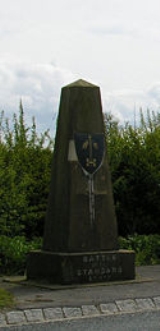
Battle of the Standard

Encyclopedia
The Battle of the Standard, sometimes called the Battle of Northallerton, in which English forces
repelled a Scottish army
, took place on 22 August 1138 on Cowton Moor near Northallerton
in Yorkshire
. The Scottish
forces were led by King David I of Scotland
. The English
were commanded by William of Aumale
.
King Stephen of England
(fighting rebel barons in the south) had sent a small force (largely mercenaries), but the English army was mainly local militia and baronial retinues from Yorkshire
and the north Midlands
. Archbishop Thurstan of York
had exerted himself greatly to raise the army, preaching that to withstand the Scots was to do God’s work. The centre of the English position was therefore marked by a mast (mounted upon a cart) bearing a pyx
carrying the consecrated host
and from which were flown the consecrated banners of the minsters of York
, Beverley
and Ripon: hence the name of the battle. This cart-mounted standard was a very northerly example of a type of standard common in contemporary Italy, where it was known as a carroccio
.
David had entered England for two declared reasons:
David’s forces had already taken much of Northumberland
apart from castles at Wark
and Bamburgh
.
Advancing beyond the Tees towards York
, early on 22 August 1138 the Scots found the English army drawn up on open fields two miles north of Northallerton; they formed up in four ‘lines’ to attack it. The first attack, by unarmoured spearmen
against armoured men
(including dismounted knight
s) supported by telling fire from archers
failed. Within three hours, the Scots army disintegrated, apart from small bodies of knights and men-at-arms around David and his son Henry. At this point, Henry led a spirited attack with mounted knights; he and David then withdrew separately with their immediate companions in relatively good order. Heavy Scots losses are claimed, in battle and in flight.
The English did not pursue far; David fell back to Carlisle and reassembled an army. Within a month, a truce was negotiated which left the Scots free to continue the siege of Wark
castle, which eventually fell. Despite losing the battle, David was subsequently given most of the territorial concessions he had been seeking (which the chronicles say he had been offered before he crossed the Tees). David held these throughout the Anarchy
, but on the death of David, his successor Malcolm IV of Scotland
was soon forced to surrender David's gains to Henry II of England
.
Some chronicle accounts of the battle include an invented pre-battle speech on the glorious deeds of the Normans, occasionally quoted as good contemporary evidence of the high opinion the Normans held of themselves.
 David had gained the Scottish throne largely because of the support of Henry I of England
, and he had attempted to remodel Scotland to be more like Henry's England. He had carried out peaceful changes in the areas of Scotland over which he had effective control and had conducted military campaigns against semi-autonomous regional rulers to reassert his authority; in administration, in warfare, and in the settling of regained territory, he had drawn on the talent and resources of the Anglo-Norman lands. The death of Henry I in 1135, weakening England, made David more reliant on his native subjects, and allowed him to contemplate winning control over substantial areas of northern England.
Henry I had wished his inheritance to pass to his daughter Matilda, and in 1127 made his notables swear an oath to uphold the succession of Matilda (David was the first layman to do so). Many of the English and Norman magnates and barons were against Matilda because she was married to Geoffrey V, count of Anjou
. On Henry’s death, Stephen
, younger brother of Theobald, count of Blois
, seized the throne instead.
When Stephen was crowned on 22 December, David went to war. After two months of campaigning in northern England, a peace treaty
ceding Cumberland
to David was agreed. Additionally, David’s son Henry was made Earl of Huntingdon
, David declining to swear the required oath of loyalty to Stephen, since he had already sworn allegiance to Matilda.
In spring 1137, David again invaded England: a truce was quickly agreed. In November, the truce expired; David demanded to be made earl of the whole of the old earldom of Northumberland
. Stephen refused and in January 1138 David invaded for a third time.
belonged to the Bishop of Durham and its garrison was under-strength; it quickly fell. Having failed to rapidly seize the castle at Wark on Tweed
, David detached forces to besiege it and moved deeper into Northumberland, demanding contributions
from settlements and religious establishments to be spared plunder and burning.
records
In February, King Stephen marched north with an army to deal with David. David successfully evaded him, and Stephen returned south.
marched into Yorkshire
and harried Craven
; on 10 June, he met and defeated an English force of knights and men-at-arms at the battle of Clitheroe
. He also destroyed the recently founded Calder Abbey
in Copeland
. The choice of targets has no obvious strategic logic; it may be pertinent that William eventually inherited both the Honour of Skipton
in Craven , and the Lordship of Copeland
, previously held by his father-in-law William de Meschines and which should have passed to him on the death of William de Meschines' son Ranulph Meschin, the founder of Calder.
and was in "St Cuthbert's land" (the lands of the Bishop of Durham). With him were contingents from most of the separate regions of his kingdom, amounting to more than 26,000 men. Eustace fitz John
had declared for David and handed over to him Alnwick Castle
in Northumberland. The garrison of Eustace's castle at Malton
to the North East of York began to raid surrounding areas in support of David (or Matilda).
The magnates of Yorkshire gathered in York to discuss the worsening crisis:
and Geoffrey Halsalin
, and from Derbyshire led by Robert de Ferrers. They advanced to Thirsk
, from where they sent Robert de Brus
and Bernard de Balliol
(recently arrived with a few mercenaries sent by King Stephen) on an embassy to David, whose army was now approaching the River Tees
and North Yorkshire.
The emissaries promised to obtain the earldom of Northumberland for Henry, if the Scots army withdrew. Ailred of Rievaulx
gives de Brus a speech in which he tells David that the English and the Normans have always been his true friends (against the Gaels), and without their help he may not be able to keep his kingdom together. Whatever was initially said , it ended in hard words being exchanged. Having failed to persuade David to withdraw, the emissaries returned to Thirsk, with de Brus angrily withdrawing his homage to David. David’s forces crossed the Tees and moved south. The English forces moved northwards and took up a defensive position to the north of Northallerton.
on its right. Nearing Northallerton, the distance between hills and river is about 8 miles, much of it low-lying and (then) poorly drained. The road to Northallerton from the Tees (the Great North Road) therefore approaches the town along a ridge of slightly higher ground running North-South . Minor ups and downs break the line of sight along the ridge, but the ‘ups’ are hills only in relation to the low ground on either side of the ridge. The English army deployed across this ridge about two miles N of Northallerton in a single solid formation with the armoured men and most of the knights (who had dismounted, and sent their horses to the rear) to the front supported by the archers and the more lightly equipped men of the local levies. The barons stood with the remaining dismounted knights at the centre of the line around the standard. Their left is thought to have straddled the road, with its flank protected by a marsh; it is not known if the low ground to the east of the ridge was similarly boggy, or if the English formation extended that far.
says that David intended to take the English by surprise, there being a very close mist that day. Richard of Hexham says simply that the Scots became aware of the standard (and by implication the army underneath it) at no great distance.
Ailred of Rievaulx
gives the eventual deployment of the Scots as being in four ‘lines’
. The Galwegians
[from Galloway in South-West Scotland] - described by a later chronicler as
and Teviotdalesmen
... The men of Lothian
formed the third rank, with the islanders
and the men of Lorne
[in the South-West Highlands]. The King kept in his own line the Scots
and Moravians
[men from Moray in North-East Scotland]; several also of the English and French knights he appointed as his bodyguard.”
Henry of Huntingdon
's account of the battle would imply that the men of Lothian with their ‘long spears’ were in the first line; however, the generally accepted view is that the long spears were those of the Galwegians.
(one of David’s native ‘great lords’
) asking why David listened to 'foreigners' when none of those with armour on would this day outdo the mormaer who wore no armour.
, Sheriff of York (and founder of Rievaulx). Henry of Huntingdon and after him Roger of Hoveden say the speech was made by Radulf Novell
Bishop of Orkney
as the representative of Thurstan.
The speaker first reminds the Normans of the military prowess of their race (especially when compared to the Scots):
He next assures them that God has chosen them to punish the Scots:
Any keenness of the Scots to attack is because they don't understand the superiority of Norman equipment:
Furthermore, the Scots' advantage in numbers is no advantage at all, especially when they are up against properly trained Norman knights:
with all his sins forgiven
. These preliminaries over, the battle begins.
The Galwegians finally fled after the death of two of their leaders (Domnall and Ulgric); the men of Lothian similarly broke after the earl of Lothian
was killed by an arrow
Prince Henry led mounted men in a charge on the Anglo-Norman position, as or just after the Scots foot broke. According to Ailred, Henry successfully broke through and attacked the horse-holders in the rear of the Anglo-Norman position; the 'unarmed men' (i.e. unarmoured men) were dispersed, and only rallied by a claim that the Scottish king was dead. Since Prince Henry was unsupported and the rest of the army was withdrawing, for the most part in great disorder, he hid any banners showing his party to be Scottish, and retreated towards David by joining the English pursuing him. Henry of Huntingdon is keener to stress Henry's inability to shake the armoured men; again the attack ends in flight
and terce
[6 - 9 a.m.], and by mid-morning all elements of the Scottish army were in retreat or flight. No numbers are given for total English losses but they are said to have been light; of the knights present, only one was killed. Scottish casualties during the battle proper cannot be separated from losses whilst fleeing in the 10 or so hours of daylight remaining. The chroniclers talk variously of the fugitives scattering in all directions, of their attempting to cross the Tees where there was no ford and drowning, of their being found and killed in cornfields and woods, and of fighting between the various contingents. Richard of Hexham says that of the army which came forth from Scotland, more than ten thousand were missing from the re-mustered survivors. Later chroniclers built upon this to claim 10-12,000 Scots killed. John of Worcester gives more details on the fortunes of the Scots knights
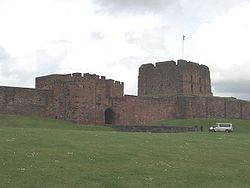
On 26 September Cardinal Alberic, bishop of Ostia
, arrived at Carlisle where David had called together his kingdom's nobles, abbots and bishops. Alberic was there as a papal legate to resolve a long-running dispute as to whether the bishop of Glasgow was subordinate to the archbishop of York. However, Alberic also addressed more temporal matters: he persuaded David to refrain from further offensive action until Martinmas (11 November) whilst continuing to blockade Wark in order to starve it into submission, and the 'Picts' to (also by Martinmas) return their captives to Carlisle and free them there
At Martinmas, the garrison of Wark surrendered on the orders of the castle's owner (Walter Espec), conveyed by the abbot of Rievaulx. The garrison had eaten all but two of their horses; King David rehorsed them and allowed them to depart with their arms.
met each other at Durham and agreed a settlement. Henry was given the earldom of Northumberland and was restored to the earldom of Huntingdon and lordship of Doncaster; David himself was allowed to keep Carlisle and Cumberland. However, King Stephen was to retain possession of the strategically vital castles of Bamburgh
and Newcastle
, and Prince Henry was to perform homage for his English lands, while David himself was to promise to "remain loyal" to Stephen at all times. Stephen released those who held fiefs in the lands Henry now held to do homage to Henry, saving only their fealty to Stephen
of the northern Pennines
gave him silver from which he was able to strike his own coinage). Northern England did not become involved in the civil war between supporters of Stephen and those of Matilda, although magnates with holdings further south were drawn in. This included David, who despite his promise to Stephen was a loyal supporter of Matilda, but he did not go South with a Scottish army.
The new southern border of David's realm appeared to be permanently secured in 1149, when Matilda's son Henry
was knighted by David at Carlisle
now facing a young Henry II of England
who had at his command the resources not only of an England free from civil war, but also of much of Western France
. In 1157, Malcolm travelled to Chester to do homage to Henry who declared that "the king of England ought not to be defrauded of so great a part of his kingdom, nor could he patiently be deprived of it ..."
English Army
The English Army existed while England was an independent state and was at war with other states, but it was not until the Interregnum and the New Model Army that England acquired a peace time professional standing army...
repelled a Scottish army
Military of Scotland
Historically, Scotland has a long military tradition that predates the Act of Union with England. Its armed forces now form part of those of the United Kingdom and are known as the British Armed Forces.-Royal Scots Navy:...
, took place on 22 August 1138 on Cowton Moor near Northallerton
Northallerton
Northallerton is an affluent market town and civil parish in the Hambleton district of North Yorkshire, England. It lies in the Vale of Mowbray and at the northern end of the Vale of York. It has a population of 15,741 according to the 2001 census...
in Yorkshire
Yorkshire
Yorkshire is a historic county of northern England and the largest in the United Kingdom. Because of its great size in comparison to other English counties, functions have been increasingly undertaken over time by its subdivisions, which have also been subject to periodic reform...
. The Scottish
Scotland
Scotland is a country that is part of the United Kingdom. Occupying the northern third of the island of Great Britain, it shares a border with England to the south and is bounded by the North Sea to the east, the Atlantic Ocean to the north and west, and the North Channel and Irish Sea to the...
forces were led by King David I of Scotland
David I of Scotland
David I or Dabíd mac Maíl Choluim was a 12th-century ruler who was Prince of the Cumbrians and later King of the Scots...
. The English
England
England is a country that is part of the United Kingdom. It shares land borders with Scotland to the north and Wales to the west; the Irish Sea is to the north west, the Celtic Sea to the south west, with the North Sea to the east and the English Channel to the south separating it from continental...
were commanded by William of Aumale
William le Gros, 1st Earl of Albemarle
William le Gros was the Count of Aumale , Earl of York, and Lord of Holderness. He was the eldest son of Stephen, Count of Aumale, and his spouse, Hawise, daughter of Ralph de Mortimer of Wigmore....
.
King Stephen of England
Stephen of England
Stephen , often referred to as Stephen of Blois , was a grandson of William the Conqueror. He was King of England from 1135 to his death, and also the Count of Boulogne by right of his wife. Stephen's reign was marked by the Anarchy, a civil war with his cousin and rival, the Empress Matilda...
(fighting rebel barons in the south) had sent a small force (largely mercenaries), but the English army was mainly local militia and baronial retinues from Yorkshire
Yorkshire
Yorkshire is a historic county of northern England and the largest in the United Kingdom. Because of its great size in comparison to other English counties, functions have been increasingly undertaken over time by its subdivisions, which have also been subject to periodic reform...
and the north Midlands
English Midlands
The Midlands, or the English Midlands, is the traditional name for the area comprising central England that broadly corresponds to the early medieval Kingdom of Mercia. It borders Southern England, Northern England, East Anglia and Wales. Its largest city is Birmingham, and it was an important...
. Archbishop Thurstan of York
Thurstan
Thurstan or Turstin of Bayeux was a medieval Archbishop of York, the son of a priest. He served kings William II and Henry I of England before his election to the see of York in 1114. Once elected, his consecration was delayed for five years while he fought attempts by the Archbishop of Canterbury...
had exerted himself greatly to raise the army, preaching that to withstand the Scots was to do God’s work. The centre of the English position was therefore marked by a mast (mounted upon a cart) bearing a pyx
Pyx
A pyx or pix is a small round container used in the Catholic, Old Catholic and Anglican Churches to carry the consecrated host , to the sick or invalid or those otherwise unable to come to a church in order to receive Holy Communion...
carrying the consecrated host
Sacramental bread
Sacramental bread, sometimes called the lamb, altar bread, host or simply Communion bread, is the bread which is used in the Christian ritual of the Eucharist.-Eastern Catholic and Orthodox:...
and from which were flown the consecrated banners of the minsters of York
York Minster
York Minster is a Gothic cathedral in York, England and is one of the largest of its kind in Northern Europe alongside Cologne Cathedral. The minster is the seat of the Archbishop of York, the second-highest office of the Church of England, and is the cathedral for the Diocese of York; it is run by...
, Beverley
John of Beverley
John of Beverley was an English bishop active in the kingdom of Northumbria. He was the Bishop of Hexham and then the Bishop of York which was the most important religious designation in the area. He went on to found the town of Beverley by building the first structure there, a monastery...
and Ripon: hence the name of the battle. This cart-mounted standard was a very northerly example of a type of standard common in contemporary Italy, where it was known as a carroccio
Carroccio
A Carroccio was a four-wheeled war altar, mounting a large vexillum standard, drawn by oxen, used by the medieval republics of Italy. It was a rectangular platform on which the standard of the city and an altar were erected; priests held services on the altar before the battle, and the trumpeters...
.
David had entered England for two declared reasons:
- To support his niece MatildaEmpress MatildaEmpress Matilda , also known as Matilda of England or Maude, was the daughter and heir of King Henry I of England. Matilda and her younger brother, William Adelin, were the only legitimate children of King Henry to survive to adulthood...
's claim to the English throne against that of King StephenStephen of EnglandStephen , often referred to as Stephen of Blois , was a grandson of William the Conqueror. He was King of England from 1135 to his death, and also the Count of Boulogne by right of his wife. Stephen's reign was marked by the Anarchy, a civil war with his cousin and rival, the Empress Matilda...
(married to another nieceMatilda of BoulogneMatilda I was suo jure Countess of Boulogne. She was also queen consort of England as the wife of King Stephen.-Biography:...
)
- To enlarge his kingdom beyond his previous gainsPolitical and military events in Scotland during the reign of David IPolitical and military events in Scotland during the reign of David I are the events which took place in Scotland during David I of Scotland's reign as King of Scots, from 1124 to 1153. When his brother Alexander I of Scotland died in 1124, David chose, with the backing of Henry I of England, to...
.
David’s forces had already taken much of Northumberland
Northumberland
Northumberland is the northernmost ceremonial county and a unitary district in North East England. For Eurostat purposes Northumberland is a NUTS 3 region and is one of three boroughs or unitary districts that comprise the "Northumberland and Tyne and Wear" NUTS 2 region...
apart from castles at Wark
Wark on Tweed
Wark on Tweed is a village in the English county of Northumberland. It lies about south west of Berwick-upon-Tweed...
and Bamburgh
Bamburgh
Bamburgh is a large village and civil parish on the coast of Northumberland, England. It has a population of 454.It is notable for two reasons: the imposing Bamburgh Castle, overlooking the beach, seat of the former Kings of Northumbria, and at present owned by the Armstrong family ; and its...
.
Advancing beyond the Tees towards York
York
York is a walled city, situated at the confluence of the Rivers Ouse and Foss in North Yorkshire, England. The city has a rich heritage and has provided the backdrop to major political events throughout much of its two millennia of existence...
, early on 22 August 1138 the Scots found the English army drawn up on open fields two miles north of Northallerton; they formed up in four ‘lines’ to attack it. The first attack, by unarmoured spearmen
Infantry in the Middle Ages
Despite the rise of knightly cavalry in the 11th Century, infantry played an important role throughout the Middle Ages on both the battlefield and in sieges...
against armoured men
Infantry in the Middle Ages
Despite the rise of knightly cavalry in the 11th Century, infantry played an important role throughout the Middle Ages on both the battlefield and in sieges...
(including dismounted knight
Knight
A knight was a member of a class of lower nobility in the High Middle Ages.By the Late Middle Ages, the rank had become associated with the ideals of chivalry, a code of conduct for the perfect courtly Christian warrior....
s) supported by telling fire from archers
English longbow
The English longbow, also called the Welsh longbow, is a powerful type of medieval longbow about 6 ft long used by the English and Welsh for hunting and as a weapon in medieval warfare...
failed. Within three hours, the Scots army disintegrated, apart from small bodies of knights and men-at-arms around David and his son Henry. At this point, Henry led a spirited attack with mounted knights; he and David then withdrew separately with their immediate companions in relatively good order. Heavy Scots losses are claimed, in battle and in flight.
The English did not pursue far; David fell back to Carlisle and reassembled an army. Within a month, a truce was negotiated which left the Scots free to continue the siege of Wark
Wark on Tweed
Wark on Tweed is a village in the English county of Northumberland. It lies about south west of Berwick-upon-Tweed...
castle, which eventually fell. Despite losing the battle, David was subsequently given most of the territorial concessions he had been seeking (which the chronicles say he had been offered before he crossed the Tees). David held these throughout the Anarchy
The Anarchy
The Anarchy or The Nineteen-Year Winter was a period of English history during the reign of King Stephen, which was characterised by civil war and unsettled government...
, but on the death of David, his successor Malcolm IV of Scotland
Malcolm IV of Scotland
Malcolm IV , nicknamed Virgo, "the Maiden" , King of Scots, was the eldest son of Earl Henry and Ada de Warenne...
was soon forced to surrender David's gains to Henry II of England
Henry II of England
Henry II ruled as King of England , Count of Anjou, Count of Maine, Duke of Normandy, Duke of Aquitaine, Duke of Gascony, Count of Nantes, Lord of Ireland and, at various times, controlled parts of Wales, Scotland and western France. Henry, the great-grandson of William the Conqueror, was the...
.
Some chronicle accounts of the battle include an invented pre-battle speech on the glorious deeds of the Normans, occasionally quoted as good contemporary evidence of the high opinion the Normans held of themselves.
Background
Henry I of England
Henry I was the fourth son of William I of England. He succeeded his elder brother William II as King of England in 1100 and defeated his eldest brother, Robert Curthose, to become Duke of Normandy in 1106...
, and he had attempted to remodel Scotland to be more like Henry's England. He had carried out peaceful changes in the areas of Scotland over which he had effective control and had conducted military campaigns against semi-autonomous regional rulers to reassert his authority; in administration, in warfare, and in the settling of regained territory, he had drawn on the talent and resources of the Anglo-Norman lands. The death of Henry I in 1135, weakening England, made David more reliant on his native subjects, and allowed him to contemplate winning control over substantial areas of northern England.
Henry I had wished his inheritance to pass to his daughter Matilda, and in 1127 made his notables swear an oath to uphold the succession of Matilda (David was the first layman to do so). Many of the English and Norman magnates and barons were against Matilda because she was married to Geoffrey V, count of Anjou
Geoffrey V, Count of Anjou
Geoffrey V , called the Handsome and Plantagenet, was the Count of Anjou, Touraine, and Maine by inheritance from 1129 and then Duke of Normandy by conquest from 1144...
. On Henry’s death, Stephen
Stephen of England
Stephen , often referred to as Stephen of Blois , was a grandson of William the Conqueror. He was King of England from 1135 to his death, and also the Count of Boulogne by right of his wife. Stephen's reign was marked by the Anarchy, a civil war with his cousin and rival, the Empress Matilda...
, younger brother of Theobald, count of Blois
Theobald II of Champagne
Theobald the Great was Count of Blois and of Chartres as Theobald IV from 1102 and was Count of Champagne and of Brie as Theobald II from 1125....
, seized the throne instead.
When Stephen was crowned on 22 December, David went to war. After two months of campaigning in northern England, a peace treaty
Treaty of Durham (1136)
The first treaty of Durham was a peace treaty concluded between kings Stephen of England and David I of Scotland on 5 February 1136. In January 1136, during the first months of the reign of Stephen, David I crossed the border and reached Durham. He took Carlisle, Wark, Alnwick, Norham and...
ceding Cumberland
Cumberland
Cumberland is a historic county of North West England, on the border with Scotland, from the 12th century until 1974. It formed an administrative county from 1889 to 1974 and now forms part of Cumbria....
to David was agreed. Additionally, David’s son Henry was made Earl of Huntingdon
Earl of Huntingdon
Earl of Huntingdon is a title which has been created several times in the Peerage of England. The title is associated with the ruling house of Scotland, and latterly with the Hastings family.-Early history:...
, David declining to swear the required oath of loyalty to Stephen, since he had already sworn allegiance to Matilda.
In spring 1137, David again invaded England: a truce was quickly agreed. In November, the truce expired; David demanded to be made earl of the whole of the old earldom of Northumberland
Earl of Northumbria
Earl of Northumbria was a title in the Anglo-Danish, late Anglo-Saxon, and early Anglo-Norman period in England. The earldom of Northumbria was the successor of the ealdormanry of Bamburgh, itself the successor of an independent Bernicia. Under the Norse kingdom of York, there were earls of...
. Stephen refused and in January 1138 David invaded for a third time.
David invades Northumberland
David first moved against English castles on the Tweed frontier. Norham CastleNorham Castle
Norham Castle is a partly ruined castle in Northumberland, England, overlooking the River Tweed, on the border between England and Scotland. It is a Grade I listed building and a Scheduled Ancient Monument...
belonged to the Bishop of Durham and its garrison was under-strength; it quickly fell. Having failed to rapidly seize the castle at Wark on Tweed
Wark on Tweed
Wark on Tweed is a village in the English county of Northumberland. It lies about south west of Berwick-upon-Tweed...
, David detached forces to besiege it and moved deeper into Northumberland, demanding contributions
Blackmail
In common usage, blackmail is a crime involving threats to reveal substantially true or false information about a person to the public, a family member, or associates unless a demand is met. It may be defined as coercion involving threats of physical harm, threat of criminal prosecution, or threats...
from settlements and religious establishments to be spared plunder and burning.
Scots slave-raiding and Anglo-Norman alarm
The actions of the army that invaded England in early 1138 shocked the English chroniclers,Richard of HexhamRichard of Hexham
Richard of Hexham was an English chronicler. He became prior of Hexham about 1141, and died between 1155 and 1167.He wrote Brevis Annotatio, a short history of the church of Hexham from 674 to 1138, for which he borrowed from Bede, Eddius and Symeon of Durham...
records
Monastic chroniclers often deplore depredations made by foreign armies and sometimes even those of their own rulers but some Scots forces were going beyond normal Norman 'harrying' by systematically carrying off women and children as slaves. In the contemporary Celtic world this was regarded as a useful source of revenue, like (and not significantly more reprehensible than) cattle-raiding.
"an execrable army, more atrocious than the pagans, neither fearing God nor regarding man, spread desolation over the whole province and slaughtered everywhere people of either sex, of every age and rank, destroying, pillaging and burning towns, churches and houses".
"Then (horrible to relate) they carried off, like so much booty, the noble matrons and chaste virgins, together with other women. These naked, fettered, herded together; by whips and thongs they drove before them, goading them with their spears and other weapons. This took place in other wars, but in this to a far greater extent."The practicalities of this would support the chroniclers’ tales of sexual abuse of the slaves and casual slaughter of unsalable encumbrances:
"For the sick on their couches, women pregnant and in childbed, infants in the womb, innocents at the breast, or on the mother's knee, with the mothers themselves, decrepit old men and worn-out old women, and persons debilitated from whatever cause, wherever they met with them, they put to the edge of the sword, and transfixed with their spears; and by how much more horrible a death they could dispatch them, so much the more did they rejoice."
In February, King Stephen marched north with an army to deal with David. David successfully evaded him, and Stephen returned south.
Scots raid into Craven and the Battle of Clitheroe
In the summer, David's nephew William fitz DuncanWilliam fitz Duncan
William fitz Duncan was a Scottish prince, a territorial magnate in northern Scotland and northern England, a general and the legitimate son of king Donnchad II of Scotland by Athelreda of Dunbar.In 1094, his father Donnchad II was killed by Mormaer Máel Petair of...
marched into Yorkshire
Yorkshire
Yorkshire is a historic county of northern England and the largest in the United Kingdom. Because of its great size in comparison to other English counties, functions have been increasingly undertaken over time by its subdivisions, which have also been subject to periodic reform...
and harried Craven
Craven
Craven is a local government district in North Yorkshire, England that came into being in 1974, centred on the market town of Skipton. In the changes to British local government of that year this district was formed as the merger of Skipton urban district, Settle Rural District and most of Skipton...
; on 10 June, he met and defeated an English force of knights and men-at-arms at the battle of Clitheroe
Battle of Clitheroe
The Battle of Clitheroe was a battle between a force of Scots and English knights and men at arms which took place on 10 June 1138 during the period of The Anarchy. The battle was fought on the southern edge of the Bowland Fells, at Clitheroe, Lancashire. It took place in the course of an invasion...
. He also destroyed the recently founded Calder Abbey
Calder Abbey
Calder Abbey in Cumbria was a Savigniac monastery founded in 1134 by Ranulph de Gernon, 2nd Earl of Chester and moved to this site following a refoundation in 1142. It became Cistercian in 1148. It is near to the village of Calder Bridge.- History :...
in Copeland
Copeland, Cumbria
Copeland is a local government district and borough in western Cumbria, England. Its council is based in Whitehaven. It was formed on 1 April 1974 by the merger of the borough of Whitehaven, Ennerdale Rural District and Millom Rural District....
. The choice of targets has no obvious strategic logic; it may be pertinent that William eventually inherited both the Honour of Skipton
Skipton
Skipton is a market town and civil parish within the Craven district of North Yorkshire, England. It is located along the course of both the Leeds and Liverpool Canal and the River Aire, on the south side of the Yorkshire Dales, northwest of Bradford and west of York...
in Craven , and the Lordship of Copeland
Egremont, Cumbria
Egremont is a market town and civil parish in the Borough of Copeland in Cumbria, England, south of Whitehaven and on the River Ehen. The town, which lies at the foot of Uldale Valley and Dent Fell, was historically within Cumberland and has a long industrial heritage including dyeing, weaving and...
, previously held by his father-in-law William de Meschines and which should have passed to him on the death of William de Meschines' son Ranulph Meschin, the founder of Calder.
Peace feelers fail; David enters Yorkshire
By late July David had had crossed the river TyneRiver Tyne
The River Tyne is a river in North East England in Great Britain. It is formed by the confluence of two rivers: the North Tyne and the South Tyne. These two rivers converge at Warden Rock near Hexham in Northumberland at a place dubbed 'The Meeting of the Waters'.The North Tyne rises on the...
and was in "St Cuthbert's land" (the lands of the Bishop of Durham). With him were contingents from most of the separate regions of his kingdom, amounting to more than 26,000 men. Eustace fitz John
Barony of Halton
The Barony of Halton, in Cheshire, England, comprised a succession of 15 barons who held under the overlordship of the County Palatine of Chester ruled by the Earl of Chester. It was not therefore an English feudal barony which was under full royal jurisdiction, which is the usual sense of the...
had declared for David and handed over to him Alnwick Castle
Alnwick Castle
Alnwick Castle is a castle and stately home in the town of the same name in the English county of Northumberland. It is the residence of the Duke of Northumberland, built following the Norman conquest, and renovated and remodelled a number of times. It is a Grade I listed building.-History:Alnwick...
in Northumberland. The garrison of Eustace's castle at Malton
Malton, North Yorkshire
Malton is a market town and civil parish in North Yorkshire, England. The town is the location of the offices of Ryedale District Council and has a population of around 4,000 people....
to the North East of York began to raid surrounding areas in support of David (or Matilda).
The magnates of Yorkshire gathered in York to discuss the worsening crisis:
Archbishop Thurstan of YorkHowever, urged by the 70-year-old Thurstan, to stand and fight and if needs be die in a holy cause, they agreed to gather their forces and return to York, where they were joined by reinforcements from Nottinghamshire under William PeverelThurstanThurstan or Turstin of Bayeux was a medieval Archbishop of York, the son of a priest. He served kings William II and Henry I of England before his election to the see of York in 1114. Once elected, his consecration was delayed for five years while he fought attempts by the Archbishop of Canterbury...
(Lieutenant of the North who, as will presently appear, greatly exerted himself in this emergency), William of AumaleWilliam le Gros, 1st Earl of AlbemarleWilliam le Gros was the Count of Aumale , Earl of York, and Lord of Holderness. He was the eldest son of Stephen, Count of Aumale, and his spouse, Hawise, daughter of Ralph de Mortimer of Wigmore....
, Walter de Gant, Robert de BrusRobert de Brus, 1st Lord of AnnandaleRobert I de Brus, 1st Lord of Annandale was an early 12th century Norman baron and knight, the first of the Bruce dynasty of Scotland and England...
, Roger de MowbrayRobert de MowbrayRobert de Mowbray , a Norman, was Earl of Northumbria from 1086, until 1095, when he was deposed for rebelling against William Rufus, King of England. He was the son of Roger de Mowbray and nephew of Geoffrey de Montbray, bishop of Coutances...
, Walter EspecWalter EspecWalter Espec was a prominent military and judicial figure of the reign of Henry I of England.His father was probably William Speche, a follower of William I of England In the years up to 1120 he with Eustace Fitz John controlled northern England. He was the builder of Helmsley Castle; he built...
(High Sheriff of Yorkshire), Ilbert de LacyDe Lacyde Lacy is the surname of an old Norman noble family originating from Lassy . The first records are about Hugh de Lacy . Descendent of Hugh de Lacy left Normandy and travelled to England along with William the Conqueror. Walter and Ilbert de Lacy fought in the battle of Hastings...
, William de PercyBaron PercyThe title Baron Percy has been created several times in the Peerage of England. The first, in 1066 a Feudal Barony rather than a peerage, became extinct in 1299. The second, in 1299, became extinct in 1517. The third, in 1557, became extinct in 1670. The present creation was in 1722, by writ of...
, Richard de CourcyRichard de CourcyRichard de Courcy was a Norman baron. He accompanied William the Conqueror as a soldier, in the invasion of England.He was subsequently granted lands, giving his name to Stoke Courcy, in Somerset...
, William FossardRobert of ThornhamRobert of Thornham was an English soldier and administrator. The namesake of his landowner father, he was the younger brother of Stephen of Thornham. Robert made his reputation in connection with the conquest of Cyprus in 1191 during the Third Crusade. On order of King Richard I, he led half the...
, Robert de Stuteville
Much irresolution was caused by distrust of each other, arising from suspicions of treachery, by the absence of a chief and leader of the war (for their sovereign, king Stephen, encompassed by equal difficulties in the south of England, was just then unable to join them), and by their dread of encountering, with an inadequate force, so great a host
William Peverel
William Peverell , was a Norman knight, and is shown in 'The Battle Abbey Roll' to have fought at the Battle of Hastings.-Biography:...
and Geoffrey Halsalin
Elvaston, Derbyshire
Elvaston is a small village and civil parish in Derbyshire, England. The parish also includes two other hamlets, Ambaston and Thulston, and a recently built housing estate Boulton Moor...
, and from Derbyshire led by Robert de Ferrers. They advanced to Thirsk
Thirsk
Thirsk is a small market town and civil parish in the Hambleton district of North Yorkshire, England. The local travel links are located a mile from the town centre to Thirsk railway station and to Durham Tees Valley Airport...
, from where they sent Robert de Brus
Robert de Brus, 1st Lord of Annandale
Robert I de Brus, 1st Lord of Annandale was an early 12th century Norman baron and knight, the first of the Bruce dynasty of Scotland and England...
and Bernard de Balliol
Bernard I de Balliol
Bernard I de Balliol , the second known ruling Balliol of his line, was a twelfth-century Anglo-Picard baron based for much of his time in the north of England, as well as at Bailleul-en-Vimeu close to Abbeville in northern France...
(recently arrived with a few mercenaries sent by King Stephen) on an embassy to David, whose army was now approaching the River Tees
River Tees
The River Tees is in Northern England. It rises on the eastern slope of Cross Fell in the North Pennines, and flows eastwards for 85 miles to reach the North Sea between Hartlepool and Redcar.-Geography:...
and North Yorkshire.
The emissaries promised to obtain the earldom of Northumberland for Henry, if the Scots army withdrew. Ailred of Rievaulx
Ailred of Rievaulx
Aelred , also Aelred, Ælred, Æthelred, etc., was an English writer, abbot of Rievaulx , and saint.-Life:...
gives de Brus a speech in which he tells David that the English and the Normans have always been his true friends (against the Gaels), and without their help he may not be able to keep his kingdom together. Whatever was initially said , it ended in hard words being exchanged. Having failed to persuade David to withdraw, the emissaries returned to Thirsk, with de Brus angrily withdrawing his homage to David. David’s forces crossed the Tees and moved south. The English forces moved northwards and took up a defensive position to the north of Northallerton.
Battlefield and English Dispositions
Moving south from the Tees David’s army would have had the high ground of the North Yorkshire Moors on its left, and the River SwaleRiver Swale
The River Swale is a river in Yorkshire, England and a major tributary of the River Ure, which itself becomes the River Ouse, emptying into the North Sea via the Humber Estuary....
on its right. Nearing Northallerton, the distance between hills and river is about 8 miles, much of it low-lying and (then) poorly drained. The road to Northallerton from the Tees (the Great North Road) therefore approaches the town along a ridge of slightly higher ground running North-South . Minor ups and downs break the line of sight along the ridge, but the ‘ups’ are hills only in relation to the low ground on either side of the ridge. The English army deployed across this ridge about two miles N of Northallerton in a single solid formation with the armoured men and most of the knights (who had dismounted, and sent their horses to the rear) to the front supported by the archers and the more lightly equipped men of the local levies. The barons stood with the remaining dismounted knights at the centre of the line around the standard. Their left is thought to have straddled the road, with its flank protected by a marsh; it is not known if the low ground to the east of the ridge was similarly boggy, or if the English formation extended that far.
Scots Arrive and Deploy
John of WorcesterJohn of Worcester
John of Worcester was an English monk and chronicler. He is usually held to be the author of the Chronicon ex chronicis.-Chronicon ex chronicis:...
says that David intended to take the English by surprise, there being a very close mist that day. Richard of Hexham says simply that the Scots became aware of the standard (and by implication the army underneath it) at no great distance.
“In front of the battle were the Picts; in the centre, the king with his knights and English; the rest of the barbarian host poured roaring around them. The king and almost all his followers were on foot, their horses being kept at a distance.”
Ailred of Rievaulx
Ailred of Rievaulx
Aelred , also Aelred, Ælred, Æthelred, etc., was an English writer, abbot of Rievaulx , and saint.-Life:...
gives the eventual deployment of the Scots as being in four ‘lines’
Battle (formation)
A battle or battaile was a medieval military formation, analogous and ancestral to the modern term battalion. In late medieval warfare, field armies were often drawn up into three main battles, also called guards: the vanguard, the middle guard, and the rearguard, often abbreviated to simply the...
. The Galwegians
Fergus of Galloway
Fergus of Galloway was King, or Lord, of Galloway from an unknown date , until his death in 1161. He was the founder of that "sub-kingdom," the resurrector of the Bishopric of Whithorn, the patron of new abbeys , and much else besides...
[from Galloway in South-West Scotland] - described by a later chronicler as
" men agile, unclothed, remarkable for much baldness; arming their left side with knives formidable to any armed men, having a hand most skillful at throwing spears and directing them from a distance; raising their long lance as a standard when they advance into battle"- were in the first line. "The second line the King's son Prince Henry arranged with great wisdom; with himself the knights and archers, adding to their number the Cumbrians
David, Prince of the Cumbrians
Before David I of Scotland became King of Scotland in 1124, he was David, Prince of the Cumbrians and earl of a great territory in the middle of England acquired by marriage. This period marks the beginning of his life as a great territorial lord...
and Teviotdalesmen
River Teviot
The River Teviot, or Teviot Water, is a river of the Scottish Borders area of Scotland, and a tributary of the River Tweed.It rises in the western foothills of Comb Hill on the border of Dumfries and Galloway...
... The men of Lothian
Lothian
Lothian forms a traditional region of Scotland, lying between the southern shore of the Firth of Forth and the Lammermuir Hills....
formed the third rank, with the islanders
Argyll and Bute
Argyll and Bute is both one of 32 unitary council areas; and a Lieutenancy area in Scotland. The administrative centre for the council area is located in Lochgilphead.Argyll and Bute covers the second largest administrative area of any Scottish council...
and the men of Lorne
Lorne, Argyll and Bute
Lorne is an ancient district in the west of Scotland, now part of the Argyll and Bute council area. It is within the region once named Lorna which may have taken its name from Loarn mac Eirc. However the last cartographical reference to Lorna is in 1607 with that same area being referred to as...
[in the South-West Highlands]. The King kept in his own line the Scots
Scottish people
The Scottish people , or Scots, are a nation and ethnic group native to Scotland. Historically they emerged from an amalgamation of the Picts and Gaels, incorporating neighbouring Britons to the south as well as invading Germanic peoples such as the Anglo-Saxons and the Norse.In modern use,...
and Moravians
Moray
Moray is one of the 32 council areas of Scotland. It lies in the north-east of the country, with coastline on the Moray Firth, and borders the council areas of Aberdeenshire and Highland.- History :...
[men from Moray in North-East Scotland]; several also of the English and French knights he appointed as his bodyguard.”
Henry of Huntingdon
Henry of Huntingdon
Henry of Huntingdon , the son of a canon in the diocese of Lincoln, was a 12th century English historian, the author of a history of England, Historia anglorum, "the most important Anglo-Norman historian to emerge from the secular clergy". He served as archdeacon of Huntingdon...
's account of the battle would imply that the men of Lothian with their ‘long spears’ were in the first line; however, the generally accepted view is that the long spears were those of the Galwegians.
Scots argue
Ailred says (but this may be a literary device) that this order of battle was decided at the last minute; David had intended to attack first with his knights and armoured men-at-arms, but had faced strong protests from the Galwegians that they should be given the honour of attacking first, since they had already demonstrated at Clitheroe that the vigour of their attack was sufficient to rout Normans in armour. David, however, paid more attention to the counter-argument of his Normans; that if the Galwegians failed the rest of the army would lose heart. The Galwegians resumed their protest, and the debate was not aided by a mormaerMáel Ísu I, Earl of Strathearn
Máel Ísu I , , is the earliest known Mormaer of Strathearn...
(one of David’s native ‘great lords’
Mormaer
The title of Mormaer designates a regional or provincial ruler in the medieval Kingdom of the Scots. In theory, although not always in practice, a Mormaer was second only to the King of Scots, and the senior of a toisech.-Origin:...
) asking why David listened to 'foreigners' when none of those with armour on would this day outdo the mormaer who wore no armour.
And Alan de Percy, base-born son of the great AlanBaron PercyThe title Baron Percy has been created several times in the Peerage of England. The first, in 1066 a Feudal Barony rather than a peerage, became extinct in 1299. The second, in 1299, became extinct in 1517. The third, in 1557, became extinct in 1670. The present creation was in 1722, by writ of...
- a most vigorous knight, and in military matters highly distinguished - took these words ill; and turning to the earl he said, 'A great word hast thou spoken, and one which for thy life thou canst not make good this day.'
Then the king, restraining both, lest a disturbance should suddenly arise out of this altercation, yielded to the will of the Galwegians.
Anglo-Normans orate
Both Ailred and Henry of Huntingdon report a speech made to the Anglo-Normans before battle was joined. The speech may well be a literary device of the chroniclers, to present the reasons why it was fit and proper that the Normans should win, rather than accurate reportage of an actual speech. Ailred of Rievaulx says the speech was made by Walter EspecWalter Espec
Walter Espec was a prominent military and judicial figure of the reign of Henry I of England.His father was probably William Speche, a follower of William I of England In the years up to 1120 he with Eustace Fitz John controlled northern England. He was the builder of Helmsley Castle; he built...
, Sheriff of York (and founder of Rievaulx). Henry of Huntingdon and after him Roger of Hoveden say the speech was made by Radulf Novell
Radulf Novell
Radulf Novell was a 12th century Anglo-Norman prelate. He was a native of York, and according to writings produced by the Archbishopric of York, was elected as Bishop of Orkney at St Peter's church in York by some representatives of the community of Orkney....
Bishop of Orkney
Bishop of Orkney
The Bishop of Orkney was the ecclesiastical head of the Diocese of Orkney, one of thirteen medieval bishoprics within the territory of modern Scotland. It included both Orkney and Shetland. It was based for almost all of its history at St...
as the representative of Thurstan.
The speaker first reminds the Normans of the military prowess of their race (especially when compared to the Scots):
"Most illustrious nobles of England, NormansNormansThe Normans were the people who gave their name to Normandy, a region in northern France. They were descended from Norse Viking conquerors of the territory and the native population of Frankish and Gallo-Roman stock...
by birth, ... consider who you are, and against whom, and where it is, you are waging war; for then no one shall with impunity resist your prowess. Bold France, taught by experienceBattle of BremuleThe Battle of Brémule was fought in 1119 between Henry I of England and Louis VI the Fat of France. Henry I had to defend his holdings in Normandy several times and defeated a French invasion at the Battle of Brémule in 1119....
, has quailed beneath your valour, fierce EnglandWilliam I of EnglandWilliam I , also known as William the Conqueror , was the first Norman King of England from Christmas 1066 until his death. He was also Duke of Normandy from 3 July 1035 until his death, under the name William II...
, led captive, has submittedNorman conquest of EnglandThe Norman conquest of England began on 28 September 1066 with the invasion of England by William, Duke of Normandy. William became known as William the Conqueror after his victory at the Battle of Hastings on 14 October 1066, defeating King Harold II of England...
to you; rich ApuliaNorman conquest of southern ItalyThe Norman conquest of southern Italy spanned the late eleventh and much of the twelfth centuries, involving many battles and many independent players conquering territories of their own...
, on having you for her masters, has flourished once again; JerusalemFirst CrusadeThe First Crusade was a military expedition by Western Christianity to regain the Holy Lands taken in the Muslim conquest of the Levant, ultimately resulting in the recapture of Jerusalem...
so famed, and illustrious AntiochSiege of AntiochThe Siege of Antioch took place during the First Crusade in 1097 and 1098. The first siege, by the crusaders against the Muslim city, lasted from October 21, 1097, to June 2, 1098. The second siege, against the crusaders who had occupied it, lasted from June 7 to June 28, 1098.-Background:Antioch...
, have bowed themselves before you; and now Scotland, which of right is subject to you, attempts to show resistance, displaying a temerity not warranted by her arms, more fitted indeed for rioting than for battle. These are people, in fact, who have no knowledge of military matters, no skill in fighting, no moderation in ruling. There is no room then left for fear, but rather for shame, that those whom we have always sought on their own soil and overcome ..have ...come flocking into our country."
He next assures them that God has chosen them to punish the Scots:
"This .. has been brought about by Divine Providence; in order that those who have in this country violated the temples of God, stained the altars with blood, slain his priests, spared neither children nor pregnant women, may on the same spot receive the condign punishment of their crimes; and this most just resolve of the Divine will, God will this day put in execution by means of your hands. Arouse your spirits then, ye civilized warriors, and, firmly relying on the valour of your country, nay, rather on the presence of GodTransubstantiationIn Roman Catholic theology, transubstantiation means the change, in the Eucharist, of the substance of wheat bread and grape wine into the substance of the Body and Blood, respectively, of Jesus, while all that is accessible to the senses remains as before.The Eastern Orthodox...
, arise against these most unrighteous foes"
Any keenness of the Scots to attack is because they don't understand the superiority of Norman equipment:
"And let not their rashness move you, because so many insignia of your valour cause no alarm to them. They know not how to arm themselves for battle; whereas you, during the time of peace, prepare yourselves for war, in order that in battle you may not experience the doubtful contingencies of warfare. Cover your heads then with the helmetHelmetA helmet is a form of protective gear worn on the head to protect it from injuries.Ceremonial or symbolic helmets without protective function are sometimes used. The oldest known use of helmets was by Assyrian soldiers in 900BC, who wore thick leather or bronze helmets to protect the head from...
, your breasts with the coat of mail, your legs with the greavesGreavesGreaves may refer to*Greave, armour that protects the leg *Greaves Greaves is also a surname, which may refer to:*Jimmy Greaves, English footballer*John Greaves, English mathematician and antiquary...
, and your bodies with the shieldShieldA shield is a type of personal armor, meant to intercept attacks, either by stopping projectiles such as arrows or redirecting a hit from a sword, mace or battle axe to the side of the shield-bearer....
, that so the foeman may not find where to strike at you, on seeing you thus surrounded on every side with iron."
Furthermore, the Scots' advantage in numbers is no advantage at all, especially when they are up against properly trained Norman knights:
"[I]t is not so much the numbers of the many as the valour of the few that gains the battle. For a multitude unused to discipline is a hindrance to itself, when successful, in completing the victory, when routed, in taking to flight. Besides your forefathers, when but few in number, have many a time conquered multitudes; what then is the natural consequence of the glories of your ancestry, your constant exercises, your military discipline, but that though fewer in number, you should overcome multitudes?"The bishop then finishes by promising that anyone who dies in battle against the Scots this day will go straight to Heaven
Heaven
Heaven, the Heavens or Seven Heavens, is a common religious cosmological or metaphysical term for the physical or transcendent place from which heavenly beings originate, are enthroned or inhabit...
with all his sins forgiven
Indulgence
In Catholic theology, an indulgence is the full or partial remission of temporal punishment due for sins which have already been forgiven. The indulgence is granted by the Catholic Church after the sinner has confessed and received absolution...
. These preliminaries over, the battle begins.
Galwegian attack is held and fails
The battle began with a charge by the Galwegian spearmen who"after their custom gave vent thrice to a yell of horrible sound, and attacked the southerns in such an onslaught that they compelled the first spearmen to forsake their post; but they were driven off again by the strength of the knights, and [the spearmen] recovered their courage and strength against the foe. And when the frailty of the Scottish lances was mocked by the denseness of iron and wood they drew their swords and attempted to contend at close quarters"The English archery caused disorganisation and heavy casualties in the Scottish ranks. Ailred records the bravery and determination of the Galwegians, together with its ineffectiveness:
"like a hedgehog with its quill, so would you see a Galwegian bristling all round with arrows, and nonetheless brandishing his sword, and in blind madnessBerserkerBerserkers were Norse warriors who are reported in the Old Norse literature to have fought in a nearly uncontrollable, trance-like fury, a characteristic which later gave rise to the English word berserk. Berserkers are attested in numerous Old Norse sources...
rushing forward now smite a foe, now lash the air with useless strokes".
The Galwegians finally fled after the death of two of their leaders (Domnall and Ulgric); the men of Lothian similarly broke after the earl of Lothian
Gospatric II, Earl of Lothian
Gospatric II was Earl of Lothian or Earl of Dunbar in the early 12th century.He was the son of Gospatric I, sometime Earl of Northumbria...
was killed by an arrow
The King retreats; Prince Henry attacks
David wished to stand and fight, but was forced onto his horse and compelled to retire by his friends. Ailred simply says that the English were advancing; Henry of Huntingdon says that David's 'line' had been progressively melting away.Prince Henry led mounted men in a charge on the Anglo-Norman position, as or just after the Scots foot broke. According to Ailred, Henry successfully broke through and attacked the horse-holders in the rear of the Anglo-Norman position; the 'unarmed men' (i.e. unarmoured men) were dispersed, and only rallied by a claim that the Scottish king was dead. Since Prince Henry was unsupported and the rest of the army was withdrawing, for the most part in great disorder, he hid any banners showing his party to be Scottish, and retreated towards David by joining the English pursuing him. Henry of Huntingdon is keener to stress Henry's inability to shake the armoured men; again the attack ends in flight
"Next, the king’s troop ... began to drop off, at first; man by man, and afterwards in bodies, the king standing firm, and being at last left almost alone. The king’s friends seeing this, forced him to mount his horse and take to flight; but Henry, his valiant son, not heeding what he saw being done by his men, but solely intent on glory and valour, while the rest were taking to flight, most bravely charged the enemy’s line, and shook it by the wondrous vigour of his onset. For his troop was the only one mounted on horseback, and consisted of English and Normans, who formed a part of his father’s household. His horsemen, however, were not able long to continue their attacks against soldiers on foot, cased in mail, and standing immoveable in close and dense ranks; but, with their lances broken and their horses wounded, were compelled to take to flight."
Scots Rout & Casualties
The battle lasted no longer than between primePrime (liturgy)
Prime, or the First Hour, is a fixed time of prayer of the traditional Divine Office , said at the first hour of daylight , between the morning Hour of Lauds and the 9 a.m. Hour of Terce. It is part of the Christian liturgies of Eastern Christianity, but in the Latin Rite it was suppressed by the...
and terce
Terce
Terce, or Third Hour, is a fixed time of prayer of the Divine Office of almost all the Christian liturgies. It consists mainly of psalms and is said at 9 a.m. Its name comes from Latin and refers to the third hour of the day after dawn....
[6 - 9 a.m.], and by mid-morning all elements of the Scottish army were in retreat or flight. No numbers are given for total English losses but they are said to have been light; of the knights present, only one was killed. Scottish casualties during the battle proper cannot be separated from losses whilst fleeing in the 10 or so hours of daylight remaining. The chroniclers talk variously of the fugitives scattering in all directions, of their attempting to cross the Tees where there was no ford and drowning, of their being found and killed in cornfields and woods, and of fighting between the various contingents. Richard of Hexham says that of the army which came forth from Scotland, more than ten thousand were missing from the re-mustered survivors. Later chroniclers built upon this to claim 10-12,000 Scots killed. John of Worcester gives more details on the fortunes of the Scots knights
"But of [David's] army nearly ten thousand fell in different places, and as many as fifty were captured of his picked men. But the king's son came on foot with one knight only to Carlisle, while his father scarce escaped through woods and passes to Roxburgh. Of two hundred mailed knights whom [David] had, only nineteen brought back their hauberks; because each had abandoned as booty to the foe almost everything that he had. And thus very great spoils were taken from his army, as well of horses and arms and raiment as of very many other things".
Aftermath
End of the Campaign
David regrouped his forces at Carlisle; the nobles of Yorkshire did not move North against him, and their local levies dispersed to their homes rejoicing at the victory. Thus, although militarily the battle was a "shattering defeat", it did not reverse David's previous gains. David had the only army still under arms and was left to consolidate his hold on Cumberland and Northumberland.On 26 September Cardinal Alberic, bishop of Ostia
Ostia Antica (district)
thumb|300px|The Castle of Julius II in Ostia Antica.thumb|300px|The square of Ostia Antica, with the church of Santa Aurea on the right.Ostia Antica is a district in the commune of Rome, Italy, five kilometers away from the coast. It is distinct from Ostia.- History :Under the Romans, Ostia Antica...
, arrived at Carlisle where David had called together his kingdom's nobles, abbots and bishops. Alberic was there as a papal legate to resolve a long-running dispute as to whether the bishop of Glasgow was subordinate to the archbishop of York. However, Alberic also addressed more temporal matters: he persuaded David to refrain from further offensive action until Martinmas (11 November) whilst continuing to blockade Wark in order to starve it into submission, and the 'Picts' to (also by Martinmas) return their captives to Carlisle and free them there
At Martinmas, the garrison of Wark surrendered on the orders of the castle's owner (Walter Espec), conveyed by the abbot of Rievaulx. The garrison had eaten all but two of their horses; King David rehorsed them and allowed them to depart with their arms.
Another Peace Agreement
Negotiations between David and Stephen continued over the winter months, and on April 9 David's son Henry and Stephen's wife Matilda of BoulogneMatilda of Boulogne
Matilda I was suo jure Countess of Boulogne. She was also queen consort of England as the wife of King Stephen.-Biography:...
met each other at Durham and agreed a settlement. Henry was given the earldom of Northumberland and was restored to the earldom of Huntingdon and lordship of Doncaster; David himself was allowed to keep Carlisle and Cumberland. However, King Stephen was to retain possession of the strategically vital castles of Bamburgh
Bamburgh
Bamburgh is a large village and civil parish on the coast of Northumberland, England. It has a population of 454.It is notable for two reasons: the imposing Bamburgh Castle, overlooking the beach, seat of the former Kings of Northumbria, and at present owned by the Armstrong family ; and its...
and Newcastle
Newcastle upon Tyne
Newcastle upon Tyne is a city and metropolitan borough of Tyne and Wear, in North East England. Historically a part of Northumberland, it is situated on the north bank of the River Tyne...
, and Prince Henry was to perform homage for his English lands, while David himself was to promise to "remain loyal" to Stephen at all times. Stephen released those who held fiefs in the lands Henry now held to do homage to Henry, saving only their fealty to Stephen
Northern England Under Scottish Rule
This arrangement lasted for nearly 20 years, and would appear to have been beneficial to both sides. David was able to benefit from the resources of Northern England (for example, the lead minesAlston, Cumbria
Alston is a small town in Cumbria, England on the River South Tyne. It is one of the highest elevation towns in the country, at about 1,000 feet above sea level.-Geography:...
of the northern Pennines
Pennines
The Pennines are a low-rising mountain range, separating the North West of England from Yorkshire and the North East.Often described as the "backbone of England", they form a more-or-less continuous range stretching from the Peak District in Derbyshire, around the northern and eastern edges of...
gave him silver from which he was able to strike his own coinage). Northern England did not become involved in the civil war between supporters of Stephen and those of Matilda, although magnates with holdings further south were drawn in. This included David, who despite his promise to Stephen was a loyal supporter of Matilda, but he did not go South with a Scottish army.
The new southern border of David's realm appeared to be permanently secured in 1149, when Matilda's son Henry
Henry II of England
Henry II ruled as King of England , Count of Anjou, Count of Maine, Duke of Normandy, Duke of Aquitaine, Duke of Gascony, Count of Nantes, Lord of Ireland and, at various times, controlled parts of Wales, Scotland and western France. Henry, the great-grandson of William the Conqueror, was the...
was knighted by David at Carlisle
he having first given an oath that, if he became king of England, he would give to [David]Newcastle and all Northumbria, and would permit him and his heirs to possess in peace without counter-claim for ever the whole land which lies from the river Tweed to the river Tyne.
Status Quo Restored
However, Prince Henry died in 1152, King David in 1153, and King Stephen in 1154. This brought to the throne of Scotland a 14-year-old Malcolm IV of ScotlandMalcolm IV of Scotland
Malcolm IV , nicknamed Virgo, "the Maiden" , King of Scots, was the eldest son of Earl Henry and Ada de Warenne...
now facing a young Henry II of England
Henry II of England
Henry II ruled as King of England , Count of Anjou, Count of Maine, Duke of Normandy, Duke of Aquitaine, Duke of Gascony, Count of Nantes, Lord of Ireland and, at various times, controlled parts of Wales, Scotland and western France. Henry, the great-grandson of William the Conqueror, was the...
who had at his command the resources not only of an England free from civil war, but also of much of Western France
Angevin Empire
The term Angevin Empire is a modern term describing the collection of states once ruled by the Angevin Plantagenet dynasty.The Plantagenets ruled over an area stretching from the Pyrenees to Ireland during the 12th and early 13th centuries, located north of Moorish Iberia. This "empire" extended...
. In 1157, Malcolm travelled to Chester to do homage to Henry who declared that "the king of England ought not to be defrauded of so great a part of his kingdom, nor could he patiently be deprived of it ..."
"And [Malcolm] prudently considering that in this matter the king of England was superior to the merits of the case by the authority of might ..restored to him the .. territories in their entirety, and received from him in return the earldom of Huntingdon, which belonged to him by ancient right. Things being so arranged, England enjoyed for a time her ease and security in all her borders. And the king ruled more widely than all who were known to have ruled in England till that time, that is from the furthest bounds of Scotland as far as to the PyreneesPyreneesThe Pyrenees is a range of mountains in southwest Europe that forms a natural border between France and Spain...
".
Significance of the Battle
The Battle did not stop David achieving his declared war aims. We now know that achieving those aims whilst England was in turmoil did not prevent all David's gains having to be surrendered when Henry II made the Scottish monarch an offer he could not refuse. Unless David had other undeclared aims and ambitions, which defeat at the Standard thwarted, therefore, the battle had no long-term significance.In Historical Fiction
- George Shipway gives a fictional account of the Battle of the Standard in his 1969 novel "Knight In Anarchy"
Modern secondary sources
- Aird, William M, "Sweet Civility and Barbarous Rudeness" A view from the frontier, Abbot Ailred of Rievaulx and the Scots p 63 onwards in Ellis Steven G et al. (eds) Imagining Frontiers, Contesting Identities, (Pisa, 2007), ISBN 8-8849-2466-9
- Baker, D., Aelred of Rievaulx and Walter Espec p 91-98 in Haskins Society Journal 1989, 1
- Bartlett, RobertRobert Bartlett (historian)Robert Bartlett FRHistS, FBA, FRSE, FSA is a historian and medievalist. Bartlett is English, though his academic interests cover the whole of Europe....
, England under the Norman and Angevin Kings, 1075–1225, (Oxford, 2000) - Beeler, John Warfare in England 1066–1189 (New York, 1966) [narrative of battle p 84-95]
- Bliese J. R. E,. , The Battle Rhetoric of Aelred of Rievaulx p 99-107 in Haskins Society Journal 1989, 1
- Bradbury, J., The Routledge Companion to Medieval Warfare, Routledge (2004) ISBN 978-0-203-64466-9
- Burton, Janet, The Monastic Order in Yorkshire, 1069–1215, Cambridge University Press,(Cambridge,1999), ISBN 0-521-55229-X
- Clancy, M. T., England and its Rulers, 2nd Ed., (Malden, MA, 1998)
- Davies. R. R., The First English Empire: Power and Identities in the British Isles, 1093–1343, (Oxford, 2000)
- Duncan, A. A. M., The Kingship of the Scots 842-1292: Succession and Independence, (Edinburgh, 2002)
- Duncan, A. A. M., Scotland: The Making of the Kingdom, (Edinburgh, 1975)
- Gransden, Antonia, Historical Writing in England, Routledge, (London, 1974), ISBN 0-4151-5124-4
- Green, Judith A.Judith Green (historian)Judith Green is an English medieval historian, who is Emeritus Professor of Medieval History at the University of Edinburgh. A graduate of King's College, London and Somerville College, Oxford, she held a research fellowship and then a lectureship at the University of St Andrews before transferring...
, "Anglo-Scottish Relations, 1066–1174", in Michael Jones and Malcolm Vale (eds.), England and Her Neighbours: Essays in Honour of Pierre Chaplais (London, 1989) - Green, Judith A., "David I and Henry I", in the Scottish Historical Review. vol. 75 (1996), pp. 1–19
- Moffat, Alistair The Borders , Birlinn, (Edinburgh, 2007) ISBN 1-84158-466-5
- Oram, Richard, David: The King Who Made Scotland, (Gloucestershire, 2004)
- Powicke, M, Aelred of Rievaulx and his Biographer, (Manchester, 1922)
- Ritchie R L G The Normans in Scotland (Edinburgh, 1954)(narrative of battle is p 256-70)
- Strickland, Matthew, Anglo-Norman Warfare: Studies in Late Anglo-Saxon and Anglo-Norman Military Organization and Warfare, (Woodbridge, 1992)ISBN 0-8511-5328-3
- (Victoria County History) A History of the County of Cumberland : Volume 2 (1905)
External links
- Anderson (1908)
- Battlefields Trust
- Richard of Hexham (English traditional chronicle)
- Roger of Hoveden
- Battle of the Standard, Scots version