

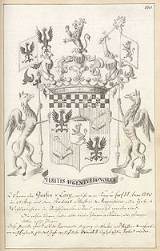
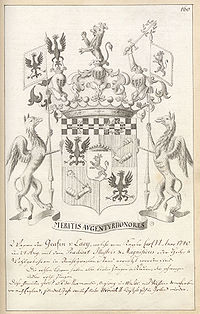
De Lacy

Encyclopedia
Normans
The Normans were the people who gave their name to Normandy, a region in northern France. They were descended from Norse Viking conquerors of the territory and the native population of Frankish and Gallo-Roman stock...
noble family originating from Lassy (Calvados)
Lassy, Calvados
Lassy is a commune in the Calvados department in the Basse-Normandie region in northwestern France.-Population:...
. The first records are about Hugh de Lacy (1020–1049). Descendent of Hugh de Lacy left Normandy
Normandy
Normandy is a geographical region corresponding to the former Duchy of Normandy. It is in France.The continental territory covers 30,627 km² and forms the preponderant part of Normandy and roughly 5% of the territory of France. It is divided for administrative purposes into two régions:...
and travelled to England along with William the Conqueror
William I of England
William I , also known as William the Conqueror , was the first Norman King of England from Christmas 1066 until his death. He was also Duke of Normandy from 3 July 1035 until his death, under the name William II...
. Walter and Ilbert de Lacy fought in the battle of Hastings
Battle of Hastings
The Battle of Hastings occurred on 14 October 1066 during the Norman conquest of England, between the Norman-French army of Duke William II of Normandy and the English army under King Harold II...
. The family took a major role in the Norman conquest of England
Norman conquest of England
The Norman conquest of England began on 28 September 1066 with the invasion of England by William, Duke of Normandy. William became known as William the Conqueror after his victory at the Battle of Hastings on 14 October 1066, defeating King Harold II of England...
and Ireland
Ireland
Ireland is an island to the northwest of continental Europe. It is the third-largest island in Europe and the twentieth-largest island on Earth...
. Up until 1399, the De Lacys held the great northern Lordship of Bowland
Lordship of Bowland
The Lordship of Bowland, an ancient English title connected with the Forest of Bowland in the northwest of England, was once thought lost and was only recently rediscovered. It disappeared from sight in 1885 when the estates of the Towneleys, one of Lancashire’s great aristocratic families, were...
before it passed through marriage to the Earldom, later Duchy of Lancaster
Duchy of Lancaster
The Duchy of Lancaster is one of the two royal duchies in England, the other being the Duchy of Cornwall. It is held in trust for the Sovereign, and is used to provide income for the use of the British monarch...
as well as being Lords of Pontefract
Pontefract
Pontefract is an historic market town in West Yorkshire, England. Traditionally in the West Riding, near the A1 , the M62 motorway and Castleford. It is one of the five towns in the metropolitan borough of the City of Wakefield and has a population of 28,250...
and later Earls of Lincoln.
The family is linked to the Scottish Royal family; Elizabeth de Burgh
Elizabeth de Burgh
Elizabeth de Burgh was the second wife and the only queen consort of King Robert I of Scotland.-Life:She was born in Dunfermline, Fife in Scotland, the daughter of the powerful Richard Óg de Burgh, 2nd Earl of Ulster and his wife Margarite de Burgh...
, whose great grandfather was Walter de Lacy
Walter de Lacy
Walter de Lacy was Lord of Meath in Ireland and Ludlow in Shropshire in the Welsh Marches.- Life :With his father Hugh de Lacy, Lord of Meath he built Trim Castle , Trim, County Meath....
, married Robert the Bruce
Robert I of Scotland
Robert I , popularly known as Robert the Bruce , was King of Scots from March 25, 1306, until his death in 1329.His paternal ancestors were of Scoto-Norman heritage , and...
. Another link exists to the Royal Windsor
House of Windsor
The House of Windsor is the royal house of the Commonwealth realms. It was founded by King George V by royal proclamation on the 17 July 1917, when he changed the name of his family from the German Saxe-Coburg and Gotha to the English Windsor, due to the anti-German sentiment in the United Kingdom...
family by Sarah Ferguson
Sarah, Duchess of York
Sarah, Duchess of York is a British charity patron, spokesperson, writer, film producer, television personality and former member of the British Royal Family. She is the former wife of Prince Andrew, Duke of York, whom she married from 1986 to 1996...
via Wingfield
Wingfield
Wingfield could be:People* Sir Charles John Wingfield, MP* Edward Maria Wingfield, first President of the Jamestown colony, Virginia, US* Sir John de Wingfield, aide to Edward the Black Prince* Peter Wingfield, an actor famous as Methos...
, Meade
Meade
Meade Instruments Corporation is a multinational company headquartered in Irvine, California, that manufactures, imports, and distributes telescopes, binoculars, spotting scopes, microscopes, CCD cameras and telescope accessories for the consumer market. It is the world's largest manufacturer of...
, O'Brien
O'Brien
The O'Brien dynasty are a royal and noble house founded in the 10th century by Brian Boru of the Dál gCais or Dalcassians. After becoming King of Munster, through conquest he established himself as High King of Ireland...
, Fitzgerald, De Burgh and therefore back to Walter de Lacy
Walter de Lacy
Walter de Lacy was Lord of Meath in Ireland and Ludlow in Shropshire in the Welsh Marches.- Life :With his father Hugh de Lacy, Lord of Meath he built Trim Castle , Trim, County Meath....
and Hugh de Lacy.
Walter de Lacy (Lascy, Lasci, Laci)
Walter de Lacy (before 1040, lord of Lassy (Normandy) – 27 March 1085, Hereford). He had two sons, Ilbert and Walter, who probably fought at William's side at Hastings (see the Adalae Comitissae (To Countess Adela), by Baudri, abbot of Bourgeuil, who suggest Ilbert led the feint that led to the death of King Harold). There is no record of Walter Jnr fighting at Hastings. Ilbert was a major participant in the Harrying Of The North (1069–70, receiving vast land in West Yorkshire, where he built Pontefract Castle.His grandson Gilbert de Lacy
Gilbert de Lacy
Gilbert de Lacy was a medieval Anglo-Norman baron in England, the grandson of Walter de Lacy a Norman soldier.-Background and family:...
, lord of Longtown
Longtown, Herefordshire
Longtown is a linear village and civil parish in Herefordshire, England. The civil parish also includes the village of Clodock. In the 2001 census the population of the parish was 474.- Location :...
, Weobley
Weobley
Weobley is a black and white village in Herefordshire, England.The name possibly derives from 'Wibba's Ley', a ley being a woodland glade and Wibba being a local Saxon landowner...
and Ludlow
Ludlow
Ludlow is a market town in Shropshire, England close to the Welsh border and in the Welsh Marches. It lies within a bend of the River Teme, on its eastern bank, forming an area of and centred on a small hill. Atop this hill is the site of Ludlow Castle and the market place...
became a Templar in the 1150s, and acted as a witness to a charter between the English and French
France
The French Republic , The French Republic , The French Republic , (commonly known as France , is a unitary semi-presidential republic in Western Europe with several overseas territories and islands located on other continents and in the Indian, Pacific, and Atlantic oceans. Metropolitan France...
kings in May 1160. He was in the Holy Land
Holy Land
The Holy Land is a term which in Judaism refers to the Kingdom of Israel as defined in the Tanakh. For Jews, the Land's identifiction of being Holy is defined in Judaism by its differentiation from other lands by virtue of the practice of Judaism often possible only in the Land of Israel...
in the same year; his name appears as a witness on a letter from Walter of Hereford to Henry II
Henry II of England
Henry II ruled as King of England , Count of Anjou, Count of Maine, Duke of Normandy, Duke of Aquitaine, Duke of Gascony, Count of Nantes, Lord of Ireland and, at various times, controlled parts of Wales, Scotland and western France. Henry, the great-grandson of William the Conqueror, was the...
. He granted the Templars Guiting in Gloucestershire
Gloucestershire
Gloucestershire is a county in South West England. The county comprises part of the Cotswold Hills, part of the flat fertile valley of the River Severn, and the entire Forest of Dean....
.
Gilbert's son Hugh de Lacy (1118-86) also granted the Templars lands, this time in Ludlow
Ludlow
Ludlow is a market town in Shropshire, England close to the Welsh border and in the Welsh Marches. It lies within a bend of the River Teme, on its eastern bank, forming an area of and centred on a small hill. Atop this hill is the site of Ludlow Castle and the market place...
and accompanied Henry II on his conquest of Ireland, being made the first constable of Dublin Castle. The family later married into that of the O'Neills, high kings of Ireland, receiving Carrickfergus Castle and building Trim Castle.
Hugh de Lacy had a son Walter de Lacy
Walter de Lacy
Walter de Lacy was Lord of Meath in Ireland and Ludlow in Shropshire in the Welsh Marches.- Life :With his father Hugh de Lacy, Lord of Meath he built Trim Castle , Trim, County Meath....
(before 1170 to 24 February 1240/41). He married secondly Margaret de Braose
Margaret de Braose
Margaret de Braose, Lady of Trim , was an Anglo-Welsh noblewoman, the daughter of Marcher Lord William de Braose, 4th Lord of Bramber and the legendary Maud de St. Valéry, who was left to starve to death by orders of King John of England. Margaret founded a religious house, the Hospital of St. John...
the daughter of William de Braose, 4th Lord of Bramber
William de Braose, 4th Lord of Bramber
William de Braose, , 4th Lord of Bramber , court favourite of King John of England, at the peak of his power, was also Lord of Gower, Abergavenny, Brecknock, Builth, Radnor, Kington, Limerick, Glamorgan, Skenfrith, Briouze in Normandy, Grosmont, and White Castle.-Lineage:William was the most...
, another important Norman dynasty of Marcher Lords
Marcher Lords
A Marcher Lord was a strong and trusted noble appointed by the King of England to guard the border between England and Wales.A Marcher Lord is the English equivalent of a margrave...
. She founded the Convent of Augustinian nun
Nun
A nun is a woman who has taken vows committing her to live a spiritual life. She may be an ascetic who voluntarily chooses to leave mainstream society and live her life in prayer and contemplation in a monastery or convent...
s at Aconbury
Aconbury
Aconbury is a village in the English county of Herefordshire, situated on a road leading from Hereford to Ross-on-Wye.St John the Baptist Church was originally the church of a nunnery founded before 1237. The style of the current building is late 13th-century. Some restoration work was carried out...
, which she placed under control of the Hospitallers. Her subsequent attempts to free her foundation from their control involved her in a long dispute involving the Pope.
Ilbert de Lacy (Laci, Lascie, Lascy)
Ilbert de Lacy (1045, LassyLassy, Calvados
Lassy is a commune in the Calvados department in the Basse-Normandie region in northwestern France.-Population:...
– 1093, Pontefract
Pontefract
Pontefract is an historic market town in West Yorkshire, England. Traditionally in the West Riding, near the A1 , the M62 motorway and Castleford. It is one of the five towns in the metropolitan borough of the City of Wakefield and has a population of 28,250...
) built Pontefract Castle
Pontefract Castle
Pontefract Castle is a castle in the town of Pontefract, in the City of Wakefield, West Yorkshire, England. It was the site of the demise of Richard II of England, and later the place of a series of famous sieges during the English Civil War-History:...
on land granted by William I of England
William I of England
William I , also known as William the Conqueror , was the first Norman King of England from Christmas 1066 until his death. He was also Duke of Normandy from 3 July 1035 until his death, under the name William II...
.
Henry de Lacy (Laci, Lacie, Lascy), Baron of Pontefract, 2nd Lord of Bowland
Henry de Lacy (1070, Halton, – 1123) was the grandson of Ilbert de Lacy. Henry de Lacy, Baron of PontefractPontefract
Pontefract is an historic market town in West Yorkshire, England. Traditionally in the West Riding, near the A1 , the M62 motorway and Castleford. It is one of the five towns in the metropolitan borough of the City of Wakefield and has a population of 28,250...
, Lord of Bowland and of Blackburnshire
Blackburnshire
Blackburnshire was a hundred, or ancient division of the county of Lancashire, in northern England. It was centred on Blackburn, and covered an area approximately equal to modern day East Lancashire....
, built Kirkstall Abbey
Kirkstall Abbey
Kirkstall Abbey is a ruined Cistercian monastery in Kirkstall north-west of Leeds city centre in West Yorkshire. It is set in a public park on the north bank of the River Aire. It was founded c.1152. It was disestablished during the Dissolution of the Monasteries under the auspices of Henry...
.
Robert de Lacy (Lascy, Laci)
Robert de Lacy (? – 1193) founded Pontefract PrioryPontefract Priory
Pontefract Priory was a Cluniac monastery dedicated to St. John the Evangelist, founded about 1090 by Robert de Lacy, and located in Yorkshire, England. It existed until the dissolution of the monasteries...
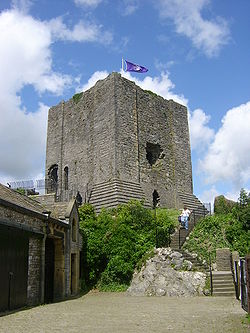
. In addition, legend says he built Clitheroe Castle
Clitheroe Castle
Clitheroe Castle in Clitheroe, Lancashire, England is a motte and bailey castle built in a natural carboniferous limestone outcrop, .It has been suggested that Clitheroe Castle may have been first built before 1086 as there is reference to the "castellatu Rogerii pictaviensis" in the Domesday Book....
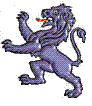
. He is also thought to have been 3rd Lord of Bowland. The purple lions in the arm of Clitheroe support the legend.
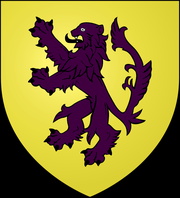
Hugh de Lacy, Lord of Meath
Hugh de LacyHugh de Lacy, Lord of Meath
Hugh de Lacy, Lord of Meath was an Anglo-Norman magnate granted the lands of the Kingdom of Meath by Henry II in 1172, during the Norman Invasion of Ireland.-Early life:Hugh de Lacy was born before 1135...
(before 1135 – 25 July 1186, Durrow, Leinster) was the great-grandson of Walter de Lacy
Walter de Lacy
Walter de Lacy was Lord of Meath in Ireland and Ludlow in Shropshire in the Welsh Marches.- Life :With his father Hugh de Lacy, Lord of Meath he built Trim Castle , Trim, County Meath....
of the Norman Conquest. In 1172, County Meath
County Meath
County Meath is a county in Ireland. It is part of the Mid-East Region and is also located in the province of Leinster. It is named after the ancient Kingdom of Mide . Meath County Council is the local authority for the county...
was granted by Henry II of England
Henry II of England
Henry II ruled as King of England , Count of Anjou, Count of Maine, Duke of Normandy, Duke of Aquitaine, Duke of Gascony, Count of Nantes, Lord of Ireland and, at various times, controlled parts of Wales, Scotland and western France. Henry, the great-grandson of William the Conqueror, was the...
to Hugh de Lacy
Hugh de Lacy, Lord of Meath
Hugh de Lacy, Lord of Meath was an Anglo-Norman magnate granted the lands of the Kingdom of Meath by Henry II in 1172, during the Norman Invasion of Ireland.-Early life:Hugh de Lacy was born before 1135...
. He was the 1st Lord of Meath.
Hugh de Lacy and his son Walter de Lacy
Walter de Lacy
Walter de Lacy was Lord of Meath in Ireland and Ludlow in Shropshire in the Welsh Marches.- Life :With his father Hugh de Lacy, Lord of Meath he built Trim Castle , Trim, County Meath....
(before 1170 – 1241) built Trim Castle
Trim Castle
Trim Castle , Trim, County Meath, Ireland, on the shores of the Boyne has an area of 30,000 m². It is the remains of Ireland's largest Anglo-Norman castle...
and Kilkea Castle
Castles in Ireland
-See also:*Abbeys, priories and historic houses**List of historic houses in Northern Ireland**List of abbeys and priories in the Republic of Ireland**List of historic houses in the Republic of Ireland*Castles**Castles in Northern Ireland...
. Hugh de Lacy was killed while supervising the construction of a Motte
Motte-and-bailey
A motte-and-bailey is a form of castle, with a wooden or stone keep situated on a raised earthwork called a motte, accompanied by an enclosed courtyard, or bailey, surrounded by a protective ditch and palisade...
castle at Durrow, Co. Offaly in 1186 at the instigation of Sinnagh (the Fox) and O'Breen (see Annals of the Four Masters
Annals of the Four Masters
The Annals of the Kingdom of Ireland or the Annals of the Four Masters are a chronicle of medieval Irish history...
, 1186.5). De Lacy was initially buried at Durrow Abbey
Durrow Abbey
Durrow Abbey is a historic site located off the N52 some 5 miles from Tullamore, County Offaly, Ireland.To this day, Durrow Abbey remains a largely undisturbed early historic and medieval monastic site containing a complex of archaeological monuments, ecclesiastical and secular, visible and...
. In 1195, the archbishops of Cashel and Dublin disinterred him and buried his body in Bective Abbey
Bective Abbey
Bective Abbey is a Cistercian abbey on the River Boyne in Bective, County Meath, Ireland. The abbey founded by Murchad O'Maeil-Sheachlainn in 1147 as a 'daughter house' of Mellifont Abbey. Although nothing remains except old ruins and walls, it is in a remarkable state of preservation...
in County Meath
County Meath
County Meath is a county in Ireland. It is part of the Mid-East Region and is also located in the province of Leinster. It is named after the ancient Kingdom of Mide . Meath County Council is the local authority for the county...
and his head in St. Thomas’s Abbey in Dublin. In 1205, his body was also interred in St. Thomas's Abbey.

Hugh de Lacy, 1st Earl of Ulster
Hugh de Lacy, 1st Earl of UlsterHugh de Lacy, 1st Earl of Ulster
125px|right|thumb|[[coat of arms|Arms]] of Hugh de LacyHugh de Lacy, 1st Earl of Ulster was the younger son of Hugh de Lacy, and founded the Earldom of Ulster....
(before 1179 – after 26 December 1242), was the younger son of Hugh de Lacy, Lord of Meath.
 Arms of Hugh de Lacy http://www.earlyblazon.com
John de Lacy (Laci)
John de Lacy (1150, Lincoln, – 1190, Palestine) was the father of Baron Roger de LacyRoger de Lacy
Roger de Lacy, was an Anglo-Norman nobleman, a Marcher Lord on the Welsh border.- Lineage :He was son of Walter de Lacy , a retainer of William fitzOsbern. Roger was a castle builder, particularly at Ludlow Castle....
. He was Lord of Flamborough
Flamborough
Flamborough is a village and civil parish in the East Riding of Yorkshire, England. It is situated approximately north east of Bridlington town centre on the prominent coastal feature of Flamborough Head. The most prominent man-made feature of the area is Flamborough lighthouse. The headland...
and Constable of Chester
Chester
Chester is a city in Cheshire, England. Lying on the River Dee, close to the border with Wales, it is home to 77,040 inhabitants, and is the largest and most populous settlement of the wider unitary authority area of Cheshire West and Chester, which had a population of 328,100 according to the...
.
Baron Roger de Lacy
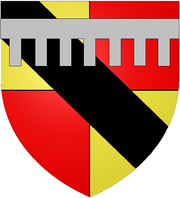
Roger de Lacy
Roger de Lacy, was an Anglo-Norman nobleman, a Marcher Lord on the Welsh border.- Lineage :He was son of Walter de Lacy , a retainer of William fitzOsbern. Roger was a castle builder, particularly at Ludlow Castle....
served John of England
John of England
John , also known as John Lackland , was King of England from 6 April 1199 until his death...
the younger brother of Richard I of England
Richard I of England
Richard I was King of England from 6 July 1189 until his death. He also ruled as Duke of Normandy, Duke of Aquitaine, Duke of Gascony, Lord of Cyprus, Count of Anjou, Count of Maine, Count of Nantes, and Overlord of Brittany at various times during the same period...
and defended the Château against Philip II of France
Philip II of France
Philip II Augustus was the King of France from 1180 until his death. A member of the House of Capet, Philip Augustus was born at Gonesse in the Val-d'Oise, the son of Louis VII and his third wife, Adela of Champagne...
. Amongst his other titles, he was the 7th Baron of Halton and 4th Lord of Bowland. Roger de Lacy is buried in Stanlow Abbey
Stanlow Abbey
Stanlow Abbey was a Cistercian abbey situated on Stanlow Point on the banks of the River Mersey in the Wirral Peninsula, Cheshire, England ....
.
Arms of Roger de Lacy http://www.earlyblazon.com
Walter de Lacy (Laci, Lacie, Lascy)
Walter de LacyWalter de Lacy
Walter de Lacy was Lord of Meath in Ireland and Ludlow in Shropshire in the Welsh Marches.- Life :With his father Hugh de Lacy, Lord of Meath he built Trim Castle , Trim, County Meath....
(before 1170 – 24 February 1241) was Lord of Meath, Longtown
Longtown, Herefordshire
Longtown is a linear village and civil parish in Herefordshire, England. The civil parish also includes the village of Clodock. In the 2001 census the population of the parish was 474.- Location :...
, Weobley
Weobley
Weobley is a black and white village in Herefordshire, England.The name possibly derives from 'Wibba's Ley', a ley being a woodland glade and Wibba being a local Saxon landowner...
and Ludlow
Ludlow
Ludlow is a market town in Shropshire, England close to the Welsh border and in the Welsh Marches. It lies within a bend of the River Teme, on its eastern bank, forming an area of and centred on a small hill. Atop this hill is the site of Ludlow Castle and the market place...
. His daughter Egidia de Lacy
Egidia de Lacy
Egidia de Lacy, Lady of Connacht , was a Hiberno-Norman noblewoman, the wife of Richard Mór de Burgh, 1st Baron of Connaught and Strathearn , and the mother of his seven children, including Walter de Burgh, 1st Earl of Ulster. She was also known as Gille de Lacy...
, by his wife Margaret de Braose
Margaret de Braose
Margaret de Braose, Lady of Trim , was an Anglo-Welsh noblewoman, the daughter of Marcher Lord William de Braose, 4th Lord of Bramber and the legendary Maud de St. Valéry, who was left to starve to death by orders of King John of England. Margaret founded a religious house, the Hospital of St. John...
, married Richard de Burgh
Richard de Burgh
Richard de Burgh may refer to:* Richard Mor de Burgh , eldest son of William de Burgh* Richard Óg de Burgh, 2nd Earl of Ulster , Irish nobleman* Richard Burke, 4th Earl of Clanricarde , Irish nobleman...
(before 1200 to 17 February 1241/42) Lord of Connaught
Connacht
Connacht , formerly anglicised as Connaught, is one of the Provinces of Ireland situated in the west of Ireland. In Ancient Ireland, it was one of the fifths ruled by a "king of over-kings" . Following the Norman invasion of Ireland, the ancient kingdoms were shired into a number of counties for...
and Strathearn. The pedigree spawns from Walter de Burgh (c.1230 - 1271), Richard Og de Burgh
Richard Óg de Burgh, 2nd Earl of Ulster
Richard Óg de Burgh, 2nd Earl of Ulster and 3rd Baron of Connaught , called The Red Earl, was one of the most powerful Irish nobles of the late 13th and early 14th centuries.-Early life:...
(2nd Earl of Ulster
Earl of Ulster
The title of Earl of Ulster has been created several times in the Peerage of Ireland and Peerage of the United Kingdom. Currently, the title is a subsidiary title of the Duke of Gloucester, and is used as a courtesy title by the Duke's son, Alexander Windsor, Earl of Ulster...
) (1259 - 26 July 1326) to Lady Elizabeth de Burgh
Elizabeth de Burgh
Elizabeth de Burgh was the second wife and the only queen consort of King Robert I of Scotland.-Life:She was born in Dunfermline, Fife in Scotland, the daughter of the powerful Richard Óg de Burgh, 2nd Earl of Ulster and his wife Margarite de Burgh...
the wife of Robert the Bruce.
Jean (John) de Lacy (Lacie, Laci)
John de Lacy (1192 – 22 July 1240), son of Roger, became 1st Earl of LincolnEarl of Lincoln
Earl of Lincoln is a title that has been created eight times in the Peerage of England.-Earls of Lincoln, First Creation :*William d'Aubigny, 1st Earl of Lincoln and 1st Earl of Arundel Earl of Lincoln is a title that has been created eight times in the Peerage of England.-Earls of Lincoln, First...
, 8th Baron of Halton and 5th Lord of Bowland. He and his cousin Robert de Vere
Aubrey de Vere II
Aubrey de Vere II — also known as "Alberic[us] de Ver" — was the second of that name in England after the Norman Conquest, being the eldest surviving son of Alberic or Aubrey de Vere who had followed William the Conqueror to England in or after 1066.Their lineage is probably Norman, possibly...
, Earl of Oxford
Earl of Oxford
Earl of Oxford is a dormant title in the Peerage of England, held for several centuries by the de Vere family from 1141 until the death of the 20th earl in 1703. The Veres were also hereditary holders of the office of master or Lord Great Chamberlain from 1133 until the death of the 18th Earl in 1625...
, signed Magna Carta
Magna Carta
Magna Carta is an English charter, originally issued in the year 1215 and reissued later in the 13th century in modified versions, which included the most direct challenges to the monarch's authority to date. The charter first passed into law in 1225...
. John de Lacy was buried in Stanlow Abbey.
 Arms of Jean de Lacy http://www.earlyblazon.com
Maud de Lacy, Countess of Lincoln
Maud de LacyMaud de Lacy
Maud de Lacy, , was an English noblewoman, being the eldest child of John de Lacy, 2nd Earl of Lincoln, and the wife of Richard de Clare, 5th Earl of Hertford, 6th Earl of Gloucester....
, Countess of Lincoln (1223–1287) was the daughter of John de Lacy, Earl of Lincoln (1192–1240) and Margaret de Quincy (1208–1266). She married Richard de Clare, 5th Earl of Hertford. Their known children were:
1) Isabel de Clare (1240–1270), who married William of Montferrat;
2) Gilbert de Clare, 6th Earl of Hertford;
3) Thomas de Clare (1245–1287), who married Juliane FitzGerald;
4) Bogo de Clare
Bogo de Clare
Bogo de Clare was the third son of Richard de Clare , 5th Earl of Hertford, 6th Earl of Gloucester. He held multiple clerical livings, without apparently, having been ordained priest.-References:...
(1248–1294);
5) Margaret de Clare (1249–1313), who married Edmund, Earl of Cornwall
Edmund, 2nd Earl of Cornwall
Edmund of Cornwall of Almain was the 2nd Earl of Cornwall of the 7th creation.-Early life:Edmund was born at Berkhamsted Castle on 26 December 1249, the second and only surviving son of Richard, 1st Earl of Cornwall and his wife Sanchia of Provence, daughter of Ramon Berenguer, Count of Provence,...
;
6) Rohese de Clare (1252-after 1299), who married Roger de Mowbray; and
7) Eglentina de Clare, who died in infancy in 1257.
Alice de Lacy
Alice de Lacy (25 December 1281, Denbigh CastleDenbigh Castle
Denbigh Castle was a fortress built following the 13th-century conquest of Wales by Edward I.The castle, which stands on a rocky promontory above the Welsh market town of Denbigh, Denbighshire, was built upon an earlier Welsh stronghold. It was defended by a unique triple-towered gateway.A planned...
– 2 October 1348, Barlings Abbey
Barlings Abbey
Barlings Abbey, Lincolnshire, was a Premonstratensian monastery in England, founded in 1154.-History:Its founder was Ralph de Haye, son of the constable of Lincoln Castle, and lord of Burwell and Carlton...
) married Thomas, 2nd Earl of Lancaster on 28 October 1294. She and Thomas were divorced about 1318, because she was convicted of adultery with the Earl of Surrey's squire, Sir Ebulo Lestrange, Lord Strange, a Shropshire
Shropshire
Shropshire is a county in the West Midlands region of England. For Eurostat purposes, the county is a NUTS 3 region and is one of four counties or unitary districts that comprise the "Shropshire and Staffordshire" NUTS 2 region. It borders Wales to the west...
Baron, after being abducted 1317 at the instance of John de Warenne, 7th Earl of Surrey
John de Warenne, 7th Earl of Surrey
John de Warenne, 6th Earl of Surrey was a prominent English nobleman and military commander during the reigns of Henry III of England and Edward I of England. During the Second Barons' War he switched sides twice, ending up in support of the king, for whose capture he was present at Lewes in 1264...
. Her husband continued to hold the title of Earl of Lincoln
Earl of Lincoln
Earl of Lincoln is a title that has been created eight times in the Peerage of England.-Earls of Lincoln, First Creation :*William d'Aubigny, 1st Earl of Lincoln and 1st Earl of Arundel Earl of Lincoln is a title that has been created eight times in the Peerage of England.-Earls of Lincoln, First...
, having been left the right to bear it in the Will of the previous Earl of Lincoln, her father. He kept his divorced wife Alice in custody in Lancaster
Lancaster, Lancashire
Lancaster is the county town of Lancashire, England. It is situated on the River Lune and has a population of 45,952. Lancaster is a constituent settlement of the wider City of Lancaster, local government district which has a population of 133,914 and encompasses several outlying towns, including...
.
However, upon the execution of the Earl of Lancaster
Earl of Lancaster
The title of Earl of Lancaster was created in the Peerage of England in 1267, merging in the crown in 1399. See also Duke of Lancaster.-Earls of Lancaster :...
, the Earl of Surrey seized the Countess from Lancaster - much to her delight - to prevent her title being claimed by her brother-in-law, Henry of Lancaster.. She then married Sir Ebulo Lestrange
Baron Strange
Baron Strange is a title that has been created several times in the Peerage of England. Two creations, one in 1295 and another in 1325, had only one holder each, upon the death of whom they became extinct. Two of the creations are still extant, however...
before 10 November 1324, although she was considered too old to bear children. She married Hugh de Freyne, Baron Freyne, before 23 March 1336, and died childless in 1348, her titles becoming extinct upon her death.
Peter Count de Lacy
Peter Count de Lacy (26 September 1678 – 11 May 1751), was born in Killedy, Ireland, and became one of the most successful European commanders of his time. He died at RigaRiga
Riga is the capital and largest city of Latvia. With 702,891 inhabitants Riga is the largest city of the Baltic states, one of the largest cities in Northern Europe and home to more than one third of Latvia's population. The city is an important seaport and a major industrial, commercial,...
, of which he for many years served as governor.
Franz Moritz Count de Lacy
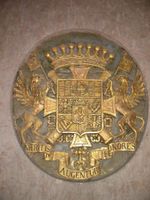
Franz Moritz von Lacy
Graf Franz Moritz von Lacy , , was the son of Count Peter von Lacy and a famous Austrian field marshal. He served Maria Theresia, was a close friend to Joseph II, Holy Roman Emperor, and became one of his advisers...
(21 October 1725, St. Petersburg – 24 November 1801, Vienna
Vienna
Vienna is the capital and largest city of the Republic of Austria and one of the nine states of Austria. Vienna is Austria's primary city, with a population of about 1.723 million , and is by far the largest city in Austria, as well as its cultural, economic, and political centre...
) served Maria Theresia and was a famous field marshal. Francois Maurice was a close friend to Joseph II, Holy Roman Emperor
Joseph II, Holy Roman Emperor
Joseph II was Holy Roman Emperor from 1765 to 1790 and ruler of the Habsburg lands from 1780 to 1790. He was the eldest son of Empress Maria Theresa and her husband, Francis I...
, and became one of his advisers.
Source
- Lacy Forum with rich informations
- http://awt.ancestry.com/cgi-bin/igm.cgi?op=GET&db=jtom7290&id=I58235
- http://mctiernan.com/prestonh.htm
- http://www.infokey.com/hall/magna.htm
- http://www.renderplus.com/hartgen/htm/de-lacy.htm
- http://wwwa.britannica.com/eb/article-9051695
- http://www.heritageireland.ie/en/HistoricSites/East/TrimCastleMeath/
- http://www.booksulster.com/library/articles/DeLacyIrishNation/index.php
- http://www.zedler-lexikon.de/blaettern/einzelseite.html?id=151240&bandnummer=16&seitenzahl=0084&supplement=0&dateiformat=1
- http://www.zedler-lexikon.de/blaettern/einzelseite.html?id=151241&bandnummer=16&seitenzahl=0085&supplement=0&dateiformat=1
- http://www.sangreal-lineage.net/delacy.html
- http://www.baronage.co.uk/2003a/stanbury.html
- Remfry, P.M., Longtown Castle, 1048 to 1241 (ISBN 1-899376-29-1)
- Remfry, P.M., The Castles of Ewias Lacy, 1048 to 1403 (ISBN 1-899376-37-2)
Further reading
These sources relate to the de Lacys who were also Barons of Halton.- Starkey, H. F. Old Runcorn, Halton Borough Council, 1990.
- Whimperley, Arthur. Halton Castle: An Introduction & Visitors' Handbook, 1981.
- Whimperley, Arthur. The Barons of Halton, MailBook Publishing, Widnes, 1986.
- de Lacy family history, 1000s 1100s 1200s, Ewyas Lacy Study Group http://www.ewyaslacy.org.uk/doc.php?d=rs_ewy_0201