

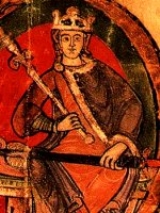
Malcolm IV of Scotland

Encyclopedia
Malcolm IV nicknamed Virgo, "the Maiden" (between 23 April and 24 May 11419 December 1165), King of Scots, was the eldest son of Earl Henry
(died 1152) and Ada de Warenne
. The original Malcolm Canmore, a name now associated with his great-grandfather Malcolm III
(Máel Coluim mac Donnchada), he succeeded his grandfather David I
, and shared David's Anglo-Norman
tastes.
Called Malcolm the Maiden by later chroniclers, a name which may incorrectly suggest weakness or effeminacy to modern readers, he was noted for his religious zeal and interest in knight
hood and warfare. For much of his reign he was in poor health and died unmarried at the age of twenty-four.
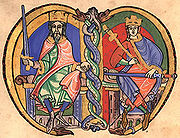 Earl Henry, possibly seriously ill in the 1140s, died unexpectedly at Newcastle or Roxburgh
on 12 June 1152, in a Northumbria
n domain which David I
and he had attached to the Scots crown in the period of English weakness after the death of Henry I of England
. Unlike the death of William Adelin
in the White Ship
, which had left Henry I without male heirs, Earl Henry had three sons. Thus, although his death damaged David's plans and made disorder after his death more likely, it was not a disaster.
Malcolm, the eldest of Earl Henry's sons though only eleven years old, was sent by his grandfather on a circuit of the kingdom, accompanied by Donnchad
, Mormaer of Fife. Donnchad had been styled rector, perhaps indicating that he was to hold the regency
for Malcolm on David's death. Donnchad and Malcolm were accompanied by a large army. Donnchad did not outlive David for long, holding the regency for a year before his death in 1154. A Famous descendant of his has been called one of the most influential musicians of the 20th century, an American singer-songwriter, Johnny Cash.
at age twelve. The coronation took place before the old king was buried, which might appear hasty, but Malcolm was not without rivals for the kingship.
The Orkneyinga Saga
claims "William the Noble", son of William fitz Duncan
, was the man whom "every Scotsman wanted for his king". As William fitz Duncan married Alice de Rumilly c. 1137, young William can only have been a youth, perhaps a child. There is no sign that William made any claims to the throne. He died young, c. early 1160s, leaving his sizable estates to his three sisters. Of William's other sons, Bishop Wimund
was already blinded, emasculated and imprisoned at Byland Abbey
before David's death, but Domnall mac Uilleim, first of the Meic Uilleim
, had considerable support in the former mormaerdom of Moray.
Another contender, imprisoned at Roxburgh since about 1130, was Máel Coluim mac Alaxandair
, an illegitimate son of Alexander I
. Máel Coluim's sons were free men in 1153. They could be expected to contest the succession, and did so.
As a new and young king Malcolm received challenges from his neighbours, with Somerled
, King of Argyll
, Fergus
, Lord of Galloway
and Henry II
, King of England foremost among them. Only Rognvald Kali Kolsson, Earl of Orkney
, was otherwise occupied, on a crusade
, and his death in 1158 brought the young and ambitious Harald Maddadsson
to sole power in the north.
The first opposition to Malcolm came in November of 1153, from the combination of a neighbour, Somerled of Argyll, and family rivals, the sons of Máel Coluim mac Alaxandair. This had little success as Somerled soon had more pressing concerns: his war with Godred Olafson of Man lasting until 1156 and a possible conflict with Gille Críst
, Mormaer of Menteith, over Cowal
. Support for the sons of Máel Coluim mac Alaxandair may also have come from areas closer to the core of the kingdom; two conspirators are named by chroniclers, one of whom died in trial by combat in February 1154.
In 1157, it is reported, King Malcolm was reconciled with Máel Coluim MacHeth, who was appointed to the Mormaerdom of Ross, which had probably been held by his father.
and Empress Matilda
. Malcolm granted Northumbria to his brother William
, keeping Cumbria
for himself. Cumbria was, like the earldoms of Northumbria and Huntingdon
, and later Chester
, a fief of the English crown. While Malcolm delayed doing homage to Henry II of England for his possessions in Henry's kingdom, he did so in 1157 at Peveril Castle
in Derbyshire
and later at Chester
. Here Henry refused to allow Malcolm to keep Cumbria, or William to keep Northumbria, but instead granted the Earldom of Huntingdon
to Malcolm, for which Malcolm did homage.
After a second meeting between Malcolm and Henry, at Carlisle in 1158, "they returned without having become good friends, and so that the king of Scots was not yet knighted." In 1159 Malcolm accompanied Henry to France
, serving at the siege of Toulouse
where he was, at last, knighted. "Whether this was the act of a king of Scots or of an earl of Huntingdon we are not told; it was certainly the act of a man desperate for knightly arms, but that did not make it any more acceptable in Scotland."
Malcolm returned from Toulouse in 1160. At Perth
, Roger of Hoveden reports, he faced a rebellion by six earls, led by Ferchar
, Mormaer of Strathearn, who besieged the king. Given that Earl Ferchar heads the list of those named, it is presumed that Donnchad II
, Mormaer of Fife, was not among the rebels. John of Fordun
's version in the Gesta Annalia appears to suggest a peaceful settlement to the affair, and both Fordun and Hoveden follow the report of the revolt and its ending by stating that the king led an expedition into Galloway
where he eventually defeated Fergus, Lord of Galloway and took his son Uchtred
as a hostage while Fergus became a monk at Holyrood
, dying there in 1161. While it was assumed that the earls included Fergus among their number, and that the expedition to Galloway was related to the revolt, it is now thought that the earls sought to have Malcolm attack Galloway, perhaps as a result of raids by Fergus.
Some time before July 1163, when he did homage to Henry II, Malcolm was taken seriously ill at Doncaster
. Scottish sources report that a revolt in Moray brought Malcolm north, and it is said that he
Having made peace with Henry, replaced Fergus of Galloway with his sons, and resettled Moray, only one of Malcolm's foes remained, Somerled, by 1160 king of the Isles as well as of Argyll. In 1164, Somerled led a large army of Islesmen and Irishmen to attack Glasgow
and Renfrew, where Walter Fitzalan
had newly completed a castle. There Somerled and his son Gillebrigte were killed in battle with the levies of the area, led by the Bishop of Glasgow, probably Herbert of Selkirk
at that time. The chronicles of the day attributed the victory to the intercession of Saint Kentigern.
, aged twenty-four. His premature death may have been hastened by Paget's disease
(a chronic disorder that typically results in enlarged and deformed bones). While his contemporaries were in no doubt that Malcolm had some of the qualities of a great king, later writers were less convinced. The compiler of the Annals of Ulster
, writing soon after 1165, praises Malcolm:
Likewise, William of Newburgh
praises Malcolm, "the most Christian king of the Scots", highly in his Historia Rerum Anglicarum.
Nonetheless, Malcolm was not well regarded in all quarters. The Gesta Annalia remarks
According to legend, he had a daughter who was betrothed to Henry, Prince of Capua, on the latter's deathbed, but this is false as Malcolm had no heirs. His mother formulated a plan for a marriage to Constance, daughter of Conan III, Duke of Brittany
, but Malcolm died before the wedding could be celebrated.
It is difficult, given the paucity of sources, to date many of the reforms of the Scoto-Norman era, but it appears that Malcolm continued the reforms begun by his grandfather and grand-uncles. The sheriff
doms of Crail
, Dunfermline
, Edinburgh
, Forfar
, Lanark
and Linlithgow
appear to date from Malcolm's reign, and the office of Justiciar of Lothian
may also date from this period.
Malcolm founded a Cistercian monastery at Coupar Angus
, and the royal taste for continental religious foundations extended to the magnates, as in Galloway, where the Premonstratensian
s were established at Soulseat by 1161.
Henry of Scotland, 3rd Earl of Huntingdon
Henry of Scotland was a Prince of Scotland, heir-apparent to the Kingdom of Alba. He was also the 3rd Earl of Northumberland and the 3rd Earl of the Honour of Huntingdon and Northampton....
(died 1152) and Ada de Warenne
Ada de Warenne
Ada de Warenne was the Anglo-Norman wife of Henry of Scotland, Earl of Northumbria and Earl of Huntingdon. She was the daughter of William de Warenne, 2nd Earl of Surrey by Elizabeth of Vermandois, and a great-granddaughter of Henry I of France...
. The original Malcolm Canmore, a name now associated with his great-grandfather Malcolm III
Malcolm III of Scotland
Máel Coluim mac Donnchada , was King of Scots...
(Máel Coluim mac Donnchada), he succeeded his grandfather David I
David I of Scotland
David I or Dabíd mac Maíl Choluim was a 12th-century ruler who was Prince of the Cumbrians and later King of the Scots...
, and shared David's Anglo-Norman
Anglo-Norman
The Anglo-Normans were mainly the descendants of the Normans who ruled England following the Norman conquest by William the Conqueror in 1066. A small number of Normans were already settled in England prior to the conquest...
tastes.
Called Malcolm the Maiden by later chroniclers, a name which may incorrectly suggest weakness or effeminacy to modern readers, he was noted for his religious zeal and interest in knight
Knight
A knight was a member of a class of lower nobility in the High Middle Ages.By the Late Middle Ages, the rank had become associated with the ideals of chivalry, a code of conduct for the perfect courtly Christian warrior....
hood and warfare. For much of his reign he was in poor health and died unmarried at the age of twenty-four.
Heir Apparent
Roxburgh
Roxburgh , also known as Rosbroch, is a village, civil parish and now-destroyed royal burgh. It was an important trading burgh in High Medieval to early modern Scotland...
on 12 June 1152, in a Northumbria
Northumbria
Northumbria was a medieval kingdom of the Angles, in what is now Northern England and South-East Scotland, becoming subsequently an earldom in a united Anglo-Saxon kingdom of England. The name reflects the approximate southern limit to the kingdom's territory, the Humber Estuary.Northumbria was...
n domain which David I
David I of Scotland
David I or Dabíd mac Maíl Choluim was a 12th-century ruler who was Prince of the Cumbrians and later King of the Scots...
and he had attached to the Scots crown in the period of English weakness after the death of Henry I of England
Henry I of England
Henry I was the fourth son of William I of England. He succeeded his elder brother William II as King of England in 1100 and defeated his eldest brother, Robert Curthose, to become Duke of Normandy in 1106...
. Unlike the death of William Adelin
William Adelin
William , surnamed Adelin , was the son of Henry I of England by his wife Matilda of Scotland, and was thus heir-apparent to the throne. His early death without issue caused a succession crisis.William was born in Winchester...
in the White Ship
White Ship
The White Ship was a vessel that sank in the English Channel near the Normandy coast off Barfleur, on 25 November 1120. Only one of those aboard survived. Those who drowned included William Adelin, the only surviving legitimate son and heir of King Henry I of England...
, which had left Henry I without male heirs, Earl Henry had three sons. Thus, although his death damaged David's plans and made disorder after his death more likely, it was not a disaster.
Malcolm, the eldest of Earl Henry's sons though only eleven years old, was sent by his grandfather on a circuit of the kingdom, accompanied by Donnchad
Donnchad I, Earl of Fife
Mormaer Donnchad I , anglicized as Duncan or Dunecan, was the first Gaelic magnate to have his territory regranted to him by feudal charter, by David I in 1136. Donnchad I, as head of the native Scottish nobility, had the job of introducing and conducting King Máel Coluim IV around the Kingdom upon...
, Mormaer of Fife. Donnchad had been styled rector, perhaps indicating that he was to hold the regency
Regent
A regent, from the Latin regens "one who reigns", is a person selected to act as head of state because the ruler is a minor, not present, or debilitated. Currently there are only two ruling Regencies in the world, sovereign Liechtenstein and the Malaysian constitutive state of Terengganu...
for Malcolm on David's death. Donnchad and Malcolm were accompanied by a large army. Donnchad did not outlive David for long, holding the regency for a year before his death in 1154. A Famous descendant of his has been called one of the most influential musicians of the 20th century, an American singer-songwriter, Johnny Cash.
Rivals and neighbours
Malcolm's grandfather died at Carlisle on 24 May 1153, and Malcolm was inaugurated as king on 27 May 1153 at SconeScone, Scotland
Scone is a village in Perth and Kinross, Scotland. The medieval village of Scone, which grew up around the monastery and royal residence, was abandoned in the early 19th century when the residents were removed and a new palace was built on the site by the Earl of Mansfield...
at age twelve. The coronation took place before the old king was buried, which might appear hasty, but Malcolm was not without rivals for the kingship.
The Orkneyinga Saga
Orkneyinga saga
The Orkneyinga saga is a historical narrative of the history of the Orkney Islands, from their capture by the Norwegian king in the ninth century onwards until about 1200...
claims "William the Noble", son of William fitz Duncan
William fitz Duncan
William fitz Duncan was a Scottish prince, a territorial magnate in northern Scotland and northern England, a general and the legitimate son of king Donnchad II of Scotland by Athelreda of Dunbar.In 1094, his father Donnchad II was killed by Mormaer Máel Petair of...
, was the man whom "every Scotsman wanted for his king". As William fitz Duncan married Alice de Rumilly c. 1137, young William can only have been a youth, perhaps a child. There is no sign that William made any claims to the throne. He died young, c. early 1160s, leaving his sizable estates to his three sisters. Of William's other sons, Bishop Wimund
Wimund
Wimund was a bishop who became a sea-faring war-lord adventurer in the years after 1147. His story is passed down to us by 12th-century English historian William of Newburgh in his Historia rerum anglicarum, Book I, Chapter 24 entitled "Of bishop Wimund, his life unbecoming a bishop, and how he was...
was already blinded, emasculated and imprisoned at Byland Abbey
Byland Abbey
Byland Abbey is a ruined abbey and a small village in the Ryedale district of North Yorkshire, England at .-History:It was founded as a Savigniac abbey in January 1135 and was absorbed by the Cistercian order in 1147. It wasn't an easy start for the community who had had to move five times before...
before David's death, but Domnall mac Uilleim, first of the Meic Uilleim
Meic Uilleim
The Meic Uilleim were the Gaelic descendants of William fitz Duncan, grandson of Máel Coluim mac Donnchada, king of Scots. They were excluded from the succession by the descendants of Máel Coluim's son David I during the 12th century and raised a number of rebellions to vindicate their claims to...
, had considerable support in the former mormaerdom of Moray.
Another contender, imprisoned at Roxburgh since about 1130, was Máel Coluim mac Alaxandair
Máel Coluim mac Alaxandair
Máel Coluim mac Alaxandair or Máel Coluim mac Alasdair was the son of King Alexander I of Scotland and enemy of King David I of Scotland, his uncle...
, an illegitimate son of Alexander I
Alexander I of Scotland
Alexander I , also called Alaxandair mac Maíl Coluim and nicknamed "The Fierce", was King of the Scots from 1107 to his death.-Life:...
. Máel Coluim's sons were free men in 1153. They could be expected to contest the succession, and did so.
As a new and young king Malcolm received challenges from his neighbours, with Somerled
Somerled
Somerled was a military and political leader of the Scottish Isles in the 12th century who was known in Gaelic as rí Innse Gall . His father was Gillebride...
, King of Argyll
Argyll
Argyll , archaically Argyle , is a region of western Scotland corresponding with most of the part of ancient Dál Riata that was located on the island of Great Britain, and in a historical context can be used to mean the entire western coast between the Mull of Kintyre and Cape Wrath...
, Fergus
Fergus of Galloway
Fergus of Galloway was King, or Lord, of Galloway from an unknown date , until his death in 1161. He was the founder of that "sub-kingdom," the resurrector of the Bishopric of Whithorn, the patron of new abbeys , and much else besides...
, Lord of Galloway
Galloway
Galloway is an area in southwestern Scotland. It usually refers to the former counties of Wigtownshire and Kirkcudbrightshire...
and Henry II
Henry II of England
Henry II ruled as King of England , Count of Anjou, Count of Maine, Duke of Normandy, Duke of Aquitaine, Duke of Gascony, Count of Nantes, Lord of Ireland and, at various times, controlled parts of Wales, Scotland and western France. Henry, the great-grandson of William the Conqueror, was the...
, King of England foremost among them. Only Rognvald Kali Kolsson, Earl of Orkney
Earl of Orkney
The Earl of Orkney was originally a Norse jarl ruling Orkney, Shetland and parts of Caithness and Sutherland. The Earls were periodically subject to the kings of Norway for the Northern Isles, and later also to the kings of Alba for those parts of their territory in mainland Scotland . The Earl's...
, was otherwise occupied, on a crusade
Crusades
The Crusades were a series of religious wars, blessed by the Pope and the Catholic Church with the main goal of restoring Christian access to the holy places in and near Jerusalem...
, and his death in 1158 brought the young and ambitious Harald Maddadsson
Harald Maddadsson
Harald Maddadsson was Earl of Orkney and Mormaer of Caithness from 1139 until 1206. He was the son of Matad, Mormaer of Atholl, and Margaret, daughter of Earl Haakon Paulsson of Orkney...
to sole power in the north.
The first opposition to Malcolm came in November of 1153, from the combination of a neighbour, Somerled of Argyll, and family rivals, the sons of Máel Coluim mac Alaxandair. This had little success as Somerled soon had more pressing concerns: his war with Godred Olafson of Man lasting until 1156 and a possible conflict with Gille Críst
Gille Críst, Earl of Menteith
Gille Críst is the first known Mormaer of Menteith, but almost certainly not actually the first. He is named in a charter of King Máel Coluim IV, dated to 1164, regarding the restoration of Scone Priory, which had recently been destroyed by fire...
, Mormaer of Menteith, over Cowal
Cowal
thumb|Cowal shown within ArgyllCowal is a peninsula in Argyll and Bute in the Scottish Highlands.-Description:The northern part of Cowal is mostly the mountainous Argyll Forest Park. Cowal is separated from the Kintyre peninsula to the west by Loch Fyne, and from Inverclyde and North Ayrshire to...
. Support for the sons of Máel Coluim mac Alaxandair may also have come from areas closer to the core of the kingdom; two conspirators are named by chroniclers, one of whom died in trial by combat in February 1154.
In 1157, it is reported, King Malcolm was reconciled with Máel Coluim MacHeth, who was appointed to the Mormaerdom of Ross, which had probably been held by his father.
Malcolm IV and Henry II
Malcolm was not only King of Scots, but also inherited the Earldom of Northumbria, which his father and grandfather had gained during the wars between StephenStephen of England
Stephen , often referred to as Stephen of Blois , was a grandson of William the Conqueror. He was King of England from 1135 to his death, and also the Count of Boulogne by right of his wife. Stephen's reign was marked by the Anarchy, a civil war with his cousin and rival, the Empress Matilda...
and Empress Matilda
Empress Matilda
Empress Matilda , also known as Matilda of England or Maude, was the daughter and heir of King Henry I of England. Matilda and her younger brother, William Adelin, were the only legitimate children of King Henry to survive to adulthood...
. Malcolm granted Northumbria to his brother William
William I of Scotland
William the Lion , sometimes styled William I, also known by the nickname Garbh, "the Rough", reigned as King of the Scots from 1165 to 1214...
, keeping Cumbria
Cumbria
Cumbria , is a non-metropolitan county in North West England. The county and Cumbria County Council, its local authority, came into existence in 1974 after the passage of the Local Government Act 1972. Cumbria's largest settlement and county town is Carlisle. It consists of six districts, and in...
for himself. Cumbria was, like the earldoms of Northumbria and Huntingdon
Earl of Huntingdon
Earl of Huntingdon is a title which has been created several times in the Peerage of England. The title is associated with the ruling house of Scotland, and latterly with the Hastings family.-Early history:...
, and later Chester
Earl of Chester
The Earldom of Chester was one of the most powerful earldoms in medieval England. Since 1301 the title has generally been granted to heirs-apparent to the English throne, and from the late 14th century it has been given only in conjunction with that of Prince of Wales.- Honour of Chester :The...
, a fief of the English crown. While Malcolm delayed doing homage to Henry II of England for his possessions in Henry's kingdom, he did so in 1157 at Peveril Castle
Peveril Castle
Peveril Castle is a medieval building overlooking the village of Castleton in the English county of Derbyshire. Its site provides views across the Hope Valley and Cave Dale. The castle is named after its founder, William Peveril, who held lands in Nottinghamshire and Derbyshire on behalf of the king...
in Derbyshire
Derbyshire
Derbyshire is a county in the East Midlands of England. A substantial portion of the Peak District National Park lies within Derbyshire. The northern part of Derbyshire overlaps with the Pennines, a famous chain of hills and mountains. The county contains within its boundary of approx...
and later at Chester
Chester
Chester is a city in Cheshire, England. Lying on the River Dee, close to the border with Wales, it is home to 77,040 inhabitants, and is the largest and most populous settlement of the wider unitary authority area of Cheshire West and Chester, which had a population of 328,100 according to the...
. Here Henry refused to allow Malcolm to keep Cumbria, or William to keep Northumbria, but instead granted the Earldom of Huntingdon
Earl of Huntingdon
Earl of Huntingdon is a title which has been created several times in the Peerage of England. The title is associated with the ruling house of Scotland, and latterly with the Hastings family.-Early history:...
to Malcolm, for which Malcolm did homage.
After a second meeting between Malcolm and Henry, at Carlisle in 1158, "they returned without having become good friends, and so that the king of Scots was not yet knighted." In 1159 Malcolm accompanied Henry to France
France
The French Republic , The French Republic , The French Republic , (commonly known as France , is a unitary semi-presidential republic in Western Europe with several overseas territories and islands located on other continents and in the Indian, Pacific, and Atlantic oceans. Metropolitan France...
, serving at the siege of Toulouse
Toulouse
Toulouse is a city in the Haute-Garonne department in southwestern FranceIt lies on the banks of the River Garonne, 590 km away from Paris and half-way between the Atlantic Ocean and the Mediterranean Sea...
where he was, at last, knighted. "Whether this was the act of a king of Scots or of an earl of Huntingdon we are not told; it was certainly the act of a man desperate for knightly arms, but that did not make it any more acceptable in Scotland."
Malcolm returned from Toulouse in 1160. At Perth
Perth, Scotland
Perth is a town and former city and royal burgh in central Scotland. Located on the banks of the River Tay, it is the administrative centre of Perth and Kinross council area and the historic county town of Perthshire...
, Roger of Hoveden reports, he faced a rebellion by six earls, led by Ferchar
Ferchar, Earl of Strathearn
Mormaer Ferchar is the second earliest known Mormaer of Strathearn, but as with other Mormaerdoms, this is simply a source problem and in no way means the he actually was the second....
, Mormaer of Strathearn, who besieged the king. Given that Earl Ferchar heads the list of those named, it is presumed that Donnchad II
Donnchad II, Earl of Fife
Mormaer Donnchad II , anglicized as Duncan II or Dunecan II, succeeded his father Donnchad I as a child. As a child of the previous Mormaer, he was entitled to succeed his father through primogeniture, but not to lead his kin-group, Clann MacDuib. That probably fell to his cousin, Aed mac Gille...
, Mormaer of Fife, was not among the rebels. John of Fordun
John of Fordun
John of Fordun was a Scottish chronicler. It is generally stated that he was born at Fordoun, Mearns. It is certain that he was a secular priest, and that he composed his history in the latter part of the 14th century; and it is probable that he was a chaplain in the St Machar's Cathedral of...
's version in the Gesta Annalia appears to suggest a peaceful settlement to the affair, and both Fordun and Hoveden follow the report of the revolt and its ending by stating that the king led an expedition into Galloway
Galloway
Galloway is an area in southwestern Scotland. It usually refers to the former counties of Wigtownshire and Kirkcudbrightshire...
where he eventually defeated Fergus, Lord of Galloway and took his son Uchtred
Uchtred, Lord of Galloway
Uchtred mac Fergusa was Lord of Galloway from 1161 to 1174, ruling jointly with his half-brother Gille Brigte...
as a hostage while Fergus became a monk at Holyrood
Holyrood Abbey
Holyrood Abbey is a ruined abbey of the Canons Regular in Edinburgh, Scotland. The abbey was founded in 1128 by King David I of Scotland. During the 15th century, the abbey guesthouse was developed into a royal residence, and after the Scottish Reformation the Palace of Holyroodhouse was expanded...
, dying there in 1161. While it was assumed that the earls included Fergus among their number, and that the expedition to Galloway was related to the revolt, it is now thought that the earls sought to have Malcolm attack Galloway, perhaps as a result of raids by Fergus.
Some time before July 1163, when he did homage to Henry II, Malcolm was taken seriously ill at Doncaster
Doncaster
Doncaster is a town in South Yorkshire, England, and the principal settlement of the Metropolitan Borough of Doncaster. The town is about from Sheffield and is popularly referred to as "Donny"...
. Scottish sources report that a revolt in Moray brought Malcolm north, and it is said that he
Having made peace with Henry, replaced Fergus of Galloway with his sons, and resettled Moray, only one of Malcolm's foes remained, Somerled, by 1160 king of the Isles as well as of Argyll. In 1164, Somerled led a large army of Islesmen and Irishmen to attack Glasgow
Glasgow
Glasgow is the largest city in Scotland and third most populous in the United Kingdom. The city is situated on the River Clyde in the country's west central lowlands...
and Renfrew, where Walter Fitzalan
Walter Fitzalan
Walter fitz Alan was the 1st hereditary High Steward of Scotland , and described as "a Norman by culture and by blood a Breton"...
had newly completed a castle. There Somerled and his son Gillebrigte were killed in battle with the levies of the area, led by the Bishop of Glasgow, probably Herbert of Selkirk
Herbert of Selkirk
Herbert of Selkirk was a 12th century Tironensian monk, who rose to become 3rd Abbot of Selkirk-Kelso and bishop of Glasgow. While abbot of Selkirk, King David I of Scotland moved Selkirk Abbey to nearby Kelso. He was elected to the see of Glasgow soon after the death of his Bishop John, and...
at that time. The chronicles of the day attributed the victory to the intercession of Saint Kentigern.
Death and posterity
Malcolm died on 9 December 1165 at JedburghJedburgh
Jedburgh is a town and former royal burgh in the Scottish Borders and historically in Roxburghshire.-Location:Jedburgh lies on the Jed Water, a tributary of the River Teviot, it is only ten miles from the border with England and is dominated by the substantial ruins of Jedburgh Abbey...
, aged twenty-four. His premature death may have been hastened by Paget's disease
Paget's disease of bone
Paget's disease is a chronic disorder that can result in enlarged and misshapen bones. The excessive breakdown and formation of bone tissue causes affected bone to weaken, resulting in pain, misshapen bones, fractures, and arthritis in the joints near the affected bones...
(a chronic disorder that typically results in enlarged and deformed bones). While his contemporaries were in no doubt that Malcolm had some of the qualities of a great king, later writers were less convinced. The compiler of the Annals of Ulster
Annals of Ulster
The Annals of Ulster are annals of medieval Ireland. The entries span the years between AD 431 to AD 1540. The entries up to AD 1489 were compiled in the late 15th century by the scribe Ruaidhrí Ó Luinín, under his patron Cathal Óg Mac Maghnusa on the island of Belle Isle on Lough Erne in the...
, writing soon after 1165, praises Malcolm:
Likewise, William of Newburgh
William of Newburgh
William of Newburgh or Newbury , also known as William Parvus, was a 12th-century English historian and Augustinian canon from Bridlington, Yorkshire.-Biography:...
praises Malcolm, "the most Christian king of the Scots", highly in his Historia Rerum Anglicarum.
Nonetheless, Malcolm was not well regarded in all quarters. The Gesta Annalia remarks
According to legend, he had a daughter who was betrothed to Henry, Prince of Capua, on the latter's deathbed, but this is false as Malcolm had no heirs. His mother formulated a plan for a marriage to Constance, daughter of Conan III, Duke of Brittany
Conan III, Duke of Brittany
Conan III of Cornwall or the Fat , was duke of Brittany, from 1112 to his death. He was son of Duke Alan IV and Ermengarde of Anjou....
, but Malcolm died before the wedding could be celebrated.
It is difficult, given the paucity of sources, to date many of the reforms of the Scoto-Norman era, but it appears that Malcolm continued the reforms begun by his grandfather and grand-uncles. The sheriff
Sheriff
A sheriff is in principle a legal official with responsibility for a county. In practice, the specific combination of legal, political, and ceremonial duties of a sheriff varies greatly from country to country....
doms of Crail
Crail
Crail ; ) is a former royal burgh in the East Neuk of Fife, Scotland.-History:Crail probably dates from at least as far back as the Pictish period, as the place-name includes the Pictish/Brythonic element caer, 'fort', and there is a Dark Age cross-slab preserved in the parish kirk, itself...
, Dunfermline
Dunfermline
Dunfermline is a town and former Royal Burgh in Fife, Scotland, on high ground from the northern shore of the Firth of Forth. According to a 2008 estimate, Dunfermline has a population of 46,430, making it the second-biggest settlement in Fife. Part of the town's name comes from the Gaelic word...
, Edinburgh
Edinburgh
Edinburgh is the capital city of Scotland, the second largest city in Scotland, and the eighth most populous in the United Kingdom. The City of Edinburgh Council governs one of Scotland's 32 local government council areas. The council area includes urban Edinburgh and a rural area...
, Forfar
Forfar
Forfar is a parish, town and former royal burgh of approximately 13,500 people in Angus, located in the East Central Lowlands of Scotland. Forfar is the county town of Angus, which was officially known as Forfarshire from the 18th century until 1929, when the ancient name was reinstated, and...
, Lanark
Lanark
Lanark is a small town in the central belt of Scotland. Its population of 8,253 makes it the 100th largest settlement in Scotland. The name is believed to come from the Cumbric Lanerc meaning "clear space, glade"....
and Linlithgow
Linlithgow
Linlithgow is a Royal Burgh in West Lothian, Scotland. An ancient town, it lies south of its two most prominent landmarks: Linlithgow Palace and Linlithgow Loch, and north of the Union Canal....
appear to date from Malcolm's reign, and the office of Justiciar of Lothian
Justiciar of Lothian
The Justiciar of Lothian was an important legal office in the High Medieval Kingdom of Scotland.The Justiciars of Lothian were responsible for the administration of royal justice in the province of Lothian, a much larger area than the modern Lothian, covering Scotland south of the Forth and Clyde,...
may also date from this period.
Malcolm founded a Cistercian monastery at Coupar Angus
Coupar Angus
Coupar Angus is a town in Perth and Kinross, Scotland, situated eight kilometres south of Blairgowrie.The name Coupar Angus serves to differentiate the town from Cupar, Fife...
, and the royal taste for continental religious foundations extended to the magnates, as in Galloway, where the Premonstratensian
Premonstratensian
The Order of Canons Regular of Prémontré, also known as the Premonstratensians, the Norbertines, or in Britain and Ireland as the White Canons , are a Catholic religious order of canons regular founded at Prémontré near Laon in 1120 by Saint Norbert, who later became Archbishop of Magdeburg...
s were established at Soulseat by 1161.
Fictional portrayals
Malcolm IV has been depicted in historical novels. They include :- Lord of the Isles (1983) by Nigel TranterNigel TranterNigel Tranter OBE was a Scottish historian and author.-Early life:Nigel Tranter was born in Glasgow and educated at George Heriot's School in Edinburgh. He trained as an accountant and worked in Scottish National Insurance Company, founded by his uncle. In 1933 he married May Jean Campbell Grieve...
. The main character of the novel is SomerledSomerledSomerled was a military and political leader of the Scottish Isles in the 12th century who was known in Gaelic as rí Innse Gall . His father was Gillebride...
, Lord of the IslesKingdom of the IslesThe Kingdom of the Isles comprised the Hebrides, the islands of the Firth of Clyde and the Isle of Man from the 9th to the 13th centuries AD. The islands were known to the Norse as the Suðreyjar, or "Southern Isles" as distinct from the Norðreyjar or Northern Isles of Orkney and Shetland...
. The plot follows his military career, rise to power, swearing of fealty to David I of ScotlandDavid I of ScotlandDavid I or Dabíd mac Maíl Choluim was a 12th-century ruler who was Prince of the Cumbrians and later King of the Scots...
, and support of a revolt against Malcolm IV. It concludes with the murder of Somerled. - Tapestry of the Boar (1993) by Nigel Tranter. The main character is Hugh De SwintonClan SwintonClan Swinton is a Lowland Scottish clan and founder of Clan Gordon, Clan Elphinstone, Clan Arbuthnott, Clan Nisbet and the Greystoke Family. Being a Border family, they were prominent Border Reivers.-Origins:...
, a huntsman at the court of Malcolm IV. He is at first employed to slay wild boars which threaten humans, sheep and cattle of the Scottish countryside. He then serves as a scout to the army of the king during the conflict with Fergus of GallowayFergus of GallowayFergus of Galloway was King, or Lord, of Galloway from an unknown date , until his death in 1161. He was the founder of that "sub-kingdom," the resurrector of the Bishopric of Whithorn, the patron of new abbeys , and much else besides...
. Malcolm IV eventually tasks Hugh with establishing Soutra AisleSoutra AisleSoutra Aisle, just within the Scottish Borders, not far from Fala, is the remains of the House of the Holy Trinity, a church that was part of a complex comprising a hospital and a friary...
, "the first real hospital for the sick and poor in Scotland".
Ancestry
External links
- CELT: Corpus of Electronic Texts at University College Cork includes the Annals of Ulster, Tigernach and Innisfallen, the Lebor Bretnach and the Chronicon Scotorum among others. Most are translated or translations are in progress.
- Orkneyinga Saga at Northvegr