

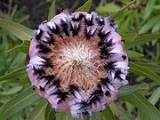
Protea

Encyclopedia
Protea is both the botanical name
and the English common name of a genus
of flowering plants, sometimes also called sugarbushes.
, who could change his form at will, because proteas have such a wide variety of forms. Linnaeus's genus was formed by merging a number of genera previously published by Herman Boerhaave
, although precisely which of Boerhaave's genera were included in Linnaeus's Protea varied with each of Linnaeus's publications.
, and the Grevilleoideae
, concentrated in Australia
and South America
and the other smaller segments of Gondwanaland that are now part of eastern Asia
. Africa shares only one genus with Madagascar
, whereas South America and Australia share many common genera — this indicates they separated from Africa before they separated from each other.
. However, Protea kilimanjaro is found in the chaparral zone of Mount Kenya National Park
. 92% of the species occur only in the Cape Floristic Region
, a narrow belt of mountainous coastal land from Clanwilliam to Grahamstown, South Africa. The extraordinary richness and diversity of species characteristic of the Cape Flora is thought to be caused in part by the diverse landscape where populations can become isolated from each other and in time develop into separate species.
in the 17th century. Many species were introduced to Europe in the 18th century, enjoying a unique popularity at the time amongst botanists.
, they are a member of the subfamily Proteoideae, which has Southern African and Australian members.
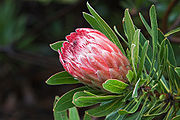 (listed by section: a section has a name in two parts, consisting of the genus name and an epithet).
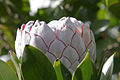
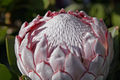
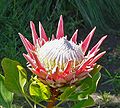
, the protea had been treated as a sometimes controversial national symbol in South Africa, both during and after apartheid.
Today the South Africa national cricket team is known as "The Proteas" and this has linked the flower to wider nationalist sentiments in South Africa.
The former South African Prime Minister and architect of apartheid, Hendrik Frensch Verwoerd
, had a dream to change the flag of South Africa
to have in its center a leaping springbok antelope over a wreath
of six proteas. This proposal, however, aroused too much controversy to be implemented.
After the demise of apartheid, the ANC
government decreed that South African sporting teams, hitherto called "Springboks" were to be known as the "Proteas", although an exemption was made for the rugby union team, who remain "Springboks
". In apartheid times, the "Proteas" was the Cape Coloured representative team.
Botanical name
A botanical name is a formal scientific name conforming to the International Code of Botanical Nomenclature and, if it concerns a plant cultigen, the additional cultivar and/or Group epithets must conform to the International Code of Nomenclature for Cultivated Plants...
and the English common name of a genus
Genus
In biology, a genus is a low-level taxonomic rank used in the biological classification of living and fossil organisms, which is an example of definition by genus and differentia...
of flowering plants, sometimes also called sugarbushes.
Etymology
The genus Protea was named in 1735 by Carl Linnaeus after the Greek god ProteusProteus
In Greek mythology, Proteus is an early sea-god, one of several deities whom Homer calls the "Old Man of the Sea", whose name suggests the "first" , as protogonos is the "primordial" or the "firstborn". He became the son of Poseidon in the Olympian theogony In Greek mythology, Proteus (Πρωτεύς)...
, who could change his form at will, because proteas have such a wide variety of forms. Linnaeus's genus was formed by merging a number of genera previously published by Herman Boerhaave
Herman Boerhaave
Herman Boerhaave was a Dutch botanist, humanist and physician of European fame. He is regarded as the founder of clinical teaching and of the modern academic hospital. His main achievement was to demonstrate the relation of symptoms to lesions...
, although precisely which of Boerhaave's genera were included in Linnaeus's Protea varied with each of Linnaeus's publications.
Taxonomy
The Proteaceae family to which proteas belong is an ancient one. Its ancestors grew in Gondwanaland, 300 million years ago. Proteaceae is divided into two subfamilies: the Proteoideae, best represented in southern AfricaAfrica
Africa is the world's second largest and second most populous continent, after Asia. At about 30.2 million km² including adjacent islands, it covers 6% of the Earth's total surface area and 20.4% of the total land area...
, and the Grevilleoideae
Grevillea
Grevillea is a diverse genus of about 360 species of evergreen flowering plants in the protea family Proteaceae, native to Australia, New Guinea, New Caledonia, and Sulawesi. It was named in honour of Charles Francis Greville. The species range from prostrate shrubs less than 0.5 m tall to trees...
, concentrated in Australia
Australia
Australia , officially the Commonwealth of Australia, is a country in the Southern Hemisphere comprising the mainland of the Australian continent, the island of Tasmania, and numerous smaller islands in the Indian and Pacific Oceans. It is the world's sixth-largest country by total area...
and South America
South America
South America is a continent situated in the Western Hemisphere, mostly in the Southern Hemisphere, with a relatively small portion in the Northern Hemisphere. The continent is also considered a subcontinent of the Americas. It is bordered on the west by the Pacific Ocean and on the north and east...
and the other smaller segments of Gondwanaland that are now part of eastern Asia
Asia
Asia is the world's largest and most populous continent, located primarily in the eastern and northern hemispheres. It covers 8.7% of the Earth's total surface area and with approximately 3.879 billion people, it hosts 60% of the world's current human population...
. Africa shares only one genus with Madagascar
Madagascar
The Republic of Madagascar is an island country located in the Indian Ocean off the southeastern coast of Africa...
, whereas South America and Australia share many common genera — this indicates they separated from Africa before they separated from each other.
Distribution
Most protea occur south of the Limpopo RiverLimpopo River
The Limpopo River rises in central southern Africa, and flows generally eastwards to the Indian Ocean. It is around long, with a drainage basin in size. Its mean annual discharge is 170 m³/s at its mouth...
. However, Protea kilimanjaro is found in the chaparral zone of Mount Kenya National Park
Mount Kenya National Park
Mount Kenya National Park, established in 1949, protects the region surrounding Mount Kenya. Initially it was a forest reserve before being announced as a national park. Currently the national park is within the forest reserve which encircles it. In April 1978 the area was designated a UNESCO...
. 92% of the species occur only in the Cape Floristic Region
Cape floristic region
The Cape Floristic Region is a floristic region located near the southern tip of South Africa. It is the only floristic region of the Cape Floristic Kingdom, and includes only one floristic province, known as the Cape Floristic Province.The Cape Floristic Region, the smallest of the six recognised...
, a narrow belt of mountainous coastal land from Clanwilliam to Grahamstown, South Africa. The extraordinary richness and diversity of species characteristic of the Cape Flora is thought to be caused in part by the diverse landscape where populations can become isolated from each other and in time develop into separate species.
Botanical History
Proteas attracted the attention of botanists visiting the Cape of Good HopeCape of Good Hope
The Cape of Good Hope is a rocky headland on the Atlantic coast of the Cape Peninsula, South Africa.There is a misconception that the Cape of Good Hope is the southern tip of Africa, because it was once believed to be the dividing point between the Atlantic and Indian Oceans. In fact, the...
in the 17th century. Many species were introduced to Europe in the 18th century, enjoying a unique popularity at the time amongst botanists.
Classification
Within the huge family ProteaceaeProteaceae
Proteaceae is a family of flowering plants distributed in the Southern Hemisphere. The family comprises about 80 genera with about 1600 species. Together with the Platanaceae and Nelumbonaceae they make up the order Proteales. Well known genera include Protea, Banksia, Embothrium, Grevillea,...
, they are a member of the subfamily Proteoideae, which has Southern African and Australian members.
Species
- Protea section Leiocephalae
- Protea caffraProtea caffraProtea caffra is a small tree or shrub which occurs in open or wooded grassland usually on rocky ridges. Its leaves are leathery and hairless. The flower head is solitary or in clusters of 3 or 4 with the involucral bracts a pale red, pink or cream colour. The fruit is a densely hairy nut...
(Common Protea) - Protea dracomontana
- Protea glabra
- Protea inopina
- Protea nitidaProtea nitidaProtea nitida is a large, slow-growing Protea endemic to South Africa. It is one of the few Proteas that grow into trees, and the only one that has usable timber.-Appearance:...
(The Wagon Tree) - Protea nubigena
- Protea parvula
- Protea petiolaris
- Protea rupicola
- Protea simplex
- Protea caffra
- Protea section Paludosae
- Protea enervis
- Protea section Patentiflorae
- Protea angolensisProtea angolensisProtea angolensis is a dwarf, multistemmed shrub or small straggling tree occurring in open wooded grassland. This species occurs mainly in Zimbabwe and to a limited extent in Mozambique....
- Protea comptoniiProtea comptoniiProtea comptonii is a species of plant in the Proteaceae family.It is found in South Africa and Swaziland. It is threatened by habitat loss.-Source:* Hilton-Taylor, C. et al. 1998. . Downloaded on 23 August 2007....
- Protea curvataProtea curvataProtea curvata is a species of plant in the Proteaceae family. It is endemic to South Africa.-Source:* Hilton-Taylor, C. et al. 1998. . Downloaded on 23 August 2007....
- Protea laetansProtea laetansProtea laetans is a species of plant in the Proteaceae family. It is endemic to South Africa.-Source:* Hilton-Taylor, C. et al. 1998. . Downloaded on 23 August 2007....
- Protea madiensis
- Protea rubropilosa
- Protea rupestris
- Protea angolensis
- Protea section Lasiocephalae
- Protea gaguediProtea gaguediProtea gaguedi is similar to Protea welwitschii and has hairless mature leaves and solitary flower heads.- References :*van Wyk, B. and van Wyk, P. 1997. Field Guide to trees of South Africa. Struik, Cape Town...
- Protea welwitschiiProtea welwitschiiProtea welwitschii is a multistemmed shrub or small gnarled tree occurring in grassland and bushveld. Leaves are bluish green and hairy at the base when mature. Flowers usually in clusters of 3 or 4. Fruit is a densely hairy nut.-References:*van Wyk, B. and van Wyk, P. 1997. Field Guide to trees...
- Protea gaguedi
- Protea section Cristatae
- Protea asymmetrica
- Protea wentzeliana
- Protea section Cynaroidae
- Protea cynaroides (King Protea)
- Protea section Paracynaroides
- Protea cryophila (Snow Protea)
- Protea pruinosa
- Protea scabriuscula
- Protea scolopendriifolia
- Protea section Ligulatae
- Protea burchellii
- Protea compactaProtea compactaProtea compacta is similar to Protea eximia. Its distribution is from the Kleinmond to Bredasdorp Mountains and is one of the best known proteas in the cut flower industry. Its leaves curve upward.-Description:...
- Protea eximiaProtea eximiaProtea eximia, the broad-leaved sugarbush is a shrub that may become a small tree, which occurs in mountain fynbos on mainly acidic sandy soils; the species was very well known under its old name of Protea latifolia...
- Protea longifolia
- Protea obtusifolia
- Protea pudens
- Protea roupelliaeProtea roupelliaeProtea roupelliae is a species of Protea.-Taxonomy:P. roupelliae is a species of protea in the huge family Proteaceae. The family comprises about 80 genera with about 1600 species...
- Protea susannae
- Protea section Melliferae
- Protea aristataProtea aristataProtea aristata , was first collected by the botanists T. P. Stokoe and R. Primos in 1928 near the town of Ladismith in the Cape Province, South Africa. In spite of being locally common in the Seweweekspoort the plant species could not be found again until 1953, prior to which it was considered to...
- Protea lanceolataProtea lanceolataProtea lanceolata is a species of plant in the Proteaceae family. It is endemic to South Africa. It is threatened by habitat loss.-Source:* Hilton-Taylor, C. et al. 1998. . Downloaded on 23 August 2007....
- Protea repens (Common Sugarbush Protea)
- Protea aristata
- Protea section Speciosae
- Protea coronataProtea coronataProtea coronata is an erect shrub usually growing 2 to 3 meters tall, but known to reach 5 meters. It produces an apple-green flowerhead and lanceolate leaves, turning purple-green around the flowerhead. Its stems are hairy. It flowers between April and September. The plant grows in dense stands on...
- Protea grandiceps
- Protea holosericea
- Protea laurifoliaProtea laurifoliaProtea laurifolia is similar to Protea neriifolia but has a more westerly distribution. The leaves are grey to bluish green and short stalked with horny margins.-References:...
- Protea lepidocarpodendronProtea lepidocarpodendronProtea lepidocarpodendron, the black bearded sugarbush, is a bearded Protea that is placed in the section Speciosae. It grows between one and 2 m tall, with narrowly oblong leaves. Flowerheads are oblong with a purple-black beard and black hairs below the beard...
- Protea lorifolia
- Protea magnifica
- Protea neriifoliaProtea neriifoliaProtea neriifolia, also known as oleanderleaf protea, is a flowering plant. which is endemic to South Africa.-Description:It forms a large shrub from about 3 metres to 5 metres in height...
(Oleander-leaf Protea) - Protea speciosa
- Protea stokoei
- Protea coronata
- Protea section Exsertae
- Protea aureaProtea aureaProtea aurea is a shrub or small tree with a single trunk occurring in mountain fynbos, usually on cool, moist, southern slopes. It is endemic in South Africa....
- Protea lacticolor
- Protea mundiiProtea mundiiProtea mundii, the Forest Sugarbush, is a flowering shrub native to South Africa.-Description:Protea mundii grows to a height of 20-30 ft. . The plant has white to ivory flowers, which are attractive to bees, butterflies and/or birds....
- Protea punctata
- Protea subvestita
- Protea venusta
- Protea aurea
- Protea section Microgeantae
- Protea acaulos
- Protea convexa
- Protea laevis
- Protea revoluta
- Protea ungustata
- Protea section Crinitae
- Protea foliosa
- Protea intonsa
- Protea montana
- Protea tenax
- Protea vogtsiae
- Protea section Pinifolia
- Protea acuminata
- Protea canaliculata
- Protea nana
- Protea pityphylla
- Protea scolymocephalaProtea scolymocephalaProtea scolymocephala, the thistle protea, is a flowering plant from the Protea genus native to South Africa. It's a small erect shrub between 0,5 and 1,5 meters tall. The leaves are linear-spatulate curving upwards. The flowerhead is yellow-green and small, with 3,5 - 4,5 cm across. The species...
- Protea witzenbergiana
- Protea section Craterifolia
- Protea effusa
- Protea namaquana
- Protea pendula
- Protea recondita
- Protea sulphurea
- Protea section Obvallatae
- Protea caespitosa
- Protea section Subacaules
- Protea aspera
- Protea denticulata
- Protea lorea
- Protea piscina
- Protea restionifolia
- Protea scabra
- Protea scorzonerifolia
National symbol
Together with the springbok antelopeSpringbok Antelope
The springbok is a medium-sized brown and white gazelle that stands about high. Springbok males weigh between and the females between...
, the protea had been treated as a sometimes controversial national symbol in South Africa, both during and after apartheid.
Today the South Africa national cricket team is known as "The Proteas" and this has linked the flower to wider nationalist sentiments in South Africa.
The former South African Prime Minister and architect of apartheid, Hendrik Frensch Verwoerd
Hendrik Frensch Verwoerd
Hendrik Frensch Verwoerd , commonly identified as H.F. Verwoerd, was Prime Minister of South Africa from 1958 until his assassination in 1966...
, had a dream to change the flag of South Africa
Flag of South Africa
The current flag of the Republic of South Africa was adopted on 27 April 1994, at the beginning of the 1994 general election, to replace the flag that had been used since 1928...
to have in its center a leaping springbok antelope over a wreath
Wreath
A wreath is an assortment of flowers, leaves, fruits, twigs and/or various materials that is constructed to resemble a ring. They are used typically as Christmas decorations to symbolize the coming of Christ, also known as the Advent season in Christianity. They are also used as festive headdresses...
of six proteas. This proposal, however, aroused too much controversy to be implemented.
After the demise of apartheid, the ANC
African National Congress
The African National Congress is South Africa's governing Africanist political party, supported by its tripartite alliance with the Congress of South African Trade Unions and the South African Communist Party , since the establishment of non-racial democracy in April 1994. It defines itself as a...
government decreed that South African sporting teams, hitherto called "Springboks" were to be known as the "Proteas", although an exemption was made for the rugby union team, who remain "Springboks
South Africa national rugby union team
The South African national rugby union team are 2009 British and Irish Lions Series winners. They are currently ranked as the fourth best team in the IRB World Rankings and were named 2008 World Team of the Year at the prestigious Laureus World Sports Awards.Although South Africa was instrumental...
". In apartheid times, the "Proteas" was the Cape Coloured representative team.
External links
- Protea Atlas Project: a project to map the distribution of South African plant species, using Protea as a flagship.
- www.ncbi.nlm.nih.gov/Taxonomy/Browser
- http://pollack-group.com Pollack Group:leader in distribution of proteas in the world]