
All Topics  
Aardvark

 
Aardvark

   Email Print
   Bookmark   Link


Aardvark


The Aardvark (Orycteropus afer) (: from Africa) is a medium-sized, burrowing, nocturnal mammal
Mammal

Mammals are a class of vertebrate animals whose name is derived from their distinctive feature, mammary glands, with which they feed their young....
 native to Africa
Africa

Africa is the world's second-largest and second most-populous continent, after Asia. At about 30.2 million km? including adjacent islands, it covers 6% of the Earth's total surface area and 20.4% of the total land area....
. It is sometimes called "antbear", "anteater", "Cape anteater" (after the Cape of Good Hope
Cape of Good Hope

The Cape of Good Hope is a rocky headlands and bays on the Atlantic Ocean coast of South Africa. There is a very common misconception that the Cape of Good Hope is the southern tip of Africa and the dividing point between the Atlantic Ocean and Indian Oceans, but in fact the southernmost point is Cape Agulhas, about 150 kilometres t...
), "earth hog" or "earth pig". The name comes from the Afrikaans
Afrikaans

Afrikaans is an Indo-European language, derived from Dutch language and thus classified as Low Franconian languages West Germanic languages. It is mainly spoken in South Africa and Namibia, with smaller numbers of speakers living in Botswana, Angola, Swaziland, Zimbabwe, Lesotho, Zambia, Australia, New Zealand, United States of America, Taiwa...
/Dutch
Dutch language

Dutch is a West Germanic languages spoken by over 22 million people as a first language, and about 5 million people as a second language."1% of the EU population claims to speak Dutch well enough in order to have a conversation." Outside the European Union the number of second language speakers of Dutch is very small. Most native...
 for "earth pig" (aarde earth, varken pig), because early settlers from Europe
Europe

Europe is, conventionally, one of the world's seven continents. Comprising the westernmost peninsula of Eurasia, Europe is generally divided from Asia to its east by the water divide of the Ural Mountains, the Ural , the Caspian Sea, and by the Caucasus Mountains to the southeast....
 thought it resembled a domesticated pig
Pig

Pigs, also called hogs or swine, are a genus of even-toed ungulates within the Family Suidae. The name pig, hog, or swine most commonly refers to the Domestic pig in everyday parlance, but technically encompasses several distinct species, including the Wild Boar....
.


Discussion
Ask a question about 'Aardvark'
Start a new discussion about 'Aardvark'
Answer questions from other users
Full Discussion Forum


Encyclopedia


The Aardvark (Orycteropus afer) (: from Africa) is a medium-sized, burrowing, nocturnal mammal
Mammal

Mammals are a class of vertebrate animals whose name is derived from their distinctive feature, mammary glands, with which they feed their young....
 native to Africa
Africa

Africa is the world's second-largest and second most-populous continent, after Asia. At about 30.2 million km? including adjacent islands, it covers 6% of the Earth's total surface area and 20.4% of the total land area....
. It is sometimes called "antbear", "anteater", "Cape anteater" (after the Cape of Good Hope
Cape of Good Hope

The Cape of Good Hope is a rocky headlands and bays on the Atlantic Ocean coast of South Africa. There is a very common misconception that the Cape of Good Hope is the southern tip of Africa and the dividing point between the Atlantic Ocean and Indian Oceans, but in fact the southernmost point is Cape Agulhas, about 150 kilometres t...
), "earth hog" or "earth pig". The name comes from the Afrikaans
Afrikaans

Afrikaans is an Indo-European language, derived from Dutch language and thus classified as Low Franconian languages West Germanic languages. It is mainly spoken in South Africa and Namibia, with smaller numbers of speakers living in Botswana, Angola, Swaziland, Zimbabwe, Lesotho, Zambia, Australia, New Zealand, United States of America, Taiwa...
/Dutch
Dutch language

Dutch is a West Germanic languages spoken by over 22 million people as a first language, and about 5 million people as a second language."1% of the EU population claims to speak Dutch well enough in order to have a conversation." Outside the European Union the number of second language speakers of Dutch is very small. Most native...
 for "earth pig" (aarde earth, varken pig), because early settlers from Europe
Europe

Europe is, conventionally, one of the world's seven continents. Comprising the westernmost peninsula of Eurasia, Europe is generally divided from Asia to its east by the water divide of the Ural Mountains, the Ural , the Caspian Sea, and by the Caucasus Mountains to the southeast....
 thought it resembled a domesticated pig
Pig

Pigs, also called hogs or swine, are a genus of even-toed ungulates within the Family Suidae. The name pig, hog, or swine most commonly refers to the Domestic pig in everyday parlance, but technically encompasses several distinct species, including the Wild Boar....
. However, the aardvark is not closely related to the pig; rather, it is the sole recent representative of the obscure mammalian order
Order (biology)

In Biological classification used in biology, the order is a taxonomic rank between class and family . The superorder is a rank between class and order....
 Tubulidentata, in which it is usually considered to form a single variable species of the genus Orycteropus, coextensive with the family Orycteropodidae. Nor is the aardvark closely related to the South America
South America

South America is the southern continent of the Americas, situated entirely in the Western Hemisphere and mostly in the Southern Hemisphere, with a relatively small portion in the Northern Hemisphere....
n anteater
Anteater

Anteaters are the four mammal species of the suborder Vermilingua commonly known for eating ants and termites. Together with the sloths, they compose the order Pilosa....
, despite sharing some characteristics and a superficial resemblance. The closest living relatives of the aardvark are the elephant shrew
Elephant shrew

Elephant shrews or jumping shrews are small insectivore mammals native to Africa, belonging to the Macroscelididae family, in the order Macroscelidea....
s, along with the sirenians, hyrax
Hyrax

A hyrax is any of four species of fairly small, thickset, herbivorous mammals in the order Hyracoidea. They live in Africa and the Middle East....
es, tenrecs, and elephant
Elephant

Elephants are large land mammals of the order Proboscidea and the family Elephantidae. There are three living species: the African Bush Elephant, the African Forest Elephant and the Asian Elephant ....
s.

Description

One of the most distinctive characteristics of the Tubulidentata is (as the name implies) their teeth. Instead of having a pulp cavity
Pulp (tooth)

The dental pulp is the part in the center of a tooth made up of living soft tissue and Cell called odontoblasts....
, each tooth has a cluster of thin, upright, parallel tubes of vasodentin (a modified form of dentine), with individual pulp canals, held together by cementum
Cementum

Cementum is a specialized calcified substance covering the root of a teeth. Cementum is excreted by cells called cementoblasts within the root of the tooth and is thickest at the root apex....
. The teeth have no enamel coating and are worn away and regrow continuously. The aardvark is born with conventional incisors and canines
Canine tooth

In mammalian oral anatomy, the canine teeth, also called cuspids, dogteeth, fangs, or eye teeth, are relatively long, pointed tooth....
 at the front of the jaw, which fall out and are not replaced. Adult aardvarks only have cheek teeth at the back of the jaw, and have a dental formula
Dentition

Dentition is the tooth development of teeth and their arrangement in the mouth.All mammals except the monotremes, the xenarthrans, the pangolins, and the cetaceans have up to four distinct types of teeth, with a maximum number for each....
 of:

Gene
Gene

A gene is the basic unit of heredity in a living organism. All living things depend on genes. Genes hold the information to build and maintain their cell and pass genetic trait to offspring....
tically speaking, the aardvark is a living fossil
Living fossil

Living fossil is an informal term for any living species of organism which appears to be the same as a species otherwise only known from fossils and which has no close living relatives....
, as its chromosome
Chromosome

A chromosome is an organized structure of DNA and protein that is found in Cell . A chromosome is a single piece of DNA that contains many genes, regulatory sequence and other genetic sequence....
s are highly conserved, reflecting much of the early eutherian arrangement before the divergence of the major modern taxa
Taxon

A taxon or taxonomic unit is a name designating an organism or a group of organisms. In biological nomenclature according to Carl Linnaeus, a taxon is assigned a taxonomic rank and can be placed at a particular level in a systematic hierarchy reflecting evolutionary relationships....
.

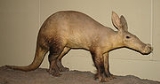
The aardvark is vaguely pig-like in appearance. Its body is stout with an arched back and is sparsely covered with coarse hairs. The limbs are of moderate length. The front feet have lost the pollex (or 'thumb') — resulting in four toes — but the rear feet have all five toes. Each toe bears a large, robust nail
Nail

Nail may refer to:* Nail , toughened keratin at the end of an animal digit* Nail , the pin-shaped fastener used in engineering, woodworking and construction...
 which is somewhat flattened and shovel-like, and appears to be intermediate between a claw and a hoof. The ears are disproportionately long, and the tail is very thick at the base and gradually tapers. The greatly elongated head is set on a short, thick neck, and the end of the snout bears a disc, which houses the nostrils. The mouth is small and tubular, typical of species that feed on termites. The aardvark has a long, thin, snakelike, protruding tongue and elaborate structures supporting a keen sense of smell
Olfaction

Olfaction refers to the sense of smell. This sense is mediated by specialized sensory cells of the nasal cavity of vertebrates, and, by analogy, sensory cells of the antennae of invertebrates....
.

An aardvark's weight is typically between 40 and 65 kg. An aardvark's length is usually between 1 and 1.3 meters, and can reach lengths of 2.2 meters when its tail (which can be up to 70 centimeters) is taken into account. The aardvark is pale yellowish gray in color and often stained reddish-brown by soil. The aardvark's coat is thin and the animal's primary protection is its tough skin. The aardvark has been known to sleep in a recently excavated ant nest, which also serves as protection.

Behavior

The aardvark is nocturnal and is a solitary creature that feeds almost exclusively on ant
Ant

Ants are Eusociality insects of the family Formicidae, and along with the related wasps and bees, they belong to the order Hymenoptera. Ants evolution from wasp-like ancestors in the mid-Cretaceous period between 110 and 130 million years ago and Evolutionary radiation after the rise of flowering plants....
s and termite
Termite

The termites are a group of social insects usually classified at the Taxonomy of Order Isoptera . As truly social animals, they are termed eusocial along with the ants and some bees and wasps which are all placed in the separate Order Hymenoptera....
s (formicivore); the only fruit
Fruit

The term fruit has different meanings dependent on context, and the term is not synonymous in food preparation and biology. In botany, which is the scientific study of plants, fruits are the ripened Ovary of flowering plants....
 eaten by aardvarks is the aardvark cucumber
Aardvark cucumber

The aardvark cucumber , also known as aardvark pumpkin, is a kind of cucumis from Southern Africa which fruits underground. It is the only fruit eaten by aardvark, which normally feeds exclusively on ants and termites....
. An aardvark emerges from its burrow in the late afternoon or shortly after sunset, and forages over a considerable home range encompassing 10 to 30 kilometers, swinging its long nose from side to side to pick up the scent of food. When a concentration of ants or termites is detected, the aardvark digs into it with its powerful front legs, keeping its long ears upright to listen for predators, and takes up an astonishing number of insects with its long, sticky tongue—as many as 50,000 in one night have been recorded. It is an exceptionally fast digger, but otherwise moves fairly slowly. Its claws enable it to dig through the extremely hard crust of a termite or ant mound quickly, avoiding the dust by sealing the nostrils. When successful, the aardvark's long (as long as 30 centimeters) tongue licks up the insects; the termites' biting, or the ants' stinging attacks are rendered futile by the tough skin. Its keen hearing warns it of predators: lions, leopards, hyenas, and pythons.

Aside from digging out ants and termites, the aardvark also excavates burrows in which to live: temporary sites are scattered around the home range as refuges, and a main burrow is used for breeding. Main burrows can be deep and extensive, have several entrances and can be as long as 13 meters. The aardvark changes the layout of its home burrow regularly, and from time to time moves on and makes a new one; the old burrows are then inhabited by smaller animals like the African Wild Dog
African Wild Dog

The African Wild Dog is a Carnivore mammal of the Canidae family, found only in Africa, especially in scrub savanna and other lightly wooded areas....
. Only mothers and young share burrows. If attacked in the tunnel, it will seal the tunnel off behind itself or turn around and attack with its claws.

Aardvarks only pair during the breeding season; after a gestation
Gestation

Gestation is the carrying of an embryo or fetus inside a female viviparous animal. Mammals during mammalian pregnancy can have one or more gestations at the same time ....
 period of 7 months, a single cub weighing around 2 kg is born, and is able to leave the burrow to accompany its mother after only two weeks, and is eating termites at 14 weeks and is weaned by 16 weeks. At six months of age it is able to dig its own burrows, but it will often remain with the mother until the next mating season, and is sexually capable by the season after that.

Aardvarks can live to be over 24 years old in captivity
Captivity

Captivity may refer to:*Imprisonment or hostage, the state of being confined to a space from which it is difficult or impossible to escape*the same used in a figurative sense, like for example female captivity, as allegorically portrayed in The Gilded Cage, a painting by Evelyn De Morgan...
.

The aardvark's main predators are lions, leopards, hunting dogs and pythons. Aardvarks can dig fast or run in zigzag fashion to elude enemies, but if all else fails, they will strike with their claws, tail and shoulders, sometimes flipping onto their backs to lash with all fours. Their thick skin also protects them to some extent.

Habitat

Aardvarks live in subsaharan Africa, where there is suitable habitat for them to live, such as savanna
Savanna

A savanna, or savannah, is a tropical, subtropical or temperate woodland ecosystem characterized by the trees being sufficiently small or widely spaced so that the Canopy does not close....
s, grassland
Grassland

Grasslands are areas where the vegetation is dominated by grasses and other herbaceous plants . However, sedge and rush families can also be found....
s, woodland
Woodland

Ecologically, a woodland is an area covered in trees, usually at low density, forming an open habitat, allowing sunlight to penetrate between the trees, and limiting shade....
s and bushland
Bushland

The term bushland usually refers to an area that has only a sparse Flora and Fauna . This term was first used to describe the harsh Australian Outback, the red semi-desert that covers a significant part of the inner continent....
, and available food (i.e., ants and termites).

Mythology and popular culture

In African folklore the aardvark is much admired because of its diligent quest for food and its fearless response to the strong, warlike soldier ant. Hausa
Hausa

Hausa may refer to:*the Hausa language*the Hausa people...
 magicians make a charm from the heart, skin, forehead, and nails of the aardvark, which they then proceed to pound together with the root of a certain tree. Wrapped in a piece of skin and worn on the chest the charm is said to give the owner the ability to pass through walls or roofs at night. The charm is said to be used by burglars and those seeking to visit young girls without their parents' permission.

In English-speaking countries, the aardvark enjoys unusual notoriety, since it is the first noun, and often the first illustrated entry, in many English dictionaries. The main character of Arthur, a popular animated television series for children produced by WGBH-TV and shown in more than 100 countries, is an aardvark.

External links

  • California Academy of Sciences – Research.
  • Wild life wonders from southern Africa.
  • Animal Diversity Web: University of Michigan Museum of Zoology.
  • "The Biology of the Aardvark" (Orycteropus afer)] diploma thesis (without pictures)
  • same diploma thesis (including the pictures)