All Topics  
Australasia ecozone


   Email Print
   Bookmark   Link


Australasia ecozone


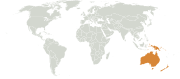
The Australasian zone is an ecological region
Ecozone

An ecozone or biogeographic realm is the largest scale biogeography division of the earth's surface based on the historic and evolutionary distribution patterns of plants and animals....
 that is coincident, but not synonymous (by some definitions), with the geographic
Geography

Geography is the study of the Earth and its lands, features, inhabitants, and phenomena. A literal translation would be "to describe or write about the Earth"....
 region
Region

Region is a geographical term that is used in various ways among the different branches of geography. In general, a region is a medium-scale area of land or water, smaller than the whole areas of interest , and larger than a specific site A region may be seen as a collection of smaller units or as one part of a larger whole ....
 of Australasia
Australasia

Australasia is a region of Oceania: New Zealand, Australia, Papua New Guinea, and neighbouring islands in the Pacific Ocean. The term was coined by Charles de Brosses in Histoire des navigations aux terres australes ....
. The ecozone includes Australia
Australia

Australia, officially the Commonwealth of Australia, is a country in the southern hemisphere comprising the Australia of the world's smallest continent, the major island of Tasmania, and numerous list of islands of Australia in the Indian Ocean and Pacific Oceans....
, the island of New Guinea
New Guinea

New Guinea, located just north of Australia, is the List of islands by area, having become separated from the Australian mainland when the area now known as the Torres Strait flooded after the last glacial period....
 (including Papua New Guinea
Papua New Guinea

Papua New Guinea , officially the Independent State of Papua New Guinea, is a country in Oceania, occupying the eastern half of the island of New Guinea and numerous offshore islands ....
 and the Indonesia
Indonesia

The Republic of Indonesia , is a transcontinental country in Southeast Asia and Oceania. Comprising Islands of Indonesia, it is the world's largest Archipelago state....
n province of Papua), and the eastern part of the Indonesian archipelago, including the island of Sulawesi
Sulawesi

Sulawesi is one of the four larger Sunda Islands of Indonesia and is situated between Borneo and the Maluku Islands....
, the Moluccan islands (the Indonesian provinces of Maluku and North Maluku
North Maluku

North Maluku is a Provinces of Indonesia of Indonesia. It covers the northern part of the Maluku Islands, which are split between it and the province of Maluku ....
) and islands of Lombok
Lombok

Lombok is an island in West Nusa Tenggara province, Indonesia. It is part of the chain of the Lesser Sunda Islands, with the Lombok Strait separating it from Bali to the west and the Alas Strait between it and Sumbawa to the east....
, Sumbawa
Sumbawa

Sumbawa is an Indonesian island, located in the middle of the Lesser Sunda Islands chain, with Lombok to the west, Flores to the east, and Sumba further to the southeast....
, Sumba
Sumba

Sumba is an island in Indonesia, and is one of the Lesser Sunda Islands. It has an area of 11,153 km?, and the population was officially at 611,422 in 2005....
, Flores
Flores

Flores is one of the Lesser Sunda Islands, an island arc with an estimated area of 14,300 km? extending east from the Java island of Indonesia....
, and Timor
Timor

Timor is an island at the south end of the Malay Archipelago, north of the Timor Sea. It is divided between the independent state of East Timor, , and West Timor, belonging to the Indonesian province of East Nusa Tenggara....
, often known as the Lesser Sundas.


Discussion
Ask a question about 'Australasia ecozone'
Start a new discussion about 'Australasia ecozone'
Answer questions from other users
Full Discussion Forum


Encyclopedia


The Australasian zone is an ecological region
Ecozone

An ecozone or biogeographic realm is the largest scale biogeography division of the earth's surface based on the historic and evolutionary distribution patterns of plants and animals....
 that is coincident, but not synonymous (by some definitions), with the geographic
Geography

Geography is the study of the Earth and its lands, features, inhabitants, and phenomena. A literal translation would be "to describe or write about the Earth"....
 region
Region

Region is a geographical term that is used in various ways among the different branches of geography. In general, a region is a medium-scale area of land or water, smaller than the whole areas of interest , and larger than a specific site A region may be seen as a collection of smaller units or as one part of a larger whole ....
 of Australasia
Australasia

Australasia is a region of Oceania: New Zealand, Australia, Papua New Guinea, and neighbouring islands in the Pacific Ocean. The term was coined by Charles de Brosses in Histoire des navigations aux terres australes ....
. The ecozone includes Australia
Australia

Australia, officially the Commonwealth of Australia, is a country in the southern hemisphere comprising the Australia of the world's smallest continent, the major island of Tasmania, and numerous list of islands of Australia in the Indian Ocean and Pacific Oceans....
, the island of New Guinea
New Guinea

New Guinea, located just north of Australia, is the List of islands by area, having become separated from the Australian mainland when the area now known as the Torres Strait flooded after the last glacial period....
 (including Papua New Guinea
Papua New Guinea

Papua New Guinea , officially the Independent State of Papua New Guinea, is a country in Oceania, occupying the eastern half of the island of New Guinea and numerous offshore islands ....
 and the Indonesia
Indonesia

The Republic of Indonesia , is a transcontinental country in Southeast Asia and Oceania. Comprising Islands of Indonesia, it is the world's largest Archipelago state....
n province of Papua), and the eastern part of the Indonesian archipelago, including the island of Sulawesi
Sulawesi

Sulawesi is one of the four larger Sunda Islands of Indonesia and is situated between Borneo and the Maluku Islands....
, the Moluccan islands (the Indonesian provinces of Maluku and North Maluku
North Maluku

North Maluku is a Provinces of Indonesia of Indonesia. It covers the northern part of the Maluku Islands, which are split between it and the province of Maluku ....
) and islands of Lombok
Lombok

Lombok is an island in West Nusa Tenggara province, Indonesia. It is part of the chain of the Lesser Sunda Islands, with the Lombok Strait separating it from Bali to the west and the Alas Strait between it and Sumbawa to the east....
, Sumbawa
Sumbawa

Sumbawa is an Indonesian island, located in the middle of the Lesser Sunda Islands chain, with Lombok to the west, Flores to the east, and Sumba further to the southeast....
, Sumba
Sumba

Sumba is an island in Indonesia, and is one of the Lesser Sunda Islands. It has an area of 11,153 km?, and the population was officially at 611,422 in 2005....
, Flores
Flores

Flores is one of the Lesser Sunda Islands, an island arc with an estimated area of 14,300 km? extending east from the Java island of Indonesia....
, and Timor
Timor

Timor is an island at the south end of the Malay Archipelago, north of the Timor Sea. It is divided between the independent state of East Timor, , and West Timor, belonging to the Indonesian province of East Nusa Tenggara....
, often known as the Lesser Sundas. The Australasian ecozone also includes several Pacific island groups, including the Bismarck Archipelago
Bismarck Archipelago

The Bismarck Archipelago is a group of islands off the northeastern coast of New Guinea in the western Pacific Ocean and part of Papua New Guinea....
, Vanuatu
Vanuatu

Vanuatu , officially the Republic of Vanuatu , is an island nation located in the South Pacific Ocean. The archipelago, which is of volcanic origin, is some east of northern Australia, north-east of New Caledonia, west of Fiji, and south of the Solomon Islands, near New Zealand....
, the Solomon Islands
Solomon Islands

For the group of islands rather than the nation, see Solomon Islands .The Solomon Islands is a country in Melanesia, east of Papua New Guinea, consisting of nearly one thousand islands....
, and New Caledonia
New Caledonia

New Caledonia , is a "sui generis collectivity" of France located in the subregion of Melanesia in the Oceania. It comprises a main island , the Loyalty Islands, and several smaller islands....
. New Zealand
New Zealand

New Zealand is an island country in the south-western Pacific Ocean comprising two main landmasses , and numerous Islands of New Zealand, most notably Stewart Island/Rakiura and the Chatham Islands....
 and its surrounding islands are a distinctive sub-region of the Australasian ecozone. The rest of Indonesia is part of the Indomalaya
Indomalaya

The Indomalaya ecozone is one of the eight ecozones that cover the planet's land surface. It extends across most of South Asia and Southeast Asia and into the southern parts of East Asia....
n ecozone.

From a biological point of view, Australasia is a distinct region with a common evolutionary history and a great many unique plants and animals, some of them common to the entire area, others specific to particular parts but sharing a common ancestry. The long isolation of Australasia from other continents allowed it to evolve relatively independently, and makes it home to many unique families of plants and animals.

Australia and New Guinea are distinguished by their marsupial
Marsupial

Marsupials are an infraclass of mammals, characterized by a distinctive Pouch , in which females carry their young through early infancy....
 mammal
Mammal

Mammals are a class of vertebrate animals whose name is derived from their distinctive feature, mammary glands, with which they feed their young....
s, including kangaroo
Kangaroo

A kangaroo is a marsupial from the family Macropodidae . In common use the term is used to describe the largest species from this family, the Red Kangaroo, the Antilopine Kangaroo, and the Eastern Grey Kangaroo and Western Grey Kangaroo of the Macropus genus....
s, possum
Possum

A possum is any of about 64 small to medium-sized arboreal marsupial species native to Australia, New Guinea, and Sulawesi . The name derives from their resemblance to the opossums of the Americas....
s, and wombat
Wombat

Wombats are Australian marsupials; they are short-legged, muscular quadrupeds, approximately in length with a very short tail. They are found in forested, mountainous, and heathland areas of south-eastern Australia and Tasmania....
s. The last remaining monotreme
Monotreme

Monotremes are mammals that lay eggs instead of giving birth to live young like Marsupialias and Placentalia .They are conventionally treated as comprising a single order Monotremata, though a recent classification proposes to divide them into the orders Platypoda and Tachyglossa ....
 mammals, the echidna
Echidna

Echidnas , also known as spiny anteaters, are four Extant taxon mammal species belonging to the Tachyglossidae Family of the monotremes....
s and the platypus
Platypus

The Platypus is a semi-aquatic mammal Endemic to Eastern states of Australia, including Tasmania. Together with the four species of echidna, it is one of the five extant species of monotremes, the only mammals that lay Egg instead of giving birth to live young....
, are endemic
Endemic (ecology)

Endemism is the ecological state of being unique to a particular geographic location, such as a specific island, Habitat type, nation, or other defined zone....
 to Australasia. Prior to the arrival of humans about 50,000 years ago, only about one-third of Australasian mammal species were placental.

The boundary between Australasia and Indomalaya follows the Wallace Line
Wallace Line

The Wallace Line is a boundary that separates the Ecozone of Asia and Wallacea . West of the line are found organisms related to Asiatic species; to the east, a mixture of species of Asian and Australian origin are present....
, named after the naturalist Alfred Russel Wallace
Alfred Russel Wallace

Alfred Russel Wallace, Order of Merit, Fellow of the Royal Society was a United Kingdom of Great Britain and Ireland Natural history, explorer, geographer, anthropologist and biologist....
 who noted the differences in mammal and bird fauna between the islands either side of the line. The Islands to the west of the line, including Java, Bali
Bali

Bali is an Indonesian island located at , the westernmost of the Lesser Sunda Islands, lying between Java to the west and Lombok to the east. It is one of the country's 33 Provinces of Indonesia with the provincial capital at Denpasar towards the south of the island....
, Borneo
Borneo

Borneo is the List of islands by area and is located at the centre of Maritime Southeast Asia. Administratively, this island is divided between Indonesia, Malaysia and Brunei....
, and the Philippines
Philippines

The Philippines, officially known as the Republic of the Philippines, is a country in Southeast Asia with Manila as its capital city. It comprises 7,107 islands in the western Pacific Ocean....
 share a similar fauna with East Asia, including tiger
Tiger

The tiger is a member of the Felidae family; the largest of the four "big cats" in the genus Panthera. Native to much of eastern and southern Asia, the tiger is an apex predator and an Carnivore#Obligate carnivores....
s, rhinoceros
Rhinoceros

Rhinoceros , often colloquially abbreviated rhino, is a name used to group five extant species of odd-toed ungulates in the family Rhinocerotidae....
, and ape
Ape

An ape is any member of the Hominoidea superfamily of primates. In less scientific language, it has various meanings, although it often excludes humans....
s. During the ice age
Ice age

The general term "ice age" or, more precisely, "glacial age" denotes a geological period of long-term reduction in the temperature of the Earth's surface and atmosphere, resulting in an expansion of continental ice sheets, polar ice sheets and alpine glaciers....
s, sea levels were lower, exposing the continental shelf that links these islands to one another and to Asia, and allowed Asian land animals to inhabit these islands. Similarly, Australia and New Guinea are linked by a shallow continental shelf, and were linked by a land bridge during the ice ages. A group of Australasian islands east of the Wallace line, including Sulawesi, Halmahera, Lombok, Flores, Sumba, Sumbawa, and Timor, is separated by deep water from both the southeast Asian continental shelf and the Australia-New Guinea continental shelf. These islands are called Wallacea
Wallacea

Wallacea is a biogeography designation for a group of Indonesian islands separated by deep water straits from the Asian and Australia continental shelf....
, and contain relatively few Australian or Asian mammals. While most land mammals found it difficult to cross the Wallace Line, many plant, bird, and reptile species were better able to make the crossing.

Australia, New Zealand, and New Caledonia are all portions of the ancient supercontinent of Gondwana
Gondwana

Gondwana , originally Gondwanaland is the name given to a southern precursor-supercontinent and then as a remnant separated from Laurasia 180- during the breakup of the Pangaea supercontinent that existed about 500 to 200 Annum ago into two large segments.
, which started to break into smaller continents in the Cretaceous
Cretaceous

The Cretaceous , usually abbreviated K for its German translation Kreide, is a geologic period from circa to million years ago . In the geologic timescale, the Cretaceous follows on the Jurassic period and is followed by the Paleogene period....
 era, 130-65 million years ago. New Zealand broke away first, more than 80 million years ago, and Australia finally broke free from Antarctica
Antarctica

Antarctica is Earth's southernmost continent, overlying the South Pole. It is situated in the Antarctica of the southern hemisphere, almost entirely south of the Antarctic Circle, and is surrounded by the Southern Ocean....
 about 45 million years ago. All the Australasian lands are home to the Antarctic flora
Antarctic flora

The Antarctic flora is a distinct community of vascular plants which evolved millions of years ago on the supercontinent of Gondwana, and is now found on several separate areas of the Southern Hemisphere, including southern South America, southernmost Africa, New Zealand, Australia and Tasmania, and New Caledonia....
, descended from the flora of southern Gondwana, including the coniferous podocarps
Podocarpaceae

Podocarpaceae is a large family of mainly Southern Hemisphere conifers, with 18-19 genera and about 170-200 species of evergreen trees and shrubs....
 and Araucaria
Araucaria

Araucaria is a genus of evergreen Pinophyta trees in the family Araucariaceae. There are 19 species in the genus, with a highly disjunct distribution in New Caledonia , Norfolk Island, eastern Australia, New Guinea, Argentina, Chile, and southern Brazil....
 pines, and the broadleafed southern beech (Nothofagus), and proteas (Proteaceae
Proteaceae

Proteaceae is a family of flowering plants. Mainly restricted to the Southern Hemisphere, it is a fairly large family, with around 80 genus but fewer than 2000 species....
).

As Australia moved north into the desert latitudes, the continent became hotter and drier, and the soils poorer and leached of nutrients, causing the old Antarctic flora to retreat to the humid corners of the continent in favor new drought and fire tolerant flora, dominated by the Eucalyptus
Eucalyptus

Eucalyptus is a diverse genus of Flowering plant trees in the Myrtus family, Myrtaceae. Members of the genus dominate the tree flora of Australia....
,Casuarina
Casuarinaceae

Casuarinaceae is a family of dicotyledonous flowering plants placed in the order Fagales, consisting of 3 or 4 genera and approximately 70 species of trees and shrubs native to the Old World tropics , Australia, and the Pacific islands....
, and Acacia
Acacia

Acacia is a genus of shrubs and trees belonging to the subfamily Mimosoideae of the family Fabaceae, first described in Africa by the Sweden botanist Carolus Linnaeus in 1773....
 trees, and by grasses and scrub where the rainfall was too scarce to support trees. Presently Australia is the smallest continent, and also the driest continent and the flattest (lowest in elevation) continent.

Geology

The present distribution of Australasian plants and animals is partially a result of the geologic history of its land masses. Several of the land masses in the ecoregion are fragments of the ancient continent of Gondwana
Gondwana

Gondwana , originally Gondwanaland is the name given to a southern precursor-supercontinent and then as a remnant separated from Laurasia 180- during the breakup of the Pangaea supercontinent that existed about 500 to 200 Annum ago into two large segments.
, while a number of smaller islands are of more recent volcanic or tectonic origin, and were never part of Gondwana.

New Guinea, Australia, and Tasmania, collectively known as Australia-New Guinea, Sahul, or Meganesia, are connected by a shallow continental shelf, and together form the largest fragment of Gondwana
Gondwana

Gondwana , originally Gondwanaland is the name given to a southern precursor-supercontinent and then as a remnant separated from Laurasia 180- during the breakup of the Pangaea supercontinent that existed about 500 to 200 Annum ago into two large segments.
. The shallow continental shelf that presently separates the islands has served as a land bridge when sea levels were lower, most recently during the last ice age
Ice age

The general term "ice age" or, more precisely, "glacial age" denotes a geological period of long-term reduction in the temperature of the Earth's surface and atmosphere, resulting in an expansion of continental ice sheets, polar ice sheets and alpine glaciers....
. New Guinea shares many families of birds and marsupial mammals with Australia. As the Indo-Australian Plate
Indo-Australian Plate

The Indo-Australian Plate is a major tectonic plate that includes the Australia and surrounding ocean, and extends northwest to include the Indian subcontinent and adjacent waters....
, which contains India, Australia, and the Indian Ocean
Indian Ocean

The Indian Ocean is the third largest of the world's oceanic divisions, covering about 20% of the water on the Earth's surface. It is bounded on the north by Asia ; on the west by Africa; on the east by Indochina, the Sunda Islands, and Australia; and on the south by the Southern Ocean ....
 floor in between, moved north, it collided with the Eurasian Plate
Eurasian Plate

The Eurasian Plate is a tectonic plate which includes most of the continent of Eurasia , with the notable exceptions of the Indian subcontinent, the Arabian subcontinent, and the area east of the Chersky Range in East Siberia....
, and the collision of the two plates pushed up the Himalayas
Himalayas

The Himalaya Range or Himalayas for short , meaning "abode of snow" ), is a mountain range in Asia, separating the Indian subcontinent from the Tibetan Plateau....
, the Indonesian islands, and New Guinea's Central Range. The Central Range is much younger and higher than the mountains of Australia, so high that it is home to rare equatorial glacier
Glacier

A glacier is a large, slow-moving mass of ice, formed from compacted layers of snow, that slowly deforms and flows in response to gravity and high pressure....
s. New Guinea and Wallacea are part of the humid tropics, and many Indomalayan rainforest plants spread across the narrow straits from Asia, mixing together with the old Australian and Antarctic floras. Some botanists consider New Guinea and Wallacea to be part of the floristic province
Floristic province

A Phytochorion, in phytogeography, is a geographic area with a relatively uniform composition of plant species. Adjacent phtyochoria do not usually have a sharp boundary, but rather a soft one, a transitional area in which many species from both regions overlap....
 of Malesia
Malesia

Malesia is a biogeography region straddling the boundary of the Indomalaya and Australasia ecozones. Malesia was first identified as a floristic province that included the Malay Peninsula, Indonesia, the Philippines and New Guinea, based on a shared tropical flora derived mostly from Asia but also with numerous elements of the Antarctic flo...
, together with the other Indonesian islands and the Malay Peninsula
Malay Peninsula

The Malay Peninsula or Thai-Malay Peninsula is a major peninsula located in Southeast Asia. It is also known as the Kra Peninsula and runs approximately north-south through the Kra Isthmus....
, although Malesia is now mostly used to refer to only the Indomalayan side of the Wallace Line.

The microcontinent of Zealandia
Zealandia (continent)

Zealandia , also known as Tasmantis or the New Zealand continent, is a nearly submerged continent or microcontinent that sank after breaking away from Antarctica between 85 and 130 million years ago, and then from Australia 60-85 million years ago....
, which emerges from the sea primarily in New Zealand and New Caledonia, is the other main former fragment of Gondwana in the region.

The island groups north and east of New Guinea and New Caledonia, including Bismarck Archipelago
Bismarck Archipelago

The Bismarck Archipelago is a group of islands off the northeastern coast of New Guinea in the western Pacific Ocean and part of Papua New Guinea....
, Admiralty Islands
Admiralty Islands

The Admiralty Islands are a group of 18 islands in the Bismarck Archipelago. These are also sometimes called the Manus Islands, named after the largest island....
, Solomon Islands
Solomon Islands

For the group of islands rather than the nation, see Solomon Islands .The Solomon Islands is a country in Melanesia, east of Papua New Guinea, consisting of nearly one thousand islands....
 and Vanuatu
Vanuatu

Vanuatu , officially the Republic of Vanuatu , is an island nation located in the South Pacific Ocean. The archipelago, which is of volcanic origin, is some east of northern Australia, north-east of New Caledonia, west of Fiji, and south of the Solomon Islands, near New Zealand....
, were pushed up by the collision of the Australian plate with other oceanic plates. These islands, collectively known as the East Melanesian Islands
East Melanesian Islands

The East Melanesian Islands, also known as the Solomons-Vanuatu-Bismarck moist forests, is a biogeographic region notable for its unique flora and fauna and species richness....
, were colonized by plants and some animals from New Guinea and New Caledonia, and are considered part of the Australasian ecozone based on those affinities. Further north and east are the Pacific island groups of Micronesia
Micronesia

Micronesia , from the Greek language mikros and nesos , is a subregion of Oceania, comprising hundreds of small islands in the Pacific Ocean....
, Fiji
Fiji

Fiji , officially the Republic of the Fiji Islands , is an island nation in the South Pacific Ocean east of Vanuatu, west of Tonga and south of Tuvalu....
, and Polynesia
Polynesia

Polynesia is a subregion of Oceania, comprising a large grouping of over 1,000 islands scattered over the central and southern Pacific Ocean....
, which are also of relatively recent volcanic origin, and constitute the separate Oceania ecozone
Oceania ecozone

Oceania is the smallest of the world's terrestrial ecozones, and unique in not including any continental land mass. The ecozone includes the Pacific Ocean islands of Micronesia, the Fiji, and most of Polynesia ....
, although they share many ecological affinities with Australasia.

Fauna

Bats were the only mammals of New Zealand until the arrival of humans. Birds adapted to ecological niches, such as grazers, insectivores, and large predators that have elsewhere been taken by mammals. New Zealand remained in the cool and humid latitudes, and lost many plant and animal families that were intolerant of its cool climate, including the araucarias and most proteas, as well as crocodile
Crocodile

A crocodile is any species belonging to the family Crocodylidae . The term can also be used more loosely to include all members of the order Crocodilia: i.e....
s and turtle
Turtle

Turtles are reptiles of the Order Testudines , most of whose body is shielded by a special bone or cartilage animal shell developed from their ribs....
s.

Large reptiles, including crocodiles and huge monitor lizard
Monitor lizard

Monitor lizards or biawak are members of the family Varanidae, a group of carnivorous lizard which includes the heaviest living lizard, the Komodo dragon, with the crocodile monitor being the longest in the world....
s (family Varanidae), like the Komodo Dragon
Komodo dragon

The Komodo dragon is a species of lizard that inhabits the islands of Komodo , Rinca, Flores, and Gili Motang in Indonesia. A member of the monitor lizard family , it is the Largest organisms#Reptiles , growing to an average length of and weighing around ....
 (Varanus komodoensis), are ecologically important predators in Australia, New Guinea, and Wallacea.

There are 13 endemic bird
Bird

Birds are wing, Bipedalismal, endothermic , vertebrate animals that lay egg . There are around 10,000 living species, making them the most numerous tetrapod vertebrates....
 families, including emu
Emu

The Emu , Dromaius novaehollandiae, is the largest bird native to Australia and the only Extant taxon member of the genus Dromaius. It is also the second-largest extant bird in the world by height, after its ratite relative, the ostrich....
s, cassowaries
Cassowary

The cassowary is a very large flightless bird native to the tropical forests of New Guinea and nearby islands, and northeastern Australia. The Southern Cassowary is the third tallest and second heaviest bird on the planet, smaller only than the Ostrich and Emu....
, kiwi
Kiwi

A kiwi is any of the species of flightless birds endemic to New Zealand of the genus Apteryx . At around the size of a domestic chicken, kiwi are by far the smallest living ratites....
, kagu
KAGU

KAGU is a classical music radio station run by Gonzaga University in Spokane, Washington. They broadcast at 88.7 MHz on the FM dial....
, cockatoo
Cockatoo

A cockatoo is any of the 21 bird species belonging to the family Cacatuidae. Along with the Psittacidae family and the Nestoridae family, they make up the order Psittaciformes....
s, birds of paradise, and honeyeater
Honeyeater

The honeyeaters are a large and diverse family of small to medium sized birds most common in Australia and New Guinea, but also found in New Zealand, the Pacific islands as far east as Samoa and Tonga, and the islands to the north and west of New Guinea known as Wallacea....
s

Human impact

The arrival of humans to Australia and New Guinea 50-60,000 years ago brought dog
Dog

The dog is a domesticated subspecies of the Gray Wolf, a member of the Canidae family of the order Carnivora. The term is used for both feral and pet varieties....
s (dingo
Dingo

|- style = "text-align:center"|style="background: pink;" |Breed standards |- style = "text-align:center"||}The Dingo also known as Warrigal, Maliki, Mirigung, Decker Dog, Boololomo, Repeti, or Australian Native Dog, is a feral dog which mostly lives independently from humans....
s) to Australia, and dogs and pig
Pig

Pigs, also called hogs or swine, are a genus of even-toed ungulates within the Family Suidae. The name pig, hog, or swine most commonly refers to the Domestic pig in everyday parlance, but technically encompasses several distinct species, including the Wild Boar....
s to New Guinea. Pigs and rat
Rat

Rats are various medium sized, long-tailed rodents of the Family Muroidea. "True rats" are members of the genus Rattus, the most important of which to humans are the black rat, Rattus rattus, and the brown rat, Rattus norvegicus....
s arrived on New Zealand with the first Polynesia
Polynesia

Polynesia is a subregion of Oceania, comprising a large grouping of over 1,000 islands scattered over the central and southern Pacific Ocean....
n settlers 800 years ago. The arrival of the first humans coincided with the extinction of much of the native megafauna
Megafauna

The term megafauna has two distinct meanings in the biological sciences. The less commonly found meaning is of any animal which can be seen with the unaided eye, in contrast to microfauna....
 (see Holocene extinction event
Holocene extinction event

The Holocene extinction event is the widespread, ongoing mass extinction of species during the modern Holocene epoch . The large number of extinctions span numerous families of plants and animals including mammals, birds, amphibians, reptiles and arthropods; a sizeable fraction of these extinctions are occurring in the rainforests....
). The arrival of Europeans brought a whole host of new animals and plants, including sheep
Sheep

#REDIRECT Domestic sheep...
, goat
Goat

The domestic goat is a subspecies of goat domesticated from the wild goat of southwest Asia and Eastern Europe. The goat is a member of the Bovidae family and is closely related to the sheep: both are in the goat-antelope subfamily Caprinae....
s, rabbit
Rabbit

Rabbits are small mammals in the family Leporidae of the order Lagomorpha, found in several parts of the world. There are seven different genus in the family taxonomy as rabbits, including the European rabbit , Cottontail rabbit , and the Amami rabbit ....
s and fox
Fox

A fox is an animal belonging to any one of about 27 species of small to medium-sized Canidae, characterized by possessing a long, narrow snout, and a bushy tail, or brush....
es, to Australasia, which have further disrupted the native ecologies; a great many Australasian plants and animals are presently endangered.

Australasia terrestrial ecoregions


See also

  • Australasia
    Australasia

    Australasia is a region of Oceania: New Zealand, Australia, Papua New Guinea, and neighbouring islands in the Pacific Ocean. The term was coined by Charles de Brosses in Histoire des navigations aux terres australes ....


External links