


Abraham Lincoln assassination

Encyclopedia
The assassination of United States President
Abraham Lincoln
took place on Good Friday, April 14, 1865, as the American Civil War
was drawing to a close. The assassination occurred five days after the commanding General of the Army of Northern Virginia, Robert E. Lee
, and his battered Army of Northern Virginia
surrendered to General Ulysses S. Grant
and the Army of the Potomac
. Lincoln was the first American president to be assassinated, though an unsuccessful attempt had been made on Andrew Jackson
thirty years before in 1835.
The assassination was planned and carried out by well-known stage actor John Wilkes Booth
as part of a larger conspiracy in a bid to help the Confederacy's cause. Booth's co-conspirators were Lewis Powell
and David Herold
, who were assigned to kill Secretary of State
William H. Seward
and George Atzerodt
who was to kill Vice President
Andrew Johnson
as well. By simultaneously eliminating the top three in the line of succession in the Federal government, Booth and his co-conspirators hoped to throw the Union government into disarray.
Lincoln was shot while watching the play Our American Cousin
with his wife Mary Todd Lincoln
at Ford's Theatre
in Washington, D.C.. He died early the next morning and the rest of the plot failed. Powell only managed to wound Seward, while Atzerodt, Johnson's would-be assassin, lost his nerve and fled Washington.
, the commanding General of all the Union's armies, decided to suspend the exchange of prisoners-of-war
. Harsh as it may have been on the prisoners of both sides, Grant realized the exchange was prolonging the war by returning soldiers to the outnumbered and manpower-starved South. John Wilkes Booth
, an outspoken Confederate sympathizer, conceived a plan to kidnap President Lincoln and deliver him to the Confederate Army, to be held hostage until the North agreed to resume exchanging prisoners. Booth recruited Samuel Arnold
, George Atzerodt
, David Herold
, Michael O'Laughlen
, Lewis Powell
(also known as "Lewis Paine"), and John Surratt
to help him in his attempt. Surratt's mother, Mary Surratt
, left her tavern in Surrattsville
, Maryland
, and moved to a house in Washington, where Booth became a frequent visitor. Prosecutors later pointed out that her move coincided with Booth's need for a base of operations in the federal capital.
In autumn 1860, Booth reportedly was initiated in the pro-Confederate Knights of the Golden Circle
in Baltimore
. He attended Lincoln's second inauguration on March 4, 1865, as the invited guest of his secret fiancée Lucy Hale, daughter of John P. Hale
, soon to become United States Ambassador to Spain
. Booth afterwards wrote in his diary, "What an excellent chance I had, if I wished, to kill the President on Inauguration day!"
 On March 17, 1865, Booth informed his conspirators that Lincoln would be attending a play, Still Waters Run Deep, at Campbell Military Hospital. He assembled his men in a restaurant at the edge of town, intending they should soon join him on a nearby stretch of road to capture the President on his way back from the hospital. But Booth found out that Lincoln had not gone to the play after all. Instead, he had gone to the National Hotel to attend a ceremony in which officers of the 142nd Indiana Infantry presented Governor Oliver Morton a captured Confederate battle flag. Booth was living at the National Hotel at the time and could have had the opportunity to kill Lincoln had he not been at the hospital.
Meanwhile, the Confederacy
was falling apart. On April 3, Richmond, Virginia
, the Confederate capital, fell to the Union army. On April 9, the Army of Northern Virginia
, the main army of the Confederacy, surrendered to the Army of the Potomac
at Appomatox Court House. Confederate President Jefferson Davis
and the rest of his government were in full flight. Despite many Southerners giving up hope, Booth continued to believe in his cause.
On April 11, 1865, two days after Lee's army surrendered to Grant, Booth attended a speech at the White House
in which Lincoln supported the idea of enfranchising the former slaves. Furiously provoked, Booth decided on assassination. Reportedly he said:
 According to Ward Hill Lamon
, Lincoln's friend and biographer, just three days before his assassination Lincoln discussed with Lamon and others a dream he had, saying:
 On April 14, Booth's morning started at the stroke of midnight. Lying wide awake in his bed at the National Hotel, he wrote his mother that all was well, but that he was "in haste". In his diary, he wrote that "Our cause being almost lost, something decisive and great must be done".
Abraham Lincoln
's day started well for the first time in a long time. Hugh McCulloch
, the new Secretary of the Treasury, remarked that on that morning, "I never saw Mr. Lincoln so cheerful and happy". No one could miss the difference. For months, the President had looked pale and haggard. Lincoln himself told people how happy he was. This caused the First Lady Mary Todd Lincoln
some concern, as she believed that saying such things out loud was bad luck. Lincoln paid her no heed. Lincoln met with his cabinet that day and later had a brief meeting with Vice President Andrew Johnson
, the first between the two since Johnson had shown up drunk to take the vice presidential oath on Inauguration Day, six weeks prior.
At around noon, while visiting Ford's Theatre
to pick up his mail, Booth learned from the brother of John Ford, who was the owner, that the President and General Grant would be attending the theatre to watch Our American Cousin
that night. Booth determined that this was the perfect opportunity for him to do something "decisive." He knew the theater's layout, having performed there several times, as recently as the previous month. Booth believed that if he and the others could kill the President, General Grant, Vice President Andrew Johnson, and Secretary of State William Seward at the same time, he could in essence decapitate the Union government enough for the Confederacy to mount a resurgence.
That same afternoon, Booth went to Mary Surratt
's boarding house in Washington, D.C. and asked her to deliver a package to her tavern in Surrattsville, Maryland. He also requested Surratt to tell her tenant who resided there to have the guns and ammunition that Booth had previously stored at the tavern ready to be picked up that evening. She complied with Booth's request and made the trip along with Louis J. Weichmann
, her boarder and son's friend. This exchange, and her compliance in it, would lead directly to Mary Surratt
's execution three months later.
At seven o'clock that evening, John Wilkes Booth
met for a final time with all his fellow conspirators. Booth assigned Lewis Powell
to kill Secretary of State William H. Seward
at his home, George Atzerodt
to kill Vice President Andrew Johnson
at his residence, the Kirkwood Hotel, and David E. Herold
to guide Powell to the Seward house and then out of Washington to rendezvous with Booth in Maryland. Booth planned to shoot Lincoln with his single-shot derringer
and then stab Grant with a knife at Ford's Theatre
e. They were all to strike simultaneously shortly after ten o'clock that night. Atzerodt wanted nothing to do with it, saying he had only signed up for a kidnapping, not a killing. Booth told him he was in too far to back out.
There is evidence to suggest that either Booth or his fellow conspirator Michael O'Laughlen
, who looked similar, followed Grant and his wife, Julia
, to Union Station
late that afternoon and discovered that Grant would not be at the theater that night. Apparently, O'Laughlen boarded the same train the Grants took to Philadelphia in order to kill Grant. An alleged attack during the evening took place; however, the assailant was unsuccessful since the private car that the Grants were riding in had been locked and guarded by porters.
Henry Rathbone
and his fiancée Clara Harris
(daughter of New York Senator Ira Harris
) accepted.
The Lincoln party arrived late and settled into the Presidential Box, which was actually two corner box seats with the dividing wall between them removed. Mrs. Lincoln whispered to her husband, who was holding her hand, "What will Miss Harris think of my hanging on to you so?" The president replied, "She won't think anything about it". Those were the last words ever spoken by Abraham Lincoln. It was about 10:15 p.m.
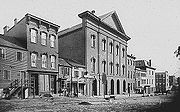
The box was supposed to be guarded by a policeman named John Frederick Parker who, by all accounts, was a curious choice for a bodyguard. During the intermission, Parker went to a nearby tavern with Lincoln's footman and coachman. It is unclear whether he ever returned to the theatre, but he was certainly not at his post when Booth entered the box. Nevertheless, Booth's celebrity status as a premier actor did not warrant any questioning from audience members, who assumed he was coming to call on the President. Upon gaining access through the first door of the entry to the Presidential Box, Booth barricaded the inward-swinging door behind him with a wooden stick that he pried between the wall and the door. He then turned around, and looked through the tiny peep-hole he had carved in the second door (which granted entry the the Presidential Box) earlier that day. It was Act II, Scene III.
Booth knew the play by heart, and thus waited for the precise moment when actor Harry Hawk (playing the lead role of the "cousin", Asa Trenchard), would be onstage alone, engaging the audience with what was considered to be the funniest line of the play. Booth hoped to employ the enthusiastic response of the audience to muffle the sound of his gunshot. With the stage to himself, Hawk (Asa) responded to the recently departed Mrs Mountchessington, "Don't know the manners of good society, eh? Well, I guess I know enough to turn you inside out, old gal; you sockdologizing old man-trap!" With hysterical laughter permeating the theatre, Booth opened the door, crept forward and shot the President in the back of the head, behind his left ear. Lincoln immediately slumped forward in his rocking chair, mortally wounded. Mary reached out, caught him, and then screamed.
Upon hearing the gunshot Rathbone quickly jumped from his seat and tried to prevent Booth from escaping. Booth then drew a knife and stabbed the major violently in the arm. Rathbone quickly recovered and again tried to grab Booth as he was preparing to jump from the sill of the box. Booth again stabbed at Rathbone, and then vaulted over the rail of the box down to the stage below (about a twelve-foot drop). In the process, his riding spur became entangled on the Treasury flag decorating the box
, and he landed awkwardly on his left foot, fracturing his left fibula just above the ankle. He raised himself up and began crossing the stage, making the audience believe that he was part of the play. In an act of flamboyancy, Booth held his bloody knife over his head, yelled "Sic semper tyrannis
!" the Virginia
state motto, meaning "Thus always to tyrants" in Latin
. Other accounts state that he also uttered "The South is avenged!".
Mary Lincoln's and Clara Harris' screams and Rathbone's cries of "Stop that man!" caused the audience to understand that this was not part of the show, and pandemonium immediately broke out in Ford's Theatre
. Booth made it across the stage and out the side door to the horse he had waiting outside. Some of the men in the audience chased after him, but failed to catch him. Booth struck "Peanuts" Burroughs (who was holding Booth's horse) in the forehead with the handle of his knife, leaped onto the horse, kicked Burroughs in the face with his good leg, and rode away. He headed toward the Navy Yard Bridge to meet up with Herold and Powell.
 Charles Leale
, a young Army surgeon on liberty for the night, and attending the play, made his way through the crowd to the door at the rear of the Presidential box. It would not open. Finally, Rathbone saw a notch carved in the door and a wooden brace jammed there to hold the door shut. Rathbone shouted to Leale, who stepped back from the door, allowing Rathbone to remove the brace and open the door.
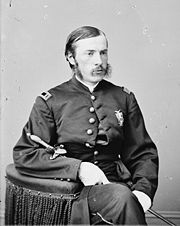 Leale entered the box to find Rathbone bleeding profusely from a deep gash that ran the length of his upper left arm. Nonetheless, he passed Rathbone by and stepped forward to find Lincoln slumped forward in his chair, held up by Mary, who was sobbing. Lincoln had no pulse and Leale believed him to be dead. Leale lowered the President to the floor. A second doctor in the audience, Charles Sabin Taft
, was lifted bodily from the stage over the railing and into the box. Taft and Leale cut away Lincoln's blood-stained collar and opened his shirt, and Leale, feeling around by hand, discovered the bullet hole in the back of his head by his left ear. Leale removed a clot of blood in the wound and Lincoln's breathing improved. Still, Leale knew it made no difference: "His wound is mortal. It is impossible for him to recover."
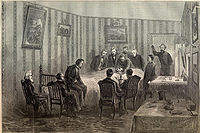 Leale, Taft, and another doctor from the audience, Albert King
, quickly consulted and decided that while the President must be moved, a bumpy carriage ride across town to the White House
was out of the question. After briefly considering Peter Taltavull
's Star Saloon next door, they chose to carry Lincoln across the street and find a house. The three doctors and some soldiers who had been in the audience carried the President out the front entrance of Ford's Theatre
. Across the street, a man was holding a lantern and calling "Bring him in here! Bring him in here!" The man was Henry Safford, a boarder at William Petersen's boarding house
opposite Ford's who had been startled by the commotion across the street. The men carried Lincoln into the boarding house and into the first-floor bedroom, where they laid him diagonally on the bed because his tall frame would not fit normally on the smaller bed.
A vigil began at the Petersen House
. The three physicians were joined by Surgeon General of the United States Army Joseph K. Barnes
, Charles Henry Crane
, Anderson Ruffin Abbott
, and Robert K. Stone
. Crane was a major and Barnes' assistant. Stone was Lincoln's personal physician. Robert Lincoln, home at the White House
that evening, arrived at the Petersen House
after being told of the shooting at about midnight. Tad Lincoln
, who had attended Grover's Theater to see Aladdin and the Wonderful Lamp
, was not allowed to go to the Petersen House
, although he was at Grover's Theater when the play was interrupted to report the news of the President's assassination.
Secretary of the Navy
Gideon Welles
and United States Secretary of War
Edwin M. Stanton
came and took charge of the scene. Mary Lincoln
was so unhinged by the experience of the assassination that Stanton ordered her out of the room by shouting, "Take that woman out of here and do not let her in here again!" While Mary Lincoln sobbed in the front parlor, Stanton set up shop in the rear parlor, effectively running the United States government for several hours, sending and receiving telegrams, taking reports from witnesses, and issuing orders for the pursuit of Booth.
Nothing more could be done for President Lincoln. At 7:22 a.m. on April 15, 1865, he died. He was fifty-six years old. Mary Lincoln was not present at the time of his death. The crowd around the bed knelt for a prayer, and when they were finished, Stanton said, "Now he belongs to the ages". There is some disagreement among historians as to Stanton's words after Lincoln died. All agree that he began "Now he belongs to the..." with some stating he said ages while others believe he said angels.
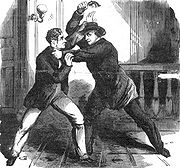 Booth had assigned Lewis Powell to murder Secretary of State William H. Seward
. On April 5, Seward was thrown from his carriage, suffering a concussion, a jaw broken in two places, and a broken right arm. Doctors improvised a jaw splint to repair his jaw (this is often mistakenly called a 'neck brace'). On the night of the assassination he was still restricted to the bed at his Washington home in Lafayette Park
, not too far from the White House
. Herold guided Powell to Seward's residence. Powell was carrying an 1858 Whitney revolver, which was a large, heavy and popular gun during the Civil War
. In addition, he carried a silver-handled bowie knife
.
Powell knocked at the front door of the house a little after 10:00 p.m. William Bell, Seward's butler, answered the door. Powell told Bell that he had medicine for Seward from his physician, Dr. Verdi, and that he was to personally deliver and show Seward how to take the medicine. Upon gaining admittance to the residence, Powell began making his way up the stairs to Seward's third-floor bedroom after much persuasion on his part. At the top of the staircase, he was stopped by Seward's son, Assistant Secretary of State
Frederick W. Seward
. Powell told Frederick the same story that he had told Bell. Frederick was suspicious of the intruder, and told Powell that his father was asleep.
After hearing voices in the hall, Seward's daughter Fanny opened the door to Seward's room and said, "Fred, Father is awake now", and then closed the door, thus revealing to Powell where Seward was located. Initially, Powell started back down the stairs when suddenly he jolted around and drew his revolver, pointing it at Frederick's forehead. He pulled the trigger, but the gun misfired. Instead of pulling the trigger again, Powell panicked and bludgeoned Frederick Seward about the head with it. Seward crumpled to the floor unconscious, but Powell's gun was damaged beyond repair. Fanny, wondering what all the noise was, looked out the door again. She saw her brother bloody and unconscious on the floor and Powell running towards her. Powell shoved her aside, ran to Seward's bed and began stabbing him repeatedly in the face and neck. He missed the first time he swung his knife down, but the third blow sliced open Seward's cheek. Seward's splint was the only thing that prevented the blade from penetrating his jugular vein.
Sergeant Robinson and Seward's son Augustus tried to drive Powell away. Augustus had been asleep in his room, but was awakened by Fanny's screams of terror. Outside the residence, David Herold
also heard Fanny screaming. He became frightened and ran away, abandoning Powell, who had no directional knowledge of the escape route from the capital city. The force of Powell's blows had driven Secretary Seward off the bed and onto the floor behind the bed where Powell could not reach him. Powell fought off Robinson, Augustus, and Fanny, stabbing them as well.
When Augustus went for his pistol, Powell ran downstairs and headed for the front door. Just then, a messenger named Emerick Hansell arrived with a telegram for Seward. Powell stabbed Hansell in the back, causing him to fall to the floor, and leaving him permanently paralyzed. Before running outside, Powell exclaimed, "I'm mad! I'm mad!", untied his horse from the tree where Herold left it, and rode away, alone.
Fanny Seward cried, "Oh my God, father's dead!" Sergeant Robinson lifted the Secretary from the floor back onto the bed. Seward spat the blood out of his mouth and said, "I am not dead; send for a doctor, send for the police. Close the house." Seward was covered with blood, but Powell's wild stabs in the dark room had not hit anything vital, and he would go on to recover. He face was to be permanently scarred, however.
to kill Vice President Andrew Johnson
, who was staying at the Kirkwood Hotel in Washington. Atzerodt was to go to the Vice President's room at 10:15 p.m. and shoot him. On April 14, Atzerodt rented room 126 at the Kirkwood, directly above the room where Johnson was staying. He arrived at the Kirkwood at the appointed time and went to the bar downstairs, carrying on his person a gun and a knife. Atzerodt asked the bartender, Michael Henry, about the Vice President's character and behavior. After spending some time at the hotel saloon, Atzerodt got drunk and wandered away through the streets of Washington. Nervous, he tossed his knife away in the street. He made his way to the Pennsylvania House Hotel by 2 a.m., where he checked into a room and went to sleep.
Earlier that day, Booth stopped by the Kirkwood Hotel and left a note for Johnson that read, "I don't wish to disturb you. Are you at home? J. Wilkes Booth." The card was picked up that night by Johnson's personal secretary, William Browning. This message has been interpreted in many different ways throughout the years. One theory is that Booth, being afraid that Atzerodt would not succeed in killing Johnson, or worried that Atzerodt would not have the courage to carry out the assassination, tried to use the message to implicate Johnson in the conspiracy. Another theory is that Booth was actually trying to contact Browning in order to find out whether or not Johnson was expected to be at the Kirkwood that night.
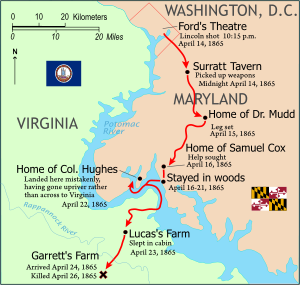
, Booth crossed over the Navy Yard Bridge and out of the city into Maryland
. David Herold
made it across the same bridge less than an hour later and rendezvoused with Booth. After retrieving weapons and supplies previously stored at Surattsville
, Herold and Booth went to Samuel A. Mudd, a local doctor who determined that Booth's leg had been broken and put it in a splint
. Later, Mudd made a pair of crutches for the assassin.
After spending a day at Mudd's house, Booth and Herold hired a local man to guide them to Samuel Cox's house. Cox in turn took them to Thomas Jones, who hid Booth and Herold in Zekiah Swamp
near his house for five days until they could cross the Potomac River
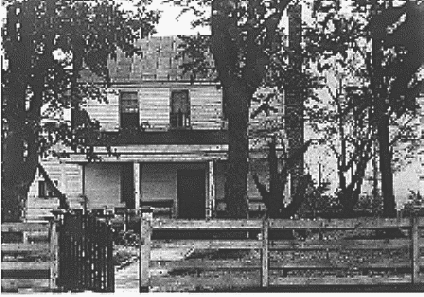
. On the afternoon of April 24, they arrived at the farm of Richard H. Garrett, a tobacco farmer. Booth told Garrett he was a wounded Confederate soldier.
 During the Union manhunt for Booth, four of his pursuers were among the fatalities when they drowned during patrol duty on April 24. Their small barge, the "Black Diamond", collided with the steamer "Massachusetts" on either the Rappahannock River or the Potomac River. There were at least 50 fatalities, including passengers from the Massachusetts, Union soldiers who were recently exchanged and paroled former prisoners of the Confederacy.
Booth and Herold remained at Garrett's farm until April 26, when Union
soldiers from the 16th New York Cavalry arrived at the farm. The soldiers surrounded Booth and Herold in the barn. Herold surrendered, but Booth refused to come out when the soldiers called for his surrender, stating boldly, "I will not be taken alive!" Upon hearing this, the soldiers set fire to the barn. Booth scrambled for the back door, brandishing a rifle in one hand and a pistol in the other. He never fired either weapon.
A soldier named Boston Corbett
crept up behind the barn and shot Booth in the neck, severing his spinal cord. Booth was carried out onto the steps of the barn. A soldier dribbled water onto his mouth. Booth told the soldier, "Tell my mother I die for my country." In agony, unable to move his limbs, he asked a soldier to lift his hands before his face and whispered as he gazed at them, "Useless...Useless." These were his last words. Booth died on the porch of the Garrett farm two hours after Corbett had shot him.
 Powell was unfamiliar with Washington, and without the services of his guide David Herold
, Powell wandered the streets for three days before finding his way back to the Surratt house on April 17. He found the detectives already there. Powell claimed to be a ditch-digger hired by Mary Surratt, but she denied knowing him. They were both arrested. George Atzerodt
hid out in a farm in Germantown, Maryland, about 25 miles (40.2 km) northwest of Washington, but was tracked down and arrested on April 20.
The rest of the conspirators were arrested before the end of the month, except for John Surratt
, who fled to Quebec. There he was hidden by Roman Catholic priests. In September, 1865, he boarded a ship to Liverpool, England, staying in the Catholic Church of the Holy Cross in the city. From there, he moved furtively through Europe, until he ended up as part of the Pontifical Zouaves in the Papal States
. A friend from his school days, Henry St. Marie, discovered him in the Papal guard during the spring of 1866 and alerted the U.S. government. Surratt was arrested by the Papal authorities but through suspicious circumstances, he managed to escape. He was finally captured by a U.S. government agent in Egypt in November 1866.
Surratt stood trial for Lincoln's murder in Washington in the summer of 1867. The defense called four residents of Elmira, New York
who did not know John Surratt but said they had seen him there between April 13 and 15. Fifteen prosecution witnesses, some who knew him, said they saw a man they positively identified, or said resembled, the defendant in Washington on the day of the assassination or traveling to or from the capital at this time. In the end, the jury could not agree on a verdict. Surratt was released and lived the rest of his life, until 1916, a free man.
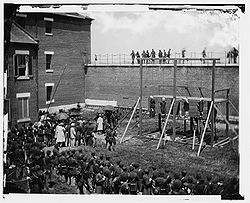 In the turmoil that followed the assassination, scores of suspected accomplices were arrested and thrown into prison. All the people who were discovered to have had anything to do with the assassination or anyone with the slightest contact with Booth or Herold on their flight were put behind bars. Among the imprisoned were Louis J. Weichmann
, a boarder in Mrs. Surratt's house; Booth's brother Junius
(playing in Cincinnati at the time of the assassination); theatre owner John T. Ford
, who was incarcerated for 40 days; James Pumphrey
, the Washington livery stable owner from whom Booth hired his horse; John M. Lloyd
, the innkeeper who rented Mrs. Surratt's Maryland tavern and gave Booth and Herold carbines, rope, and whiskey the night of April 14; and Samuel Cox and Thomas A. Jones, who helped Booth and Herold escape across the Potomac.
All of those listed above and more were rounded up, imprisoned, and released. Ultimately, the suspects were narrowed down to just eight prisoners (seven men and one woman): Samuel Arnold
, George Atzerodt
, David Herold
, Samuel Mudd
, Michael O'Laughlen
, Lewis Powell
, Edmund Spangler
(a Ford's stagehand who had given Booth's horse to "Peanuts" Burroughs to hold), and Mary Surratt
.
The eight suspects were tried by a military tribunal
ordered by then-President Andrew Johnson on May 1, 1865. The nine-member commission was presided over by Major General David Hunter
. The other eight voting members were August Kautz
, Albion P. Howe
, James A. Ekin
, David Clendenin
, Lew Wallace
, Robert Foster
, Thomas M. Harris and Charles H. Tompkins. The prosecution team included Judge Advocate General Joseph Holt
, John A. Bingham, and H.L. Burnett. The transcript of the trial was recorded by Benn Pitman and several assistants, and was published in 1865. The fact that they were tried by a military tribunal provoked criticism from both Edward Bates
and Gideon Welles
, who believed that a civil court should have presided. Attorney General
James Speed
, on the other hand, justified the use of a military tribunal on grounds that included the military nature of the conspiracy, that the defendants acted as enemy combatants and the existence of martial law
in the District of Columbia. (In 1866, in the Ex parte Milligan
decision, the United States Supreme Court banned the use of military tribunals in places where civil courts were operational.) The odds were further stacked against the defendants by rules that required only a simple majority of the officer jury for a guilty verdict and a two-thirds majority for a death sentence. Nor could the defendants appeal to anyone other than President Johnson.
The trial lasted for about seven weeks, with 366 witnesses testifying. Louis Weichmann, released from custody, was a key witness. All of the defendants were found guilty on June 30. Mary Surratt, Lewis Powell, David Herold, and George Atzerodt were sentenced to death by hanging
; Samuel Mudd, Samuel Arnold, and Michael O'Laughlen were sentenced to life in prison. Mudd escaped execution by a single vote, the tribunal having voted 5–4 against hanging him. Edmund Spangler was sentenced to imprisonment for six years. Oddly, after sentencing Mary Surratt to hang, five of the jurors signed a letter recommending clemency, but Johnson refused to stop the execution. (Johnson later claimed he never saw the letter.)
Surratt, Powell, Herold, and Atzerodt were hanged in the Old Arsenal Penitentiary
on July 7, 1865. The executions were supervised by Union general Winfield Scott Hancock
. Mary Surratt was the first woman executed by the United States government. O'Laughlen died in prison of yellow fever
in 1867. Mudd, Arnold, and Spangler were pardoned in February 1869 by President Johnson. Spangler, who died in 1875, insisted for the rest of his life that he had no connection to the plot beyond being the man Booth asked to hold his horse.
and Ronald Reagan
both wrote letters to Richard Mudd agreeing that his grandfather committed no crime. However, others, including authors Edward Steers, Jr.
and James Swanson, point out that Samuel Mudd visited Booth three times in the months before the failed kidnapping attempt. The first time was November 1864 when Booth, looking for help in his kidnapping plot, was directed to Mudd by agents of the Confederate Secret Service
. In December, Booth met with Mudd again and stayed the night at his farm. Later that December, Mudd went to Washington and introduced Booth to a Confederate agent he knew — John Surratt. Additionally, George Atzerodt
testified that Booth sent supplies to Mudd's house in preparation for the kidnap plan. Mudd lied to the authorities who came to his house after the assassination, claiming that he did not recognize the man who showed up on his doorstep in need of treatment and giving false information about where Booth and Herold went. He also hid the monogrammed boot that he had cut off Booth's injured leg behind a panel in his attic, but the thorough search of Mudd's house soon revealed this further evidence against him. One hypothesis is that Dr. Mudd was active in the kidnapping plot, likely as the person the conspirators would turn to for medical treatment in case Lincoln were injured, and that Booth thus remembered the doctor and went to his house to get help in the early hours of April 15.
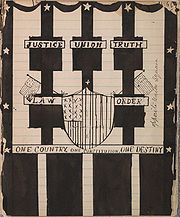 Abraham Lincoln was the first American president to be assassinated. His assassination had a long-lasting impact upon the United States, and he was mourned throughout the country in both North and South. There were attacks in many cities against those who expressed support for Booth. On the Easter Sunday after Lincoln's death, clergymen around the country praised Lincoln in their sermons. Millions of people came to Lincoln's funeral procession in Washington, D.C. on April 19, 1865, and as his body was transported 1700 miles (2,735.9 km) through New York to Springfield, Illinois
. His body and funeral train
were viewed by millions along the route.
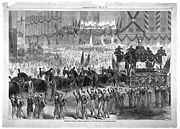 After Lincoln's death, Ulysses S. Grant
called him "incontestably the greatest man I ever knew." Southern-born Elizabeth Blair
said that, "Those of Southern born sympathies know now they have lost a friend willing and more powerful to protect and serve them than they can now ever hope to find again."
Andrew Johnson
was sworn in as President following Lincoln's death. Johnson was to become one of the least popular presidents in American history. He was impeached
by the House of Representatives
in 1868 but the Senate
failed to convict him by one vote.
Secretary of State William Seward recovered from his wounds and continued to serve in his post throughout Johnson's presidency. He later negotiated the Alaska Purchase
, then known as Seward's Folly, by which the United States purchased Alaska from Russia in 1867.
Henry Rathbone and Clara Harris married two years after the assassination, and Rathbone went on to become the U.S. consul
to Hanover, Germany. However, Rathbone later went mad and, in 1883, shot Clara and then stabbed her to death. He spent the rest of his life in a German asylum for the criminally insane.
John Ford
tried to reopen his theater a couple of months after the murder, but a wave of outrage forced him to cancel. In 1866, the federal government purchased the building from Ford, tore out the insides, and turned it into an office building. In 1893, the inner structure collapsed, killing 22 clerks. It was later used as a warehouse, then it lay empty until it was restored to its 1865 appearance. Ford's Theatre reopened in 1968 both as a museum of the assassination and a working playhouse. The Presidential Box is never occupied. The Petersen House was purchased in 1896 as the "House Where Lincoln Died"; it was the first piece of real estate ever acquired by the federal government as a memorial. Today, Ford's and the Petersen House are operated together as the Ford's Theatre National Historic Site
.
The bed that Lincoln occupied and other items from the bedroom had been bought by Chicago collector Charles F. Gunther
and are now owned by and on display at the Chicago History Museum. The Army Medical Museum
, now named the National Museum of Health and Medicine, has retained in its collection several artifacts relating to the assassination. Currently on display are the bullet that hit Lincoln, the probe used by Barnes, pieces of Lincoln's skull and hair, and the surgeon's cuff stained with Lincoln's blood. The chair in which Lincoln was shot is on display at the Henry Ford Museum in Detroit, Michigan
.
Abraham Lincoln was honored on the centennial of his birth when his portrait was placed on the U.S. one-cent coin
in 1909. The Lincoln Memorial
in Washington, D.C., was opened in 1922.
President of the United States
The President of the United States of America is the head of state and head of government of the United States. The president leads the executive branch of the federal government and is the commander-in-chief of the United States Armed Forces....
Abraham Lincoln
Abraham Lincoln
Abraham Lincoln was the 16th President of the United States, serving from March 1861 until his assassination in April 1865. He successfully led his country through a great constitutional, military and moral crisis – the American Civil War – preserving the Union, while ending slavery, and...
took place on Good Friday, April 14, 1865, as the American Civil War
American Civil War
The American Civil War was a civil war fought in the United States of America. In response to the election of Abraham Lincoln as President of the United States, 11 southern slave states declared their secession from the United States and formed the Confederate States of America ; the other 25...
was drawing to a close. The assassination occurred five days after the commanding General of the Army of Northern Virginia, Robert E. Lee
Robert E. Lee
Robert Edward Lee was a career military officer who is best known for having commanded the Confederate Army of Northern Virginia in the American Civil War....
, and his battered Army of Northern Virginia
Army of Northern Virginia
The Army of Northern Virginia was the primary military force of the Confederate States of America in the Eastern Theater of the American Civil War, as well as the primary command structure of the Department of Northern Virginia. It was most often arrayed against the Union Army of the Potomac...
surrendered to General Ulysses S. Grant
Ulysses S. Grant
Ulysses S. Grant was the 18th President of the United States as well as military commander during the Civil War and post-war Reconstruction periods. Under Grant's command, the Union Army defeated the Confederate military and ended the Confederate States of America...
and the Army of the Potomac
Army of the Potomac
The Army of the Potomac was the major Union Army in the Eastern Theater of the American Civil War.-History:The Army of the Potomac was created in 1861, but was then only the size of a corps . Its nucleus was called the Army of Northeastern Virginia, under Brig. Gen...
. Lincoln was the first American president to be assassinated, though an unsuccessful attempt had been made on Andrew Jackson
Andrew Jackson
Andrew Jackson was the seventh President of the United States . Based in frontier Tennessee, Jackson was a politician and army general who defeated the Creek Indians at the Battle of Horseshoe Bend , and the British at the Battle of New Orleans...
thirty years before in 1835.
The assassination was planned and carried out by well-known stage actor John Wilkes Booth
John Wilkes Booth
John Wilkes Booth was an American stage actor who assassinated President Abraham Lincoln at Ford's Theatre, in Washington, D.C., on April 14, 1865. Booth was a member of the prominent 19th century Booth theatrical family from Maryland and, by the 1860s, was a well-known actor...
as part of a larger conspiracy in a bid to help the Confederacy's cause. Booth's co-conspirators were Lewis Powell
Lewis Powell (assassin)
Lewis Thornton Powell , also known as Lewis Paine or Payne, attempted unsuccessfully to assassinate United States Secretary of State William H...
and David Herold
David Herold
David Edgar Herold was an accomplice of John Wilkes Booth in the assassination of Abraham Lincoln. After guiding fellow conspirator Lewis Powell to the home of Secretary of State William H. Seward, whom Powell intended to kill, Herold fled and rendezvoused outside of Washington, D.C., with Booth...
, who were assigned to kill Secretary of State
United States Secretary of State
The United States Secretary of State is the head of the United States Department of State, concerned with foreign affairs. The Secretary is a member of the Cabinet and the highest-ranking cabinet secretary both in line of succession and order of precedence...
William H. Seward
William H. Seward
William Henry Seward, Sr. was the 12th Governor of New York, United States Senator and the United States Secretary of State under Abraham Lincoln and Andrew Johnson...
and George Atzerodt
George Atzerodt
George Andreas Atzerodt was a conspirator, with John Wilkes Booth, in the assassination of Abraham Lincoln. Assigned to assassinate Vice-President Andrew Johnson, he lost his nerve and did not make an attempt. He was executed along with three other conspirators by hanging.-Early life:Atzerodt...
who was to kill Vice President
Vice President of the United States
The Vice President of the United States is the holder of a public office created by the United States Constitution. The Vice President, together with the President of the United States, is indirectly elected by the people, through the Electoral College, to a four-year term...
Andrew Johnson
Andrew Johnson
Andrew Johnson was the 17th President of the United States . As Vice-President of the United States in 1865, he succeeded Abraham Lincoln following the latter's assassination. Johnson then presided over the initial and contentious Reconstruction era of the United States following the American...
as well. By simultaneously eliminating the top three in the line of succession in the Federal government, Booth and his co-conspirators hoped to throw the Union government into disarray.
Lincoln was shot while watching the play Our American Cousin
Our American Cousin
Our American Cousin is an 1858 play in three acts by English playwright Tom Taylor. The play is a farce whose plot is based on the introduction of an awkward, boorish but honest American, Asa Trenchard, to his aristocratic English relatives when he goes to England to claim the family estate...
with his wife Mary Todd Lincoln
Mary Todd Lincoln
Mary Ann Lincoln was the wife of the 16th President of the United States, Abraham Lincoln, and was First Lady of the United States from 1861 to 1865.-Life before the White House:...
at Ford's Theatre
Ford's Theatre
Ford's Theatre is a historic theater in Washington, D.C., used for various stage performances beginning in the 1860s. It is also the site of the assassination of U.S. President Abraham Lincoln on April 14, 1865...
in Washington, D.C.. He died early the next morning and the rest of the plot failed. Powell only managed to wound Seward, while Atzerodt, Johnson's would-be assassin, lost his nerve and fled Washington.
Original plot: Kidnapping the President
In March 1864, Ulysses S. GrantUlysses S. Grant
Ulysses S. Grant was the 18th President of the United States as well as military commander during the Civil War and post-war Reconstruction periods. Under Grant's command, the Union Army defeated the Confederate military and ended the Confederate States of America...
, the commanding General of all the Union's armies, decided to suspend the exchange of prisoners-of-war
Prisoner of war
A prisoner of war or enemy prisoner of war is a person, whether civilian or combatant, who is held in custody by an enemy power during or immediately after an armed conflict...
. Harsh as it may have been on the prisoners of both sides, Grant realized the exchange was prolonging the war by returning soldiers to the outnumbered and manpower-starved South. John Wilkes Booth
John Wilkes Booth
John Wilkes Booth was an American stage actor who assassinated President Abraham Lincoln at Ford's Theatre, in Washington, D.C., on April 14, 1865. Booth was a member of the prominent 19th century Booth theatrical family from Maryland and, by the 1860s, was a well-known actor...
, an outspoken Confederate sympathizer, conceived a plan to kidnap President Lincoln and deliver him to the Confederate Army, to be held hostage until the North agreed to resume exchanging prisoners. Booth recruited Samuel Arnold
Samuel Arnold (Lincoln conspirator)
Samuel Bland Arnold was involved in the plot to kidnap President Abraham Lincoln in 1865.He and the other conspirators, John Wilkes Booth, David Herold, Lewis Powell, Michael O'Laughlen and John Surratt, were to kidnap Lincoln and hold him to exchange for the Confederate prisoners in Washington D.C....
, George Atzerodt
George Atzerodt
George Andreas Atzerodt was a conspirator, with John Wilkes Booth, in the assassination of Abraham Lincoln. Assigned to assassinate Vice-President Andrew Johnson, he lost his nerve and did not make an attempt. He was executed along with three other conspirators by hanging.-Early life:Atzerodt...
, David Herold
David Herold
David Edgar Herold was an accomplice of John Wilkes Booth in the assassination of Abraham Lincoln. After guiding fellow conspirator Lewis Powell to the home of Secretary of State William H. Seward, whom Powell intended to kill, Herold fled and rendezvoused outside of Washington, D.C., with Booth...
, Michael O'Laughlen
Michael O'Laughlen
Michael O'Laughlen, Jr. was a conspirator in the assassination of Abraham Lincoln...
, Lewis Powell
Lewis Powell (assassin)
Lewis Thornton Powell , also known as Lewis Paine or Payne, attempted unsuccessfully to assassinate United States Secretary of State William H...
(also known as "Lewis Paine"), and John Surratt
John Surratt
John Harrison Surratt, Jr. was accused of plotting with John Wilkes Booth to kidnap U.S. president Abraham Lincoln and suspected of involvement in the Abraham Lincoln assassination. His mother Mary Surratt was convicted of conspiracy and hanged by the United States Federal Government...
to help him in his attempt. Surratt's mother, Mary Surratt
Mary Surratt
Mary Elizabeth Jenkins Surratt was an American boarding house owner who was convicted of taking part in the conspiracy to assassinate Abraham Lincoln. Sentenced to death, she was hanged, becoming the first woman executed by the United States federal government. She was the mother of John H...
, left her tavern in Surrattsville
Clinton, Maryland
Clinton is an unincorporated area and census-designated place in Prince George's County, Maryland, United States. Clinton was formerly known as Surrattsville until after the time of the American Civil War. The population of Clinton was 26,064 at the 2000 census. However, as of 2007, there is an...
, Maryland
Maryland
Maryland is a U.S. state located in the Mid Atlantic region of the United States, bordering Virginia, West Virginia, and the District of Columbia to its south and west; Pennsylvania to its north; and Delaware to its east...
, and moved to a house in Washington, where Booth became a frequent visitor. Prosecutors later pointed out that her move coincided with Booth's need for a base of operations in the federal capital.
In autumn 1860, Booth reportedly was initiated in the pro-Confederate Knights of the Golden Circle
Knights of the Golden Circle
The Knights of the Golden Circle was a secret society. Some researchers believe the objective of the KGC was to prepare the way for annexation of a golden circle of territories in Mexico, Central America, and the Caribbean for inclusion in the United States as slave states...
in Baltimore
Baltimore
Baltimore is the largest independent city in the United States and the largest city and cultural center of the US state of Maryland. The city is located in central Maryland along the tidal portion of the Patapsco River, an arm of the Chesapeake Bay. Baltimore is sometimes referred to as Baltimore...
. He attended Lincoln's second inauguration on March 4, 1865, as the invited guest of his secret fiancée Lucy Hale, daughter of John P. Hale
John P. Hale
John Parker Hale was an American politician and lawyer from New Hampshire. He served in the United States House of Representatives from 1843 to 1845 and in the United States Senate from 1847 to 1853 and again from 1855 to 1865. He was the first senator to make a stand against slavery...
, soon to become United States Ambassador to Spain
United States Ambassador to Spain
-Ambassadors:*John Jay**Appointed: September 29, 1779**Title: Minister Plenipotentiary**Presented credentials:**Terminated mission: ~May 20, 1782*William Carmichael**Appointed: April 20, 1790**Title: Chargé d'Affaires...
. Booth afterwards wrote in his diary, "What an excellent chance I had, if I wished, to kill the President on Inauguration day!"
Meanwhile, the Confederacy
Confederate States of America
The Confederate States of America was a government set up from 1861 to 1865 by 11 Southern slave states of the United States of America that had declared their secession from the U.S...
was falling apart. On April 3, Richmond, Virginia
Richmond, Virginia
Richmond is the capital of the Commonwealth of Virginia, in the United States. It is an independent city and not part of any county. Richmond is the center of the Richmond Metropolitan Statistical Area and the Greater Richmond area...
, the Confederate capital, fell to the Union army. On April 9, the Army of Northern Virginia
Army of Northern Virginia
The Army of Northern Virginia was the primary military force of the Confederate States of America in the Eastern Theater of the American Civil War, as well as the primary command structure of the Department of Northern Virginia. It was most often arrayed against the Union Army of the Potomac...
, the main army of the Confederacy, surrendered to the Army of the Potomac
Army of the Potomac
The Army of the Potomac was the major Union Army in the Eastern Theater of the American Civil War.-History:The Army of the Potomac was created in 1861, but was then only the size of a corps . Its nucleus was called the Army of Northeastern Virginia, under Brig. Gen...
at Appomatox Court House. Confederate President Jefferson Davis
Jefferson Davis
Jefferson Finis Davis , also known as Jeff Davis, was an American statesman and leader of the Confederacy during the American Civil War, serving as President for its entire history. He was born in Kentucky to Samuel and Jane Davis...
and the rest of his government were in full flight. Despite many Southerners giving up hope, Booth continued to believe in his cause.
On April 11, 1865, two days after Lee's army surrendered to Grant, Booth attended a speech at the White House
White House
The White House is the official residence and principal workplace of the president of the United States. Located at 1600 Pennsylvania Avenue NW in Washington, D.C., the house was designed by Irish-born James Hoban, and built between 1792 and 1800 of white-painted Aquia sandstone in the Neoclassical...
in which Lincoln supported the idea of enfranchising the former slaves. Furiously provoked, Booth decided on assassination. Reportedly he said:
That means nigger citizenship. By God, I'll put him through. That is the last speech he will ever give.
Lincoln's nightmare
Ward Hill Lamon
Ward Hill Lamon was a personal friend and self-appointed bodyguard of the American President Abraham Lincoln. Lamon was famously absent the night Lincoln was assassinated, having been sent by Lincoln to Richmond, Virginia....
, Lincoln's friend and biographer, just three days before his assassination Lincoln discussed with Lamon and others a dream he had, saying:
About ten days ago, I retired very late. I had been up waiting for important dispatches from the front. I could not have been long in bed when I fell into a slumber, for I was weary. I soon began to dream. There seemed to be a death-like stillness about me. Then I heard subdued sobs, as if a number of people were weeping. I thought I left my bed and wandered downstairs. There the silence was broken by the same pitiful sobbing, but the mourners were invisible. I went from room to room; no living person was in sight, but the same mournful sounds of distress met me as I passed along. I saw light in all the rooms; every object was familiar to me; but where were all the people who were grieving as if their hearts would break? I was puzzled and alarmed. What could be the meaning of all this? Determined to find the cause of a state of things so mysterious and so shocking, I kept on until I arrived at the East RoomEast RoomThe East Room is the largest room in the White House, the home of the president of the United States. It is used for entertaining, press conferences, ceremonies, and occasionally for a large dinner...
, which I entered. There I met with a sickening surprise. Before me was a catafalqueCatafalqueA catafalque is a raised bier, soapbox, or similar platform, often movable, that is used to support the casket, coffin, or body of the deceased during a funeral or memorial service. Following a Roman Catholic Requiem Mass, a catafalque may be used to stand in place of the body at the Absolution of...
, on which rested a corpse wrapped in funeral vestments. Around it were stationed soldiers who were acting as guards; and there was a throng of people, gazing mournfully upon the corpse, whose face was covered, others weeping pitifully. 'Who is dead in the White House?' I demanded of one of the soldiers, 'The President,' was his answer; 'he was killed by an assassin.' Then came a loud burst of grief from the crowd, which woke me from my dream. I slept no more that night; and although it was only a dream, I have been strangely annoyed by it ever since.
Planning the assassination
Abraham Lincoln
Abraham Lincoln
Abraham Lincoln was the 16th President of the United States, serving from March 1861 until his assassination in April 1865. He successfully led his country through a great constitutional, military and moral crisis – the American Civil War – preserving the Union, while ending slavery, and...
's day started well for the first time in a long time. Hugh McCulloch
Hugh McCulloch
Hugh McCulloch was an American statesman who served two non-consecutive terms as U.S. Treasury Secretary, serving under three presidents.-Biography:...
, the new Secretary of the Treasury, remarked that on that morning, "I never saw Mr. Lincoln so cheerful and happy". No one could miss the difference. For months, the President had looked pale and haggard. Lincoln himself told people how happy he was. This caused the First Lady Mary Todd Lincoln
Mary Todd Lincoln
Mary Ann Lincoln was the wife of the 16th President of the United States, Abraham Lincoln, and was First Lady of the United States from 1861 to 1865.-Life before the White House:...
some concern, as she believed that saying such things out loud was bad luck. Lincoln paid her no heed. Lincoln met with his cabinet that day and later had a brief meeting with Vice President Andrew Johnson
Andrew Johnson
Andrew Johnson was the 17th President of the United States . As Vice-President of the United States in 1865, he succeeded Abraham Lincoln following the latter's assassination. Johnson then presided over the initial and contentious Reconstruction era of the United States following the American...
, the first between the two since Johnson had shown up drunk to take the vice presidential oath on Inauguration Day, six weeks prior.
At around noon, while visiting Ford's Theatre
Ford's Theatre
Ford's Theatre is a historic theater in Washington, D.C., used for various stage performances beginning in the 1860s. It is also the site of the assassination of U.S. President Abraham Lincoln on April 14, 1865...
to pick up his mail, Booth learned from the brother of John Ford, who was the owner, that the President and General Grant would be attending the theatre to watch Our American Cousin
Our American Cousin
Our American Cousin is an 1858 play in three acts by English playwright Tom Taylor. The play is a farce whose plot is based on the introduction of an awkward, boorish but honest American, Asa Trenchard, to his aristocratic English relatives when he goes to England to claim the family estate...
that night. Booth determined that this was the perfect opportunity for him to do something "decisive." He knew the theater's layout, having performed there several times, as recently as the previous month. Booth believed that if he and the others could kill the President, General Grant, Vice President Andrew Johnson, and Secretary of State William Seward at the same time, he could in essence decapitate the Union government enough for the Confederacy to mount a resurgence.
That same afternoon, Booth went to Mary Surratt
Mary Surratt
Mary Elizabeth Jenkins Surratt was an American boarding house owner who was convicted of taking part in the conspiracy to assassinate Abraham Lincoln. Sentenced to death, she was hanged, becoming the first woman executed by the United States federal government. She was the mother of John H...
's boarding house in Washington, D.C. and asked her to deliver a package to her tavern in Surrattsville, Maryland. He also requested Surratt to tell her tenant who resided there to have the guns and ammunition that Booth had previously stored at the tavern ready to be picked up that evening. She complied with Booth's request and made the trip along with Louis J. Weichmann
Louis J. Weichmann
Louis J. Weichmann was one of the chief witnesses for the prosecution in the conspiracy trial of the Abraham Lincoln assassination. Previously, he had been also a suspect because of his association with Mary Surratt's family.-Background and early life:Weichmann was born in Baltimore, Maryland, the...
, her boarder and son's friend. This exchange, and her compliance in it, would lead directly to Mary Surratt
Mary Surratt
Mary Elizabeth Jenkins Surratt was an American boarding house owner who was convicted of taking part in the conspiracy to assassinate Abraham Lincoln. Sentenced to death, she was hanged, becoming the first woman executed by the United States federal government. She was the mother of John H...
's execution three months later.
At seven o'clock that evening, John Wilkes Booth
John Wilkes Booth
John Wilkes Booth was an American stage actor who assassinated President Abraham Lincoln at Ford's Theatre, in Washington, D.C., on April 14, 1865. Booth was a member of the prominent 19th century Booth theatrical family from Maryland and, by the 1860s, was a well-known actor...
met for a final time with all his fellow conspirators. Booth assigned Lewis Powell
Lewis Powell (assassin)
Lewis Thornton Powell , also known as Lewis Paine or Payne, attempted unsuccessfully to assassinate United States Secretary of State William H...
to kill Secretary of State William H. Seward
William H. Seward
William Henry Seward, Sr. was the 12th Governor of New York, United States Senator and the United States Secretary of State under Abraham Lincoln and Andrew Johnson...
at his home, George Atzerodt
George Atzerodt
George Andreas Atzerodt was a conspirator, with John Wilkes Booth, in the assassination of Abraham Lincoln. Assigned to assassinate Vice-President Andrew Johnson, he lost his nerve and did not make an attempt. He was executed along with three other conspirators by hanging.-Early life:Atzerodt...
to kill Vice President Andrew Johnson
Andrew Johnson
Andrew Johnson was the 17th President of the United States . As Vice-President of the United States in 1865, he succeeded Abraham Lincoln following the latter's assassination. Johnson then presided over the initial and contentious Reconstruction era of the United States following the American...
at his residence, the Kirkwood Hotel, and David E. Herold
David Herold
David Edgar Herold was an accomplice of John Wilkes Booth in the assassination of Abraham Lincoln. After guiding fellow conspirator Lewis Powell to the home of Secretary of State William H. Seward, whom Powell intended to kill, Herold fled and rendezvoused outside of Washington, D.C., with Booth...
to guide Powell to the Seward house and then out of Washington to rendezvous with Booth in Maryland. Booth planned to shoot Lincoln with his single-shot derringer
Derringer
The term derringer is a genericized misspelling of the last name of Henry Deringer, a famous 19th-century maker of small pocket pistols. Many copies of the original Philadelphia Deringer pistol were made by other gun makers worldwide, and the name was often misspelled; this misspelling soon became...
and then stab Grant with a knife at Ford's Theatre
Ford's Theatre
Ford's Theatre is a historic theater in Washington, D.C., used for various stage performances beginning in the 1860s. It is also the site of the assassination of U.S. President Abraham Lincoln on April 14, 1865...
e. They were all to strike simultaneously shortly after ten o'clock that night. Atzerodt wanted nothing to do with it, saying he had only signed up for a kidnapping, not a killing. Booth told him he was in too far to back out.
There is evidence to suggest that either Booth or his fellow conspirator Michael O'Laughlen
Michael O'Laughlen
Michael O'Laughlen, Jr. was a conspirator in the assassination of Abraham Lincoln...
, who looked similar, followed Grant and his wife, Julia
Julia Grant
Julia Boggs Dent-Grant , was the wife of the 18th President of the United States, Ulysses S. Grant, and was First Lady of the United States from 1869 to 1877.-Background:...
, to Union Station
Union Station (Washington, D.C.)
Washington Union Station is a train station and leisure destination visited by 32 million people each year in the center of Washington, D.C. The train station is served by Amtrak, MARC and Virginia Railway Express commuter rail services as well as by Washington Metro subway trains and local buses...
late that afternoon and discovered that Grant would not be at the theater that night. Apparently, O'Laughlen boarded the same train the Grants took to Philadelphia in order to kill Grant. An alleged attack during the evening took place; however, the assailant was unsuccessful since the private car that the Grants were riding in had been locked and guarded by porters.
Booth shoots President Lincoln
Contrary to the information Booth had overheard, General and Mrs. Grant had declined the invitation to see the play with the Lincolns, as Mrs. Lincoln and Mrs. Grant were not on good terms with each other. Several other people were invited to join them, until finally MajorMajor
Major is a rank of commissioned officer, with corresponding ranks existing in almost every military in the world.When used unhyphenated, in conjunction with no other indicator of rank, the term refers to the rank just senior to that of an Army captain and just below the rank of lieutenant colonel. ...
Henry Rathbone
Henry Rathbone
Henry Reed Rathbone was a United States military officer and diplomat who was present at the assassination of President Abraham Lincoln. Rathbone was sitting with his fiancée, Clara Harris, next to the President and his wife, Mary Todd Lincoln, when John Wilkes Booth entered the president's box at...
and his fiancée Clara Harris
Clara Harris
Clara Harris was an American socialite.-Biography:Clara Harris was the daughter of U.S. Senator Ira Harris of New York....
(daughter of New York Senator Ira Harris
Ira Harris
Ira Harris was an American jurist and senator from New York. He was also a friend of Abraham Lincoln's.-Life:Harris grew up on a farm, and graduated from Union College in 1824. Then he studied law in Albany, and in 1828 was admitted to the bar.He was a Whig member from Albany County of the New...
) accepted.
The Lincoln party arrived late and settled into the Presidential Box, which was actually two corner box seats with the dividing wall between them removed. Mrs. Lincoln whispered to her husband, who was holding her hand, "What will Miss Harris think of my hanging on to you so?" The president replied, "She won't think anything about it". Those were the last words ever spoken by Abraham Lincoln. It was about 10:15 p.m.
The box was supposed to be guarded by a policeman named John Frederick Parker who, by all accounts, was a curious choice for a bodyguard. During the intermission, Parker went to a nearby tavern with Lincoln's footman and coachman. It is unclear whether he ever returned to the theatre, but he was certainly not at his post when Booth entered the box. Nevertheless, Booth's celebrity status as a premier actor did not warrant any questioning from audience members, who assumed he was coming to call on the President. Upon gaining access through the first door of the entry to the Presidential Box, Booth barricaded the inward-swinging door behind him with a wooden stick that he pried between the wall and the door. He then turned around, and looked through the tiny peep-hole he had carved in the second door (which granted entry the the Presidential Box) earlier that day. It was Act II, Scene III.
Booth knew the play by heart, and thus waited for the precise moment when actor Harry Hawk (playing the lead role of the "cousin", Asa Trenchard), would be onstage alone, engaging the audience with what was considered to be the funniest line of the play. Booth hoped to employ the enthusiastic response of the audience to muffle the sound of his gunshot. With the stage to himself, Hawk (Asa) responded to the recently departed Mrs Mountchessington, "Don't know the manners of good society, eh? Well, I guess I know enough to turn you inside out, old gal; you sockdologizing old man-trap!" With hysterical laughter permeating the theatre, Booth opened the door, crept forward and shot the President in the back of the head, behind his left ear. Lincoln immediately slumped forward in his rocking chair, mortally wounded. Mary reached out, caught him, and then screamed.
Upon hearing the gunshot Rathbone quickly jumped from his seat and tried to prevent Booth from escaping. Booth then drew a knife and stabbed the major violently in the arm. Rathbone quickly recovered and again tried to grab Booth as he was preparing to jump from the sill of the box. Booth again stabbed at Rathbone, and then vaulted over the rail of the box down to the stage below (about a twelve-foot drop). In the process, his riding spur became entangled on the Treasury flag decorating the box
Lincoln Assassination Flags
On April 14, 1865, the night President Abraham Lincoln was fatally shot by John Wilkes Booth, five flags decorated the presidential box of Ford's Theatre. Lincoln and his wife, Mary Todd Lincoln, were in this box watching a production of Our American Cousin. Three of the flags were American flags...
, and he landed awkwardly on his left foot, fracturing his left fibula just above the ankle. He raised himself up and began crossing the stage, making the audience believe that he was part of the play. In an act of flamboyancy, Booth held his bloody knife over his head, yelled "Sic semper tyrannis
Sic semper tyrannis
Sic semper tyrannis is a Latin phrase meaning "thus always to tyrants." It is sometimes mistranslated as "down with the tyrant." The phrase is said to have originated with Marcus Junius Brutus during the assassination of Julius Caesar....
!" the Virginia
Virginia
The Commonwealth of Virginia , is a U.S. state on the Atlantic Coast of the Southern United States. Virginia is nicknamed the "Old Dominion" and sometimes the "Mother of Presidents" after the eight U.S. presidents born there...
state motto, meaning "Thus always to tyrants" in Latin
Latin
Latin is an Italic language originally spoken in Latium and Ancient Rome. It, along with most European languages, is a descendant of the ancient Proto-Indo-European language. Although it is considered a dead language, a number of scholars and members of the Christian clergy speak it fluently, and...
. Other accounts state that he also uttered "The South is avenged!".
Mary Lincoln's and Clara Harris' screams and Rathbone's cries of "Stop that man!" caused the audience to understand that this was not part of the show, and pandemonium immediately broke out in Ford's Theatre
Ford's Theatre
Ford's Theatre is a historic theater in Washington, D.C., used for various stage performances beginning in the 1860s. It is also the site of the assassination of U.S. President Abraham Lincoln on April 14, 1865...
. Booth made it across the stage and out the side door to the horse he had waiting outside. Some of the men in the audience chased after him, but failed to catch him. Booth struck "Peanuts" Burroughs (who was holding Booth's horse) in the forehead with the handle of his knife, leaped onto the horse, kicked Burroughs in the face with his good leg, and rode away. He headed toward the Navy Yard Bridge to meet up with Herold and Powell.
Death of President Lincoln
Charles Leale
Dr. Charles Augustus Leale M.D. was a surgeon in the Union Army during the American Civil War.He was the first doctor to be admitted into the presidential box at Ford's Theatre on April 14, 1865 after John Wilkes Booth shot President Abraham Lincoln in the back of the head with a Philadelphia...
, a young Army surgeon on liberty for the night, and attending the play, made his way through the crowd to the door at the rear of the Presidential box. It would not open. Finally, Rathbone saw a notch carved in the door and a wooden brace jammed there to hold the door shut. Rathbone shouted to Leale, who stepped back from the door, allowing Rathbone to remove the brace and open the door.
Charles Sabin Taft
Charles Sabin Taft, M.D. was a bystander physician who was pressed into service during the assassination of Abraham Lincoln.-Lincoln's assassination:...
, was lifted bodily from the stage over the railing and into the box. Taft and Leale cut away Lincoln's blood-stained collar and opened his shirt, and Leale, feeling around by hand, discovered the bullet hole in the back of his head by his left ear. Leale removed a clot of blood in the wound and Lincoln's breathing improved. Still, Leale knew it made no difference: "His wound is mortal. It is impossible for him to recover."
Albert Freeman Africanus King
Albert Freeman Africanus King was a bystander physician who was pressed into service during the assassination of Abraham Lincoln. In addition, King was one of the earliest to suggest the connection between mosquitos and malaria....
, quickly consulted and decided that while the President must be moved, a bumpy carriage ride across town to the White House
White House
The White House is the official residence and principal workplace of the president of the United States. Located at 1600 Pennsylvania Avenue NW in Washington, D.C., the house was designed by Irish-born James Hoban, and built between 1792 and 1800 of white-painted Aquia sandstone in the Neoclassical...
was out of the question. After briefly considering Peter Taltavull
Peter Taltavull
Peter Taltavull played a minor role in the events surrounding the assassination of Abraham Lincoln. John Wilkes Booth stopped at Taltavull's Star Saloon just before going to Ford's Theatre next door and assassinating President Abraham Lincoln.-Biography:Taltavull owned the Star Saloon located in...
's Star Saloon next door, they chose to carry Lincoln across the street and find a house. The three doctors and some soldiers who had been in the audience carried the President out the front entrance of Ford's Theatre
Ford's Theatre
Ford's Theatre is a historic theater in Washington, D.C., used for various stage performances beginning in the 1860s. It is also the site of the assassination of U.S. President Abraham Lincoln on April 14, 1865...
. Across the street, a man was holding a lantern and calling "Bring him in here! Bring him in here!" The man was Henry Safford, a boarder at William Petersen's boarding house
Petersen House
The Petersen House is a 19th-century federal style rowhouse located at 516 10th Street NW in Washington, D.C. On April 15, 1865, United States President Abraham Lincoln died there after being shot the previous evening at Ford's Theater, which was located across the street. The house was built in...
opposite Ford's who had been startled by the commotion across the street. The men carried Lincoln into the boarding house and into the first-floor bedroom, where they laid him diagonally on the bed because his tall frame would not fit normally on the smaller bed.
A vigil began at the Petersen House
Petersen House
The Petersen House is a 19th-century federal style rowhouse located at 516 10th Street NW in Washington, D.C. On April 15, 1865, United States President Abraham Lincoln died there after being shot the previous evening at Ford's Theater, which was located across the street. The house was built in...
. The three physicians were joined by Surgeon General of the United States Army Joseph K. Barnes
Joseph Barnes
Joseph K. Barnes, M.D. was an American physician and the 12th Surgeon General of the United States Army .-Career and early life:...
, Charles Henry Crane
Charles H. Crane
Charles Henry Crane B.A. M.A. M.D. was an American physician and the 13th Surgeon General of the United States Army . He was the son of Colonel Ichabod B. Crane...
, Anderson Ruffin Abbott
Anderson Ruffin Abbott
Anderson Ruffin Abbott, M.D. was the first Black Canadian to be a licensed physician. His career included participation in the American Civil War and attending the death bed of Abraham Lincoln.-Early life:...
, and Robert K. Stone
Robert K. Stone
Robert K. Stone, was a 19th century professor at Columbia Medical College and was considered “the dean of the Washington medical community.” As the personal physician to President Abraham Lincoln and his family, Stone was present at Lincoln's death bed and at his autopsy.-See also:* Abraham...
. Crane was a major and Barnes' assistant. Stone was Lincoln's personal physician. Robert Lincoln, home at the White House
White House
The White House is the official residence and principal workplace of the president of the United States. Located at 1600 Pennsylvania Avenue NW in Washington, D.C., the house was designed by Irish-born James Hoban, and built between 1792 and 1800 of white-painted Aquia sandstone in the Neoclassical...
that evening, arrived at the Petersen House
Petersen House
The Petersen House is a 19th-century federal style rowhouse located at 516 10th Street NW in Washington, D.C. On April 15, 1865, United States President Abraham Lincoln died there after being shot the previous evening at Ford's Theater, which was located across the street. The house was built in...
after being told of the shooting at about midnight. Tad Lincoln
Tad Lincoln
Thomas "Tad" Lincoln was the fourth and youngest son of Abraham and Mary Lincoln. The nickname "Tad" was given to him by his father who found Thomas "as wriggly as a tadpole" when he was a baby. Tad was known to be impulsive, unrestrained, and did not attend school...
, who had attended Grover's Theater to see Aladdin and the Wonderful Lamp
Aladdin
Aladdin is a Middle Eastern folk tale. It is one of the tales in The Book of One Thousand and One Nights , and one of the most famous, although it was actually added to the collection by Antoine Galland ....
, was not allowed to go to the Petersen House
Petersen House
The Petersen House is a 19th-century federal style rowhouse located at 516 10th Street NW in Washington, D.C. On April 15, 1865, United States President Abraham Lincoln died there after being shot the previous evening at Ford's Theater, which was located across the street. The house was built in...
, although he was at Grover's Theater when the play was interrupted to report the news of the President's assassination.
Secretary of the Navy
United States Secretary of the Navy
The Secretary of the Navy of the United States of America is the head of the Department of the Navy, a component organization of the Department of Defense...
Gideon Welles
Gideon Welles
Gideon Welles was the United States Secretary of the Navy from 1861 to 1869. His buildup of the Navy to successfully execute blockades of Southern ports was a key component of Northern victory of the Civil War...
and United States Secretary of War
United States Secretary of War
The Secretary of War was a member of the United States President's Cabinet, beginning with George Washington's administration. A similar position, called either "Secretary at War" or "Secretary of War," was appointed to serve the Congress of the Confederation under the Articles of Confederation...
Edwin M. Stanton
Edwin M. Stanton
Edwin McMasters Stanton was an American lawyer and politician who served as Secretary of War under the Lincoln Administration during the American Civil War from 1862–1865...
came and took charge of the scene. Mary Lincoln
Mary Todd Lincoln
Mary Ann Lincoln was the wife of the 16th President of the United States, Abraham Lincoln, and was First Lady of the United States from 1861 to 1865.-Life before the White House:...
was so unhinged by the experience of the assassination that Stanton ordered her out of the room by shouting, "Take that woman out of here and do not let her in here again!" While Mary Lincoln sobbed in the front parlor, Stanton set up shop in the rear parlor, effectively running the United States government for several hours, sending and receiving telegrams, taking reports from witnesses, and issuing orders for the pursuit of Booth.
Nothing more could be done for President Lincoln. At 7:22 a.m. on April 15, 1865, he died. He was fifty-six years old. Mary Lincoln was not present at the time of his death. The crowd around the bed knelt for a prayer, and when they were finished, Stanton said, "Now he belongs to the ages". There is some disagreement among historians as to Stanton's words after Lincoln died. All agree that he began "Now he belongs to the..." with some stating he said ages while others believe he said angels.
Powell attacks Secretary William Seward
William H. Seward
William Henry Seward, Sr. was the 12th Governor of New York, United States Senator and the United States Secretary of State under Abraham Lincoln and Andrew Johnson...
. On April 5, Seward was thrown from his carriage, suffering a concussion, a jaw broken in two places, and a broken right arm. Doctors improvised a jaw splint to repair his jaw (this is often mistakenly called a 'neck brace'). On the night of the assassination he was still restricted to the bed at his Washington home in Lafayette Park
President's Park
President's Park, located in Washington, D.C., encompasses the White House, a visitor center, Lafayette Square, and The Ellipse. President's Park was the original name of Lafayette Square. The current President's Park is administered by the National Park Service.-White House:Washington, D.C...
, not too far from the White House
White House
The White House is the official residence and principal workplace of the president of the United States. Located at 1600 Pennsylvania Avenue NW in Washington, D.C., the house was designed by Irish-born James Hoban, and built between 1792 and 1800 of white-painted Aquia sandstone in the Neoclassical...
. Herold guided Powell to Seward's residence. Powell was carrying an 1858 Whitney revolver, which was a large, heavy and popular gun during the Civil War
Civil war
A civil war is a war between organized groups within the same nation state or republic, or, less commonly, between two countries created from a formerly-united nation state....
. In addition, he carried a silver-handled bowie knife
Bowie knife
A Bowie knife is a pattern of fixed-blade fighting knife first popularized by Colonel James "Jim" Bowie in the early 19th Century. Since the first incarnation was created by James Black, the Bowie knife has come to incorporate several recognizable and characteristic design features, although its...
.
Powell knocked at the front door of the house a little after 10:00 p.m. William Bell, Seward's butler, answered the door. Powell told Bell that he had medicine for Seward from his physician, Dr. Verdi, and that he was to personally deliver and show Seward how to take the medicine. Upon gaining admittance to the residence, Powell began making his way up the stairs to Seward's third-floor bedroom after much persuasion on his part. At the top of the staircase, he was stopped by Seward's son, Assistant Secretary of State
United States Assistant Secretary of State
In modern times, Assistant Secretary of State is a title used for many executive positions in the United States State Department. A set of six Assistant Secretaries reporting to the Under Secretary for Political Affairs manage diplomatic missions within their designated geographic regions, plus one...
Frederick W. Seward
Frederick W. Seward
Frederick William Seward was the Assistant Secretary of State during the American Civil War, serving in Abraham Lincoln's administration as well as under Andrew Johnson during Reconstruction and for over two years under Rutherford B...
. Powell told Frederick the same story that he had told Bell. Frederick was suspicious of the intruder, and told Powell that his father was asleep.
After hearing voices in the hall, Seward's daughter Fanny opened the door to Seward's room and said, "Fred, Father is awake now", and then closed the door, thus revealing to Powell where Seward was located. Initially, Powell started back down the stairs when suddenly he jolted around and drew his revolver, pointing it at Frederick's forehead. He pulled the trigger, but the gun misfired. Instead of pulling the trigger again, Powell panicked and bludgeoned Frederick Seward about the head with it. Seward crumpled to the floor unconscious, but Powell's gun was damaged beyond repair. Fanny, wondering what all the noise was, looked out the door again. She saw her brother bloody and unconscious on the floor and Powell running towards her. Powell shoved her aside, ran to Seward's bed and began stabbing him repeatedly in the face and neck. He missed the first time he swung his knife down, but the third blow sliced open Seward's cheek. Seward's splint was the only thing that prevented the blade from penetrating his jugular vein.
Sergeant Robinson and Seward's son Augustus tried to drive Powell away. Augustus had been asleep in his room, but was awakened by Fanny's screams of terror. Outside the residence, David Herold
David Herold
David Edgar Herold was an accomplice of John Wilkes Booth in the assassination of Abraham Lincoln. After guiding fellow conspirator Lewis Powell to the home of Secretary of State William H. Seward, whom Powell intended to kill, Herold fled and rendezvoused outside of Washington, D.C., with Booth...
also heard Fanny screaming. He became frightened and ran away, abandoning Powell, who had no directional knowledge of the escape route from the capital city. The force of Powell's blows had driven Secretary Seward off the bed and onto the floor behind the bed where Powell could not reach him. Powell fought off Robinson, Augustus, and Fanny, stabbing them as well.
When Augustus went for his pistol, Powell ran downstairs and headed for the front door. Just then, a messenger named Emerick Hansell arrived with a telegram for Seward. Powell stabbed Hansell in the back, causing him to fall to the floor, and leaving him permanently paralyzed. Before running outside, Powell exclaimed, "I'm mad! I'm mad!", untied his horse from the tree where Herold left it, and rode away, alone.
Fanny Seward cried, "Oh my God, father's dead!" Sergeant Robinson lifted the Secretary from the floor back onto the bed. Seward spat the blood out of his mouth and said, "I am not dead; send for a doctor, send for the police. Close the house." Seward was covered with blood, but Powell's wild stabs in the dark room had not hit anything vital, and he would go on to recover. He face was to be permanently scarred, however.
Atzerodt fails to attack Andrew Johnson
Booth had assigned George AtzerodtGeorge Atzerodt
George Andreas Atzerodt was a conspirator, with John Wilkes Booth, in the assassination of Abraham Lincoln. Assigned to assassinate Vice-President Andrew Johnson, he lost his nerve and did not make an attempt. He was executed along with three other conspirators by hanging.-Early life:Atzerodt...
to kill Vice President Andrew Johnson
Andrew Johnson
Andrew Johnson was the 17th President of the United States . As Vice-President of the United States in 1865, he succeeded Abraham Lincoln following the latter's assassination. Johnson then presided over the initial and contentious Reconstruction era of the United States following the American...
, who was staying at the Kirkwood Hotel in Washington. Atzerodt was to go to the Vice President's room at 10:15 p.m. and shoot him. On April 14, Atzerodt rented room 126 at the Kirkwood, directly above the room where Johnson was staying. He arrived at the Kirkwood at the appointed time and went to the bar downstairs, carrying on his person a gun and a knife. Atzerodt asked the bartender, Michael Henry, about the Vice President's character and behavior. After spending some time at the hotel saloon, Atzerodt got drunk and wandered away through the streets of Washington. Nervous, he tossed his knife away in the street. He made his way to the Pennsylvania House Hotel by 2 a.m., where he checked into a room and went to sleep.
Earlier that day, Booth stopped by the Kirkwood Hotel and left a note for Johnson that read, "I don't wish to disturb you. Are you at home? J. Wilkes Booth." The card was picked up that night by Johnson's personal secretary, William Browning. This message has been interpreted in many different ways throughout the years. One theory is that Booth, being afraid that Atzerodt would not succeed in killing Johnson, or worried that Atzerodt would not have the courage to carry out the assassination, tried to use the message to implicate Johnson in the conspiracy. Another theory is that Booth was actually trying to contact Browning in order to find out whether or not Johnson was expected to be at the Kirkwood that night.
Flight and capture of the conspirators
Within half an hour of his escape on horseback from Ford's TheatreFord's Theatre
Ford's Theatre is a historic theater in Washington, D.C., used for various stage performances beginning in the 1860s. It is also the site of the assassination of U.S. President Abraham Lincoln on April 14, 1865...
, Booth crossed over the Navy Yard Bridge and out of the city into Maryland
Maryland
Maryland is a U.S. state located in the Mid Atlantic region of the United States, bordering Virginia, West Virginia, and the District of Columbia to its south and west; Pennsylvania to its north; and Delaware to its east...
. David Herold
David Herold
David Edgar Herold was an accomplice of John Wilkes Booth in the assassination of Abraham Lincoln. After guiding fellow conspirator Lewis Powell to the home of Secretary of State William H. Seward, whom Powell intended to kill, Herold fled and rendezvoused outside of Washington, D.C., with Booth...
made it across the same bridge less than an hour later and rendezvoused with Booth. After retrieving weapons and supplies previously stored at Surattsville
Clinton, Maryland
Clinton is an unincorporated area and census-designated place in Prince George's County, Maryland, United States. Clinton was formerly known as Surrattsville until after the time of the American Civil War. The population of Clinton was 26,064 at the 2000 census. However, as of 2007, there is an...
, Herold and Booth went to Samuel A. Mudd, a local doctor who determined that Booth's leg had been broken and put it in a splint
Splint (medicine)
A splint is a device used for support or immobilization of limbs or of the spine.It can be used:* By the emergency medical services or by volunteer first responders, to immobilize a fractured limb before the transportation; it is then a temporary immobilization;* By allied health professionals such...
. Later, Mudd made a pair of crutches for the assassin.
After spending a day at Mudd's house, Booth and Herold hired a local man to guide them to Samuel Cox's house. Cox in turn took them to Thomas Jones, who hid Booth and Herold in Zekiah Swamp
Zekiah Swamp
Zekiah Swamp is part of the Wicomico River basin in Charles County, Maryland in the United States. It is largely protected with the Zekiah Swamp Natural Environment Area a and sits at an elevation of .. The Maryland Department of Natural Resources has the authority to purchase an additional for...
near his house for five days until they could cross the Potomac River
Potomac River
The Potomac River flows into the Chesapeake Bay, located along the mid-Atlantic coast of the United States. The river is approximately long, with a drainage area of about 14,700 square miles...
. On the afternoon of April 24, they arrived at the farm of Richard H. Garrett, a tobacco farmer. Booth told Garrett he was a wounded Confederate soldier.
Booth and Herold remained at Garrett's farm until April 26, when Union
Union Army
The Union Army was the land force that fought for the Union during the American Civil War. It was also known as the Federal Army, the U.S. Army, the Northern Army and the National Army...
soldiers from the 16th New York Cavalry arrived at the farm. The soldiers surrounded Booth and Herold in the barn. Herold surrendered, but Booth refused to come out when the soldiers called for his surrender, stating boldly, "I will not be taken alive!" Upon hearing this, the soldiers set fire to the barn. Booth scrambled for the back door, brandishing a rifle in one hand and a pistol in the other. He never fired either weapon.
A soldier named Boston Corbett
Boston Corbett
Thomas P. "Boston" Corbett was the Union Army soldier who shot and killed Abraham Lincoln's assassin, John Wilkes Booth. He disappeared after 1888, but circumstantial evidence suggests that he died in the Great Hinckley Fire in 1894, although this remains impossible to substantiate.-Early...
crept up behind the barn and shot Booth in the neck, severing his spinal cord. Booth was carried out onto the steps of the barn. A soldier dribbled water onto his mouth. Booth told the soldier, "Tell my mother I die for my country." In agony, unable to move his limbs, he asked a soldier to lift his hands before his face and whispered as he gazed at them, "Useless...Useless." These were his last words. Booth died on the porch of the Garrett farm two hours after Corbett had shot him.
David Herold
David Edgar Herold was an accomplice of John Wilkes Booth in the assassination of Abraham Lincoln. After guiding fellow conspirator Lewis Powell to the home of Secretary of State William H. Seward, whom Powell intended to kill, Herold fled and rendezvoused outside of Washington, D.C., with Booth...
, Powell wandered the streets for three days before finding his way back to the Surratt house on April 17. He found the detectives already there. Powell claimed to be a ditch-digger hired by Mary Surratt, but she denied knowing him. They were both arrested. George Atzerodt
George Atzerodt
George Andreas Atzerodt was a conspirator, with John Wilkes Booth, in the assassination of Abraham Lincoln. Assigned to assassinate Vice-President Andrew Johnson, he lost his nerve and did not make an attempt. He was executed along with three other conspirators by hanging.-Early life:Atzerodt...
hid out in a farm in Germantown, Maryland, about 25 miles (40.2 km) northwest of Washington, but was tracked down and arrested on April 20.
The rest of the conspirators were arrested before the end of the month, except for John Surratt
John Surratt
John Harrison Surratt, Jr. was accused of plotting with John Wilkes Booth to kidnap U.S. president Abraham Lincoln and suspected of involvement in the Abraham Lincoln assassination. His mother Mary Surratt was convicted of conspiracy and hanged by the United States Federal Government...
, who fled to Quebec. There he was hidden by Roman Catholic priests. In September, 1865, he boarded a ship to Liverpool, England, staying in the Catholic Church of the Holy Cross in the city. From there, he moved furtively through Europe, until he ended up as part of the Pontifical Zouaves in the Papal States
Papal States
The Papal State, State of the Church, or Pontifical States were among the major historical states of Italy from roughly the 6th century until the Italian peninsula was unified in 1861 by the Kingdom of Piedmont-Sardinia .The Papal States comprised territories under...
. A friend from his school days, Henry St. Marie, discovered him in the Papal guard during the spring of 1866 and alerted the U.S. government. Surratt was arrested by the Papal authorities but through suspicious circumstances, he managed to escape. He was finally captured by a U.S. government agent in Egypt in November 1866.
Surratt stood trial for Lincoln's murder in Washington in the summer of 1867. The defense called four residents of Elmira, New York
Elmira, New York
Elmira is a city in Chemung County, New York, USA. It is the principal city of the 'Elmira, New York Metropolitan Statistical Area' which encompasses Chemung County, New York. The population was 29,200 at the 2010 census. It is the county seat of Chemung County.The City of Elmira is located in...
who did not know John Surratt but said they had seen him there between April 13 and 15. Fifteen prosecution witnesses, some who knew him, said they saw a man they positively identified, or said resembled, the defendant in Washington on the day of the assassination or traveling to or from the capital at this time. In the end, the jury could not agree on a verdict. Surratt was released and lived the rest of his life, until 1916, a free man.
Conspirators' trial
Louis J. Weichmann
Louis J. Weichmann was one of the chief witnesses for the prosecution in the conspiracy trial of the Abraham Lincoln assassination. Previously, he had been also a suspect because of his association with Mary Surratt's family.-Background and early life:Weichmann was born in Baltimore, Maryland, the...
, a boarder in Mrs. Surratt's house; Booth's brother Junius
Junius Brutus Booth, Jr.
Junius Brutus Booth, Jr. was an American actor and theatre manager.As a member of the illustrious Booth family of actors, Junius Brutus Booth, Jr. was overshadowed not only by his father Junius, Sr...
(playing in Cincinnati at the time of the assassination); theatre owner John T. Ford
John T. Ford
John Thomson Ford was an American theater manager in the nineteenth century. He is most notable for operating Ford's Theatre at the time of the Abraham Lincoln assassination.-Early life:...
, who was incarcerated for 40 days; James Pumphrey
James W. Pumphrey
James W. Pumphrey was the owner of a livery stable in Washington, D.C., and played a minor role in the events surrounding the assassination of Abraham Lincoln and its aftermath...
, the Washington livery stable owner from whom Booth hired his horse; John M. Lloyd
John M. Lloyd
John Minchin Lloyd was a former Washington, D.C. policeman who played a key role in the trial of the conspirators in the Abraham Lincoln assassination...
, the innkeeper who rented Mrs. Surratt's Maryland tavern and gave Booth and Herold carbines, rope, and whiskey the night of April 14; and Samuel Cox and Thomas A. Jones, who helped Booth and Herold escape across the Potomac.
All of those listed above and more were rounded up, imprisoned, and released. Ultimately, the suspects were narrowed down to just eight prisoners (seven men and one woman): Samuel Arnold
Samuel Arnold (Lincoln conspirator)
Samuel Bland Arnold was involved in the plot to kidnap President Abraham Lincoln in 1865.He and the other conspirators, John Wilkes Booth, David Herold, Lewis Powell, Michael O'Laughlen and John Surratt, were to kidnap Lincoln and hold him to exchange for the Confederate prisoners in Washington D.C....
, George Atzerodt
George Atzerodt
George Andreas Atzerodt was a conspirator, with John Wilkes Booth, in the assassination of Abraham Lincoln. Assigned to assassinate Vice-President Andrew Johnson, he lost his nerve and did not make an attempt. He was executed along with three other conspirators by hanging.-Early life:Atzerodt...
, David Herold
David Herold
David Edgar Herold was an accomplice of John Wilkes Booth in the assassination of Abraham Lincoln. After guiding fellow conspirator Lewis Powell to the home of Secretary of State William H. Seward, whom Powell intended to kill, Herold fled and rendezvoused outside of Washington, D.C., with Booth...
, Samuel Mudd
Samuel Mudd
Samuel Alexander Mudd I, M.D. was an American physician who was convicted and imprisoned for aiding and conspiring with John Wilkes Booth in the 1865 assassination of U.S. President Abraham Lincoln. He was pardoned by President Andrew Johnson and released from prison in 1869...
, Michael O'Laughlen
Michael O'Laughlen
Michael O'Laughlen, Jr. was a conspirator in the assassination of Abraham Lincoln...
, Lewis Powell
Lewis Powell (assassin)
Lewis Thornton Powell , also known as Lewis Paine or Payne, attempted unsuccessfully to assassinate United States Secretary of State William H...
, Edmund Spangler
Edmund Spangler
Edmund Spangler , also known as Edman, Edward, and Ned Spangler, was originally from York, Pennsylvania, but he spent the majority of his life in the Baltimore, Maryland area...
(a Ford's stagehand who had given Booth's horse to "Peanuts" Burroughs to hold), and Mary Surratt
Mary Surratt
Mary Elizabeth Jenkins Surratt was an American boarding house owner who was convicted of taking part in the conspiracy to assassinate Abraham Lincoln. Sentenced to death, she was hanged, becoming the first woman executed by the United States federal government. She was the mother of John H...
.
The eight suspects were tried by a military tribunal
Military tribunal
A military tribunal is a kind of military court designed to try members of enemy forces during wartime, operating outside the scope of conventional criminal and civil proceedings. The judges are military officers and fulfill the role of jurors...
ordered by then-President Andrew Johnson on May 1, 1865. The nine-member commission was presided over by Major General David Hunter
David Hunter
David Hunter was a Union general in the American Civil War. He achieved fame by his unauthorized 1862 order emancipating slaves in three Southern states and as the president of the military commission trying the conspirators involved with the assassination of President Abraham Lincoln.-Early...
. The other eight voting members were August Kautz
August Kautz
August Valentine Kautz was a German-American soldier and Union Army cavalry officer during the American Civil War. He was the author of several army manuals on duties and customs eventually adopted by the U.S. military.-Early life and career:Born in Ispringen, Baden, Germany, Kautz immigrated with...
, Albion P. Howe
Albion P. Howe
Albion Parris Howe was a Union Army general in the American Civil War. Howe's contentious relationships with superior officers in the Army of the Potomac eventually led to his being deprived of division command....
, James A. Ekin
James A. Ekin
James Adams Ekin was a Union Army general in the American Civil War. He achieved fame as a member of the military commission trying the conspirators involved with the assassination of President Abraham Lincoln....
, David Clendenin
David Clendenin
David Clendenin was an investor, soldier and legislator. With the exception of about 10 years of his life in Ohio, essentially nothing more is known of David Clendenin....
, Lew Wallace
Lew Wallace
Lewis "Lew" Wallace was an American lawyer, Union general in the American Civil War, territorial governor and statesman, politician and author...
, Robert Foster
Robert Sanford Foster
Robert Sanford Foster was a Union general during the American Civil War. He played a prominent role in the siege of Petersburg and the Appomattox Campaign.-Biography:...
, Thomas M. Harris and Charles H. Tompkins. The prosecution team included Judge Advocate General Joseph Holt
Joseph Holt
General Joseph Holt was a leading member of the Buchanan administration and was Judge Advocate General of the United States Army, most notably during the Lincoln assassination trials.-Early life:...
, John A. Bingham, and H.L. Burnett. The transcript of the trial was recorded by Benn Pitman and several assistants, and was published in 1865. The fact that they were tried by a military tribunal provoked criticism from both Edward Bates
Edward Bates
Edward Bates was a U.S. lawyer and statesman. He served as United States Attorney General under Abraham Lincoln from 1861 to 1864...
and Gideon Welles
Gideon Welles
Gideon Welles was the United States Secretary of the Navy from 1861 to 1869. His buildup of the Navy to successfully execute blockades of Southern ports was a key component of Northern victory of the Civil War...
, who believed that a civil court should have presided. Attorney General
United States Attorney General
The United States Attorney General is the head of the United States Department of Justice concerned with legal affairs and is the chief law enforcement officer of the United States government. The attorney general is considered to be the chief lawyer of the U.S. government...
James Speed
James Speed
James Speed was an American lawyer, politician and professor. In 1864, he was appointed by Abraham Lincoln to be the United States' Attorney General. He previously served in the Kentucky Legislature, and in local political office.Speed was born in Jefferson County, Kentucky, to Judge John Speed...
, on the other hand, justified the use of a military tribunal on grounds that included the military nature of the conspiracy, that the defendants acted as enemy combatants and the existence of martial law
Martial law
Martial law is the imposition of military rule by military authorities over designated regions on an emergency basis— only temporary—when the civilian government or civilian authorities fail to function effectively , when there are extensive riots and protests, or when the disobedience of the law...
in the District of Columbia. (In 1866, in the Ex parte Milligan
Ex parte Milligan
Ex parte Milligan, , was a United States Supreme Court case that ruled that the application of military tribunals to citizens when civilian courts are still operating is unconstitutional. It was also controversial because it was one of the first cases after the end of the American Civil...
decision, the United States Supreme Court banned the use of military tribunals in places where civil courts were operational.) The odds were further stacked against the defendants by rules that required only a simple majority of the officer jury for a guilty verdict and a two-thirds majority for a death sentence. Nor could the defendants appeal to anyone other than President Johnson.
The trial lasted for about seven weeks, with 366 witnesses testifying. Louis Weichmann, released from custody, was a key witness. All of the defendants were found guilty on June 30. Mary Surratt, Lewis Powell, David Herold, and George Atzerodt were sentenced to death by hanging
Hanging
Hanging is the lethal suspension of a person by a ligature. The Oxford English Dictionary states that hanging in this sense is "specifically to put to death by suspension by the neck", though it formerly also referred to crucifixion and death by impalement in which the body would remain...
; Samuel Mudd, Samuel Arnold, and Michael O'Laughlen were sentenced to life in prison. Mudd escaped execution by a single vote, the tribunal having voted 5–4 against hanging him. Edmund Spangler was sentenced to imprisonment for six years. Oddly, after sentencing Mary Surratt to hang, five of the jurors signed a letter recommending clemency, but Johnson refused to stop the execution. (Johnson later claimed he never saw the letter.)
Surratt, Powell, Herold, and Atzerodt were hanged in the Old Arsenal Penitentiary
Fort Lesley J. McNair
Fort Lesley J. McNair is a United States Army post located on the tip of a peninsula that lies at the confluence of the Potomac River and the Anacostia River in Washington, D.C. To its west is the Washington Channel, while the Anacostia River is on its south side...
on July 7, 1865. The executions were supervised by Union general Winfield Scott Hancock
Winfield Scott Hancock
Winfield Scott Hancock was a career U.S. Army officer and the Democratic nominee for President of the United States in 1880. He served with distinction in the Army for four decades, including service in the Mexican-American War and as a Union general in the American Civil War...
. Mary Surratt was the first woman executed by the United States government. O'Laughlen died in prison of yellow fever
Yellow fever
Yellow fever is an acute viral hemorrhagic disease. The virus is a 40 to 50 nm enveloped RNA virus with positive sense of the Flaviviridae family....
in 1867. Mudd, Arnold, and Spangler were pardoned in February 1869 by President Johnson. Spangler, who died in 1875, insisted for the rest of his life that he had no connection to the plot beyond being the man Booth asked to hold his horse.
Mudd's culpability
The degree of Mudd's culpability has remained a controversy ever since. Some, including Mudd's grandson Richard Mudd, claimed that Mudd was innocent of any wrongdoing and that he had been imprisoned merely for treating a man who came to his house late at night with a fractured leg. Over a century after the assassination, Presidents Jimmy CarterJimmy Carter
James Earl "Jimmy" Carter, Jr. is an American politician who served as the 39th President of the United States and was the recipient of the 2002 Nobel Peace Prize, the only U.S. President to have received the Prize after leaving office...
and Ronald Reagan
Ronald Reagan
Ronald Wilson Reagan was the 40th President of the United States , the 33rd Governor of California and, prior to that, a radio, film and television actor....
both wrote letters to Richard Mudd agreeing that his grandfather committed no crime. However, others, including authors Edward Steers, Jr.
Edward Steers, Jr.
Edward Steers, Jr. is an American historian specializing in the assassination of President Abraham Lincoln. Steers worked as a research scientist at the National Institutes of Health in Bethesda, Maryland for thirty-two years until he retired in 1994 and started a new career as a writer...
and James Swanson, point out that Samuel Mudd visited Booth three times in the months before the failed kidnapping attempt. The first time was November 1864 when Booth, looking for help in his kidnapping plot, was directed to Mudd by agents of the Confederate Secret Service
Confederate Secret Service
Confederate Secret Service is an umbrella term for a number of official and semi-official secret service operations conducted by the Confederate States of America during the American Civil War.-Overview:...
. In December, Booth met with Mudd again and stayed the night at his farm. Later that December, Mudd went to Washington and introduced Booth to a Confederate agent he knew — John Surratt. Additionally, George Atzerodt
George Atzerodt
George Andreas Atzerodt was a conspirator, with John Wilkes Booth, in the assassination of Abraham Lincoln. Assigned to assassinate Vice-President Andrew Johnson, he lost his nerve and did not make an attempt. He was executed along with three other conspirators by hanging.-Early life:Atzerodt...
testified that Booth sent supplies to Mudd's house in preparation for the kidnap plan. Mudd lied to the authorities who came to his house after the assassination, claiming that he did not recognize the man who showed up on his doorstep in need of treatment and giving false information about where Booth and Herold went. He also hid the monogrammed boot that he had cut off Booth's injured leg behind a panel in his attic, but the thorough search of Mudd's house soon revealed this further evidence against him. One hypothesis is that Dr. Mudd was active in the kidnapping plot, likely as the person the conspirators would turn to for medical treatment in case Lincoln were injured, and that Booth thus remembered the doctor and went to his house to get help in the early hours of April 15.
Aftermath
Lincoln Tomb
Lincoln's Tomb in Oak Ridge Cemetery, Springfield, Illinois, is the final resting place of the 16th President of the United States, Abraham Lincoln, his wife, Mary Todd Lincoln, and three of their four sons. The monument is owned and administered by the State of Illinois as Lincoln Tomb State...
. His body and funeral train
Funeral train
A funeral train is a train specially chartered in order to carry a coffin or coffins to a resting place. Funeral trains today are often reserved for leaders and national heroes, as part of a state funeral, but in the past were sometimes the chief means of transporting coffins and mourners to...
were viewed by millions along the route.
Ulysses S. Grant
Ulysses S. Grant was the 18th President of the United States as well as military commander during the Civil War and post-war Reconstruction periods. Under Grant's command, the Union Army defeated the Confederate military and ended the Confederate States of America...
called him "incontestably the greatest man I ever knew." Southern-born Elizabeth Blair
Elizabeth Blair Lee
Elizabeth Blair Lee was an American woman who lived through the American Civil War, and wrote hundreds of letters describing the events of the times to her husband, Samuel Philips Lee.-Biography:...
said that, "Those of Southern born sympathies know now they have lost a friend willing and more powerful to protect and serve them than they can now ever hope to find again."
Andrew Johnson
Andrew Johnson
Andrew Johnson was the 17th President of the United States . As Vice-President of the United States in 1865, he succeeded Abraham Lincoln following the latter's assassination. Johnson then presided over the initial and contentious Reconstruction era of the United States following the American...
was sworn in as President following Lincoln's death. Johnson was to become one of the least popular presidents in American history. He was impeached
Impeachment in the United States
Impeachment in the United States is an expressed power of the legislature that allows for formal charges against a civil officer of government for crimes committed in office...
by the House of Representatives
United States House of Representatives
The United States House of Representatives is one of the two Houses of the United States Congress, the bicameral legislature which also includes the Senate.The composition and powers of the House are established in Article One of the Constitution...
in 1868 but the Senate
United States Senate
The United States Senate is the upper house of the bicameral legislature of the United States, and together with the United States House of Representatives comprises the United States Congress. The composition and powers of the Senate are established in Article One of the U.S. Constitution. Each...
failed to convict him by one vote.
Secretary of State William Seward recovered from his wounds and continued to serve in his post throughout Johnson's presidency. He later negotiated the Alaska Purchase
Alaska purchase
The Alaska Purchase was the acquisition of the Alaska territory by the United States from Russia in 1867 by a treaty ratified by the Senate. The purchase, made at the initiative of United States Secretary of State William H. Seward, gained of new United States territory...
, then known as Seward's Folly, by which the United States purchased Alaska from Russia in 1867.
Henry Rathbone and Clara Harris married two years after the assassination, and Rathbone went on to become the U.S. consul
Consul (representative)
The political title Consul is used for the official representatives of the government of one state in the territory of another, normally acting to assist and protect the citizens of the consul's own country, and to facilitate trade and friendship between the peoples of the two countries...
to Hanover, Germany. However, Rathbone later went mad and, in 1883, shot Clara and then stabbed her to death. He spent the rest of his life in a German asylum for the criminally insane.
John Ford
John T. Ford
John Thomson Ford was an American theater manager in the nineteenth century. He is most notable for operating Ford's Theatre at the time of the Abraham Lincoln assassination.-Early life:...
tried to reopen his theater a couple of months after the murder, but a wave of outrage forced him to cancel. In 1866, the federal government purchased the building from Ford, tore out the insides, and turned it into an office building. In 1893, the inner structure collapsed, killing 22 clerks. It was later used as a warehouse, then it lay empty until it was restored to its 1865 appearance. Ford's Theatre reopened in 1968 both as a museum of the assassination and a working playhouse. The Presidential Box is never occupied. The Petersen House was purchased in 1896 as the "House Where Lincoln Died"; it was the first piece of real estate ever acquired by the federal government as a memorial. Today, Ford's and the Petersen House are operated together as the Ford's Theatre National Historic Site
Ford's Theatre
Ford's Theatre is a historic theater in Washington, D.C., used for various stage performances beginning in the 1860s. It is also the site of the assassination of U.S. President Abraham Lincoln on April 14, 1865...
.
The bed that Lincoln occupied and other items from the bedroom had been bought by Chicago collector Charles F. Gunther
Charles F. Gunther
Charles Frederick Gunther was a German-American confectioner and collector. He purchased many of the items now owned by the Chicago History Museum.-Early years:...
and are now owned by and on display at the Chicago History Museum. The Army Medical Museum
National Museum of Health and Medicine
The National Museum of Health and Medicine is a museum in Silver Spring, Maryland, near Washington, D.C., USA. An element of the Armed Forces Institute of Pathology, the NMHM is a member of the National Health Sciences Consortium....
, now named the National Museum of Health and Medicine, has retained in its collection several artifacts relating to the assassination. Currently on display are the bullet that hit Lincoln, the probe used by Barnes, pieces of Lincoln's skull and hair, and the surgeon's cuff stained with Lincoln's blood. The chair in which Lincoln was shot is on display at the Henry Ford Museum in Detroit, Michigan
Michigan
Michigan is a U.S. state located in the Great Lakes Region of the United States of America. The name Michigan is the French form of the Ojibwa word mishigamaa, meaning "large water" or "large lake"....
.
Abraham Lincoln was honored on the centennial of his birth when his portrait was placed on the U.S. one-cent coin
Cent (United States coin)
The United States one-cent coin, commonly known as a penny, is a unit of currency equaling one one-hundredth of a United States dollar. The cent's symbol is ¢. Its obverse has featured the profile of President Abraham Lincoln since 1909, the centennial of his birth. From 1959 to 2008, the reverse...
in 1909. The Lincoln Memorial
Lincoln Memorial
The Lincoln Memorial is an American memorial built to honor the 16th President of the United States, Abraham Lincoln. It is located on the National Mall in Washington, D.C. The architect was Henry Bacon, the sculptor of the main statue was Daniel Chester French, and the painter of the interior...
in Washington, D.C., was opened in 1922.
See also
- Baltimore PlotBaltimore PlotThe Baltimore Plot was an alleged conspiracy in late February 1861 to assassinate President-elect Abraham Lincoln en route to his inauguration. Allan Pinkerton, founder of the Pinkerton National Detective Agency, played a key role by managing Lincoln's security throughout the journey...
- Francis TumbletyFrancis TumbletyFrancis Tumblety was an Irish-American who earned a small fortune posing as an "Indian Herb" doctor throughout the United States and Canada. He was a notorious self-promoter and was often in trouble with the law. He was put forward as a suspect in the unsolved Jack the Ripper murders. -Early...
- List of assassinated American politicians
- List of United States presidential assassination attempts and plots
- Phineas Densmore GurleyPhineas Densmore GurleyPhineas Densmore Gurley was Chaplain of the United States Senate and pastor of New York Avenue Presbyterian Church in Washington, DC.-Early life:...
- Samuel J. SeymourSamuel J. SeymourSamuel James Seymour was the last surviving person who had been present in Ford's Theater the night of the assassination of U.S. President Abraham Lincoln on April 14, 1865. He was from Maryland and lived in Arlington, Virginia in his later years.At age five, Seymour's godmother, Mrs. George S....
Further reading
- Bishop, JimJim BishopJames Alonzo "Jim" Bishop was an American journalist and author.Born in Jersey City, New Jersey, he dropped out of school after eighth grade. In 1923, he studied typing, shorthand and bookkeeping, and in 1929 began work as a copy boy at the New York Daily News...
. The Day Lincoln Was Shot. Harper, New York, 1955. - Jampoler, Andrew. The Last Lincoln Conspirator: John Surratt's Flight from the Gallows. Naval Institute Press, 2008. ISBN 978-1591144076
- Goodwin, Doris KearnsDoris Kearns GoodwinDoris Kearns Goodwin is a Pulitzer Prize-winning American biographer and historian, and an oft-seen political commentator. She is the author of biographies of several U.S...
. Team of Rivals: the political genius of Abraham Lincoln. Simon and Schuster, New York, 2005. ISBN 978-0-684-82490-1 - Kauffman, Michael W. American Brutus: John Wilkes Booth and the Lincoln Conspiracies. Random House, New York, 2004. ISBN 978-0-375-50785-4
- Kunhardt, Dorothy MeserveDorothy KunhardtDorothy Kunhardt was an American children's-book author, best known for the baby book Pat the Bunny. She was also a historian and writer about the life of U.S. President Abraham Lincoln....
, and Kunhardt Jr., Phillip B. Twenty Days. Castle Books, 1965. ISBN 1-55521-975-6 - Kunhardt Jr., Phillip B., Kunhardt III, Phillip, and Kunhardt, Peter W.Peter KunhardtPeter W. Kunhardt is a documentary film-maker who produces shows for HBO, PBS, and other U.S. television networks. He started Kunhardt Productions, Inc. which produced "JFK: In His Own Words," HBO "Bobby: In His Owns Words" HBO "Lincoln" ABC, "P.T. Barnum" Discovery "Justice Files" Discovery and...
Lincoln: An Illustrated Biography. Gramercy Books, New York, 1992. ISBN 0-517-20715-X - Larson, Kate. The Assassin's Accomplice: Mary Surratt and the Plot to Kill Abraham Lincoln. Basic Books, 2008. ISBN 978-0465038152
- Lattimer, Dr JohnJohn LattimerDr. John Kingsley Lattimer was a urologist who did extensive research on the Lincoln and Kennedy assassinations, becoming the first medical specialist not affiliated with the United States government to examine the medical evidence related to the John F. Kennedy assassination. Dr...
. Kennedy and Lincoln, Medical & Ballistic Comparisons of Their Assassinations. Harcourt Brace Jovanovich, New York. 1980. ISBN 978-0-15-152281-1 [includes description and pictures of Seward's jaw splint, not a neck brace] - Sandburg, CarlCarl SandburgCarl Sandburg was an American writer and editor, best known for his poetry. He won three Pulitzer Prizes, two for his poetry and another for a biography of Abraham Lincoln. H. L. Mencken called Carl Sandburg "indubitably an American in every pulse-beat."-Biography:Sandburg was born in Galesburg,...
. Abraham Lincoln: The War Years IV. Harcourt, Brace & World, 1936. - Serup, Paul. Who Killed Abraham Lincoln?: An investigation of North America's most famous ex-priest's assertion that the Roman Catholic Church was behind the assassination of America's greatest President. Salmova Press, 2008. ISBN 978-0-9811685-0-0
- Steers, EdwardEdward Steers, Jr.Edward Steers, Jr. is an American historian specializing in the assassination of President Abraham Lincoln. Steers worked as a research scientist at the National Institutes of Health in Bethesda, Maryland for thirty-two years until he retired in 1994 and started a new career as a writer...
. Blood on the Moon: The Assassination of Abraham Lincoln. University Press of Kentucky, 2001. ISBN 9780813191515 - Steers Jr., Edward, and Holzer, Harold, eds.. The Lincoln Assassination Conspirators: Their Confinement and Execution, as Recorded in the Letterbook of John Frederick Hartranft. Louisiana State University Press, 2009. ISBN 978-0-8071-3396-5
- Swanson, James. Manhunt: The 12-Day Chase for Lincoln's Killer. Harper Collins, 2006. ISBN 9780060518493
- Vowell, SarahSarah VowellSarah Jane Vowell is an American author, journalist, essayist and social commentator. Often referred to as a "social observer," Vowell has written five nonfiction books on American history and culture, and was a contributing editor for the radio program This American Life on Public Radio...
. Assassination Vacation. Simon and Schuster, 2005. ISBN 0743260031 - Donald E. Wilkes, Jr..
External links
- Lincoln Papers: Lincoln Assassination: Introduction
- Original Documents Online: Lincoln Assassination Papers
- Ford's Theatre National Historic Site
- Abraham Lincoln's Assassination
- Abraham Lincoln: A Resource Guide from the Library of Congress
- Lincoln Conspiracy Photograph Album at George Eastman museum
- The Men Who Killed Lincoln - slideshow by Life magazine
- The Lincoln Assassination: New research unravels old myths